
Reflections by an Eminent Chemist: William J. Knox (unedited footage) Tape 1
- 1987

These captions and transcript were generated by a computer and may contain errors. If there are significant errors that should be corrected, please let us know by emailing digital@sciencehistory.org.
Transcript
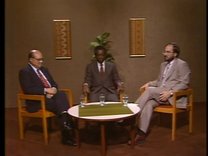
00:00:00 I live in West Newton, Massachusetts, and my address there is 88 Chestnut Street, apartment
00:00:08 207.
00:00:09 I'm Walter Cooper, Rochester, New York.
00:00:23 I'm Jeff Sturchio, and I live in Wayne, Pennsylvania.
00:00:27 How's that?
00:00:28 Okay.
00:00:29 Okay.
00:00:30 All right, so shall we get started, Robert?
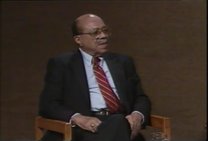
00:00:36 Well, Dr. Knox, we know you were born in New Bedford, Massachusetts, in January 1904.
00:00:43 I wonder if you could tell us a little bit about your childhood and early years there,
00:00:48 your family context, and what New Bedford was like in those times.
00:00:53 Well, I was the third of five children in my family.
00:00:59 It was a very close-knit family.
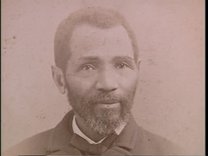
00:01:02 My grandfather was an ex-slave who evidently bought his freedom around 1847 and came to
00:01:10 New Bedford.
00:01:11 My father was born in New Bedford, Massachusetts, and he graduated from high school.
00:01:18 My mother was born in Waterloo, New York, and she was self-educated.
00:01:27 I had two sisters who were older than I and two brothers who were younger.
00:01:35 This family was a very close-knit family, and they were very anxious to see to it that
00:01:40 we got an education because somehow or other they realized that Negroes in their day and
00:01:48 time could achieve anything at all, if they would achieve anything at all, would have
00:01:55 to have a solid education, so they encouraged all of us to do just that.
00:02:02 We were not confined to study particular things, but we were permitted to study anything that
00:02:07 we thought we might be interested in, and this was the attitude of the home in which
00:02:14 I grew up and in which my brothers and sisters grew up.
00:02:19 We all graduated from New Bedford High School.
00:02:23 My two sisters were the smartest ones in the family.
00:02:27 The boys were not the smartest at all, but my father was somewhat of a chauvinist.
00:02:33 He didn't believe very much in the education of women, and he permitted my sister, my older
00:02:38 sister, to go to a normal school in Bridgewater, Massachusetts.
00:02:44 She later went to Rutgers and received a Bachelor of Arts degree, and then she did graduate
00:02:51 work at the University of Pennsylvania.
00:02:55 My younger sister went to a secretarial school and became an executive secretary.
00:03:06 My two brothers, they went to college.
00:03:10 The one next to me went to Bates, and he got a Master's degree from Leland Stanford and
00:03:16 a Ph.D. from Harvard in organic chemistry.
00:03:20 My younger brother went to Williams College, where he was elected the Phi Beta Kappa, and
00:03:25 he got a Master's degree from Brown, and he later went to Harvard and got a Ph.D. in European
00:03:33 history.
00:03:34 I graduated from New Bedford High School and I went to Harvard, entering Harvard in 1921.
00:03:46 I then taught for a few years and went back to study again at the Massachusetts Institute
00:03:52 of Technology, where I received a Master's degree from the Department of Chemical Engineering.
00:03:58 After teaching a year at Howard, I then went back to MIT to work on a Ph.D., which I finally
00:04:05 received in 1935, I believe it was, from the Department of Physical Chemistry.
00:04:12 So that, in brief, is the history of my family.
00:04:17 Before we move on to Harvard and MIT, which we'd like to talk to you about in some more
00:04:21 detail, could you tell us what New Bedford was like in those years up until 1920, 21?
00:04:27 New Bedford was a very interesting town.
00:04:29 They had a very excellent school system.
00:04:31 There was only a very small minority group population there, and evidently the people
00:04:39 who went before were people who were self-educated and had built a tradition upon which the younger
00:04:47 ones built and realized that they had certain standards to meet.
00:04:55 Frederick Douglass spent some time there, and it's interesting to note that he developed
00:05:03 some of his oratorical skills in New Bedford by preaching to black audiences in a church
00:05:11 which he founded himself.
00:05:13 This indicates that the Negroes there were self-educated, because in order to develop
00:05:20 that kind of oratorical skill, he had to have listeners who had some education.
00:05:28 They must have been self-educated, because in that day and time, schools were not open
00:05:34 to them.
00:05:35 So what they learned, they learned outside of school.
00:05:39 There were only about 700 Negroes in that community at that time, but the community
00:05:47 had, among its members, a photographer who had a studio downtown, which is quite interesting
00:05:59 for a period that early.
00:06:02 There were two black physicians, there were two black lawyers, there were about seven
00:06:11 members of the police force.
00:06:14 So this was a rather advanced community.
00:06:18 This is not to say that there was not prejudice there, but there was a certain tradition of
00:06:23 independence which seemed to be the guiding light of the people who lived there.
00:06:29 This was one of the influences to which my family was subjected as we grew up.
00:06:36 It was an attitude of independence that developed as a result of the tradition built by our
00:06:41 forebears.
00:06:43 Did most of the black families in New Bedford live there as long as yours, or had they come
00:06:48 from the South recently?
00:06:50 Most of them had lived there as long as I had.
00:06:54 Many of them came from the South.
00:06:56 For example, some of my grandfather's contemporaries came from the South and were ex-slaves, and
00:07:06 their children lived in the community and built their lives there.
00:07:14 Bill, New Bedford was known as a whaling community, fishing community.
00:07:23 What attracted blacks from the South to migrate to New Bedford?
00:07:28 Well, it was an important station in the Underground Railway, and many of them came there.
00:07:34 I've often wondered why they came there and stopped, and I suspect it was due to the fact
00:07:41 that there were laws in Massachusetts which prevented Negroes from being taken back to
00:07:47 the South if they were caught.
00:07:49 Consequently, they came there and lived, and they had opportunities to work there, and
00:07:57 they built their community independently on the basis of the opportunities which were
00:08:03 theirs.
00:08:07 The community which developed was a rather unusual one.
00:08:11 Quite amazing, I think, for the early part of the century for people to have advanced
00:08:19 that far under the conditions which prevailed in this country.
00:08:26 The students you went to New Bedford High School with and your friends at that age,
00:08:32 did they go on to Harvard and MIT the way that you and your brother did?
00:08:37 There were not many.
00:08:39 For example, there was only one other black in my class, and I don't know what happened
00:08:44 to her, but I went on to Harvard with two of my white colleagues, and in those days
00:09:02 you had to take entrance examinations, and I think that there was a period in which races
00:09:11 could not be identified, and we took those examinations and three of us were admitted.
00:09:18 A very close friend of mine who lived in my neighborhood was admitted along with another
00:09:25 fellow who lived farther away, and we went to Harvard together.
00:09:33 Interestingly enough, all of us were admitted to the freshman dormitories, because at that
00:09:40 time it was a requirement that all freshmen at Harvard should live in the freshman dormitories.
00:09:49 I went up there, that is, I had received my reservations for the freshman dormitories
00:09:55 in a hall called Standish Hall, but I had to go there to take a laboratory examination.
00:10:04 I took this laboratory examination under one named James Bryant Kohnert, and after returning
00:10:12 I received a message from the university that there was a mistake in my reservations, and
00:10:20 I was to send back those reservations, and I found out later that it was the policy of
00:10:27 the university not to permit Negro freshmen to live in freshman dormitories, because it
00:10:34 was the opinion of the administration at that time, since all freshmen were required to
00:10:38 live there, it would be unfair for them to be forced to live with an undesirable neighbor.
00:10:46 Was that, did they, did the dean tell you this, or how was that message?
00:10:52 No, this was told to a friend of mine who was one of the people, who was one reason
00:10:58 I went, a fellow named Edwin Bush Jordan, Jr. He had just graduated, and he was there
00:11:07 during my freshman year as a graduate student in the business school, and this was the first
00:11:15 thing that was told to him by the executives at Harvard College.
00:11:23 So where, how did you find a place to live then, if you weren't?
00:11:27 I was assigned to dormitories in the yard. At that time, only upper classmen were supposed
00:11:32 to live in the yard. This was an unfortunate thing as far as I was concerned, because I
00:11:38 was only a lad 17 years old. I was separated from the members of my class, I was separated
00:11:44 from my own schoolmates, and actually I got none of the instruction that usually went
00:11:49 along with the entrance into college, because I was not permitted to live in the freshman
00:11:56 dormitories. So I had to sort of shift for myself, and this began a period of isolation,
00:12:06 which was unfortunate. I believe that in any educational process, there are three things
00:12:13 which are very important. The equipment that the school offers, the faculty, and the student
00:12:19 body, and all of these things contribute to the educational climate in an institution.
00:12:25 And when you are denied by isolation contact with your fellow students, you're really giving
00:12:31 up one-third of the opportunity of an education at that particular institution, which I think
00:12:36 is very harmful and very detrimental, because it handicaps one from feeling a part of the
00:12:43 institution and causes one to withdraw somewhat from general programs from which you might
00:12:51 benefit.
00:12:53 Did you ever think of quitting Harvard and going somewhere that was a little bit more
00:12:57 congenial?
00:12:58 I thought of it, but my parents understood these things, and in those days you did what
00:13:03 your parents told you to do, and they said you were to stay there and you were to graduate.
00:13:08 And that was what I did.
00:13:10 Well, it's good to have some parental encouragement from time to time.
00:13:15 Bill, you majored in chemistry at Harvard. Was that interest something new or associated
00:13:24 with your entrance, or did you have it from your high school years?
00:13:27 I had it from my high school years. I took a course in chemistry in high school, and
00:13:32 I was quite good in mathematics and in chemistry. I went to Harvard with the idea that I wanted
00:13:40 to be a pioneer of following the career as an industrial chemist. Black men in those
00:13:48 days who followed chemistry were considered somewhat weird, because the claim was that
00:13:56 there was no opportunity for them, therefore it was a waste of time for them to study.
00:14:00 Also there was sort of a background feeling that Negroes were not up to it intellectually.
00:14:08 To follow the rigorous routine which was necessary for the making of a chemist. So you looked
00:14:20 upon something of a weirdo, and you were isolated, and people, even members of the faculty or
00:14:28 the student body, never paid very much attention to you.
00:14:36 Your peers either in the New Bedford black community or at Harvard among the black students
00:14:42 there, what sorts of careers did they have in mind then if being a chemist or a scientist
00:14:45 was a little strange?
00:14:46 For example, there were traditional occupations as far as blacks were concerned. They could
00:14:54 go into law or medicine or teaching, and this is what most of them were planning to do.
00:15:02 At Harvard, there were two or three people who were engaged in the study of chemistry.
00:15:10 One on the graduate level was Percy LaVon Julian, who had a very extensive career as
00:15:16 a chemist, and a couple of others who were undergraduates who were interested in chemistry
00:15:24 as such. But ultimately, they changed their field because opportunities never appeared
00:15:34 in which they could develop their interest.
00:15:41 I'd like to ask you to talk a little bit about the chemists you came in touch with at Harvard,
00:15:46 but I wonder if you could tell us a little bit about the other kinds of courses you took
00:15:49 and the professors you had.
00:15:52 I enjoyed Harvard, despite the fact that it was not a very hospitable climate. As a matter
00:16:04 of fact, it was rather hostile. But I did have the opportunity of listening to erudite
00:16:12 men of great intellectual accomplishment. I remember taking a course in economics under
00:16:19 Professor Taussig, who was quite a prominent economist in those days. I took a course
00:16:25 in Shakespeare under Professor Kitteridge, who was one of the most famous Shakespearean
00:16:36 teachers of his day, and I actually enjoyed that course very much. I took a course in
00:16:44 history under Professor Schlesinger, who is the father of Dr. Schlesinger now, teaching
00:16:56 in the New York school system. He was an American historian. These were very helpful and very
00:17:04 interesting courses, and I gained some insight into what an intellectual life was really
00:17:10 like. This was quite a thrilling experience for me.
00:17:17 So that's the second part of the benefits of a college education, the instructors, the
00:17:25 students, and equipment. What were the laboratories like?
00:17:28 The laboratories were, I guess, the best that there were in those days. They were well-equipped
00:17:35 laboratories, and there was very little instrumentation, because instrumentation hadn't come into
00:17:41 vogue in those days. This was before extensive instrumentation became the order of the day.
00:17:51 But the laboratories were adequate, and the instruction was adequate. The professors giving
00:17:59 the course were not the laboratory people. They had assistants who did the laboratory
00:18:04 work, and the laboratory instruction, I found, was quite adequate.
00:18:11 What was the chemical curriculum like at Harvard in the early 20s?
00:18:14 Well, I think there's—I'm looking at this thing through actually a dim view of a long
00:18:22 ago past. But I believe we had to take four courses in chemistry, and I think that those
00:18:34 courses involved not only elementary organic chemistry and advanced organic chemistry,
00:18:42 industrial chemistry, qualitative and quantitative analysis, all given by very excellent people
00:18:51 in the field, people like George Shannon Forbes in qualitative analysis, and people like James
00:18:59 Bryant Kuhnert in organic chemistry. And I can't think of—I think there was a professor
00:19:07 Baxter who also taught analytical chemistry. But they were—I was very much impressed
00:19:14 by the lectures which these men could give. They were very excellent lecturers.
00:19:19 Did you have contact with people like E.P. Kohler, who taught the advanced organic chemistry?
00:19:29 I took a course under E.P. Kohler. I couldn't think of his name offhand. E.P. Kohler gave
00:19:34 an advanced course in organic chemistry. Very excellent lecturers, which I remembered for
00:19:43 a long, long time.
00:19:45 A lot of people who were at Harvard in the 20s and 30s really had a lasting impression
00:19:52 from Kohler's course. How about industrial chemistry? You had said you went to Harvard
00:19:58 with the thought of becoming an industrial chemist.
00:20:00 Yes. I was given by Grinnell Jones, who I think was also a surface chemist. We had an
00:20:08 opportunity then to visit various industrial plants. These were intriguing trips. This
00:20:16 was what I was interested in and what I hoped to do, but it took me a long time to arrive
00:20:24 at that point in life where I was able to do those things.
00:20:32 You wanted to ask about some of Dr. Knox's friends at Harvard and life outside the laboratory.
00:20:40 There were a fair number of blacks at Harvard, either upperclassmen when you entered as a
00:20:49 freshman or who entered once you became an upperclassman. I guess some of the names that
00:20:57 come to mind are people like Raymond Pace Alexander, Robert Weaver, Ralph Bunch, and
00:21:02 others.
00:21:03 Well, Robert Weaver was a Harvard undergraduate. He came a short time after I was there, but
00:21:11 Raymond Pace Alexander was a law school student. He was a contemporary of Charles Hamilton
00:21:27 Houston, who was also a law student. Raymond Pace Alexander became a judge in Pennsylvania.
00:21:35 Charles Hamilton Houston became one of the leading civil rights lawyers in the nation.
00:21:44 As a matter of fact, he was a very brilliant fellow. He was born in Washington, D.C., graduated
00:21:53 from Dunbar High School and went to Amherst. He was a 580 Caperman from Amherst, member
00:21:58 of the Law Review at Harvard, and then he became dean of the law school at Howard University.
00:22:05 It was from that position that he led the civil rights cases. I think his first case
00:22:12 was a case in Maryland where he opened the University of Maryland to aspiring black lawyers.
00:22:20 There was also in graduate school Percy L. Julian, who got his master's degree in chemistry.
00:22:36 There were people like Allison Davis, who was an anthropologist who later became a professor
00:22:44 of anthropology at the University of Chicago, and Sterling A. Brown, who was the black poet
00:22:53 laureate of the United States for a long period of time. I think he's still living, but a
00:23:00 very bright and very stimulating acquaintance and friend. These were the people who made
00:23:08 up some of the black population at Harvard. There were people in the business school,
00:23:18 a fellow named Martin from Mississippi, and also in the graduate school of religion, there
00:23:27 were people like Wesley, George Wesley, I think his name was, who became the president
00:23:37 of the study religion. He finally became president of a school out in Ohio. Wilberforce College.
00:23:49 There were historians there like A. A. Taylor, who was the teacher of John Hope Franklin.
00:23:58 He taught at Frisk, and John Hope Franklin got his start at Frisk, and later studied
00:24:05 at Harvard and got his doctorate from Harvard. There was Rayford Logan, who was an American
00:24:14 historian.
00:24:15 Was it Leo Hansberry?
00:24:17 Leo Hansberry. Leo Hansberry was a student of African history. We used to call him the
00:24:24 emperor. His nickname was Pete Hansberry, and he never got a degree because there wasn't
00:24:32 anybody on the faculty there who knew enough about African history to supervise his work.
00:24:39 He later went to Howard and became head of the department there, and then I think he
00:24:43 spent some time in Africa. As a matter of fact, I think that there is an education institution
00:24:49 in Nigeria named after him.
00:24:52 Yes, the College of Nigeria at Nsukka. Once, I think in 1960 or so, there was a conference
00:25:01 in 1962. It was named the Leo Hansberry College, and primarily because Hansberry had a belief
00:25:12 and a faith that Africa indeed had a history, when very few in the Western world thought
00:25:19 that the continent had much of a history. So it seems as though you were part of a remarkable
00:25:25 group of black men who made significant contributions to American society. Robert Weaver, for example,
00:25:35 was the first black to hold a cabinet post.
00:25:38 Yes, Robert Weaver started out as an engineer at Harvard. Of course, you see, opportunities
00:25:45 were so few and far between that there was really not much motivation in those fields.
00:25:53 And I think he finally went into economics. There were several people he knew. There was
00:26:01 a fellow there named Mills, Clarence Harvey Mills, who was a philologist. He was a very
00:26:10 brilliant fellow. He was a Phi Beta Kappa man from Dartmouth and got a master's degree
00:26:18 from Harvard and then went on to get a degree, a Ph.D. from the University of Chicago.
00:26:26 But these were competent black men who, with almost no motivation, went on to follow their
00:26:35 interests and achieve their goals. My brother came a little later. He was considered a little
00:26:43 weird because he was interested in Turkish history. Not only was he considered weird
00:26:51 by the white community, but he was also considered a little weird by the black community. He
00:27:01 became a man without a country, sort of. Those were interesting days. But the commitment,
00:27:08 I think, of those men was remarkable.
00:27:13 I saw an interesting article which, in a sense, capsulized a study of the blacks who had attended
00:27:27 Harvard between, I think, 1920 and 1945. And that study showed that the black men who had
00:27:38 graduated, out of the individuals who had graduated, 23 percent had pursued careers
00:27:46 in science and technology. And much like their white counterparts, 75 percent of them went
00:27:52 on to graduate school. So it was a very competitive, a very intellectually oriented group of black
00:28:00 men who attended Harvard during your years and afterwards. A tradition must have been
00:28:08 built up based upon the achievements of you and Raymond Pace Alexander and the others.
00:28:18 Well, I think while I was there, the men came there to meet the requirements of the university
00:28:26 and to follow their careers. They were very serious students, very serious students. And
00:28:34 some of them were in athletics, but athletics never was the principal part of their agenda.
00:28:45 Edwin Orville Gurdine finished the year before I got there and he went on to study law. He
00:28:53 broke the world's record in the broad jump, I think, around that period. He was an Olympic
00:28:59 broad jumper. And there was a fellow named Earl Brown, who finished the year before I
00:29:06 got there. No, he finished the year after I got there. And he was the first-string pitcher
00:29:14 on the Harvard baseball team. My roommate aspired to be a cross-country one, and he
00:29:22 would let him eat at the training table, so he quit there.
00:29:28 I see. Do you find it somewhat ironic that based upon that study, wherein 23 percent
00:29:36 of the blacks who attended and graduated from Harvard from 1920 to 1945 pursued careers
00:29:44 in science and technology at a time when there were no obvious economic opportunities, and
00:29:53 in contrast to today, where the economic opportunities are there, yet we do not have a significant
00:30:00 number of black men and women who pursue careers in science and technology?
00:30:06 Well, I think probably it's part of a change in the times. I think that actually youngsters
00:30:17 no longer feel that it's necessary for them to make those kinds of sacrifices which are
00:30:24 required to follow a career in science. And they're looking for easier ways to go. They
00:30:32 want to take on the habits of the larger community. They like to be in those professions where
00:30:40 they can play golf and go on tours. And actually this is something which they'll have to deprive
00:30:51 themselves of if they want to follow in any determined manner a career in science, because
00:31:01 there the competitive skill is important and one has to stay with it in order to beat the
00:31:09 competition.
00:31:13 You mentioned your roommate was Benjamin Carlyle Bland. He had wanted to run cross-country.
00:31:22 And another friend of yours, Cecil Blue, was a colleague of yours in later years, wasn't
00:31:28 he?
00:31:28 Right. Cecil A. Blue was an English student. Cecil A. Blue was born in British Guiana.
00:31:33 His father was a physician in Washington and he was interested in English. He got his degree
00:31:41 in 1925 and stayed on to get his master's degree. And then he came to join me at Johnson
00:31:50 C. Smith where I was teaching and we taught there for a couple of years. And he was a
00:31:58 professor and I went back to school and he went on to teach English at Lincoln University
00:32:03 in Jefferson City, Missouri.
00:32:07 Well how did you end up with a job at Johnson C. Smith in Charlotte, North Carolina?
00:32:12 Well, being interested in chemistry and not being able to get a job in industry, one always
00:32:21 looked around for some place where he could sustain his interest in chemistry. And the
00:32:28 schools in the south were in need of instructors in all areas of human activity. So it was
00:32:36 the custom in those days for black men and black women, for that matter, in any field
00:32:46 to go south to teach because there were no other openings for them. So I went to Johnson
00:32:54 C. Smith as an instructor in chemistry. And actually it was a deep gratitude to the students
00:33:07 in those institutions in which I taught because they kept my interest in chemistry alive and
00:33:16 actually they were bright and they were determined and they taught me a lot.
00:33:24 Actually I went on to rather distinguished careers in the field of medicine and in chemistry.
00:33:38 I remember one fellow at Johnson C. Smith and these institutions in those days were
00:33:46 prestigious institutions as far as the black community was concerned. Their fathers were
00:33:55 graduates of those institutions and they would send their sons to those schools. And I remember
00:34:02 one fellow whom I taught there went on to become a significant teacher of chemistry
00:34:10 at Tuskegee Institute after he had finished his undergraduate and graduate work.
00:34:19 They were eager to learn and they were bright and they would actually take courses as difficult
00:34:29 as you were willing to make them and they would succeed in those courses, which made
00:34:34 it a rather inspiring and profitable outlet for one who was interested in chemistry. It
00:34:40 kept him alive, kept him on his toes, and actually eventually led him into the opinion
00:34:49 that if he were still to teach it would be necessary for him to go back to school in
00:34:55 order to remain current in the field.
00:34:58 Was that the thought that led you to go to Chicago one summer?
00:35:01 Well, I went to Chicago one summer because a little undetermined. You see, the intellectual
00:35:09 atmosphere in those schools was not what it was cracked up to be. And one tried to save
00:35:17 oneself from becoming actually ossified intellectually. So I went on to Chicago with Brew to look
00:35:25 into other professions, and I thought that at one time I might study law, but I found
00:35:36 out that my personality and interests were not actually those which would be beneficial
00:35:45 in the study of law. So I sat in on a course in surface chemistry, and it was a course
00:35:54 for a fellow named Hawkins at the University of Chicago, and then went back to Johnson
00:36:01 C. Smith to spend another year.
00:36:04 Bill, you had set up kind of a criteria for institution in terms of its excellence. I
00:36:12 think you talked about equipment, the composition of the student body, and the quality of the
00:36:20 faculty. How would you assess that criteria based upon your experience at Johnson C. Smith?
00:36:31 I know you've mentioned that the students whom you had were highly stimulating and kept
00:36:38 you involved in chemistry. How about the other two elements, the equipment and your contemporaries
00:36:46 in the faculty and administration of Johnson C. Smith College?
00:36:50 Well, actually the equipment was very poor. One had to improvise all the way. And this
00:36:57 took a little doing to keep young fellows interested in the sciences when there was
00:37:03 not much equipment around. And the faculties, some of them were, only a few of them were
00:37:11 young, much resisted by older members of the faculty who thought they were a bunch of upstarts
00:37:19 who were down there to destroy the moral values of the institution. And so the intellectual
00:37:31 atmosphere was not what you would call stimulating, and it was confined to the younger members
00:37:38 who were carrying on, who were close to the student body, and who were responsible for
00:37:46 the intellectual lives of the student body because their standards were high. And it
00:37:52 was interesting to me that students responded to high standards. It was interesting that
00:37:58 you never lost a student's respect because you imposed upon him high standards. You never
00:38:04 drove him out of your courses because you imposed high standards. He would stay there
00:38:10 when he knew that he had to meet certain standards, he would meet them. And this, I think, was
00:38:19 a very stimulating atmosphere as far as the students were concerned, and it kept one alive
00:38:26 and made one feel a little worthwhile even though he had been denied opportunities in
00:38:33 the larger world.
00:38:34 There were aggressive students, too. I remember some years ago I had a fellow in one of my
00:38:41 classes named Arthur Clement, and this is remarkable to me. For example, I would say
00:38:49 40 years ago I read in the New York Times that there was a fellow named Arthur Clement
00:38:55 who was running for the House of Representatives from the state, from Charleston, South Carolina.
00:39:03 Now this was amazing. This was long before civil rights. This was long before any of
00:39:09 these movements that we think of and talk so much of now were involved. He was a fellow
00:39:16 who just decided that he probably should be in the House of Congress, and he just ran
00:39:23 for election. He never won, but that he would do this, I think, is a tribute to the spirit
00:39:31 of the times and was an example of the type of individual who was going to those institutions
00:39:38 and the type of individual which made life livable for educated Negroes who could find
00:39:46 all the outlet for their talents and their expertise.
00:39:53 So during those days, were there any black women in your chemistry classes?
00:40:00 No, no, not in those days. There were black women who were, there were one or two black
00:40:09 women at Radcliffe, and there were black women throughout the New England colleges, but they
00:40:17 were not in science. They were either in education or in English or one of some of the humanities
00:40:32 or in social sciences. But they knew of no black women in the field of science in those
00:40:41 days.
00:40:41 How heavy was your teaching load at Johnson C. Smith?
00:40:46 At Johnson C. Smith, it was quite heavy in that I had to teach all of the courses, organically.
00:40:51 General, analytical, organic, and physical.
00:40:54 That's right.
00:40:55 I see. So you were a one-man staff.
00:41:00 That's right. Well, there was one other fellow there, and we had to, in some of the law courses,
00:41:07 the student body was rather large because a lot of those fellows were only going to
00:41:11 medicine. And so in the law courses, while they were rather large, we had to split these
00:41:20 things up. But we taught all of those. We were experts in all of those.
00:41:27 So the pre-medical syndrome existed in the mid-1920s, too.
00:41:32 That's right.
00:41:33 I think you told me at one time that as part of your responsibilities at Johnson C. Smith,
00:41:39 you had to teach Sunday school.
00:41:41 Oh, yeah. Well, these were religious schools. And it was a little difficult to fit into
00:41:49 this kind of an environment, coming from a place like Harvard, where even Episcopalianism
00:41:56 wasn't very strong.
00:42:00 And the president was a Presbyterian minister, and he thought that these youngsters should
00:42:08 have a religious education, and he thought that they should go to chapel every day, and
00:42:16 he thought that they should go to Sunday school every Sunday.
00:42:21 And in order to set a good example for them, the members of the faculty were supposed to
00:42:26 teach Sunday school, whether they knew anything about the Bible or not.
00:42:33 You had to be a role model for Christ.
00:42:35 That's right. So, Breu and I used to try to get around this. We didn't want to go every
00:42:42 Sunday, but we tried to alternate. But the inspection by the president was also on alternate
00:42:52 Sundays, apparently, and he chose his alternate days to coincide with my alternate days.
00:43:01 Consequently, I was never there, and I fell into very serious disrepute as a non-clerical
00:43:09 member of the faculty.
00:43:16 Here you were in your mid-twenties in North Carolina. Not only the religious atmosphere,
00:43:21 but other aspects of life must have been very different than Massachusetts.
00:43:25 Well, I wasn't in my mid-twenties. I was just 21 years old when it went down.
00:43:28 Oh, well, your early twenties.
00:43:30 Actually, it was very difficult to make this kind of adjustment.
00:43:36 I had not lived a life which was free from discrimination, but I wasn't prepared for
00:43:43 this kind of discrimination that I ran into in the South, where you couldn't go to a movie
00:43:48 unless you sat in the peanut gallery or you couldn't ride on the bus unless you rode in
00:43:53 the back of the bus.
00:43:55 One of the amazing things that I ran across was they had segregated cemeteries down there.
00:44:00 I didn't see how black folk could intermingle with whites.
00:44:05 And this still puzzles me.
00:44:08 The cemeteries were not integrated.
00:44:12 I just didn't understand this.
00:44:14 So there were these adjustments that one had to make, and what the result was,
00:44:21 that not being willing to suffer the indignity of riding on the back of a bus
00:44:28 or going into a peanut gallery, you simply didn't do anything.
00:44:33 And you had to rely for recreation on your colleagues' relaxation.
00:44:44 In discussions with your colleagues, those that were amenable to discussions,
00:44:49 that is, the younger ones around, and we exchanged ideas and tried to formulate
00:44:55 educational philosophy which would benefit the students in the institution.
00:45:01 We were not always successful because this interfered frequently
00:45:06 with the religious agenda of the school.
00:45:13 But that's quite a stark contrast between the intellectual life of a black college
00:45:19 like Johnson C. Smith and the social environment in the outside world.
00:45:24 That's right.
00:45:26 And it's something that people really have lost sight of,
00:45:29 that it wasn't that many years ago that things were very different.
00:45:32 That's right.
00:45:34 Well, after a few years, you did decide to go back to school
00:45:39 and went back to MIT in 1928 to get a master's degree.
00:45:43 That's right.
00:45:44 Can you tell us a little bit about that?
00:45:46 Well, for example, I was unable to get into graduate school
00:45:51 because I didn't have enough mathematics.
00:45:53 So I had to take a year of mathematics in summer school
00:45:56 and went into the engineering school and took courses like heat exchange.
00:46:03 I've forgotten all the courses that I took.
00:46:08 Thermodynamics.
00:46:10 No, I didn't take thermodynamics in those days.
00:46:14 That is, I've forgotten what the course schedule was.
00:46:18 But heat transfer and things of chemical engineering
00:46:25 was the fundamental course, which I found quite interesting
00:46:28 and had hoped to use that to project myself into American industry.
00:46:34 But this wasn't sufficient.
00:46:37 After I got the master's degree,
00:46:40 I found out that the doors were not even ajar
00:46:45 as a result of further education.
00:46:48 So I went back to teaching.
00:46:51 And it so happened that Percy Jr. was head of the department at Howard.
00:46:56 He asked me to come down there to teach physical chemistry.
00:47:01 And I went down there and stayed for a year.
00:47:04 And then I went back to MIT.
00:47:11 Can you tell us a little more about your year at Howard?
00:47:14 Because that was really a lively place in the United States.
00:47:18 Well, for example, from my position at Howard,
00:47:22 it was not a very stimulating environment at that particular time.
00:47:27 Julian was just getting to organize the department.
00:47:31 I did meet some interesting people down there.
00:47:33 For example, I met Ernest Just there,
00:47:36 who was a very stimulating character.
00:47:38 He wasn't interested in science because he was a role model.
00:47:42 And there were members of the faculty like Cooper and Tulane.
00:47:48 They didn't have graduate degrees.
00:47:52 Julian actually didn't have his graduate degree at that time
00:47:57 because he was on his way to Austria, I guess.
00:48:05 He was on his way to Vienna to do his doctorate work.
00:48:10 There was very little research going on there.
00:48:13 They were just getting ready to build a new laboratory,
00:48:17 which would be geared to a more pronounced research facility.
00:48:30 So there was not much going on there as far as research was concerned.
00:48:34 I didn't find the students there as stimulating as I did at Johnson C. Smith,
00:48:41 or as stimulating as I was subsequently to find them
00:48:44 at places like A&T and Talladega College.
00:48:49 I went back to MIT to get my degree in physical chemistry.
00:48:59 This is where I took thermodynamics.
00:49:02 I took thermodynamics under a Dr. Gillespie.
00:49:07 The textbook was Willard Gibbs' original papers.
00:49:17 This was the textbook of thermodynamics.
00:49:20 It's a good thing you took that math a few years earlier.
00:49:25 There were fellows there like Beatty,
00:49:28 who was an equation of state man.
00:49:32 There was George Skatchit.
00:49:35 George Frederick Keyes was the head of the department at that time.
00:49:40 That was where I took theoretical physics under John Slater.
00:49:47 John Slater was the son of John Slater
00:49:50 in the Rochester University English Department.
00:49:53 He gave a course with Frank.
00:49:59 Slater and Frank had this textbook.
00:50:03 I did my dissertation under a fellow named Louie Harris.
00:50:09 Louie Harris was interested in the photochemistry of nitrogen tetroxide.
00:50:20 I did my dissertation on the absorption of light by nitrogen tetroxide.
00:50:30 That's already a different style of research than was going on at Harvard.
00:50:36 We'll get back to that.
00:50:39 I was going to ask about instruments.
00:50:42 Oh, yes.
| Property | Value |
|---|---|
| Creator of work | |
| Format | |
| Genre | |
| Medium | |
| Extent |
|
| Language | |
| Subject | |
| Rights | In Copyright |
| Rights holder |
|
| Credit line |
|
Institutional location
| Department | |
|---|---|
| Collection |
Related Items
Cite as
American Chemical Society. “Reflections by an Eminent Chemist: William J. Knox (Unedited Footage) Tape 1.” U-matic (tm), 1987. American Chemical Society Audiovisual Collection. Science History Institute. Philadelphia. https://digital.sciencehistory.org/works/12x3hjs.
This citation is automatically generated and may contain errors.