
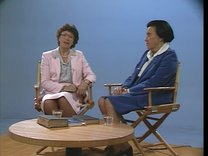
Reflections by an Eminent Chemist: Rosalyn Yalow (unedited master 2)
- 1980s

These captions and transcript were generated by a computer and may contain errors. If there are significant errors that should be corrected, please let us know by emailing digital@sciencehistory.org.
Transcript
00:00:00 Before I put anything down.
00:00:02 Mm-hmm.
00:00:04 That's good.
00:00:06 So you can do it that way then.
00:00:08 After that I edit it. I don't like this word. I don't like that word.
00:00:12 Mm-hmm.
00:00:18 Whenever you're ready, you can begin.
00:00:20 Okay.
00:00:21 We talked about RIA being widely used with all kinds of different hormone assays, Dr. Yalow.
00:00:26 Can you explore that for us a little more?
00:00:29 Well, I pointed out that radioimmunoassay really was developed for the measurement of the peptide hormones.
00:00:35 And what we did initially was to go one after another.
00:00:40 As the purified peptides were available, we developed assays for them.
00:00:44 So that we developed next an assay for growth hormone, for parathyroid hormone, for ACTH.
00:00:50 We stayed away from the gonadotropins because we worked in the Veterans Administration Hospital.
00:00:55 Right.
00:00:56 And the gonadotropins were not that important there.
00:00:59 In 1968 or 69, when we were developing an assay for gastrin,
00:01:09 Mort Grossman, who was one of the country's leading gastroenterologists, wanted to send one of his investigators to us.
00:01:18 And I met John Walsh, who had been working at the NIH, and said, what are you working on?
00:01:24 And he said, I'm working on Australian antigen.
00:01:27 I said, that's interesting.
00:01:29 Maybe we can make a radioimmunoassay for it.
00:01:31 Australian antigen is now, of course, known as hepatitis B.
00:01:35 And I said, bring the virus along to the laboratory.
00:01:38 We'll see what we can do.
00:01:40 I brought the virus to the laboratory.
00:01:42 We labeled it.
00:01:44 And we always use as control blood, the blood from people in the laboratory.
00:01:50 And it turned out that two of the people in the laboratory had antibody titers to hepatitis B.
00:01:58 The reason why they did is that during World War II, they were immunizing soldiers against malaria.
00:02:12 And whole regiments came down with hepatitis.
00:02:17 So that one of these two people didn't, in fact, know he had subclinical hepatitis.
00:02:21 The other did not even know.
00:02:24 And we immediately discovered they had antibodies, so that there was no need to develop antiserum in animals.
00:02:30 You had your secret source of supply.
00:02:32 We had our secret source of supply.
00:02:34 And so within six months of John's coming to the laboratory, we had an assay going for hepatitis B.
00:02:40 And within two years, all bank blood was tested and is continuing to be tested by the radioimmunoassay for hepatitis B.
00:02:48 And then it became abundantly clear to me that radioimmunoassay would have wide applicability in infectious diseases.
00:03:00 And so Eugene Strauss, who came to my laboratory in 1972, started to develop an assay for mycobacterium tuberculosis.
00:03:11 And has published in that field, and I think there will soon be available, a commercial assay for active tuberculosis, not for the antibody.
00:03:22 Now, it still surprises me that the assay for AIDS is for antibody rather than for virus.
00:03:30 Because of great concern will be who are the people who have the virus without having the antibody.
00:03:40 Are you expanding into the AIDS field?
00:03:43 I'm a little reluctant to have AIDS in my laboratory.
00:03:50 Largely because none of the physicians working with me at the present time are interested in that area.
00:03:57 What I'm trying to do is to get some enthusiasm in other laboratories that might be interested in doing this.
00:04:04 I will be speaking down at the CDC in June.
00:04:08 And perhaps I can interest some of their people who are involved in AIDS research to going after the virus rather than the antibody.
00:04:17 I expect that's true. What about cholecystokinin? We mentioned that just briefly some time ago.
00:04:23 Well, what you're asking now is what is it and are you still interested?
00:04:28 What is my laboratory doing now?
00:04:31 Actually, my laboratory is working in a variety of fields.
00:04:36 One of the interesting things was the clinical situation that happened in our hospital in 1979.
00:04:43 There was a patient in the intensive care unit who suddenly became lethargic, comatose.
00:04:50 They had the wisdom to do a stat blood sugar and he was hypoglycemic.
00:04:55 They called an endocrine consult and one of the endocrine fellows from my laboratory went up.
00:05:01 When we were discussing the case, I suggested to him that the most likely cause of hypoglycemia in the hospital setting was inappropriate insulin administration.
00:05:11 And he said, but the patient isn't a diabetic. I said, sometimes people get the wrong injections.
00:05:16 And he went up to the ward, looked into the box where the pronestil should have been and found NPH insulin.
00:05:22 So we knew what had happened, but now how are you going to convince anybody?
00:05:26 Well, I'm a great saver.
00:05:28 And so I had one of our antisera from insulin-resistant patients that we'd gotten in 1960 that had great sensitivity and could distinguish between human and animal insulin.
00:05:40 And we were able to demonstrate that this patient's plasma, at the time of hypoglycemia, contained an animal insulin.
00:05:49 Now, since that time, we've been involved in a murder case.
00:05:54 We've been involved in two cases of child abuse.
00:05:58 And we've made use of the species-specific antiserum to distinguish between human and animal insulins.
00:06:04 We were never given a sample from the von Buelow case, however.
00:06:08 Do you mean these cases that you're involved with are real, live utilizations of RIA in an entirely different aspect from hospital clinical?
00:06:17 That's right. We were able to distinguish between animal and human insulin.
00:06:23 And there are a number of situations in which people have received insulin inappropriately, sometimes accidentally.
00:06:31 We know one patient who was supposed to have gotten heparin and got insulin.
00:06:35 We've had these two very interesting cases of child abuse, where a mother had an 18-month-old child who had an older sibling who was a diabetic.
00:06:46 And whenever it became too much for her to handle, she would give the younger child insulin.
00:06:53 The child would get a hypoglycemic reaction, would be hospitalized, and the mother would have a few days off in the hospital with this child.
00:07:01 We had another case of a child of 13 months who, on several occasions from the time she was four months old, had had hypoglycemic episodes.
00:07:11 We never did know the reason why the mother was doing this.
00:07:15 That was the underlying cause.
00:07:18 And we had a real murder case involved with a nurse who was doing this to patients.
00:07:27 Oh, my goodness.
00:07:29 So that's been an interesting situation.
00:07:33 For forensic use of radiomyoassay.
00:07:35 Yes.
00:07:37 We have also, since I work in the Veterans Administration Hospital, I am still concerned with the application of radiomyoassay to problems of concern to veterans.
00:07:51 In 1979, the National Academy of Science, under funding from the Veterans Administration,
00:07:57 were able to demonstrate that World War II veterans who were double above-knee amputees were 3.5-fold higher risk for cardiovascular death
00:08:11 than either unilateral amputees or people who had been disfigured as a result.
00:08:17 And the VA asked people to look into it, and our hospital volunteered to examine the possible causes of the earlier cardiovascular death.
00:08:28 And so we looked at this problem with respect to Vietnam veterans.
00:08:32 And we were able to demonstrate that the double above-knee amputees, a certain fraction of them,
00:08:40 developed acute-onset obesity following the injury.
00:08:45 And some 15 years later, they are markedly hypertensive and hyperinsulinemic.
00:08:50 And we are investigating as whether or not there's a lot of work now going on in the field,
00:08:56 suggesting that high levels of insulin per se may have some role in hypertension.
00:09:03 So that's the second area that we're working in.
00:09:06 The third area of great concern is that in 1975, Van der Heggen et al.
00:09:12 demonstrated there was a peptide in the brain that cross-reacted in the gastrin assay.
00:09:17 Now, gastrin and cholecystokinin share the C-terminal pentapeptide.
00:09:23 And therefore, some antisera measure both.
00:09:26 It turns out the peptide in the brain is cholecystokinin.
00:09:30 And there are a lot of interesting problems in that.
00:09:33 Although the messenger RNA is the same in the brain as it is in the gut,
00:09:41 the post-translational processing of cholecystokinin in the brain and gut are different.
00:09:47 In the brain, there's very rapid processing to set up the octapeptide, the 8-amino acid C-terminal.
00:09:56 In the gut, there's the classic cholecystokinin that was first described, 33 and 39.
00:10:02 Now, what accounts for the different processing in the two tissues?
00:10:07 Cholecystokinin in the gut is found in mucosal tissue, but also in neuronal tissue.
00:10:13 Is the processing in the neuronal tissue in the gut the same as in the mucosal tissue?
00:10:18 I don't know the answer to that yet.
00:10:20 Those are some of the things that we're working on.
00:10:22 But you're still looking for answers.
00:10:23 We're still looking for answers.
00:10:25 You know, it's the old story.
00:10:27 You come into the laboratory every day and hope you're going to make a discovery.
00:10:30 Fantastic.
00:10:31 That's a great attitude.
00:10:32 Tell us a little bit about your professional children you call your motley crew at the laboratory.
00:10:37 Well, I don't like to call them a motley crew, but I like to call them my professional children.
00:10:42 We've never had a very large laboratory, and therefore we can never take on too many people at a time.
00:10:51 I told you about the first of our professional children, Mark Rothschild,
00:10:57 who did take the job at the 23rd Street VA where he's been head of what is now called the Nuclear Medicine Service.
00:11:08 At the same time Mark was there, we had Art Bauman, who went on in the private practice of medicine.
00:11:15 But he has a son, and his son is Bill Bauman.
00:11:19 And his son, Bill Bauman, who had always wanted to work with me, is now working with me,
00:11:24 and he is actually the one who did this work on the species-specific insulin.
00:11:28 Very good. So this is second generation, your professional grandchild, would you call this one?
00:11:34 Well, it's almost that way.
00:11:36 And then, of course, I have another favorite child.
00:11:40 I said I went to the chief of medicine, and he sent Saul Burson to me.
00:11:46 In 1972, three months before Saul Burson died, Bernie Strauss' son came to me.
00:11:53 Good, good.
00:11:55 And had been with me for a number of years.
00:11:57 He's now head of the Division of Digestive Diseases at Downstate, and of course he's the one who did the tuberculosis assay.
00:12:04 So I'm starting in on the second generation.
00:12:06 I think that's great. I think that's terrific.
00:12:08 What is this philosophy you teach your professional children along with your radioisotope techniques?
00:12:15 Well, I'm concerned that people aren't going into science for the right reasons nowadays.
00:12:23 I was sort of trained in little science.
00:12:25 You went into science because you loved it.
00:12:28 You didn't go into science for fame, fortune, or trips to Europe.
00:12:33 I think that there have been problems of dishonesty in the laboratories.
00:12:39 There have been a number of scandals that have come to people's attention.
00:12:43 I think these scandals are associated with the fact that the mentors are not spending sufficient time with the people in training in their laboratory.
00:12:51 In one of the famous scandals, the head of the laboratory said he didn't see that he was doing anything wrong.
00:12:58 He spoke to his people every six weeks.
00:13:00 Oh, dear.
00:13:02 I understand that you are not going to hire or have any more people in your laboratory than you can personally supervise.
00:13:08 Bake cookies for us so that you have, at report time, coffee and cookies, courtesy of Dr. Young.
00:13:14 I don't bake the cookies. I just bring them in.
00:13:17 But I think it's important to be in the laboratory all the time.
00:13:23 My door is always open so that anybody can come in and talk to me at any time.
00:13:31 I no longer go over day by day in detail the strips that come off the counters, as I did for many years.
00:13:39 John Eng really does that for me. He's a clinical investigator with me now.
00:13:45 But he's in to see me two, three times a day, and I see the other people all the time.
00:13:51 You talk about what they're doing and why they're doing it and how to think about it.
00:13:57 I think this is what the role of a mentor should be.
00:14:02 Right, right.
00:14:04 Would you ever intend to retire?
00:14:07 I will retire when I no longer have young people wanting to work with me.
00:14:12 Now, how long will that be?
00:14:14 Well, I'm starting a new clinical endocrine fellow in 1987, and that's two years.
00:14:22 And then if he turns out to be as good as I think he is, then perhaps I can feed him into the B.A. career development program.
00:14:30 That might be ten years.
00:14:33 So my retiring and not retiring really depends.
00:14:36 I don't expect to get another Nobel Prize.
00:14:39 On the other hand, I have certain attitudes towards science that I think are good for the development of young scientists.
00:14:45 And as long as I have a role in that, I will continue to work.
00:14:50 Have you ever thought of having retired scientists come to work for you?
00:14:53 You say your budget is not too big.
00:14:55 Perhaps there are some retired scientists who might be interested in coming and working with you in your lab.
00:15:01 I think retired scientists should have another function.
00:15:06 It may be that I still have the teacher in me.
00:15:10 I suspect so.
00:15:11 But I do a good deal of talking to the general public about science,
00:15:17 and I do a good deal of speaking even to science teachers to tell them that they have responsibilities not only to train scientists,
00:15:25 but if science is going to persist, it must have general support from the population,
00:15:30 which means that we must be very concerned with science for the citizen.
00:15:34 The whole idea of risk-benefit analysis, risk-cost, cost-benefit,
00:15:40 these are things that must be taught to the general public.
00:15:43 How much money can you put to save a life?
00:15:47 These are very important things, and scientists should be trained to think about them.
00:15:51 The general public isn't.
00:15:53 So I think that it would be very important for the retired scientists to go out and communicate to the public what they know,
00:16:01 to become experts in the various fields of decision-making.
00:16:06 I've had fun talking to four-year-olds about what science is all about.
00:16:12 I think older people would probably not be that useful in a laboratory that they haven't worked in before.
00:16:19 I don't think they will pick up new methodology as quickly as the college kids who come in.
00:16:25 On the other hand, they've accumulated a lot of experience, and they know how to think about science.
00:16:30 I really think they have to get out there to the churches, the synagogues, the teachers' organizations,
00:16:37 the Lions Clubs, Ladies' Garden Club, whatever.
00:16:41 I think that you have a faculty of doing such a great job of talking to all levels of people about science
00:16:48 and making them understand this.
00:16:50 Many scientists are not such good communicators.
00:16:53 Perhaps you could train a cadre of people to go out and spread the word in your system the way you can talk to four-year-olds.
00:17:01 Not many scientists I know can talk to four-year-olds and have them understand about science.
00:17:07 We've talked a little bit about your professional children.
00:17:09 How about your real children, Dr. Yalow?
00:17:12 Well, I have two children.
00:17:15 Benji was born in 1952, and Alana was born in 1954.
00:17:21 I can tell an interesting story about that.
00:17:23 When I first came to the VA, there was a rule that you had to resign in the fifth month of pregnancy.
00:17:30 In fact, when I was pregnant with Benji, a veterinarian at the hospital was forced to resign.
00:17:36 And I laughingly say I had the only 8-pound, 2-ounce, 5-month baby.
00:17:43 They weren't going to make me resign because I was already too valuable.
00:17:47 And actually, I was out a week with each of my children.
00:17:51 I was back in.
00:17:54 Interestingly enough, the first semester, each of them was in college.
00:17:58 They were pre-med.
00:18:00 The second semester, they were not.
00:18:04 My son went to Columbia and could have been a scientist in any field.
00:18:09 He took all their physics courses, geology, astronomy, math.
00:18:13 His field is computers.
00:18:15 And he's at the City University Computer Center with a title I don't know,
00:18:19 but it's equivalent to professorial rank, full professorial rank.
00:18:23 My daughter took her doctorate in educational psychology at Stanford.
00:18:28 And her field is essentially, again, something I don't understand, evaluation and testing, test design.
00:18:33 She's been involved in the Arkansas test for teachers.
00:18:40 They're now doing a program for Texas in designing in education.
00:18:45 So that's been her field of interest.
00:18:48 They had the wisdom to stay out of my field.
00:18:50 I don't know about wisdom, but I can see they have made their own way in the world.
00:18:57 Obviously, we haven't talked much about all the awards you have won.
00:19:02 I understand that the Lasker Award and the Nobel Prize are your favorites.
00:19:06 I brought some of the materials we can look at.
00:19:10 What did it feel like to win a Nobel Prize?
00:19:15 You spend a week in a fairyland.
00:19:21 You arrive—well, I'd like to say a word about the Lasker Prize.
00:19:25 Sure, please do.
00:19:26 As you know, there haven't been many women who have won Nobel Prizes.
00:19:30 Dirty Corrie was the first woman to win a Nobel Prize.
00:19:35 She and her husband shared the Nobel Prize with Hussein.
00:19:39 Her husband, the year before, had gotten the Lasker Award.
00:19:43 She did not share it with him.
00:19:45 So I was the first woman to get a Lasker Award in basic research.
00:19:53 To return to the Nobel Prize—
00:19:56 Hold your medal out so we can see.
00:19:58 Well, this is the replica of the medal.
00:20:00 It has Alfred Nobel on one side,
00:20:04 and then, of course, the name and the year on the other side.
00:20:11 This is a replica.
00:20:13 The real medal is Sago Gold and sits in a vault.
00:20:18 I haven't seen it since I returned from Stockholm.
00:20:23 Nobel Week is a very dramatic and exciting week.
00:20:28 At the Nobel Ceremonies, the laureates are considered more royal than royalty.
00:20:35 As you know, the head of state is always the last one to enter.
00:20:39 In our country, they play Hail to the Chief and the president comes in.
00:20:44 At the Nobel Ceremonies, the king and the royal family are on the stage,
00:20:51 and the laureates are led in.
00:20:54 Oh, it shivers up my spine.
00:20:56 At Nobel Week, the laureates are more royal than royalty.
00:21:04 You don't say anything at the ceremony itself.
00:21:08 Afterwards, there is a banquet,
00:21:11 and it's in the City Hall and about almost 3,000 people there.
00:21:21 It's a magnificent room.
00:21:22 The audience is seated, and we come down a beautiful staircase.
00:21:30 I come down on the arm of the king.
00:21:34 And I sit next to the king at dinner.
00:21:37 Now, my year, and for many years, after they toast Nobel,
00:21:44 the laureates are toasted by the students of Stockholm.
00:21:51 And one of them is chosen to reply to the students of Stockholm.
00:21:56 The student leader is supposed to then come
00:22:01 and escort the speaker to the platform to speak.
00:22:09 The place is hushed as the student walks down that very long table
00:22:16 and stands behind my husband.
00:22:19 Ah.
00:22:20 I was at the opposite side of the table.
00:22:23 And so I look at him, and I rise,
00:22:27 and we slowly walk down the opposite sides of the table.
00:22:33 That's a great story.
00:22:35 And it could only have happened at your order.
00:22:37 Now, of course, what happened is that at the beginning of my speech,
00:22:41 I was going to discuss the lack of the role of women as leaders in the world,
00:22:46 and I interjected in spite of what happened tonight.
00:22:52 That's good.
00:22:53 The Nobel speeches are given at another time.
00:22:56 And our speeches, for those who won in Physiology and Medicine,
00:23:01 was given at Karolinska.
00:23:02 And I rather regretted that I did not hear the other Nobel laureates.
00:23:06 I would have loved to have heard the other laureate speeches.
00:23:09 But they're all given at the same time so that you can't.
00:23:13 Now you have an escort at all times from the foreign ministry
00:23:17 to make sure that you get from place to place.
00:23:20 It's just one thing after another.
00:23:22 There's nothing like it.
00:23:23 I can imagine there wouldn't be.
00:23:25 That's fantastic.
00:23:27 You've had a lot of other firsts in your life.
00:23:30 You were the first woman president of the Endocrine Society
00:23:33 and a variety of other associations in which you're active.
00:23:37 And with someone with this kind of a background,
00:23:40 what advice do you have to young people
00:23:42 who are entering the science field for their careers these days?
00:23:46 I think the important thing is to know who you are and what you want
00:23:54 and to keep your eye on the ball,
00:23:57 not to be disturbed by discrimination because it may or may not occur.
00:24:02 I've been the first woman in so many different situations
00:24:05 that you learn how to deal with it.
00:24:07 What I've always found out is that once they let your foot in the door,
00:24:11 if you do things well, discrimination disappears.
00:24:16 And so my advice is if you want to go into something,
00:24:21 go in because you want it.
00:24:23 You don't go into science for fame or fortune
00:24:26 or trips to Europe or awards.
00:24:28 You go into science because you love it.
00:24:31 And I've certainly had all the awards that I could retire,
00:24:37 but I'm in science because I still love it.
00:24:39 I like to come in each day and think I'm going to know something
00:24:43 that nobody knew before, and that's what science is all about.
00:24:46 Fantastic. Thanks, Dr. Yalow. It's been marvelous.
00:24:49 I've enjoyed it.
00:24:54 Okay.
00:25:02 All right.
00:25:03 We're going to have to get something over here.
00:25:08 Okay. Tell us what you want.
00:25:12 Oh, I thought you were staring off into space
00:25:15 because the tape hadn't been running or something.
00:25:17 No.
00:25:18 It's getting real quiet.
00:25:21 That happened to us.
00:25:23 I don't know whether we would have said well.
00:25:26 Whoops. Whoops.
00:25:29 We want to do the ending again.
00:25:32 We want to thank each other for coming again,
00:25:34 and we're going to bring the studio lights down.
00:25:36 Okay.
00:25:49 Okay.
00:26:02 Okay.
00:26:07 Stand by.
00:26:14 And begin.
00:26:16 Dr. Yalow, I want to thank you very much
00:26:18 for allowing the American Chemical Society
00:26:21 to do this eminent chemist interview with you.
00:26:24 I've enjoyed it tremendously. Thank you very much.
00:26:26 It's been fun.
00:26:29 Science has always been fun for you.
00:26:31 Interviewing is fun as well, right?
00:26:35 Well, I think what I'll do is I'll see if I can get the press room
00:26:38 to do something about the interview you have on Tuesday,
00:26:42 and perhaps we can get you to the Women Chemist Luncheon.
00:26:46 They have 75, 80 women there,
00:26:48 and they probably haven't ever been this close
00:26:50 to a Nobel Prize winner before.
00:26:52 I think they'd enjoy having us introduce you.
00:26:56 Okay.
00:26:57 Good. We'll see what we can do.
00:26:58 I'll show up at the press room at 11.
00:27:01 All right.
00:27:02 If somebody leads me to a lunch, I'll go.
00:27:05 We'll do that. Very good.
00:27:06 I'm excited about that.
00:27:09 That's true.
00:27:14 And as I am.
00:27:16 All right. Keep jogging.
00:27:18 This month, next month, just one of those things.
00:27:23 Four months rolled into two.
00:27:25 It's just one thing after another.
00:27:28 But, you know, it's my responsibility.
00:27:32 I think that's great that you do feel that way,
00:27:35 a sense of responsibility.
00:27:37 I mean, I've had everything the world can offer me,
00:27:39 and if these people gain something from my becoming involved,
00:27:45 I do what I can.
00:27:46 That's great.
00:27:47 How many societies and associations do you belong to?
00:27:53 Let's see now.
00:27:57 There's a big conflict going on now.
00:28:01 The man who's president of the Diabetes Association this year
00:28:06 The ODA?
00:28:07 Yeah. He's a very old friend of mine.
00:28:09 And he desperately wants me at the banquet this year.
00:28:16 The only trouble is that it's in Anaheim, California,
00:28:20 and on Saturday night, and the whole big press will be on Sunday,
00:28:25 and I have to be at the Society of Nuclear Medicine in Washington
00:28:29 because Alberson and I are being named nuclear pioneers.
00:28:34 But that's not until later in the evening on Sunday.
00:28:37 You can get a Concorde flight.
00:28:40 It's 8.30 in the morning. I have to be in Washington.
00:28:43 How about red-eye specials? Do they still have red-eye specials?
00:28:46 I am not up to taking a red-eye special and showing up.
00:28:52 So we were just on the phone last night, and I said, I just can't.
00:28:56 You sometimes wish you were twins, huh?
00:29:00 Okay?
00:29:01 Okay?
00:29:02 Yes, ma'am.
00:29:03 All right.
00:29:06 Okay.
00:29:07 I always thought the TV studios were very hot.
| Property | Value |
|---|---|
| Creator of work | |
| Format | |
| Genre | |
| Medium | |
| Extent |
|
| Language | |
| Subject | |
| Rights | In Copyright |
| Rights holder |
|
| Credit line |
|
Institutional location
| Department | |
|---|---|
| Collection |
Related Items


Cite as
American Chemical Society. “Reflections by an Eminent Chemist: Rosalyn Yalow (Unedited Master 2).” Open reel videotapes, 1980–1989. American Chemical Society Audiovisual Collection. Science History Institute. Philadelphia. https://digital.sciencehistory.org/works/7hin0i1.
This citation is automatically generated and may contain errors.