
Reflections by an Eminent Chemist: Joel Hildebrand (unedited master)
- 1981

These captions and transcript were generated by a computer and may contain errors. If there are significant errors that should be corrected, please let us know by emailing digital@sciencehistory.org.
Transcript
00:00:00 It's going to be one grand, big, great blowout, I'll bet.
00:00:06 And it should be a lot of fun for everybody, particularly for you.
00:00:10 And you've had quite a lot of preparation to do for this, too, haven't you?
00:00:14 Yes, very nice things about it.
00:00:17 All the visitors that come to your house, and that very beautiful home you have out
00:00:22 there, with those beautiful trees that you planted out there.
00:00:26 The first event was the videotape with Bob Scott.
00:00:31 Aha, yes.
00:00:34 And he says it worked out very well.
00:00:37 And you did a book with Bob Scott, didn't you?
00:00:40 Several.
00:00:41 Several books with him, yes.
00:00:45 I sucked him in to collaborate with me.
00:00:52 And he was a very good collaborator.
00:00:54 He did much more hard work than I would do.
00:01:01 You say, maybe you always underestimate the amount of work that you do.
00:01:10 This is one of the American Chemical Society programs on the eminent chemists.
00:01:17 And this interview today will indeed be one of those very rare occasions, because this
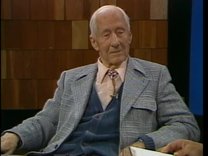
00:01:24 is in the 100th year of Joel Hildebrand's very abundant life.
00:01:35 Today is October 9th, 1981.
00:01:40 November 16th, 1981 will be his 100th anniversary.
00:01:47 We're particularly fortunate today, too, to have with us Mrs. Hildebrand, Emily Hildebrand.
00:01:55 And it really is wonderful to have you here, to have one who has been with him, who has
00:02:02 been so graciously loyal to him all the time, and of whom he is so very proud.
00:02:11 Do you remember when you first met him?
00:02:14 Oh, yes.
00:02:16 And how old were you then?
00:02:18 Nineteen.
00:02:19 Nineteen.
00:02:20 And, Joel, do you remember your first thoughts when you first saw her?
00:02:28 The first time I saw her, I decided she was going to be my wife.
00:02:34 Just like that.
00:02:35 Just like that.
00:02:36 I'm very proud of my power of decision.
00:02:41 Well, you've shown that in many, many other instances, too, and it's worked out beautifully.
00:02:45 Well, we want to thank you so much for being with us here and having the opportunity to
00:02:51 introduce you with Professor Hildebrand.
00:02:55 And so, and I should tell you, while we're waiting, that I'm David Ridgway of the
00:03:26 Chemical Education Materials Study located at the Lawrence Hall of Science here on the
00:03:30 university campus.
00:03:33 And again, we are very, very fortunate and happy to have with us Professor George Pimentel.
00:03:41 Professor Pimentel is one of the distinguished chemists of our very distinguished chemistry
00:03:47 department here at the University of California that Joel Hildebrand has had so much to do
00:03:53 with developing.
00:03:59 Joel Hildebrand has had so many honors come to him, and in such a variety of ways, that
00:04:07 it is one of those things that would take so long to list them all that we're not going
00:04:13 to do it.
00:04:14 If you really want to see a list of the many medals and so forth that he has received,
00:04:19 you can find that in Who's Who in America.
00:04:22 There's a very nice article there.
00:04:24 But we mentioned medals, and so let us take a look just for a moment at some of the medals
00:04:31 Professor Hildebrand has received.
00:04:35 And perhaps you'd identify them.
00:04:39 And let's...
00:04:40 This is the Distinguished Service Medal, which I received from World War I.
00:04:51 I was in France in the Army.
00:04:58 This is the King's Medal, which I received as a member of the American Embassy in London
00:05:09 during the Second World War.
00:05:11 This is British.
00:05:13 This is the Nichols Medal, which was the first one I received for research.
00:05:33 This is the Gibbs Medal, and this is the Priestly Medal.
00:05:39 This is the medal which is regarded by the American Chemical Society as its chief honor
00:05:51 for services to chemistry.
00:05:54 Now, I didn't stop.
00:05:58 When I had those photographed, I didn't expect to get any more.
00:06:07 But last year, the Academic Senate of the University of California voted me the Kerr Medal.
00:06:21 This is the Kerr Medal.
00:06:23 It's bronze.
00:06:24 It's not gold.
00:06:25 The first editions were gold, but it's too expensive now to give them a medal.
00:06:34 This is for service to higher education, and I appreciate that very much from the people
00:06:43 that know me best.
00:06:47 You know, you've had such a varied, very abundant life, and you've done such a great variety
00:06:54 of things, and I think one of the ways that we can show that is just to show a series
00:07:01 of pictures of you.
00:07:04 And at this point, then, we're going to show them.
00:07:08 And here you are as a student at the University of Pennsylvania, where you were a stroke for
00:07:17 the crew.
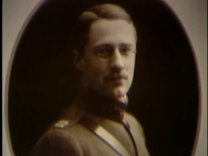
00:07:21 And then, here's one as a military officer in World War I, the service for which you
00:07:28 were decorated with the Distinguished Service Medal.
00:07:33 And you were always tremendously devoted to the out-of-doors, and you were no mean skier.
00:07:47 And here we see you with Harry Truman and President Fisher of the University of Southern
00:07:51 California.
00:07:54 And when you received the Remsen Award in 1949, and here you are as President of the
00:08:02 American Chemical Society in 1955, you always had a reputation as being an inspiring seminar
00:08:12 leader, to say nothing of your being an author of many, many books.
00:08:21 And you were a research chemist and a lecturer to how many students?
00:08:30 Some 40,000 students in this career of yours.
00:08:37 And the one time when you probably reached the biggest audience at one single time was
00:08:42 when you were a television teacher on the nationally broadcast Continental Classroom
00:08:47 with Professor Baxter of the University of Florida.
00:08:53 And then, besides all these things, you've written a lot of poems, and you are a very
00:09:00 talented amateur musician.
00:09:04 A lot of people have said impressive things about you, and it's impossible in the time
00:09:11 we have to read them all, but here are a few that I thought might give some idea of the
00:09:21 kinds of things that were said about you.
00:09:25 In 1962, the William Proctor Prize for Scientific Achievement was awarded by the Scientific
00:09:32 Research Society of America to you.
00:09:35 It described you as a teacher, eminent scientist, architect of the theory of solubility, champion
00:09:44 of sound high school education, and distinguished government servant in war.
00:09:50 A talented administrator whose intellectual vigor and personal warmth have inspired his
00:09:57 colleagues.
00:09:59 And then Peter Debye wrote, Dear Joel, it was a delight to read the logical development
00:10:06 in your paper, Order from Chaos.
00:10:11 Then a New York Times book review said, More scientists of Mr. Hildebrand's standing should
00:10:17 take a turn at telling what science is actually like.
00:10:23 Then Robert Nisbet, a former student, quite recently, November 10, 1980, must have been
00:10:31 on the occasion of your 99th birthday, said, Science is only one of the dimensions of your
00:10:38 magnificent mind and spirit.
00:10:40 He goes on to say, I have been privileged to meet and even know a few of the world's
00:10:47 great men, but never one who outshone you and your marvelously creative and generous life.
00:10:57 I appointed him as assistant dean of the College of Letters and Science when he was only an instructor.
00:11:08 Oh, how about that.
00:11:11 Again, one of your good decisions.
00:11:14 He has had a very distinguished career.
00:11:19 In that connection, I neglected to say earlier that you were instrumental in bringing George
00:11:23 Pimentel to the department, and not only that, but in keeping him here at the point when
00:11:30 he was almost lured away.
00:11:33 That was one of the greatest services that I've performed for the University of California.
00:11:40 Well said.
00:11:43 Dave, let me inject a quotation from Frank Long's letter to Joel.
00:11:49 This was written 10 years ago on the occasion of your 90th birthday.
00:11:55 Frank Long, of course, is a famous chemist from Cornell University, and in his letter
00:12:00 he reminisces, I think back with equal pleasure on my days as an assistant in your freshman
00:12:07 chemistry course, remembering the many important lessons I learned as a teaching assistant
00:12:12 with you.
00:12:13 I find myself wondering why you didn't ever write the unique book that was yours to do
00:12:20 labeled How to Teach Chemistry.
00:12:23 Must every new chemistry teacher relearn by experience the principles and precepts you
00:12:28 use so successfully?
00:12:31 Let me turn to my interaction with you in my past Berkeley days.
00:12:36 It is a curious fact that the memorable later encounters with you are mostly ones which
00:12:40 occurred outside of Berkeley.
00:12:43 Two of them stand out.
00:12:45 The first occurred in Providence, Rhode Island.
00:12:48 Was it perhaps in 1939?
00:12:51 It was when we all gathered at Brown University to dedicate a new building for Charlie Krauss,
00:12:57 and when simultaneously the Division of Physical Chemistry held a symposium to solution theory.
00:13:04 Most of us experimentalists were rather overpowered by the theorists.
00:13:09 It was, you will recall, when Joe Mayer presented his Derby hat theory of the critical state.
00:13:15 You were the one who saved us all by asking the fundamental, often rather simple questions
00:13:20 about the points that were troubling us, but which we ourselves were too embarrassed to
00:13:25 bring to light.
00:13:27 The other occasion which I remember with particular fondness was the time when you came to Cornell
00:13:33 to be toastmaster for Peter Debye's 70th birthday.
00:13:38 Given the affection in which the Debyes were held by all Cornell chemists, this retirement
00:13:44 dinner could not help but be sentimental and emotional.
00:13:48 Thanks entirely to you, it was also a notably warm and gay occasion.
00:13:55 Thank you for reading that.
00:13:56 Frank Long.
00:13:58 Here's another one from James W. Nelson, president of Holiday Cups Incorporated, and
00:14:09 this is a very recent letter too.
00:14:11 It was written March 16th, 1981, this year.
00:14:15 Dear Dr. Hildebrand, recently you were featured in a UPI news story which was printed in the
00:14:21 Milwaukee Journal.
00:14:22 It was gratifying to read that you are still going strong and doing so well.
00:14:30 You look it.
00:14:33 As one of your countless students, Chem 1A, 1B in 1937, BSEE in 1941, I have frequently
00:14:41 reflected on the consequences of my various educational experiences of the past almost
00:14:48 50 years.
00:14:50 He was a student of yours some 50 years ago.
00:14:55 Over the years I have grown to see Chem 1A, 1B as the high point of all the courses of
00:15:00 instruction which I was blessed to experience in high school, college, and several graduate
00:15:06 universities.
00:15:08 You made chemistry into a wonderful learning experience of scientific method, logic, and
00:15:14 deduction, as well as basic inorganic chemistry.
00:15:18 And I can't tell you how much lifelong pleasure you have given this student in making these
00:15:24 approaches helpful in all the work that followed.
00:15:28 For me, most of my work has been in non-chemical, industrial settings, but I am sure that the
00:15:34 approaches which you developed in basic technical approaches have been more helpful than one
00:15:41 realizes.
00:15:42 For me, Hildebrand chemistry was the high point of those college years and the life
00:15:47 that followed, and I hope you don't mind this verbal reminder of the impact of your work
00:15:53 on your students.
00:15:54 I certainly didn't.
00:15:55 And that was James W. Wilson, Jr.
00:15:59 One final one.
00:16:01 David Saxon, president of the University of California, recently wrote, at the risk of
00:16:07 becoming overly sentimental, let me say there is no way that we in the University of California
00:16:14 can ever sum up what you have done for the university and indeed for the nation's scientific
00:16:21 community.
00:16:22 And then there's one I know that you are, of which you are very proud.
00:16:27 Your son, Roger, wrote you, nearly every evening after dinner, he would read to us some play
00:16:35 or novel.
00:16:36 He taught us to recognize the paintings of the great masters.
00:16:40 He taught us to know all the trees in the Sierra forest, the flowers and rocks in the
00:16:45 field, the constellations in the sky.
00:16:48 He taught us how to swim and to dive and how to sail a boat.
00:16:53 He taught us about getting along with people.
00:16:58 And that you are a master at.
00:17:01 He was asked to be one of two introducers of me for the Gibbs medal.
00:17:09 And this was part of that, yes.
00:17:15 Well let us go for a moment now back to some of the beginnings.
00:17:22 I believe you first developed your interest in science in grammar school, didn't you?
00:17:29 Well my interest was developed first in elementary school by this lecturer.
00:17:43 I discovered science at that time.
00:17:48 Very few students at an early age, the early age that I had experienced, heard any exposition
00:17:58 of science.
00:17:59 And I was very fortunate.
00:18:06 I acquired Newcomb's Astronomy, some—Jader's Geology.
00:18:19 And you had good books in your home, didn't you?
00:18:25 And I discovered the best books in my grandfather Hildebrand's library.
00:18:37 He lived in a country town that had no bookstore, I'm sure.
00:18:44 But there were traveling book agents who, in those days, were supplied with books like
00:18:55 Quisey's Fifteen Decisive Battles of History from Marathon to Waterloo, Plutarch's Lives,
00:19:09 Class Book on Chemistry.
00:19:12 And your grandfather had these books?
00:19:14 He had those books.
00:19:15 He had only a common school education, but he was an educated man.
00:19:21 He educated himself.
00:19:22 But he had an uncommon education, didn't he?
00:19:25 Yes.
00:19:26 Well I was fortunately a very avid reader.
00:19:31 And as I look back to my own education, I don't remember very much of my schooling.
00:19:42 But I do remember the books that I read.
00:19:46 I could write down quite an impressive list.
00:19:50 I read whenever I had a chance.
00:19:54 If I was eating alone, I always had a book to read while I was eating.
00:20:00 And you liked to do experiments, too, didn't you, Mr. Boyle?
00:20:02 Oh yes, indeed.
00:20:03 I had a workshop.
00:20:09 I made an induction coil.
00:20:13 I made a hero's fountain.
00:20:17 I was very fortunate.
00:20:19 My father had no particular education, but he was friendly towards my education.
00:20:30 So you not only had the books around, but you had things with which you could build
00:20:34 things and develop things, didn't you?
00:20:36 Then you got, a little bit later, more interested directly in chemistry, didn't you?
00:20:45 Yes.
00:20:46 There was no separate subject of physics, and not very much writing on physics.
00:20:57 And there wasn't a distinction between chemistry and physics.
00:21:04 But I could find more things to do with chemistry than I could with physics.
00:21:10 I didn't have instruments that could be used for experiments, but for chemistry, I could
00:21:24 do anything I wanted to do.
00:21:27 And you took some chemistry courses then at the university.
00:21:31 Yes.
00:21:32 They were very fortunate, because most of them consisted of things that weren't true.
00:21:44 And I developed the habit of doubting current explanations.
00:22:01 I gave a lecture for years, recent years, at Oak Ridge Laboratory on—it ain't necessarily
00:22:21 so—the discrepancies between actual facts and current explanations for them.
00:22:37 So there are more things that weren't so.
00:22:43 One of my most interesting experiences was during 1980, I was invited to write a history
00:22:56 of solution theory.
00:23:03 And I could do it, but I had more background than anybody else, because I was in Germany
00:23:16 when Van't Hoff and Nernst and others—it was a big subject.
00:23:23 Did you work with Van't Hoff while you were there in Germany?
00:23:26 No, not with Van't Hoff, but with Nernst.
00:23:31 Van't Hoff didn't have any students at that time.
00:23:38 Joel, were people still arguing at that time about whether aqueous solutions had ions?
00:23:45 Oh, yes.
00:23:47 That was just the period when—what's his name—Bronsted?
00:24:05 Was it Bronsted?
00:24:06 No, not Bronsted.
00:24:07 I met Otto Hahn when he was—he had just come
00:24:30 back from Toronto at Bronsted.
00:24:38 But there were people, really experienced scientists, who found it difficult to accept
00:24:44 the ion concept.
00:24:46 Yeah, well, the chief ones couldn't imagine, didn't realize that an ion was a special
00:25:08 kind of matter.
00:25:10 But isn't that where you began to sense the importance of intermolecular interactions?
00:25:16 Oh, yes.
00:25:17 The solvation concept that you developed and participated in the development of that idea.
00:25:31 In 1920, Jenks—C.A. Jenks—determined the solubility of iodine in different solvents.
00:25:46 And it was very obvious.
00:25:49 I plotted them as—for the first time, I plotted them as a chemical equilibrium.
00:25:58 Joel, before we show that plot, could I just do a little experiment here?
00:26:04 Sure.
00:26:05 Following the practices I learned from you as my mentor, I'll say this is an experiment,
00:26:14 and one that I know you have done many, many times, and from which you learned a very large
00:26:21 amount of chemistry.
00:26:23 The separatory funnel contains alcohol, ethyl alcohol, and I have here a small amount of
00:26:33 iodine solution.
00:26:35 And your interest was attracted to the beautiful and varying colors of iodine in different
00:26:43 solvents in 1915 or so, wasn't it?
00:26:50 Yes, it was too far earlier than that.
00:26:55 This is the color of iodine in alcohol, and now I'd like to add a second liquid.
00:27:02 This is hexane, which does not dissolve in alcohol, but it does dissolve iodine.
00:27:18 And this is one of the many experiments one can perform in chemistry, which is not only
00:27:24 interesting but aesthetically beautiful.
00:27:27 And I know you favor very much that kind of behavior.
00:27:33 So we have here hexane and alcohol competing for the iodine, and the colors were very interesting
00:27:45 to you.
00:27:46 I was very fortunate in selecting iodine as a test substance, just because of this difference.
00:27:57 It made it possible to distinguish between physical and chemical solutions.
00:28:04 In the violet solution, the iodine is like it is in iodine vapor, same color, same stuff.
00:28:16 Almost identical to the vapor color, isn't it?
00:28:20 Yes.
00:28:21 Whereas in the alcohol, it's solvated.
00:28:29 And I was able, by means of color and other properties, to form a regular solution theory.
00:28:57 This is a regular solution.
00:29:00 It's how the solute and solvent are not combined with each other, chemically.
00:29:12 And therefore, the violet solutions are the first to understand.
00:29:18 Now, you put that on a quantitative basis with Benassi, didn't you, when you took
00:29:23 Yes.
00:29:30 The solution of iodine and benzene is red.
00:29:39 That's number three, isn't it?
00:29:41 Number three.
00:29:43 Here it is.
00:29:45 And it takes out some of the blue, you see.
00:29:50 So that accounts for the color change in benzene.
00:29:52 Yes.
00:29:53 Now, ethyl alcohol is one of those, isn't it?
00:29:57 No, it's the ether.
00:29:58 The ether.
00:29:59 It has about the same color, I guess, as the—
00:30:01 A good deal of the same color.
00:30:03 And that's number five.
00:30:04 Now—
00:30:05 What about the surprise?
00:30:06 Well, I had a—I wanted to investigate this red color.
00:30:28 And the instrument, the spectrophotometer, operated out in the ultraviolet.
00:30:41 Where the eye is not sensitive.
00:30:44 Yes.
00:30:46 But the astonishment was that although this is a very strong absorption, here is ten times
00:30:59 the absorption.
00:31:00 Out in the ultraviolet.
00:31:01 Yes.
00:31:02 And that led to a—to a test for salvation.
00:31:09 Yeah.
00:31:10 Now, that really was the first discovery, wasn't it, of the charge transfer?
00:31:14 Yes.
00:31:15 It was.
00:31:16 So this is one of my—
00:31:19 That was with Bennacy, right?
00:31:20 Yes.
00:31:21 That was with Bennacy.
00:31:22 Late 40s or something.
00:31:24 He still—he still—he came—called upon him, maybe not very long ago.
00:31:31 And he did a great many things, very good things.
00:31:34 And I think you recognized that there's an iodine-benzene complex—
00:31:38 Yes.
00:31:39 —responsible for that—
00:31:40 That's it.
00:31:41 That's it.
00:31:42 —ultraviolet absorption.
00:31:43 Yes.
00:31:44 But that's one of the pleasures of chemistry, isn't it?
00:31:46 The discovery of the unexpected.
00:31:47 Yes.
00:31:48 You have to be able to recognize it.
00:31:51 Yes.
00:31:52 There's something new.
00:31:55 But in any event, you were looking at the solubility of iodine in a systematic way.
00:32:00 This is way back to 1920, I think.
00:32:03 Yes.
00:32:04 Well, this made it evident.
00:32:07 This is—this is benzene.
00:32:09 It has a different slope.
00:32:11 The others evidently have—belong to a family of curves.
00:32:17 They—you can use the same equation but the different values to the—to the tolerance.
00:32:24 Now, was that where you recognized the concept of regular solutions?
00:32:29 Yes.
00:32:30 Yes.
00:32:34 Now, that—
00:32:35 These—these obeyed as the same rule.
00:32:38 Yeah.
00:32:39 And therefore, it couldn't—I couldn't use the term normal solution.
00:32:46 It was used in—but it required a different term.
00:32:57 Now, you were one of the first, weren't you, to plot the logarithm of mole fraction
00:33:01 against log T as a way of displaying this information.
00:33:05 Yes.
00:33:06 This naturally curves.
00:33:09 But the log—the plot against log T gives straight lines except up near this place.
00:33:22 There's another one here.
00:33:25 Here, this is it.
00:33:27 Yes.
00:33:28 That shows how many systems you studied.
00:33:30 I kept adding—studying different systems.
00:33:36 This is water, for example.
00:33:38 Has a different slope.
00:33:40 Now, the slopes are very informative, aren't they?
00:33:43 Yes, they are.
00:33:44 They tell the entropy of solution.
00:33:46 Yes.
00:33:47 And the fact that they're straight lines makes it possible to pick out the exact value.
00:33:54 Uh-huh.
00:33:55 Now, here—here is—
00:33:59 That's ethanol.
00:34:00 Ethanol.
00:34:01 Now, that's the one we just demonstrated.
00:34:03 Yes.
00:34:04 And it has a different slope.
00:34:05 Here's benzene.
00:34:08 That's why it is red instead of—
00:34:10 Uh-huh.
00:34:12 And then here is—
00:34:14 That's mesitylene, I think.
00:34:16 But all these—
00:34:17 Yeah.
00:34:18 Now, when we—these are straight here until we get up near the melting point.
00:34:25 Uh-huh.
00:34:26 Uh-huh.
00:34:27 And this has an S shape.
00:34:30 Uh-huh.
00:34:31 And that is like the S shape of a binary solution.
00:34:46 Because—
00:34:47 Oh, yeah.
00:34:48 I could recognize that this S shape—
00:34:51 Oh, yeah.
00:34:52 —meant a liquid curve.
00:34:56 Yes.
00:34:59 This was one of my favorite results because it was absolutely opaque, so much iodine.
00:35:09 But I had—in order to fix this curve,
00:35:18 I had to seal up a tube of iodine and the solvent
00:35:36 and mount it in a little balance, really.
00:35:43 Oh.
00:35:44 With a spring.
00:35:47 Uh-huh.
00:35:51 And I heated it up in an air bath.
00:35:59 And I rocked it back and forth to mix it.
00:36:03 Mm-hmm.
00:36:06 And then I let it cool.
00:36:08 I heated it up to the point that it would give one phase.
00:36:13 I see, yeah.
00:36:14 And then when I let it cool slowly, as soon as I reached the point on this curve,
00:36:29 some iodine separated—
00:36:32 Crystalline material would separate.
00:36:34 No, no.
00:36:35 Liquid.
00:36:36 Oh.
00:36:37 But it was heavier than the carbon tetrachloride.
00:36:40 I see.
00:36:43 And so immediately it created a torque.
00:36:47 Uh-huh, uh-huh.
00:36:49 Beautiful.
00:36:50 I had a little mirror.
00:36:56 So you couldn't see what was going on, but the torque would tell you.
00:37:00 The torque, exactly.
00:37:01 Ah.
00:37:02 How clever.
00:37:05 And it would never have been discovered by accident.
00:37:12 No.
00:37:13 It had to be planned.
00:37:15 Beautiful, beautiful.
00:37:17 Well, those slopes, I take it, led you to this kind of a plot.
00:37:20 Yes, yes.
00:37:22 Where you are now able to see which systems—
00:37:27 The systems which are regular, violet, all violet,
00:37:32 belong to another theory than these others.
00:37:44 Yes.
00:37:45 Well, now then, all of these slopes, the points fall on this line.
00:37:52 Uh-huh.
00:37:53 And this is the plot of entropy.
00:37:56 So these would be the violet solutions that fall on the line.
00:37:58 Yes.
00:37:59 And these are all brown.
00:38:00 Uh-huh, uh-huh.
00:38:01 Or some other color.
00:38:03 Now, that's very—it was very important to be able to distinguish between these two types of—
00:38:11 And I was lucky enough to use iodine, which has this different color.
00:38:18 Well, you were lucky enough to have an eye that is attracted to aesthetically beautiful chemistry.
00:38:23 Yes, yes.
00:38:24 Well, then, of course, your plot—
00:38:27 Now, this is a next step in the—
00:38:36 These are the two members of the equation for regular solutions.
00:38:45 And all of these points fall on the 45-degree line, you see.
00:38:50 These are solubility parameters?
00:38:52 Is that what you call them?
00:38:54 These are solubility parameters.
00:38:56 Yes.
00:38:58 And these are the solubility.
00:39:00 Thank you.
00:39:02 Now, these are not on the line because they shouldn't be.
00:39:06 They're more polar.
00:39:10 And they have different attractions for each other, but not—
00:39:14 For instance, like acetone?
00:39:16 Would that be an example?
00:39:17 Yes.
00:39:18 Uh-huh.
00:39:20 These are aromatics from toluene to azimuthicetylene.
00:39:33 These are fluorocarbons.
00:39:36 But these are a longtime puzzle.
00:39:42 These are—this is carbon—this is cyclohexane.
00:39:50 This is monomethylcyclohexane.
00:39:54 This is dimethyl.
00:39:58 These are straight-chain paraffins.
00:40:03 That are falling off the curve.
00:40:05 They're falling off this curve.
00:40:09 They diverge more as you point—get to the shorter—
00:40:19 Skeleton.
00:40:21 Line, line.
00:40:23 These are all linear.
00:40:25 Oh, I see.
00:40:28 These are things like iso-octane.
00:40:32 Have more than one—more than the two methyl groups on the end.
00:40:40 But the iso-octane has five methyl groups.
00:40:50 At this point is octamethyltetracyloxane.
00:40:57 The more methyl groups, the more they diverge.
00:41:07 But now the number of methyl groups falls on a straight line.
00:41:20 This is the farthest away.
00:41:23 And then these next and these next.
00:41:28 But all of this represented, I think,
00:41:32 one of the earliest recognitions of the importance of entropy and understanding solution behavior.
00:41:39 Yes.
00:41:40 Let me read a sentence you wrote in your Priestly lecture in 1965.
00:41:46 And, of course, you were stating in 1965 something you'd recognized back, I think, in the early 20s.
00:41:53 Entropy is the thermodynamic function most closely related to structure.
00:41:58 And maximum entropy of mixing indicates that the molecules of the mixture are in a state of maximum disorder.
00:42:05 That gave you a norm to make these comparisons, with which to make these comparisons.
00:42:13 And, of course, in addition, gave you the opportunity to...
00:42:20 I'd lost my microphone. I've got to put that back.
00:42:25 Perhaps I'll read this again, if I might.
00:42:27 No.
00:42:28 Entropy is the thermodynamic function most closely related to structure.
00:42:33 And maximum entropy of mixing indicates that the molecules of the mixture are in a state of maximum disorder.
00:42:40 That idea, which you expressed in the Priestly lecture in 1965, is something you recognized in the 20s.
00:42:48 And I take it that represents then a norm for regular solution behavior...
00:42:54 That's right.
00:42:55 ...that permitted you to understand these other solutions that were deviating.
00:43:01 And then one more reference to your early recognition of the importance of entropy
00:43:07 is your restatement of what became known as the Hildebrand rule.
00:43:14 The entropy of vaporization is approximately the same if liquids are compared not at their boiling points,
00:43:21 where the pressures are the same, but at temperatures so selected that the final volume of vapor is always the same.
00:43:29 That expressed the concept that was embedded in Troughton's rule in terms of entropy, didn't it?
00:43:37 The Troughton's rule is wrong.
00:43:39 Right. And the Hildebrand rule, by use of entropy, brought it to its correct form.
00:43:47 This is a plot of nonpolar liquids.
00:43:55 And there are a number of nonpolar liquids.
00:44:00 And the polarity would make them steeper.
00:44:07 Therefore, here is a line of certain volume.
00:44:14 It's 100 liters.
00:44:17 It's pretty dilute gas.
00:44:22 So you can apply the gas law to it.
00:44:25 It could be almost anything as long as it's pretty dilute.
00:44:28 Yes.
00:44:29 And you're consistent.
00:44:30 The slope at such a line, at the intersection, is the entropy.
00:44:48 Now, very important is that there exists a number of liquids which have the same entropy at the same vapor volume.
00:45:08 And that means that they have the maximum disorder.
00:45:17 Are those ideal solutions? I guess those would be regular solutions.
00:45:21 Well, perfect solutions are ideal solutions.
00:45:25 With the maximum disorder.
00:45:26 Yes.
00:45:33 Now, I've written a history of solution theory, which will be out in November.
00:45:52 The history includes all sorts of theories of liquids, which include cell theories.
00:46:11 There are no cells, no liquids with cells, natural cells.
00:46:17 Nick Ferguson has never taken the trouble to realize that.
00:46:30 Lattice theories.
00:46:31 Yes.
00:46:33 That is the concept that there are little crystallites floating around.
00:46:38 Yes, yes.
00:46:39 That, I thought, was so beautifully brought out by your figure here.
00:46:44 The molar volume behavior is a function of temperature.
00:46:47 Eyring has a... Harry, this is...
00:46:55 It's in perazolin and metazolin.
00:46:57 Yes.
00:46:58 Showing how the molar volume changes with temperature.
00:47:01 And absolutely no manifestation of the impending molar volume change immediately before the crystallization point.
00:47:12 And as you point out, this just obviously indicates that there's no preliminary freezing of small...
00:47:21 Guggenheim and Langer-Higgins and Prigogine were writing books on theory of... on solutions.
00:47:34 And they all put in structures that are not... that don't exist.
00:47:39 Yes.
00:47:41 And I haven't... all I've done is to criticize them. I haven't explained them.
00:47:50 But you pointed to important experimental observations...
00:47:53 Yes.
00:47:54 ...that have to be taken into account.
00:47:56 Yes.
00:47:58 Now, going back to the entropy concepts, you remarked in, I think, 1934,
00:48:07 that a regular solution is one involving no entropy change when a small amount of one of its components
00:48:15 is transferred to it from an ideal solution of the same composition, the total volume remaining unchanged.
00:48:22 That was a definition of a regular solution.
00:48:24 Yes.
00:48:25 And as I have indicated, I feel that your emphasis on entropy as the premier guiding concept
00:48:34 shaped the way people think about liquids.
00:48:37 If you have non-polar liquids, you can use Raoult's Law, even though it isn't an ideal solution.
00:48:49 That is that the vapor pressure is proportional to the mole fraction.
00:48:57 Yes.
00:48:59 Now, here in 1934, in the AAAS lecture on the liquid state, you said,
00:49:06 the entropy of vaporization is larger and more varying for the associated liquids,
00:49:12 indicating a stronger attraction of the molecules for each other.
00:49:16 That was the value of this plot that we were looking at.
00:49:19 Yes, yes.
00:49:20 That's an index of molecular interactions.
00:49:29 So, you picked early in your career the liquid state and recognized how important it is.
00:49:43 Yes.
00:49:44 And I'd like, again, if you will let me, to read some of your words.
00:49:48 Oh, I'd love to have it.
00:49:50 In your book with Bob Scott.
00:49:52 Yes, I'm so proud of it.
00:49:54 Well, you should be proud of this statement.
00:49:56 The importance of solubility.
00:49:58 You point out, the entire history of chemistry bears witness to the extraordinary importance of the phenomena of solubility.
00:50:07 The somewhat mysterious nature of solution and recrystallization invited the speculations of ancient philosophers.
00:50:15 The importance of the subject has not diminished with the development of chemistry,
00:50:21 and the chemist encounters problems in solubility upon every hand.
00:50:26 It's going on all around us, inside of us, so it's the most important.
00:50:33 But quite difficult, isn't it?
00:50:36 Yes.
00:50:37 The liquid state has been very difficult to unravel.
00:50:39 There's so many phenomena and so many types of solutions, so many types of interaction.
00:50:50 But it's important to recognize them.
00:50:57 Now, Joel, there's one more thing I'd like to ask you to do, if you would.
00:51:02 I read with great pleasure your Remsen lecture in 1949 on your philosophy of teaching.
00:51:10 Yes.
00:51:11 And you made a number of statements in that lecture that I try to live by as an educator myself.
00:51:19 And you succeed.
00:51:21 I wonder if you would be willing to read these so that we have them in your voice.
00:51:26 Yes.
00:51:27 These are from your Remsen lecture.
00:51:28 All right.
00:51:29 All right.
00:51:37 Freshmen are more dependent upon good teaching than at any later period.
00:51:45 It is therefore more of a challenge to teach at this stage, and more of an art to do it well.
00:51:54 It is the accepted doctrine in the department that a number of permanent staff members regularly take charge of small freshman quiz sections.
00:52:06 And, of course, I've participated in your course as a leader of the freshman section,
00:52:13 both as a graduate student and then as one of these faculty people.
00:52:17 Do you want me to read this?
00:52:19 Please, would you?
00:52:20 I and my colleagues have experimented for many years upon the problem of presenting chemistry to students in such a way as to activate their minds,
00:52:38 to stimulate them to develop some degree of skill to think and to act scientifically.
00:52:47 Scientists, a 1962 William Proctor Prize winner addressed,
00:52:56 scientists are best developed in an environment in which science is being pursued as an exciting adventure,
00:53:06 where the participants are eager to hear, to discover, and to tell some new thing.
00:53:20 Now this next one goes back to the Remsen lecture.
00:53:24 If we are trying to help graduate students to become scientists, should we not begin to treat them as scientists?
00:53:39 Should we not encourage in them the qualities of the scientist, such as imagination, originality, initiative, judgment, and curiosity,
00:53:52 expecting them to acquire the knowledge essential to their work, but not insisting on too much more?
00:54:01 A university should be primarily not a place of compulsions, but one of opportunities.
00:54:09 And there's one more quote that I think you are as good an example as any scientist I know, the scientist teacher.
00:54:16 The discovery of truth and its transmission to others belong together,
00:54:22 and their joint exercise can afford satisfactions greater than either one practiced by itself.
00:54:33 Well, I've had a wonderful time.
00:54:37 Well, you've had a great impact on many of us who had the pleasure of being close to you.
00:54:42 In the making of a teacher, I like to read this.
00:55:05 The editor wrote this.
00:55:12 Joel H. Hildebrand is celebrated in many branches of the chemical profession.
00:55:19 He has blazed research trails in fluorine chemistry, chemical solubility, electroanalysis,
00:55:30 and is associated with the editor of JACS, the Journal of Physical and Catalytic Chemistry.
00:56:00 and the Journal of Chemical Education, and is author of textbooks and monographs.
00:56:06 He served as scientific liaison officer for the OSRD attached to the American Embassy in London during World War I.
00:56:16 He has received many high honors and awards by the chemical world,
00:56:22 but it is as a teacher that his influence will be felt longest.
00:56:28 Now this is what I want.
00:56:31 A thoroughgoing, enthusiastic, sympathetic trainer of students,
00:56:37 he has the gift of being able to inspire and draw forth potentialities.
00:56:46 Perhaps this is due to his own indefatigable curiosity,
00:56:51 which extends ever over into the realm of sports, music, and cooking, to mention only a few.
00:57:00 Well, that's the thing I like.
00:57:05 Gift of being able to inspire and draw forth potentialities.
00:57:10 Well, you have indeed done that today.
00:57:13 You have inspired us.
00:57:15 We have gotten just a sampling of the few kinds of things,
00:57:20 of the many kinds of things that you have done.
00:57:23 We have gotten examples of your own good nature and your enthusiasm
00:57:30 and your ability to stimulate our intellects,
00:57:35 the kind of thing that you've always done in teaching.
00:57:38 Today we've had just a sampling of it.
00:57:41 We've had a chance to meet with you, talk with you a little bit,
00:57:46 and share our ideas together, and this has been great.
00:57:50 It's been wonderful to have Emily with us today
00:57:53 so that people could see the kind of a companion that you've had.
00:57:57 It's been great to have a distinguished chemist to talk with you
00:58:03 as we've developed some of the kinds of things that you have worked on in chemistry.
00:58:09 And we just want to say thank you very much, Joel Hildebrand.
00:58:12 Well, there aren't two people who could have done more than you could have done.
00:58:17 You always end by saying something very nice.
00:58:21 And with that, thank you to all.
00:58:26 Well, it's just 11 o'clock.
00:58:28 Just 11 o'clock.
00:58:33 Well, I think that went beautifully.
00:58:35 I think that went beautifully.
00:58:37 I think so too.
00:58:38 I think we got in all the things we wanted.
00:58:40 Yes.
00:58:41 Don't you?
00:58:42 Yes, I do.
00:58:43 That was very nice.
00:58:45 This was beyond my fondest expectations.
00:58:49 And you were absolutely sparkling and bubbling today, which was great.
00:58:58 Well, this will do a good deal of good.
00:59:03 Well, it's the kind of thing that will give many people an opportunity
00:59:08 to see you just in a relaxed, conversational mood.
00:59:18 Incidentally...
00:59:23 Excuse me.
00:59:24 One thing we have to do, we didn't get enough shots of people listening,
00:59:27 so we've turned the lights back on now.
00:59:29 And I'll talk to Mike in a second, but I think he wants us just to have you
00:59:33 sitting just looking at each other and looking at Dr. Hildebrand,
00:59:37 the two of you, and then we'll just...
00:59:39 But nobody talking.
00:59:40 With no one talking, fine.
00:59:54 Chemistry is fun.
00:59:57 It can be fun.
00:59:59 Most people don't make it that way.
01:00:03 People help a lot.
01:00:21 Well, I'll put my...
01:00:23 Joel, I think they want just a couple more shots of you listening.
01:00:27 I realize I didn't say anything all that important,
01:00:30 but I think they want to have you as one of the most viewed...
01:00:36 We have enough now.
| Property | Value |
|---|---|
| Creator of work | |
| Format | |
| Genre | |
| Medium | |
| Extent |
|
| Language | |
| Subject | |
| Rights | In Copyright |
| Rights holder |
|
| Credit line |
|
Institutional location
| Department | |
|---|---|
| Collection |
Related Items
Cite as
American Chemical Society. “Reflections by an Eminent Chemist: Joel Hildebrand (Unedited Master).” Open reel videotapes, 1981. American Chemical Society Audiovisual Collection. Science History Institute. Philadelphia. https://digital.sciencehistory.org/works/8q0j0kg.
This citation is automatically generated and may contain errors.