
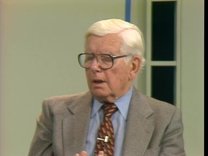
Reflections by an Eminent Chemist: Herman Mark (master) Reel 1
- 1981

These captions and transcript were generated by a computer and may contain errors. If there are significant errors that should be corrected, please let us know by emailing digital@sciencehistory.org.
Transcript
00:01:05 Well, Professor Mark, it's just great to
00:01:10 see you here and have a chance to chat with you.
00:01:15 I was looking at an article concerning your life and background,
00:01:20 and of course we've known each other for many years.
00:01:25 I note that you were born in 1895 in Vienna.
00:01:30 And I'm sure years ago you told me a little bit about your parents
00:01:35 and from time to time, but I have forgotten the exact details and
00:01:40 exactly what your family was like and what were the incentives for you
00:01:45 to excel in some intellectual activity.
00:01:53 Well, first of all, Charlie, I would like to express my sincerest thanks
00:01:58 to the American Chemical Society, to you, to everybody who is connected
00:02:03 with this program, and I want to emphasize it's a particular pleasure for me
00:02:08 to come here and have this exchange of words and of thoughts
00:02:13 with you here in this beautiful center of
00:02:18 media activities in Ann Arbor.
00:02:23 Now, as far as my earliest recollections go,
00:02:28 my father was a
00:02:33 practical physician, and he
00:02:38 was born in Hungary, what was
00:02:43 then Hungary, a city of medium size.
00:02:48 Now it's called Bratislava, and it is now in Czechoslovakia.
00:02:53 His father was
00:02:58 Jewish, and my father, of course, also Jewish originally,
00:03:03 was a businessman in a small
00:03:08 village near Bratislava.
00:03:13 My mother was born in Budapest, strangely enough,
00:03:18 even though she, her father and mother, her family
00:03:23 came from Bavaria, and then eventually
00:03:28 they met in Vienna when my father studied medicine
00:03:33 and when the father of my mother, who was an architect,
00:03:38 had to do some buildings in Vienna.
00:03:43 He was
00:03:48 evidently a very able
00:03:53 physician. Your father, your father. Yeah, my father.
00:03:58 And he had a nice skin and tail so that the family
00:04:03 was fairly well off, I would say middle class.
00:04:09 Now I had a brother and a sister.
00:04:14 My brother was a year younger than I, and my sister was about
00:04:19 10 years younger than I. And as we grew up in the
00:04:24 environment of pre-war Austria, pre-war Vienna,
00:04:29 that means under the domination, under the reign of the emperor
00:04:35 with all the paraphernalia, I think
00:04:40 the overruling feeling of
00:04:45 everybody, not us children, but everybody,
00:04:50 before the war
00:04:55 approached, let us say, the first decade. We're now talking about the First World War.
00:05:00 We are talking about the First World War, yeah.
00:05:05 Not only the feeling, it was the conviction of complete safety.
00:05:10 The conditions were stable. Everybody knew
00:05:15 pretty much what he had. He also knew what he
00:05:20 possibly could expect, and he also knew that he would have to work for that.
00:05:25 And there was no tendency not to work.
00:05:30 Of course there were levels, as always, but
00:05:35 within each level I think there was knowledge and
00:05:40 understanding of what could be done, and of course it was perfectly
00:05:45 possible to go from one level to another either way.
00:05:50 These levels you're talking about are social levels. Yeah, social levels.
00:05:55 It was possible to get up and it was also possible to go down.
00:06:00 Now then, for our life,
00:06:05 our life, children's life, let us say from
00:06:10 1900 to 1910, this span...
00:06:15 You were protected, in a sense. We were protected. There was no question
00:06:20 that I would go on forever. But the interesting
00:06:25 feature of this school life
00:06:30 and whatever was beyond was an interesting mixture
00:06:35 of discipline and freedom.
00:06:40 There were domains of discipline. You have to get up, you have to make
00:06:45 your room, your room had to be neat, you had to be neatly dressed,
00:06:50 then you got your breakfast and off to school. And work.
00:06:55 And there you had to do something
00:07:00 in order to get through. And there was really
00:07:05 never any question that that has to be. There was no necessity.
00:07:10 And this was not only in our families. It was in all families of the same social level.
00:07:15 And I think of almost any social level. But then beyond
00:07:20 that, there was complete freedom. You could do what you were interested
00:07:25 in, provided that
00:07:30 you would remain in the domain of
00:07:35 your actual activities. Parents always expect, even
00:07:40 in our age now, their children to produce
00:07:45 and work. In your own case,
00:07:50 it of course was expected of you that you
00:07:55 would do that. Was your father or mother the more
00:08:00 dominant force in that usual exchange between children
00:08:05 and parents that always occurs in that
00:08:10 from the age of 10 to 16? Yes, yes. I understand. My mother.
00:08:15 And the simple reason was that my father was always
00:08:20 on his way to visit patients.
00:08:25 And when he was at home, the people came
00:08:30 and he had a normal practice,
00:08:35 normal medical
00:08:40 practice. So we really saw him. Well, we saw
00:08:45 him probably every day, but not for very long. And my mother really
00:08:50 ran the show.
00:08:55 So what was the freedom? How was the freedom used? Well, the freedom was used
00:09:00 to a large extent for sport and art.
00:09:05 Sport, beginning with 10 years, there was tennis, there was soccer,
00:09:10 there was swimming, there was skating,
00:09:15 and a lot of activities of this type.
00:09:20 Later on, maybe after 14 or 15,
00:09:25 mountain climbing was added very vigorously and
00:09:30 with a great deal of energy. Vienna is
00:09:35 located at the fringes of the Alps and therefore it was easy
00:09:40 in summer it was climbing and
00:09:45 in the winter it was skiing. So between these things
00:09:50 we moved around and did one thing or the other. Not only we,
00:09:55 all our friends in the classes, in the same classes, that was
00:10:00 more or less the life of young people.
00:10:05 When did you begin to feel
00:10:10 that you might want to enter a career in science?
00:10:15 Of course, your father was a physician and that had connotations
00:10:20 of chemistry and physics in it.
00:10:25 Somewhere in that stage, as you say,
00:10:30 approaching 16, there must have been some motivation, other
00:10:35 motivations that you had already begun to think about. At least I think
00:10:40 in those days people made up their minds a little bit earlier than they do now
00:10:45 what they think they want to do. Where did these motivations
00:10:50 come from that you can remember?
00:10:55 I understand very well what you mean.
00:11:00 As far as I remember there were really two reasons.
00:11:05 Beginning with 15, 14, 15, in our
00:11:10 high school we had, of course,
00:11:15 mathematics and then we had natural sciences, which was
00:11:20 essentially in the lower levels, it was essentially the
00:11:25 descriptive sciences, both in zoology and mineralogy.
00:11:30 In the higher, in the four higher classes, it was physics and
00:11:35 chemistry. In physics and chemistry we had a teacher
00:11:40 who actually was a priest. His name was Lavaty.
00:11:45 It's a Czech name, so he probably somehow
00:11:50 came from Prague, from Bohemia.
00:11:55 At that time there didn't exist any Czechoslovakia. It was part of the Austrian Empire.
00:12:00 He was excellent. He was very strict, but
00:12:05 he really gave us fantastic lectures in physics.
00:12:10 It started with physics and then came to chemistry.
00:12:15 He was one of the sources of kindling
00:12:20 the interest in natural sciences, in the exact natural sciences.
00:12:25 The other one was a friend of mine. His name is
00:12:30 Gerhard Kirsch, K-I-R-S-C-H. He
00:12:35 was the son of a professor at the Technical University in
00:12:40 Vienna. His father was professor of material sciences at the Technical University
00:12:45 in Vienna. His son studied in the same school as I
00:12:50 and probably because of his father was very early interested
00:12:55 in physics and also in chemistry.
00:13:00 He was three years older than I, so I was very much under his influence.
00:13:05 When he said, let's do that, I said okay. When he said, let's not do that,
00:13:10 I also said okay. So he really educated me by his
00:13:15 advanced information about things. He always told me what would come next
00:13:20 in physics and chemistry so that I could already prepare myself a little bit.
00:13:25 Because of the influence of his father, who was a very famous professor of
00:13:30 material sciences, he had access to books and to models.
00:13:35 Because of my father, who was a physician, we had access to certain chemicals.
00:13:40 Then we pooled our resources and pooled our interests
00:13:45 and actually rigged up a little laboratory in a small room
00:13:50 of the apartment of Gerhard Kirsch
00:13:55 where we carried out experiments until Mrs. Kirsch threw us out
00:14:00 because of all kinds of side products of our experimental activities.
00:14:05 But those very definitely have been the two roots.
00:14:10 So you would have been 16 or 17?
00:14:15 Yes, that started maybe around 14 when Gerhard was 17.
00:14:20 When I was 16, he was 19. He already started to study at the University of Vienna
00:14:25 where he later became a professor. He later was a professor of physics at the University of Vienna.
00:14:30 So that when I approached the end of the high school studies,
00:14:35 it was a foregone conclusion that I would study either physics or chemistry.
00:14:40 And of course there was never any doubt that you would not go to the university.
00:14:45 I mean, that was assumed.
00:14:48 No, there was never any doubt.
00:14:53 The question, of course, which I find
00:14:58 that is extremely interesting is that there would be a material science
00:15:03 program that early
00:15:08 in the social events of the chemistry world
00:15:13 because material science really did not develop here nearly that early
00:15:18 in any formal structure anyway.
00:15:23 I'm very interested in the fact that there was a professorship of material science.
00:15:29 The German word, I mean, his professorship,
00:15:34 the professorship of Bernhard Kirsch, he was the father,
00:15:39 was known as Materialkunde.
00:15:44 Materialkunde. Well, kunde is not science.
00:15:49 Kunde is descriptive.
00:15:54 Ceramic, wood, anything which was used
00:15:59 for building purposes, of course, not plastics because it didn't exist at that time.
00:16:04 But certainly wood was, and certainly all metals were
00:16:09 and all the ceramics were. But it was essentially descriptive because
00:16:14 well, metallurgy, of course, was already, and metallography
00:16:19 existed already as a science. So I think the chair
00:16:24 for Materialkunde was a little bit scientific,
00:16:29 mostly descriptive.
00:16:34 Then, of course, came,
00:16:39 you were 16 or 17. I know that you went into
00:16:44 the army at 18, the Austrian army. Did you get to the university
00:16:49 at all before you went into the army?
00:16:54 Well, before I answer this question, let me say a few words about
00:16:59 the other part of our main interest, and that was art.
00:17:04 All right. And mainly music.
00:17:09 In all families, in most families of the middle class
00:17:14 in Vienna, there was active musical
00:17:19 performance. Somebody played the piano, somebody
00:17:24 played the violin, somebody played the cello. I remember that
00:17:29 in the larger circle of my family, there were
00:17:34 four quartets which met regularly and performed
00:17:39 all kinds of musical pieces
00:17:44 so that we grew up in this atmosphere.
00:17:49 And then, of course, there came the opera in Vienna, and then there came the
00:17:54 many, many concert halls in Vienna, so that particularly, let us say,
00:17:59 from 16 to 18, we went to
00:18:04 a musical performance almost every evening somehow. And, of course,
00:18:09 they were very good, and they were very famous conductors and very famous performers
00:18:14 in those years, so that really sport and music,
00:18:19 those were the two components of our freedom,
00:18:24 which eventually we blended and
00:18:29 enjoyed very much. And they were both very educational.
00:18:34 Well, I know that you've had this long interest
00:18:39 in music, and I see it in other
00:18:44 friends that grew up in middle Europe.
00:18:49 There were definitely that kind of
00:18:54 intellectual activity, which didn't necessarily mean
00:18:59 you had to be a performer, a public performer, but you appreciated
00:19:04 music in all of its aspects. And that, I think,
00:19:09 made an impact years later
00:19:15 when many of these individuals might have come to the States.
00:19:20 There's no question about the fact that that cultural activity
00:19:25 was expected of everyone
00:19:30 in middle Europe, not even just Austria, I think, and mostly.
00:19:35 Well, I come back to my question. You
00:19:41 then began to prepare yourself to enter the university.
00:19:46 The First World War came along at about
00:19:51 the same time. How did that work? Had you started at the university before
00:19:56 you went into the Austrian army, or did you go in before you came back and went to the
00:20:01 university? Well, I graduated from high school,
00:20:06 as usually, in June 1913.
00:20:11 And I had to report to my regiment
00:20:16 in October. So it was June, July,
00:20:21 August, September. In other words, there were three and a half months,
00:20:26 which was just one semester at the university.
00:20:31 So I enrolled for this one semester,
00:20:36 of course, not knowing that there would be a war and expecting that I would just go
00:20:41 around for four years or five years and wind up in 1918
00:20:46 or maybe somewhere like that.
00:20:51 I was interrupted because a year after that, in June 1914,
00:20:56 the war started. So we were all sent to various
00:21:01 fronts. First, my regiment or the division
00:21:06 really was sent to Russia because there was an emergency
00:21:11 and we suffered a very heavy defeat. The Russians pushed us all the way
00:21:16 400 kilometers or 250 miles to the west
00:21:21 until somehow the army recovered and pushed them back
00:21:26 again. This went on three or four times for the poor country.
00:21:31 And then, of course,
00:21:36 our division, because we were mountaineering,
00:21:41 we were trained in mountaineering, was put down to the Alps as soon
00:21:46 as Italy declared war. That was in the middle of 1915.
00:21:51 And then I stayed during the war at the southern front.
00:21:56 I was wounded twice and went through a lot of
00:22:01 various actions. At the end of the war, that was in
00:22:06 October 1918, the division
00:22:11 to which I belonged was captured.
00:22:16 For most members of the Austrian army, the war ended in October
00:22:21 1918, but not for us.
00:22:26 We were a year in Italy,
00:22:31 imprisoned. But I must say that even the war was not
00:22:36 civilized at all. Everything around the war was
00:22:41 civilized. Prisoners were very reasonably treated
00:22:46 and we didn't have really any hard time, except that we didn't know
00:22:51 how long it would last. Now then, eventually, in
00:22:56 summer 1919, we were gradually
00:23:01 released to go back to our country. And I returned
00:23:06 in August 1919 and immediately resumed,
00:23:11 of course, my studies at the university.
00:23:16 So I had one semester already and then I got two in 1919 and so on
00:23:21 and on. I kind of scraped up as many
00:23:27 semesters as I possibly could. Of course, one never knows
00:23:32 the impact of the battle
00:23:37 and war and all of the emotions that go with it,
00:23:42 which we call fear, bravery, courage.
00:23:47 But it's almost impossible not to conclude that you do
00:23:52 learn a lot about people. You may not learn a great deal
00:23:57 about new knowledge, but you learn a lot about people under that kind
00:24:02 of stress. That's correct. I am sure that any experience
00:24:07 of that sort matures an individual. You see people
00:24:12 at their worst and best. Yeah, you're absolutely correct.
00:24:17 It's a good testing machine, a psychological
00:24:22 testing machine. So then at the university
00:24:27 you progressed. You undoubtedly
00:24:32 had some teachers there that influenced you
00:24:37 because then one is becoming closer to the system
00:24:42 of more personal attention and very strong personalities
00:24:47 in the university. What in the university then began to influence
00:24:52 you as to what you did next? Who
00:24:57 did you admire? Who did you want to be like?
00:25:02 That's always a question which I've asked myself. Who was your idol?
00:25:07 Well, because of Gerhardt,
00:25:12 who was a physicist, I was first inclined to
00:25:17 major in physics. Well, the first two semesters, of course, makes no difference.
00:25:22 You have to take mathematics, physics, chemistry, whatever you do later.
00:25:27 But then, as you said, there was a
00:25:32 personality which changed my mind and influenced me
00:25:37 quite considerably during the next years, in fact, and that was
00:25:42 Professor Wilhelm Schlenk.
00:25:47 He came from Munich and he was
00:25:52 a pupil of Adolf von Bayer,
00:25:57 an organic chemist, a real organic chemist, a good old
00:26:02 organic chemist, an experimentalist.
00:26:07 He liked to make new substances, he liked to find out how they would behave, make
00:26:12 conclusions, make other ones, and he had
00:26:17 already, several years ago,
00:26:22 chosen for his studies what was called
00:26:27 at that time the trivalent carbon atom.
00:26:32 The stable free radical type.
00:26:37 Now, in fact, it's interesting that the first
00:26:42 scientist who ever did that with great precision
00:26:47 was Gomberg, here in Michigan. He studied in Germany
00:26:52 with Bayer and came
00:26:57 over to the United States in 1905, 1904,
00:27:02 and became professor here and started here
00:27:07 work on these strange
00:27:12 compounds. There are certain organic compounds where carbon, which
00:27:17 always is tetravalent, seems to be only turbulent.
00:27:22 He made a number of them and crystallized them and
00:27:27 just established groundwork. And Schlenk, who
00:27:32 worked with Bayer, I think Gomberg had already left Munich when Schlenk
00:27:37 came in. But anyway, there was some tradition and Schlenk
00:27:42 continued that work in Munich. And when he
00:27:47 came to Vienna, he continued it in Vienna. And it was good
00:27:52 plain organic chemistry. You would take a certain compound
00:27:57 and see to it that one substituent would be taken away and
00:28:02 much to your surprise, the material would not have the tendency to add another
00:28:07 substituent. It would remain with one arm cut off. As you said it
00:28:12 before today, we call it the stabilized free radical.
00:28:17 And that was exciting. That was really exciting.
00:28:22 He was also an excellent teacher. His general
00:28:27 chemistry course was most stimulating.
00:28:32 So I decided I would not study physics but
00:28:37 instead chemistry. And since he was an organic chemist, I would study with him.
00:28:42 I would try to get him as my graduate
00:28:47 advisor, as my graduate professor.
00:28:52 Did you live at home or at the university?
00:28:57 At home. So you were close enough so that you could do that?
00:29:02 Yeah. I walked half an hour to the university every morning. Pretty good
00:29:07 exercise. But since I was intrinsically
00:29:12 interested in physics, at least I tried to get as much physical
00:29:17 as possible. And of course this was chemistry.
00:29:22 There was no reason why I shouldn't take more courses than
00:29:27 were actually prescribed in physical chemistry.
00:29:32 How was the decision made those days to accept someone into Schlenk's group?
00:29:37 How would he make that decision on the basis of your performance to date?
00:29:42 He couldn't accept everybody that wanted to work with him. So he made that decision.
00:29:47 Well, it was like this. Of course he
00:29:52 had several assistants. One assistant would take care of
00:29:57 the laboratory in detail. The other assistant would
00:30:02 take care of the budget of his institute, which was a pretty large
00:30:07 institute. And one assistant would take care of the
00:30:12 personnel properties, personnel problems.
00:30:17 So that was Dr. Wolf.
00:30:22 So one day I went to him and I said,
00:30:27 Doctor, I would like to become a graduate student of the chief.
00:30:32 He said, well, that would not be very easy, but
00:30:37 show me your credentials. So then you showed him the grades
00:30:42 which you had made in the various courses.
00:30:47 Then again he shook his head and said, well, we have a lot
00:30:52 of people already, but maybe I should ask you a few
00:30:57 questions. And then you had to pass an informal exam of
00:31:02 three or four questions. Then he would go to the boss and he would say,
00:31:07 well, I have somebody I think we should take. And if he would not
00:31:12 want to take a girl or a boy, he would say nothing.
00:31:17 He would be just out in the cold.
00:31:22 So it was pretty much like it is here, only rather informal.
00:31:27 I can imagine that,
00:31:32 I don't know whether you said this, but your interest in
00:31:37 physical chemistry and at that stage of those kinds of problems, someone who had
00:31:42 some knowledge of physical chemistry would have been very valuable
00:31:47 to that group.
00:31:52 I had very good teachers in physical chemistry. There was Professor Emil Abel,
00:31:57 who was a modern physical chemist.
00:32:02 There was Professor Wegscheider, who was a classical physical chemist, thermodynamics.
00:32:07 So I had very good instructors there.
00:32:12 And then you see it was the first time in my life really that I became interested
00:32:17 in swimming between two boats.
00:32:22 Not be a hundred percent organic chemist, not be a hundred percent
00:32:27 physical chemist, but try to learn as much as
00:32:32 possible between these two disciplines and eventually profit from
00:32:37 this dual information.
00:32:42 Later it all went ahead with polymers.
00:32:47 As you look at it now,
00:32:52 with making adjustments
00:32:57 for the differences in time
00:33:02 and scientific content, you would regard your
00:33:07 undergraduate education as first-rate. That is, the University of Vienna
00:33:12 had a quality which was above normal.
00:33:17 Yes, certainly in those years
00:33:22 and also in those areas in
00:33:27 middle Europe. Of course, there were many other excellent universities in Munich
00:33:32 and so on and so many others, but Vienna was good.
00:33:37 Then of course also the graduate part of it, or the
00:33:42 research part of it, if you want to call it that,
00:33:47 was good. Eventually, of course, these papers were
00:33:52 published and they were accepted.
00:33:57 Do you remember your doctoral thesis exam?
00:34:02 Yes, sure. First of all, of course, I remember very well the work on my thesis itself,
00:34:07 which was the preparation of a highly
00:34:12 aromatized ethane and butane,
00:34:17 which would then break into two pieces because of the
00:34:22 absorbency of valence forces through the
00:34:27 aromatic rings. Then you would have two free radicals,
00:34:32 highly colloid, very unstable, a little bit of oxygen,
00:34:37 and it would be an end. I still remember
00:34:42 very well those were really two years, graduate work
00:34:47 were two years.
00:34:52 It was a field
00:34:57 where fundamental research, and that was really fundamental research,
00:35:02 new information was gathered in this specific
00:35:07 field. It was very inexpensive because all you needed was
00:35:12 an organic chemical laboratory, beakers and
00:35:17 flasks and stills, oil and gas of course, small scale,
00:35:22 and then of course chemicals.
00:35:27 Well, the simple chemicals you would buy, and the more complicated you would have to make yourself.
00:35:32 So that from the point of view of expenses,
00:35:37 this research was practically negligible, very much
00:35:42 different today. I mean, the characterization of our
00:35:47 compounds was they crystallized through
00:35:52 a microscope. You would establish whether they are needles or whether they are platelets,
00:35:57 and then you would make a melting point, and then you would
00:36:02 check the solubility in three or four different solvents,
00:36:07 and that was all. There was no infrared and there was no X-ray.
00:36:12 Elemental analysis sometimes. Of course, elemental analysis. Elemental analysis would be the first.
00:36:17 Yes, you are right. Elemental analysis would be the first, and then would be the other things.
00:36:22 Did Blank take some personal time with his students at that time?
00:36:27 Yes, this was very interesting. Of course, he was a very busy man. He was director of the institute and he was dean
00:36:32 and he was a member of the academy and he had to go to the ministry and so on,
00:36:37 so many committee meetings. We never saw him during the day. Very rarely.
00:36:42 But after he had his dinner, his
00:36:47 apartment was in the institute at 8.30 or so,
00:36:52 he would come over with a cigar and then he would
00:36:57 go from one to the other and chat.
00:37:02 Eventually, he would show us how to crystallize something,
00:37:07 how to prevent crystallization.
00:37:12 Once, when I had my final body,
00:37:17 so to speak, my final compound,
00:37:22 he himself made the elemental analysis.
00:37:27 He said, give it to me, and then he lit up this long, long stove
00:37:32 and made it all himself from the beginning to the end,
00:37:37 three hours job. Just because it would have to be published
00:37:42 and he did not want to rely on me,
00:37:47 he wanted to check. He considered it important enough to...
00:37:52 He considered it important enough also educationally. He showed us. We all stood around and watched him.
00:37:57 And then eventually
00:38:02 also he would sit on a stool and we would gather around him
00:38:07 and then he would tell us stories about Emil Fischer and about Adolf von Bayer
00:38:12 and about Willstedt, about the current in organic chemistry.
00:38:17 He would tell us the work of Willstedt on enzymes and the work
00:38:22 of Emil Fischer and his followers on polypeptides.
00:38:27 So we didn't have to read much in the textbooks.
00:38:32 We got it right from the horse's mouth.
00:38:37 You know, it's always interested me in reading what you have written and many others about the period
00:38:42 then on from the 1920s.
00:38:47 There was recognition that Fischer's
00:38:52 polypeptides were made by conventional
00:38:57 organic processes and were large molecules or relatively
00:39:02 large molecules. Now I've often speculated that the reason
00:39:07 that didn't sink in to the community was that they were
00:39:12 DPs of 20 or 25 or 30, not so much higher than that
00:39:17 and people still regarded that as a small molecule.
00:39:22 But conceptually, I've never fully
00:39:27 understood why the organic community didn't see that earlier, that
00:39:32 you were making a large molecule.
00:39:37 I think there were several reasons.
00:39:42 Of course, Fischer, he was extremely
00:39:47 scientifically minded. He would not make any statement unless he would have
00:39:52 100% quantitative proof.
00:39:57 He said, I know now how to put those things together, which was really a precursor of the
00:40:02 Merrifield synthesis. I think he only used
00:40:07 two or three at that time. And then when I
00:40:12 build up a chain of a thousand, I am stopped
00:40:17 because of solubility. These things are not soluble anymore.
00:40:22 So how should I put the next link on if the
00:40:27 damn thing is not soluble? So he stopped.
00:40:32 He said, my experimental power does not
00:40:37 permit me to go any further. Nature apparently
00:40:42 has more experimental power than I have and goes much further.
00:40:47 I don't know how far. These were almost his words
00:40:52 at a meeting of the
00:40:57 AAAS in 1906.
00:41:02 No, 1912 in Vienna. Those were almost
00:41:07 his words, but of course it's printed.
00:41:12 So then your equivalent of a Ph.D. was obtained
00:41:17 in 1921.
00:41:22 And then I have forgotten the sequence of events
00:41:27 that precisely perhaps you might remind me of.
00:41:32 In 1920,
00:41:37 well, Emil Fischer died in 1919
00:41:42 and the chair
00:41:47 was offered to Wilstetter, who at that time was professor
00:41:52 in Munich. In 1920, Wilstetter
00:41:57 declined. He says, I am now in Munich. I have my group.
00:42:02 I'm perfectly happy. I don't want to change.
00:42:07 And Fischer was in Berlin.
00:42:12 He was a professor for another successor
00:42:17 and they offered the chair to Schlenk.
00:42:22 And he accepted.
00:42:27 At the beginning of 1921, he accepted.
00:42:32 And then he got ready to move and decided that he would take
00:42:37 four or five of his closest collaborators
00:42:42 so that the work which he was doing in Vienna would be
00:42:47 continuously transferred to Berlin.
00:42:52 And I was one of these six. He took six assistants, we would say,
00:42:57 from Vienna to Berlin.
00:43:02 And in the summer, soon after I got my degree,
00:43:07 I went with him to Berlin. The whole gang went up to Berlin
00:43:12 and established ourselves in the old institute of Emil Fischer.
00:43:17 Now there were there several of the...
00:43:22 This was a big institute. And in fact, each part of it
00:43:27 had a full professor as director.
00:43:32 Now the organic chemist was Gabriel,
00:43:37 a man who worked on alkaloids.
00:43:42 The other organic chemist was Loix, Hermann Loix.
00:43:47 Yes. Carbohydrate synthesis.
00:43:52 The third was Freudenberg.
00:43:57 So there were three people of this character.
00:44:02 And the physicochemical division was Panet.
00:44:07 Free radical Panet.
00:44:12 And the inorganic division was a certain Dr. Tide, also a very famous inorganic chemist.
00:44:17 Full professors, and above all of them was the director of the entire institute.
00:44:22 So we six
00:44:27 learned a tremendous amount by just going to these people
00:44:32 and just listening to what they would say. They were very nice.
00:44:37 They said, well, now we have a new boss and he brings with him young people.
00:44:42 And that was fantastic. So the first four months, we all did nothing,
00:44:47 but we went to Loix and we went to Gabriel and we went to Freudenberg and just
00:44:52 listened to what they would tell us. It was by far the best introduction to
00:44:57 modern organic chemistry. Not only organic chemistry. Panet was there too.
00:45:02 So that was the changeover from Vienna to Berlin.
00:45:07 And in a sense, it's the first time you left home.
00:45:12 Well, during the war I was away for five years, yes.
00:45:17 So, and then in 1920,
00:45:22 I had met Mimi Schrammeck. Very nice girl.
00:45:27 I always thought so.
00:45:32 And then she came with me to Berlin.
00:45:37 And then I worked on the Schlenk or with Schlenk
00:45:42 again on a few modifications of these
00:45:47 free radials. Not very long.
00:45:52 Because one day
00:45:57 Schlenk told me tomorrow
00:46:02 a good friend of mine, Geheimrat Haber
00:46:07 of the Haber ammonia synthesis
00:46:12 wants to talk with me about
00:46:17 setting up a new institute and
00:46:22 maybe I will want you to come in for a while.
00:46:27 So I was there the next day. And sure enough, he called me in.
00:46:32 And they were sitting, the two professors, each of them smoked a big cigar.
00:46:37 The whole room was full of smoke. I couldn't breathe.
00:46:42 And they were chatting. And then
00:46:47 Haber said,
00:46:52 the German industry
00:46:57 is now planning to use
00:47:02 the ammunition factories,
00:47:07 that is the nitrocellulose factories,
00:47:12 built up during the war for peaceful purposes.
00:47:17 Of course they are not permitted to make explosives.
00:47:22 Well, nitrocellulose is a cellulose derivative.
00:47:27 And because of that, the equipment and the people
00:47:32 are so that this has to be converted
00:47:37 into some cellulose chemistry. We look about cellulose acetate
00:47:42 for film, for fiber, for molding.
00:47:47 We look about cellulose xanthate for cellophane
00:47:52 and for rayon.
00:47:57 Did Haber have this background himself in knowing something about cellulose acetate?
00:48:02 No, but he knew the general planning.
00:48:07 And then he said, out there in Dahlem,
00:48:12 in my Kaiser Wilhelm Institute, we have a lot of good
00:48:17 physical chemists. We have also physicists.
00:48:22 But cellulose is an organic compound, so we need organic chemists.
00:48:27 And my friend Professor Schlenk has told me
00:48:32 that you are interested in physical chemistry, but you are trained in organic chemistry.
00:48:37 So that's the kind of people I'm looking for,
00:48:42 not only for you alone, for others too.
00:48:47 And what is going to be done is a new institute will be, or has already been
00:48:52 founded, the Institute of Fiber Research,
00:48:57 Faserstoff Chemie. The director is
00:49:02 Professor Herzog, and I'm now helping him to get his
00:49:07 staff together. So then I left.
00:49:12 Now, later on I told Schlenk, well, I hate to leave
00:49:17 this place here where I have started such nice things, and you have been so kind with me.
00:49:22 So he said, I'll tell you something. Why don't you go out and have a look at it?
00:49:27 If you like it, stay. If you don't like it, you can come back in a year or so.
00:49:32 So, ideal. Because it was obviously an unknown entity in a sense that
00:49:37 it was a challenge, I presume, and that however
00:49:42 much could be done depending on the initiatives of
00:49:47 yourself. And of Herzog, of the director, you see. And Schlenk said, look here,
00:49:52 this here is an established institute that exists since 80 years,
00:49:57 and there's no question that it's going to run on.
00:50:02 Now, you go now in a newly founded institute, nobody knows what will happen there.
00:50:07 And how long now did you stay at that institute?
00:50:12 So then I went out to Dahlem, after all, under Herzog.
00:50:17 And there was a group of young people,
00:50:22 typically assembled, you know.
00:50:27 Polanyi, who was from Budapest, Katz,
00:50:32 who was from Amsterdam, Weissenberg, who was from Vienna,
00:50:37 Vacek, who was from Graz, Szilard, who was from Budapest,
00:50:42 Wigner, who was from Budapest. In other words,
00:50:47 everybody saw that Herzog scraped together whatever he could get hold of.
00:50:52 But every one of those names in later life did something.
00:50:57 And they moved out in different directions, but it was
00:51:02 obviously a superb choice of intellectual excitement at this point.
00:51:07 And for a while we started to work,
00:51:12 and we were not told, now, we would like you to work on
00:51:17 cellulose and its derivative, eventually starch and its derivatives,
00:51:22 because this also would be an industry.
00:51:27 Silk, of course, because that was a fiber. Wool, because that was a fiber.
00:51:32 And then, because that was
00:51:37 used as important adhesives, on rubber.
00:51:42 In other words, the assignment was to work
00:51:47 on what we today call high-polymer materials.
00:51:52 Nobody called it that way. And the interesting thing is,
00:51:57 and I remember that very strongly, each of this
00:52:02 discipline was a world.
00:52:07 There were rubber chemists, there was a rubber society,
00:52:12 there were textbooks on rubber, there were meetings on rubber chemistry,
00:52:17 there was a textbook on starch, and there were starch chemists,
00:52:22 and there were textbooks on cellulose, and there was a society on cellulose,
00:52:27 and of course on proteins, on wool.
00:52:32 And yet there was no concept that they were a really similar thing.
00:52:37 Rubber and cellulose, at that time,
00:52:42 they were like Venus and Mars before Copernicus.
00:52:47 Different worlds.
00:52:52 And those were the early twenties.
00:52:57 I know that you've told me years ago that you had no good
00:53:02 x-ray diffractometer, you had to build one,
00:53:07 and this is where that occurred.
00:53:12 This is the time, you see, when all these materials are solid.
00:53:17 So it was really the beginning of solid state physics of organic compounds.
00:53:22 And of course, solid state means x-ray diffraction,
00:53:28 it means infrared absorption, it means electron diffraction.
00:53:33 In other words, it means new methods.
00:53:38 Who did the infrared at that time?
00:53:43 At that time, the infrared at our institute did Gerda Lasky,
00:53:48 a Ph.D., a girl, a very nice, intelligent girl.
00:53:53 She worked with Rubens at the physics institute.
00:53:58 Rubens was the discoverer of infrared radiation.
00:54:03 And she was one of his Ph.D.s, and she had an infrared,
00:54:08 at that time, of course, very primitive.
00:54:13 She made the first infrared pictures of cellulose acetate films and such things.
00:54:19 Now we embarked on x-ray, of course, and Brill, Rudy Brill,
00:54:24 he was a graduate student at that time, and he and I would build up
00:54:29 x-ray tubes, which you couldn't buy at that time,
00:54:34 and started to work on cellulose, and when CATS came and showed it,
00:54:39 stretched rubber would give an x-ray diagram, of course.
00:54:45 And so the first x-ray diagrams and their evaluation,
00:54:50 Polanyi, I think, was the man who evaluated the first diagram of cellulose,
00:54:55 and Weissenberg, they were really excellent theoreticians.
00:55:00 So I could say from 1922 to 1925,
00:55:06 this group under Herzog's direction,
00:55:16 he was a very benevolent dictator.
00:55:21 He was a dictator, but a very benevolent dictator.
00:55:26 I have been called the same.
00:55:32 Now then, of course, in the early 20s,
00:55:40 Staudinger had published his first progressive and exciting article
00:55:48 on rubber.
00:55:53 Freudenberg had published his exciting article on cellulose,
00:55:59 so that the concept of chain structure came in.
00:56:04 And then, of course, everything became clear.
00:56:09 They're all chains, and all the difference is they have different substituents.
00:56:14 One is a hydrocarbon, and one has hydroxyl groups,
00:56:19 and the other one has amino groups.
00:56:24 And in good old organic chemistry,
00:56:29 we knew those groups from small molecules,
00:56:34 and it was quickly established that such a group doesn't care whether it's affixed to a small molecule
00:56:39 or whether it's affixed to a long chain.
00:56:44 And that was really the opening up of a new era.
00:56:49 And I was at that institute until 1926.
00:56:54 And in 1926,
00:56:59 sometimes in the summer of 1926,
00:57:04 Haber called me in his office,
00:57:09 and he said,
00:57:14 Professor Meyer, K. H. Meyer.
00:57:19 There were so many Meyers that one had to use the initials.
00:57:24 And he is the director of a big laboratory
00:57:29 in Ludwigshafen, IG Laboratory in Ludwigshafen.
00:57:34 And he would like to talk to you.
00:57:39 So the next day, I was there,
00:57:44 and Meyer said,
00:57:49 we now in the IG have done
00:57:54 what the Fasser Institute started to do.
00:57:59 We have converted nitrocellulose plants
00:58:04 for new stuff, but we cannot make materials
00:58:09 which compete successfully with what the English people do,
00:58:14 what the French people do. We don't know enough fundamentally about all those things.
00:58:19 Also, we want to make synthetic materials, something like polystyrene
00:58:24 or something like polyvinyl chloride.
00:58:29 But we don't know how to polymerize them intelligently.
00:58:34 So I want to set up, he said, a laboratory
00:58:39 for polymer science and engineering.
00:58:44 I think we terminate. I think we'll need another half hour.
00:58:49 Is that possible?
00:58:54 We had about a minute left on the tape. I think another half hour we need.
00:58:59 No more. We haven't been going an hour.
00:59:04 Everything from Brooklyn on is so well known.
00:59:09 But we should say something about it.
00:59:14 So we'll do a little bit faster from now on.
00:59:19 Okay. I think if we could have another 20 minutes maybe.
00:59:24 I think 20, 25 minutes.
| Property | Value |
|---|---|
| Creator of work | |
| Format | |
| Genre | |
| Medium | |
| Extent |
|
| Language | |
| Subject | |
| Rights | In Copyright |
| Rights holder |
|
| Credit line |
|
Institutional location
| Department | |
|---|---|
| Collection |
Related Items
Cite as
American Chemical Society. “Reflections by an Eminent Chemist: Herman Mark (Master) Reel 1.” Open reel videotapes, 1981. American Chemical Society Audiovisual Collection. Science History Institute. Philadelphia. https://digital.sciencehistory.org/works/eb9fbs2.
This citation is automatically generated and may contain errors.