Digital Collections

Organic Chemistry

  • Circa 1987

These captions and transcript were generated by a computer and may contain errors. If there are significant errors that should be corrected, please let us know by emailing digital@sciencehistory.org.

Transcript

00:00:00 Hello, I am Harry Sello. It is my pleasure to introduce Tempest in a Test Tube, a television

00:00:11 show which made its debut August 24, 1955 on KQED Channel 9, the educational station

00:00:19 for the San Francisco Bay Area. Tempest was a series of 53 half-hour shows pioneering

00:00:27 a new approach in which I, as lecture demonstrator, gave live, unrehearsed presentations of a

00:00:34 series of chemical experiments. These were designed to illustrate basic, simple chemical

00:00:42 principles. The purpose was to stimulate an interest in chemistry by teenage students

00:00:48 and by adults. The talks and experiments had to be entertaining, educational, and simple.

00:00:56 Spontaneity and liveliness were key to the approach. All the experiments used in the

00:01:02 shows were designed and constructed by members of the California section of the American

00:01:07 Chemical Society. The participants were employed by the Shell Development Company, Emeryville,

00:01:14 and by Chevron Research, Richmond. A grant of $52,000 from the Ford Foundation and National

00:01:22 Educational Television permitted the filming of the first 24 shows of the series. The management

00:01:29 for the ACS consisted of Alan Nixon, section chair, Fred Strauss, TV committee chair, myself

00:01:37 as first MC, and Aubrey McClellan, second MC. We four constitute the core of the present

00:01:45 committee. The series was extremely popular then with KQED viewers of all ages. The senior

00:01:55 chemist committee of the California section today is determined to revive Tempest for

00:02:02 the benefit of elementary schools, high schools, adult education classes, ACS local sections,

00:02:10 historical archives, TV stations, and similar organizations. We believe in chemistry as

00:02:17 a second language. While basic principles have not changed, practices have. Forty-five

00:02:26 years ago, such simple chemical demonstrations were not treated with the degree of safety

00:02:32 considerations that they are today. Today, even such simple demonstrations would be carried

00:02:39 out with the proper regard for safety glasses, shields, protective gloves, laboratory coats,

00:02:47 and visible fire extinguishers. The principle of safety first would be explicitly present

00:02:54 as part and parcel of a modern Tempest in a Test Tube.

00:03:08 Thank you.

00:03:39 Tempest in a Test Tube, a series of experiments designed to explain the mysteries of chemistry

00:03:46 and the laws that govern it. Produced by KQED San Francisco. In cooperation with the California

00:04:08 section of the American Chemical Society. For the educational television and radio

00:04:18 center. And now let's go to our laboratory and meet Dr. Harry Sello.

00:04:26 Hello. Let me show you a very interesting experiment.

00:04:39 Very good. The compound I have just made is an organic compound, a non-drinkable variety.

00:04:47 By an organic compound, I mean one which is made of carbon atoms, or contains carbons.

00:04:57 This is a definition of a field, an entire field of chemistry.

00:05:02 Let's take a look at it.

00:05:07 It's made of carbon atoms, or contains carbons.

00:05:12 This is a definition of a field, an entire field of chemistry, the chemistry of carbon

00:05:18 and its compounds. Organic chemistry.

00:05:23 What's so important about carbon that it has to have an entire field of chemistry devoted

00:05:29 to it? The answer can be seen simply this way. Of all the elements in the periodic table,

00:05:36 carbon forms by far the greatest number of compounds. There are something like, oh, half

00:05:42 a million or better compounds of carbon known today. While the number of compounds known

00:05:49 of all the other elements put together is something far less than that, I would guess

00:05:53 say between 50 and 100,000. Because carbon, rather, forms so many compounds, it can then

00:06:01 form a whole field of study by itself.

00:06:06 So the topic of this talk, then, is organic chemistry. Let's look at some of the, let's

00:06:12 look at a difference between carbon compounds and other kinds of compounds.

00:06:20 Here I have two solids. There's one, pieces of which I'll put into this beaker.

00:06:39 Here's the other, the form of a powder.

00:06:45 I'll put both of these on the hot plate. Watch what happens.

00:06:56 This is the compound which I just cut with the spatula. Here's the other one, the powder.

00:07:04 The first compound is beginning to melt, changing from a solid into a liquid. The second one

00:07:11 is not changing at all.

00:07:15 The compound I used in this beaker is wax, which is a compound composed of carbon and

00:07:21 hydrogen. This is the first compound.

00:07:26 The compound I used in this beaker is wax, which is a compound composed of carbon and

00:07:32 hydrogen. This beaker, the powder, is ordinary salt, table salt.

00:07:39 This point right here is one of the differences between carbon compounds and other compounds,

00:07:45 or the difference between organic compounds and inorganic compounds. I'll have to take

00:07:51 this off the flame, off the hot plate, because if it heats up anymore, it will catch fire.

00:07:57 In this particular case, the difference was that the carbon compound is very easy to melt,

00:08:03 while the salt has to be heated to a much higher temperature in order to melt. You see,

00:08:08 in the wax, the solid is made up of atoms of carbon and hydrogen, while in the salt,

00:08:18 the solid is made up of ions of sodium and chlorine. That is, the sodium is in the form

00:08:25 of a charged particle, that is, an atom which has lost an electron, making it a charged

00:08:31 particle. The chlorine is a chlorine chloride ion, rather. It has picked up this electron,

00:08:36 so you have a solid made up of alternately sodium ions and chloride ions, sodium ions

00:08:42 and chloride ions. In the carbon compound, or the organic compound, the wax, we don't

00:08:48 have ions, but we have atoms. This is one of the essential differences between organic

00:08:55 and inorganic compounds, the way in which they're made up. It exhibits itself here by

00:09:02 the fact that the wax has a lower melting point. There is another difference that can

00:09:07 be pointed out between these two compounds. As an example here, the salt will conduct

00:09:12 electricity when molten, while the wax will not conduct electricity. This is also another

00:09:17 way, this is due to the fact that the salt does have ions, as I mentioned. Well, let's

00:09:23 go on and look at some of these properties of carbon compounds, or the field of organic

00:09:28 chemistry. Let's go over here to the end of the table and take a look at the setup, which

00:09:34 has been running here for some time now. Started it at the beginning of the show. In order

00:09:44 to make this more visible, these flames here, I'll just throw a little bit of salt into

00:09:49 the tube. Watch what happens. There's the salt going down the tube. A little more. All

00:10:08 the salt does is make the flame visible. Notice the periodic nature of these flames. A flame

00:10:15 starts at the top, moves down the tube, gets there, gets used up. The manner of speaking

00:10:21 starts at the top again, moves down the tube. Again, let's make it a little visible. Throw

00:10:26 a little salt in the tube. And again, periodic. These can be timed. They're about something

00:10:37 like three seconds apart, and with an amazing regularity. Here's the tube, at the bottom

00:10:44 of which is placed a burner. Ordinary Bunsen-type burner, which is not lit. All it does is feed

00:10:51 gas and air up through the tube. At the top is a burner which is lit, serving as the igniting

00:10:58 burner. You can see its flame if I just sprinkle a little salt into it. There it is. The fuel

00:11:08 being fed into the lower burner is essentially methane. This is a carbon compound, a compound

00:11:14 of carbon and hydrogen. The burner at the bottom feeds a mixture of methane and air.

00:11:21 This can be burnt. However, it must rise all the way up through the tube until it becomes

00:11:27 ignited at the top. When it's ignited, the flame travels back down the tube, burning

00:11:33 up all the methane and air which is present in the tube. As soon as that has happened,

00:11:38 the gas being consumed, more must be supplied from the burner, filling up the tube again.

00:11:43 And again, the process repeats itself. The gas is ignited and burnt as the flame shoots

00:11:49 down the tube, and finally, more has to come up to the top to be replenished. Let's just

00:11:55 do this once more to see whether the flames are still going at a regular cycle like they

00:12:00 were before. The sodium chloride that I'm throwing in the tube gives the flame a characteristic

00:12:09 color of sodium, a sort of a bright yellow-orange. This is a typical color due to the presence

00:12:15 of sodium. Any sodium compound will do this. There it goes down the tube again. So, the

00:12:29 carbon compound concerned here is methane. It is the simplest of all the hydrocarbons,

00:12:35 we call them, of all the compounds of carbon and hydrogen that we know. The formula for

00:12:40 methane is CH4. Let's write the equation for the burning of methane on the blackboard.

00:12:50 Methane, CH4, combines with oxygen, and the product is carbon dioxide, or the products

00:13:02 are, one of them carbon dioxide, the other water. The chemist, however, prefers to write

00:13:09 this in a proper proportion, that is, balance is the reaction he calls it. To do that, we'll

00:13:14 put a 2 here, then we must put a 2 here. Now it's written in its proper proportions,

00:13:21 that is, a molecule of methane combines with two molecules of oxygen, the product is carbon

00:13:27 dioxide here, and two molecules of water. Actually, if you could see very closely in

00:13:32 the tube there, you can see a film of steam on the inside of the tube. This reaction is

00:13:38 typical of the burning of all hydrocarbons. All hydrocarbons, compounds of carbon and

00:13:43 hydrogen, that is, will burn to form carbon dioxide and water. This is exactly what happens

00:13:49 in the internal combustion engine, that is, the automobile engine. A fuel like methane,

00:13:56 containing more carbons than hydrogens, but just in this proportion generally, burns to

00:14:00 form carbon dioxide and water. Sometimes if the burning is poor, it's possible to obtain

00:14:08 other products besides carbon dioxide, namely carbon monoxide and even in some cases free

00:14:14 carbon. This means inefficient burning. Let's go on then and look at this property of compounds

00:14:21 of carbon, namely their flammability. We've seen now that methane, a gas, can be burnt

00:14:27 in a very picturesque way. Here is still another exhibition of this flammability. Another glass

00:14:35 tube. I'll put a little piece of cotton, which itself is a compound of carbon, organic compound,

00:14:44 carbon, hydrogen and oxygen, cellulose mostly. Put this in the end of the tube. And with

00:14:56 care, put a flammable compound of carbon in on the cotton. This happens to be ethyl ether.

00:15:09 This is not the name of a girl, it's the name of this compound. This is used in the hospitals

00:15:14 for anesthesia. It's possible the lecturer might be overcome by this too. Let's hope

00:15:22 not. Now I put that in on the cotton wad and give the vapors a chance to move where

00:15:33 they want to move and see what happens. Now watch what happens. Nothing yet. Let's put

00:15:54 a little bit more ether in the top. It's very warm here and the ether evaporates very readily.

00:16:02 In fact it's very hard to suck it into the little eyedropper because of its high vapor

00:16:07 pressure, of its high volatility that is. There, now maybe it'll do something. Give it a few

00:16:20 moments to move along. Let's try that again now. There it goes. The flame just shot up

00:16:31 the tube. I think the cotton is burning. Yes it is. There's a little yellow flame. If I

00:16:41 hold it, there it is. You can see it burning against this darker background. This experiment

00:16:50 showed that the vapors of ether are heavier than those of air. That is they move downwards.

00:16:56 This illustrates the fact for one thing that if ether is to be used in an open space, care

00:17:02 must be taken not to let it accumulate because it'll lie on the floor seemingly out of the

00:17:06 way and then when a spark is struck it can be the cause of a disastrous fire. This has

00:17:11 on rare occasions occurred in places where ether is used. Let's go on then and look at

00:17:17 further properties of compounds of carbon. Here we have a more practical demonstration

00:17:23 of the use of the foam than in the early experiment. Pour a little bit of an organic

00:17:29 compound in this beaker. This is a compound of carbon and hydrogen called benzene. Also

00:17:48 flammable. Let's get a better look at what's coming off the end of the spout here. There.

00:18:17 Demonstration of how to extinguish a fire by the use of foam. The two liquids are the

00:18:28 following. The milky looking one is a mixture of sodium bicarbonate, an organic compound

00:18:36 commonly called baking soda, and a detergent, a foaming agent. In the other jar we have

00:18:47 a clear solution of aluminum sulfate. Aluminum sulfate is an inorganic compound not composed

00:18:53 of carbon. Aluminum sulfate reacts with the sodium bicarbonate to generate carbon dioxide.

00:19:01 In the presence of the foaming agent, the carbon dioxide charges into the beaker carrying

00:19:06 with it a great quantity of the sudsy foam, of the sudsy foam, which smothers the fire.

00:19:12 This is actually the practical use of foam type fire extinguishers. You see, if I were

00:19:20 to squirt a stream of water into that burning benzene, I would just throw the burning benzene

00:19:24 all over the place and make it more a danger than it really was if I didn't use the water.

00:19:29 However, by using this foam, the foam blankets on the surface of the benzene, cutting off

00:19:34 its air supply, and since it also has bubbles of carbon dioxide, why the fire is extinguished.

00:19:42 So we're using one carbon compound to extinguish another carbon dioxide in this case.

00:19:51 Well, the benzene is a flammable material. We used the ether. It was a flammable material.

00:19:57 We could have used gasoline or any one of several kinds of organic compounds.

00:20:04 The ones that we demonstrated here were flammable. Let's go on now and look at further uses or

00:20:09 further applications of organic chemistry in a slightly different way.

00:20:14 For this experiment, I'll need my hot plate again, so I better go over and get it.

00:20:22 It's still pretty hot.

00:20:28 Now, here's an organic compound in this box. Lard.

00:20:39 Fish out a little bit of this and throw it in the beaker.

00:20:48 This is a compound composed essentially of carbon, hydrogen, and oxygen.

00:20:53 Put this on the hot plate and allow it to melt.

00:21:08 It's now beginning to melt.

00:21:12 In this particular case, we're going to use a little bit of water.

00:21:17 It's starting to melt.

00:21:20 In this particular case, organic compounds such as this, coming from natural products, animal or vegetable sources,

00:21:30 or originally from living material, the study of organic compounds such as this is confined to yet another field of chemistry called biochemistry.

00:21:41 The study of the chemistry of the human body, for example, or of any animal material.

00:21:51 Now this lard or fat has almost completely melted.

00:21:55 Let's put in a little bit of this other organic compound solution.

00:22:01 And while this is warming up, I'll pour out some of this in the beaker.

00:22:09 And now, see, maybe we'll need a little bit more of this.

00:22:17 There.

00:22:19 The fat is dissolving in this solution.

00:22:23 What I have here is a little bit of lard.

00:22:25 The fat is dissolving in this solution.

00:22:29 What I have here is sodium hydroxide, lye, dissolved in methyl alcohol.

00:22:35 Methyl alcohol is an organic compound.

00:22:37 Sodium hydroxide, however, isn't.

00:22:40 And it's reacting with the lard, the melted lard.

00:22:44 I'll now pour it out into this beaker here.

00:22:47 See what we get.

00:22:51 Let's allow it to cook just a little bit more.

00:22:53 Not quite ready, I see.

00:23:03 Along here.

00:23:05 Methyl alcohol can be boiled very easily.

00:23:07 It has a very low boiling point.

00:23:14 Now, don't hit it on top here.

00:23:17 Now, let's see if we can fish a little bit of this solid.

00:23:23 We don't want any of this lard now.

00:23:25 Let's take it off.

00:23:29 Fish a little bit of this solid out of this beaker.

00:23:38 Come on out of there.

00:23:40 Come on out of there.

00:23:46 Pour it in the test tube.

00:23:53 Slippery stuff.

00:23:57 Now, squirt some water on it.

00:24:01 This is a very interesting little gadget.

00:24:03 It's a polyethylene squeeze bottle.

00:24:05 You squeeze it, water comes out.

00:24:10 Here.

00:24:13 It also has a leak.

00:24:16 Let me just tighten this stopper here.

00:24:19 There.

00:24:21 Now, I'll just rinse this with a little water first.

00:24:23 Pour out the water.

00:24:26 Try not to lose that solid we just put in there.

00:24:30 There.

00:24:32 And add a little bit more water.

00:24:40 Comes out in a very fine stream.

00:24:42 You have to really squeeze this to get the water out.

00:24:45 Very handy little gadget.

00:24:47 You can rinse the test tube while you're pouring this out.

00:24:50 Now, then.

00:24:52 That ought to be enough.

00:24:56 And stopper it up.

00:24:58 Shake well before using.

00:25:04 There.

00:25:06 There.

00:25:09 There is the final product,

00:25:11 which is a suds made by soap.

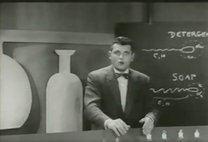
00:25:17 What we've done here is to manufacture soap.

00:25:20 We started with a fat,

00:25:22 which we converted into a soap by cooking it with lye.

00:25:25 This process is called saponification.

00:25:29 Saponification.

00:25:31 The process of converting a fat into soap.

00:25:32 This was the first step.

00:25:34 That is, the saponification was,

00:25:36 we added the lye to the fat.

00:25:38 Cooked it together.

00:25:40 The fat saponified.

00:25:42 We then poured the fat into a solution of sodium chloride,

00:25:44 ordinary salt.

00:25:46 This process is called salting out.

00:25:49 Sort of a convenient term.

00:25:51 What this means is

00:25:53 that the fat which is,

00:25:55 the soap which was formed is insoluble in the salt

00:25:58 and will float to the top.

00:25:59 Or separate itself.

00:26:01 We then fished out a product,

00:26:03 this soap,

00:26:05 and showed it was a soap

00:26:07 by making a suds in water.

00:26:09 This is the old fashioned way

00:26:11 in which your great, great, great grandmothers

00:26:13 might have made soap from collecting fats.

00:26:15 Actually, commercially soap is made

00:26:17 in somewhat the same way.

00:26:19 By a saponification step,

00:26:21 followed by a salting out.

00:26:23 You can then add perfumes and coloring matter

00:26:25 and have any kind of soap you like.

00:26:26 Well, let's go on and look further

00:26:28 at the chemistry of compounds

00:26:30 which are derived from animal source

00:26:32 or vegetable source,

00:26:34 which constitute not only organic chemistry

00:26:36 but biochemistry.

00:26:38 We have looked now at a fat,

00:26:40 separated it into its parts.

00:26:42 Let's look at another natural type material.

00:26:46 Milk.

00:26:49 Here is some common, ordinary milk.

00:26:53 This is the fat.

00:26:54 This is the milk.

00:26:58 Which is very thin

00:27:00 and liquidy.

00:27:02 I can pour it through this

00:27:04 fine wire gauze, as a matter of fact.

00:27:06 Goes right through.

00:27:08 Leaves little or no residue behind.

00:27:13 Nothing left but a little film of milk.

00:27:17 Now, I think first I'd better shut this off.

00:27:20 It's sort of hot in this region.

00:27:25 Through this milk,

00:27:27 I'll add a common inorganic chemical.

00:27:31 Hydrochloric acid.

00:27:33 Let's see what happens.

00:27:51 Action is starting now.

00:27:55 A little bit more.

00:28:03 And now, let's pour this resulting mixture

00:28:06 through the gauze again

00:28:08 and see what it has in it, if anything.

00:28:13 Oh yes, it doesn't go through quite so easily now.

00:28:17 It has formed solid material.

00:28:20 A white solid is formed now on the gauze.

00:28:22 This does not want to go through the

00:28:25 filter, this gauze, which is a strainer, rather.

00:28:28 Let's put this out here on the

00:28:31 dish.

00:28:34 Compare it to the

00:28:36 original milk itself.

00:28:44 Here it is again on this gauze.

00:28:46 The hydrochloric acid has curdled the milk.

00:28:49 What has happened is

00:28:50 that in the presence of hydrochloric acid,

00:28:53 an organic compound has separated from the milk.

00:28:56 This organic compound is called casein.

00:28:59 That's the name of it.

00:29:01 It is what the chemist calls a protein.

00:29:04 A protein is a compound composed of

00:29:07 carbon, hydrogen, oxygen, and nitrogen.

00:29:11 It's one of the building blocks of

00:29:13 the human body or of animal material.

00:29:15 Proteins are made up of simple compounds

00:29:18 of carbon, hydrogen, oxygen, and nitrogen

00:29:21 called amino acids.

00:29:24 This is beginning to sound complicated now.

00:29:26 Well, look at it this way.

00:29:28 You start out with amino acids.

00:29:30 The amino acids are built in the

00:29:32 human body into proteins.

00:29:35 In milk, the final proteins, the

00:29:37 particular kind, is called casein.

00:29:39 It was precipitated out by the

00:29:41 action of hydrochloric acid.

00:29:42 This is precisely what happens in

00:29:44 your stomach when you swallow some milk.

00:29:46 The milk curdles.

00:29:48 Thank goodness it does.

00:29:50 It doesn't do so before you get to your stomach.

00:29:52 It doesn't look very much like you

00:29:54 want to drink the milk anyway.

00:29:56 Not certainly free curdled.

00:29:59 Well, before this talk curdles anyone,

00:30:02 let's look back and summarize

00:30:04 on what we have seen here.

00:30:09 We've looked at the production of

00:30:10 hydrocarbons.

00:30:12 We've looked at the field of

00:30:14 organic chemistry.

00:30:16 Organic chemistry is the study of

00:30:18 carbon and its compounds.

00:30:21 Because carbon forms so many

00:30:23 compounds, it makes a very fine

00:30:25 field for study and a very broad one.

00:30:27 There's something like over a half

00:30:29 a million compounds of carbon known.

00:30:32 We started out showing the simplest

00:30:34 of all compounds of carbon and

00:30:36 hydrogen by burning it in a tube

00:30:38 so that we got a recurring flame.

00:30:40 This was methane which we burnt

00:30:42 to form carbon dioxide and water,

00:30:44 the equation for which is written

00:30:46 on the board.

00:30:48 We then went on to look at such

00:30:50 compounds as ether, as benzene,

00:30:53 compounds which are liquids but

00:30:55 which burn readily.

00:30:57 And we made some foam by the

00:30:59 action of one organic compound,

00:31:01 sodium carbonate, with another

00:31:03 inorganic compound, aluminum

00:31:05 sulfate, in the presence of a

00:31:06 third compound, an organic

00:31:08 compound this time, a detergent

00:31:10 to form suds or a foam.

00:31:12 We then touched upon biochemistry

00:31:14 or the organic chemistry of

00:31:16 animal and vegetable matter,

00:31:18 that is we saponified a fat.

00:31:20 By this we mean we converted

00:31:22 the fat into soap.

00:31:24 A fat plus sodium hydroxide,

00:31:26 sodium hydroxide rather,

00:31:28 yields soap plus glycerin.

00:31:31 Glycerin is still another

00:31:33 organic compound.

00:31:34 Finally, we curdled some milk

00:31:36 to show that we could precipitate

00:31:38 from milk a carbon compound

00:31:41 called a protein,

00:31:43 made up of amino acids.

00:31:45 Thank you.

00:31:46 Thank you.

00:32:16 This is National Educational Television.