
High Temperature Superconductivity Part 1 (ACS video course)
- 1987-May-28

These captions and transcript were generated by a computer and may contain errors. If there are significant errors that should be corrected, please let us know by emailing digital@sciencehistory.org.
Transcript
00:01:00 Let me introduce tonight's program by reading you, it's very unusual for me to read a book
00:01:29 and it's very unusual that you get an opportunity to open an American Chemical Society meeting
00:01:34 and particularly a technical meeting by using information from the Wall Street Journal.
00:01:40 I've been wanting to do this for a very long time.
00:01:43 So let me introduce tonight's program to reading to you some of the excerpts from the editorial page
00:01:50 of the Wall Street Journal of last Monday.
00:01:54 And I quote,
00:01:55 Bored by our anamok, had enough of insider trading investigations, take heart.
00:02:03 While politicians and prosecutors dance atop the heads of legal pins,
00:02:08 science has just presented two of the most dazzling discoveries of our time,
00:02:13 superconductivity and a grand and puzzling supernova.
00:02:18 Researchers seeking superconductivity have been scientists, men of La Mancha,
00:02:24 dreaming an impossible dream.
00:02:26 The dream was the possibility of creating materials that would transmit electricity at room temperature
00:02:32 without losing power into the transmitting material.
00:02:36 Superconducted electricity, for instance, could be transmitted from coast to coast without any loss of energy.
00:02:43 In the past year, scientists believe that they have learned how to achieve superconductivity
00:02:48 at higher temperatures using new ceramic-like materials.
00:02:53 The practical applications could be immense.
00:02:56 At a scientific colloquium in New York on March 18th,
00:03:00 Bell Labs physicist Bertram Batlogg stood before a hall crammed with excited colleagues
00:03:05 and spoke six words that may become history's signature for the superconductivity revolution.
00:03:11 I think our life has changed.
00:03:14 Electric motors may become much smaller, perhaps a tenth of their current size.
00:03:19 Electric cars become a reasonable option.
00:03:22 The Japanese have been working on a new railway system or railway design
00:03:28 that uses electromagnets to levitate the train slightly above the tracks and propel it at super speeds.
00:03:35 Superconductivity could make such trains an affordable reality.
00:03:39 A breakthrough in this area would also impact some planned major facilities.
00:03:44 For example, if superconducting magnets could be run at liquid nitrogen temperatures rather than liquid helium,
00:03:49 the cost of the supercollider could possibly be reduced by 50%.
00:03:54 However, much hard work in these areas lies ahead, of course.
00:03:58 It is rare, though, for knowledge to hurdle progress forward on such a vast scale.
00:04:03 The progress began last April with a successful superconduction experiment
00:04:07 by physicist K. Alex Muller at an IBM laboratory in Zurich.
00:04:12 Researchers at the University of Alabama at Huntsville and the University of Houston
00:04:16 then offered the composition of the material slightly
00:04:19 and achieved even higher and better superconductivity results.
00:04:23 Physicists all over the world dropped their research to take up the challenge
00:04:27 of achieving superconduction at or near room temperature.
00:04:32 By now, a rapid headway has been made in laboratories in the United States, Europe, Japan, and China.
00:04:39 This kind of thing, an MIT scientist remarks, you see once in your lifetime.
00:04:44 It is so unusual to have such a fast-breaking science area
00:04:48 in which chemistry will ultimately play such a pivotal role.
00:04:52 The latter part of these comments are my own, not the Wall Street Journal's.
00:04:56 It is immensely exciting to host this tutorial.
00:05:03 We are very fortunate to have some of the principal players in this new area to address us tonight.
00:05:09 They have responded on very short notice, and we are grateful.
00:05:13 At this point, I'd like to introduce Dr. Valerie Cook from AMTT Laboratories.
00:05:18 They're laboratories who will introduce the speakers.
00:05:22 Valerie deserves most of the credit for arranging this tutorial,
00:05:26 and I would like to thank her publicly for doing the legwork that made it possible.
00:05:30 Val, the program is all yours.
00:05:42 I'll tell you, I thought getting speakers to come on short notice was tough.
00:05:46 I thought this was a little tougher.
00:05:49 All of us as scientists have noted specific reactions or observed phenomena
00:05:54 occurring at exponential rates in our laboratories,
00:05:57 but rarely have advances occurred in the field of science at this rapid rate.
00:06:01 But this is what is happening in the area of high-temperature superconductivity.
00:06:06 Until 1986, the highest temperature observed for superconducting behavior
00:06:11 was 23 degrees Kelvin, and research, as Mary said,
00:06:15 was exclusively within the realm of physicists.
00:06:18 In the fall of 1986, results from IBM Zurich were published
00:06:23 that reported superconductivity at 30 degrees Kelvin.
00:06:27 Subsequent work carried out in various laboratories throughout the world
00:06:31 verified these findings, and then the race was on.
00:06:35 In the last three months, superconductivity has been reported
00:06:40 first at 39 degrees K, then 50, 59, 90, and as of two weeks ago,
00:06:47 according to the New York Times, at 220 degrees K.
00:06:52 The key to this rapid growth in high-temperature superconductivity
00:06:56 has been the identification of a new class of superconducting materials,
00:07:01 one which I believe chemists will find very exciting.
00:07:06 At present, the physical basis on how these new superconductors work
00:07:11 is not well understood, and the structural determinants are not known.
00:07:16 Solving these problems will require both a chemical and physical understanding
00:07:20 that can be only achieved, I believe, when chemists, physicists,
00:07:25 and material scientists work together.
00:07:28 The technological impact that high-temperature superconductors
00:07:32 will have on all of our lives is so profound that the popular press,
00:07:36 such as the New York Times, Time Magazine, and I understand
00:07:39 an excellent article in Businessweek, to name a few,
00:07:42 have printed extensive articles on this topic.
00:07:46 Condescending of the potential impact of these materials
00:07:50 and the importance of understanding their properties,
00:07:52 coupled with the insight chemists could bring to bear on this problem,
00:07:57 this evening's program has been organized.
00:08:00 At the risk of boring those of you who are familiar with the field,
00:08:04 but try to keep all of you on board,
00:08:07 I have asked that our speakers speak on a general plane.
00:08:12 To maintain continuity to tonight's proceedings
00:08:15 and to conclude at a reasonable hour, remember 1 o'clock is our deadline,
00:08:19 I ask that you hold your questions for the panel discussion,
00:08:22 which will be held at the end after all the speakers have presented their work.
00:08:27 Before we start, I too would like to thank some people.
00:08:30 I would like to express my appreciation to the ECS president, Mary Good,
00:08:34 and to ECS staff personnel.
00:08:37 In particular, I would like to identify Chris Pruitt and Barbara Hodgson,
00:08:40 who took care of all the facilities and everything in this wild dash.
00:08:44 They were tremendous.
00:08:46 Above all, I would like to thank our speakers,
00:08:49 who on very short notice, as Mary has told you, agreed to come
00:08:53 and leave their laboratories, coming away from the cutting edge of science,
00:08:57 and come and share with us the excitement of high-temperature superconductivity.
00:09:01 And now, with no further ado, we will start with our first speaker.
00:09:06 For your information, the list of speakers, as you saw in the notice, is not the list.
00:09:12 The order in which they're going to occur tonight,
00:09:14 someone came up to me and thought it was neat that they were all alphabetical,
00:09:17 and that's the way they're going to go.
00:09:19 That's not the case.
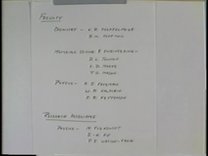
00:09:21 For your information, Robert Dynes will speak first,
00:09:25 then Art Slate, if you wish to mark on yours,
00:09:29 then Don Murphy,
00:09:33 Hal Wang,
00:09:36 Ed Engler,
00:09:39 Thomas Mason,
00:09:41 and we have an addition.
00:09:43 This was put together very fast,
00:09:45 and I had trouble getting a hold of one of the people I wanted to be here tonight,
00:09:49 but it is connected.
00:09:50 And if I got a hold of her, Angela Stacey will speak at the end.
00:09:56 Bob Dynes is a director of the Chemical Physics Research Laboratory
00:10:00 at AT&T Bell Laboratories.
00:10:02 He is a fellow of the American Physical Society
00:10:05 and sits on review committees at Los Alamos National Laboratory,
00:10:09 Argonne National Laboratory,
00:10:11 the Institute for Theoretical Physics,
00:10:13 and several universities.
00:10:16 Bob is a research physicist whose interests are in the area of properties of materials
00:10:21 and low temperatures.
00:10:22 He has worked in the area of superconductivity for 20 years.
00:10:27 Tonight, Bob will speak to us on superconductivity.
00:10:31 What's the fuss all about?
00:10:33 Robert Dynes.
00:10:35 What I hope to do for you this evening is to convey to you
00:10:50 the level of excitement that exists in the physics community
00:10:54 on these high-temperature superconductors.
00:10:58 Why physicists are appearing in centerfolds in Business Week, for example.
00:11:04 Well, it's the best we can do. What the hell?
00:11:09 Why we're not sleeping these nights,
00:11:12 and why people are calling the New York Times
00:11:18 rather than sending their articles to physical review letters.
00:11:24 Actually, what I really hope to do is first get your attention
00:11:28 and then give you a little bit of a tutorial
00:11:31 on what we do know about superconductivity,
00:11:34 as physicists point to superconductivity,
00:11:37 and why these materials are probably different
00:11:41 from what we generally understand with superconductors.
00:11:47 First, I'll try to get your attention by showing you a series of slides.
00:11:53 Is that focused?
00:11:55 Okay. All right.
00:11:59 Until recently, that is, until the last less than a year,
00:12:05 it was generally believed, or it was generally understood,
00:12:09 this empirical relationship that I'm showing you here.
00:12:12 This is a plot of the maximum critical temperature
00:12:16 that had been achieved with superconductors as a function of time,
00:12:20 starting with the year 1911,
00:12:22 when Cameron Leonis first discovered the phenomenon of superconductivity,
00:12:26 up to and including 1973,
00:12:30 the highest TC known to man and woman,
00:12:34 that is, niobium-3-germanium,
00:12:37 which was first discovered at Westinghouse
00:12:40 and then, let me be parochial,
00:12:42 then shortly thereafter at Bell Laboratories.
00:12:49 It's only an empirical relationship,
00:12:51 but every one of us in the business sort of knew this curve
00:12:55 and we were grieving by the observation
00:12:59 that nothing had been discovered since 1973.
00:13:02 And it sort of bothered us,
00:13:05 and some of us actually spent some time
00:13:07 going through theoretical calculations
00:13:09 worrying about maximum TCs,
00:13:11 and I'll get back to that in a few minutes, myself included.
00:13:14 Then Ben Norston Mueller, IBM Zurich,
00:13:20 announced in a European journal
00:13:26 a possible superconductivity close to 30 degrees.
00:13:32 That's shown as this, I think, red or orange dot.
00:13:38 And the first I heard about it,
00:13:40 and the first most of the people in the U.S. heard about this,
00:13:43 was at the MRS meeting in Boston
00:13:47 the first week of December, 1986.
00:13:50 And amazingly enough, it was announced to us
00:13:52 by Kitazawa from the University of Tokyo,
00:13:56 who had earlier seen the work from IBM Zurich.
00:14:01 It's a comment on our times, I'm afraid.
00:14:04 And they had gone back and isolated the particular phase
00:14:08 that Mueller and Ben Norston had first observed
00:14:16 And at that point, all hell broke loose in the U.S.
00:14:20 And within a few weeks, we at AT&T, Bell Laboratories,
00:14:25 and in several other places, I'm glad to understand,
00:14:32 I was supposed to slip on it,
00:14:37 with some reasonably small substitution,
00:14:43 as is shown in the next point up there,
00:14:47 up to close to 40 degrees.
00:14:49 At that point, I was delirious,
00:14:51 because I immediately went and put this on this curve.
00:14:54 We actually used to call this a Matias plot.
00:14:57 And I put this on this Matias plot
00:15:00 and projected that we had reached the year 2025,
00:15:05 as is shown by the arrow down at the bottom.
00:15:10 Well, you know, you can only bask in glory for so long.
00:15:14 And this is the same curve now,
00:15:18 with the announcement from Paul Chu and his collaborators
00:15:22 at the University of Houston and Huntsville.
00:15:29 Only a few weeks later, they announced a superconductor
00:15:33 with a critical temperature above 90 degrees.
00:15:37 And then, in a matter of hours,
00:15:40 after the particular set of ingredients,
00:15:45 not the concentrations, but the set of ingredients were known,
00:15:49 there were several laboratories,
00:15:51 and I couldn't possibly count them,
00:15:53 but there were several laboratories
00:15:55 that had reproduced the results from the University of Houston.
00:15:59 And within days, the particular crystal structure
00:16:05 and the right concentrations in the phase had been isolated.
00:16:09 And it was clearly demonstrated that bulk superconductivity,
00:16:14 that is, the entire phase was going superconducting,
00:16:17 at above 90 degrees, about 93, 94 degrees Kelvin.
00:16:22 We now had a superconductor above liquid nitrogen temperature.
00:16:27 And that, it turns out, is very important for practical reasons.
00:16:33 And that's, I think, probably most simply demonstrated in this next slide,
00:16:39 where I have listed several cryogens, several cryogenic fluids,
00:16:45 and simply the latent heat of those cryogenic fluids.
00:16:49 I don't have dollars associated with that,
00:16:51 but I'll translate that for you if you like.
00:16:54 Until these materials, what we did was cool materials
00:17:00 that we knew were going to be superconductors,
00:17:03 or we wanted to be superconductors.
00:17:05 We cooled them with liquid helium.
00:17:07 Even niobium and 3-germanium,
00:17:09 we weren't crazy enough to cool them with liquid hydrogen.
00:17:12 If you look at that, if you look at those numbers,
00:17:16 you realize that the latent heat of liquid nitrogen
00:17:21 is substantially higher, of order 50 times higher
00:17:29 than that of liquid helium.
00:17:32 Translated in real terms, it means that if you take a 100-watt light bulb
00:17:36 and you put it in liquid nitrogen,
00:17:38 it takes a couple seconds to boil off a cubic centimeter.
00:17:42 It's only something like 20 milliseconds to boil off
00:17:45 a cubic centimeter of liquid helium.
00:17:49 Put another way, in terms of cost,
00:17:51 the cooling power per dollar of liquid nitrogen
00:17:57 compared to liquid helium is about a factor of 1,000.
00:18:01 And so it starts to become very important.
00:18:05 And if you start looking at other cryogens,
00:18:08 I've even been so folly as to use water down at the bottom
00:18:13 as a potential cryogen.
00:18:20 I'm a low-temperature physicist.
00:18:22 I had a dilution refrigerator in my laboratory,
00:18:26 and my technician looked at me about a month ago and said,
00:18:29 what the hell are we going to do with this?
00:18:32 As we start cooling things down to liquid nitrogen,
00:18:34 and start measuring them rather than 5 milliKelvin.
00:18:40 Anyway, I hope what that does is illustrate for you
00:18:43 the very practical reason why physicists
00:18:48 and electrical engineers are getting very excited
00:18:52 about superconductors.
00:18:55 Now hopefully I've gotten your attention.
00:18:58 I'm going to go back and describe for you a little bit
00:19:01 about what superconductivity is
00:19:05 and what we know about traditional superconductors.
00:19:09 For those of you who understand all this, I apologize.
00:19:12 This is going to be pretty dull for the next few minutes.
00:19:14 But let me start at the beginning
00:19:18 and tell you what a lot of you know.
00:19:21 And that is that if you start cooling down a metal
00:19:24 and you look at the resistance of a metal,
00:19:27 depending upon whether you've chosen an alloy to look at
00:19:30 or whether you've chosen an elemental material
00:19:34 like niobium or lead or tin or something,
00:19:38 the temperature dependence of the resistance
00:19:40 will look rather different.
00:19:42 If you choose a very clean, pure material,
00:19:45 you'll get a curve like that bottom curve
00:19:48 where the resistance as you cool down decreases,
00:19:51 goes down rather rapidly,
00:19:53 and then it levels off at the bottom.
00:19:55 If you look very carefully,
00:19:57 you'll see that I drew the asthmatode
00:19:59 going into a finite value at low temperatures.
00:20:02 On the other hand, an alloy,
00:20:04 something that has some disorder and mixtures
00:20:07 and dislocations and defects, etc., etc.,
00:20:09 an alloy will show very little temperature dependence
00:20:13 to the resistance.
00:20:15 And that comes about because the electrons
00:20:18 are scattering off defects and impurities
00:20:21 and interstitials, dislocations, etc.,
00:20:24 in the alloy.
00:20:27 If you look a little more carefully
00:20:30 at what causes electron scattering in a metal,
00:20:34 there are a myriad of scattering mechanisms,
00:20:38 and I've shown you some pretty pictures
00:20:41 of only three of them,
00:20:43 the three dominant scattering mechanisms in metals.
00:20:46 The top one is scattering off the lattice vibrations.
00:20:50 At finite temperatures, of course,
00:20:52 the lattice is vibrating,
00:20:54 the phonons are propagating through the material,
00:20:56 and the electrons in their block states
00:20:58 will scatter off the vibrations
00:21:00 and cause a change in energy and momentum
00:21:03 of the electron,
00:21:05 resulting in losses, in dissipation,
00:21:07 in a change of the energy and momentum of the electron.
00:21:10 That shows up as resistance.
00:21:12 At lower temperatures,
00:21:14 but still a temperature-dependent phenomenon,
00:21:16 electrons can scatter off other electrons.
00:21:19 And as shown in the middle part of this slide,
00:21:24 this is also temperature-dependent
00:21:26 and goes to zero at t equals zero
00:21:29 because of the Pauli exclusion principle.
00:21:32 And it's these top two scattering mechanisms,
00:21:36 which are the dominant scattering mechanisms
00:21:38 responsible for the temperature dependence
00:21:40 that I showed you in the previous slide.
00:21:43 Finally, the world is real,
00:21:45 and we don't make perfect crystals,
00:21:48 and there are interstitials, impurities,
00:21:52 dislocations, etc.,
00:21:54 and electrons scatter off those,
00:21:56 block states scatter off those impurities and dislocations,
00:22:00 and that's a temperature-independent scattering process
00:22:04 and results in a temperature-independent resistance
00:22:08 as the alloy that I showed you in the previous view graph.
00:22:13 The net result of all this dirt,
00:22:15 of all this scattering, is resistance.
00:22:18 That is, if you put a current through a material,
00:22:21 it will measure a voltage.
00:22:24 And that implies then that there's dissipation,
00:22:27 there's power being dissipated in that material,
00:22:29 just as there's power being dissipated
00:22:31 in this obnoxious light that's up here
00:22:35 that's making me about 10 degrees hotter than the rest of you.
00:22:40 Heating and losses, all right?
00:22:44 On the other hand,
00:22:48 Kamerlingh Onnes, in the year 1911,
00:22:52 was looking at these processes,
00:22:54 he was looking at, trying to understand
00:22:57 what was the source of resistance in metals,
00:23:02 and he was looking at single-crystal mercury,
00:23:06 largely because it's easy to grow single-crystals of mercury,
00:23:10 and as he lowered the temperature,
00:23:14 of course, the light allows for the first to liquefy helium,
00:23:18 so he had a head start on the rest of the world in this regard.
00:23:21 As he lowered the temperature,
00:23:23 he discovered to his horror at the time
00:23:26 that the resistance went down many orders of magnitude,
00:23:30 somewhere around 4.2 degrees.
00:23:32 He worried about that,
00:23:33 because that's a liquefaction point of liquid helium.
00:23:36 It was a coincidence at the time,
00:23:37 and like a responsible scientist,
00:23:40 he wrote down there,
00:23:42 this is actually lifted from his paper,
00:23:44 he wrote down there,
00:23:45 10 to the minus 5 ohms, rather than 0 ohms.
00:23:49 He put up with a lot of flack at the time,
00:23:53 because, of course,
00:23:54 everyone knew that electrons were scattering in these materials,
00:23:58 and there was no such thing as a perfect conductor.
00:24:01 Well, it turns out that there is such a thing as a perfect conductor,
00:24:04 it's a superconductor,
00:24:05 and Carolingius was indeed the first person
00:24:08 to demonstrate superconductivity in a material.
00:24:14 Since that time, since the first discovery,
00:24:16 until the microscopic description,
00:24:19 which I'll get to in a minute,
00:24:21 which was in 1956,
00:24:23 there was a lot of experimental work
00:24:27 and a lot of phenomenology associated with superconductivity.
00:24:31 But suffice it to say that what the essence of it is,
00:24:36 is that there is simply no resistance.
00:24:38 The resistance absolutely goes to zero.
00:24:41 There's no dissipation,
00:24:43 and there are no losses.
00:24:45 And a favorite example of physicists,
00:24:48 and in fact one of the ways it was first demonstrated
00:24:51 that there were no losses,
00:24:52 was to take a loop, a wire,
00:24:57 induce a current in that wire
00:25:00 while it was in liquid helium,
00:25:01 while it was superconducting,
00:25:03 and walk away from it,
00:25:04 and come back later and ask
00:25:06 whether that current was still going around in that wire.
00:25:08 And the answer was yes,
00:25:11 as long as you did the experiment properly.
00:25:14 The current was still going around in the wire,
00:25:16 and the current was still the same current
00:25:18 as the one that you induced.
00:25:20 Be it an hour, a day, a week, a month, a year later,
00:25:24 that current was still going around in that loop.
00:25:28 Now that's something that has intrigued physicists
00:25:33 since the discovery of superconductivity,
00:25:37 and is a little counterintuitive,
00:25:41 to say the least.
00:25:42 It also implies one of the first applications
00:25:44 of superconductivity.
00:25:46 If you have that loop,
00:25:47 and you have a circulating current,
00:25:51 then there's a magnetic field
00:25:53 coming out of the board.
00:25:55 It's a right-hand rule.
00:25:56 You have a magnetic field coming out of the screen.
00:25:59 And so you can well imagine
00:26:01 winding a solenoid with a lot of loops,
00:26:05 bringing the wire back on itself,
00:26:08 inducing a current in that solenoid,
00:26:10 and you have a very, very stable
00:26:13 and long-lasting magnetic field.
00:26:15 And that, of course,
00:26:16 is an application of superconductivity,
00:26:19 which has long been used in laboratories,
00:26:24 and in fact, it's finally reaching the,
00:26:28 well, I'm not sure you'd call
00:26:31 anemometromography consumer market,
00:26:33 but nonetheless, it's reaching the outside world,
00:26:37 superconducting magnets.
00:26:40 Persistent currents are things
00:26:42 that have fascinated physicists
00:26:44 for a very long time.
00:26:47 Now, it wasn't until the year 1956
00:26:50 that superconductivity
00:26:52 was really fully described,
00:26:54 and it was a major triumph
00:26:56 of many-body theory,
00:26:58 many-body solid-state physics,
00:27:00 to describe how you can get
00:27:03 this macroscopic phenomenon
00:27:05 from microscopic interactions.
00:27:07 And I'll try to walk this through with you
00:27:10 to try to give you a feeling
00:27:12 for how you can get
00:27:14 microscopic interactions
00:27:16 and translate that
00:27:17 to a macroscopic phenomenon,
00:27:19 that is, a persistent current in a wire
00:27:21 that can be extremely, extremely large.
00:27:24 This was explained to us
00:27:27 by Barty, Cooper, and Schrieffer
00:27:29 in the year 1956,
00:27:31 and it goes something like this.
00:27:33 If you take a lattice,
00:27:35 which I've sort of drawn up there
00:27:38 as point-positive charges
00:27:40 with its background C
00:27:42 of negative electron charge,
00:27:44 and an electron is charging
00:27:46 through that lattice,
00:27:48 as is illustrated by whatever color
00:27:50 that line is going through there.
00:27:52 I can't see up here.
00:27:54 That's why I'm sort of staggering.
00:27:56 This light is completely blinding me.
00:27:59 Why not?
00:28:02 Anyway, as the electron
00:28:04 is propagating through,
00:28:06 what I've tried to depict there
00:28:08 is that the lattice actually
00:28:10 responds a little bit,
00:28:12 and you end up with a strain field
00:28:14 that follows the electron.
00:28:16 So the ions in the lattice
00:28:18 actually relax a little bit
00:28:20 as the electron goes through the solid.
00:28:22 Now, the timescale for that relaxation
00:28:24 is simply 1 over the phonon frequency.
00:28:27 Phonon frequencies are typically
00:28:29 10 to the 12th hertz or so.
00:28:31 So the timescale for this relaxation process
00:28:34 is about 10 to the minus 12 seconds.
00:28:37 Now, a second electron will come along.
00:28:39 I hope this is an overlay here.
00:28:41 Yeah, a second electron will come along,
00:28:43 and the second electron is going
00:28:45 sort of going the other direction.
00:28:47 And it can come by at a time
00:28:49 which is later than that first electron,
00:28:51 as long as it's within
00:28:53 the 10 to the minus 12 seconds.
00:28:55 And it will see the lattice polarization
00:28:58 but it really won't see the first electron
00:29:01 because the first electron
00:29:03 will be long gone.
00:29:05 And I'll get to some numbers
00:29:07 at the bottom of the slide in a minute.
00:29:10 And so the net result
00:29:12 is that that second electron
00:29:14 will see an attractive interaction
00:29:16 to the first electron
00:29:18 via the lattice relaxation
00:29:20 associated with the polarization cloud
00:29:22 that the first electron
00:29:24 generates.
00:29:26 Now, when does that work,
00:29:28 what timescale does that work,
00:29:30 and what length scale does that work at?
00:29:33 Now, if I can see that,
00:29:35 the timescale for this lattice
00:29:37 to relax and then to follow
00:29:39 and then relax back again
00:29:41 is something like about
00:29:43 10 to the minus 12 seconds,
00:29:45 as I suggested earlier.
00:29:47 The range of interaction,
00:29:49 that is, how far these two electrons
00:29:51 can stay in the lattice
00:29:53 and how far these two electrons
00:29:55 can still see each other
00:29:57 via this lattice relaxation
00:29:59 is a long distance.
00:30:01 And that's where we go
00:30:03 from the microscopic
00:30:05 to the macroscopic.
00:30:07 The distance can be as far
00:30:09 as a micron.
00:30:11 And the way that happens
00:30:13 is the first electron
00:30:15 goes zooming through
00:30:17 at its Fermi velocity,
00:30:19 which is about
00:30:21 a micron.
00:30:23 Later, it sees this lattice cloud
00:30:25 and there's a net attraction.
00:30:27 The length scale,
00:30:29 the first electron has gone
00:30:31 of order a micron
00:30:33 by the time the second electron
00:30:35 sees that.
00:30:37 And so it doesn't see
00:30:39 the Coulomb repulsion anymore
00:30:41 because it's well outside
00:30:43 any screening lengths.
00:30:45 So there's a very weak
00:30:47 Coulomb repulsion.
00:30:49 So what happens is
00:30:51 that the electrons on this length scale
00:30:53 are bound together.
00:30:55 And the binding energy
00:30:57 is given by the balance
00:30:59 between this electron
00:31:01 full-on attraction
00:31:03 and the Coulomb repulsion.
00:31:05 The Coulomb repulsion becomes very weak
00:31:07 because of this very long distance
00:31:09 over which they look at each other.
00:31:13 And there's a second issue
00:31:15 which is very important
00:31:17 when we compare these microscopics
00:31:19 to the macroscopics,
00:31:21 and that is that over this length scale
00:31:23 there are something like a million
00:31:25 to ten million other electrons
00:31:27 that are also engaged
00:31:29 in a similar dance.
00:31:31 So over this distance
00:31:33 of typically a micron
00:31:35 or between a thousand electrons
00:31:37 and a micron,
00:31:39 there are something like
00:31:41 a million electrons
00:31:43 that are dancing coherently
00:31:45 almost from a microscopic
00:31:47 individual particle interaction
00:31:49 to a macroscopic interaction
00:31:51 where all ten to the sixth of them
00:31:53 have to know what each other is doing
00:31:55 at some level.
00:31:57 That is, you end up with a coherence length
00:32:01 where the electrons
00:32:03 know what each other is doing,
00:32:05 which is of the order
00:32:07 of a micron or so.
00:32:09 Now, you can think of this thing at the bottom
00:32:11 that I drew, this blue box at the bottom
00:32:13 as a wire,
00:32:15 and this yellow ball
00:32:17 is a coherence length.
00:32:19 And there are about a million electrons
00:32:21 inside there that know what each other is doing,
00:32:23 and if I violate those electrons
00:32:25 by taking an unpaired electron
00:32:27 and putting it in there,
00:32:29 all the rest of them have to respond
00:32:31 to that one electron that I put in.
00:32:33 So you can think of this
00:32:35 as a coherence state
00:32:37 which has to respond
00:32:39 in some collective way
00:32:41 to a perturbation
00:32:43 that I put into the system.
00:32:47 And so
00:32:49 I go then
00:32:51 from something that's microscopic,
00:32:53 from this basic electron lattice
00:32:55 interaction, to something that's
00:32:57 macroscopic, where I think of this
00:32:59 very large, long-range
00:33:01 wave function, which has
00:33:03 an amplitude,
00:33:05 which is the binding energy,
00:33:07 which is how much these energies are bound,
00:33:09 these electrons are bound together,
00:33:11 and a phase.
00:33:13 The phase of this wave function
00:33:15 is basically dictated
00:33:17 by,
00:33:19 if I push on one end
00:33:21 of this phase-coherent region,
00:33:23 the other end knows it.
00:33:25 So if I change
00:33:27 the phase of one end, a current
00:33:29 will flow to try to compensate
00:33:31 for that change of phase.
00:33:33 So I now have a macroscopic
00:33:35 wave function
00:33:37 which describes
00:33:39 the way this system would respond
00:33:41 to any perturbation.
00:33:45 Now,
00:33:49 what determines when this happens?
00:33:51 Again, it was
00:33:53 Barney and Cooper and Schrieffert
00:33:55 which told us when this happens,
00:33:57 and it's related
00:33:59 to the
00:34:01 lattice vibrational frequency,
00:34:03 which is given by this f,
00:34:05 and an exponential which has in it
00:34:07 the basic binding energy
00:34:09 associated with the electrons.
00:34:11 That is the
00:34:13 number of electrons, n of 0, which is the
00:34:15 electronic density of states, and v,
00:34:17 this coupling matrix element
00:34:19 associated with the electron-phonon interaction.
00:34:21 But the important issue
00:34:23 here, and I'll come back to that in a few minutes,
00:34:25 is that the lattice
00:34:27 vibration frequencies
00:34:29 in this mechanism
00:34:31 sets the energy scale
00:34:33 for the superconductivity.
00:34:35 And this is possibly where
00:34:37 things are different in these new oxides.
00:34:39 Some typical numbers,
00:34:41 if you put in typical numbers, the things that we
00:34:43 know and understand and have known and understood
00:34:45 for 20 years,
00:34:47 typical numbers are 10 to the 12 hertz for phonon
00:34:49 frequencies, which is an order
00:34:51 of 100 degrees Kelvin.
00:34:53 Actually, 10 to the 12 hertz is about 40 Kelvin.
00:34:55 The n of 0,
00:34:57 v, the basic binding energies
00:34:59 times the density of states
00:35:01 represents binding energy as a number, which is
00:35:03 between 0.2 and 0.4.
00:35:05 And that results in a critical
00:35:07 temperature somewhere between 1 and 10 Kelvin.
00:35:09 And almost every superconductor we know
00:35:11 and love is somewhere in that range,
00:35:13 with the exception of these extremes.
00:35:19 Now,
00:35:21 superconductivity can be destroyed several ways.
00:35:23 The most obvious way is to raise
00:35:25 the temperature, and
00:35:27 that's shown in the upper left
00:35:29 where I've plotted resistance as a function of temperature.
00:35:31 The resistance is 0, we reach a certain temperature,
00:35:33 the critical temperature, the resistance goes up.
00:35:35 It can also be destroyed
00:35:37 by the impression
00:35:39 of a very high magnetic field.
00:35:41 As we keep cranking up the magnetic field,
00:35:43 we reach a critical field
00:35:45 called HC2, for historical reasons.
00:35:49 And at that point, the resistance
00:35:51 pops normal again.
00:35:53 And finally, if we put too much current
00:35:55 through that superconductor,
00:35:57 we'll end up, at a critical current,
00:35:59 we'll end up with the resistance
00:36:01 going finite again
00:36:03 and dissipation.
00:36:05 Now, all three of those
00:36:07 simple curves
00:36:09 suggest applications,
00:36:11 which I'll get back to at the end of my talk.
00:36:13 The most obvious application
00:36:15 is, of course,
00:36:17 high magnetic fields.
00:36:19 Because
00:36:21 these critical currents,
00:36:23 these HC2s,
00:36:25 or these oxide superconductors
00:36:27 are now getting up towards
00:36:29 a magnet gauss, possibly.
00:36:31 Then, as
00:36:33 people started to mix metals together
00:36:35 forming alloys, they discovered a couple of things.
00:36:37 They discovered, one, that the
00:36:39 critical temperatures went higher
00:36:41 in alloys, and that the critical fields
00:36:43 went higher in alloys.
00:36:45 That's a subtlety associated
00:36:47 with the nature of
00:36:49 magnetic fluxes
00:36:51 in superconductors.
00:36:53 That's a subtlety which I don't want to go into
00:36:55 here, but suffice it
00:36:57 to say that at that point, people started thinking
00:36:59 about high field magnets.
00:37:03 As a function of time,
00:37:05 people then discovered
00:37:07 that intermetallic
00:37:09 compounds showed
00:37:11 even higher critical temperatures
00:37:13 and even higher critical fields,
00:37:15 and that brought in the
00:37:17 era of the A15s, vanadium-3-silicon,
00:37:19 niobium-3-tin,
00:37:21 lithium-3-germanium, etc.
00:37:23 That brought us up to 1973
00:37:25 and the present, the present being
00:37:27 early 1986.
00:37:29 And finally, these oxides,
00:37:31 the critical temperatures
00:37:33 are substantially higher,
00:37:35 and the
00:37:37 critical fields,
00:37:39 it turns out, are substantially
00:37:41 higher.
00:37:47 Of course, history doesn't
00:37:49 really evolve as simply as
00:37:51 people when they're sitting in a
00:37:53 chair after it's happened
00:37:55 and want to make
00:37:57 slides.
00:37:59 I'd like to write it down.
00:38:01 It turns out that
00:38:03 these oxides actually
00:38:05 have been around for
00:38:07 quite some time, and in fact
00:38:09 some of them we've known
00:38:11 have been superconductors for
00:38:13 some time.
00:38:15 The first one, to my knowledge,
00:38:17 was discovered in the
00:38:19 mid-60s, and that was strontium
00:38:21 titanate. It was
00:38:23 a semiconducting
00:38:25 superconductor.
00:38:27 It had a very low carrier density.
00:38:29 When you doped the strontium titanate with
00:38:31 niobium, tantalum, or, God forbid,
00:38:33 even hydrogen, what was discovered
00:38:35 was that it became a superconductor.
00:38:37 Now, its critical temperature didn't get much above
00:38:39 about 0.6 or 0.7
00:38:41 kelvin, so aside
00:38:43 from the intrinsic interest in why the
00:38:45 superconductor, there wasn't
00:38:47 really any practical interest
00:38:49 in it, although I remember the time
00:38:51 I was a student when
00:38:53 strontium titanate was
00:38:55 first discovered,
00:38:57 and people were chewing over why it was
00:38:59 a superconductor.
00:39:01 There really wasn't a satisfactory explanation
00:39:03 for why strontium titanate was a superconductor.
00:39:05 And then in the mid-70s,
00:39:07 and you may hear a little more of it from
00:39:09 parts later, in the mid-70s,
00:39:11 bismuth oxide was
00:39:13 discovered, and
00:39:15 I remember
00:39:17 at that time,
00:39:19 a lot of people, us included,
00:39:21 we were chewing on trying to understand why
00:39:23 that was a superconductor.
00:39:25 It had a critical temperature which was quite
00:39:27 respectable. It was about 11 degrees.
00:39:29 And again,
00:39:31 we really weren't satisfied as to why
00:39:33 as to whether
00:39:35 we understood whether it was a superconductor
00:39:37 or why it was a superconductor.
00:39:39 So there around, what we didn't recognize,
00:39:41 and I have to say,
00:39:43 was that there was a class
00:39:45 of materials there.
00:39:47 You know, you kid yourself, of course.
00:39:53 And so
00:39:55 in fact,
00:39:57 I expect that this is not
00:39:59 a complete list of
00:40:01 superconducting oxides. In fact, I know it's not
00:40:03 a complete list of superconducting oxides.
00:40:05 I'm afraid it's a parochial view.
00:40:07 And this starts
00:40:09 with what I suggested, which was the
00:40:11 early work on strontium titanate.
00:40:13 And then in the mid-70s,
00:40:15 barium lead bismuth oxide
00:40:17 really got people more interested
00:40:19 in these oxides.
00:40:23 Both because
00:40:25 they were higher critical temperatures.
00:40:27 Well, high, geez, it doesn't look high anymore.
00:40:29 13 Kelvin.
00:40:33 But also because they were very
00:40:35 interesting from a physicist's point of view.
00:40:37 The materials were either
00:40:39 superconductors or very close to metal insulator
00:40:41 transitions, and that was
00:40:43 interesting in its own right.
00:40:45 Then, of course, 1986, Ben Orson Mueller
00:40:47 with the lanthanum-barium
00:40:49 copper oxide, and then
00:40:51 I'm parochial on the next one,
00:40:53 the Bell Labs effort in lanthanum strontium
00:40:55 copper oxide, and then
00:40:59 the over-90
00:41:01 Kelvin work
00:41:03 of Chew and his collaborators, and then the rest
00:41:05 of the world following suit one weekend.
00:41:09 It was a hell of a weekend.
00:41:13 And then
00:41:15 I have down there etc.,
00:41:17 which are
00:41:19 all the reports
00:41:21 that have been,
00:41:23 all the press conferences that have
00:41:25 ensued from that time on.
00:41:27 What I have listed here are verified
00:41:29 superconductors.
00:41:31 It's not that I'm pessimistic,
00:41:33 I'm enormously optimistic
00:41:35 that we haven't seen the end of this,
00:41:37 and that's the reason for the etc.
00:41:41 What I have listed here
00:41:43 are superconductors that the community
00:41:45 basically agrees are now all
00:41:47 superconductors.
00:41:49 Most of the other
00:41:51 press conferences
00:41:53 and rumors, etc., that some of you have heard
00:41:55 may be right, they just haven't been
00:41:57 verified in other laboratories yet.
00:41:59 And so I haven't included them
00:42:01 in that view graph.
00:42:03 Now, let's talk about
00:42:05 limits. Where the hell is it going to end?
00:42:07 And I guess
00:42:09 I have to say I don't know
00:42:11 at this point. If I were giving
00:42:13 this talk a year ago, I'd say 30 degrees
00:42:15 is about as high as we're ever going to get.
00:42:17 Now that's honest. I really would have said that a year ago.
00:42:19 I'd say, I just don't see how we're going to get above 30 degrees.
00:42:23 But we're well above that,
00:42:25 and that has to
00:42:27 rattle you at the knees
00:42:29 a little bit and
00:42:31 make you start thinking that
00:42:33 perhaps there are other mechanisms
00:42:35 beside this electron-phonon interaction
00:42:37 that I described for you
00:42:39 several slides ago.
00:42:41 Remember what I told you,
00:42:43 that the critical temperature
00:42:45 scales with the
00:42:47 lattice vibration frequencies,
00:42:49 that's BCS theory, and then some
00:42:51 exponents, which are basically the coupling
00:42:53 constants.
00:42:55 Now, we and other people
00:42:57 went through detailed
00:42:59 numerical studies of the theory
00:43:01 ad nauseum in the 70s, and what
00:43:03 we concluded was that there was no limited
00:43:05 principle using the electron-phonon
00:43:07 interaction, but what happened was that nature couldn't
00:43:09 stand it. As you kept cranking up
00:43:11 the electron-phonon interaction,
00:43:13 finally nature would say, I can't take any more
00:43:15 and there'd be a structural phase transition.
00:43:21 So there really wasn't any
00:43:23 reason for optimism.
00:43:25 It really looked as if
00:43:27 we were almost at the limit.
00:43:29 And then
00:43:31 these oxides came along.
00:43:33 And although they are close to structural
00:43:35 phase transitions, try as I
00:43:37 might, and putting numbers
00:43:39 as well as I understand
00:43:41 electron-phonon interaction,
00:43:43 I don't see how we can get a 100-degree superconductor
00:43:45 out of electron-phonon interaction.
00:43:47 It just doesn't seem reasonable.
00:43:49 So,
00:43:51 at last count, there were
00:43:53 eight mechanisms
00:43:55 that I know of from various theorists
00:43:57 for
00:43:59 these superconductors.
00:44:01 And they range from basically
00:44:03 every interaction that electrons have
00:44:05 in solids. Theorists have
00:44:07 now postulated that this is
00:44:09 responsible for superconductivity.
00:44:11 It's a hell of an exciting time for us
00:44:13 because there's
00:44:15 some really new physics going on here.
00:44:19 I think I'll skip that.
00:44:23 Now,
00:44:25 potential applications.
00:44:27 I think it's important to discuss this a little bit.
00:44:29 And I have two caveats there.
00:44:31 The first is, be careful of
00:44:33 overly-my English is really terrible-be careful
00:44:35 of overly enthusiastic physicists.
00:44:37 On the other hand, I'm an
00:44:39 overly enthusiastic physicist at the moment.
00:44:43 In the
00:44:45 days of the late 60s and early 70s
00:44:47 when people were worried about
00:44:49 applications of superconductivity,
00:44:51 and they went through all the
00:44:53 calculations of power transmission,
00:44:55 microcircuitry,
00:44:57 energy storage
00:44:59 with massive magnetic fields
00:45:01 and coils wrapped around mountains
00:45:03 and things like that where you would store
00:45:05 electric power, the equivalent of pumping
00:45:07 water up into a
00:45:09 lake and then dropping it
00:45:11 during the night time and then letting it run down
00:45:13 through turbines during the day, which is
00:45:15 massive superconducting costs.
00:45:17 People went through all those calculations. They've all been done.
00:45:19 And the
00:45:21 economics basically said, forget it.
00:45:23 Well,
00:45:25 the economics have changed.
00:45:27 And all of these
00:45:29 potential applications have to be looked at again.
00:45:31 High-field magnets are an
00:45:33 obvious application, and
00:45:35 I just don't see how that's not going to happen.
00:45:39 One that's not really talked about very much,
00:45:41 but one which
00:45:43 should be looked at, we are looking at,
00:45:45 are low-level sensors and detectors.
00:45:47 These things are marvelous infrared detectors.
00:45:49 Infrared
00:45:51 detectors working at liquid nitrogen temperature.
00:45:53 Now, if you're particularly perverse, you can think
00:45:55 of reasons why you would like infrared detectors
00:45:57 working at nitrogen temperatures.
00:46:01 High-speed electronics, one of the serious problems
00:46:03 associated with
00:46:05 taking silicon smaller and smaller and
00:46:07 smaller, is that ultimately
00:46:09 you're going to melt
00:46:11 your chips. And the
00:46:13 reason is that the power
00:46:15 dissipation becomes just too high.
00:46:17 You think about
00:46:19 how much current you're driving through the interconnects
00:46:21 between transistors,
00:46:23 and how much power you have
00:46:25 to dissipate every time you take
00:46:27 a MOSFET and you slam it from
00:46:29 high to low,
00:46:31 and you
00:46:33 start going sub-micron, and you realize
00:46:35 how much power is dissipated
00:46:37 in each switch.
00:46:39 You come to the realization that the power dissipation
00:46:41 becomes rather large,
00:46:43 and that's one of the very serious limitations
00:46:45 on
00:46:47 microcircuitry.
00:46:49 Well, people should rethink
00:46:51 that issue, because you can
00:46:53 imagine having interconnects where
00:46:55 power dissipation is the problem.
00:46:57 And finally, one of the most way-out
00:46:59 possibilities are transmission lines, where
00:47:01 you can imagine running one of these lines from
00:47:03 well, let's see, this isn't
00:47:05 the East Coast anymore, so you can imagine
00:47:07 one of these lines from hydroelectric
00:47:09 power plants and go back to Denver? No.
00:47:11 But to the Northeast,
00:47:13 for example.
00:47:15 And I think these things have to be looked at again.
00:47:17 These things are
00:47:19 potentially very serious and could
00:47:21 indeed change
00:47:23 how much we pay for oil.
00:47:27 Finally, where is it going? This is my last slide.
00:47:31 Obviously, there are going
00:47:33 to be some more new materials.
00:47:35 This is clearly not the end of it.
00:47:37 After all, we're just talking
00:47:39 about copper oxide, but I hope I've
00:47:41 convinced you already that
00:47:43 there were some early
00:47:45 titanates and some
00:47:47 bismuth oxides.
00:47:49 There
00:47:51 are undoubtedly
00:47:53 more.
00:47:55 And
00:47:57 I'm just hopeful
00:47:59 that we'll
00:48:01 be on top of them when they appear.
00:48:03 Higher critical temperatures, I think,
00:48:05 will happen. I don't believe
00:48:07 we've seen the end of that, either.
00:48:09 There's clearly some new physics. I hope
00:48:11 I've conveyed that to you, that the mechanisms
00:48:13 responsible for this phenomenon
00:48:15 are just not understood.
00:48:17 And applications, as we
00:48:19 learn how to make wires, tapes,
00:48:21 thin films, etc., etc., the applications
00:48:23 will follow from that.
00:48:25 These are very exciting times.
00:48:27 I believe we're seeing history
00:48:29 at this point.
00:48:31 How much it's going to change our lives, I don't think
00:48:33 any of us know yet.
00:48:35 It's one of those times
00:48:37 where if you're not in the business, you probably wish
00:48:39 you were, and if you are in the business,
00:48:41 you wish you'd get a good night's sleep.
00:48:43 Thank you very much.
00:48:45 applause
00:48:47 applause
| Property | Value |
|---|---|
| Creator of work | |
| Format | |
| Genre | |
| Medium | |
| Extent |
|
| Language | |
| Subject | |
| Rights | In Copyright |
| Rights holder |
|
| Credit line |
|
Institutional location
| Department | |
|---|---|
| Collection |
Related Items
Cite as
American Chemical Society. “High Temperature Superconductivity Part 1 (ACS Video Course).” U-matic (tm), May 28, 1987. American Chemical Society Audiovisual Collection. Science History Institute. Philadelphia. https://digital.sciencehistory.org/works/f0opvuk.
This citation is automatically generated and may contain errors.