
The Chemical World and Man: The Chemistry of Life
- 1960s

These captions and transcript were generated by a computer and may contain errors. If there are significant errors that should be corrected, please let us know by emailing digital@sciencehistory.org.
Transcript
00:00:00 The following program is produced by KQED and the American Chemical Society.
00:00:10 Man probes the stars, reaches for the moon, peers at creatures that no one can say are alive.
00:00:18 It is a search for meaning.
00:00:20 The search has led him to explore his own body, to know the twists and shapes of molecules
00:00:25 that let him breathe, work, play, eat food, think, learn, and even dream.
00:00:33 This chemistry of life is opening up the past and future.
00:00:37 The past by unraveling our origins, how life was created.
00:00:41 The future by bringing the synthesis of life a bit closer to reality.
00:00:46 The chemistry of life is changing medicine.
00:00:50 Diseases are being looked at as molecular errors to be repaired with molecules,
00:00:55 or as an imbalance of molecules to be leveled by adding the right ingredient.
00:01:00 The chemistry of life, or biochemistry, has made the search for new drugs and exact science.
00:01:07 It has brought us closer to understanding the riddle of cancer.
00:01:11 It is helping in the battle against killer viruses.
00:01:14 Above all, it has helped us to understand ourselves, how an egg smaller than a pin dot becomes a man.
00:01:21 Why children look like their parents.
00:01:24 The strength of a muscle, the quickness of a nerve cell.
00:01:28 It has spawned molecular biology, chemical genetics, biophysics, chemotherapy,
00:01:34 a host of other exotic titles.
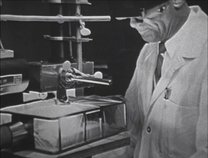
00:01:37 Biochemistry is a baffling world, full of flashing tubes, spinning machines,
00:01:43 complex and colorful molecules of gigantic models built by computers.
00:01:49 And all of it part of a single goal, to understand how it is we are alive.
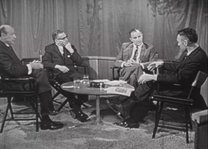
00:01:55 Here is the moderator, David Perlin, science editor of the San Francisco Chronicle.
00:02:12 Good evening.
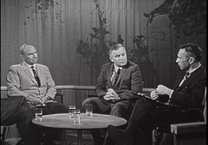
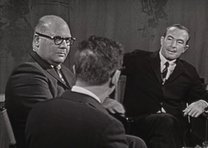
00:02:13 Our guests this evening are Dr. Cyril Ponamparuma,
00:02:17 who is chief of the chemical evolution branch at the Space Agency's Ames Research Center at Moffett Field, California,
00:02:23 and Dr. Paul Saltman, professor of biology and provost of Revell College at the University of California at San Diego.
00:02:32 Both of these men have been engaged in research at cellular levels and molecular levels.
00:02:39 Dr. Ponamparuma, for example, for a long time has been working to build up more and more complex molecules,
00:02:46 the kind of pre-biological molecules that might have begun our own evolution billions of years ago.
00:02:53 And I'd like to ask you first, Dr. Ponamparuma, where do you stand in this research,
00:02:57 and is this kind of pre-biological evolution which you're engaged in examining
00:03:04 really pre-biological in the sense that you think it does actually lead to life?
00:03:11 To answer the first part of your question, where we stand in this regard,
00:03:16 we've perhaps come a long way from the time that Stanley Miller did his first experiment in 53
00:03:22 and synthesized a few amino acids.
00:03:25 We've made amino acids now, we've made some of the purines and pyrimidines,
00:03:29 we've made the sugars necessary for nucleic acids,
00:03:33 and in some cases we've been even able to put these together.
00:03:37 So chemically speaking, we have perhaps the beginning of the pathway leading to nucleic acids on the one hand
00:03:45 and proteins on the other.
00:03:47 Now this is a far cry from anything living.
00:03:51 Though if one examines the whole continuity of evolution from the beginning of the origin of the elements
00:03:59 up to the time you get to man, it's very hard to say where one thing stops and the other thing begins.
00:04:06 However, compared to a cell, we are very far from that.
00:04:10 We've just stopped the beginnings of the chemistry.
00:04:13 How do you suppose that a cell ever gets formed with a bundle of chemicals
00:04:18 such as the complex ones that you've already synthesized?
00:04:21 Well, there are many possible ways by which this could happen.
00:04:25 You see, as a matter of fact, the kind of work perhaps Paul has been doing,
00:04:29 some other biologists have been engaged in,
00:04:32 have shown us that one can understand the structure of these small units
00:04:40 and reconstruct these things.
00:04:42 But if one translates from their transposes to pre-biological times,
00:04:47 one could think of, say, what might have happened in a primitive ocean.
00:04:51 You have an ocean with organic matter dissolved in it.
00:04:55 You'll have a layer of hydrocarbons on the top of this.
00:04:59 And maybe a film could form around some of those early large molecules
00:05:04 we've synthesized in the laboratory in our experiments.
00:05:08 This kind of thing could happen.
00:05:10 We have the possibility of coacervation.
00:05:12 This is an idea put forward by Bungenberg de Jong, the Dutchman in the early 30s.
00:05:18 Hoparing suggested this as the first model of a cell.
00:05:23 We can look at some of the things that Sidney Fox has suggested of microspheres.
00:05:28 So there are various ways by which this could have happened.
00:05:32 Now, let it be understood that the work you're doing and your colleagues
00:05:37 consists of, in a sense, duplicating the conditions that exist on a primitive,
00:05:43 that might have existed on a primitive Earth three, four and a half billion years ago.
00:05:48 And after duplicating an atmosphere of methane and ammonium and stuff like that,
00:05:53 or a primitive soup of some sort, successively building up more complicated molecules.
00:05:58 And now you suggest that other researchers have developed theories
00:06:01 which might indicate how a membrane could be formed around some of these chemical constituents.
00:06:08 Would that be a cell, Dr. Saltzman?
00:06:11 I think you have to, Dave, take a position with respect to what is alive and what is not alive.
00:06:17 And once you've taken a position, then you can work to understand
00:06:22 whether or not you have achieved a living system.
00:06:26 And I think that as I look at living systems, all living systems,
00:06:31 be they bacterial or plant or animal, I see three processes which take place,
00:06:37 which are extremely important and essentially prevail in all living systems that we know of.
00:06:42 One is reproduction.
00:06:45 The other is mutation.
00:06:48 And the third is an active metabolic process,
00:06:51 that is the getting and using of energy and the synthesis and development of molecules
00:06:56 and breaking them down, et cetera.
00:06:58 So what you're really asking Cyril to do for you,
00:07:02 besides having some creature crawl out of his crazy machine that sits over there at Ames,
00:07:07 is to have a system, and I'm not going to call it a creature,
00:07:11 but a system that will do these three processes.
00:07:15 Now, as Cyril is approaching the game, he's coming from the nonliving toward the living end.
00:07:22 The kind of work that I do and many of my colleagues do is to take a living system
00:07:28 and break it down into its components and try to see how these function
00:07:32 in the processes of reproduction, mutation, and metabolism.
00:07:37 And we're very much, I think, molecular biologists today are very much like five-year-old kids
00:07:42 trying to understand how a watch works.
00:07:44 You know, you take a watch and you grab a hammer and you smash the watch
00:07:48 and all of a sudden these pieces come apart,
00:07:50 and now you start taking these pieces and you start fitting them together.
00:07:54 Now, that's all, you know, if you get four pieces that fit together,
00:07:57 that doesn't mean you're keeping time.
00:08:00 And I think that the excitement to me of the work that's going on right now, Dave,
00:08:05 is that we are living in a period of time in which two very powerful philosophies, if you will,
00:08:11 are kind of in conflict with one another.
00:08:14 There's the spirit of vitalism that Polanyi, Michael Polanyi,
00:08:19 and many of his colleagues expressed.
00:08:21 That is that the whole of the cell is greater than the sum of its physical chemical parts.
00:08:27 And then there is the position, I think, that Francis Crick has stated so eloquently
00:08:33 in his book Molecules and Men, in which he said,
00:08:36 we have to look at life as a physical chemical process and understand it as such.
00:08:42 And I think this is the excitement that's taking place in biology today,
00:08:46 to study, to understand a living cell, a living system as a physical chemical entity
00:08:53 and try to understand, is there something outside the organization?
00:08:57 Because that example I gave you of a watch, you see,
00:09:00 Polanyi would say there's something more to a watch than the physics and the chemistry of the watch.
00:09:07 And he's right. It's the organization.
00:09:09 How do the pieces fit together and make this watch?
00:09:13 I think in a sense that as a biochemist, I feel it's the integrity,
00:09:17 the organization of the living cell, which gives it the uniqueness that is involved.
00:09:24 And the question is, where does this organization arise?
00:09:27 Paul, you touched upon a very important point here, this idea of the continuity, you know,
00:09:33 and the organization as being the kind of thing we recognize.
00:09:37 But the biochemist might interject that we do not know what the smallest organism is.
00:09:45 We may not know it when we've done an experiment in the laboratory.
00:09:49 As a matter of fact, the first polymer that begins to replicate may be so small
00:09:56 that we may not be able to recognize the fact,
00:10:00 so that we first see the evidence for life only after it has reached long enough,
00:10:06 you know, gone through several stages of replication.
00:10:10 Now, Arthur Kornberg has synthesized a molecule which does replicate
00:10:20 in the sense that the viral nucleic acid core replicates.
00:10:25 And this is a relatively small piece of genetic material, as I understand genetic material, isn't it?
00:10:32 Can it get much smaller than that and still be capable of replicating?
00:10:35 Dave, I mean, the kind of experimental work we are doing, we are looking at single nucleotides.
00:10:41 We can synthesize a dinucleotide and a tetranucleotide.
00:10:45 This is still a very small entity, you see.
00:10:49 So the growth of a tetranucleotide may not be easily observable in the way, say, for example,
00:10:56 the kind of replication of the viral nucleic acid which Kornberg has worked with.
00:11:03 This is where the whole question of defining where life begins becomes very, very difficult.
00:11:12 There was a mathematician from New Zealand who suggested that the electrons and protons were living
00:11:21 because you could go all the way back.
00:11:24 Well, I guess they do mutate if you think of resonances.
00:11:30 Just for the sake of argument, accept the three criteria that I put forth.
00:11:35 Then you see the virus itself is not a living system because the virus has no active metabolism of its own.
00:11:43 It cannot get and use energy of itself.
00:11:48 Arthur Kornberg is essentially a surrogate cell for the DNA molecule.
00:11:56 He's playing daddy and host to that DNA molecule, which normally goes into an Escherichia coli,
00:12:02 which is a bacterium that lives in our intestine.
00:12:06 And what Arthur does, he feeds his string of DNA, his biochemical information,
00:12:12 he feeds it an enzyme which can do the copying process.
00:12:17 He feeds it the trinucleotides, which are in essence the energy sources that it needs,
00:12:23 and he buys those from a vendor or has them made himself or gets them himself.
00:12:29 So he's doing all of these things and out of this test tube situation, so then the DNA replicates.
00:12:36 And this is a very exciting phenomenon because what he is saying is,
00:12:40 I can tell you how viral DNA information can be replicated and replicated faithfully
00:12:49 so that now when I take the DNA that has been made in my test tube
00:12:53 and put it back into an Escherichia coli cell,
00:12:56 out of it will come the complete virus protein coats.
00:12:59 And it will be accurately...
00:13:01 And it's accurately and faithfully transcribed.
00:13:04 And this is an exciting kind of an experiment,
00:13:07 but it doesn't answer the total question that Cyril has to deal with,
00:13:11 and that is at what moment in time and at what level of complexity
00:13:16 is the system which can now replicate that information and use it?
00:13:23 Well, since the organisms exist, they must have come to exist.
00:13:28 This is a fairly simple question.
00:13:30 Yeah, that's right.
00:13:32 And since some of the most primitive organisms in fossil forms, you tell me,
00:13:38 have been found, what, 3 billion plus...
00:13:41 3.1 was the date that was given to us about a year ago,
00:13:44 but during the last few weeks,
00:13:46 Professor Engel of the University of California, San Diego,
00:13:50 has found microorganisms in a rock 3.4 billion years old.
00:13:55 See, and the Earth is only 4.5 billion...
00:13:57 So that gives you a billion years for the whole process of chemical evolution
00:14:01 to produce something alive.
00:14:02 Yeah, but at the same time, one must remember that these organisms
00:14:05 is found in the underwalked shale are fairly complicated things.
00:14:11 You can see structure in the fossil.
00:14:14 So during that first billion years,
00:14:17 already evolution had brought them to that stage.
00:14:21 So presumably the chemical evolution we are talking of
00:14:24 took place at the very early period,
00:14:27 maybe the first 100 million years.
00:14:30 You're going to start out with a big bang theory for life.
00:14:33 It seems to be working out that way,
00:14:36 Well, the whole question of the synthesis of proteins,
00:14:41 some of the experiments that have been done in our laboratory
00:14:44 have shown that one doesn't need a long period of time
00:14:48 for the accumulation of these amino acids.
00:14:51 As a matter of fact, in an experiment we've done,
00:14:53 within 24 hours, some polymerization of amino acids has already taken place.
00:14:59 So that starting with the amino acids, you created proteins
00:15:03 by adding energy and in a very short time.
00:15:06 I wouldn't use the word protein here.
00:15:08 We are still in a very, very preliminary stages of the game.
00:15:12 Proto-protein?
00:15:13 Maybe small polypeptides, small peptides.
00:15:17 We couldn't find any amino acids in the experiment.
00:15:20 In any way, in any event though,
00:15:22 you were producing larger molecules than amino acids.
00:15:26 That's right.
00:15:27 Molecules on the way to proteins.
00:15:29 We found the amino acids were already hooked up.
00:15:32 In other words, this of course argues another advantage.
00:15:36 It argues that chemical evolution becomes much more feasible
00:15:40 because the chemicals necessary won't get destroyed.
00:15:44 You see, they'll get organized before they get destroyed
00:15:47 by ultraviolet light and other forces which may have existed.
00:15:53 I think this is true also at other levels of complexity, Dave,
00:15:57 and it's worth considering.
00:15:59 We always like to think of life as sort of like a series of small bricks
00:16:04 that we wheel up to a plot of ground,
00:16:07 and then it gets terribly, terribly complicated
00:16:09 to put the bricks up in the form of a cathedral.
00:16:13 The exciting thing that is developing out of many areas of biochemistry now
00:16:17 is the notion that the bricks aren't just simple all-the-same bricks,
00:16:23 that there are certain kinds of forces at work
00:16:27 pulling bricks together in a very organized way.
00:16:30 As Cyril points out, it's actually thermodynamically more stable,
00:16:34 that is energetically more stable,
00:16:36 to make a polypeptide than it is to make a bunch of simple amino acids.
00:16:41 The same is true, for example, as many...
00:16:44 For example, let me just be egomaniacal and tell you about our work.
00:16:47 We worry about a complicated protein molecule
00:16:50 which we use to store iron in our liver.
00:16:52 It consists of an iron ball in the center.
00:16:55 It's called ferritin.
00:16:56 And around this great big iron ball are 20 little protein balls
00:17:01 which protect the iron and allow it to be used when your blood gets tired.
00:17:06 Now, it looks like a very complicated molecule,
00:17:09 and you say, gee, how could you fit 20 balls
00:17:11 around the surface of that very complicated big iron ball?
00:17:15 And the answer is, that's the most stable configuration.
00:17:18 If you take the proteins off the iron ball and separate them out,
00:17:22 now you put them back together,
00:17:24 just the natural stability of this goes blink, blink, blink, blink, blink, blink, blink,
00:17:27 and out of it comes this beautiful crystalline molecule of ferritin.
00:17:31 Well, even though that's not a living molecule,
00:17:33 in a sense it has an adaptive...
00:17:36 It's undergoing an adaptation.
00:17:38 It has an adaptational advantage, let's say.
00:17:40 Absolutely.
00:17:41 An evolutionary advantage.
00:17:42 Absolutely.
00:17:43 And this is true, for example, of the way that Bob Wood
00:17:46 and Bill Edgar at Caltech have been studying
00:17:51 how do you put together something far more complicated?
00:17:54 How do you put together a whole virus molecule?
00:17:57 Or, that's not a molecule, but a whole virus system?
00:18:01 Because a virus is very complicated.
00:18:03 It has a DNA in the center, and it's got protein along the outside,
00:18:07 and it's got a little tailpiece that bolts onto that,
00:18:09 and it's got a tail that sits down,
00:18:11 and it's sort of like a needle to inject the DNA,
00:18:13 and it's got spider-like legs that hang off the bottom
00:18:16 and clutch the molecule or the surface of the host to inject.
00:18:21 It must have, what, Cyril, about 20 different bits and pieces
00:18:24 of different kinds of complicated molecules.
00:18:28 And what they have been showing is that many of these units
00:18:31 assemble by themselves because of the physical chemical forces
00:18:36 of these large molecules of which they're built.
00:18:40 And then you only have to have small chemical reactions
00:18:42 to kind of bolt the whole thing together and make a virus out of it.
00:18:46 Now, this to me is a great step forward
00:18:49 because we have always been super awed in the past
00:18:52 by the complexity of the architecture of these systems
00:18:56 with which we are dealing.
00:18:58 And now we see that the architecture
00:19:00 is the consequence of physical and chemical forces.
00:19:02 And what Paul has said about the organization on that level
00:19:06 goes also at the molecular level,
00:19:08 on the synthesis of adenine, for example.
00:19:10 When adenine was first synthesized from methane, ammonia, and water,
00:19:13 we were very surprised by it.
00:19:15 But today we know that the intermediate is hydrogen cyanide
00:19:18 and five molecules of hydrogen cyanide give you adenine.
00:19:22 To the biochemist, adenine is perhaps the single most important biochemical
00:19:26 found in RNA, DNA, in the coenzymes, in ATP.
00:19:30 And the fact that this comes out, almost pops out of something like this,
00:19:35 suggests, I hate to use the word, you know, an inherent tendency,
00:19:40 but it's the way the molecules get together.
00:19:44 They behave that way.
00:19:46 Presumably the most efficient way for them to exist in an environment
00:19:49 such as exists at the moment in your laboratory
00:19:52 with the given amount of gravity and the given amount of everything else.
00:19:55 Right, right.
00:19:56 And if we are then simulating the conditions on a planet
00:19:59 four and a half billion years ago,
00:20:01 the same kind of thing would have happened.
00:20:03 Well, I would take it then that both of you people,
00:20:05 you from the cell down call and you from the primordial soup up,
00:20:11 Cyril, would agree that you can or would hope to eventually
00:20:17 be able to understand really the architecture and the organization
00:20:21 and the information capacity of the living system
00:20:24 by understanding you taking it apart and you putting it together,
00:20:28 understanding the physical and chemical forces
00:20:30 that go into these living systems.
00:20:32 I think this is a very excellent statement of the nature of one area
00:20:37 of modern biology today,
00:20:39 and that is the understanding of the living cell
00:20:42 at a physical and chemical level
00:20:44 and trying to understand how that all of these fantastic reactions
00:20:49 do take place and take place in such a beautifully,
00:20:52 well-balanced, stabilized fashion.
00:20:54 That's not to say it's the only area of biology today.
00:20:57 It seems to me that out of these kinds of understandings
00:21:02 come questions about things as exotic as memory,
00:21:08 as the thought process,
00:21:10 as can you sit there and say,
00:21:12 Saltman, do you really believe that between your ears
00:21:16 is going on nothing but physical chemistry, you know,
00:21:19 and that that is consciousness and that that is self
00:21:22 and that that is behavior?
00:21:24 And the answer is, well, that's just one more order of complexity
00:21:28 higher than I've been talking about now.
00:21:31 We don't know the answers to that,
00:21:33 but at least we have a, if you will, it is a faith
00:21:37 which says that by exploring living systems
00:21:42 at all these different levels that we're talking about,
00:21:45 ultimately we will have better understanding of their nature.
00:21:50 Do you not think you are likely to run into intractable problems,
00:21:55 problems that just are not going to be solvable?
00:21:59 At this stage, I think that we've progressed so well so far,
00:22:04 you know, from one problem to another,
00:22:07 I think it is, it's probably, we're probably optimistic
00:22:12 and say that we might solve them as we go along.
00:22:16 You know, the problems that appear too great for us now
00:22:19 may not be that great 50 years from now.
00:22:23 What sorts of experimental work do you see ahead of you now, for example?
00:22:32 Well, first of all, I don't want to give you the impression
00:22:37 that we've solved the entire problem of prebiological chemistry.
00:22:41 We've made a few molecules.
00:22:43 Nor do I understand that you have yet to make a plant
00:22:45 with photosynthesizers in a test tube.
00:22:48 So one of the big questions before us is to understand
00:22:51 the mechanism involved in, say, the synthesis of nucleotides,
00:22:56 the condensation reactions that go on in a primordial ocean
00:23:01 or may have gone on.
00:23:03 So this is one area in which a great deal of work has to be done.
00:23:07 The other one is to see the interaction between nucleic acids and proteins.
00:23:12 Can we make larger polynucleotides?
00:23:15 Can we make larger polypeptides?
00:23:17 Can we make them interact in vitro in the laboratory
00:23:22 in the way they interact even in the smallest living organism?
00:23:26 So this is the kind of direction in which our research is taking.
00:23:31 And at the same time, you asked me a question earlier
00:23:34 about knowledge of the ancient fossils and so on.
00:23:38 We are going back in time and looking at ancient rocks and sediments.
00:23:42 We are looking at the 3.1 billion-year-old rock in our laboratory,
00:23:46 looking for traces of molecular fossils
00:23:49 to see whether the understanding of the organic chemistry
00:23:52 recorded for us there will give us some idea of what went on.
00:23:58 Can this give you some idea also of—
00:24:01 and I know the answer to this question anyway
00:24:03 because you wouldn't be working in a laboratory financed by the Space Agency.
00:24:06 The question simply is, does this give you some idea
00:24:09 of what might be happening or have happened elsewhere in our universe?
00:24:14 Yes, David, I'm very glad you asked me that question because—
00:24:17 I figure I'd better get it in.
00:24:19 See, one of the prime goals of space biology
00:24:23 is the search for extraterrestrial life.
00:24:25 This is the greatest effort we are making in the space program,
00:24:28 at least where the biological scientists are concerned,
00:24:31 to see whether there's life elsewhere in the universe.
00:24:34 And one of the best ways of finding that out
00:24:36 is to retrace the path by which life appeared on the Earth.
00:24:40 If the same conditions exist elsewhere in the universe,
00:24:43 the same things could have happened.
00:24:46 So even before we get messages from outer space,
00:24:50 we may have the answers in the laboratory.
00:24:53 And since presumably one star in what,
00:24:57 a million, million, million, billion,
00:24:59 or maybe many more than that,
00:25:02 contains planets that are probably of about the size of ours,
00:25:06 why the search for life,
00:25:08 while you may not be able to communicate with it,
00:25:11 your chemistry may tell you that it must or probably or possibly exists.
00:25:16 Exactly.
00:25:17 This is one of the reasons why the space agency
00:25:22 is very interested in work on the origin of life.
00:25:25 I would think so.
00:25:26 Now, this kind of exobiological research
00:25:31 which relates to molecules,
00:25:34 you're a cell man.
00:25:36 I guess.
00:25:37 Be careful.
00:25:39 McCarthy may be alive someplace
00:25:41 and we'll have investigations of various cells at universities.
00:25:45 Well, I'm thinking again,
00:25:47 we were talking earlier of vitalism and reductionism
00:25:50 and we were talking about whether understanding this
00:25:53 leads to an understanding of how systems get organized
00:25:55 and really become alive.
00:25:57 Is the possibility of cellular life as we conceive it to be,
00:26:03 as we know it to be here on Earth,
00:26:05 equally possible elsewhere?
00:26:06 Yes.
00:26:07 And many fine scientists,
00:26:09 like Norman Horowitz from Caltech
00:26:11 and Wolf Vishniak, I guess,
00:26:13 who's where, Buffalo now?
00:26:14 Rochester.
00:26:15 Rochester, right.
00:26:16 They have devised the most fantastic and elaborate devices
00:26:20 to fly to the other planets
00:26:22 and to the surface of the moon and other areas
00:26:25 to be able remotely to detect the presence of life
00:26:30 on those surfaces.
00:26:32 And the whole predication of these experiments
00:26:36 is, I think, this matter of faith
00:26:38 that a living system there
00:26:40 will be similar to a living system here.
00:26:42 And so they're seeking to detect metabolism
00:26:45 in terms of the utilization of various compounds of carbon.
00:26:49 They are seeking to detect whether or not they have proteins.
00:26:53 They are seeking to detect
00:26:54 whether there are self-duplicating systems.
00:26:57 Using all of the physical chemical knowledge
00:26:59 that we have of our life as we know it.
00:27:02 Now, we can be fooled.
00:27:03 The one thing I want to point out about science
00:27:05 is that there have been all kinds of pronunciamentos in science historically
00:27:10 which have been long ago put in garbage cans.
00:27:13 Now, the exciting thing about science
00:27:14 is they put them in garbage cans
00:27:16 and they close the lid and they say,
00:27:17 where do we go from here?
00:27:18 Where's the sweet fruit?
00:27:20 Where's the bread?
00:27:21 And so I think that we should be willing to discard
00:27:24 any preconceived notions that we have,
00:27:26 willing to look for new systems,
00:27:28 and if we should find them,
00:27:29 to then make further studies predicated on this new knowledge.
00:27:33 But for the time being, at least,
00:27:35 you must make the working assumption
00:27:38 that the life that you look for
00:27:40 will be based on carbon
00:27:42 and reproduce with nucleic acids
00:27:45 the way planet's viral cores do.
00:27:49 I think Cyril brings up a very interesting point,
00:27:51 and that is that if you look at
00:27:53 just the physical chemistry of silicon, for example,
00:27:55 then you decide,
00:27:56 well, gee, we can't have silicon life.
00:27:58 It must be carbon.
00:27:59 Well, and with that,
00:28:00 we'll have to close this discussion
00:28:02 of life here on Earth and on other planets.
00:28:05 Thank you, and good evening.
00:28:19 Our guests for this program
00:28:20 are Dr. Paul Saltman,
00:28:21 Provost of Revell College,
00:28:22 University of California,
00:28:24 San Diego campus,
00:28:25 and Dr. Cyril Panamperuma,
00:28:28 Chief of the Chemical Evolution Branch,
00:28:30 Ames Research Center.
00:28:32 Moderator was David Perlman,
00:28:34 Science Editor of the San Francisco Chronicle.
00:28:40 We wish to thank
00:28:41 the American Cancer Society,
00:28:43 Eli Lillian Company,
00:28:44 National Educational Television,
00:28:46 and the National Foundation March of Dimes
00:28:49 for their cooperation
00:28:50 in providing visuals used on this program.
| Property | Value |
|---|---|
| Creator of work | |
| Format | |
| Genre | |
| Medium | |
| Extent |
|
| Language | |
| Subject | |
| Rights | Public Domain Mark 1.0 |
| Credit line |
|
Institutional location
| Department | |
|---|---|
| Collection |
Related Items
Cite as
KQED-TV (Television station : San Francisco, Calif.), and American Chemical Society. “The Chemical World and Man: The Chemistry of Life.” 16mm (photographic film size), 1960–1969. American Chemical Society Audiovisual Collection. Science History Institute. Philadelphia. https://digital.sciencehistory.org/works/h69o2cd.
This citation is automatically generated and may contain errors.