
Biotechnology Industry Organization: Industry Pioneers: Monday Breakfast
- 2004-Jun-07

These captions and transcript were generated by a computer and may contain errors. If there are significant errors that should be corrected, please let us know by emailing digital@sciencehistory.org.
Transcript
00:00:01 ...sciences is deeply rooted inside the story of civilization itself. The opening books of the Bible tell us about Joseph and his coat of many colors, that as the story of mankind progresses, time and again, it's scientific and technological achievements that determine the fate and the future of mankind,
00:00:27 and no story is more compelling, more rewarding, more optimistic than the story of the development of our understanding of the molecular level of life.
00:00:39 It's now 350 years since Robert Hooke opened up to us the microscopic world, through his first use of the microscope. It's now a little over 200 years since Anton Lavoisier developed the order and nomenclature of the chemical sciences and gave a language in which to discuss these things.
00:01:01 It's a little over a century since Pasteur opened further chapters, and of course, early in the 20th century, we began for the first time to get drugs that actually had positive effects upon human health.
00:01:19 But it's the last 50 years that have been truly extraordinary. We're just a little over 50 years since Watson and Crick deciphered the structure of DNA. We're just 25 years since biotechnology itself began to be a recognizable occupation and pursuit.
00:01:39 And in this last quarter century, we've seen the fulfillment of the dream of the alchemists, the ability of mankind to understand sufficiently about the mysteries of life, to develop drugs that would deal with the issues and problems of health that have plagued mankind since time immemorial.
00:02:03 The story of the development of biotechnology is a wonderful latest chapter in this long saga, and the purpose of the Biotechnology Heritage Award, which the Chemical Heritage Foundation set up in 1999 with the Biotechnology Industry Organization,
00:02:23 the purpose of this award is to recognize and salute the extraordinary achievements of the leading figures in our field, and to pause and reflect on the deeper meanings of what we're engaged in, and to draw inspiration and courage for the daily struggle, because it is through daily struggle that the sciences and technologies advance.
00:02:49 Previous winners of the Biotechnology Heritage Award are luminous names like George Rathman, Bill Rutter, Phil Sharpe, Wally Gilbert, Ather Boyer, Bob Swanson, Francis Collins, Craig Venter.
00:03:05 To this luminous roster, today, we're adding the name of Leroy Hood. Leroy's work is central, of course, to the understanding of DNA itself. His central role in the development of the analyzers and sequences that are necessary in this field has been extraordinary.
00:03:30 His vision and his drive are known by everyone. His ability to see the picture in its broadest and deepest dimensions has really been a key, key element in driving forward the progress of technology.
00:03:46 And today, we're honored and delighted to add Leroy Hood's name to this long historical sequence through which mankind is indeed progressing, and to recognize and acknowledge the promise that lies in the future of biotechnology. Thank you.
00:04:06 Ladies and gentlemen, please welcome Dr. Arnold Thackeray and our 2004 Heritage Award winner, Dr. Leroy Hood.
00:04:17 As you all know, the Bay Area is the birthplace of modern biotechnology, just a quarter of a century ago.
00:04:39 And here today, on the opening day of Bio 2004 in San Francisco, almost 20,000 people are gathering, which is itself a remarkable tribute to the progress of biotechnology.
00:04:55 It's also a very special moment because this is the first time that the Biotechnology Heritage Award has been given at a San Francisco meeting of bio.
00:05:08 And it's also a very special time because this year's award winner, Lee Hood, is very much a citizen of the West.
00:05:18 His whole life and career is identified with the West Coast and with California, and so today, we are especially honored and delighted on behalf of the Biotechnology Industry Organization, on behalf of the Chemical Heritage Foundation,
00:05:36 and on behalf of all of you here present today, to make this award to Leroy Hood in recognition of his distinguished career as a biochemist, his entrepreneurial talents in the development of sequences and synthesizers that have transformed genomics, and his powerful vision of a systems approach to biology and medicine.
00:06:01 Lee, congratulations.
00:06:04 Thank you.
00:06:17 Thank you very much.
00:06:18 It's a real honor to receive this award.
00:06:23 We stand today at a wonderful inflection point in biotechnology where we view biology and medicine and where we practice it will heretofore be quite different from the ways we've done it in the past.
00:06:37 In large part, this arises from the consequences of the Human Genome Project, which I think led to two fascinating conclusions.
00:06:49 The first was the articulation and enunciation of the idea that biology is an informational science, and this has deep implications for how we're going to think in a moment about systems biology.
00:07:05 Because the essence of biology as an information science is the realization that living organisms operate by virtue of networks of interactions of proteins, and these networks are the manifest expression of the genomic information encoded by our genes.
00:07:32 The second major conclusion that came from the Human Genome Project was the enormous importance of developing high-throughput technologies to be able to make many different types of measurements.
00:07:46 We're all familiar with the emerging technologies in genomics and proteomics, but what I'd like to stress is I think the future very much is going to be pointed towards microfluidics and nanotechnology.
00:08:01 The Institute for Systems Biology recently has set an alliance up with three scientists, two physicists and a chemist from Caltech, to use the needs of systems biology to drive the development of new nanotechnology tools.
00:08:18 And we envision, over the next five to 10 years, creating a nanolaboratory that will have the ability to interrogate individual cells, both with regard to their behavior, with regard to a precise quantitation of the content of proteins and RNA they have,
00:08:39 and with regard to the interrogation of how protein molecules interact with one another and their cognate DNA binding sites for regulation.
00:08:50 And it is through these measurements from single cells we'll be able to create these networks of life.
00:08:57 And, of course, what this raises is the absolute fascinating possibility that we can begin to distinguish health from disease by virtue of the fact the networks in disease tissues and organisms will be perturbed in fascinating ways.
00:09:17 This leads quite naturally to what I think is going to be a transformation in medicine that will come over the next 10 to 20 years of movement from our current reactive medicine to predictive, preventive, and personalized medicine.
00:09:33 And let me talk about what each of these words means.
00:09:38 We will, in 10 years, have nanotechnical tools that will allow us to sequence single molecules of DNA 4,000 times as fast as we can do today.
00:09:49 And that means the genome sequence of everyone in this room could be done in a fraction of an hour for under $1,000.
00:09:59 And this will be the basis of this predictive medicine, for from these sequences we'll be able to write out for each individual probabilistic health histories based on statistical analysis of gene variants and their likely outcomes.
00:10:18 Now, it's not enough in predictive medicine to be able to look at what the predicted future is.
00:10:24 We have to be able to look at where the present has us, at what the environmental stimuli have done to the unfolding of this genetic program.
00:10:36 So, my prediction is in about 10 years we'll have small handheld devices that will be able to operationally prick your thumb, take a small droplet of blood, make 10,000 measurements, and from those measurements we can make the blood a window into health and disease.
00:10:54 We can identify disease states and stratify them and follow their progression in your reactivity, your reactions to therapy, and the like.
00:11:05 The ability, of course, to predict disease without the ability to cure it and or to prevent it, of course, isn't a real anathema.
00:11:14 And I think over the next 10 to 20 years we will begin applying in very, very powerful ways these systems approaches to understanding these networks of life in normal cells and in their disease counterparts,
00:11:30 and coming to understand how the disease networks are perturbed and what the key nodal points are that might be a focus for therapeutic application.
00:11:42 And in time what one will be able to do with this little handheld device is prick your thumb, take an analysis, send that information via cell phone into a server,
00:11:57 and it'll every six months send you back an email that says you're fine, do it again in six months, or you better see your oncologist.
00:12:06 From the predicted DNA information, we'll be able to say you have a 40% chance of getting cardiovascular disease by the time you're 60 years of age,
00:12:15 but if you take these pills starting when you're 40, you won't have to worry about that.
00:12:20 Finally, of course, we all differ on average from one another by perhaps 6 million nucleotides,
00:12:27 and that means we're each susceptible to differing combinations of diseases and that we will have to be treated in a very individualistic way.
00:12:36 Now my prediction is if this comes true, that over the next 30 years or so we'll see an enormous elongation, perhaps 10 or even 20 years, in the productive lifespan of the average individual.
00:12:54 And, of course, all of this vision raises a whole series of social and ethical questions.
00:12:59 How do we deal with older people that are going to be productive?
00:13:03 How do we deal with a very different kind of medicine, both in terms of educating physicians and educating the public?
00:13:11 And, of course, there are fascinating issues about how will this transform the healthcare industry?
00:13:18 And it will transform every aspect of the healthcare industry.
00:13:23 And, of course, from our point of view, where there is transformation, there are enormous opportunities for reconstituting new approaches to doing things very much better.
00:13:36 The biology I've talked about is going to catalyze enormous convergences with information science, with nanotechnology, with material science.
00:13:48 And, again, at each of these interfaces there will be powerful and unique opportunities.
00:13:55 What I'd like to close by saying is that the dimension of the social and ethical issues that is created by this new vision is one that is replete with opportunity on the one hand and challenge on the other hand.
00:14:14 And I think as I look out at the protesters we see last night and today, we must be forced to recognize how remiss we as scientists have been in taking to the public knowledge of what science is and knowledge of the opportunities as well as the challenges.
00:14:39 And I would argue that scientists today have a very different role than they did perhaps even five or ten years ago where the major vision was we had to educate and we had to acquire knowledge.
00:14:54 I would add to that we must have a major commitment of transferring knowledge to society.
00:15:00 And whether that is in our local communities enabling K-12 science education or whether it is spinning off intellectual property and creating companies, we all have these obligations to transfer knowledge to society for a society that has enabled us to be in this most wonderful of all professions.
00:15:24 And finally, I would say scientists in the past have been enormously deficient in being able to be willing to play leadership roles in the community in helping the community transform itself into the kind of place that we'd like our children and our grandchildren to live in.
00:15:47 So we see before us this wonderful inflection, this world of opportunity, and this world of challenges.
00:15:56 Thank you.
00:15:57 Ladies and gentlemen, please welcome our moderator, award-winning television journalist, Mr. Charlie Rose.
00:16:07 This is an extraordinary time, as I said, to be talking about these subjects.
00:16:11 It comes on a morning that has been an extraordinary news weekend, Normandy, the passing of President Reagan, and here we are at this time not only looking back with the people who were the visionaries, the people who were there at the beginning, but also looking ahead.
00:16:30 Dr. Hood talked about some of that in his remarks in accepting this honor.
00:16:35 We will talk more about it this morning.
00:16:38 I want to begin by introducing to you a rather remarkable panel, people that have shaped this industry in remarkable ways, and I want to get the order here.
00:16:48 I begin with Dr. Lee Hood.
00:16:52 I'm sorry, I don't.
00:16:53 I begin with Dr. Bill Rudder, Ph.D., co-founder of Chiron, and he also was a 2003 Biotech Heritage Award winner.
00:17:01 Also here, Tom Perkins, founding chairman of Genetec, and a senior partner at Kleiner Perkins.
00:17:17 And you previously met your 2004 Heritage recipient, Dr. Lee Hood.
00:17:33 We may have gotten the chairs mixed up.
00:17:43 If so, I'll take the responsibility.
00:17:46 I want to begin because there are many people who look at the founding of Genetec as the beginning of this industry.
00:17:53 It certainly was there when the world began to take note of the possibilities of the science that had already taken place, and people were thinking about where to go from here.
00:18:08 Tom, look back for us at the time that you and your colleagues were putting together this company.
00:18:15 Well, I think I should maybe just touch on what venture capital was like back then.
00:18:28 I think the term venture capital had been around for a long time, maybe from the 1930s, because venture capital was practiced by the Rockefeller family and the Whitney's and a few other prominent East Coast families.
00:18:42 But there was nothing remotely like venture capital as we know it today.
00:18:50 So when Eugene Kleiner and I put together Kleiner Perkins back at the end of 1972, Gene had been involved with Shockley Semiconductors and Fairchild Semiconductors.
00:19:03 I had been involved with lasers and starting the computer operation at Hewlett Packard.
00:19:09 Anyway, we got together and we put together the world's largest venture capital fund.
00:19:16 It was $8 million.
00:19:20 Everybody said, what in the world?
00:19:22 We tried to raise $10 million.
00:19:23 We couldn't get more than $8 million.
00:19:26 It just seemed like an absurd amount of money, far more than we could ever invest.
00:19:33 And in fact, by the end of the first partnership, we didn't invest the $8 million, and we gave four of it back to the partners before we moved on to another partnership.
00:19:46 So all the venture capitalists in America could comfortably sit just here on this stage in those days.
00:19:56 I knew them all.
00:19:58 It was a very informal thing.
00:20:00 Eugene and I had our office in San Francisco.
00:20:03 We had a part-time secretary.
00:20:06 The phone never rang.
00:20:09 Nobody called about anything.
00:20:12 And we sort of sat around and thought, what are we going to do?
00:20:18 So we hired a couple of partners to work with us, a fellow named Jimmy Treibig.
00:20:24 I'm not going to go into that whole story, but Jimmy had the idea to make a fault-tolerant computer.
00:20:30 We founded a company called Tandem Computers, which became very successful.
00:20:35 So we spun that out of our own office.
00:20:39 Then we had another partner, Bob Swanson, who was working with us on things in general.
00:20:47 Bob became personally intrigued.
00:20:51 He'd had a lunch with Professor Glaser at UC.
00:20:56 Glaser had talked about maybe there could be something in recombinant genetic engineering.
00:21:05 That term wasn't used then.
00:21:07 Glaser had mentioned that there was a Professor Boyer and a Professor Cohen
00:21:13 that knew something about restriction enzymes and opening up plasmids and putting them back together.
00:21:19 But, of course, nobody had really done it with any commercial intent or even scientific intent.
00:21:27 So Bob became very intrigued by this and decided to—he had a famous meeting with Professor Boyer, a very busy man.
00:21:37 It was supposed to be five minutes, and it went on for hours.
00:21:42 The following week, Bob brought Professor Boyer into my office to talk about forming genetics.
00:21:52 Well, I knew nothing about biotechnology.
00:21:56 I maybe knew a little bit about computers and physics, but nothing.
00:22:00 I had no idea how to evaluate this.
00:22:05 Everybody said it was going to be very risky.
00:22:08 I could understand that part.
00:22:10 I asked Herb Boyer to just go through what would the experiment be.
00:22:17 What would you do?
00:22:19 What equipment would you need?
00:22:21 What measurements would you make?
00:22:23 How would you know when you'd succeeded?
00:22:26 He had answers for all of that.
00:22:29 He had thought it through in complete detail.
00:22:32 So I became convinced that we could do the experiment.
00:22:37 We could try to open up a plasmid, put something in, close it, have it express.
00:22:43 At least we knew how to do the experiment.
00:22:47 We didn't know if it would work, but we knew how to do it.
00:22:51 Then—shall I keep going?
00:22:53 Yes, please.
00:22:55 Well, then the question was, how do we do it?
00:22:59 Bob thought it would be nice to have about $3 million
00:23:03 and rent a facility, buy the equipment, hire the people, and do the experiment.
00:23:11 Now, as I probably indicated,
00:23:14 it wasn't clear to me that God would let us make a new life form just like that.
00:23:20 I thought the risks were just enormous.
00:23:24 If there's any secret recipe to venture capital, I'll let you in on it right now.
00:23:31 It is to use the initial money to reduce the risk, whatever you think the risk is.
00:23:38 If it's technical, use the initial money to reduce that.
00:23:41 If it's people, if it's marketing, production, get rid of that part of the risk,
00:23:47 and then the rest of it is just developing the company.
00:23:51 So I felt that we shouldn't do it that way
00:23:56 because we might put several million dollars into the company
00:24:00 and discover that, no, God wouldn't let you do that.
00:24:04 It just couldn't be done.
00:24:06 So I persuaded Bob to look around the country
00:24:11 and see if we could find laboratories elsewhere
00:24:14 that we could subcontract parts of this experiment to.
00:24:18 And indeed, between the University of California,
00:24:22 the City of Hope Medical Research Foundation, and Caltech,
00:24:27 we were able to assemble the knowledge we needed.
00:24:31 And we wrote contracts with all those people.
00:24:35 They weren't good enough contracts, and we've been sued perpetually since.
00:24:41 But that's another story.
00:24:48 But anyway, we decided to...
00:24:50 One of these suits came 27 years after the initial, but anyway.
00:24:57 Contingency lawyers.
00:25:02 Anyway, we did subcontract the experiment.
00:25:06 It did work.
00:25:08 The initial investment in Genentech, this is almost embarrassing to admit,
00:25:14 was $100,000 for a third of the company.
00:25:20 However, I spent the next 20 years...
00:25:22 $100,000 for a third of the company?
00:25:24 Yes.
00:25:25 Which is worth today?
00:25:27 I don't know.
00:25:30 $300 billion or something like that.
00:25:35 My job in Genentech was to make sure Genentech didn't run out of money.
00:25:41 And Swanson's job was to assemble the scientists
00:25:46 and do the work with help from Boyer and, of course, the whole staff.
00:25:51 So over the next 20-some years,
00:25:54 I raised about $3.5 billion for Genentech
00:25:59 through every form of financing you can think of.
00:26:03 We invented new forms of financing.
00:26:06 Bill, what lessons are there to be learned
00:26:09 in terms of not only Chiron,
00:26:10 but being out here and watching this industry grow?
00:26:16 20,000 people here today.
00:26:18 I mean, seven years ago,
00:26:20 a much smaller group of people came in to watch and talk about biotech.
00:26:26 What have been the lessons that you think have made it the industry it is today,
00:26:30 both at Chiron and its own survivability,
00:26:33 but also the industry itself?
00:26:36 Well, I think the transition from gee whiz technology,
00:26:42 that is an understanding of sort of dreams that the technology could do things,
00:26:50 and the development over time of the ability to measure
00:26:58 both the power of that kind of technology
00:27:01 and the utility in a knowledge-based framework.
00:27:05 The lessons are certainly that the reality of both discovery and producing products
00:27:13 have become much more complicated than they existed then.
00:27:17 In the early days, it was possible, as a knowledge-based company,
00:27:23 to do a 50-50 deal, as we originally did with many companies,
00:27:29 bringing the knowledge and the technology,
00:27:32 and the other companies brought the resources
00:27:35 and, to some extent, marketing and selling.
00:27:40 This kind of situation allowed the growth of the industry in the research phase.
00:27:46 But today, the issue is much more direct
00:27:51 in the sense that there's a strong coupling
00:27:54 between the ability of new knowledge to create products
00:27:58 and the demands associated with getting those products
00:28:02 through the regulatory requirements and into the market,
00:28:07 which have dominated the business.
00:28:10 Reflect on the biggest challenge you faced
00:28:12 as well as what you think is the biggest obstacle in the future.
00:28:18 Well, I think the obstacles in the future
00:28:20 are partly associated with the industry
00:28:29 and the sales and marketing necessities
00:28:34 that are associated with the dealing of products.
00:28:37 Regulation around the world cost issues,
00:28:43 the reciprocity which exists between countries,
00:28:47 the necessity to produce life-saving and prolonging medicines
00:28:53 for people at large throughout the world,
00:28:56 the discordancy between GDP of various countries,
00:29:01 so the overlying political, social, economic disparities,
00:29:08 as opposed to the common needs of people throughout the world.
00:29:12 That's kind of the major underpinning.
00:29:17 Then, within the context of developing our own businesses,
00:29:22 we have the issues of the rate of development,
00:29:27 the cost of development of products.
00:29:32 These issues are partly dealt with
00:29:35 by increasing sophistication of technologies,
00:29:39 which will, over time, increase the efficiency of the process
00:29:45 and, in a sense, transform products
00:29:49 from being palliative to be more decisively curing.
00:29:54 So the challenges then are to provide better and bigger solutions
00:30:01 to the ailments of mankind
00:30:04 within the context of the cost framework,
00:30:08 which not only we can afford as individuals in the United States,
00:30:13 but other people in the world.
00:30:15 Lee Hood, pick up on that.
00:30:16 What are the challenges you see for the industry going forward?
00:30:21 I think the major challenges for the industry going forward
00:30:27 are, one, to acknowledge that, in general,
00:30:32 big pharma and, even to a certain extent, biotech
00:30:36 is failing in an effective means for discovering drug targets
00:30:42 and being able to carry drugs all the way through
00:30:45 in an efficient way to realization.
00:30:50 I think my own view is the industry, over the next ten years,
00:30:54 is going to be transformed
00:30:56 by some of these ideas I talked about a little earlier,
00:31:00 where we're going to use these systems approaches
00:31:03 to define networks in normal cells and pathologic cells,
00:31:08 and we're going to come to understand the interrelationships
00:31:11 and how those interrelationships have to be manipulated
00:31:14 with drugs to deal with therapy
00:31:17 or, ultimately, more excitingly, to deal with prevention.
00:31:22 And I think, really, the enormous challenge any industry always has
00:31:30 is how to deal with change and how to deal with new opportunities
00:31:33 and how to integrate these opportunities effectively into the industry.
00:31:38 My experience over many years has led me to the conclusion
00:31:42 that almost always, if you have a new idea,
00:31:46 you need a new administrative structure for carrying out the idea
00:31:51 because administrative structures are optimized
00:31:54 to execute the past and possibly the present.
00:31:57 They have a great deal of difficulty with new ways of doing things.
00:32:01 So there are going to be a lot of new ways
00:32:04 of thinking about drugs and drug target discovery,
00:32:08 and I think one of the challenges is how the industry,
00:32:12 both big pharma and biotech,
00:32:14 is going to use these new opportunities.
00:32:18 And perhaps the biggest challenge is the mandate
00:32:22 to be able to integrate enormous amounts
00:32:26 of different types of information,
00:32:28 something biologists have never been very good at.
00:32:31 When you said the failures to follow through, what do you mean?
00:32:38 There are three aspects to discovering a new drug.
00:32:44 One is to identify the key targets.
00:32:47 The second is to identify a drug
00:32:50 that can actually manipulate that target appropriately.
00:32:53 And the third is how to deal with the side effects of drugs
00:32:58 in a rational and effective way and how to realize them
00:33:01 before you get into your third phase of clinical trials,
00:33:04 and you've already spent several hundred million,
00:33:07 if not half a billion dollars.
00:33:09 So I think we don't have very effective ways for dealing with these issues.
00:33:14 And I think as we move into this preventive medicine that I talked about,
00:33:19 this is even going to be more of a challenge.
00:33:22 Talk about the future from where you sit
00:33:25 in terms of not only raising the money but guiding a company.
00:33:32 Well, you've got to be very flexible.
00:33:36 I think that there remain a number of problems out there
00:33:42 that still have to be overcome.
00:33:45 I don't know whether to put the Food and Drug Administration
00:33:51 or bioethicists or investment bankers at the head of the problem list,
00:33:56 but something like that.
00:34:03 I think you just have to be very responsive.
00:34:07 Characteristically, we have built companies around technology
00:34:13 and let the management organization, as Lee said,
00:34:18 adjust to the needs of the technology.
00:34:22 So, for example, we rarely look for a complete management team to back.
00:34:29 We look for the key technical person.
00:34:33 We'll, ourselves, attempt to get the company off the ground.
00:34:37 And once we've gotten rid of that initial startup risk,
00:34:41 then we can hire the best management in the world.
00:34:44 If someone was coming in to see you today with an idea,
00:34:48 what do you want from them?
00:34:50 I mean, you just suggested you're not looking for a management backup,
00:34:53 but you're looking for...
00:34:56 Well, I can't tell you how to write a business plan,
00:35:00 but I can tell you how I read one.
00:35:03 I start at the back, and if the numbers are really big,
00:35:07 I look at the front and see what sort of business it is.
00:35:10 It's very sophisticated.
00:35:13 And if the numbers are just so-so, your interest is so-so.
00:35:17 Our competitors can take care of that.
00:35:21 But you never know where the next great idea is going to come from,
00:35:24 and I can't tell you what it's going to be.
00:35:27 Recently, we've been very successful with a company called Google.
00:35:32 They walked in with a new idea, and we liked it.
00:35:37 But do you depend on your in-house people, or are you going to reach out?
00:35:40 I mean, if it's more not Google in terms of the technology,
00:35:43 but also what you guys know about,
00:35:46 but more in the biotech area, which you also know about,
00:35:49 witnessing the successes you've had.
00:35:52 But in terms of today,
00:35:55 where do you go to get your grounding in the science?
00:36:00 Well, we do have consultants and associations with universities and so forth.
00:36:06 But I think we typically rely on our own judgment, pretty much.
00:36:12 Over the years, we've tended to specialize a little bit in the partnership.
00:36:16 Brooke Byers, for example, worrying more about biotech.
00:36:20 John Doerr, Vinod Khosla,
00:36:22 worrying more about computers and communications and so forth.
00:36:27 A little bit I have to do with it these days is more optics and physics.
00:36:33 So, yeah, we specialize a little bit.
00:36:36 But we've actually made a deal on the first meeting with entrepreneurs.
00:36:45 We have made deals without ever seeing a business plan.
00:36:49 In fact, we'd probably prefer to make a deal without a business plan
00:36:52 because if they've got a business plan, they may take it to a competitor.
00:36:56 It's better to leave them without a business plan.
00:37:00 So, I don't know. It's pretty ad hoc.
00:37:06 Bill, tell me what you think.
00:37:08 Lee talked about prevention in terms of the next 10 years.
00:37:11 What are the discoveries? Where is it going?
00:37:14 Those of us in journalism want to know what's the next big idea?
00:37:18 What are the discoveries that we can look forward to?
00:37:21 Backstage, we talked about what questions is science asking
00:37:25 that there may be a possibility of turning the corner in the near future?
00:37:31 Well, prevention at one level can simply be extended by good metrics.
00:37:41 For example, still in the world, 80% of the population
00:37:46 is subject to contaminated blood.
00:37:50 So, provision of good metrics to 100% of the world population
00:37:57 can dramatically decrease the spread of disease.
00:38:03 That's an easy one.
00:38:05 Vaccinology has in the past been developed more or less on a country-wide basis.
00:38:14 Now, it's available on a worldwide basis using new technologies.
00:38:19 In my view, the industry in general has viewed prevention
00:38:28 as not a major source of value creation
00:38:34 because it's been in the public health arena.
00:38:37 The price of vaccines have normally been low.
00:38:41 On the other hand, the populations are very large.
00:38:44 And because now of great population mixing throughout the world,
00:38:51 contamination of infectious agents is a worldwide problem,
00:38:59 not just a local problem.
00:39:01 So, developing vaccinology in its current dimension
00:39:08 to not just produce antibodies but to produce T-cell,
00:39:12 cell-based immunological responses are a major opportunity.
00:39:19 And I think it's a field which, in fact, has not gotten the attention,
00:39:24 either on the research side or, in fact, on the financial side.
00:39:32 So, DNA-based vaccines, different modes of delivery,
00:39:38 provide a mechanism by which infectious diseases,
00:39:42 which are now recognized to cause many debilitating diseases as well,
00:39:48 that is the role of infectious agents in the causation of both cancer,
00:39:53 cardiovascular disease, a number of other diseases,
00:39:56 is getting stronger all the time.
00:40:00 So, a tremendous opportunity for prevention along those lines.
00:40:09 Yeah, I do agree.
00:40:10 I'd be slightly more explicit.
00:40:13 I think one of the enormous revolutions that's going to come very early
00:40:18 over the next five to seven years is early diagnostics.
00:40:22 And I think this vision of the blood being a window into health and disease
00:40:27 or being able to interrogate on a regular basis your blood
00:40:30 to determine what, in fact, is happening in the organism
00:40:35 is really going to be a key to managing disease.
00:40:38 For example, Andy von Eschenbach,
00:40:41 the head of the National Cancer Institute about 18 months ago,
00:40:44 made this statement which some have ridiculed
00:40:47 about no suffering or death from cancer by 2015.
00:40:51 And I can tell you that there actually is one shot at that,
00:40:55 and it's early diagnostics.
00:40:57 The fact is with cancer, in most cases,
00:41:00 if you can detect it very early and you know where it is,
00:41:03 you can deal with it with classical kinds of methods.
00:41:06 So I think early diagnostics is really going to be transformational.
00:41:10 And, again, I think with the systems approaches that we've talked about here,
00:41:15 we can really revolutionize our knowledge of the immune system, as Bill said.
00:41:20 The really interesting fact is we know more about the cellular
00:41:24 and molecular details of the immune system
00:41:27 than any other system in human organisms,
00:41:31 and yet we're making vaccines the same way we made them 100 years ago.
00:41:36 And the answer is we have to understand
00:41:39 not how the individual bits and pieces do carry out functions
00:41:44 in response to something, but how the whole system works.
00:41:47 So I think these systems approaches to the immune system
00:41:50 are going to give us a means for creating vaccines that have a cellular basis,
00:41:55 which is virtually impossible to do today.
00:41:58 And I think they're going to be a very powerful mode
00:42:01 of dealing with these emergent infectious diseases in the developing countries.
00:42:08 Go ahead, Bill.
00:42:10 And I'm going to come back to that, SARS as well as AIDS.
00:42:13 Okay.
00:42:14 Well, Lee and I certainly agree about the importance of metrics.
00:42:18 Metrics drives not only the science itself,
00:42:21 but the practice of medicine and other practices which are based on science.
00:42:27 And the rapid development of sophistication in metrics
00:42:33 will transform both science, development of drugs,
00:42:38 and the utilization by individuals and, in some senses, determine the markets.
00:42:46 One of the important features of that is the communication of that information
00:42:53 on an agnostic basis, that is, take measurements from any kind of an instrument,
00:42:58 translate those measurements into a form that can be understood by the patients,
00:43:03 by the physician, and to third-party payers.
00:43:06 That kind of dream will facilitate, actually,
00:43:10 the actuality of that kind of information collection
00:43:15 will then facilitate the development of further metrics
00:43:18 and the use of these throughout the development and healthcare industry.
00:43:24 And one of the companies that I'm associated with, iMetricus,
00:43:29 is focused on that very issue,
00:43:32 to be agnostic with respect to the methodology itself or the metric instrument,
00:43:38 to be agnostic with respect to the communication,
00:43:41 whether it's a smartphone or the Internet,
00:43:44 and thus provide information on a non-biased basis
00:43:51 to both individuals, healthcare professionals, and to society at large.
00:43:57 I think that facet of dealing with communication
00:44:02 can have a dramatic impact on the way medicine is practiced,
00:44:06 the way research is done.
00:44:09 I would just break in here and point out that, in my view,
00:44:13 there is a Microsoft 2 that's waiting to happen in healthcare,
00:44:16 because if you think about...
00:44:18 You just got their attention.
00:44:20 If you think about the amount of data...
00:44:23 Look, we'll have 300 million people in the U.S.
00:44:26 We'll have their genome sequences.
00:44:28 We'll have 10,000 measurements from their blood every six months.
00:44:32 How do you deal with this information?
00:44:34 And just as Bill said,
00:44:36 how do you deal with the enormous signal-to-noise problems
00:44:40 and translate that information into something that a physician can actually use
00:44:45 and the patient can use to guide their own health course and so forth?
00:44:50 This is an incredible opportunity waiting to happen.
00:44:54 And what I can guarantee you is Microsoft 2 is not going to come out of Microsoft 1.
00:45:00 Well, I know all of you have heard this, but it is...
00:45:04 Bill Gates said this to me, and he said it to other people,
00:45:07 and I'm told that a lot of other people in technology have said the same thing,
00:45:13 that if they were starting out today, they would not start out in technology.
00:45:16 They would start out in biotech.
00:45:18 Gates has said that.
00:45:19 I mean, he has obviously an interest in it that comes out of his foundation's work,
00:45:23 and that interest has grown.
00:45:25 But when he looks at where it is, I mean, I suspect that he would totally agree with you.
00:45:29 There is the potential for another Microsoft in biotechnology.
00:45:33 Well, I had dinner with Bill about six weeks ago,
00:45:37 and the subject of about a three-and-a-half-hour conversation
00:45:41 was how you can digitize the output of the immune system
00:45:46 to be able to analyze the health course of individuals.
00:45:50 I mean, if you think about it, the immune system reflects our history,
00:45:55 both with regard to general diseases, but certainly infectious diseases.
00:45:59 And Bill was incredibly fascinated with these ideas of how can you digitize
00:46:05 and measure this information and recreate an infectious history past for individuals
00:46:10 and even project into future responses and things like that.
00:46:14 Any conversation about this erases the specter of AIDS.
00:46:18 Bill, you all have thought about this, and you have all looked at the specter.
00:46:24 And when you talk about what is happening in India today
00:46:29 and what has happened in Africa, and you look at China in terms of the populations,
00:46:34 should we be at a better place than we are, and why are we not,
00:46:41 when you just talked about what science has learned about immunization?
00:46:46 Right. I mean, look, there's only one general solution to AIDS, and that's a vaccine.
00:46:54 And at least our attempts to create a vaccine have been pretty dismal.
00:47:01 And I think they underline this idea that we have to learn more about the immune system
00:47:06 and general approaches to being able to manipulate it so that it can, in this case,
00:47:13 use a much more effective cellular kind of response.
00:47:17 But I think the really important point is we're still kind of doing vaccines,
00:47:24 whether it's DNA vaccines or protein vaccines or whole microbe vaccines.
00:47:29 We're still doing them very much the same way we did 100 years ago.
00:47:33 Well, with respect to that, part of the issue is the matter of what you demand for a preventative.
00:47:46 When we developed hepatitis B, the technology for the hepatitis B vaccine,
00:47:51 the first experiments were done in 1981.
00:47:55 The vaccine was approved in 1984 and was broadly used throughout the world
00:48:04 in the next two or three years and has since been used, same vaccine.
00:48:10 In HIV, we started the program to first sequence the virus
00:48:17 and then develop immunological strategies for prevention much along the line of hepatitis B
00:48:25 in the same time frame, 1982, 1983.
00:48:30 Since that time, there have really only been a couple of experiments on the vaccine itself.
00:48:41 Part of that has been due to the fact that many people have worried about the degree of protection
00:48:50 which is required for a vaccine in this way
00:48:54 and the demand that the vaccine be essentially complete in its protective ability
00:49:02 and the degree of sophisticated analysis which would allow you to project such complete protection
00:49:10 has in one sense prevented the use of the further experimentation with versions.
00:49:19 The recent trial by VaxGen used a technology which was discarded by most of the industry 15 years ago.
00:49:32 It's been very difficult to get trials going in human beings with vaccines.
00:49:37 Part of it is the regulatory issues.
00:49:41 That is to say, somebody has to give the bandwidth about which approval could be expected.
00:49:51 The second issue has been a disparity in the view about how these vaccines would be paid for
00:50:03 given the fact that the major population is outside the paying world.
00:50:10 Then businesses may come to the conclusion that this is simply not a business you want to get into
00:50:17 because fundamentally there's no profit there.
00:50:20 That's been partly addressed but hasn't been fully addressed.
00:50:25 The third issue is the countries that are most afflicted are by and large
00:50:31 or have been dependent upon illuminationary activity from our own, that is giveaway programs.
00:50:38 They're not willing to face these issues themselves in order to get trials going, etc.
00:50:46 They expect them to be paid for by other folks and be paid very well for them and so on.
00:50:52 We have a broad conundrum which has inhibited the development of human trials in this area.
00:51:03 In this kind of a program, it's hard to believe that it has taken this long a time
00:51:12 to start programs on prevention based either on voluntary efforts or in fact facilitatory efforts
00:51:22 to get more and more sophisticated attempts into the public.
00:51:34 I'll just piggyback on that a little bit.
00:51:37 At Genentech, AIDS was taken very seriously in the early, mid-80s.
00:51:44 A very significant chunk of Genentech's research was devoted to both vaccine and cure for AIDS.
00:51:55 There were essentially four very significant programs.
00:52:00 Each one of them failed.
00:52:04 The effort in AIDS at Genentech hurt Genentech.
00:52:08 It depleted the pipeline, so to speak, and led to financial problems
00:52:14 which ultimately led to the affiliation with Roche and so forth.
00:52:21 AIDS is a very tough problem.
00:52:24 A lot of good people have tried very hard.
00:52:30 A business question. Do you think that this industry is on the right track
00:52:35 in terms of ethically and efficiently commercializing science?
00:52:43 Yes, but...
00:52:47 I'm more interested in the but.
00:52:52 I think we have proven that the fundraising side can work.
00:52:58 But the amount of money required to bring a new drug to the public is so staggering.
00:53:08 Such a huge portion of that is required by the regulatory process, Food and Drug Administration.
00:53:19 It's very difficult if you're a pharmaceutically-oriented company
00:53:23 to battle the Food and Drug Administration
00:53:25 because you have a pipeline of things which they have to approve.
00:53:29 If you take them on in one thing, they can be very vindictive, believe me.
00:53:36 The FDA is a substance abuser.
00:53:39 They're addicted to placebos.
00:53:46 This makes it very tough.
00:53:48 To take between $500 million and $1 billion to bring a drug to market
00:53:54 is, I think, preposterous.
00:53:58 You both are shaking your heads.
00:54:00 We've got three of the great companies in the industry
00:54:02 in which each of you have had different connections with.
00:54:05 Is he right?
00:54:08 I think he's absolutely right.
00:54:10 It seems to me one of the really explicit challenges
00:54:15 that the pharmaceutical industry faces
00:54:18 is the fact that in the future we will stratify diseases.
00:54:23 That is, we will take prostate cancer and find it's four or five different diseases
00:54:28 and one aspect of cardiovascular may be a number of different diseases.
00:54:33 They will require different diagnostics, different kinds of treatments,
00:54:38 but most important, that'll really reduce the market
00:54:42 that you can sell your new drugs to.
00:54:44 That means you have to figure out a way of bringing drugs to market
00:54:49 for costs that are consistent with much less than this billion-dollar-a-year goal
00:54:56 that many of the pharma industry have now.
00:54:59 There are a lot of really terrific drugs that big pharma has just thrown out
00:55:03 because in their estimation this is only going to bring in half a billion a year
00:55:07 and this isn't going to be enough money to pay for the drug
00:55:10 and all the other drugs that fail.
00:55:13 When they throw it out, what happens to it?
00:55:16 Typically it dies because I think most big pharma is really very unwilling
00:55:22 to release anything that they've done.
00:55:25 So it just gets filed away and that's it.
00:55:28 A good idea that does not have a sufficient amount of return to satisfy big pharma
00:55:34 will die because they're not going to release whatever research they've already done
00:55:38 and yet they're not going to do it because the payoff is not there.
00:55:42 Then how should that be fixed?
00:55:46 You know, I think the way...
00:55:49 It goes into their patent base and that's about all they do with it.
00:55:56 I think it can be fixed in one of two ways.
00:55:59 One, I think there are going to emerge biotech companies
00:56:03 that will be much more effective in this drug discovery process
00:56:06 and be able to make money and produce drugs for 50 or 100 million a year
00:56:12 and hence can take on these stratified drug possibilities.
00:56:17 I've always thought the other really interesting possibility
00:56:20 is could there emerge a company that could go around to these big pharma
00:56:25 and say, look, we'll split this with you.
00:56:28 We can handle this. We can do it.
00:56:30 You've taken it this far. We'll give you your value,
00:56:33 give this to us and let us try and produce a drug for a tenth as much as you can do it.
00:56:38 Why hasn't that happened? That seems like a perfectly logical idea.
00:56:43 You know, I think it's happened in little bits and pieces,
00:56:46 but I've never heard of a company that really tried to put that formally forward,
00:56:51 but it's a great idea.
00:56:52 No, I was just going to make a comment about the general aspect of regulation.
00:57:00 There's kind of a view dominantly held by us, that is us meaning the U.S.,
00:57:08 that we have high standards and therefore the FDA stands for those high standards.
00:57:15 Now, there are other major countries that are trying to get in the pharma game,
00:57:22 China being one of them, India being another,
00:57:25 and one of the major issues facing drug development is the speed with which one gets clinical trials going,
00:57:34 that is trials in human beings, and the patient subset on which those trials can be carried out.
00:57:42 The country that makes it easier in a straightforward way, also in a disciplined way,
00:57:50 to get into people faster, focusing on the patients that need the treatment earlier,
00:57:56 can transform the paradigm.
00:57:59 It's my view that the pharma industry, one way or another,
00:58:04 and our regulatory system has to address the needs of patients.
00:58:09 I'll give you one example.
00:58:11 In the United States, if you're doing trials in cancer,
00:58:16 typically you deal with failure patients, that is say patients that have failed other treatments,
00:58:24 and you get a crack at then treating those patients.
00:58:30 In India, it's possible to do trials on patients that have received no other treatment,
00:58:37 and earlier stage cancer instead of terminal cancer.
00:58:41 In that context, the chance of showing the activity of your drug in that environment is both better
00:58:51 and in a sense maybe more realistic in establishing first-line therapy.
00:58:58 That kind of approach can in fact facilitate development, decrease the cost,
00:59:03 and essentially open up some interesting new avenues for development.
00:59:09 Just to follow on with that, it's quite clear that we can use these DNA diagnostics techniques
00:59:16 to stratify the patients of a particular type, so we can say it's this 20% subset
00:59:23 is very likely to respond to the drug, and you can do your clinical trials on those stratified subsets.
00:59:29 That's one way you can really change the cost of clinical trials.
00:59:33 I think that's one of the unusual and maybe unexpected things that came from understanding the human genome.
00:59:41 The variances, the SNP variances, the small molecular weight changes that occur in each of us,
00:59:50 in each one of our proteins, which in a sense modulate the response toward drugs.
00:59:56 The degree to which that affects population and the responses is, in my way and the way I think of it,
01:00:04 one of the big surprises which resulted from a genomic study.
01:00:09 Has since that day that Celera and other people from the NIH stood there with the president
01:00:21 and they announced the sequencing of the human genome, and we all understood that with that,
01:00:27 there was much more to be understood even about the sequencing, but there was in front of us then
01:00:34 this huge future that we all talked about, that the road was just beginning.
01:00:40 My question is, have we progressed on that road with the speed that you and you and you expected?
01:00:49 Where are we in terms of taking advantage of using what we have learned from sequencing the genome
01:00:58 and in terms of its promise?
01:01:04 Nothing moves as fast as one would hope, and I've always underestimated how long it takes.
01:01:09 You've always underestimated how long it takes.
01:01:11 Always underestimated. It's one of my failings.
01:01:14 But I'd say where you begin to see glimmer is in the area of metrics that Lee has been talking about.
01:01:22 The utilization of that information from the standpoint of developing therapeutics has, I'd say, not come into full sway.
01:01:32 We suffer from a surfeit of information and an under amount of understanding about using that information.
01:01:42 We're still in the gathering stage.
01:01:48 Let me come back to you.
01:01:50 I don't think I have anything to add to that.
01:01:55 Well, I would say a couple of things.
01:01:58 I mean, it is a beginning, and I think the beginning that it provided was this genetics parts list
01:02:06 that enabled us to think for the first time about these systems kinds of approaches.
01:02:12 Where I think there is enormous challenge is in government funding for this kind of research.
01:02:19 There is at the National Institutes of Health and NIH a sense of that the individual initiated investigator grants are sacred,
01:02:32 and that a large bulk of the funding should go to those.
01:02:36 And my argument to Andy von Eschenbach, if he really wants to meet his 2015 goal for cancer,
01:02:44 is you really have to go in and reconsider your portfolios and balance them out,
01:02:52 because integrated kind of systems biology with all of the technologies and cross-disciplinary needs you have
01:03:00 is not the same as R01 science.
01:03:03 They can enormously enrich one another, these two types of sciences interacting together,
01:03:09 but I think we're really under-invested in this new kind of science.
01:03:16 NIH's new roadmaps, in many ways, are all about trying to enable this new integrated type of science.
01:03:26 I think the major block there, frankly, is going to be the study sections that still view science the way they did 10 years ago,
01:03:34 and when you bring in these proposals time and time again,
01:03:38 you see they're treated in a way that reflects the past rather than the opportunities of the future.
01:03:45 Is one of the questions that face science, and whether it is within people who are part of this industry,
01:03:51 is the necessity of explaining science to a broader public and institutions which have some impact on it.
01:04:03 Is there a terrible lack of communication and understanding of the power that is in our hands
01:04:12 and our ability to develop consensus about it?
01:04:17 I could go from there into stem cell, but just stay where I am.
01:04:21 Well, I think the answer is obviously yes, and in the talk I gave earlier,
01:04:27 I stressed the fact that when I go home to Montana and I talk to my parents' neighbors,
01:04:34 there is an enormous distrust, an intrinsic distrust of technology,
01:04:40 and particularly biotechnology and the vague feeling that it's going to do bad things for us,
01:04:46 and they don't understand anything about it at all.
01:04:50 One of the big problems we have is when we train young scientists,
01:04:56 there are very few places that put any value on the idea that you have to communicate with the lay public,
01:05:04 and in fact, scientists should learn how to communicate with the lay public,
01:05:08 and most of them do a pretty terrible job in that regard.
01:05:13 The problem divides really into two interesting aspects.
01:05:19 K-12 science is someplace where we can make an enormous impact,
01:05:23 because these kids are really, you can really get them turned on and excited.
01:05:28 I'm a little more skeptical about whether we truly, maybe we can educate adults.
01:05:33 I don't think you ever change their minds.
01:05:35 You have more experience than I do in that regard.
01:05:39 But how we can reach out to adults effectively,
01:05:44 the trouble with public television and NOVA programs is they're being watched by the already converted, right?
01:05:51 How do you reach...
01:05:52 So we should put science on MTV.
01:05:55 But the trouble with that is you've only got ten seconds to explain any concept that...
01:06:06 Let me, I want to turn this around.
01:06:08 I've got just a few minutes, and I'll start with Tom.
01:06:10 I know that you can answer this.
01:06:13 I realize that we have, on the one hand, you have seen, if Genentech is a huge success,
01:06:23 take me to a failure and why it was a failure.
01:06:28 Oh, well, hello.
01:06:32 It doesn't want me to talk about failure, I guess.
01:06:38 We have a lot of failures, a lot of failures.
01:06:41 Kleiner Perkins, I think we've financed pretty close to 400 companies now since 1972.
01:06:49 And a rather large percentage, let's say 20%, 30% of those have failed.
01:06:58 And I think that's just fine.
01:07:00 If the company is structured so that you don't lose very much money getting rid of that risk up front,
01:07:10 and you don't get rid of the risk, it fails, and you try something else.
01:07:15 And many times we've taken the same entrepreneurs that have failed in this
01:07:20 and put them into something else where they have succeeded.
01:07:24 So the same people can go from failure to success.
01:07:27 Yes, absolutely. We've done that many times.
01:07:31 So as a venture capitalist, if you don't have very many failures in your total portfolio,
01:07:37 you're not taking enough risk.
01:07:39 Your overall financial returns will probably be low.
01:07:46 You've got a mic, so.
01:07:48 As we go for the last six or seven minutes here, if you were giving a last lecture,
01:07:54 this audience is looking at three, and this is Bill,
01:07:59 there's three of the visionaries and founders of this industry.
01:08:05 And if you look at the companies you have been involved with
01:08:09 and the honors that have been bestowed on you, you have earned that characterization.
01:08:15 If you had to give one last lecture about the future and what you have learned and where we're going,
01:08:22 what one message would you want to get out?
01:08:27 Is it optimistic? Is it hopeful?
01:08:31 Are people in this room, by choosing to be in biotechnology, clearly on the back of the future?
01:08:42 We were talking about this issue just before we came on stage,
01:08:48 and we agreed that this is the most interesting time that any of us have experienced
01:08:55 in terms of the potential for the use of knowledge to benefit the human condition.
01:09:05 Knowledge expansion and the development of knowledge at all levels,
01:09:10 with human, animal, and other organisms,
01:09:14 is increasing fundamentally at a rate that is almost impossible for the individual to comprehend.
01:09:24 Whenever a situation exists when knowledge increases,
01:09:30 the chances to use that knowledge for good, largely for good,
01:09:36 exist and they represent enormous opportunities.
01:09:41 So choosing the branch of knowledge in which you as an individual or you as a group can make a contribution,
01:09:50 usually down a path that hasn't been well-traveled,
01:09:55 creates both an exhilarating possibility and a tremendous way to spend your efforts in life.
01:10:04 No time better than the present to examine that set of possibilities and start moving.
01:10:11 Tom, when you look at where biotech is, does it offer from you and the capitalists that you are
01:10:24 more opportunities than you have ever seen in your lifetime today, or not?
01:10:31 Is this a romantic ending, hoping that we are at the dawn of a new age?
01:10:40 I think we are at the dawn of a new age.
01:10:43 Now whether I and my partnership will be smart enough to see the next Genentech, I can't tell you.
01:10:51 But I think in all the things I've done over all the years, Genentech was the most important thing that I've done.
01:10:59 Because of the impact it can have on how we live our lives.
01:11:03 Because of the impact on the way we live our lives and the doors it's opened to all kinds of future research and future possibilities.
01:11:12 So yes, I think it is overwhelmingly the most important thing I've done.
01:11:17 And with the tools at hand today, and you've seen the convergence of technology and biology, convergence of those.
01:11:28 We are at the beginning of this, are we not?
01:11:31 I think so. I would encourage any young person to go into biotech rather than almost anything else.
01:11:37 High tech?
01:11:38 Yes.
01:11:39 Because?
01:11:40 Because we're still at the threshold, I think.
01:11:43 And we're just sort of looking under the crack in the door, really.
01:11:47 I honestly think it's that important.
01:11:50 All right, we'll come to you in a second.
01:11:52 Is it, should we have expected this earlier?
01:11:56 And has the industry made mistakes that would have put us here earlier?
01:12:02 Because this promise is not an idea that we just thought about in the last, even in this century.
01:12:10 This promise has been there.
01:12:12 I think it's gone faster than I would have ever dreamed.
01:12:16 Well, first of all, it's taken far more money than I ever dreamed.
01:12:22 And made more money than you ever dreamed.
01:12:25 And made more money.
01:12:26 But the system works.
01:12:28 You know, I complain about this and that, but the system has absolutely worked.
01:12:32 And I think it's rocketed along much faster than I would have thought.
01:12:37 I want to continue this.
01:12:42 Somebody let me know exactly, my watch may not be right, exactly how much time I have.
01:12:46 Nine o'clock.
01:12:47 Nine o'clock.
01:12:50 Pick up on this last lecture and this idea of where we are and what mistakes, looking at history, what mistakes should we be mindful of as we march in and thinking of all the things you said up here as well as what you've said here.
01:13:06 Well, I would say one of the biggest mistakes we ever made in science was when Vannevar Bush, right after World War II, attempted to make a distinction between basic science and applied science that I think is utterly nonsensical.
01:13:22 I don't think there is any division between those two things.
01:13:27 And what I would argue is if we want to deal with the issues of perceptions, there's a marvelous vision around which we can unite.
01:13:37 And I think that is the vision of predictive and preventive medicine.
01:13:41 You can reach out to ordinary citizens.
01:13:43 They can come to understand what these things are about.
01:13:47 They can see how that's going to benefit them in very direct ways.
01:13:51 We could maybe educate the protesters out here.
01:13:55 But I think around this kind of vision, you can begin to build a view that emphasizes the opportunities that come from this enormous new technology.
01:14:11 And I'll just emphasize again, I think the opportunities are unparalleled.
01:14:16 First of all, understanding how biological systems work and how they're changed in disease, this is going to transform the whole industry.
01:14:25 But to do it, we have to catalyze these convergences.
01:14:29 We have to catalyze the development of the tools of microfluidics and nanotechnology.
01:14:35 We have to embrace information technologies in new and really striking ways.
01:14:43 And we can take advantage of material sciences in all these incredible ways.
01:14:48 So I think there's kind of an integrated view that the ordinary person could understand and have some sense of why this is important not only to the venture capitalists and the scientists but to ordinary citizens as well.
01:15:03 Speak to protesters.
01:15:06 I mean, what would be your response if you were one-on-one with people who are fearful of the implications of biotechnology?
01:15:19 So most of the protesters will be pretty fixed in their opinions of things.
01:15:28 I've had all sorts of debates with the anti-biotech people, and I don't think I've ever convinced any of them in the slightest as to the merits because those people don't want to hear arguments.
01:15:42 They want to tell you why what you're doing is bad and why it's inimicable and why it's a part of the power structure.
01:15:51 And my own feeling is we are wasting our time trying to convert those people.
01:15:56 But where we can make an impact is on children, so I think K-12 science education, and I think is on the general public that may be more open-minded.
01:16:08 But again, this issue of how do you reach the people that watch Mariner games rather than NOVA programs about biotechnology?
01:16:20 I don't know how you reach out to them, particularly when on commercial TV you're lucky if you have 15 seconds to make your point.
01:16:29 Bill?
01:16:30 I think one of our deficiencies has been the inability or the lack of development of a set of spokesmen for science who aren't engaged in science in a productive fashion.
01:16:46 Hence, they can be seen as objective observers.
01:16:51 If you think about it, we don't have people in the Congress who essentially can present an argument on both sides, come to a conclusion, and articulate a reason for being there.
01:17:04 And similarly, in the context of the media itself, it's a difficult role to play.
01:17:10 But we need educators that can translate and essentially take a position which, in a sense, deals with opinions on both sides and comes to a conclusion.
01:17:24 And essentially brings support for that based on facts, the facts that are there, and essentially trying to deal with the concept of risk which is so poorly understood.
01:17:38 Here's what's interesting about that.
01:17:41 Programs like NOVA and mine and others are preaching to the converted with respect to science and biotechnology and not just the issues that may be in conflict by those who see risk.
01:17:56 I assume most people in this room are concerned about the ethics of what they do and look at careful consideration of that.
01:18:05 But the interesting thing to me is that if you talk about young people, they are the people that have most used technology.
01:18:13 I mean, they are more technology-friendly.
01:18:17 And why isn't that with respect to one of the most incredible byproducts of technology, its convergence with science and all the deliverance there, why that can't be somehow made?
01:18:32 Well, you know, it's an unfortunate statistic that most of the graduate students in the United States come from foreign soil, an amazing statistic.
01:18:42 And it sort of reflects the lack of ability to generate enthusiasm for a life's work surrounding the new knowledge which is being created.
01:18:54 You know, I'd like you to just follow up on that for a second.
01:18:57 What is striking about the last year is the number of graduates that are coming in from foreign countries has gone down dramatically.
01:19:05 For example, at Caltech, it's down 40%.
01:19:08 And why is that?
01:19:10 It's because they don't want to put up with what they have to put up with coming into this country now.
01:19:16 Immigration issues?
01:19:17 Immigration issues around terrorism and things like that.
01:19:21 And I would follow up with that point.
01:19:24 What makes our conversations so difficult is the enormously polarized state of this country.
01:19:33 I mean, on any issues of debate, there's no middle ground.
01:19:37 I mean, you're either on one side or you're on the other side.
01:19:41 And it really makes a rational consideration, a thoughtful consideration of issues like stem cells or creationism or any of these other kinds of things almost impossible.
01:19:53 And that, I hope, is something we can change.
01:19:56 Okay, I want to talk about that because, I mean, clearly, I've got a few more minutes here.
01:19:59 Clearly, the idea of the science, young people are attracted to science.
01:20:09 Maybe a message.
01:20:10 They are everywhere, aren't they?
01:20:15 It's declining.
01:20:16 And in terms of, especially in computer science, it's way down, as David and others will say, in Caltech and also at Harvard and other places.
01:20:24 Young, and enrollment in China is up.
01:20:28 Enrollment in India is up in terms of scientists.
01:20:32 Do we risk losing our lead if we don't change that?
01:20:36 In other words, it's the scientific lead that the United States has had because people came here to our graduate schools and stayed.
01:20:42 If they are not coming or they're not staying, are we talking about this convention will be held in Shanghai ten years from now?
01:20:52 I think we're enormously at risk.
01:20:55 And let me just tell you a little scenario.
01:20:58 We started a program, a systemic program in the Seattle schools about eight years ago.
01:21:04 And the first year of the program, we had a celebration at one of the schools.
01:21:09 And in the second grade, there were four African-American girls around an experiment.
01:21:15 And I said to them, what would you like to do when you grow up?
01:21:18 And three out of four said, we want to be scientists.
01:21:22 We can convey the excitement and the compelling nature to these kids who are really undifferentiated,
01:21:30 if we're willing to make the commitments we need each in our community to bring this education to a very different state than it is currently.
01:21:39 Yes.
01:21:41 I think the change in the balance between nations is inevitable.
01:21:48 The drive and interest of the United States doesn't have any hold on brilliance, for sure.
01:21:56 In the past, it has held an attraction based on both a way of life and economic status.
01:22:03 And educational institutions.
01:22:05 Exactly.
01:22:07 Nowadays, there's such, as Lee was pointing out, such a great enthusiasm in most parts of the world for technology leading to advancement in their own economic status and social status.
01:22:26 This is the dream of almost every country, to transition to a high GDP status, use biotechnology.
01:22:37 It's been that way for 15 or 20 years.
01:22:40 Now, there is money behind that enthusiasm.
01:22:44 And for sure, the United States will be in a competition in the next 20 years, which will be difficult.
01:22:54 What are the consequences of the stem cell policy of the federal government?
01:23:00 Well, I think it's outrageous.
01:23:03 Fundamentally, I think it's the first time, in my experience, when research in an important area of human endeavor has been curtailed artificially.
01:23:17 So, it's a situation which is very serious indeed.
01:23:23 Lee?
01:23:24 The stem cell situation reminds one very much of Russia and Lysenkoism.
01:23:33 That the state can dictate the policy of how you think about science is something that has to be abhorrent to all of us.
01:23:41 And I hope there will be changes.
01:23:45 Do you see the private sector picking up on this?
01:23:49 And can it do what is necessary without federal funding?
01:23:54 Charlie, I'm not qualified to answer that.
01:23:58 I think it is happening in smallish ways.
01:24:02 But with the hostile federal policy, it's really tough.
01:24:07 I think it's idiotic.
01:24:09 I agree with my panelists.
01:24:10 You all three agree it's idiotic.
01:24:12 That the strides in stem cells will take place beyond our shores?
01:24:18 Europe.
01:24:19 It is going to happen in Europe?
01:24:20 Unequivocally.
01:24:21 Unequivocally.
01:24:22 And what are the consequences of that?
01:24:23 Terrible.
01:24:24 Terrible.
01:24:25 I would just say, as I look to the future, I see stem cells as one incredible therapeutic preventive opportunity.
01:24:35 There's going to be enormous scientific and economic opportunities.
01:24:41 Some of the very best people are leaving the U.S. to go to Britain and other places.
01:24:45 It's going to be done somewhere, but it isn't going to be done here unless we change these policies.
01:24:50 So I'm left with this idea.
01:24:52 In certain areas, there's reason for us to be enormously concerned.
01:24:55 On certain areas, because of where we are, it could be the most exciting time.
01:25:01 And that there is this extraordinary challenge to figure out a way that the process of taking drugs and the product of science from a laboratory to a consumer needs a lot of work to make it better.
01:25:18 It's working.
01:25:19 It is too slow.
01:25:20 It is too inefficient.
01:25:21 And too many things are left behind.
01:25:24 On behalf of this audience, my apologies because of our microphone system.
01:25:30 We will work that out.
01:25:32 Blame me.
01:25:33 Secondly, I know nothing technically, obviously.
01:25:37 My thanks for these three men who stood at the beginning of this industry in three companies, but also in their passion for the future.
01:25:47 Lee Hood, Tom Perkins, Bill Rudder.
01:25:50 Thank you very much.
01:25:54 Thank you.
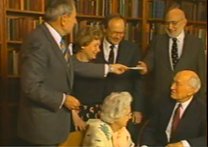
Part of the BIO 2004 conference in San Francisco, hosted by the Biotechnology Industry Organization. The video begins with an introduction by Arnold Thackray, who then presents the 2004 Biotechnology Heritage Award to biochemist Leroy Hood.
Charlie Rose moderates a panel discussion with William Rudder, Thomas Perkins, and Leroy Hood.
| Property | Value |
|---|---|
| Creator of work | |
| Place of creation | |
| Format | |
| Genre | |
| Medium | |
| Extent |
|
| Language | |
| Subject | |
| Rights | In Copyright - Rights-holder(s) Unlocatable or Unidentifiable |
| Credit line |
|
Institutional location
| Department | |
|---|---|
| Collection |
Related Items



Cite as
Biotechnology Industry Organization. “Biotechnology Industry Organization: Industry Pioneers: Monday Breakfast.” Betacam (tm), June 7, 2004. Science History Institute DVD and Video Collection. Science History Institute. Philadelphia. https://digital.sciencehistory.org/works/h8eplei.
This citation is automatically generated and may contain errors.