
30 Month Call to Action Update
- 1993-Sep-27

These captions and transcript were generated by a computer and may contain errors. If there are significant errors that should be corrected, please let us know by emailing digital@sciencehistory.org.
Transcript
00:00:00 Let me just start out with some current events.
00:00:27 President Clinton last week came out with his health care plan in the United States.
00:00:32 And for those of you outside the United States, it's a big deal because it impacts our largest
00:00:38 unit Syntex Laboratories and has a profound impact on the corporation.
00:00:45 The details of his plan are still to come.
00:00:50 He gave a very brilliant speech, I thought, outlining the broad concepts of the plan.
00:00:56 And as so many commentators have said, the devil is in the details, and the details
00:01:00 will be negotiated with Congress over the next year.
00:01:04 Now let me get into Syntex business and bring Dick Powers up here.
00:01:09 Dick?
00:01:10 I'd like to spend just a few minutes reviewing our fourth quarter activities and talk a little
00:01:16 bit about our goals towards cost reduction in the 30-month call to action.
00:01:22 Let me start out with the fourth quarter sales.
00:01:25 The sales in the fourth quarter for Syntex were above the fourth quarter a year ago.
00:01:30 They were $541 million.
00:01:33 Although they were slightly below the third quarter, that indicated in the third quarter
00:01:40 we had some unusual buy-in so that overall we feel pretty good about the fourth quarter
00:01:46 sales numbers.
00:01:48 And the fact that we managed to beat last year's fourth quarter also is important.
00:01:53 I think it's important to note too that for fiscal 1993, Syntex set a record sales number
00:02:00 of $2,123,000.
00:02:04 I'd like to move to selling general and administrative expenses.
00:02:09 And I think here we can show our most dramatic results.
00:02:12 You can see that selling general and administrative expenses, and this slide has really two lines
00:02:18 on it.
00:02:19 The bar chart talks about selling general and administrative expenses as a percent of
00:02:24 sales and the line demonstrates the absolute reduction.
00:02:29 And you can see beginning in the second quarter of this year, that white line has gone down
00:02:34 quite a bit in terms of our actual spending.
00:02:38 Part of that, of course, is the painful reduction we've had in the workforce.
00:02:43 This graph depicts the fact that we were at 11,700 people back in August of 1992 and
00:02:50 our goal is to reach 9,500 by August 1995 or the end of our fiscal year 95.
00:02:58 We're probably about 10,600 people today and we have to get down to 9,500.
00:03:06 However, most of the actions we need to take to reach 9,500 are already in place.
00:03:14 It'll come primarily from the further rationalization of our plant consolidation and some of the
00:03:19 rollout of our shared services so that the actions to get to 9,500 have been for the
00:03:25 most part communicated to those affected and we believe we've got a sound plan to get from
00:03:30 where we are today down to the final level.
00:03:34 One of our major goals was to maximize sales and the chart you have now in front of you
00:03:40 depicts the naproxen sales.
00:03:43 Naproxen remains our primary engine for Syntex in fiscal 93 and certainly for at least part
00:03:50 of fiscal 94.
00:03:52 I'd like to talk about our strategy, though, for naproxen as it goes off patent on the
00:03:57 21st of December.
00:04:01 This rather busy chart depicts several items that I know you've all heard about.
00:04:07 First let me talk about the OTC status.
00:04:10 As you know, there was another advisory committee and as of now we are talking to the FDA and
00:04:18 expect that we should get approval for OTC.
00:04:22 I don't know when, but certainly we're negotiating with the FDA on labeling and we feel that
00:04:29 approval should happen.
00:04:33 And the revisory committee was not a negative one.
00:04:36 The second one pretty much looked at what we had to do, the changes we had to make,
00:04:42 and we're now beginning to negotiate serious negotiations with the FDA and hopefully soon
00:04:49 rather than later we would like to have an approval of that product.
00:04:55 The next one down are the bulk chemical sales and here we've already experienced a great
00:04:59 deal of success.
00:05:00 We basically have signed up every major generic company in the United States for bulk chemicals
00:05:05 and we're not really aware right now of any major firm producing bulk chemicals to supply
00:05:11 the generic market.
00:05:13 So we hope here that although we're not going to make the profit we did on bulk chemicals
00:05:19 we did on the original version of naproxen, it will continue to cover our overhead and
00:05:26 keep our plants going.
00:05:29 We expect to launch a generic naproxen sometime in the fall of 1993.
00:05:35 We've hired the firm of HMS to market that for us and to assist in our own marketing
00:05:42 of generic naproxen through Hamilton Pharma, our division that will be marketing naproxen,
00:05:50 generic naproxen, and may well market other generic products for us.
00:05:55 We're also looking towards the branded market for new formulations and we're hopeful that
00:06:00 the EC formulation of naproxen or the enteric coated formulation will be approved also.
00:06:09 And of course we have our existing RX brand of naproxen and anaprox which will still be
00:06:15 promoting to the doctors and hopefully we can retain some market share there.
00:06:20 Let me take a look at Ketorolac right now.
00:06:23 Ketorolac continues to grow.
00:06:25 There have been disappointments in Ketorolac, I'll just review them briefly and if you want
00:06:30 during the Q&A you can ask some questions on that.
00:06:33 In Germany we are not selling Ketorolac, the German government has this under review.
00:06:39 We're not optimistic about that review but we're at least talking to that government.
00:06:44 In other countries of Europe we're primarily talking about label changes and we're working
00:06:50 with the various countries in Europe regarding that.
00:06:53 And in the U.S. we probably don't see a major impact, we will be looking at some label changes
00:07:01 but I think that's mostly going to be related to the post-marketing study that's due to
00:07:05 be completed in December.
00:07:07 This is a large extensive study on Ketorolac that will deal with its safety and effectiveness
00:07:14 and I think the results of that study will be important as to whether there are any further
00:07:20 label changes in the United States.
00:07:23 The IMS data for the past three months show that the oral Ketorolac is continuing to grow.
00:07:30 New prescriptions grew from 385,000 to 395,000 in June to August of this year and total prescriptions
00:07:40 grew from 469,000 to 496,000 in the same period June to August.
00:07:49 Ticlopidine also we did well in the fourth quarter, Ticlopidine reached almost 15 million
00:07:54 dollars in sales in the fourth quarter.
00:07:57 It was up 22% in the United States and 16% internationally.
00:08:03 At this point I'd like to turn the podium back over to Paul who will talk about how
00:08:07 we're strengthening our worldwide marketing capabilities.
00:08:13 With regard to what has gone on in the past three months, we're realigning sales force
00:08:19 resources particularly in Syntex Labs.
00:08:22 There was a restructuring of Syntex Labs that really deals with the change to managed health
00:08:28 care in the United States.
00:08:31 We had two separate sales forces, a blue team and a red team which means potentially two
00:08:36 individual representatives calling on the same doctor with two separate managers, two
00:08:42 separate regional managers and so on and so forth.
00:08:46 We decided that with managed care you can't afford to do that.
00:08:49 We're not dealing any longer with 500,000 American fee-for-service physicians.
00:08:56 We're dealing with the Kaisers, we're dealing with the Pacific Cares, we're dealing with
00:09:00 major buying organizations and as a consequence of that we thought that we could slim the
00:09:05 organization down, have one person going to see one doctor or one institution with
00:09:11 one manager.
00:09:14 With regard to other changes, the Mexican sales force was expanded.
00:09:20 Most of you in this room at least are not probably aware of what a magnificent job our
00:09:25 Mexican colleagues performed last year.
00:09:27 They had an outstanding year and they really would like to get more resource to pour coals
00:09:32 to the fire and we're providing them with that resource.
00:09:37 We have a bullet there that says appointing new leadership.
00:09:40 There's been a massive change in Syntex Laboratories.
00:09:45 It's a change that I think deals with the change in the environment in the United States.
00:09:51 Mel Booth has come down as president of Syntex Labs.
00:09:54 He's one of our most capable executives in the company and I think he will really light
00:10:00 a fire in labs.
00:10:02 Mike Ball who was the president of our Canadian company had the guts to give up his presidency
00:10:08 and come down as the head of sales in the United States.
00:10:12 That's a big tough move for any human being to take but there's a challenge and Mike's
00:10:17 a guy who likes to take on a challenge.
00:10:20 And Debbie Jo Blank is a very interesting person if you've not met her yet.
00:10:26 She is an outstanding marketing person.
00:10:28 She's an MD marketeer and she's one of the most creative people in the world.
00:10:33 We're recruiting very hard for a European and Pacific sector president with Mel Booth
00:10:39 moving to the States.
00:10:40 We need to replace him and with Gerhard von Wetzelbeck retiring very shortly, we're actively
00:10:47 recruiting in that area.
00:10:49 We've really got some superb candidates both internal and external that are coming down
00:10:55 on a final decision.
00:10:58 Next slide please.
00:11:00 Advancing the pipeline was the third piece of the strategy and I'm really excited to
00:11:05 tell you that we've added a fifth compound to the four priority compounds that you're
00:11:11 all aware of.
00:11:12 It goes by the sexy name of RS-25259.
00:11:17 It is a product, an anti-emetic drug to stop nausea and vomiting in patients undergoing
00:11:22 chemotherapy during cancer therapy.
00:11:25 It's a very important drug potentially.
00:11:28 There are a lot of competitors on the market and being developed, but this one has a promise
00:11:34 of being almost 100% effective.
00:11:37 If it works out in phase three trials as it has in preclinical work, we've got a real
00:11:42 winner.
00:11:43 And I think it's important to note that Bob Lewis again had the guts to bring in an outside
00:11:48 reviewer to take a look at his entire basic research program.
00:11:54 We brought in a Sir David Jack who was the head of Glaxo, one of the best research organizations
00:12:00 in the world.
00:12:02 He's retired now.
00:12:04 He's the guy that helped discover Zantac.
00:12:07 He came in and reviewed the products in our pipeline and he said, if all these products
00:12:12 were under my purview, first of all, I would be proud and secondly, why the hell haven't
00:12:18 you put your feet to the pedal on RS-25259?
00:12:20 He said, this is a good looking product.
00:12:23 Go with it.
00:12:24 And he inspired us to go with it.
00:12:26 So we've moved this to the next stage of development.
00:12:30 Little checks on the side of all these state that everything's on track.
00:12:37 In the last three months, not only have we stayed on track, but we've actually moved
00:12:41 ahead in the case of moncufinalate.
00:12:44 Now, let me talk to you a little bit about what the outside world is saying about Zantac
00:12:50 now.
00:12:51 The tune is starting to change.
00:12:53 It's still not in our corner.
00:12:55 But I feel pretty good about this in terms of the cuts that we've made at Zantac, which
00:13:01 we keep saying were painful, were painful, but also were necessary, were necessary, and
00:13:06 this is what people are saying.
00:13:07 If you ever wanted to know what it's all about, this is what it's all about.
00:13:12 It's a picture of what the future might bring.
00:13:15 We call it a bimodal strategy.
00:13:18 There's been a thought that since Merck and Metco combined in the United States or a major
00:13:24 company bought a distribution system, that all companies are going to have to go that
00:13:29 way or perish.
00:13:31 And with the merges of major companies, Bristol-Myers Squibb, SmithKline, Beecham, again, there's
00:13:39 a thought you have to be big to survive.
00:13:42 We see this as bimodal, kind of as spreading into two basic camps.
00:13:46 If you look at the left side where it says fully integrated pharmaceutical companies,
00:13:52 example Merck-Metco, clearly there are going to be more of these companies that try and
00:13:56 scoff up the distribution system.
00:14:00 So not only are they large pharmaceutical companies, they may be large wholesalers,
00:14:06 they may be large pharmaceutical benefit-managing schemes, et cetera, et cetera.
00:14:11 On the right, we see the fully capable discovery-driven company.
00:14:16 Companies like Syntex, Astra, Chiron might be companies like Roche, for example, companies
00:14:22 that will not choose to get involved in a fully integrated distribution situation.
00:14:32 How the heck can these little guys on the right or relatively little guys survive with
00:14:36 the giants on the left?
00:14:38 One, we think that the fully integrated pharmaceutical companies are going to be somewhat distracted
00:14:44 from their basic premise, that is, researching and developing new drugs.
00:14:50 I may be wrong on that, but I think the integration of two such disparate entities within one
00:14:56 has to have a tremendous organizational strain.
00:15:01 We feel clearly there is going to be a need for the discoverers of pharmaceutical products,
00:15:08 innovative, cost-effective drugs coming to the market, are going to be more in demand
00:15:13 than ever.
00:15:15 You could draw lots of arrows on this thing.
00:15:18 One is that the fully capable discovery-driven companies can sell their products directly
00:15:23 to managed care in the United States or to governments in Europe directly.
00:15:29 Secondly, we can actually sell products to these mega giants, the monstrous Merck-Metco
00:15:35 types of companies, because when you've got a $10, $15, or $20 billion company, how do
00:15:41 you grow it 8% to 10% a year?
00:15:45 It's an incredible feat to try, in the case of Merck, for instance, to add a billion dollars
00:15:51 in new sales every year when you can't raise your prices as you have in the past.
00:15:58 We think there'll be arrows flowing down, arrows flowing to the side, and on top you
00:16:03 have the biotech innovation specialists.
00:16:07 Jim Wilson used a term that I kind of like.
00:16:09 He said, this is going to be the farm team, for those of you that follow baseball, for
00:16:14 the Major League teams down below.
00:16:17 It's a place where innovation will take place, much innovation, not the only place.
00:16:22 It's a place where experimentation will take place.
00:16:25 Will any of the gene therapies really make it?
00:16:29 Out of this group, and it's not just biotech, but companies like Alza, some, but we think
00:16:35 very few, will move down to the fully capable, discovery-driven company box.
00:16:42 I hope that's clear.
00:16:43 We think very few.
00:16:44 We think most of these are going to consolidate, quite a few will disappear, and some will
00:16:49 stay small, if they're smart, because it's going to be really hard to make that jump
00:16:55 to fully capable, discovery-driven from where these companies are today, and virtually impossible
00:17:02 to move into the fully integrated side.
00:17:05 In the bottom middle, you have a little bunch of boxes called generics, pharmaceutical benefit
00:17:11 management companies, and wholesalers.
00:17:14 We'll be working with them directly as a company, and with consortium of other companies to
00:17:19 bring our products to the market.
00:17:21 This is kind of a picture that we think is developing for the next decade, and it influenced
00:17:26 our thinking in terms of how we deal with the world around us.
00:17:30 A couple of illustrative slides, on biotech, we have choices.
00:17:38 We said that it's unlikely that we will acquire or merge with a major biotech company like
00:17:45 an Amgen or a Chiron.
00:17:48 Probably the reason is that most of their products are licensed out already to big pharmaceutical
00:17:52 companies, and there's not much left, but we do think the acquisition of a small biotech
00:17:58 firm that might have a short-term product line that's not spoken for is real interesting
00:18:04 to us, and we're actively pursuing that, and then the alliances with biotech companies
00:18:10 such as Aguron and Chiron are really very interesting to us.
00:18:16 Research collaborations or equity investments in early-stage technology would be the way
00:18:21 to go.
00:18:22 On the next slide, we look very hard at generics.
00:18:27 Generics are going to boom.
00:18:28 Why shouldn't we get into this business?
00:18:31 We're forecasting in eight years that business will go from $8 billion to $30 billion.
00:18:37 That's a tremendous increase.
00:18:39 The $30 billion is really broken into three pieces.
00:18:43 Self-patent brands, that will be Naproxen on December 22nd.
00:18:47 They still sell a lot.
00:18:49 We've got Lidex, Sinalar, Noreno, they're still selling.
00:18:53 The third-party generics, these are the generic companies that are going to sell our products,
00:18:59 companies like Barr and Mylan, PAR, names such as this, and the originated generics
00:19:05 will be Syntex's Hamilton strategy, and we see that as the smallest piece, but nonetheless
00:19:12 a legitimate piece.
00:19:14 We decided after examining all these pieces that this is not a good business for Syntex
00:19:20 to get in at this point.
00:19:22 Why don't we go out and buy a third-party generic company?
00:19:26 The fact is, they're too darn expensive.
00:19:30 As we looked at pharmaceutical stocks losing about $100 billion in market value over the
00:19:36 past year, you look at generics, and they've been growing well over 100% in terms of their
00:19:45 value.
00:19:46 We looked at companies that had grown 300% this year and were showing losses.
00:19:51 Let me just give you a fictitious example.
00:19:54 Most of these companies are around $200 million in size, and they throw off no income.
00:19:59 There's zero, minus two, plus two, but there's not a big deal in the whole crowd.
00:20:05 If we were to go out and buy a $200 million company, we'd have to spend $250 to $300 million
00:20:10 to buy them.
00:20:11 We should get our money back in three years.
00:20:14 That means that they would have to throw off $100 million a year in income for us to make
00:20:19 it a worthwhile deal.
00:20:20 Well, if they're throwing off $2 million losses, you don't have to be a mathematician to figure
00:20:25 that one out.
00:20:27 We've kind of washed our hands at this time because of the prices of the generic companies.
00:20:33 The last slide I'm going to show you really is a strategic conclusion.
00:20:36 First, that innovative products will continue to drive our strategy and all companies' strategies
00:20:42 in the 90s.
00:20:43 I don't care how clever you are with boxes and circles and arrows, unless you have the
00:20:49 beef inside the hamburger, you're not going to get by with the bread.
00:20:53 You need products, and those companies that will have products will grow.
00:20:57 I think the industry has to reshape itself like Syntex is doing and has done.
00:21:03 We are clearly a leader in that regard, and I'm getting phone calls from other CEOs in
00:21:07 the industry on how we've handled our restructuring.
00:21:11 The wave is really starting to churn.
00:21:15 We believe very strongly that we have a strong pipeline of new drugs in the middle to late
00:21:20 90s.
00:21:21 This is critical.
00:21:22 If we're wrong, this company's in big trouble, but we think we're right, and we really have
00:21:27 argued that point inside and out.
00:21:29 I'm very proud of the company pipeline right now.
00:21:34 Syntex's main challenge, as far as I'm concerned, really falls into two areas.
00:21:40 One is a short-term product pipeline.
00:21:42 We sure as hell could use a new drug now, not 1996.
00:21:46 We don't have one coming out of Syntex.
00:21:50 Any acquisition or deal that we make right now in the short term has to give us product
00:21:56 now, not three years from now, but now.
00:21:59 That's a guiding principle.
00:22:01 With that, I'm going to say it's time for a Q&A.
00:22:05 I would hope a spirited discussion, either verbal or in the form of notes passed over
00:22:11 to the end of the aisles, will take place starting now.
00:22:15 The feeling is that we have too many consultants running around Syntex, that as a consequence
00:22:21 of that, they've kind of come in between the top management and the rest of the management
00:22:26 of the company.
00:22:27 There's probably some truth to that, but I must say that the process probably never
00:22:32 would have kicked off in this company without a hard-nosed look on the part of consultants
00:22:40 as to where benchmark companies are and where we are, and their experience of what companies
00:22:46 are doing to better themselves today.
00:22:49 I think, very honestly, the management of the company, myself especially, still feels
00:22:55 somewhat paternalistic.
00:22:57 I don't think we would have had the guts and determination to move to the difficult steps
00:23:04 that we moved to without a prod.
00:23:06 I think now's the time to start relaxing a little bit from the consultants, and I would
00:23:11 hope that they disappear within the next year.
00:23:14 We have a series of international questions.
00:23:17 One reason is that this session is being videotaped so that everybody working for Syntex who's
00:23:24 outside of Palo Alto and Evergreen can have a chance to participate.
00:23:30 One of the criticisms we've had of the last couple of videos is that the questions are
00:23:34 so Palo Alto-oriented.
00:23:37 We asked for some input, and let me just read, I think, what is probably the single most
00:23:42 important question, not just to our international colleagues, but to many people here as well.
00:23:51 International Keter-Rolak sales have been hurt by the more restrictive labeling in Europe
00:23:55 and by the negative publicity from the German license suspension.
00:23:59 What are we doing to respond to these lost sales?
00:24:02 What is the status of Keter-Rolak regarding WHO, CPMP, U.S. labeling changes, and so forth?
00:24:08 Let me say at the very start, the most important thing that we have done as a corporation to
00:24:15 respond to this crisis, if you will, is provide the authorities around the world with quality
00:24:22 safety data on Keter-Rolak.
00:24:24 We have turned what was to some extent a black eye into a very positive impression with many
00:24:31 authorities around the world.
00:24:33 The reason we did that is that, first of all, we moved far faster than I think people thought
00:24:38 we could as a corporation.
00:24:40 Secondly, the data was provided in a very high-quality fashion so that they were, in fact, able to sort
00:24:47 out a very complex picture.
00:24:49 That has been the number one task.
00:24:52 Now, we've got a number of ongoing tasks that relate to additional meetings in Europe, and this is
00:24:58 what the CPMP refers to.
00:25:01 We've got labeling discussions in the U.S., which are largely behind us, but we've got ongoing
00:25:06 marketing issues and so forth.
00:25:08 We're organized to do that by expanding the Keter-Rolak PMT.
00:25:14 So to make sure that we, in fact, have worldwide communication and coordination, all activities
00:25:21 relating to Keter-Rolak safety and marketing issues and other issues that might impact authorities
00:25:29 around the world must now all go through this expanded role of a PMT.
00:25:35 This is not a traditional role of a PMT, which is much more product development-oriented.
00:25:40 Paul just suggested that I explain PMT.
00:25:42 You know, we get so used to acronyms around here, they just roll off.
00:25:46 This refers to the program management teams.
00:25:49 Each of our products in development, whether it be Keter-Rolak, Oral-Ganciclovir,
00:25:54 Mycophenolate, Mopetil, each has a program management team.
00:25:59 They report to Bob Rowe, and as I said, they have a development responsibility, but we've
00:26:04 expanded the Keter-Rolak responsibility.
00:26:07 The question is, how are we doing with the key principles in the 30-month plan?
00:26:12 And I think all of us probably have pretty similar feelings, and we'll all talk about it.
00:26:19 I don't think the management of the company has been focusing heavily on empowerment in
00:26:26 terms of implementation, not in terms of theory, at a time where we're just coming out of the
00:26:31 cycle of downsizing.
00:26:33 I think we need to show big improvements in this area.
00:26:38 I truly believe that there are empowered portions of our company that are doing quite well.
00:26:46 We have empowered managers who you are seeing grow up in the company at this time, but by
00:26:52 and large, this is a condition that needs a lot of work, a lot of training, and I would
00:26:57 put a message out to the middle management who sits in this room, is kind of get out
00:27:04 of the way if you've got good people working for you.
00:27:07 Don't feel that you have to put your thumb down on all the things that are going on in
00:27:12 your area.
00:27:13 That's an absurdity.
00:27:14 That is the antithesis of empowerment.
00:27:17 Again, it's frustrating for me sometimes to learn about people at a certain level blocking,
00:27:26 blocking the flow of what we think is the beginnings of a really open company once again.
00:27:32 I'd just say that we're doing okay and not outstanding.
00:27:36 One area I'd like to touch on involving that that came up in the last meeting, and it was
00:27:41 an issue of diversity.
00:27:43 A lot of people have said, who cares about diversity at a time when the company is going
00:27:48 through a lot of problem?
00:27:49 I care about diversity, and I want you to know that, and I think I can speak for our
00:27:55 operating committee, is that we don't want to limit opportunity in this company based
00:28:00 on your color or your religion or your sexual preference.
00:28:04 I think if you're good, you ought to be able to move in this company.
00:28:08 We have to do a better job in bringing people of diversity, of quality into our company
00:28:13 at an earlier stage.
00:28:16 There are rumors of further restructuring to reorganize the Pacific and European sectors.
00:28:21 Can you comment on these?
00:28:22 Will the Pacific sector remain strong now that Mel Booth and Mike Ball have both been
00:28:26 recruited to join labs?
00:28:28 Will Syntex continue to be active in Europe?
00:28:33 When we announced the sector organization, we made a number of points, but one of them
00:28:38 is that we were trying to take a layer out of the company.
00:28:42 Before we had the sector organization, we had one international president, then we had
00:28:47 a series of area and regional vice presidents, then we had country managers.
00:28:52 We've effectively eliminated that middle layer so that the sector presidents report
00:28:58 directly to me, just as an international president would, but each of these sector presidents
00:29:03 report now virtually all of the country managers.
00:29:07 One of the most positive areas of feedback that I have received is from the country managers
00:29:14 and how much they appreciate having that layer eliminated, knowing that they report to somebody
00:29:20 who sits on the operating committee.
00:29:22 So the answer is we will not be changing that structure.
00:29:28 Second is, will the Pacific sector remain strong now that Mel Booth and Mike Ball have
00:29:32 recruited?
00:29:33 I don't think that gives nearly enough credit to the fantastic group of leaders that we
00:29:37 have in the Pacific sector, taking nothing away from Mel Booth and Mike Ball.
00:29:41 They're terrific leaders.
00:29:44 them, but you still have people like Rogelio Gallegos, Manolo Manriquez in Mexico, S.K.O.
00:29:52 in Korea, John Graves in Japan, Jeff Stewart and his team in Australia, and a fantastic
00:30:01 team of managers in Canada.
00:30:04 So the Pacific sector is strong.
00:30:07 We're recruiting a replacement for both Mel Booth and Mike Ball, but the Pacific sector
00:30:12 is still doing well.
00:30:14 Rumors have been flying that the Syntax corporate jet has been sold.
00:30:18 Is that true?
00:30:19 The reason I'm repeating your question is they can't pick your voice up on this.
00:30:23 The jet has not been sold.
00:30:25 We're looking now at leasing or chartering it.
00:30:30 There are today, I just spoke to a gentleman that's handling the sale for us.
00:30:36 There are 11 challenges for sale around the world, used challenges.
00:30:41 The economic conditions of the world are such that there aren't too many people buying airplanes
00:30:47 right now, but there are people who are chartering them, and there are people who are leasing
00:30:53 them.
00:30:54 And it seems to us if we can get the plane off our books and give it to someone else
00:30:59 for a couple of years, we'd be well served.
00:31:02 So if we can't sell it, we'll go to one of those two stages.
00:31:06 How successful have we been in licensing in new products for international markets?
00:31:12 This again is a question from our international units.
00:31:15 I think we've had mediocre success in that regard.
00:31:19 We have licensed in the Elan compound, Naprolan sustained release product in a few countries.
00:31:28 We've licensed Didronel, an osteoporosis drug in the UK.
00:31:32 We're in conversations with a company that makes a form of hyaluronic acid for arthritis.
00:31:40 We've licensed in a compound for depression in Australia, but it's kind of bits and pieces.
00:31:45 I'd say that we've just done a mediocre job in that sense.
00:31:49 And for those of you out in the rest of the world, hats off to Nick Halliday particularly
00:31:55 for a very aggressive approach to licensing in the UK.
00:32:00 With that, I would say that we're on time and thank you all very much for coming.
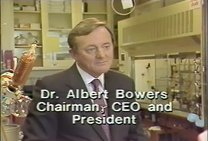
This video for employees of pharmaceutical company Syntex features company executives Paul Freiman, Jim Wilson, and Dick Powers providing an update on the company's activities.
| Property | Value |
|---|---|
| Creator of work | |
| Place of creation | |
| Format | |
| Genre | |
| Medium | |
| Extent |
|
| Language | |
| Subject | |
| Rights | In Copyright - Rights-holder(s) Unlocatable or Unidentifiable |
| Credit line |
|
Institutional location
| Department | |
|---|---|
| Collection | |
| Series arrangement |
|
| Physical container |
|
Related Items
Cite as
Syntex Corporation. “30 Month Call to Action Update.” Vhs, September 27, 1993. Albert Bowers and Gwynn Akin Bowers Papers, Box 21. Science History Institute. Philadelphia. https://digital.sciencehistory.org/works/mv2uqu1.
This citation is automatically generated and may contain errors.