
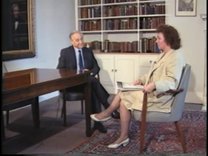
Interviews with Distinguished British Chemists: Sir George Porter (unedited footage), Tapes 3-5
- 1988-May-11

These captions and transcript were generated by a computer and may contain errors. If there are significant errors that should be corrected, please let us know by emailing digital@sciencehistory.org.
Transcript
00:00:00 And most of all, that's the second thing, it then became possible to study photosynthesis, which is the
00:00:09 really the
00:00:10 most
00:00:12 Certainly the most important photochemical reaction is probably the most important chemical reaction
00:00:17 Almost the most important thing that happens because it's the origin of life and it
00:00:23 provides all our food and energy for life, so it's
00:00:26 it's pretty basic and
00:00:29 I've become more and more interested in that and at the moment. We're at the stage of
00:00:36 isolating the reaction centers separately from all the rest of the
00:00:43 Rubbish and other things which which surround them and we are able to look at the
00:00:52 Primary reactions that occur when they absorb light
00:00:56 But parallel with that for quite a long time
00:01:01 Particularly with Dr. Tony Harriman who was with me for 15 years or so I became
00:01:13 Interested in chemical approaches to solar energy, solar energy conversion
00:01:21 And I had some very good people working with me on on that
00:01:28 Sylvia da Costa
00:01:31 Mary Archer
00:01:35 And Tony Harriman in particular and we for some years we thought
00:01:41 that
00:01:43 we would be able to
00:01:45 It's a bit arrogant, but we would be able to beat the nature and make a better leaf
00:01:53 Make something which traps the solar energy photochemically, which is more efficient and in principle one can the leaf is less than 1% efficient
00:02:01 you see
00:02:03 Well, it's was very interesting
00:02:06 It turned out some very interesting chemistry and a lot of people the whole society is devoted to this a lot of people still doing it
00:02:12 But I don't believe I don't think it looks very promising from a solar energy practical point of view
00:02:20 My own view at the moment is that solar energy will be a major form of energy for the future
00:02:27 But the most promising there are two promising approaches to it
00:02:32 One is to make electricity rather than chemicals
00:02:36 using photovoltaic
00:02:41 Cells as we do in satellites at the moment
00:02:45 And the other is to make the chemicals if you want to make the fuels and the chemicals and so on
00:02:50 you
00:02:52 Do this you let nature do this for you by the photosynthesis pro
00:02:57 the photosynthesis
00:02:59 route
00:03:00 But through genetic engineering as we understand more about photosynthesis
00:03:04 We may modify those plants to produce the products we want and to do so more efficiently
00:03:10 And it's the second approach that interests me most now
00:03:15 In other words, it's easier to grow spinach than to try to make one yourself
00:03:20 You don't have a photovoltaic cells on your house. Do you by chance?
00:03:26 No on my boat though. Oh, really? Yes, it uh, they keep the keep the very good
00:03:30 They keep the battery charged through the winter you see you didn't think about uh trying to heat the house that way
00:03:35 Enough enough sunlight. Oh, you wouldn't heat the house that way. Um
00:03:39 To go through the through electricity. I think the trouble with photovoltaic cells is storage. You see you you'd have I think um
00:03:48 Well, they're increasingly becoming important in in small scale
00:03:52 I mean like like watches and so forth and and above all in in satellites remote places
00:03:59 And I think they and also for pumping water in um developing
00:04:04 Countries in place of diesel engines and so on they'll become more and more important there
00:04:08 I think there's a great future for them, especially since amorphous silicon will make them very much cheaper
00:04:16 It was time
00:04:23 That's that's that's one hour it's one hour, isn't it?
00:04:28 Yeah
00:04:33 It's just trying to keep track of the conversation and trying
00:04:37 Make sure we're going forward
00:04:41 I want to um, i'm just going to I want them to
00:04:45 Uh, can you tell them about
00:04:58 We can do it because it doesn't matter which tape it comes on because they can be
00:05:03 Used in the editing machine in any order. Yes, and that's the beauty of doing them in 20 minute bits
00:05:08 Well, you could uh, we could slip that in just in case you go anywhere else
00:05:16 And I believe okay
00:05:24 Five four three
00:05:28 You got the idea for the flash ptosis experiments in the navy
00:05:35 well, no, uh, I didn't think of flash ptosis when I was in the navy I thought of it, uh,
00:05:40 uh, as I said when um
00:05:42 When I was when I went to cambridge and I was doing the experiments with very bright continuous light sources
00:05:49 but the
00:05:51 Idea of using pulses
00:05:55 Apart from seeing the flash lamps, which was a great help, uh was really
00:06:01 intrinsically, uh,
00:06:03 What I had been doing for four years in the navy in radar
00:06:07 Because radar sends out a microsecond electro
00:06:13 Electromagnetic wave and the very word microsecond was unheard of in the chemistry laboratory, of course even millisecond
00:06:21 So the idea of microseconds and the fact that you could manipulate them
00:06:25 By electronic methods and you could make measurements using
00:06:30 Optical delays and so forth all that
00:06:33 Was well known
00:06:35 Uh with electromagnetic pulses, but it hadn't
00:06:39 been used in quite the same way with light pulses, so once
00:06:44 The problem was there one wanted to
00:06:46 Uh look at things
00:06:49 Optically the flashes were there then the rest of it the electronics
00:06:53 and the
00:06:55 mirror delays and the velocity of light, uh,
00:07:00 Delaying units and so on all that was um
00:07:04 Just could be carried straight over from
00:07:06 my ideas
00:07:09 My experience of radar
00:07:11 You also learned a lot of electronics in the navy. Was this useful when you went to cambridge? Oh, yes. Yes
00:07:18 um
00:07:20 It's not much use now because the valves and all those things have disappeared but certainly at that time
00:07:27 I really had to build my own oscilloscope almost and
00:07:30 And uh, and most of the other electronic stuff, yes
00:07:35 Now, why did you decide to go into the navy at all?
00:07:39 um
00:07:40 well because uh, as I say, I
00:07:43 I'm a bit of a fish really and i've always
00:07:47 The sea has always appealed to me
00:07:49 uh
00:07:50 It's the senior service
00:07:52 it's uh
00:07:54 Everything about the navy appealed to me travel. It's a marvelous service. It's much
00:08:00 nicer than the army or the air force because you have your own
00:08:04 As long as you're not sunk it's much more comfortable you stay in one place
00:08:08 And and yet you're traveling all the time you have your cabin and you go around the world
00:08:14 But you were you were there for four years. Uh, did you miss being away from science?
00:08:19 Well, I wasn't very much away from science as I say I was I was entirely a radar officer
00:08:26 I'd uh, you see I followed
00:08:29 Having got my chemistry degree
00:08:31 The country decided that chemists were no use because we didn't have chemical warfare
00:08:35 And so they retrained us all in fact, I spent nearly all my last year
00:08:40 As an undergraduate doing a course in radio physics, and then I went to Aberdeen University
00:08:45 For a special crash course of three three months
00:08:50 In radio physics even before I knew what radar was
00:08:54 so, um
00:08:56 I'd spent quite a lot of time on on radio physics and so on. So I was quite interested in that side anyway
00:09:04 Furthermore in the last part of my career in the navy I became I I
00:09:09 Set up and uh and ran a school
00:09:12 a radar training school
00:09:15 uh in northern ireland
00:09:18 Which again was quite a lot of experience I hadn't
00:09:22 uh
00:09:23 I began to set up lectures and demonstrations and this sort of thing
00:09:27 Which is the first experience i'd ever had of doing any teaching so it was quite valuable really
00:09:33 Were you ever in any situations which were dangerous while you were on the ship? Well, I suppose
00:09:40 it's a bit dangerous in the middle of
00:09:42 Uh the atlantic in the middle of a war
00:09:46 and
00:09:47 I had a little extra
00:09:50 Excitement in that. I was the only
00:09:53 a radar specialist in the whole
00:09:56 convoy
00:09:58 um, you know, the convoy was about a hundred merchant ships and
00:10:02 between six and a dozen escorts around
00:10:06 And they all all the escorts had radar and I was the only one so I had to go from ship to ship
00:10:11 By rowing but whale whaler in the middle of the atlantic from time to time with my
00:10:17 avometer and uh and spanner sounds slightly hazardous
00:10:22 But I I never got my feet wet as I say I was never sunk
00:10:27 but we had uh
00:10:29 We had some quite exciting times
00:10:31 You also had some depth charging submarines and so on
00:10:35 We did we did meet one or two submarines on the surface and so on
00:10:39 You um also
00:10:41 Were reflecting at one point
00:10:44 About the time to think that you thought it was not a bad idea to have some sort of break
00:10:49 In formal education that you found it actually in some ways very valuable. It was it's a marvelous actually because
00:10:56 uh, you you really
00:10:59 Education is so intensive up to the first degree that you never have much time to think about what you're doing
00:11:06 or what you want to do I was
00:11:08 I was
00:11:09 only 20 when I
00:11:11 Took my degree. I was 17 when I went to university
00:11:15 and
00:11:16 I spent as I said
00:11:18 Much of my time when I was supposed to be doing a chemistry degree doing doing the electronics and radio physics and so forth
00:11:26 so I was pretty busy and
00:11:29 I never really had much time to um
00:11:33 To think about other things and what I wanted to do. I hadn't really quite made up my mind
00:11:40 What I wanted to do after the war whether I wanted to go into industry or do research or whatever
00:11:47 And uh
00:11:50 In the navy, I I did a lot of reading outside science I read poetry and so on and I
00:11:57 Listened to a lot of music and things I hadn't had a lot of time for before it was marvelous from that point of view
00:12:02 but also I
00:12:04 was able to read
00:12:06 much more deeply into science
00:12:09 in a more in a broader way
00:12:11 And a more detailed way in my own subject. I did a lot of reading in physical chemistry and so on
00:12:16 I hadn't had time to digest
00:12:19 um
00:12:21 And a lot of
00:12:23 Um
00:12:26 Autobiographies of scientists and so on and decided that was the life for me that research was really
00:12:33 I couldn't think of anything else really worth doing half as much as basic
00:12:39 Search for knowledge
00:12:41 Would you recommend to uh
00:12:44 The undergraduate coming out now to take a four-year break and go into the navy to do something
00:12:49 Four years is probably a bit too much a bit extravagant life is short. Um
00:12:56 I don't think it would do him any harm except that he'd lose four years as I did
00:13:01 Although as i've said it wasn't a lot one year. I think it very I think a year between school and university
00:13:07 another advantage of this break
00:13:10 Was that when I went back to university to do my phd?
00:13:13 I was so much older and and had so much more experience of life
00:13:19 outside
00:13:20 Uh that I thoroughly enjoyed it. I mean in fact, I think most people will tell you
00:13:27 that the best time the universities have ever had were those years
00:13:31 from 1945 to 50 the not just the
00:13:35 Students who were there, but the staff will tell you that everyone was motivated
00:13:39 They'd all decided what they wanted to do and they wanted to do it as quickly as possible
00:13:43 They worked hard and they played hard. They'd had their
00:13:46 They'd had their relaxation they'd had their change
00:13:49 And they went back with enormous enthusiasm. So I do think a break of a year between school and university
00:13:57 Would do everybody
00:13:58 some good
00:14:01 Um, can we take another topic now you have a very interesting story that you tell about
00:14:08 When you actually learned that you were to be awarded the nobel prize for chemistry
00:14:13 Hmm and uh
00:14:15 Do you want to tell me how you actually did it?
00:14:18 Well, you know, I think you'll find almost every nobel prize winner has uh has an interesting story about this because I think it's
00:14:25 part of the game of the swedish
00:14:29 academies, uh
00:14:31 to be very secretive about it and
00:14:34 And announce it in the most peculiar ways and it certainly happened to me
00:14:38 I certainly wasn't expect i'd had no inclination of it and I was in no way
00:14:43 Expecting to get the nobel prize. It was a complete surprise to me and one
00:14:49 monday morning, uh in october
00:14:52 um
00:14:53 Oh, I think it was first week in november
00:14:56 Um, I had a german
00:14:59 visitor who come to see me for the for a couple of days and he just arrived he was in my office about
00:15:05 10 30 in the morning and the telephone rang and um
00:15:11 There was a swedish voice on the other end of the phone
00:15:15 that said
00:15:17 um
00:15:18 I just wanted to ask you professor porter what you thought about the nobel prize
00:15:24 and I said, uh
00:15:26 I think it's a very good thing. Uh, I I hope the swedish swedes will continue to do this
00:15:31 It's a great stimulus to sciences. He said no, I wondered what you thought about your nobel prize
00:15:37 And I said I haven't got one and he said you have
00:15:40 At least I my information is that you have I said, who are you?
00:15:45 And he said he was from the swedish press
00:15:47 And he'd come over to london
00:15:50 Uh to see me because he had been born to do so and that's the way they they do it
00:15:55 They have they have their swedish reporters already
00:16:01 So, uh
00:16:03 I thought well, this is a strange way of doing it, but I said, um
00:16:08 Who else has got it? And he said well, I think there is a german
00:16:13 And I said oh, yes, I wasn't sure who that would be because there's no german in flash photographs surely
00:16:20 um
00:16:22 But he that's all he said and he said well, but may I come over and see you and take some photographs
00:16:29 And I said yes do i'm going to talk some more
00:16:33 and uh, it so happened that it's a half term and my
00:16:37 Two sons and my wife were there. It was in the royal institution. We lived there
00:16:43 so I thought
00:16:44 I really ought to
00:16:46 Tell them about this interesting call, but I said don't you know?
00:16:49 I'm, not sure about it. This was just a phone call and uh, so don't get too excited
00:16:54 Don't tell anyone else but this is what uh, this is what happened
00:16:59 So I then went and went back he said he'd be around in about 20 minutes two hours later nothing had happened
00:17:09 And he eventually came I suppose it was about half past 12
00:17:15 he did turn up and he was a swedish reporter and
00:17:19 We talked about it and it seemed it began to look fairly genuine and then it was on the one o'clock news
00:17:25 On the radio
00:17:27 And so that was pretty definite then, uh, just to make it more definite. I did eventually get
00:17:33 Get a telegram about three o'clock that afternoon
00:17:37 but there was a rather
00:17:39 um
00:17:41 a rather
00:17:43 Uh
00:17:45 questioning time for two hours when I began to wonder what awful friends I had who
00:17:52 Were practical jokers and could imitate a swedish accent
00:17:57 Isn't it true though that uh, one of your sons wasn't uh awfully impressed by this, um
00:18:04 Attention and really rather embarrassed. They're very they're very odd, aren't they? Yes. Um, yes
00:18:10 Well what he actually said was they were immediately as soon as it was announced they brought institutions to a party, of course
00:18:18 got out the champagne and so forth and my students came down and
00:18:22 uh
00:18:24 somebody asked
00:18:25 My younger son what he thought about he said well
00:18:29 Dad, I was there
00:18:31 well that
00:18:33 I can just about stand this but if you get one of those sir things i'm going
00:18:39 And did he pack his case when you got one of those no, he was a bit older and appreciated it
00:18:45 Well, I don't i'm not so sure about appreciate
00:18:48 He was able to stand it
00:18:51 Uh, you spent 20 years at the royal institution
00:18:55 um
00:18:56 Was there any question at all about you not coming to the royal society? I mean you were
00:19:01 Elected and then took up the position here in the last uh, you took it up a couple of years ago. That's right. Yes
00:19:08 Not really. I mean it's uh
00:19:13 It's a very great honor indeed and uh one uh
00:19:16 uh
00:19:18 Faraday refused it, but
00:19:21 He was getting he he felt he couldn't do it. He was he was getting a bit old and so forth
00:19:27 Now I I didn't I could didn't feel I could refuse it. But on the other hand, uh, it is I uh
00:19:35 There are problems
00:19:36 I couldn't do the I couldn't continue to be director of the royal
00:19:39 I should have been direct still director of the royal institution today because my I haven't reached retiring age quite I nearly have
00:19:47 uh, but I when I was asked about it, I
00:19:50 They said well what you're going to do about the royal institution
00:19:52 I said well, I can't do both and I have to give up the royal institution
00:19:55 Although I should I want to continue my research. I still have
00:19:58 in fact, I've moved my research now from the royal institution to imperial college and i've got a
00:20:04 a little group of five students
00:20:07 Two three students and two postdocs working with me there. I've got a nice new lab and I hope to go on doing that for
00:20:15 A few more years, but I couldn't do this is the royal society. Um
00:20:21 Presidency today. It's getting busier and busier and we're doing more and more things and it's almost a full-time job
00:20:27 It's of course, it's an honorary job too. That's that's not no salary. No salary. Yes, but it's uh
00:20:34 It's so important and it's uh
00:20:36 looking at the
00:20:38 My great predecessors. It's something that no scientist I think would want to
00:20:43 Refuse
00:20:45 And one of the roles that you play is um on advisory committees to government
00:20:52 That must be very time consuming
00:20:56 Yes, I mean we don't uh, it's not time consuming in the in the hours spent sitting with the prime minister or anything of this kind
00:21:03 but of course, it's time consuming in preparing the evidence and
00:21:08 and so on before you do meet the ministers and
00:21:13 and answering
00:21:14 For it afterwards in various ways
00:21:17 Yes, you recently gave a lecture on television the dimbleby lecture
00:21:23 Uh, which discussed some of the directions and funding and science policy
00:21:28 um
00:21:29 How do you see the state of uk science?
00:21:34 Well, uh, we had a dinner last night of our
00:21:38 Uh our university research fellows, you know the university the royal society has uh,
00:21:44 We have no
00:21:45 Institutes of our own but we have some 200 fellows and professors in universities and these these fellows are
00:21:52 are young
00:21:54 and
00:21:55 With a single voice there. Oh, although they're they're all right. They've got a nice fellowship for 10 years anyway
00:22:02 but with a single voice they were
00:22:05 Speaking in a very depressed way
00:22:08 about
00:22:09 the science in the universities and that the departments they are the the
00:22:15 It's partly lack of funding
00:22:17 insufficient funding
00:22:19 and it's partly the
00:22:22 uh
00:22:23 Changed attitude to science of governments and the public
00:22:28 Since the
00:22:30 The 50s and the early 60s were wonderful days for science, um
00:22:36 the the general, uh
00:22:39 Excitement of the public and and governments and so everybody thought sciences is a great thing
00:22:44 Today scientists think it's even greater than ever
00:22:46 but but the public doesn't the public sees pollution and and and nuclear weapons
00:22:53 and
00:22:55 insecticides and environment
00:22:57 Problems and lots of an animal experiments and all these things and this this
00:23:04 Increasingly occupying our time in public relations and so on. So that's depressing on the financial side
00:23:12 The total amount my view is I was trying to tell to
00:23:16 Convince some of the young people about this. My view is that the total amount spent on science of 4.6 billion
00:23:23 Is probably all we're going to get
00:23:27 Certainly out of this government probably out of other governments and it's the way we spend it but it's got it's a lot of money
00:23:34 And the amount the fraction of that that goes into real basic science in the universities is minuscule. I mean the
00:23:41 the funding
00:23:42 of grants
00:23:44 By the science research council university grants in the basic sciences
00:23:50 Only takes about 30 million
00:23:53 Out of
00:23:54 4,600 million you see
00:23:56 So I think it's up to the scientists as well as the scientists to persuade the government
00:24:01 But the scientists themselves to get their priorities right on this. I think we're spending
00:24:07 we're
00:24:08 with the government's
00:24:12 Encouragement
00:24:13 the scientists who direct our affairs
00:24:17 are increasingly
00:24:19 Directing them too much. They are
00:24:23 Saying we want to turn
00:24:27 Exploit science in this way. We went want to set up institutes to do this
00:24:32 we want to get
00:24:34 Stop in individual scientists doing their own thing and get them all together into teams
00:24:39 and this is the
00:24:41 There there is some sense in it for some
00:24:44 projects particularly in development
00:24:47 But I have a great
00:24:49 faith
00:24:50 In the individual scientists still even in these days of big projects and so on I think the real
00:24:56 Discoveries and breakthroughs are made by individuals doing their own thing
00:25:01 And it's becoming increasingly difficult for them to get the funding that they need for their own thing
00:25:08 You're also very involved in the public understanding of science both with the committee on the public understanding of science and in other ways
00:25:15 This is very important you think you said the education of
00:25:19 Both the general public and young people about science is extremely important. Would you like to say a little bit more about it?
00:25:24 Well, it's important. You might say well, what does it matter some scientists do they some scientists get very depressed and say well
00:25:31 I'm just going to go get on with my science and not worry about the stupid people who don't care about it
00:25:40 the government and everything else, but you can't do that because the
00:25:43 The government is elected by people
00:25:45 And therefore the people are really choosing
00:25:49 the way that everything goes including science and
00:25:54 Science just isn't a vote catcher and so governments are not interested in it
00:25:59 And and it's up to the public to make it a vote catcher
00:26:01 It's up to the public to say we're not going to elect you unless you do support it
00:26:06 The improvement of knowledge and so forth and you realize that there is something else in life than just
00:26:13 Immediate short-term exploitation of technology
00:26:17 the
00:26:36 Foreign
00:26:51 Do you have any advice that you'd give to people contemplating a career in science now
00:26:58 Yes
00:27:00 Go ahead
00:27:01 um
00:27:02 I think it's
00:27:04 A marvelous life. I
00:27:06 Couldn't have been happier
00:27:08 um, I can't think of any other
00:27:11 like absolutely no other I mean
00:27:13 However successful I might have been prime minister or whatever
00:27:17 Nothing would have given me as much real satisfaction deep satisfaction
00:27:23 as
00:27:24 science the
00:27:26 pursuit of knowledge even if one only makes
00:27:28 Uh
00:27:30 Dots a few i's and crosses a few t's even if one makes only a very small contribution
00:27:36 it is a permanent contribution to
00:27:39 to
00:27:40 the advancement
00:27:42 Of mankind if to discover something i'm not sure that you can say that of any other field really
00:27:49 And physical chemistry, which was your field?
00:27:52 uh
00:27:53 Well, I in any in any
00:27:56 proper science, which is
00:27:59 which is
00:28:02 Based on the scientific method that is to say it is
00:28:07 Assessed by other scientists and thrown backwards and forwards so that it is really
00:28:12 uh
00:28:14 It is really a true advance of knowledge
00:28:18 Physical chemistry is just one of those as far as physical chemistry is concerned. If you mean would I advise?
00:28:25 Some to do physical chemistry. Yes
00:28:28 Because physical chemistry is very basic science which can be applied
00:28:33 To the upper atmosphere or to the low lowest plant or the lowest animal
00:28:41 I do think right now
00:28:44 In fact i've shifted my research towards photosynthesis as I said, I do think right now
00:28:50 the action is
00:28:52 on the biological side
00:28:54 But it's the biological side using physics and chemistry. It's uh
00:28:58 It's not stamp collecting or plant collecting anymore. It is biophysics
00:29:03 And biochemistry where the advances are being made
00:29:08 but by the time
00:29:10 a 10 year old today is
00:29:13 Doing his research at the age of 25. It may be different
00:29:17 perhaps
00:29:19 It will come back to fundamental particle physics, which at the moment. I don't find very exciting. I
00:29:25 feel that
00:29:27 There isn't the equivalent advance occurring there which was happening in the 20s and early 30s, for example
00:29:34 So I my choice at the moment would certainly be on the bio biophysics biochemistry biological side where enormous
00:29:42 Advances are being made
00:29:44 Well Professor Sir, George Porter. Thank you very much
00:29:54 That's it
00:29:57 Yeah
| Property | Value |
|---|---|
| Creator of work | |
| Place of interview | |
| Format | |
| Genre | |
| Medium | |
| Extent |
|
| Language | |
| Subject | |
| Rights | In Copyright |
| Rights holder |
|
| Credit line |
|
Institutional location
| Department | |
|---|---|
| Collection |
Related Items
Cite as
Royal Society of Chemistry (Great Britain), and American Chemical Society. “Interviews with Distinguished British Chemists: Sir George Porter (Unedited Footage), Tapes 3-5.” U-matic (tm), May 11, 1988. American Chemical Society Audiovisual Collection. Science History Institute. Philadelphia. https://digital.sciencehistory.org/works/on2qnqv.
This citation is automatically generated and may contain errors.