
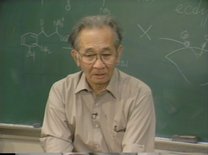
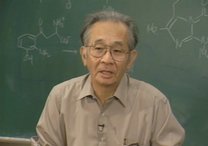
Koji Nakanishi interviewed by Leon Gortler (unedited footage), Part 2
- 1987-Sep-20

These captions and transcript were generated by a computer and may contain errors. If there are significant errors that should be corrected, please let us know by emailing digital@sciencehistory.org.
Transcript
00:00:00 One of the first problems you worked on after coming to Columbia
00:00:29 was the fluorescent Y base from yeast phenylalanine transfer of RNA and can you tell me a little
00:00:36 bit about how you got into that problem and what the challenges were?
00:00:42 Yes, well it was suggested by Charlie Cantor who is now chairman of the human genetics
00:00:50 at our medical school and he said that I understand your two structures and I can suggest you
00:00:59 a very fascinating problem and it is this fluorescent Y base which is contained positioned
00:01:07 near the anticodon of phenylalanine tRNA and because it's very unstable and it's fluorescent
00:01:15 and people have been trying to clarify the structure and why don't you start doing it?
00:01:23 So this was done in collaboration with Bernie Weinstein and Dijon Grunberger who are both
00:01:31 now professors uptown and Bernie Weinstein is now head of the cancer institute there
00:01:39 I think and so we collaborated with them.
00:01:42 They got the yeast phenylalanine for us and the most challenging thing was its instability
00:01:49 and its extremely minuscule amount which is available and it was known how to cleave
00:01:57 this Y base up from the tRNA but it is only stable from between pH 3 to 10 only neutral
00:02:06 conditions and after lots of hard work we were able to purify for the first time but
00:02:14 the whole entire amount was only about 300 micrograms and I had also, it was the first
00:02:22 real work I did when I came to Columbia from Japan so it was mostly done with the post
00:02:29 docs who came from Japan with me.
00:02:33 We are not used to the American system too and I remember we arrived at Columbia in the
00:02:39 end of August and I think, well the lab was quite not set up and we were, I was so glad
00:02:47 when we were able to carry out our first reflux about two months later.
00:02:54 Anyhow, because of the limited amount and at that time spectroscopy was not as advanced
00:03:03 as it was now and we had to do things extremely carefully and coupled with synthesis and
00:03:11 made a slow stepwise progress and until we got the full structure and I'm still proud
00:03:19 of this because it's got a, it is still the only known tricyclic nucleic acid base and
00:03:28 it had one chiral center and we carried out a micro-os analysis with 30 micrograms and
00:03:37 isolated the compound and got the absolute configuration and when we first published
00:03:43 this many people were dubious about the results but next year we managed to synthesize it
00:03:49 and prove that it was correct so it's still a very pleasant recollection for me.
00:03:59 Probably one of the most exciting areas that you've been working in and you've been working
00:04:03 on in the chemistry of vision for 10 or 12 years now and the work goes on and I suspect,
00:04:14 well it would be nice if you could tell me something about that work, how it got started
00:04:18 and where you are today.
00:04:22 Yes, this was again, I forgot, I think it was early, around 73, 74 and there were at
00:04:31 that time two young colleagues of mine in the biology department, the names are Barry
00:04:38 Hornig who is now a professor in again the biochemistry department at our place and the
00:04:44 other guy was Tom Eberle who is now a professor in biophysics at Champaign-Urbana and they
00:04:51 said, told me why don't you come and have a look in our labs and it was the first time
00:04:57 I went into a dark room where they were carrying out some rhodopsin related studies.
00:05:05 Incidentally these two are one of the earlier workers in this field and they had at that
00:05:11 time published quite a few review articles.
00:05:14 Barry Hornig had a hypothesis in which he had published with Martin Karplus and this
00:05:22 hypothesis, correctness or not, could be checked by making a synderic retinal analogue.
00:05:29 So we started working on that and that was in 1975, our first paper, and since then we've
00:05:38 been in this field and currently about half of my group, namely about 15 people, are in
00:05:48 this group and I think we, over the past 10 years or so, we have now made about over 80
00:05:56 analogues of retinals.
00:05:59 Our basic approach is the following, many people in my retinal group have synderic
00:06:07 backgrounds and we do some tailor synthesis and making retinal models, analogues, and
00:06:15 then putting them into natural rhodopsins.
00:06:20 Incidentally rhodopsin now, the family has grown quite big and generically call them
00:06:26 the retinal proteins and this includes the visual pigments and then the proton pumping
00:06:32 protons, proteins, also I'll mention in a moment but the chlamydomonas receptor which
00:06:41 is responsible for the phototactic action of chlamydomonas and we call all of these
00:06:48 together retinal proteins and they have a common basis for cyclic adenylate systems
00:06:56 and so it's attracting lots of attention.
00:07:02 First of all, what is this in the case of vision, how does it ends up, the protein gets
00:07:11 modified, you see in the protein, the retinal in the rhodopsin case, it is 11-cis retinal
00:07:21 which is hooked to the protein through a protonated shift base onto the lysine and then
00:07:28 upon light irradiation, the 11-cis isomerizes to oral trans and then that sort of starts,
00:07:38 triggers a change in the shape of the protein and it initiates a cascade of enzymatic reactions
00:07:45 which ends up in a hydrolysis of cyclic GMP to GMP and at this stage, one photon of light
00:07:53 is amplified by 10 to the 5th and so what is the mechanism for example and that is,
00:08:01 shares many common bases with the cyclic adenylate system and we want to understand
00:08:07 all of this more clearly on a molecular structure basis, the same thing happens with
00:08:12 bacterial rhodopsin which is another retinal protein and in this case, it is one of the
00:08:19 simplest of the membrane proteins and we don't understand many things about the membrane
00:08:25 proteins, it's very easy to grow and also many people are studying this because upon irradiation
00:08:34 of light in this case, a proton is transported through the membrane, okay, so it is a simple
00:08:42 system to study the transport of ions through the membrane, so we make these over 80 or so
00:08:54 and then fit them into the proteins and then of course, it alters their physical properties,
00:09:01 biochemical properties, biological properties and so as a result of this, it ends up
00:09:08 in many, many cases, collaboration with other specific groups and this has
00:09:17 led us into a very interdisciplinary area and as a result of this, I have started
00:09:26 to work together with physicists and even some theoretical people and many biophysicists,
00:09:35 spectroscopists, very specialized spectroscopists like picosecond spectroscopists and so on
00:09:42 and I don't know whether this is healthy or not but if you count the groups in which we are
00:09:49 collaborating with, with whom we are collaborating with, it's between 15 to 20
00:09:54 right now. In this particular problem? Yes, yes. I see. And my wife says I'm not only in this case
00:10:01 but in other cases too, I mean it's spread out too much and you started selling rotten fruit, she said.
00:10:11 This sort of is now a certainly common thread through a lot of your work and
00:10:18 you're becoming more and more interdisciplinary. Yes, I enjoy it, I do enjoy it but I cannot
00:10:26 deny the fact that it's, I mean, spreading out too much you see and maybe in some cases it is
00:10:33 not healthy to spread out too much and on the other hand, for me, problems, there are so many
00:10:44 exciting problems in the interdisciplinary field you see and when people approach us and say would
00:10:50 you like to do this and so on and then in many cases we can. It's very enticing to do that. Yes and we can contribute
00:10:57 to a certain extent. Yes. So it's a very difficult decision to make. Yes. Another thing is about
00:11:05 the, I may have told you before but so-called the percentage, because it's interdisciplinary you see
00:11:18 quite a few, quite a bit, a proportion of the work does not
00:11:28 does not terminate. In other words, it doesn't end up in writing a paper
00:11:32 and maybe the batting average in that sense is about 50 percent or so. I see. Yeah, but so far
00:11:40 I'm collaborating with many, many people and I think almost without exception it's a very pleasant
00:11:49 the collaboration. Okay, I know another piece of work that was a collaborative effort and
00:11:56 in which you ended up with at least determining what I thought was a very exciting
00:12:02 structure was the work on the red tide dinoflagellate and the structure of brevitoxin,
00:12:08 first of brevitoxin B and then later brevitoxin A and maybe again you can tell me a little bit
00:12:15 about that work. Yes, it happens that, well this is a toxin which leads to the red tide
00:12:25 in toxins which we find in the Gulf of Mexico and this toxin was known for about 20 years
00:12:35 and just by accident it turns out that before a few months before I was approached by this
00:12:45 group in Texas for collaboration I was reading a thesis written by a biochemist and I was in fact
00:12:54 the referee and it was about a very long thesis about 150 pages or so and it was dealing with
00:13:02 isolation, purification, toxicity, electrophysiological properties and so on you see.
00:13:08 Now I don't want to say anything negative but a few months later it was brought into our hands
00:13:17 and then because we are professionals in isolation and so on without boasting and it was given to a
00:13:28 postdoc from Poland who had excellent hands and he managed to purify it in a very straightforward
00:13:36 manner and in about two months it's fortunately crystallized in the NMR tube and then after that
00:13:45 two three months later we had the full structure. This was brevitoxin B? That is brevitoxin B
00:13:51 which means that you see this brevitoxin the presence of that was known for years
00:13:59 and but because it was not purified the data coming out of this was you were not sure
00:14:10 I mean what it really meant and quantitatively of course yeah but we must have been very lucky
00:14:17 somehow because there was another I learned later that Professor Shimizu at the University of Rhode
00:14:25 Island he is probably the number one expert on these red tide toxins he's done an enormous
00:14:31 amount of work on the other type of red tide toxins and he was also on it and somehow
00:14:42 he could it was not crystalline in his hands so we must have been lucky
00:14:45 on the other hand the other toxin you mentioned brevitoxin A this is the reverse we tried to
00:14:51 crystallize this for years and then Shimizu managed it and he got the structure back first
00:14:57 so yeah you had also worked on the structure of A but using different spectroscopic methods
00:15:04 yes that's right because we couldn't get it into crystals so I do have a tendency maybe of overusing
00:15:14 spectroscopy and as a result I have made quite a few mistakes structure-wise but my main interest
00:15:22 is developing spectroscopic methods and so we use this brevitoxin A as an ultimate
00:15:29 example of what one can do with current day NMR and mass spec and I had two fantastic co-workers
00:15:41 one with Jan Pavlak the other one is Mike Tempesta and it started at Santori Institute
00:15:52 which I will mention later and then they and then it just continued Mike Tempesta brought the
00:16:00 he started working on the brevitoxin A structure at Columbia as well and
00:16:06 and I think it's got 50 or so carbon atoms 70 protons and this nucleus of this is quite
00:16:19 different from brevitoxin B and with the mass spec which is done by Jan Pavlak in a very elegant
00:16:27 way I must say coupled with the NMR and we got the whole structure of this compound
00:16:35 using about total of six milligrams which I think was quite an achievement except that we there was
00:16:41 one misinterpretation of nuclear overhauls effects and there was one metal group in which we had the
00:16:47 configuration wrong and it was published it was announced at the same meeting in which Shimizu
00:16:55 gave his structure which was done by this x-ray and he first couldn't believe that we had the
00:17:02 whole structure I see yeah I see so for me this was for us it was maybe a happy ending
00:17:09 but I mean I think this era has gone now we only do the things to prepare ourselves so that
00:17:16 there are many many cases in which you cannot get things crystalline especially when they are
00:17:22 in the interdisciplinary area and the factors which are intimately related to the maintenance
00:17:28 of life and so on many things are not crystalline yes so this gives us good exposure experience
00:17:36 and also forces us to develop new methods of course if one can do it by x-ray there's no
00:17:43 I mean x-rays by far quicker quicker more efficient and less prone to error so so they
00:17:52 actually the brevitoxin B which you first isolated and crystallized that was done by x-ray
00:17:56 that was done by x-ray and I'm glad at that time because x-ray was done by John Crotty
00:18:02 brevitoxin A also was done by John Crotty but at that time it was impossible to do that
00:18:09 any other way yeah any other way yeah no it's an extremely complex structure yeah
00:18:20 some of your more current work
00:18:22 uh sure yeah anyway
| Property | Value |
|---|---|
| Creator of work | |
| Format | |
| Genre | |
| Medium | |
| Extent |
|
| Language | |
| Inscription |
|
| Subject | |
| Rights | In Copyright |
| Rights holder |
|
| Credit line |
|
Institutional location
| Department | |
|---|---|
| Collection |
Related Items
Cite as
American Chemical Society. “Koji Nakanishi Interviewed by Leon Gortler (Unedited Footage), Part 2.” U-matic (tm), September 20, 1987. American Chemical Society Audiovisual Collection. Science History Institute. Philadelphia. https://digital.sciencehistory.org/works/2bt8ywt.
This citation is automatically generated and may contain errors.