
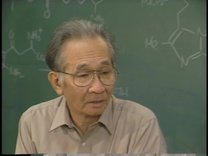
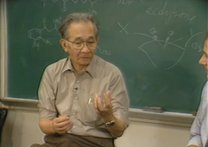
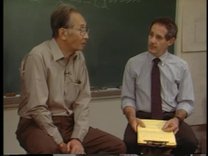
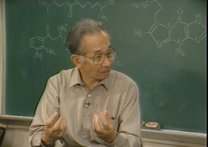
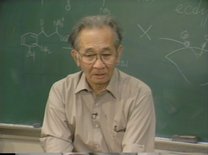
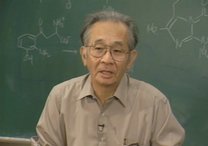
Koji Nakanishi interviewed by Leon Gortler (unedited footage), Part 3
- 1987-Sep-20

These captions and transcript were generated by a computer and may contain errors. If there are significant errors that should be corrected, please let us know by emailing digital@sciencehistory.org.
Transcript
00:00:00 As you go that way, you'll end up at the swinging door, essentially where you are right now except on the other side of that wall.
00:00:06 Then go down the stairs, one floor, and it's right there.
00:00:14 That's the most difficult thing around.
00:00:21 Do you want to talk for a few minutes about the work that you're doing there, some of these things that you showed me?
00:00:27 Yeah, I can.
00:00:28 Okay, and then we'll be essentially finished.
00:00:32 Okay.
00:00:33 How did you finally get from the airport here?
00:00:36 I'll never do that again.
00:00:38 What happened?
00:00:39 I couldn't believe that you wanted to do that.
00:00:41 I don't want people to...
00:00:43 Oh, that's to let some air in here.
00:00:44 Oh.
00:00:45 That's for you.
00:00:47 I'd forgotten how long it took to get from Kennedy Airport to Manhattan.
00:00:51 Oh, you came from Kennedy?
00:00:52 Yeah.
00:00:53 Where are you flying from?
00:00:54 From Washington.
00:00:56 How did you come?
00:00:57 Across the Van Wyk or something like that?
00:00:59 I took the...
00:01:01 Or belt all the way around?
00:01:03 Oh, no, it's terrible.
00:01:04 Well, he called me last night.
00:01:06 He says, I'm going to come into Kennedy, and I decided, well, if he feels more comfortable.
00:01:10 I didn't want to scream, don't do that.
00:01:12 I've never...
00:01:13 Traffic from Kennedy to here is terrible.
00:01:18 If we have to do any more, we'll do it under influence.
00:01:22 And five, four, three, two, one.
00:01:35 Since 1979, you've had a fair amount of success in the work that's been done at the Centauri Institute.
00:01:42 What are some of the problems that have been worked on?
00:01:45 What are the problems that you're working on now there?
00:01:49 Well, I go there four or five times a year.
00:01:53 And before that, I might mention just one comment.
00:01:59 And before I undertook this directorship, I knew that they asked me to come there four or five times a year.
00:02:05 And it amounts to about seven weeks or eight weeks out of the year, and that's quite a big proportion.
00:02:11 So I checked with the chairman and my colleagues, and they said, why don't you take it?
00:02:19 It's an honor for this place, and you should take it.
00:02:22 Which was very encouraging.
00:02:25 Yes.
00:02:26 Anyhow, and then I go there mainly doing consulting and broad direction decisions.
00:02:38 And there are groups with which I'm not involved in.
00:02:41 And we have one of the best synthetic chemists.
00:02:46 We have a synthetic group.
00:02:48 We have a group dealing with plant tissue culture.
00:02:52 And that is also one of the earliest groups to do this in Japan.
00:02:58 We have another group which is dealing with what I so-called the water-soluble compounds.
00:03:04 And these are starting to get involved with receptor sites and so on.
00:03:09 I will only mention two or three studies that we have done, which I have been involved directly.
00:03:19 And, well, before that, the water-soluble group is dealing with domoic acid and gamma-aminobutyric acid receptors,
00:03:30 also ADP ribose, and very biochemical and challenging problems.
00:03:36 Now, also, there's a group that is dealing with marine products.
00:03:43 And there we have had recently quite a bit of success.
00:03:48 Also, I have started a small group working on bacterial adoption.
00:03:55 And there, recently, we have succeeded in measuring this, taking good quality different spectra of proteins.
00:04:09 Now, the marine project, which is headed by Deputy Director Yoko Naya,
00:04:14 and recently, I'll just tell you two things that they have done recently.
00:04:20 One is they have identified the malt-inhibiting hormone of crustaceans.
00:04:27 And this is the paper which is in press now.
00:04:30 And, again, it's been many groups have tried to identify this.
00:04:40 And quite recently, two groups have identified a peptide, which also induces the same effect.
00:04:50 What it amounts to is all the malting, in other words, the shedding of skins of insects,
00:04:56 are controlled by this one compound, which is ectison, 20-hydroxyectison, to be more precise.
00:05:04 In the case of crustaceans, this is the eyes.
00:05:22 And then here, there's an organ, which is called the Y organ.
00:05:29 And this produces, biosynthesizes, ectison.
00:05:36 And then there's another organ here, around in the stem of the isotope, which is called an X organ.
00:05:42 And this one now, somehow, interferes with the biosynthesis of ectison.
00:05:50 And there's also this peptide, I think, which other groups,
00:05:55 Chang, for example, has recently isolated, is the one which we don't know, we haven't proven yet,
00:06:04 which gives out the message order to produce this NIH, malt-inhibiting hormone.
00:06:14 We have not proven yet whether it's a hormone or not,
00:06:18 but at least I can say that we have identified the compounds which has a malt-inhibitory effect.
00:06:25 In other words, a compound which interferes with the biosynthesis of this ectison.
00:06:32 And it's this malting hormone and the malt-inhibiting hormone,
00:06:37 they both have a delicate balance and control the life cycle of crustaceans.
00:06:45 For example, the soft-shelled crab is the one which they just,
00:06:52 there are some symptoms when the crabs are about ready to shed their skins.
00:06:58 Then they are put in a separate tank, and the moment they shed their skins,
00:07:03 they are put on the ice, so that they slow down their life, and then shipped to various places.
00:07:12 This was, since the crabs were cheaper to get in New York and Long Island,
00:07:19 over the years we have sent to Japan the blue crabs, about 5,000 of those.
00:07:25 And we tried to collect the eyeballs in the chemistry department,
00:07:32 and of course, in those days, the whole department smelled it.
00:07:41 And the smell would be taken up to the elevator on the different floors.
00:07:46 But fortunately, after four years, five years, again here,
00:07:51 the most difficult stage was setting up an assay, bioassay.
00:07:57 And anyhow, we have recently been able to identify this,
00:08:02 and it turns out to be a compound which is called 3-hydroxychynurenine.
00:08:07 And this is a very famous metabolite of tryptophan,
00:08:12 and a further metabolite down the route is xanthurenic acid.
00:08:19 And we think that probably xanthurenic acid is the real compound
00:08:24 which interferes with the biosynthesis of ectisome.
00:08:28 And now we're going into mode of action studies, and how does it interfere.
00:08:32 And it is an oxygenase inhibitor, so we're trying to prove what's happening there.
00:08:40 Now the other compound which we have recently done is,
00:08:46 it is a compound which leads to symbiotic relation between a very common sea animal,
00:08:58 which is called the anemone, or sea anemone.
00:09:01 And it's a very colorful thing.
00:09:03 And some sea anemone species live symbiotically, and very species specific,
00:09:13 with another common tropical fish, which the common name is called clownfish, or anemone fish.
00:09:21 These are striped with orange stripes, and you can see them in aquarium.
00:09:28 And when these, the newly hatched ones, and they come straight to this particular,
00:09:36 I'm giving you one particular example, particular species of sea anemone,
00:09:40 and then from there on they live symbiotically.
00:09:44 The newly born fish go directly to the anemone.
00:09:47 Yes, so it's an instinct, it's not learned, that's what I want to say.
00:09:51 And genetically controlled.
00:09:54 And what is the substance?
00:09:56 And again, the difficult thing was...
00:09:58 What was the substance that tracks them, you mean?
00:10:00 Yes, and what is the substance which induces the symbiotic behavior between the anemone,
00:10:06 and the sea anemone, and the anemone fish?
00:10:10 And we had to hire a post-doc who got a degree on the behavior of anemone fish.
00:10:24 And it's not trivial, these kind of things.
00:10:28 And it took us seven years to get a degree, and so on.
00:10:34 And incidentally, she's what we call an ethologist.
00:10:40 And just to show you that there are couples like this,
00:10:45 we had to send her down to the Okinawa Aquarium,
00:10:50 because it had to be done where they had natural anemone fish.
00:10:55 These are not so easy to raise in the lab, and so on.
00:10:58 And then it had to be done in a dark room,
00:11:00 and we had to have lots of young, newly hatched anemone fish.
00:11:05 It's a very exhausting thing, because the assay is not trivial.
00:11:11 They are delicate fish, and they had to be done in the dark room under the red light.
00:11:17 And it's terribly hot.
00:11:19 There's no air conditioning at the Okinawa Aquarium, where they had the labs for sparring.
00:11:28 And she would go there for periods of one month, a few months.
00:11:34 Then she would get exhausted and say, I'm going to join my husband.
00:11:38 And her husband turns out to be another ethologist, animal behaviorist,
00:11:45 who is specifically studying the mating behavior of mosquitoes who live on glaciers.
00:11:53 And so she goes to Patagonia, on top of the glaciers, and joins her husband.
00:11:58 Just to cool off.
00:12:00 She told me later that if you keep these mosquitoes on your palm,
00:12:04 after two or three minutes they are dead. It's too hot for them.
00:12:08 And so, anyhow, this woman, and because of the difficulty in biasing,
00:12:17 and because of the extremely small content,
00:12:20 finally we succeeded, after four years,
00:12:23 followed by this very, I would say, frustrating assay,
00:12:29 positive and negative and so on, until she established a way to do this.
00:12:33 From 15 kilograms of a particular species of sea anemone,
00:12:38 which we have to ask the collectors to collect,
00:12:41 and they don't like it because they have to dive rather deeply,
00:12:46 and it's stuck to the rock.
00:12:48 Anyhow, 15 kilograms of this, coupled with two or three years of assay,
00:12:53 we were able to isolate this active factor, a total of about 40 micrograms.
00:13:01 And it turns out to be a new structure, a new peptide,
00:13:08 a dipeptide containing a quaternary pyridinium moiety hooked onto a lysine.
00:13:16 Okay, oh, we have the structure.
00:13:18 We have the structure. It's this structure on the...
00:13:24 It's here, this one, and this is lysine and this is a pyridinium moiety.
00:13:29 Which is a new amino acid.
00:13:31 A new amino acid.
00:13:33 And we are now synthesizing this, and during this course of studies
00:13:38 we also identified the other factors which lead to this symbiotic behavior.
00:13:44 It involves they're attracted, and then they go up and down,
00:13:48 they meaning the fish, and then at the same time do sort of a hula hoop.
00:13:52 They sway their bodies.
00:13:54 We have identified the other factors, and they all happen to be neurotransmitters.
00:14:01 And this structure looks, it could be a neurotransmitter.
00:14:05 So from this, very specific at this stage,
00:14:08 but after we synthesize this, we would like to look into its effect
00:14:14 as other pharmacological effects.
00:14:17 And I wouldn't be surprised if it has some other effects,
00:14:20 but at this stage we don't know.
00:14:28 Well, I can just tell you one more thing.
00:14:30 Okay.
00:14:31 There's another thing which is published recently,
00:14:34 and I don't have the structure,
00:14:36 but this is, it may provide a new source of natural products,
00:14:41 and that is there is a group of insects which is called plant hoppers.
00:14:50 And these are sap-sucking insects,
00:14:54 and some of them, in this particular case,
00:14:59 we worked on a plant hopper which is a pest to a rice plant in Southeast Asia.
00:15:10 And in this particular case, we found that, not we,
00:15:15 some microbiologists in Japan had published this some time ago,
00:15:23 that the eggs, you can incubate the egg for 37 degrees for a certain period,
00:15:29 and then the eggs will hatch normally.
00:15:31 But the insects which come out of this, either they are totally undeveloped,
00:15:36 they become fertile, or the wings missing,
00:15:43 or in some cases the whole body becomes covered with white mold.
00:15:48 And these people, it's Dr. Kita and his co-workers,
00:15:53 developed then Sugiura at, this is a government agency, a big lab.
00:15:59 We collaborated with this group,
00:16:01 and they were able to develop a method in which you can culture these symbiotic microorganisms.
00:16:09 And at first it was not so easy, but then once you know how to do it,
00:16:13 we started screening for a lot of these,
00:16:16 and looking for specific antibiotic activity against agricultural pathogens.
00:16:23 And by this way, we found another tripeptide,
00:16:27 which was just published in a recent issue of American Chemical Society,
00:16:32 which contains a polyene structure,
00:16:37 and this is specifically active against a pathogen,
00:16:43 which causes the rice plant to,
00:16:48 it induces the so-called white blight disease.
00:16:56 And in other words, what we think is this insect,
00:17:00 while it's sucking the sap from this rice plant,
00:17:04 must transmit this symbiotic microorganism into the rice plant,
00:17:10 and then this microorganism, which is a pseudomonas, we think,
00:17:16 produces this antibiotic, which is specifically active against the pathogen,
00:17:22 which would destroy the rice plant.
00:17:24 And maybe it is a way of protecting their own food source.
00:17:30 At the same time, they're protecting the rice plant as well.
00:17:34 This could be very exciting for protecting the...
00:17:37 Yeah, we found quite a few other antibiotics,
00:17:40 but most of them were known.
00:17:44 They had been isolated by pharmaceutical companies from the common soil and so on,
00:17:48 but this one is new.
00:17:50 So I think there is some promise as a new source of antibiotics with specific activity.
00:18:00 Well, it's fairly obvious that you're doing some very, very exciting work.
00:18:06 Obviously, we're always looking for young new blood to go into science,
00:18:11 and would you have any advice for young people
00:18:14 who are interested in a career in science today?
00:18:19 Yeah.
00:18:21 Frankly, I become much more talkative when I drink,
00:18:25 and I'm quite sober now, so let me see.
00:18:31 I think, well,
00:18:38 the young people, obviously, are all very intelligent,
00:18:42 and they have a good memory.
00:18:45 But I can mention a few, two, three interesting things.
00:18:50 One of the important things, which I think,
00:18:53 is to always have your, what do you say,
00:18:58 antennas stretched out so that you can explore what's going on,
00:19:06 and to be very sensitive so that they can catch anything
00:19:10 which the student can translate in terms of coming up with a solution
00:19:17 in terms of organic chemistry or structure.
00:19:21 And for that, they have to be very curious about the things.
00:19:28 To have a very sensitive antenna means to have a tremendous amount of curiosity.
00:19:33 And also, it turns out that try to pull out some interesting,
00:19:39 to extract an interesting subject while you're talking with your colleagues in other fields.
00:19:45 You have to have a concerted effort to do these kind of things.
00:19:48 Otherwise, I don't think you can come up,
00:19:51 it's very difficult to come up with the projects that I've been discussing so far.
00:19:56 And in some cases, as I mentioned, it's quite true that we don't know where the exciting projects lie.
00:20:04 The biologists don't know that.
00:20:06 They know that there's such a phenomenon,
00:20:08 but they do not know that this could be a chemical problem.
00:20:11 So when you meet with biologists, to have a good conversation,
00:20:15 when we started this project, I mentioned Suntory, for example,
00:20:19 and the first thing we did was we asked the biology professors at the University of UQ.
00:20:27 And fortunately, ten of them came.
00:20:29 We sat around the table and we discussed some things.
00:20:33 And that's where some of these projects came.
00:20:35 And from that meeting came out a project which we solved the problem of a shark repellent,
00:20:42 which was secreted by a flat fish.
00:20:46 And this was done by Tachibana.
00:20:48 And papers are still coming out.
00:20:51 But from this, we also isolated, Tachibana isolated and clarified,
00:20:55 32-33 peptide, which is also amphiphilic.
00:21:01 And it's going to have very interesting biochemical properties.
00:21:05 But again, this all started through the conversation with the biologists.
00:21:11 And to have not only that, not only ask straight questions,
00:21:15 but lots of imagination, you see.
00:21:17 Could this be translated into an organic problem? And so on.
00:21:21 And also to have a very broad mind and also very critical.
00:21:30 When you read papers, don't think, don't accept the things written there.
00:21:37 Take it for granted.
00:21:39 And I think it's try to retain, I mean, this is all ideally speaking.
00:21:47 4, 3, 2.
00:22:02 Also, when one reads a paper, I think it's important to not only to understand the paper,
00:22:09 but also to retain some information, take an active attitude,
00:22:15 trying to extract an information which will have a positive influence
00:22:21 on the person's research at that particular time.
00:22:26 And that is another thing.
00:22:30 And also, as it becomes more and more interdisciplinary,
00:22:35 I think one should strive to look at things from various angles in a very broad manner.
00:22:42 Otherwise, you see, even if two people, A and B, collaborate,
00:22:49 even if it is interdisciplinary, they have to touch bases at some stage.
00:22:54 And this can only be done if people have a broad, open mind.
00:22:59 And this is what I think is a tremendous advantage of the education system in this country
00:23:06 compared to, in particular, Japan.
00:23:10 And this country, you have in the States, you can choose courses, and it's not a set menu,
00:23:19 but a la carte, this and that and that.
00:23:22 But in Japan, it's not like that.
00:23:24 It's more like a set menu, plus there's not enough mixing of blood.
00:23:29 And that is one tremendous advantage that people in this country have.
00:23:36 So there's very fair competition.
00:23:40 And people who manage to do good work, outstanding work, while they are young,
00:23:47 they immediately get recognized, independent of what school they come from.
00:23:51 It's not even discussed.
00:23:53 It's solely on a fair play.
00:23:56 And in many other countries, it's not necessarily so.
00:24:00 So that is a very healthy situation in this country.
00:24:09 I wonder what else.
00:24:14 Let me just stop it.
00:24:16 Thank you.
00:24:31 Another point maybe I should mention is the importance of lab techniques.
00:24:39 And, you see, discussion, particularly in interdisciplinary areas or whatever,
00:24:46 discussion is glorified.
00:24:49 But the thing which is very difficult is to prove that a negative result is really negative.
00:24:57 And in order to do that, you have to have very good lab techniques
00:25:02 to be confident about what you're doing.
00:25:05 And about the micro scale, I don't worry.
00:25:08 Many students ask, how come you can do things on a micro scale like that,
00:25:13 which is in most cases invisible.
00:25:15 But if you're forced to do that, practically anyone can do this.
00:25:20 But it is to have good techniques, which means clean and reliable hands,
00:25:26 that you know that your results are correct and not to be sloppy.
00:25:30 And this constantly depends on the constant effort on the side of the students.
00:25:38 In addition to having this broad concept and the liberal mind and dynamic,
00:25:45 all of these things, plus the creativity, imagination, well, it's said quite often.
00:25:54 So have good hands and a sharpened antenna, and hard work.
00:26:00 Koji, thank you very, very much.
00:26:02 It's really been a delight, and I appreciate your talking to me.
00:26:06 Thank you very much.
00:26:09 Thank you.
| Property | Value |
|---|---|
| Creator of work | |
| Format | |
| Genre | |
| Medium | |
| Extent |
|
| Language | |
| Inscription |
|
| Subject | |
| Rights | In Copyright |
| Rights holder |
|
| Credit line |
|
Institutional location
| Department | |
|---|---|
| Collection |
Related Items
Cite as
American Chemical Society. “Koji Nakanishi Interviewed by Leon Gortler (Unedited Footage), Part 3.” U-matic (tm), September 20, 1987. American Chemical Society Audiovisual Collection. Science History Institute. Philadelphia. https://digital.sciencehistory.org/works/e3pcoai.
This citation is automatically generated and may contain errors.