
On The Science Scene: Series 1
- 1980

These captions and transcript were generated by a computer and may contain errors. If there are significant errors that should be corrected, please let us know by emailing digital@sciencehistory.org.
Transcript
00:00:30 Years ago, the room-high ENIAC computer, crammed with vacuum tubes, was the electronic marvel
00:00:35 of the world.
00:00:36 Now it's relegated to museums by the microcircuitry of the silicon chip.
00:00:41 One chip, photochemically etched with a million switches and circuits, has ten times the components
00:00:46 of the huge ENIAC.
00:00:48 Yet visionary scientists predict the day when the chip, too, will be antiquated by electronic
00:00:54 switches of organic molecules so small billions fit on the head of a pen.
00:00:59 It's important to be able to store it on a molecular basis because it's the smallest
00:01:02 building block that mankind can work with.
00:01:05 Most research into developing a practical, molecular-level electronic mechanism is only
00:01:10 at the theory stage, that is, formulating possible approaches.
00:01:14 But at the Johns Hopkins Applied Physics Lab, chemist Richard Potemper and colleague Ted
00:01:19 Poehler are the first able to demonstrate one possibility, a way to electrically switch
00:01:25 molecule complexes from insulators to conductors and back.
00:01:29 They use a special film of organic molecules and metal atoms and a laser beam to switch
00:01:34 them.
00:01:35 We place the films on this base.
00:01:37 The laser beam strikes the organic film and either writes or reads the information stored
00:01:44 on the organic molecules.
00:01:46 The light bounces off, the laser light bounces off the organic film and then goes into a
00:01:51 spectrometer which acts as an electronic eye which can detect the switched and the
00:01:56 unswitched states of the organic materials.
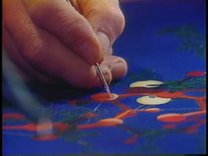
00:01:59 A microscope is a second way to see the process.
00:02:01 The dots represent the laser altering the molecule complexes on the organic film.
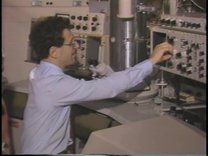
00:02:07 An oscilloscope shows the switching in still another way.
00:02:11 Here a molecular device is switching from the insulating state to the conductive state
00:02:15 and back again.
00:02:16 Can this electrochemical process or other theories still on paper really lead to something
00:02:21 so incredibly small as electronic mechanisms built from molecules?
00:02:26 As one highly respected chemist in the field confidently puts it, it's not a matter of
00:02:31 can, only when.
00:02:34 On the science scene, I'm Alan Smith.
00:02:46 Americans by the millions take to the seashore for swim, sun, and just plain fun.
00:03:17 The lure of the ocean is a powerful one, but powerful too is a stormy ocean that can wipe
00:03:22 out entire beaches right to the foundations of seaside homes.
00:03:27 Seawalls built to prevent beach erosion are sometimes successful, sometimes not.
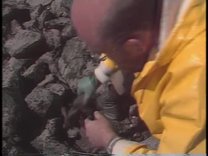
00:03:31 However, a retired chemical engineer, Bill Garrett Sr. of Greenville, Delaware has hit
00:03:36 on a simple idea, a plastic seaweed called Seascape.
00:03:40 The tough, lightweight, type R woven plastic was formulated in the chemistry lab for carpet
00:03:45 backing and road building.
00:03:47 But as Garrett's son explains, with fronds and an anchor tube for sand, it's now saving
00:03:52 beaches.
00:03:53 Seascape works like an underwater snow fence.
00:03:56 You position it offshore in a series of rows, Seascape slows the wave energy and collects
00:04:01 sand building a sandbar.
00:04:03 And then we find that between the bar and the beach, the beach tends to fill in.
00:04:07 Installations from Lake Michigan to the Carolina coast seem to indicate Seascape is successful.
00:04:13 One major project, try to save the Cape Hatteras lighthouse.
00:04:17 The sea had gnawed to within 100 feet of the North Carolina beacon.
00:04:20 We put in a 400 unit installation in May of 81.
00:04:24 That was so successful, it was followed up by a mile long installation in October of
00:04:29 82.
00:04:30 Since both of those installations, the results have been dramatic.
00:04:34 The beach was extended seaward two to 300 feet.
00:04:38 It's extended approximately the length of each installation.
00:04:42 A Corps of Engineers study is assessing the lighthouse beach buildup and Seascape's role.
00:04:47 So far, it's withstood some of the stormiest weather.
00:04:50 Time is the ultimate test, but perhaps the comment of a Save the Light committee official
00:04:55 best sums up the apparent success of this brainchild of a chemical engineer.
00:04:59 And he showed me one of the units of Seascape.
00:05:04 I was kind of mad because I hadn't thought of it.
00:05:07 It's so simple, it works.
00:05:09 From the science scene, I'm Alan Smith.
00:05:40 Farmers one day may fertilize crops with a residue from a relatively new process that
00:05:46 burns coal cleanly.
00:05:47 The process, fluidized bed combustion, keeps acid rain producing pollutants from escaping
00:05:52 up a power plant smokestack.
00:05:54 Instead, they're trapped in the furnace in a residue considered an excellent soil neutralizer.
00:05:59 Chief elements that are beneficial are calcium, magnesium, and sulfur, which makes it ideal
00:06:06 for application to the soil.
00:06:10 Fluidized bed coal burning, which produces the residue, is a technology still being refined.
00:06:15 In the furnace of this Department of Energy funded prototype power plant, crushed coal
00:06:18 under air pressure burns in a limestone bed.
00:06:22 Sulfur dioxide from the coal reacts with the limestone, and more than 90% of the acid rain
00:06:27 producing gases are captured and neutralized in the ash of the furnace bed.
00:06:31 But the residue itself poses a major disposal problem.
00:06:35 What to do with the truckloads that quickly build up?
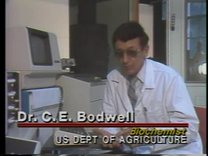
00:06:38 That's when agriculture department chemists entered the picture.
00:06:41 Once we found out what was in the residue, then we said, well, look, this might work
00:06:46 out very well for agricultural uses.
00:06:50 Then followed five years of extensive greenhouse, field, and feeding studies.
00:06:54 The findings?
00:06:55 Plants can absorb the ash's chemical nutrients, and fed to plants, animals show no adverse
00:07:00 effects.
00:07:01 Cadmium, a heavy metal in the ash, which could be toxic in quantity, did show up in oats,
00:07:06 but not high enough to be significant.
00:07:08 Overall, the research is encouraging.
00:07:11 So far, it looks very promising that we'll be able to utilize this in our agricultural
00:07:18 situation.
00:07:19 But to be certain, two more years of studies are ahead on plants and animals.
00:07:23 If no harmful buildups are found, then the ash, as a fertilizer, might well help hasten
00:07:28 wider adoption of the very process that produces it, a coal-burning technique that reduces
00:07:34 acid rain.
00:07:35 On the Science Scene, I'm Alan Smith.
00:07:58 For pilots landing on an aircraft carrier, a non-skid deck and a solid arresting cable
00:08:21 are their vital sea legs.
00:08:22 But that non-skid deck coating takes a tremendous beating from the cable and tires, a beating
00:08:27 of much concern to the Navy.
00:08:30 The two prime concerns of ours are the service life of the non-skid coating and damage to
00:08:36 aircraft engines as a result of non-skid coating chipping off the deck and being drawn into
00:08:41 aircraft engines.
00:08:43 There's damage to aircraft in the area of over three million a year just in the Atlantic
00:08:47 fleet.
00:08:49 The current non-skid material is replaced on each carrier about twice a year at a cost
00:08:55 of three million dollars for the entire fleet.
00:08:58 Those kind of dollar figures sent paint chemist Larry Kraft and his fellow scientists to work
00:09:02 at their Naval Research Lab in Washington, D.C.
00:09:06 They began looking for a tougher, non-chip deck coating, and preliminary results indicate
00:09:11 they've found it.
00:09:12 Nothing exotic, but a new mix of known materials.
00:09:15 A coating that powders instead of chipping, and one strong enough to last a year before
00:09:20 resurfacing.
00:09:22 The new material has passed the most critical test with flying colors in competition with
00:09:26 a current coating.
00:09:28 We take a two pound steel ball and drop it from a height of eight feet, twenty-five times
00:09:33 on a six by six inch steel panel, and then probe to find what paint has been removed
00:09:38 by the ball.
00:09:40 The current materials show between thirty and ninety percent intact, whereas the new
00:09:45 material shows ninety-five to a hundred percent.
00:09:48 Sea trials are next, and if this new non-skid coating holds up well under actual pounding
00:09:53 from jets and cable as it has in the lab, then the U.S. taxpayer stands to save no less
00:09:59 than six million dollars a year.
00:10:02 On the Science Scene, I'm Alan Smith.
00:10:18 Today, some six thousand U.S. homes are electrically powered by solar cell arrays of crystal silicon.
00:10:46 The number might be far greater, but for the present cost of making such photovoltaic
00:10:50 cells, they're produced in a limited batch mode.
00:10:53 Well, at the present time, the cost per kilowatt hour of a silicon cell system is between ten
00:10:59 and twenty cents, and the cost of conventional electricity is between five and ten cents.
00:11:05 Fraser Russell heads the University of Delaware's Institute of Energy Conversion.
00:11:09 The research lab, with federal funding, is among those exploring concepts for mass-producing
00:11:14 thin-film solar cells.
00:11:16 The aim?
00:11:17 To bring the cost of solar electricity for the home within the range of utility-generated
00:11:21 power.
00:11:22 One demonstrated approach relies on a chamber in which a cadmium sulfide-based material
00:11:27 called CDS becomes the semiconductor when it's vaporized onto a moving sheet of thin
00:11:33 metal.
00:11:34 We first load the material into the source, which you can see at the bottom of the deposition
00:11:42 unit.
00:11:44 We then load a reel of zinc-coated copper into the drive mechanism on the door of the
00:11:52 unit.
00:11:53 The unit is then shut, the temperature is brought up, and the material is deposited
00:11:59 on the backup sheet.
00:12:02 After the deposition has been completed, we cool it down, open the unit, and take the
00:12:09 semiconductor material out and make it into modules.
00:12:14 A finished module would be layered with a current-collecting grid and an anti-reflectant.
00:12:19 The CDS-based coating is but one possibility.
00:12:22 It's ten percent efficient in converting sunlight, while batch-made crystal silicon can reach
00:12:26 17.
00:12:28 Research goes on with other materials and modes for greater efficiency and durability.
00:12:33 But the point Dr. Russell stresses is that the key to widespread use of solar electricity
00:12:38 is in the capability and the commitment to mass-produce solar cells by the millions of
00:12:44 feet.
00:12:45 On the Science Scene, I'm Alan Smith.
| Property | Value |
|---|---|
| Creator of work | |
| Format | |
| Genre | |
| Medium | |
| Extent |
|
| Language | |
| Subject | |
| Rights | In Copyright |
| Rights holder |
|
| Credit line |
|
Institutional location
| Department | |
|---|---|
| Collection |
Related Items
Cite as
American Chemical Society. “On The Science Scene: Series 1.” U-matic (tm), 1980. American Chemical Society Audiovisual Collection. Science History Institute. Philadelphia. https://digital.sciencehistory.org/works/6dwz39y.
This citation is automatically generated and may contain errors.