
On The Science Scene: Series 6
- 1980

These captions and transcript were generated by a computer and may contain errors. If there are significant errors that should be corrected, please let us know by emailing digital@sciencehistory.org.
Transcript
00:00:30 From college newspaper cartoonist to renowned scientific artist seems quite a transition.
00:00:50 But in the 50 years since his college days, Irving Geis indeed has achieved worldwide
00:00:56 recognition for his remarkable interpretations of the submicroscopic realm of chemical and
00:01:01 biochemical processes, the realm of atoms and molecules.
00:01:06 His artwork, which he produces in his New York City apartment studio, has appeared in
00:01:10 hundreds of textbooks and journals and in such prestigious magazines as Fortune and
00:01:15 Scientific American.
00:01:17 His is a most unusual field of art.
00:01:19 I want to give the feel of the mood of the molecule or the mood of the research or its
00:01:25 significance in some way and I try to do that by color and by lighting, by giving it
00:01:30 style if you will.
00:01:32 But within that is the accurate representation of the molecule itself.
00:01:38 Irving Geis acknowledges that his technique is often compared to the surrealism of Salvador
00:01:42 Dali.
00:01:44 While there is that quality, Geis' art is carefully developed from molecular models,
00:01:48 mathematical calculations and extensive conferences with scientific experts.
00:01:54 This he's able to bring to life in accurate three-dimensional artistry such complex structures
00:01:59 as the chemistry of blood.
00:02:01 Students may be familiar with his work in collaboration with chemist-author Richard
00:02:05 Dickerson of UCLA's Molecular Biology Institute.
00:02:09 Together they've produced a series of textbooks on the principles of biochemistry.
00:02:14 With his rare talent, Irving Geis shows that it is possible to blend scientific precision
00:02:19 with artistic beauty, or as he modestly characterizes it,
00:02:24 It's a little like a good portrait.
00:02:25 That's both a likeness and still a mood.
00:02:29 So it's possible to be both accurate and fanciful at the same time.
00:02:34 Artistry in chemistry, understanding science through the art of Irving Geis.
00:02:39 On the Science Scene, I'm Alan Smith.
00:03:19 In this red hot oven at the National Bureau of Standards, research chemists are cooking
00:03:28 powdered chemicals at almost 3,000 degrees Fahrenheit.
00:03:32 The scientists and American Dental Association research team are producing a new kind of
00:03:37 cement for repairing teeth and bone.
00:03:40 They call it a natural cement.
00:03:42 We call it natural because the cement is biocompatible with living tissue.
00:03:47 Basically cement is a mixture of two calcium phosphates which, when combined, forms the
00:03:52 principal mineral that actually makes teeth and bone.
00:03:55 The cooked material, when cooled, finely ground, and then mixed with water, sets up fast in
00:04:00 10 to 15 minutes, much like Portland cement.
00:04:04 The research chemists are now testing it in a variety of uses.
00:04:08 The cement can be injected as filler material into the sockets left when teeth are extracted,
00:04:13 or it can be used to plug root canals.
00:04:15 As new bone, it can replace that lost from periodontal disease.
00:04:20 Or molded, it can be used to build up the shrunken jawbone of a denture wearer.
00:04:25 Since the cement maintains its shape attached to the jawbone, it's felt to be ideally suited
00:04:29 for such purposes.
00:04:31 While Dr. Chow says it may take at least another two years to complete clinical trials, and
00:04:36 five years until the cement is approved for use, he's enthused about its possibilities.
00:04:41 Besides its quick-hardening properties, unlike other materials which will require bone to
00:04:46 grow around it, this material actually becomes part of a bone.
00:04:51 Chemistry and Dentistry, producing a new kind of dental cement, a natural kind for repairing
00:04:56 teeth and bone.
00:04:57 On the Science Scene, I'm Alan Smith.
00:05:42 The Fourth of July just wouldn't have the same zip, bang, and sparkle if it weren't
00:05:51 for the inventive artistry of the professional pyrotechnicians.
00:05:56 Pyrotechnicians are people like those at Zambelli Internationale in Newcastle, Pennsylvania.
00:06:01 They both manufacture fireworks and produce fireworks displays.
00:06:05 While fireworks are fundamentally gunpowder explosions, the artistry involves choreographing
00:06:10 spectacular displays built around a variety of chemical reactions.
00:06:15 It's this combination that produces the oohs and aahs from an appreciative audience.
00:06:20 Chemical mixtures which burn readily and give off bright, distinct flame colors provide
00:06:24 a spectacular visual effect associated with fireworks.
00:06:28 Charcoal and iron give beautiful gold sparks.
00:06:30 Strontium compounds burn with a deep red flame, while barium nitrate gives a bright green color.
00:06:36 Blue, however, is the most difficult color to produce, and the search continues today
00:06:40 for a chemical mixture that will produce the deep blue flame.
00:06:44 The different effects created, both in color and form, depend on how the fireworks are made.
00:06:50 Once the fireworks maker chooses the colors he wants, the appropriate chemical powders
00:06:54 are compressed into small pellets called stars.
00:06:57 A Roman candle may contain several of these stars, which are shot out one at a time, while
00:07:02 a large aerial shell will contain hundreds of stars, each of which leaves a trail of
00:07:06 a brilliant color in the sky when the shell explodes.
00:07:09 Most of the effects in aerial fireworks are created by different combinations of stars
00:07:13 and what we call salutes, which are large firecrackers.
00:07:16 Today, the most elaborate fireworks displays are produced by the licensed professionals.
00:07:21 Theirs is a field that combines both science and showbiz.
00:07:25 Not only must they understand chemistry and physics, but also possess the aesthetic sense
00:07:30 necessary to create what, in effect, amounts to a full symphony of sight and sound.
00:07:37 On the Science Scene, I'm Alan Smith.
00:08:24 Scientists are preparing to screen the DNA in this man's blood cells to learn if he's
00:08:28 carrying defective genes.
00:08:30 Chemists call the DNA molecule in each of our cells the genetic code of life.
00:08:35 If any part of this complex DNA chain is flawed, it could trigger one or another hereditary
00:08:40 disorder, from diabetes to muscular dystrophy.
00:08:44 Thus, genetic screening, a relatively new biochemical technology.
00:08:49 Scientists have synthesized genetic probes, which will detect abnormal genes that represent
00:08:57 genetic diseases, or propensities toward problems which are of genetic origin.
00:09:05 Genetic screening done manually can take more than a week, but Dr. Ledley, developing a
00:09:09 computerized robotic chemical procedure, has cut the process to little more than a day.
00:09:15 He can investigate eight different gene sequences simultaneously.
00:09:19 The patient's DNA is spread in a gel onto the fingers of a plastic frame.
00:09:23 Its molecules are then separated electrically, and the material dried in a microwave oven.
00:09:28 Next, it's combined chemically with radioactively tagged gene probes.
00:09:33 If the patient's DNA contains a target gene, a probe will stick to the DNA.
00:09:39 The material is then washed, again dried, and finally scanned electronically for any
00:09:44 radioactivity.
00:09:45 If there is, it means a target gene is present, one that may be defective.
00:09:50 Dr. Ledley sees the day when the automatic gene analyzer is commonplace in the doctor's
00:09:55 office as a chemical diagnostic device.
00:09:58 And beyond that, a day when gene therapy may lead to treatments and cures for illnesses
00:10:03 now thought incurable.
00:10:05 I think the genetic therapy will be just as important, if not more important, than antibiotic
00:10:10 therapy, which of course has prevented untold millions of deaths from bacterial diseases.
00:10:17 On the Science Scene, I'm Alan Smith.
00:10:47 America's leather industry, confronted by higher costs and stringent air pollution regulations,
00:11:09 faces tough competition from overseas.
00:11:12 Foreign nations processing hides from the U.S. turn them into finished products, usually
00:11:17 for a lot less than they can be made here.
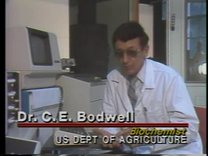
00:11:20 Now though, chemists from the Agriculture Department's Research Center in Philadelphia
00:11:24 have developed a new leather coating and curing process.
00:11:27 Said to be both cost-cutting and pollution-free, it's a method that may return the competitive
00:11:32 edge to the U.S.
00:11:34 As we see in a laboratory-scale demonstration, ultraviolet light ingrains the leather with
00:11:39 previously applied chemicals as the leather passes along a conveyor belt.
00:11:44 Unlike conventional processes, no heating ovens are required.
00:11:49 All we have to do is apply our coatings by spray or roller coating, and then shine high-intensity
00:11:55 ultraviolet light upon the surface.
00:11:59 Reaction is instantaneous, cure is effective immediately, and no solvents are involved.
00:12:04 Or release to the air.
00:12:06 The simple process that infuses the chemicals produces leather with excellent physical properties.
00:12:12 Tests for durability show the radiated leather holding up just as well as that treated conventionally.
00:12:16 Moreover, the new chemical ultraviolet light process has already been upscaled and tested
00:12:22 commercially at a leather plant in Massachusetts where these shoes were made.
00:12:26 Officials there feel the process, if broadened to include a wide range of leathers and finishes,
00:12:31 could greatly benefit the U.S. leather industry.
00:12:34 And that's what Dr. Skolnick and his team are working toward now.
00:12:38 Already though, they've accomplished their basic goals.
00:12:41 There were two aims we were out to achieve.
00:12:44 One was reduction in air pollution, and the other was to cut down on energy requirements.
00:12:50 Our process achieves both of these things.
00:12:53 A new scientific twist, chemically processing leather using ultraviolet light.
00:12:59 On the Science Scene, I'm Alan Smith.
| Property | Value |
|---|---|
| Creator of work | |
| Format | |
| Genre | |
| Medium | |
| Extent |
|
| Language | |
| Subject | |
| Rights | In Copyright |
| Rights holder |
|
| Credit line |
|
Institutional location
| Department | |
|---|---|
| Collection |
Related Items
Cite as
American Chemical Society. “On The Science Scene: Series 6.” U-matic (tm), 1980. American Chemical Society Audiovisual Collection. Science History Institute. Philadelphia. https://digital.sciencehistory.org/works/j14gbyn.
This citation is automatically generated and may contain errors.