
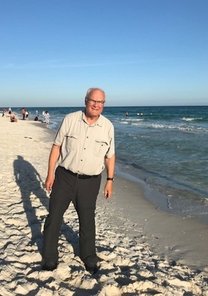
Oral history interview with Igor Goljer
- 2022-May-04
- 2022-May-10
- 2022-May-26
- 2022-Jun-01
Oral history interview with Igor Goljer
- 2022-May-04
- 2022-May-10
- 2022-May-26
- 2022-Jun-01

Igor Goljer was born in Bratislava, Czechoslovakia (now Slovakia). His parents worked in banking and his mother later became an economist in the health care industry. Learning languages, including Slovak, Russian, German, and English, was a big part of Goljer’s education, and his English teacher, Livia Hrozienčíková, made an impact on him. Outside of school, Goljer would play with his brother and other children in the neighborhood.
In high school, Goljer developed an interest in math, physics, and chemistry. He participated in chemical, mathematical, and physical olympiads. He also enjoyed drawing and painting. Religion was not completely suppressed by the Communist Party, and Goljer was raised Lutheran. Goljer remembers seeing tanks and hearing planes in August 1968 when the Soviets invaded Czechoslovakia following the Prague Spring.
Goljer attended Slovak Technical University in Bratislava to study physical chemistry and chemical physics. Goljer excelled in school. His undergraduate education was four years, followed by a fifth year to complete a master’s degree. Goljer’s master’s research was focused on describing the energy levels of dioxetane.
After graduating, Goljer was looking for books in a bookstore one day when he met his wife. They began dating and continued to date while Goljer completed his service in the Czechoslovak military. During his military service, he learned about chemical weapons and how to protect troops from chemical warfare.
Goljer was hired as an assistant professor in the physical chemistry department at Slovak Technical University. In that position, he taught classes in physical chemistry. During his time as an assistant professor, he also worked on a PhD, studying under Ladislav Valko.
Goljer’s PhD studies were focused on the composition of dioxetane and light created by the decomposition of dioxetane. He received code from Michael James Steuart Dewar, learned the computer programming language Fortran, and used punch cards to carry out his work. He also employed perturbation theory and Liouville theory in his research. In addition to Valko, Peter Pelikán and Vojtech Kellö provided guidance about his research. Goljer explains that his work on optimization of energy levels on a broad surface was novel work.
As he was finishing his graduate studies, Goljer was offered a position in an NMR lab. To learn about the lab equipment, Goljer traveled to the United States to train on JEOL and Varian instruments. At Brooklyn College, he worked with Vojtech Fried. Goljer then traveled around the country for equipment training with his colleague Miroslav Vida.
After returning to Czechoslovakia, Goljer set up a lab and worked as a Nuclear Magnetic Resonance (NMR) spectroscopist. Goljer and Tibor Liptaj studied classical analytical chemistry and two-dimensional Fourier transform NMR spectroscopy, using what they learned to write the book New Methods in Fourier Transform NMR Spectroscopy in Liquids. Goljer and Liptaj used simple descriptions of methods to make them accessible to a broad audience.
Eventually, Goljer saw the need for more advanced equipment in his lab, and a grant provided him with funds to purchase modern equipment. With the new instrumentation, Goljer’s lab began work on the structure and viability of human red cells. New technology also allowed Goljer to study high-resolution NMR spectra in solids through use of a probe analyzing solidstate high-resolution carbon-13 NMR spectra.
Goljer was awarded a grant from the German Academic Exchange Service (DAAD) to work in the lab of Hans Wolfgang Spiess at the Max Planck Institute for Polymer Research in Mainz. Goljer spent three months conducting research there in 1983, learning more about solid states and contributing to collaborative research.
Changes in funding opportunities and leadership positions led Goljer to explore employment in the United States. He accepted a position as a postdoctoral fellow in Philip Bolton’s lab at Wesleyan University. In Bolton’s lab, Goljer created structures with aldehydic abasic sites. After a yearlong postdoc, Goljer accepted the opportunity to continue in Bolton’s lab. He did some collaborative work with David L. Beveridge’s lab. Goljer’s notable research projects included work on aptameric DNA and proton-carbon coupling constants.
Goljer was familiar with the people at DNAgency, and when they were looking for a chemist, they reached out to him. Goljer accepted the position, utilizing his knowledge of DNA synthesis to address problems and make processes more efficient.
Varian contacted Goljer when they were looking for an applications chemist, and Goljer accepted a position based in Florham Park, New Jersey. At Varian, Goljer assisted customers in using NMR spectroscopy for DNA structure elucidation and protein structure elucidation. He learned new NMR technology as it was developed and became an expert in hyphenated technology. He began working with many customers in the pharmaceutical industry.
During this time, Goljer researched how to make two-dimensional sequences faster and he introduced the combination of liquid chromatography detection with the Hadamard transformation. He worked on limited data sets and also worked with Howard Taylor on noisy spectra. Additionally, Goljer worked on microquantities.
Goljer traveled often for his role at Varian and he eventually became a US citizen, knowing it would make traveling easier and working for government customers easier. Over time, Goljer built up a reputation with the customers he served through his position at Varian.
After working at Varian, Goljer accepted a position at Wyeth Pharmaceuticals. He managed the NMR laboratory and recorded, sent, and elucidated the structure of spectra. Goljer elucidated small quantities with the nano probe. He also purchased equipment for Wyeth and learned to use the Bruker microcryoprobe to elucidate the structures of metabolites. While at Wyeth, Goljer was involved in the development of Prevnar 13, a vaccine to prevent pneumonia. Following the transition of his work from Wyeth to Pfizer, Goljer’s time with the company ended. As Goljer looked for his next role, he did some pro bono consulting for people he knew.
Goljer accepted a research scientist position with GlaxoSmithKline (GSK), returning to the area of NMR spectroscopy. At GSK, Goljer used the expertise he had gained from his prior positions to solve structures, advise colleagues, and introduce the Bruker microcryoprobe. Goljer’s work on structures made it possible for the HIV treatment drug dolutegravir to gain FDA approval. Goljer encouraged GSK to share technology across laboratories, furthering openness and efficiency across GSK sites. He worked in collaboration with colleagues in the United Kingdom on a bacterial topoisomerase that is now used to treat anthrax infections.
During Goljer’s retirement, he has traveled around Europe and the US. He and his family have visited Slovakia, and Goljer was in Slovakia when the COVID-19 pandemic hit. Goljer gave lectures at the University of Slovakia about COVID-19 vaccines and his drug development expertise.
Goljer discusses the war between Russia and Ukraine, staying in touch with scientists in Slovakia, and pressing issues in science. He reflects on contributions he has made to the development of drugs and vaccines and to the use of NMR technology. He shares gratitude for his wife and family and his hopes for the future.
This interview was conducted remotely via Zoom.
| Property | Value |
|---|---|
| Interviewee | |
| Interviewer | |
| Format | |
| Genre | |
| Extent |
|
| Language | |
| Subject | |
| Rights | In Copyright |
| Rights holder |
|
| Credit line |
|
About the Interviewers
Sarah Schneider was a Program Associate in the Center for Oral History at the Science History Institute from 2021-2026. She had an interest in preserving and sharing immigration stories in the oral history collection. Schneider holds a BA in American Studies from Brandeis University and an MA in History (Public History track) from the University of Central Florida.
David J. Caruso earned a BA in the history of science, medicine, and technology from Johns Hopkins University in 2001 and a PhD in science and technology studies from Cornell University in 2008. Caruso is the director of the Center for Oral History at the Science History Institute, a former president of Oral History in the Mid-Atlantic Region (2012-2019), and served as co-editor for the Oral History Review from 2018-2023. In addition to overseeing all oral history research at the Science History Institute, he also holds several, in-depth oral history training workshops each year, consults on various oral history projects, and is adjunct faculty at the University of Pennsylvania, teaching courses on the history of military medicine and technology and on oral history.
Institutional location
| Department | |
|---|---|
| Collection | |
| Oral history number | 1135 |
Related Items


Interviewee biographical information
| Born |
|
|---|
Education
| Year | Institution | Degree | Discipline |
|---|---|---|---|
| 1973 | Slovenská vysoká škola technická v Bratislave | MS | Physical and Analytical Chemistry |
| 1979 | Slovenská vysoká škola technická v Bratislave | PhD | Physical and Analytical Chemistry |
Professional Experience
Slovenská vysoká škola technická v Bratislave
- 1973 to 1984 Assistant Professor, Department of Physical Chemistry
- 1984 to 1991 Associate Research Professor and Chairman of Central Laboratories, Faculty of Food and Chemical Technology
Wesleyan University (Middletown, Conn.)
- 1991 to 1995 Postdoctoral Research Associate, Department of Chemistry
DNAgency
- 1995 to 1996 Principal Chemist
Varian, Inc.
- 1996 to 2005 Senior Applications Chemist
Wyeth Pharmaceuticals
- 2005 to 2009 Principal Research Investigator, Head of NMR Laboratory
Pfizer Inc.
- 2009 to 2010 Principal Research Investigator, Head of NMR Laboratory
GlaxoSmithKline
- 2010 to 2017 Senior Research Investigator, Department of Drug Metabolism and Pharmacokinetics
Honors
| Year(s) | Award |
|---|---|
| 1983 | Scholarship from Deutscher Akademischer Austauschdienst (German Academic Exchange Service, DAAD) to study for three months as a young assistant professor at the Max-Planck-Institut für Polymerforschung (Max Planck Institute for Polymer Research) in Mainz, Germany with Hans Wolfgang Spiess studying slow motion of polymer groups using deuterium solid-state NMR spectroscopy. |
Cite as
See our FAQ page to learn how to cite an oral history.
00:00:05 SCHNEIDER: So today is Wednesday, May 4, 2022. My name is Sarah Schneider, and I am joined by David J. Caruso. We are conducting the first session of an oral history interview with Dr. Igor Goljer online via Zoom. So, Dr. Goljer, thank you for joining us today and being with us. And we’d like to just start off by hearing a little bit about your experience growing up in Slovakia and some of your memories from growing up there.
00:00:36 GOLJER: Thank you for having me. Growing up in Slovakia. I was actually born in the country which was formerly called Czechoslovakia. And Slovakia is after the two countries, Czech Republic and Slovak Republic, split. I believe it was in ’93. I don’t have exactly the date. [The date was January 1, 1993.] So growing up in Slovakia, Czechoslovakia. Born in Bratislava in the family of—my father was more or less an administrator and worker. And he was working in the finances. My mother was also working in the banking. They were from families—one family was from middle Slovakia, one family from northern Slovakia. They met in Bratislava. They have a, sort of, melting pot at that time.
00:02:02 They got married in ’49 and in 1950 I was born. At that time, it was the postwar Czechoslovakia. So there were some limitations. And also they were at times when the system was changing from former pre-war Czechoslovakia to the country which was under the influence of the Soviet Union, it was liberated by the Soviet Union, and that’s how the whole landscape was—the political landscape was moving on.
00:02:53 From early childhood, what I remember, I was visiting elementary school. The elementary school since I was six years old, in first grade, that is basically the same thing like in the US, learning basic grammar letters, how to connect them, how to speak, how to write some basic expressions. In the second grade, they started also with some foreign languages, some basic languages. It was mainly Russian. But my mom, with the money, she had a little bit left. She sent me to private lessons and learning a little bit of German. It was until my brother was born. And then the other chores started, so basically between the school and chores at home . . . . I was getting familiar more and more with the school. The basic education was the Slovak language, math, the Russian language, some basic history. And later on as education progressed, the biology in—I believe it was fifth grade, chemistry in fifth grade. Then physics. Some basics of physics were added. And it was preparation for middle school and in the middle school, all this CV, curriculum was in full scale.
00:05:31 Basically, school started in the morning at 8:00 a.m. We have to be ready. Then the classes were conducted on a forty-five-minute base and was a ten-minute break and another class started. Usually, it was one kind of a class per day. Slovak language, math, physics, physical education. And physical education was very important because children can move a little bit better. And the basics of gymnastics, basics of some games like soccer, basics of basketball was taught. So it was pretty good. And when the summer or spring started, we went outside and we were playing games outside or having some physical education outside.
00:06:54 The language is very important for me. I learned languages, basically, with teachers. We didn’t have an opportunity to travel to other countries. [Most of] the teachers were educated here in Slovakia and some of them were educated also abroad. The teachers which we had in our high school emphasized two things. It was basic knowledge, so memorizing the material, and also the logic. And logic was mostly important during math sessions and physics. Some basic physics.
00:08:09 Also, some logic was important in languages. The Slovak language is very complicated. It has a very complicated grammar, so it was not easy to cope and achieve some grades which are satisfactory for me and my parents. Basically, the grades were good. I was able to pass the exam to high school. And the high school was a general high school. So after learning some basic German during the seventh, eighth, and ninth grade, from tenth grade, I started to learn English. It was my first touch with English, which was basically like a shock. Our teacher, she [Livia Hrozienčíková] was educated in the UK. She was educated in Oxford. And her level was on an entirely different level than other teachers which I had previously.
00:09:42 What basically she emphasized is spoken English. From start on—and I didn’t know a basic word in English—she started to talk English, British English. It was Oxford English. And slowly we had to learn to react, to answer. And she also gave us some guidance. We have to basically learn from that what she was pointing at and how she was talking, the whole basic vocabulary. Besides that, she emphasized learning the vocabulary and memorizing phrases. By the end of the first year in high school, I was speaking broken English.
00:10:51 Sometimes when she needed some extra things for the class, she took me out because for some reason I was her, sort of, favorite student. She was walking next to me and we were walking on the street and she was talking English. I was answering with my broken English until we got to the store. And then we started shopping for some notebooks, for some pencils, which were necessary for the class. The second year, it was much better. In third year, basically, she was very tough that we will speak English fluently. We learned some basic chapters from [John] Steinbeck and we learned lots of songs. So it was very interesting. My English grammar wasn’t very good, but at least the spoken English was on some level that I can speak freely with anybody who was speaking British English. So that was the high school and English classes.
00:12:27 At that time, in high school, I developed also the taste for math, physics, and chemistry. Even before, in middle school, I was taking part in some chemical extracurricular training. We called it olympiads. Basically, after ninth grade in the middle school, I was awarded the third place, I think, for chemistry in the whole Slovakia. It was, sort of, such an impetus for me where to move. My other hobbies were also drawing and painting. I was visiting some art school for painting. I was pretty good at it. I had all the things open because that was pretty broad interest or they were broad interests, which I had.
00:14:10 More and more, in high school, I became focused on physics. So I was even considering to take the college somewhere where I will study basic physics and nuclear physics, or something like that. Considering all the things which were going on in industry, I chose some compromise. I went to Faculty of Chemical Engineering in Slovak Technical University in Bratislava. I was admitted there. My goal was to study physical chemistry and chemical physics.
00:15:10 The curriculum was basically given by the teachers and there was no choice, besides languages, what you can choose. So I continued, studied English language and the specification for chemistry and physics. The first year, there was some general chemistry. Inorganic chemistry, which was very important. It was theoretical inorganic chemistry. It was mathematics. It was physics. And also some basics of chemical engineering because we were trained to do, to be employed in chemical industry as an engineer and supervisor of some devices, some reactors, the production lines, and so on and so on. So that was the first year. And my grades were pretty good. I was always in the top 5 percent of the class.
00:16:57 So the second year, the classes continued with higher mathematics. Calculus, basic differential equations. Then in the chemistry, we had classes in organic chemistry. Basic organic chemistry. It was very interesting that they taught us how to put together and synthesize the product first theoretically, then also practically in the labs from some basic entities, basic raw materials. It was very interesting. The professor who was leading the class was asking me if I will join organic chemistry. I said to him, “Well, it’s very attractive, but thank you. My goal is to study physical chemistry.”
00:18:25 From the point of physics, we were given the higher basics of physics like basics of Faraday equations and Maxwell equations and some basic formulas. It was very interesting because the physics was part of the engineering training where you have to understand how the electronics, which regulates the chemical processes, is working. So you have to have a basic concept of the temperature, of the thermodynamics because that’s very important in chemistry. You have to have a concept of how to regulate temperature in reactors. What kind of different reactors you have. So it was very broad.
00:19:49 The second year, we were taught also some basics of chemical industry. How to—how chemical industry is working. How inorganic industry is working. What the raw materials are in the chemical industry. So these were the first two years. So some general chemical engineering education. Then the third year became more specialized and we were taking classes in physical chemistry and chemical physics. Higher mathematics. Quantum chemistry and quantum mechanics. So it was very theoretical, the specialization. So basically, you become quite proficient at the third year of solving some basic equations in quantum chemistry, but on a very basic level. The same thing continued in the fourth year.
00:21:35 Also, what I didn’t mention, the third year where we were obliged, because we were chemical engineers, to take the processes like [controls] in [the chemical industry]. The electronic [controls] response [to that] and also some basic mathematics associated with it. In the fourth year and fifth year, we were obliged to take also some classes about some basic [terms of law] of how to read the contracts in chemistry, how to understand the basics of economics of chemistry. So it was a very broad education, but the specialization was basically the chemical physics and quantum mechanics and quantum chemistry.
00:22:51 The fifth year, the first half-year we were ending and preparing for the final exams. Also, we were given the task what to work on and prepare like work and present it in the form of a very thick, written . . . like a thesis. And what I was given is the basics of some quantum chemistry, which was empirical quantum chemistry. So prepared the program, which was based on some semiempirical calculations of some molecules and demonstrated that I can work with this program and I can get some results.
00:24:28 After that, when we graduated . . . . [blows nose] Sorry. After graduation as chemical engineer, we had several options. Join the school or go to industry. Because I was on the top of the class, I was invited by Professor Kellö, [Vojtech] Kellö, which was the chair of physical chemistry, to join physical chemistry as assistant professor. I graduated in 1973.
00:25:26 Then after graduation, there was a short period when I was a little bit working. And then everybody was obliged to join the military. So for one year, we were serving in the Czechoslovak military and the training there was the basic military training, just to have some idea of how the military works and also some organization. I was trained to be some leader of the group of chemical protection. So we had to learn how to use the basic equipment, how to prepare the tents for the troops, how to disinfect them, how to measure the radioactivity, and all kinds of things which was necessary to do. I was also—yeah?
00:26:46 SCHNEIDER: I’m sorry to interrupt. I’d love to hear more about that in a moment. But I’m wondering if we can go back just a little bit to—back to when you were talking about your coursework and your studies. Was that both an undergraduate and master’s degree in one or what was the educational system like?
00:27:10 GOLJER: Yeah. That’s a very good question. So undergraduate and master’s degree, the undergraduate was four years and the fifth year was the preparation of the master’s degree. So it was, sort of, everything blended together. So finally, you have to prepare some work that you are able to work independently, that you are able to study literatures, that you are able to get to the basics of the problem and formulate the basic goals and to accomplish the final goal, what has to be presented.
00:28:04 SCHNEIDER: Okay. And—yeah. And when you were early in your education, when you were a child, you know, you talked a lot about the different classes. Were you—were there certain classes when you were very young that you enjoyed? Was it PE or some of those science classes when you were young, or was it . . . . I’m just, kind of, curious, when you were a child, what your interests were.
00:28:30 GOLJER: Well, when I was . . . . In early education, what I enjoyed is drawing and painting, mostly. The Slovak language was not one of my favorites because it’s very difficult and it was lots of rules about lots of exceptions, I will say. To speak correctly Slovak, you have some basic rules and you have lots of exceptions, and that’s why it wasn’t my favorite language. The more favorite thing, which was the German and, sort of, easy to learn the Russian.
00:29:26 Mathematics in my early education was just basic numbers, adding, subtracting, and quickly multiplying. I was not enjoying that at all. When I started to enjoy mathematics when, in fifth grade, we started with some basic equations, like linear equations and one variable and solve it and some formulation of the problem from the given task. Like, for example, one train is moving from point A to point B with the speed of that, and another train opposite is moving from another and they meet and all kinds of things. You have to form, sort of, equation and solve the problem. So that was what I was enjoying. I also, besides, from an early age, I was looking for the literature where these kind of equations were given. And at that time, the literature, which was also translated literature, was mostly in Russian. Because all the books—and it was also in the later studies—there was, sort of, agreement between the US and the Soviet Union that the US was translating all the scientific journals to English and Russia was translating all the scientific journals and also some important books into Russian. But there was also some basic Russian literature in mathematics and physics, which was pretty enjoyable to read.
00:31:59 But it was when I was at the age, like, fourteen, fifteen years old. At that time, at the age of fourteen, I was first exposed to some challenges in mathematics to participate in some olympiads, and you have to always learn something more to be ahead of the class.
00:32:34 But beside that, as a child, you are allowed to go outside and allowed to have some physical activities. So at that time, I was taking my brother who was, like, three, four, or five years old, and we were enjoying the outdoors. We were also living next to an area where the students from the colleges were training, and we were going there watching how they were training and how they were running and jumping. The childhood was not very organized. Mom was working. Dad was working. And after school, you have to just fill your activities the best you can and don’t do anything that the parents will not be proud of you. And how to avoid the problems, you see. [laughter]
00:33:49 CARUSO: So if you don’t mind my asking, you’re growing up in a very interesting time in Czechoslovakia, right? I know that [. . .] prior to the Second World War, the country had lost territories to Hungary and other neighboring countries. And then after the end of the war, there was, sort of, a reunification of the country. But you’re also going into the Soviet Bloc. Your parents, where were they during the Second World War? Had they been—were they born in Czechoslovakia? Had they migrated there?
00:34:34 GOLJER: Yes. They were born in Czechoslovakia. Mom [Anna Jarolinova] was born in 1924 in the small village called Horné Naštice. And my dad [Arnost Goljer] was born in 1923 in the little town called Rajec. And at that time, it was Czechoslovakia. Already after 1918, Czechoslovakia was formed. So when the Second [World] War started, they were in the age when they were attending the high school. How it affected. After 1938, ’39, Czechoslovakia— Czech part was occupied by Germany, Nazi Germany, and Slovakia declared an independent Slovak state. So it was like a puppet state of Germany. So I am always laughing that Slovakia also was forced to declare the war later on when the United States joined the alliance and declared war on Germany. So at that time, what my mother was telling me, she was traveling from her village to get the higher education in the city of Trenčín. And she was visiting the school where she has to become, like, accountant on a high school level. Unfortunately, as the war passed on and the fighting started, she was not able to finish the education. After the second year, she was forced to stay at home and to help [her] parents with—they were small farmers and her father was a small farmer and also working in the factory, which was nearby. It was a factory producing some kind of walking sticks or some furniture. So my mom was forced to stay there.
00:37:53 My father, he was finishing education in Žilina. It was a high school education. And at that time to finish a high school education, you became almost as a college graduate without a degree. So you had to learn French. My mom had to learn German because of accounting. My father was born in the family which wasn’t agreeing with the trend of how the country was going. He was born in a Lutheran family, and Lutherans were not part of the old Nazi propaganda. So they were not very happy with what was happening in the country.
00:39:14 And when the uprising started, my father was basically a student and it got him in Žilina, and he joined as a student to helping to tend for the wounded partisans and stuff like that. He—as I can remember, he got also this small identification that he is part of the unit. He was remembering very tough times when the Germans were approaching the city of Žilina and it was taken over and he has to tend for some wounded soldiers. But after that, what he has to do, he has to basically burn his ID and start thinking how to get home to his village of Rajec.
00:40:38 But he was caught. He was taken to interrogation. Of course, he knew from the friends what were the news. And he was telling, “Okay, I was going home for some kind of wedding. I was called here so I was forced. And blah, blah, blah.” And the Nazis sent him with the letter, which he has to carry to the authorities in the riots. Of course, when he opened it, it was, “He’s lying. Shoot him and whatever.” So he had to disappear.
00:41:29 He had to disappear. And he somehow got to Bratislava. He was hiding there with his friends which were from the same town. And that’s how he survived the end of the war until liberation by the Soviet Army. Our family—also, my uncle was involved in the uprising. He was drafted to the Slovak Nazi army. He was on the eastern part of Slovakia when uprising came. The Germans came and basically took their weapons and dispensed the units. So they have to go back, walk miles to middle of Slovakia and join the uprising there. Uprising lasted for about two months and they were hiding in mountains. Somehow, he survived.
00:42:54 And he was talking about these stories to me, what I remember. So our family was, sort of—I was born to the family which was on the other side of the fence at that time. It also contributed to my further opinions about the Nazis and Germany and everything what was continuing there.
00:43:30 CARUSO: When—again, I’m not too familiar with where battles happened and near the end of the war. Was there any physical destruction? Buildings knocked down, bombs dropped, things shot up in that area during the war? Or was it left relatively physically intact even after Russian liberation?
00:44:03 GOLJER: Talking about Bratislava, Germans were planning to put a very strong defense against the Soviet army. Bratislava was also bombed by British and United States forces, but it was the industrial part where the oil refinery was. So the oil refinery and the port was destroyed because there was important port carrying oil from Romania to Bratislava for refining and providing oil for Nazi troops. So it was completely destroyed. Some of the buildings in Bratislava were hit. I remember my mother was telling me that one building, which was the bank, was hit by a bomb, but the bomb didn’t explode, somehow. So Bratislava as the city was relatively intact. The bridge also was destroyed between Hungary and Bratislava by Nazi troops between Austria and Bratislava.
00:45:42 And the Soviet Army, basically, it didn’t fight [viciously] because the Germans, as they were encircled by [Germans] from the south and from the north, they [the Soviet Army] withdrew without too much fight. But anyway. In Bratislava, there were about 2,000 fallen Soviet soldiers liberating Bratislava in fighting Nazi resistance. So Bratislava was not so much destroyed. Much worse were the villages in the northern part of Slovakia during the uprising, when the Nazi army basically came and wiped them out. So about—the numbers vary between 27,000 up to 50,000 of Slovak citizens which were joining the uprising were basically eliminated by Nazi forces and also this collaboration with the Nazis, which were called Hlinkova garda.
00:47:11 The memorials are all over the country and, you know, it was the time when a country after the Second World War needed to be rebuilt. So after that, the country was unified with the Czech Republic, the parts of the occupied Czechoslovakia by Hungary, Poland, or other countries were joined back and the Czechoslovakia was basically rising from the ashes.
00:48:03 CARUSO: So how did your family feel—I mean, Czechoslovakia was an independent state. I think it declared its independence in 1918, originally?
00:48:15 GOLJER: Yes.
00:48:16 CARUSO: So there is a history of being independent. And then you’re brought back together at the end of the war and immediately go into becoming part of the Soviet Bloc. And so I’m wondering, was there—how your family felt about being part of the Soviet Union? I know you said that the Soviets were—the Russians were greeted as liberators. So there’s that thankfulness. So that way they were no longer part of the German Nazi machine. But I’m wondering, in, at the time that you were growing up, was there an embrace of the Soviet lifestyle? Was it just the way things were and people were going about their daily lives? Was there frustration at being part of this larger Soviet bloc? I’m just curious to know what it was like when you were growing up for your family in relation to the country’s history and where it was at that moment in time.
00:49:20 GOLJER: Well, because my family, my father and my uncle, joined the uprising and there was a lot of Soviet partisans and support from the Soviet Union, at the beginning, they felt very well, these are the liberators. And basically after the Second World War in 1945, the Czechoslovakia was, sort of, left alone. There was still the renewed political parties, strong political parties, like the Communist Party, there was still a strong Socialist Party, Democratic Party. And there was, sort of, the political struggle going on.
00:50:22 But after—slowly, the Communist Party became the most powerful party because Russians provided the grain, although the Soviet people were starving. But as part of the propaganda, they were providing the grain and the life was actually getting better. So people didn’t feel like they are going to be part of a very strong bloc.
00:51:02 And when the—I think in 19—up to 1950, ’49, 1950, there was not such a strong political grip of the Communist Party. But as Stalin grew older and before the death of Stalin, the grip and the prosecutions of some—even the Party members—became more obvious. And some of the Party members were arrested as nationalists, like Gustáv Husák. Some of them were executed. But as a child, you don’t know about it. This was everything till 1953.
00:52:04 And my father has to be very careful of what he has to say. Basically, if he wants to be part of the, sort of, there was a strong move to integrate everybody as a Party member. So he became the Party member and he basically has to join the Party. So it was—and he was very cautious about what he was doing and how he was behaving to the people. And he was saying to me always, “If you can’t help people, you don’t try to harm people. So you don’t do anything.” And that was, the whole life, his credo.
00:53:11 CARUSO: You mentioned that your family’s Lutheranism contributed to their not wanting to be part of the Nazi structure. So that’s where some of the resistance was coming from.
00:53:28 GOLJER: Yes.
00:53:28 CARUSO: Did that Lutheranism persist? So was Lutheranism part of your upbringing? Was it something that your family continued to embrace? Were they going to religious services on a regular basis? Or did things . . . . What was it like for you growing up religiously, if anything?
00:53:51 GOLJER: Yeah, that’s an interesting question. Lutheranism and also the church was not entirely suppressed by the Communist Party. They realized that lots of Party members, even from the Catholic side, were visiting the church. Visiting the church, not openly. My father, he was, sort of, like, “Okay. This chapter is over.” He was no more visiting church, but I was. My mother was visiting church. I was visiting church with my mother. I was also having some religious education up till first grade. Going to Lutheran Church and visiting Sunday School. So a lot of things were happening at that time. So people were not entirely convinced to embrace the communist or socialist ideology and to leave behind the years of upbringing of their forefathers. Slovakia is, from the religious point of view, is, like, 70 percent Catholics, 17 percent Lutheran. Then there are Orthodox [Christians].
00:55:52 Also part of Slovakia in the former Czechoslovakia, lots of Jewish religion, Jewish religious people were there. There was a strong Jewish community. In Bratislava, we have now a memorial for the school, which is part of a yeshiva school. And a Chatam Sofer [Moses Sofer] memorial. And his religious teaching, I think it’s from the [18th through the 19th] century. [He lived from 1762 to 1839]. He had a few students and there was a lot of Jewish philosophy going on here in Bratislava. [Rabbi Moses Sofer (Schreiber), also known as Chatam Sofer, started the Pressburg Yeshiva, which became a preeminent yeshiva in Central Europe.] There was also a strong Jewish community in Bratislava before and also during the Second World War.
00:57:06 The people who [had a] Lutheran upbringing helped also save some Jewish families from persecution. Priests were baptizing Jewish people in the church. Sometimes it helped. Sometimes it didn’t. A lot of Jewish were deported from Slovakia and a lot of them didn’t come back from Nazi camps. So Slovakia has, sort of, a split history. Agreeing with the Nazis on an official level, it helped temporarily the economy. Also, it was pressed on to deal with the Jewish community. And for some people who joined the official Nazi police of Slovakia, which was Hlinkova garda and they were part of the, a very active part of the persecution of the Jewish community. So they were trying to get their businesses, their property, seize their wealth. So one part was ideological. One part was, “Oh, now I can grab some property, some successful business.” They called them arizators, which were first, like, the supervisor of a Jewish business. And when the Jews were taken to the concentration camps, they became the owners of those. So these kind of things in Slovakia happened. It’s part of our history. It’s a part we cannot deny. And Slovakia wasn’t during the Second World War entirely—it was basically on the bad side of the events as it happened. So that’s why it was very complicated.
01:00:03 CARUSO: Thank you. Sarah, that’s all I have for now.
01:00:06 SCHNEIDER: Thanks. So you mentioned your father’s side of the family being Lutheran. What was your mother’s background like? Was she—did she grew up in a religious family and did—
01:00:18 GOLJER: Yes. A Lutheran religious family.
01:00:20 SCHNEIDER: Lutheran also.
01:00:21 GOLJER: Yes, yes, yes. At that part of the country, like, half of the village was Lutheran, half the village was Catholic. And when you go to north to Uhrovec, that was mostly Lutheran. So there were some pockets in Slovakia which were purely Lutheran areas. Some pockets which were purely Catholic. Some pockets which were purely Orthodox Church also. So the religious—religiously, the country was very diversified.
01:01:11 SCHNEIDER: And were there certain celebrations or cultural events during the year that the country maybe as a whole celebrated or that your family celebrated?
01:01:25 GOLJER: Christmas. Christmas was celebrated no matter what. Easter was celebrated no matter what. So even during the time of socialism, these religious celebrations were basically part of the culture of Slovak and Czechoslovak culture. So Christmas tree and the presents and going to church, going to services. So that was part of the whole picture, how the country was.
01:02:17 There were also some small businesses during the time of socialism. First, the agriculture was very farm-oriented before 1953. After 1953, what happened in the country [was] that there was a push for creating cooperatives. The food—how to improve the—increase the production. So they were considering something like Soviet or American farms where you have many cows in one farm and you have the milking machines and you have combines which can harvest the crops and being more effective.
01:03:39 So the push was putting all these farms together. Also, they become the cooperative members. Yeah, the relationship was like some of the farmers joined voluntarily. Some of the farmers were forced to join. My family, they didn’t have too much land. They joined voluntarily. My uncle, he was a, basically, furniture builder. He created his own business after the Second World War. Small shop where he was producing the kitchen furniture and also the bedroom furniture. So he created that shop nearby in Bratislava. He became quite a wealthy man after, in two or three years. Yeah. But then, basically, all this or he has to give in this shop voluntarily and they build a factory based on that. He became part of the leadership of the factory because of his experience, how to build the furniture.
01:05:28 My family in the village, they became part of the cooperative. Basically, who stayed in the village was my uncle. One uncle. His name was Joseph. Another uncle, Mike, he was first a shop proprietor. Then later on he was a worker in the factory, factory producing some trucks, Tatra. My father, he got a—he finished, I think it was in 1960, he finished the college education. He became an economic engineer. And there was a lack of highly educated people. And he had also some experience with the law. He joined the Ministry of Finance and later on he was transferred to the city as the guy who was budgeting everything for the city of Bratislava. So that was basically how it happened with my family.
01:07:13 My mother, in between, because she didn’t finish the education, she finished the education when my brother was growing up. So she finished her high school education and she became an economist. And she joined the health care industry in Bratislava. She was very meticulous. She was very organized. So she was part of the budget team. Later on, she became the head of the budget team budgeting the health care for about 5,000 employees, which was the health care of Bratislava and the whole and part of the Slovakia. It was a—growing up, seeing how my parents were struggling, how my parents were studying, taking care of my brother and taking care of my needs and my education. So that was the background.
01:08:45 SCHNEIDER: And so did your parents really encourage your education? Did they—is that something they talked about, or do you think it was more seeing their—seeing them and how they lived their lives that—do you think that had an impact on you in any way?
01:09:03 GOLJER: Oh. They had expectations that I become college educated and then my brother will become college educated. So my brother is a medical doctor and PhD in medicine and I became an engineer. So they encouraged that. They didn’t force us to do any kind of stuff which we didn’t want to do. Sort of, it was expected to get good grades. They were not very—they were not really saying, “Oh, your grades are great and blah, blah, blah.” When I was bringing the final grades, they were looking at it, then just smiled and that was it. That was the reward for the year of work, and it was, sort of, expected. It wasn’t too much fuss going on about that.
01:10:28 So my brother, he learned quite a bit from me because I was the older brother. He was a very curious person. And he had an excellent memory. So first, I had to read to him and then he was, like, five years old and he had such a good memory that anything what you told him once, he remembered it, or what he read, he remembered it, like almost a photographic memory. And he had also fantastic logic. So these two parts of him . . . . He had no problems to finish anything what he wanted. For me, it was, sort of, searching, what is the best for me? Where I will find the best possibilities. After I finished my education, I became assistant professor and also I was studying the PhD.
01:11:50 SCHNEIDER: Yeah. And I want to hear more about that time in a bit as well. But first, I’m curious . . . . I just had a thought, and it just escaped me. You were talking about your education and your brother and . . . . Well, I guess I’ll ask, when you were growing up, did you have friendships and peer relationships? What was that like of people who you were friends with?
01:12:26 GOLJER: Oh. When I was growing in Bratislava, during the school year, I was in Bratislava. During the vacation, I was growing in with my—my parents brought me to the village [Miezgovce] where my grandmother [Anna Holičkova] lived. And I was there for about two months helping Grandma with the chores that she has to do. During the time when I was in Bratislava, you basically live in the block, and there were several families living in that block. As I remember, from my block, there was one older boy who was much older. He was about five years older. His name was Juraj [Križan], George. Another boy, he was about three years older, John [Jan Luky]. Also another, he was his peer, Peter [Tomasovič]. And we were like friends. I was the youngest. I was, sort of, given the task of what to do and how to become the friends. And I was like a little soldier. [laughs] But I learned a lot and at that time, being part of the, sort of, clan, it was, sort of, friendship. It also meant that you behave a certain way. You behave a certain way and you were playing— we were playing. They were teaching me how to play soccer, how to play hockey, how to wrestle. So wrestling with spears. Luckily at that time, in the front of our apartment complex, they finished the park and we were running around that park. Before that, it was running around the area where the buildings were risen. So it was a lot of danger also involved there.
01:15:36 I remember there was also a lot of danger playing on the street. One of the boys during the wintertime when there was ice on the road, he got a crazy idea that he will start to hook on the truck and it will push him. Unfortunately, he slipped and he ended up underneath of the rear wheel and he died. And it was also part of the learning experience that you have to be careful. You have to think about it, where you go, what you do. There were no precautions. There was some fence, which as boys we liked to jump the fence and go to the building site and play there and be part of that, as in the bunkers or in the . . . . So, you know, this is how we were growing up. I’m wondering how we survived at the end of the day.
01:17:13 The same experience I have when I am talking to my friend in New Jersey, Ivan [Skala]. He was later my classmate in high school. He also experienced the same way. How growing in Bratislava, it was on the edge. For boys, it was pretty dangerous. Also for girls, but the girls were more cautious. They were playing a separate way and it wasn’t like—boys were more like hockey, soccer, where you can go, where you can jump, how high you can jump. So later on, it became more organized as we were in high school, where we had physical education.
01:18:18 SCHNEIDER: And you mentioned the olympiads. So I’m wondering if you could talk a little bit about what participating in the olympiads was like. If you remember any of the competitions or preparation for those olympiads.
01:18:38 GOLJER: Yeah. I started with olympiads, I believe it was in eighth grade, of my middle school. It was first the chemical olympiad. The teacher, sort of, prepared us for that. If you want to be a member of the team, you have to have certain grades. You have to have a certain . . . . You have to like it.
01:19:20 He was showing some experiments and one of the most attractive experiments, which is also quite very dangerous. It’s basically now forbidden in the elementary class. It was taking sodium, metal sodium, and putting it into the flask of water. What it does is it basically runs around on the top of the water and creates the vapors and sometimes it catches the flames. What is going on, there is a strong reaction going on creating sodium hydroxide and the water is decomposing, releasing the hydrogen.
01:20:23 When you are not careful, and you have the piece of sodium, which is not shiny already, but it is white. It is sodium peroxide there. Once you put it in the flask of water, it explodes. And it explodes, and if you don’t have a shield on your face, the sodium is on your face and it reacts. That was very attractive. It was very attractive, what is the chemistry behind it? Also, part of the experiment was you put some color there, it was pink, and then it turns blue as the sodium hydroxide was created. Later on, we were instructed to stay away, to put some shields, to wear a laboratory coat. So this was the part of the attraction which basically attracts the young chemists.
01:21:52 Later on, less dangerous experiments, like creating some compounds, calculating the yields, doing some reactions. And it was part of the preparation of olympiads. Also, solving some chemical equations and problems, like equalizing the equations. Once you pass these preliminary exams, you were able to join the second round of olympiad, which was usually in a specialized school properly equipped with the hoods and everything. In that first year in eighth grade, I didn’t get too far. But in the ninth grade, I was very successful. And I was getting from the local grade up to the whole of Slovakia or Czechoslovakia level, and I was able to compete there and I was able to get the third place and award. That was the attraction, which basically is behind the chemistry.
01:23:27 At that time, I also participated in mathematical olympiads and physical olympiads. The mathematics, it was just not too specialized in the level where we had it. There were some specialized mathematical schools in Bratislava where they were teaching specialized mathematics, preparing people how to solve the problems. That was my drawback. I have to figure out everything by myself and it takes time. The solution is a little bit lengthy, so I did get to the second level or third level and I didn’t get too far.
01:24:19 In physics, I was a little bit more successful. But in physics, basically, also it takes some specialized education. I got more proficient, especially in physics and chemistry in high school. Also in mathematics. And in mathematics, I was always on the top of my class. I was always on the top of my school in physics.
01:24:59 The teacher, she was a—she knew that I was able to cope with a little bit more material, so she gave me some higher-level tasks and she pointed me to the way how I solve the problems. So that’s why it was interesting. That mostly teachers have to deal with the level what was prescribed by the Ministry of Education, but many teachers took initiative and when they saw the student who was more proficient or interested in chemistry and physics or mathematics, they, sort of, initiated his interest that way. So that’s how it was. In high school, there were also high school olympiads. But as I was saying, in mathematics, there was no chance to get to the higher level than to the second, to the local Bratislava level because they were some very specialized schools which produced a lot of good mathematicians later on, in the colleges. They had had some—my friend [Peter Kurdel], who was also in touch [during the] school [years], he became part of the Academy of Sciences. He was involved in some discrete mathematics, and he got pretty far in mathematics, but it wasn’t my strongest forte.
01:27:33 SCHNEIDER: And you mentioned also doing a lot of language learning throughout your education, and it sounded like your parents also learned languages. So I’m wondering at home, did you speak the Slovak language primarily? Did you speak a variety of languages at home?
01:27:50 GOLJER: At home, we spoke Slovak, primarily. And when I didn’t know something, my mother was pretty fluent in German, so she helped me out. We spoke in German and she had excellent memory. My father, he was not able to help me too much because he spoke French. But he also spoke broken German a little bit. But as soon as I was in high school and started to specialize in English, there was no possibility to learn German, so I specialized in English. And every occasion what I had to read some English literature, to understand, to read the scientific literature, I was doing it.
01:29:01 I was encouraged by my teacher a lot. So she . . . . Dr. Hrozienčíková was her name. First name, Livia. She was really the teacher which I have the best memories. Also, although it was a tough time with her sometimes because sometimes we were not cooperating. So she started to be tough and the grades were going down. But I liked it. I like challenges. I like challenges and that was the time when I learned the English the best.
01:30:05 Also, at that time, I had to learn Russian. Basically, finishing a high school education means you pass one foreign language. Compulsory was Russian. Then compulsory was Slovak language and then was mathematics and physics. So you pass these four exams, which were specialized exams, and you get the high school degree and high school diploma after that.
01:30:47 During the time when you are finishing your high school degree, you also are trying to get to college. I was applying for the college like chemical engineering, faculty of chemical engineering. Because I had the good grades and also I passed the exams, I was admitted there.
01:31:23 SCHNEIDER: Did you apply to multiple schools?
01:31:27 GOLJER: No. I didn’t. I didn’t apply to multiple schools. I was very cocky at that time, so I said, “Oh, now I have to get to this school.” And, you know, the odds were pretty good. So with my degree and my education and how I accomplished the exams, I got there pretty easily. So it was in 1968.
01:32:08 SCHNEIDER: And did you—you mentioned your English teacher who made a really big impact on you. Did you ever keep in touch with her or tell her later on that you, you know, used your English education, I imagine, in the States when you came here? Was that something she ever knew?
01:32:27 GOLJER: I think by the time I came to the United States, I don’t know if she was—she was probably retired. When I was in the college, I was able to get in touch with her and I was telling her that I was, I’m able to read English literature because you have to do some research projects. And besides Russian language, you have to use English and also some German. We had a library. It was a classical library. There was no computers at that time. It was all going through journals. It was going through references and creating a web of references and what is the most important. So that was the only time when I had an opportunity to speak to her. Later on, she retired. And I don’t know when she died. It wasn’t like that. When I came to the United States, it was close to—in ’91. And at that time it was after my PhD. So that’s how it goes.
01:34:27 Another person who made quite an impact was this teacher of physics [Ms. Tokarikova]. She was very good. She was very forthcoming. The teacher whom I didn’t like so much, but I wanted to prove myself to him was teacher of mathematics and geometry [Mikulas Smetana]. He knew that I was able to achieve many things. So he paid special attention to me, giving me sometimes tasks which are—nobody can solve. Also grading me when my solution wasn’t exact. But at the end of the day, he understood that I was able to solve some examples which were not taught in the class. And I got an excellent grade also from him.
01:35:57 I remember the time when he was doing some kind of proof on the board. At that time there was no slides, so everything was on the board. So he was going from some presumptions and trying to prove something. He stopped. And he was quite open, “How the heck I’m going from here?” And because I was paying attention, I said, “Well, I think that what I will do is this.” And he was like, “Of course, get the hell out of here.” He was continuing with the proof. [laughter] But it was a funny situation. It was like competition between the teacher and the student. At the end of the day, we liked each other. We were on good terms and he recognized that I was trying to get—to do all my best and I was not trying to undermine his authority because I never tried to undermine authority of a teacher. The authority of a teacher was, for me, like the teachers always knew something what I didn’t. And I have to get to that point where I will be teaching someone.
01:37:56 SCHNEIDER: And so as you made that transition into your undergraduate education, when you—did you live at home with your family during that education, or did you actually move to a different place? Like did you have your own residence during that time?
01:38:17 GOLJER: Actually, because the college which I attended was in Bratislava and we lived in Bratislava, I was—by definition, you stay where you are. Only students which were twenty miles away from Bratislava were allowed to live in dorms and move into dorms because there were not enough dorm beds and places where all these students were accommodated. So most of the students lived in dorms. But many students in our college lived in Bratislava.
01:39:11 So basically, there were like four cities where college education—people were able to finish. It was Bratislava, it was Košice, it was Banská Bystrica, and Martin. The small city near Bratislava was Trnava, but it was mostly education, like teachers and other schools, religious education. It was interesting that also in that time, there were some religious colleges here in Slovakia. It was a religious school in Bratislava, in Trnava. And they were priests, which are students attending those religious colleges. At those times, it was under strong supervision of the Communist Party, but they recognized that new priests need to be educated. The villages needed new priests. So these kind of colleges were also—and they are now thriving also here in Slovakia. Yeah.
01:41:02 So this is how the landscape was, basically, in Slovakia. Some students decided to attend colleges in Prague. People who were going to study, like very specialized, like nuclear chemistry or physics of particles, they were going to Prague. They were part of the education. They had to be very talented. There was a chance to get there. It was like one from five students with good grades who’ve applied to get to Charles University. So it was considered the top- notch education, the Prague, Brno. And they lived in their colleges.
01:42:16 CARUSO: I have a question. Now I believe it’s near the end of your high school education before you move into or start your college education, that there’s the—I think it’s called the summer of ’68—when the Russian Army—or the Soviet Union—invaded Czechoslovakia to crush the Prague Spring. Could you—is that something that you experienced? Is that something you remember? Is that something . . . .
01:42:47 GOLJER: Yeah. I experienced that. Basically, what was happening, in, I think, in 1967 or before, Alexander Dubček was elected as—or 1966—Alexander Dubček was elected as a top general secretary of the party, of the Communist Party. He started to—flowed with some new ideas. In some ideas how to the socialism will become a little bit less strict, sort of. [Ease] some ideas [of communism]. So he was introducing the idea of “socialism with a human face.” And it caught up very quickly in the Czech Republic, in the Communist Party. Also, part of—some Party members which were prosecuted before, they’re, sort of, rehabilitated and they [got] back their membership [in the Communist Party]. He was a promoter of open ideas. Okay. His idea was, let’s see what ideas are better, the socialism or capitalism. So he was, on this ideological level, something very new, which was unexperienced in the Soviet Union.
01:45:34 At that time, Leonid [Ilʹich] Brezhnev was the general secretary. He was an old apparatchik and he was not very fond of new ideas. So they started to watch it very well, very closely. They came here. Friendly visits. And, “How is everything going?” Also, some enterprises started to be created. There was an idea that, especially if you release some restrictions and open the market to the West because Czechoslovakia was the border country between East and West Austria, Germany. They were our neighbors.
01:46:52 So some enterprises like cooperatives were created where they started to have shares and they started to acquire lands in foreign countries. They started to trade [with the West. And people working in those cooperatives saw their] salaries going up and the ideas of improvement [were spreading] abroad [in socialist countries]. So these kind of enterprises started to pop up. It was like new wind. And it was catching up in Hungary, basically in Poland, in East Germany. But they labeled it as a revisionism.
01:47:58 I remember there was one last meeting between Alexander Dubček and Brezhnev. It was in East Slovakia. And probably—we don’t know what happened there—he got warning. And after that, it was not possible for him, for Dubček, to backtrack because the atmosphere was like Prague Spring and so on and so on. So he continued with those ideas.
01:48:50 In August 1968, five states of Warsaw Pact invaded Czechoslovakia from all parts. It was from Hungary, from Poland, from East Germany. The only country who didn’t join was Romania. As I remember, I woke up in our house in the morning of August of—I don’t know which date it was exactly. Twenty-eighth, or . . . . [The invasion occurred 20–21 August 1968.] And I heard planes and tanks rolling around our street. And my father was telling me, “Oh. Soviets came and you have to be very careful.” He stayed at home. I stayed at home. There was a lot of confusion going on. When we went outside of the house, across on the streets, there were three tanks standing and Russians sitting there and people were giving them water. Because these were people who were taken from factories and brought here. They were—they looked confused as we were. So that was the first thing.
01:50:55 Then, some sort of resistance in radio started and some news we were listening and Alexander Dubček was taken to Moscow and didn’t know what happened to him. There were rumors that he is in jail and taken to Siberia. Our president, Ludvík Svoboda, was traveling to Moscow. He had a lot of standing with the Russian military because he was part of the Soviet Army liberating Czechoslovakia. He was a four-star general. He was president of the country and he had a lot of friends with all the Russian military. So he came to Moscow and he was able to bring back the politburo, also Alexander Dubček, to Prague.
01:52:12 He said, “All the military has to stay in the military barracks. There should be no fighting. There should be welcoming.” And he handled the situation very well. That’s why during the first few days, only a few people were killed. I don’t know the final number. They are talking a hundred or something like that, but the basic structure of Czechoslovakia was intact. The enterprise is very intact. The military’s barracks were intact. Slowly, the Russians moved to the campgrounds. Alexander Dubček was replaced by Gustáv Husák. And the process of normalization started. Part of that process was pledging the loyalty of the party—to the party and to Soviet Union.
01:53:27 And then I remember at that time—I don’t know who was the president of the United States. I think it was [Lyndon B.] Johnson? Yeah?
01:53:39 CARUSO: Yes.
01:53:40 GOLJER: And he basically said, “Well, this is part of the Eastern Bloc, what is happening, and U.S. have nothing to do and will not interfere,” at that time. That was how everything ended. And during that time, I started my first year in the college. So after the summer of ’68, in September, fifteenth of September, we started the college and we started regularly the classes, meant nothing too much was happening. On the political level, basically, there was everything part of the normal life. Later on— [Caruso starts to say something]
01:54:45 CARUSO: No, please, go ahead.
01:54:48 GOLJER: Later on—yeah. What was the question?
01:54:50 CARUSO: I said, “Please go ahead.” I was just going to, sort of, reaffirm what you said, that it sounded like everything was pretty much normal, even though there was this movement of the Soviet Army into the country, it was still, kind of, just a show of force more than anything else.
01:55:10 GOLJER: Exactly. Exactly. That was how the things were solved. Part of it, why it went this way, either because Czechoslovakia learned the lesson from—I believe it was 1956 when something was happening in Hungary and the Soviet Army basically came there and some uprising was there and crushed the uprising. But that was bloodier than it was in Czechoslovakia. So it was very, like, “peaceful.”
01:56:02 CARUSO: And then, I mean, I guess one consequence was in January of ’69, the establishment of the Slovak Socialist Republic, right?
01:56:14 GOLJER: Yes.
01:56:15 CARUSO: Yeah. And was that still just a—more of, like, a political designation, but life in Czechoslovakia really didn’t change?
01:56:24 GOLJER: No, it didn’t. It was Czechoslovak Socialist Republic and Slovak Socialist Republic and Czech Socialist Republic. Yeah, the two countries were created with basically industrial ratio two to one and population ratio two to one. About 10 million Czechs and almost 5 million Slovaks—almost 10 million Czechs at that time. Yeah, so.
01:57:00 CARUSO: Yeah, Sarah, that’s all I had to ask.
01:57:03 GOLJER: Yeah.
01:57:04 SCHNEIDER: Yeah. Okay. So when you entered university and you’re engaged in the studies and you already described the different years and the different classes that you took over time, could you talk a little bit more about how you decided to go into your specific field and why? I know you had been interested in physics and a lot of different things and why you ended up on the path that you did go on.
01:57:38 GOLJER: Part of it was to understand more deeply chemical processes on the physical level. And the physical chemistry gives you a unique opportunity to understand how the chemical reactions are working. Physical chemistry, it’s a very complex science. Basic thermodynamics. Thermodynamics. Statistical dynamics. Electrochemistry. And chemical physics. Yeah. So you have these four different areas. Also—[coughs] let me take some sip of the water.
01:58:46 As we were progressing, there was the introduction of a very important part of physical chemistry, sort of, colloid chemistry, which is colloid physics, small particles, how they behave, and so on and so on. So to understand all of this behavior, you have to understand what is [colloid] physics behind it that the—how the scaling of material behaves. So from water, which is in the flask, how it goes to the droplet, how it goes to the vapor, how it goes to the droplets we see as a fog. So that’s all physical chemistry. The processes also involve how [. . .] some materials are changing from solid to liquid to a vapor state, like water. Everything behind [the phase change], there is physics and there is some basic physics and there is some physics [on an atomic level] and chemistry physics and quantum chemistry.
02:00:30 So at that time, it was very popular to understand a chemical reaction based on Pauling’s theory. [Linus] Pauling was a Nobel Prize winner. He was very famous. He created these semiempirical equations. But it has some limitations, this Pauling’s theory. It was necessary to understand a little bit more on the level which comes closer to Schrödinger equation and how to solve Schrödinger equation, which is the basic equation of the quantum mechanics on a chemistry level.
02:01:40 The Schrödinger equation is solved exactly on the level of two particles. [The Schrödinger equation can be exactly solved for a hydrogen atom.] If you get to three particles and more particles, like you get between atoms and interaction between atoms, you are getting into the problem that you cannot solve it exactly. There were several approaches to that. It was a, sort of, ab initio approach. That, okay, we are creating some model functions, which we will add some coefficients. And we will fit those functions and solve the Hamiltonian. This, at that time, was very computer dependent. You have to have very fast computers. You have to have the computers which were not available, especially in Eastern Bloc countries. Also, they were not commonly available in US universities. Those computers were available—I think the first of those computers were Cray computers and they were available at IBM and all of these big companies which were producing huge and very powerful computers.
02:03:49 So the other way how to approach this problem was to create some semiempirical functions. And those semiempirical functions are based on chemistry potentials and classical potential theory. There were several schools in the US which were approaching this a different way. One was Dr. [David L.] Beveridge’s school at Wesleyan University, which solved this problem, like intermediate approach called INDO [Intermediate Neglect of Differential Overlap] method. And it was the school in a university in Austin, Texas [University of Texas at Austin]. Michael, Professor Michael [James Steuart] Dewar, was head of that school. And he created the medium overlap of atomic orbitals [MINDO] theory.
02:05:11 What was basically behind all these approaches, how to create the most feasible term, which is called a potential term of a Heisenberg equation. And it is [how, in molecules, these] particles are interacting. So they are interacting based on some kind of potential. And you describe that potential as a Coulombic potential or Coulombic potential with some kind of a Gaussian distribution. So these kind of possibilities popped up and they were very successful. MINDO [Modified Intermediate Neglect of Differential Overlap] method, MINDO method as it was called, was successful in solving some chemical questions, some chemical problems. That’s why computer chemists oriented themselves this way.
02:06:47 I was, at that time, with Professor [Ladislav] Valko and he suggested, especially when I was starting a PhD, that I will try to orient myself into these kind of methods because computer power was not available and there was possibility to solve the problem, the task, which I accepted to solve during my PhD studies. It was the composition of dioxetane and how it decomposes and why it creates the light.
02:07:41 This had some kind of practical use because there was a need during the deep sea dive to have some chemical flashlight which will be glowing for a long enough time that the divers will see what’s around them. The batteries were not enough at that time. And dioxetane is the simplest molecule which is part of the natural organism which are created. If you see that flies, in the summer during the night and day, glow the light. So these are the—this is the chemical light, which is produced by decomposition of this basic dioxetane ring, this four-membered ring, and it has a very interesting structure. This was how I was approaching my studies how I have to create the program. So what I did at that time, I wrote a letter to Professor Dewar hoping, “Well, if you can give me the code of your program.” I was shocked. In two months, I received the stack [holds hands to indicate a large, vertical stack] of huge printouts [holds hands in a wide shape to indicate a large horizontal size]. And then it was about 6,000 lines of code, which was the program which I have to transfer to our computer. Well. And the heavy job started.
02:10:25 So at that time, there was no—not like today—word processors, nothing like that. We had the punch cards, the cards which were stuck behind each other. And I had to create the stack of 6,000 cards, punching line by line and testing to find errors because you made typos on the punching machine. So it took me about a year and a half. The program started to work.
02:11:17 Besides that, I had to understand how the program is internally working. How the potentials are—what kind of potentials are there? How it is programmed there. And how the equation is solved. And how the transposition—the basic equation is solved that you have the matrix lines in the rows and you try to find so-called eigenvalues of this matrix. So in order to do that, you have to diagonalize it. And you have to do it iteratively until the reasonable solution is found. And you have to control that process. You have to—if some kind of a variable goes too far away and it starts diverging and goes nowhere, you have to bring that back. So it’s a very iterative process.
02:12:47 So I learned programming in Fortran. I had to learn how the equations from paper are [converted] into the computer language, in the programming language, and how to do that. The program itself wasn’t enough to solve my PhD problem. I found that you know that to solve the basic question “Why the light is created and how it is created,” it is to find and to program so- called perturbation theory. You get the basic levels here. And you get some excitation and the result is emitting the light. Or you get electrons from the higher level to lower level and it emits some light. But how it is done in static—it’s static. It doesn’t tell you anything. So the levels have to, sort of, cross. In order to cross, they have to be perturbed. There has to be some kind of impetus. And the only way how you do that is when you from that static molecule start to twist it and follow how all the levels are changing.
02:14:53 In order to create this luminous and light, you have to cross so-called singlet and triplet level. And you have to find the point where it is crossed. And after, basically, three more years, I found it. I create a, sort of, surface. Very limited surface. And I successfully defended my PhD degree. At that time, I recognized that the static equation—Schrödinger equation—is not enough. And it has to be time equation. And I started to fool with the idea, what kind of time, how it is implemented. And it is implemented by so-called Liouville theory. I will get to that further. When I was finishing the degree, also one opportunity came up and it was working with magnetic resonance. And it was the method which can identify exactly the structure of the organic molecule. This method was invented in the United States by Purcell and Pound until it was developed by Varian. And then later on, many instruments were created. I was interested in how I can describe this phenomena with a quantum approach.
02:17:29 At that time, when I was finishing my PhD, a very exciting opportunity came up from classical called CW [continuous wave] sweeping magnetic resonance, there was a [new approach based on] Fourier transform magnetic resonance [was] created. And there were some commercially available instruments at that time. It was an instrument from JEOL [Japan Electron Optics Laboratory], a Japanese company, from Varian [Associates], and from German company Bruker. Those three companies were competing for the world market. So I got the opportunity to get into this field.
02:18:30 The Fourier transform was described by very strict mathematical procedures of Fourier transformation and fast Fourier transformation was implemented into computers. With Fourier transformation, new possibility arrived and in the school of [Richard] Ernst in Switzerland, they created the first two-dimensional Fourier transform NMR spectroscopy. To understand that, you have to read the paper in chemical physics heavily dependent on the mathematics and Liouville theory; time-dependent Schrödinger equation. So I have to learn the matrix density formulas and theory. That was after I finished my PhD and I was actually working in the lab on Fourier transform instruments.
02:20:15 So I understood that, and my coworker and colleague, he was also interested. He was a long- time NMR spectroscopist, Tibor Liptaj. But he was the classical NMR spectroscopist. He didn’t know theory behind it. So we, sort of, created the team, and I pointed him to the literature, what to study and also helped him to study. And we created a very good team where we understood how it works and we were able to design some new experiments based on that theory.
02:21:09 Of course, besides playing with the theory and all kind of—you have to do your daily work. We got the samples from organic chemists. We have to do the spectra. We have to dissolve them. We have to record the spectra. We have to get the spectra back to them and try to assign the signals that they can create or that they can confirm the structure, what they were creating. So it was a very busy time. I was spending at that time in the lab, like, ten hours a day besides other stuff.
02:22:06 SCHNEIDER: And was that during—was that the period after your PhD was completed, or are you talking about during?
02:22:12 GOLJER: After the PhD.
02:22:13 SCHNEIDER: Okay. And what was the time like when you were working with the punch cards and doing that work for your PhD? What kind of schedule did you have during that time?
02:22:23 GOLJER: Oh. As an assistant professor, I had teaching duties. I had to teach physical chemistry. So basic physical chemistry. I had about ten hours of classes a week. So I had to follow up with students of what they heard on the lectures. And I have to teach them how to solve physical chemistry tasks like in thermodynamics, electrochemistry, how to calculate potentials. The basic physical chemistry, electrochemistry. And it was all five years. Till I graduated.
02:23:28 Besides working on my PhD, it was necessary to do the teaching, attend the meetings, grading the students, and giving response to the professors. A lot of work. Busy, busy days. Sometimes the day wasn’t enough. So you have to work during the night in order to debug the program, in order to grade. You have, like, twenty, twenty-five students and each of them produce, like, five pages of tests and you have to do it, everything, do it correctly. It was a busy life. Besides, at that time in ’75, I got married. Family came, ’76 my daughter was born. It was fun. It was time. A lot of energy. No time to fool around.
02:24:57 SCHNEIDER: And so since you mentioned that, how did you meet your wife?
02:25:03 GOLJER: Oh. Funny. I like to go—when I was, I finished my Master’s degree. It was two months of a period where I was starting my employment. And I was looking for some books. And they were not in a regular library, so I went to the antique books. And in antique books, there were also some books from mathematics, from physics, from chemistry, from literature, from all kinds of . . . . And there she [Margita Havlikova] was. Looking also. She was starting her undergrad studies and she was looking for some basic books for mathematics. They were not there, and I said, “Okay. I have something what I can lend you.”
02:26:22 So we talked and we met. We dated for a little while. It was all about her future education. And after the end of summer, I have to go and join the military. So for one year we wrote each other. So after we met back, after one year, we started dating more seriously. After one year of dating, I proposed and we got married. But she was a student at the time. She was studying economy. She was in the third grade [third year of her undergraduate studies]. Of course, we got married. The daughter [Silvia] was born when she was in the fourth grade [fourth year of her undergraduate studies], so she has to study. We raised the daughter. Fortunately, we lived with my parents, so we had one big room. It was like a one-bedroom apartment. This all what we need to have. Kitchen. We have where to sleep. We survived. So that was a tough time.
02:28:13 SCHNEIDER: Yeah. And so going back to your PhD work, who were mentors or advisors during that time while you were doing that, those studies?
02:28:25 GOLJER: I had one advisor. It was Professor Valko. He was very good in explaining simply what is going on in physics and physical chemistry. He was very good in understanding of how the semiempirical methods can be involved in explaining chemistry. He got a . . . . He was also one of the people who designed some basic potentials. When he was doing his—like a grant. He got a grant from France to go there and to work for, at some university as an independent researcher, and he published some work. So he was one person.
02:29:49 Another person was the guy who introduced us to quantum chemistry, to quantum mechanics. It was Dr. and Professor [Peter] Pelikán. And another person who was like my mentor was Professor Kellö, who was a member of the Academy of Sciences. He was a very smart person. He had an excellent memory. He was able to come to the class and starting teaching the students from, based on the goals, what he put on the board. And he wrote all of the equations. He derived all the equations. He remembered all the coefficients. Like Avogadro’s number and all the numbers which are important in physical chemistry. So he was very impressive.
02:31:18 He wrote also with a colleague, the book, which in Slovakia is called Bible of physical chemistry [Physical Chemistry].1 Like it was the Bible of physical chemistry and it was his book. And this book was also—which was used in Prague in a partner university, which was Faculty of Chemical Technology of Czech Technical University [University of Chemistry and Technology]. They knew him very well also in Charles University. He had a lot of respect. He was a very respected member of the Academy of Sciences. Yeah. That was basically three people.
02:32:25 I also I met with many other colleagues which were part of my further orientation. One of them was Professor [Vladimir] Kvasnicka. At that time, he was the doctor coming from Prague. He finished PhD and he was introducing perturbation theory. He was one of the founders of perturbation theory with Dr. [Ivan] Hubač. And he introduced also how to simplify the equations using the diagrams.
02:33:22 There is the theory where you can solve this perturbation theory using so-called Feynman diagrams. And they are representing some terms, like dots are representing some terms. Then from dots there are some, like, spikes going on. There are interactions. You have another dots, the terms, and how you combine them. And there are some rules, how you create the story, which combination is possible, which not. So it simplifies how you derive this perturbation equation. So we had a very good school in Slovak Technical University about this perturbation theory.
02:34:20 The problem which I found with perturbation theory was one basic problem. As you’re trying to solve the equation and to solve the spectra of the molecule, if you introduce the first level of perturbation, you get a better result. You get closer to the experiment. You introduce the second level of perturbation, which are many more terms. Sometimes you get improvements, sometimes you’re not. You have to get to the third level, which number of equations and terms is growing almost exponentially.
02:35:22 And when I was talking to these two people who introduced perturbation theory and pointing to Dr. Hubač, “Look. Basically, you never know with the next level you’re approaching, but you have to introduce so many levels that you don’t have enough computer power to solve them.” He was like, “You’re right.” That’s why I abandoned this approach, which I was using in my PhD and basically went away from quantum chemistry and starting to focus myself on NMR experiments and theory of NMR spectroscopy. Yeah. You have a—like going into this, it’s not the straightforward way, how you go further and further.
02:36:41 SCHNEIDER: And did you—so remind me, what was the focus of your thesis work in your master’s and were any of those same or related techniques involved or were you focused in a different area, in your master’s?
02:36:58 GOLJER: In my master’s, I described the—on a very basic level—the energy levels of this dioxetane. So I was not able—the master’s—because there was a very short period of time— you can only describe with very simple theory how this can be, what are the energy levels and what is the basic quantum chemical description of this molecule. In the PhD degree, you have to go much deeper. You have to go closer to the experimental data. You have to introduce more precise calculations. You have to start moving the molecule. The molecule is no more static. You try first to optimize where the minimum energy is and how it gets out of the basic state to the excited state. So you have to—and that’s dynamics. And you have to do it, basically, step by step.
02:38:39 How it is done in practice. At that time, you have to create new coordinates on the punch cards and feed it to the computer program that it will calculate the energy of the molecule and energy level of the molecule. So you have to go point by point, like on the surface, like you will be stitching, patiently, some embroidery and create some pattern. So this is the way, how it was done before some automated procedures were invented when the computers were much more powerful. So you get sometimes to the level, you give the coordinates where the program was not just converging. So you have to go back. You have to try another approach. So trial and effort method was the basic method, what you get to the result.
02:40:08 SCHNEIDER: Yeah, very interesting. So your military service, was that, did you say, right after your master’s was over?
02:40:17 GOLJER: Yes.
02:40:18 SCHNEIDER: Okay. And so could you tell us a little bit about what that was—what that was like, how long you served, and yeah, just that experience.
02:40:28 GOLJER: Well. During undergrad studies, we had also basic training in military education. We were trained as—everybody was different. Like chemistry, at that point, they decided they will be trained—chemists will be trained—as the commander of the tank. Okay. So we were there. If you’re jumping in the tanks as a student. Some theory. Some basic theory. After I graduated, no more, nothing more like that. You are not necessary. You will be trained as a chemist. We need to protect our troops. Okay, fine. But in between, that it was necessary to do some chemical education in a high school which was oriented military for these students. So I was teaching there and teaching myself chemistry.
02:42:05 As you progress, you will get promoted and ended up as a—what is this—not lieutenant, but it is a junior lieutenant of the Czechoslovak Army. After that, for five years, you don’t see the—or for four years—you don’t see anything [regarding military equipment]. You don’t have anything to do with the Army. Then, they call you for the retraining for eight weeks. Doing some military exercises in some remote areas. And that was basically it. You will have to learn how to protect troops. You have to learn about different ways how armies are fighting the chemical war, biological war. Like [chemical weapons]. You have to learn how to decontaminate everything. Because these are very dangerous weapons. Luckily, the disarmament treaty was signed and the chemical infantry is not needed so much anymore. Maybe in the future it will become more relevant. These are very nasty weapons. You have different kinds of gases which can penetrate everywhere and suffocate people, suffocate soldiers if they don’t use the masks properly.
02:44:22 There are those agents which they are spread all over a huge area and when soldiers are touching them, they created nasty lesions on the skin and they penetrate to the soldier and impact the neural system. They were developed during the Second World War, mostly by Nazi Germany. Somehow, they were taken into arsenals of armies all over the world, and they were improved and sophisticated and so on and so on.
02:45:19 I will get back to it during my time in the US. I met the person who was in charge in destroying all these warfare chemicals somewhere in islands of Pacific Oceans. It was a very small atoll. But we can get to that later. So we had a lot of things to talk about. He was a very smart person. Very nice person.
02:46:07 SCHNEIDER: And when you were in this—in your military service, were there other people that you had studied with at university who were also in this specialty of working with, you know, on the chemical . . . ?
02:46:20 GOLJER: Yes. Yes. Basically everybody, no matter what, if you are a college graduate, you join the military for one year because you had some basic education during the college studies. If you are an undergraduate, you join the military for two years. So it was—and the military was structured in such a way, there were some military officers, military corps, and they were in charge to train the troops. So basic training and everything. It was basic military drill, which we had to undergo through. It was like marching, saluting, working with weapons, and all kinds of stuff. Everything was done under supervision of these professionals. Yeah. At that time, the time of the Cold War, there were huge armies standing on the border of Czechoslovakia and Germany. Austria was neutral, so it wasn’t a . . . . But huge armies were standing here. It was tough. It was not easy.
02:48:04 SCHNEIDER: Yeah. And where were you located during your service and were there multiple places where you were sent?
02:48:14 GOLJER: No. During my service, I was stationed in the middle of Slovakia, Banská Bystrica. And then during the training, I was near Lučenec. There is a special military exercise area. By the way, US troops were there recently, which entered Slovakia. It’s multiple places very well located. And part of the training was also [logistics], moving equipment and packing everything and how to move equipment and put it on trains and traveling with trains. It’s a . . . .
02:49:17 I remember we had one exercise during the winter. It was such a cold winter, when we moved all the equipment on the train—we were traveling with that equipment to the point where it has to be unloaded. It was around Lučenec or somewhere and that station. It was during the night. Was freezing. In centigrade, it was minus ten centigrade. So it was ten centigrade below water freezing and none of the equipment could start properly. So we had to use generators, start [the engine in one truck and use it to jumpstart the others]. And do it the whole day long to start the equipment and keep it running and keep it running and keep it ready for transfer to the point where the real exercise in building the tents started.
02:50:43 So we were up about twenty-four hours, sleeping just for one hour or two. In the morning, when we got to the place, we had to start building the tents. And finally we can get and get sleeping. Many soldiers had problems, frozen hands and because there was frostbite on their feet. It wasn’t a pleasant experience. And it was freezing all the time. For three weeks we were there and the freezing time never ended. We were glad to go back to barracks and to go home.
02:51:52 SCHNEIDER: Okay. So I think this is a really great place to stop for the day. Thank you so much for participating in this first session. And in a moment after I stop the recording, maybe we can talk a little bit about scheduling a next session. So thank you.
[END OF AUDIO, FILE 1.1]
[END OF INTERVIEW]
02:52:18 CARUSO: Great. So today is May 10, 2022. I’m David Caruso here with Sarah Schneider. We’re continuing our oral history interview with Dr. Igor Goljer. Thank you very much again for meeting with us on Zoom to talk about your life and your experiences as a scientist.
02:52:35 Before we pick up from where we left off last time, I had just a couple of follow-up questions regarding your time as a graduate student. I was curious to know whether or not while you were a graduate student, while you were working in the lab, were you going to scientific conferences? Were you doing so within Czechoslovakia? Were you traveling outside of Czechoslovakia to attend conferences? I’m just, sort of, wondering what level of engagement with the broader scientific community you had in terms of interacting with other individuals in your field or in other fields as well.
02:53:16 GOLJER: Yeah. The meeting, most scientific meetings at that time as a graduate student were in Czechoslovakia. So the scientific meetings were basically on the local level with some invited speakers from abroad, and that was basically it. There was not too much interaction with the West. Mostly, it was interaction with scientists from Eastern Bloc countries like Hungary, Poland, Soviet Union, German Democratic Republic, and like that. So at that time, the communication with the West was pretty restricted. It gradually got a little bit easier to invite somebody after I graduated, but that was basically it.
02:54:28 Besides, this kind of work, what I was working on, was actually not yet done in either—in Czechoslovakia or I don’t know about that work in the United States because it was optimization of energy levels on a broad surface, and at that time, the programs were only in development for such kind of studies. So I didn’t have too much to actually acquire experience from either the West or East. So it was pretty novel work.
02:55:34 At that time, computers were not yet at the level that like today, for example, if you want to optimize the structure of the molecule, even with this ab initio method, which are very computing demanding, it is possible to do it. And today companies have, basically, computer centers which can do it. At that time, the computers were on the level where it was not possible to do it easily.
02:56:15 Also, the programs were not yet ready, like the methods which were developed later on, like steepest descent method for pointing where you go with optimization of the energy level and molecular structure. It was not possible at the quantum chemical level. It was possible on the level of some methods which used potentials and classical methods. But it was not our goal because we were looking at some quantum mechanical, quantum chemical properties of the dioxetane molecule. So that’s briefly what I recall. Maybe in some universities, like top-notch universities, the programs were being developed, but not as of my knowledge at that point.
02:57:26 CARUSO: Just one other question. So you weren’t really traveling professionally to—outside of Czechoslovakia for conferences. Had you traveled personally outside of the country much up to this point in time? Were you able to visit other parts of the Soviet Union or travel outside of the Soviet Union?
02:57:47 GOLJER: Not too much time. And also outside of Soviet Union countries, it was not possible, so easy to travel. There was lack of funds, funding. It was everything based on the dollar and German mark and they were so-called hard currencies and so both the financial and also some restrictions. You have to have a really good reason why you want to travel outside or why you want to go and join and to work in some kind of lab in the West. It—just, for me, it will take a lot of work and a lot of preparation during the time when I was doing my PhD studies.
02:58:51 CARUSO: Okay. Sarah, that’s all that I had.
02:58:54 SCHNEIDER: Okay. So when—after you finished your PhD, you continued to work as a professor at Slovak University of Technology. And how did—you talked a little bit about how you were teaching and doing research and you said you created a team to design experiments. Could you talk a little bit more about the research that was conducted during that time? And if— and it looks like you had a number of years after your PhD was completed, so from 1979 to 1991, I believe, you continued on as a professor. So if you could talk a little bit about that work.
02:59:40 GOLJER: I would like to go back before that. Now I remember. Before, right before I was finishing my graduate studies, I got the offer to join NMR lab. And because the equipment was bought, which was JEOL and they had training centers in New Jersey, I was able to go to United States. But it was everything paid by JEOL as part of the training. I was there with Dr. [Miroslav] Vida. At that time, before I was able to go to JEOL, I traveled to—when my daughter was born it was 1976. I traveled to United States to stay at Brooklyn College with Professor [Vojtech] Fried and, sort of, learn what they have, what kind of equipment. So I take that back, the answer.
03:00:55 So but it wasn’t for my regular PhD work. It was something which was preparation for training for new so-called Fourier-transform NMR instruments which supposed to be delivered, like, within 1977 or ’78, and the whole lab was completed. So I had to get this training. Dr. Vida had to get this training. And that’s why we were allowed to travel to United States. And the funds were secured within the contract between not university, but Ministry of Sciences and other institutions. So it was a government-supported program to create, sort of, a central analytical lab for more sophisticated studies.
03:02:03 So at that time I was at Brooklyn College. Then I went [first to Houston, Texas and then] to New Jersey to do training there in Cranford, New Jersey with JEOL. Then we went to do the training in Cali[fornia] [with Varian], which were part of the deal. And also the training in California, in Santa Ana, California, at Varian, which provided the central computer. So the lab was designed like two instruments which were digitized and be connected to a central computer, which was Varian, and we will be further processing NMR spectra and doing some calculations there. I got a pretty extensive training.
03:03:07 Also, at that time, I learned quite a bit of English. I improved my English so I was able to fluently speak, to understand what is going on. Also, I had to grasp very quickly how the computers are working, like how the Bootstrap program is working. It was on a very low level. They were so-called minicomputers. Part of the JEOL instruments were computers TI—I believe 980B and Varian V77 was the central computer. So I learned about the computers quite a bit during half year being in the United States.
03:04:02 CARUSO: So can you tell me a little bit more about what it was like coming to the United States at that period of time and how you were received and just your general impressions of what it was like? I mean, you saw the Northeast, you wound up in the West Coast. I’m just curious to know what your impressions were of the US at that time and also how US scientists were responding to you. Because at least in the United States, this is still an important time in terms of Cold War, our perceived communist threat. This is—I guess it’s the Carter years that you’re coming in. So this is right near the Reagan era where there’s a lot going on in the United States. So I’m wondering what it was like for you culturally and how you felt people were responding to you as a Soviet citizen.
03:04:50 GOLJER: It was interesting. What our university was able to—and just to give you a background how the scientists were sent out to the United States or abroad to Western countries. So basically, I was given the ticket, travel to Prague, from Prague to Kennedy Airport. Over there, I took the bus to, I believe it was Holiday Inn hotel. I didn’t have too much money to stay in the hotel. So I said, “Okay, I will settle my bill after I will connect to people in JEOL.”
03:05:50 Unfortunately, what happened, it was a weekend. I was not able to—I was able to connect just to one salesperson, Mr. [Howard] Levy. And he was asking me who I am and where I am from and who sent me. So I gave him all the background. That it was purchased through Mr. Ishida, through JEOL Prague and everything. So he understood that I need some funds. So he came to Holiday Inn and he said, “Okay. Here are some money. It will get you through the weekend. And we will connect to JEOL Prague if you’re telling the truth, if you’re not imposing something.” So they sent some wires and I was confirmed, passport and identity, and so they accepted me. They started to talk to me and I was able to then settle my bill at Holiday Inn and go to—and to find an apartment in Brooklyn.
03:07:20 It was interesting that when I was leaving Holiday Inn hotel, I met, on the curb, I was standing, trying to catch a cab and one guy with a huge car—I don’t know if it was a Chevy Nova or whatever—stopped by, “Where I am traveling?” I said, “Brooklyn.” “Oh, I am going also there.” I was like, “Fine.” “Which area?” “Flatbush Avenue.” “Good.” And he asked, “Where are you from?” And I said, “I am from Czechoslovakia.” And he said, “Oh, Czechoslovakia helped us a lot in 1947.” I said, “Whom?” He said, “I am from Israel.” And so conversation started. So he dropped me off.
03:08:22 I was able to rent an apartment and connect with Professor Vojtech Fried, who was at that time distinguished professor at the City University of [New York], Brooklyn [College]. So he, sort of, took me under his wings. How, actually, I knew him, his brother, who was in Slovakia, and he was a good friend with my father. And he—my father helped him quite a bit. So he said, “Well, here is the phone number of my brother and your son can actually connect with him and he will try to help him to introduce him to the scientific community.”
03:09:20 So they accepted me very well at Brooklyn College. I was part of the lab team and I improved my English. I found how they are conducting the work, the grants, how they are written. And also, at that time, Professor Fried was writing the book. And so I took the part of a lot of, sort of, going through some physical chemistry also for NMR theory. So it was very well. It was very good. So then my colleague [Dr. Vida] arrived from Japan. He was in Japan setting up instruments. And then we traveled to TI [Texas Instruments Incorporated] in Austin, [Texas] for the training on TI computers. Then we traveled back to New Jersey and from New Jersey to California.
03:10:31 So impression of people, United States. Basically, normal, friendly people. Friendly scientists. I was accepted. They asked where I am from, what kind of university, and they basically knew that the schools were pretty good. Professor Vojtech Fried was actually formerly associate professor at Charles University in the department of physical chemistry. So he knew all around Czechoslovakia. He basically stayed in the United States because his wife immigrated to the United States with his son. So he stayed in the United States. Of course, he’d had some consequences for his brother’s family, and that’s how my father basically helped him out and find a job. So we were on a very friendly basis.
03:11:48 He also asked me if I want to immigrate in United States. I said—at that time, my daughter was in Czechoslovakia. My father was in the position of vice mayor of the city. My brother was studying at the university. And also I didn’t have impression that I will be able to soon connect to my family. So I decided, “No, thank you very much for the offer.” I knew the consequences that basically, at that time, there will be consequences for my family, which will be not very pleasant in Czechoslovakia.
03:12:42 So I, basically, after the training, I returned back to Czechoslovakia and starting to set up the lab. So that’s how, basically, I—is about my impression about the United States. I was welcomed in all the parts of the country. They recognized that I am eager to learn whatever they have to offer to teach me. And I got a good impression of American people. Very good impression.
03:13:28 CARUSO: So, I mean, clearly, you’re doing a lot of work to understand, to learn. You’re in the labs doing this. What were you doing when you weren’t working? Like, what were you doing in your off time while you were in the United States?
03:13:41 GOLJER: We were visiting—with my colleague—we were visiting some parks, some memorials. We were going through Atlanta, Georgia. New Orleans, [Louisiana]. You know, he was, sort of, eager to know about American nature. We went to Chattanooga, [Tennessee]. Because instead of buying the airplane tickets and staying in the hotel, what we did with the money, we bought an old car and we were traveling on our own across the United States. Of course it had some dangers, but we were very careful and cautious and even able to successfully go from Texas to New Jersey and from New Jersey through Texas back through to California.
03:14:59 CARUSO: So it sounds like a relatively, kind of, standard American road trip.
03:15:05 GOLJER: Yes. Yes. Las Vegas, [Nevada]. I was curious—we were curious what is in Las Vegas. So we went. And visiting the Hoover Dam. At that time, the water was, the reservoir was very high. When I came to the United States, and especially during these times, the Hoover Dam is almost depleted from the water. So it changed a lot. It changed a lot. There is different nature. I never have seen the palms and never have seen the desert and Monument Valley and southern part of the Grand Canyon. Some Indian reservations. But it was like trips, one day trip, and the next day we stayed in some lounge, cheap hotel, motel, and we were traveling around and looking at nature. Yeah, basically, that was during my free time. I had, took a lot of pictures and then shared with my family at home.
03:16:35 CARUSO: Thank you. Sarah, that’s all I have.
03:16:37 GOLJER: Yeah. So we can now continue where we left off after I graduated. So after I graduated, I basically started working full-time as an NMR spectroscopist and slowly I become lab manager. I was able to grasp the theoretical background, as I was telling you, studying the papers of Richard Burns about two-dimensional spectroscopy with my colleague who, one colleague, which we were in the United States. He actually immigrated, Dr. Vida, to the United States. He immigrated through Vienna outside of former Czechoslovakia, and we lost contact there.
03:17:47 But there was another of his students who—Dr. Liptaj—and we were continuing to work as NMR spectroscopists learning about classical analytical chemistry, Fourier transformation, two- dimensional, and wrote together a book which I gave you a reference. New Methods in Fourier Transform NMR Spectroscopy [in Liquids] [see images of the book in the Appendix].2 That book was based on the much broader work of Dr. Ernst. The book of Dr. Ernst had, like, 600 pages loaded with heavy theory. What we wrote was a simplified version based on so-called vector model that a broader physical chemistry and chemical audience can understand that. We were the first writing such a book in Czechoslovakia.
03:19:01 So in Prague they were even talking that the new school in Bratislava was started, but soon Czech and the Czech scientists caught up and they developed further this work. They were somehow traveling from the Czech Republic. [University of Chemical Engineering in Prague’s] was much easier. The professors have more contacts in the United States. There were lots of professors which were part of American universities. And these personal contacts also make a big difference in the further education of scientists. So I say personal contacts in science are as—almost as important as your knowledge as you are, how good you are in the science. That’s one of the aspects what I noticed in science. That’s why I tried to keep my contacts always alive and write to them. At that time there was no email, some letters and so on. So it was on the basis of mostly writing the letters at that time.
03:20:50 SCHNEIDER: Yeah. And could you talk a little bit more about that book that you were working on, and was that published at that time or later on? And once it was published, what was the reaction of people in Czechoslovakia to that book?
03:21:08 GOLJER: Now, the book was some theoretical background. People didn’t understand at that time how new methods Fourier transform NMR methods are working. Most of NMR scientists were educated on old, so-called CW [Continuous Wave] instruments. Basically, the construction of the instruments was like two independent coils. One was transmitter coil, one was receiver coil. You have to tune in in such a way that there was no interaction. And you excite the signal, NMR signal, with the transmitter coil, and you detect the response with the receiver coil. And you sweep through the spectrum and you get some peaks with frequencies. You always have to add some standards and the frequencies for [referencing the scale] was standards chemical shifts and based on the chemical shifts and splitting of the signals, you were able to confirm or disprove the structure of the molecule.
03:22:47 The Fourier transformation was an entirely new method. The classical CW spectrum took five to ten minutes to record. Fourier transformation was entirely different. You record the spectra within—after pulse—within five seconds. That’s huge progress from the point of view of analytical chemistry. In order to understand that, you have to learn the theory of so-called pulse NMR spectroscopy and response.
03:23:43 These instruments were entirely different way constructed. The key part was the probe, which has only a single coil. And there was fast electronic in that probe, which was able to switch from the transmitter mode to receiver mode. So transmitter mode was several microseconds, like ten microsecond pulse and then, basically, shut off the pulse and start recording the signals as soon as possible. Within, like, fifteen, twenty microseconds the first point was recorded. And the spectrum was recorded point by point and it was like echo. [Makes motions with hands to demonstrate an attenuated sine wave going up and down in a repeated fashion.] So it was like an echo when you have some kind of amplifier and you have music and you record different tones. So this echo has to be analyzed and transformed by the method called Fourier transformation into the spectrum which was readable for a spectroscopist, for an NMR spectroscopist. This method was known from physics. It was a, basically, old method, and it was used in physics a long, long time ago. But the spectra which they were recording were so-called low-resolution spectra. It was—like a classical chemical NMR spectrum can have ten kilohertz, but this broad spectrum is one hump which is, like, five or one megahertz wide.
03:26:04 The reason why these are so different because of how the molecules and spins interact in solid state. In liquid state, they don’t interact so firmly. So there is much weaker interaction between them. So you can recognize individual chemical shifts in the molecule and you can recognize also interaction between individual protons, hydrogens or hydrogens and carbons, hydrogens and fluorines. These all have to be magnetically active nuclei.
03:26:58 So understanding how this Fourier transformation works and how response works was the key to understand, also, so-called two-dimensional NMR spectroscopy. Two-dimensional NMR spectroscopy was created because people need it at a very short period of time to understand the interaction network of the molecule. And based on that interaction network, they were able to create the structure of the molecule. Before any of these classical methods, they were just irradiating one signal until another collapsed. And now we knew that this triplet is because it’s interacting with the ethyl CH2 group on that part of the molecule. It was very time-consuming.
03:28:10 In order to get the network interaction using classical CW method, you need to do overnight experiments. With two-dimensional NMR spectroscopy, you can do it within ten minutes. And the school of Professor Ernst developed this two-dimensional NMR spectroscopy and they were able to develop it because magnetic spins have very long memory. Memory in physics is associated with two variables, and it’s called relaxation times. One is T1 longitudinal relaxation time and one is T2, which is transversal relaxation time. And because these times are in the order of seconds and several seconds, the spin system has a memory of what happened with him and how he evolved during the series of pulses. So based on that, you create the map of interactions. And you are able to easy way solve the structure of the molecule.
03:30:01 So first two-dimensional spectra were taken in ETH by Professor Ernst. They created their own instrument. But later on, quickly, companies like Varian and Bruker and JEOL started to develop commercial instruments. In order to program those instruments, you need to understand what is behind how you program them and how to get the best spectra possible. So that’s why we created this book. We compiled a lot of literature. We had to go through at least a hundred papers written mostly in English in the Journal of Magnetic Resonance, in the Journal of Chemical Physics. We were able to, sort of, simplify it to make it understandable for people in the broader NMR community. I don’t know. I used many terms, but unfortunately, I am not able in such a short period of time to describe it an easier way.
03:31:30 CARUSO: No, that was a great description.
03:31:34 GOLJER: Thank you.
03:31:36 SCHNEIDER: And so as you were doing this research and writing the book and spreading your knowledge of the equipment and of the technology, what—were you also mentoring students? Were there students working with you as well?
03:31:54 GOLJER: Yes. At that time, many colleagues from NMR labs, like, for example, one student, graduate student [Jaroslav Zajíček], from Prague from the lab of Dr. [Bohdan] Schneider and Dr. [Danica] Doskočilová, he [the student] was working on polymers. And he came to us and taking some spectra and learning with us. Also, I had myself one graduate student and one undergraduate student. I was trying to pass on my knowledge [to my colleagues]. I also had a lot of coworkers from organic chemistry. They want to elucidate the structure. So at that time, the number of papers which I participated on basically exploded.
03:33:05 We were also able to conduct some individual research, and with my colleague Tibor and the other guy [Dr. Palovcik], we were able to understand some processes which are going on. I wrote the paper of how this polarization transfer is accomplished during the pulse sequence called INEPT [Insensitive Nuclei Enhancement by Polarization Transfer]. Actually, all these sequences were given some funny names. Like INEPT was an acronym of some sequence. And Dr. [Ray] Freeman, who created the sequence, he said, “Oh, [it] is the sequence for inept chemists which are not able to otherwise assign NMR spectra.” So it was—it was, sort of, funny to see all these methods, all this development.
03:34:30 The basic method, which was a two-dimensional method, this was called COSY, correlation spectroscopy. It was an acronym of correlation spectroscopy. So it was COSY for chemists to go through the network and assign the structure of the molecule based on the cross peaks around the diagonal. It was very simple, very easy, and that’s why all kind of acronyms were created. So in our books, we—actually in our book, we actually describe those methods in a very simple way, how they are working, and a broader audience can understand it and also students can learn it. It was interesting, when I was in GSK and it was later, later on, somebody from the UK, from Dr. Freeman’s lab, joined the group in the UK and he was showing me this book. And I said, “Where did you get this book?” And he was the graduate student of Dr. Liptaj who was working in our lab. Then I was already in the United States working at Varian. It is interesting how this book got spread even outside of the country. And it was all written in Slovak. But mathematics is general and formulas are general and acronyms are general. Some basic names are general. So people even who don’t understand the Slovak language are able, based on the formula, to understand what is going on. So mathematics is, sort of, and physics, is, sort of, a general language which scientists can speak.
03:36:53 SCHNEIDER: And during this time, were you continuing to go to some academic meetings in Czechoslovakia just to share your work?
03:37:02 GOLJER: Yes. As a group, we created a very active group of NMR spectroscopists across Czechoslovakia. And the group got quite a bit of recognition also abroad. So we were able to invite some speakers from the West, also from East. I remember a very famous speaker from the German Democratic Republic was giving the lecture about the structure of silicone materials based on solid-state Fourier transform NMR studies. So it was Professor [Günter] Engelhardt. He ended up [. . .] at, I think, Berlin University, Freie University of Berlin [Free University of Berlin] or somewhere else. He was very well recognized.
03:38:24 Also, I remember in the conference that was in České Budějovice, which was organized by Czech colleagues, there was the scientist [Malcolm H. Levitt] from Dr. Ernst’s lab. We also created the meeting in the castle of Smolenice and Dr. [Malcolm] Levy was able to meet from Professor Freeman’s lab. And he basically introduced to us the simpler description of NMR experiments using the vector formalism. So it was quite a bit of collaboration. I participated in those meetings. Also, it takes a lot of time to participate, to prepare the meeting, to write all the invitations. At that time, we were a very vibrant scientific community catching up with whatever was done in Western countries.
03:39:54 Also in Prague, the new instruments were purchased, 400-megahertz Bruker, higher-level instruments. Some 400-megahertz Varian. Fourier transform with full-blown computers. Still, there were some restrictions given by the US commerce department [United States Department of Commerce], what kind of computers Varian or Bruker can export to Eastern Bloc countries. Of course, as an NMR lab manager, you have to always sign the proclamation that the computers will be used only for this purpose. Only—they will be not taken away from the instrument. But it was natural for us, whoever will break into a half-a-million-dollar instrument in order to take some parts of it and make it inoperable. It was a, sort of, precaution from United States, I understand that.
03:41:19 The United States at that time was the leading power in computer technology. In developing of hard drives, creating new types of memory from core memory, classical magnetic memory, which was in the computers, what we had before it went to semiconductor memory. There were some chips developed in TI and also in Motorola. In Intel, memory chips were developed. Lots of US companies, computer companies, were mushrooming across the US. At that time, IBM was the leading, then it was Sperry Rand Corporation, UNIVAC Corporation, Texas Instruments, Varian, Silicon Graphics.
03:42:39 And many other companies which later on basically collapsed because of new way how the chips were developed and how the computing from the board—so you have the CPU on the board. It basically went to a little chip, one chip, which was more powerful, faster, less energy consuming. The minicomputers were basically abandoned and from microcomputers were developing minicomputers, 16-bit, 32-bit, and once 32-bit and 64-bit computers were on the one single chip. Also, the large computer companies like Sperry Rand Corporation and IBM went into the direction like PCs. And it was a very exciting time to be in NMR spectroscopy and also to understand computer science, what is happening.
03:43:54 SCHNEIDER: So were you traveling to Prague to use the technology? Or was it—did it just arrive in Prague and then came to where you were?
03:44:03 GOLJER: We had some technology in Bratislava, in our NMR lab. But slowly, it was becoming obsolete and I understood that it was necessary to write the grant and ask for the money to buy new equipment. At that time in Prague, they basically had two Varians. One was 300-megahertz, one—or 200-megahertz—and I think they ordered 400-megahertz.
03:44:55 I—because to write the grant, it wasn’t simple. You have to justify that you are helping also industry. Somehow, the industry was benefiting from analytical power of the lab. Our lab was also collaborating with chemical industry. Basic collaboration was on the level of checking the purity of materials for chemical industry. Checking the structure. But also solving the problems in chemical industry.
03:45:39 What happened that in one factory which was producing nylon—and nylon was based on the polymer, which was epsilon-Caprolactam [ε-Caprolactam]—they had the technology from Japan. And it was working fine until something happened and they were not able to produce raw material and create the strong filament without breaking it. So they came to me and asked me if we can help. And I said, “Okay, we will see what we can do.” At that time in the lab, we had these two Fourier transform NMR spectrometers and one so-called broad-line NMR spectrometer. And I was the only one operating this broad-line NMR spectrometer.
03:46:50 So I asked them, “Okay, bring me the raw material, what you are using, and I will try to check the profile of the spectrum at different temperatures from good raw material and from the bad raw material.” By comparing to spectra and taking the temperature profile, I was able to pinpoint that the material which was not good had some cross-links. It was material which wasn’t properly polymerized. And I shared that knowledge with the scientists and also with the engineers at that company, as they say, “Oh. Well, we had a problem. We had some micropuncture in the equipment and we are absorbing oxygen in the process of creating the polymer.”
03:48:07 They went through it, they checked on the leaks, they fixed it. And they basically wrote a very good letter, supportive letter, which told that based on this knowledge, we were able to [improve production, which saved] about 500,000 dollars, and we are able to continue to produce these filaments and to produce. So this was very helpful because I introduced that into the yearly report for our Ministry of Science and as a support for asking new funds for NMR instruments. So at that time we were awarded about 250,000 or 350,000 dollars—250,000 dollars—to purchase new instruments. So we were able to purchase modern, 300-megahertz Varian instrument and we were able to continue with further support of the research of chemistry and also start to look at some biological materials.
03:49:46 What we were able to do, we were able to measure phosphorous spectra of, like, a little piece of [lean pork] meat, which was in deuterated water. Based on that, we started collaboration with a medical institution and checking on the structure and viability of human red cells. Human red cells when the blood is drawn from the vein, it is conserved and it’s supposed to be stored. And the red cells are supposed to be kept as healthy as possible. But for that, you have some indication, and a very good indication is the phosphorus spectrum. Red cells, when they are healthy, they contain lots of adenosine triphosphate and it has three signals in a phosphorus NMR spectrum and there is also one signal which is the inorganic phosphate. As the adenosine triphosphate is depleted in those cells, the membrane of those cells becomes more susceptible for decomposition and the blood is no more viable for transfusion.
03:51:52 So we created this kind of project, and this was my first application from chemistry, going from chemistry going to biology. It was because my brother was, at that time, working with one lady [Viera Fábryová], she was the head of the transfusion station in Bratislava and they were interested in viability of and how to better preserve erythrocytes. We published several papers about that and the medical community responded very well to that.3 So that was how NMR spectroscopy can help in different areas from polymers to, basically, biological materials like human red cells.
03:53:07 We also studied the red cells. And there is a rare disease where red cells have accelerated metabolism and become very quickly depleted from this basic adenosine triphosphate, which is like energy source for the red cells. Adenosine triphosphate is basically energy material for all human and also mammal cells, but especially it can be easily studied in red cells. When we got these red cells of rare disease, we found that at regular conditions, the ATP, adenosine triphosphate, was depleted within a couple hours in regular media where the red cells are stored.
03:54:25 So based on that, there was not necessary to do some other studies. Like if the person is suffering from this disease, it was just simple to take some blood from that person, prepare it, bring it to NMR [lab], and if you observe this kind of decay, you can identify this kind of disease. This was also published by me, my brother, Dr. [Lubomír] Zalibera, also, this lady medical doctor. She was the lead author of this paper. Yeah. So these kind of things brought me to the area from chemistry. Analytical chemistry, structural chemistry, polymer chemistry, up to medicinal and life chemistry.
03:55:37 SCHNEIDER: Very interesting to see how the—how your research had that impact and had those applications. So yeah. Okay. So during this time when you were doing all of this work, what was your family life like? I know you had at least one child and I think maybe two children during this time period?
03:55:57 GOLJER: Yeah. Yeah. So in 1980, my son was born, so we had two children, the girl, which was four years older, Silvia [Goljer], and my son Jaroslav [Goljer]. Our family life, we were able to go for a vacation, to travel within Slovakia, also to Hungary. I remember we were on vacation with my wife and my children in Yugoslavia, in Croatia. So, of course, to take this kind of trip to Yugoslavia, it takes a lot of planning, saving the money. You have to have a certain goal. You have to take care of the family. You have to pay your bills. You have to save for a vacation. Have some fun with children and teach them.
03:57:18 Most of the time when I was abroad or on scientific conferences, my wife and my mother-in-law and my mother was taking care and helping my wife with my children. So it was the effort of the whole family. My wife had also a very successful career. She became the director of one division in the bank, and she was very successful. The life was basically going on very well.
03:58:11 During that time, also, I recognized that besides the basic NMR spectroscopy in liquids, the lab needed to develop something and some knowledge to study high-resolution NMR spectra in solids. And with the purchase of new instruments, we got lucky and we were able to buy the probe, which was able to record solid-state high-resolution carbon-13 NMR spectra.
03:58:55 And the probe was developed based on the idea of John [S.] Waugh from MIT, based on so- called magic angle spinning. To understand magic angle spinning, you have to understand some solid-state interactions. To understand solid-state interactions, you have to study those books from how they describe solid-state interaction. I started to learn about the complete NMR Hamiltonian. For a liquid state, [many solid-state interactions are averaged out only basic chemical shifts and through-bond coupling constant interactions remain]. They are two interactions which are in a liquid state. And you have very nice, sharp spectra because other interactions are, by nature, in liquid states so-called averaged out. Yeah. To understand this averaging in solid-state, you have to understand the interactions.
04:00:31 First time I learned about complete NMR Hamiltonian, I was like, “Wow.” Besides two terms, you have additional at least three terms called quadrupolar interactions, dipole–dipolar interaction, and chemical shift and isotropic interactions. Quadrupolar interactions are interactions, many are magnetic—actually, magnetically active nuclei, has a spin value more than one half. Like deuterium, for example, has spin one. You cannot easily record deuterium spectrum because of so-called quadrupolar interaction, quadrupolar moment.
04:01:37 But in the case of carbon-13, the quadrupolar interactions are not a problem. And the problem is strong dipole–dipolar interaction between the magnetic moments which are fixed between protons and carbons. So you have to somehow get rid of those interactions. And to get rid of those interactions there exists the system that you tilt the sample in magnetic field at the so- called magic angle, which is fifty-five point whatever degree. And you can start rotating the sample. And they average out and suddenly, from very broad carbon spectra, these narrow lines are becoming and you are able to read chemical shifts of the carbon-13 in solid-state.
04:02:58 Why it was important. It was important because in many processes, what is happening, the materials, basic materials are in certain crystal state. Once you start to process them, the crystal state is getting altered. And the alteration of the crystal state you cannot detect by liquid state, but you have to detect it by solid state. So I studied those books written by Professor [Ulrich] Haeberlen, Professor Waugh, and Professor Michael Mehring from Germany. Haeberlen and Mehring were actually students, graduate students of Professor Waugh from MIT. In order to understand better how they came to these ideas, I applied for the grant when I was actually—as NMR spectroscopy came in our NMR lab in [Czechoslovakia]. And the application went to the German institution called DAAD, Deutscher Akademischer Austauschdienst [German Academic Exchange Service]. So it’s like a German exchange service for scientists. So I had to write a proposal. I had to write some stuff in the German language. And at that time, I went back, and I said, “How good that I was studying German.” My mother forced me to learn some German and I was studying German in elementary school. So I refreshed my German and I was able to write some proposal and it was [accepted].
04:05:24 The committee actually decided that I can—I will be granted three months of scholarship and it will be in the laboratory of Professor [Hans Wolfgang] Spiess in—it wasn’t in Karlsruhe—in Mainz. It was a polymer institute, the Institute for Research of Polymers [Max Planck Institute for Polymer Research] in Mainz. It was the academic institution, very well recognized. And Professor Spiess was actually working on other projects and he was willing to accept me. Professor Haeberlen, at that time, was conducting different kind of studies and Professor Michael Mehring was conducting also for—was more interested in EPR, electron paramagnetic resonance and Fourier transform version of it.
04:06:50 So I ended up in the lab of Professor Spiess who was studying solid-state interactions in polymers. I also wrote about that I was interested in polymers. But it was quadrupolar nuclei. And it was deuterium. So they had this probe and solid-state instrument. And I talked to people in the lab, how they were working and what they were working on. And they ask me to do, “Oh, you have a proficiency in computers, so our spectra, which are coming from these Bruker instruments, are not digitized. So make sure to digitize them, that we can transfer them to the computer and process them further and maybe do two-dimensional Fourier transform NMR spectroscopy.” So I looked at the programs, went into nuts and bolts and created the program and I was successful. Able to create the code and give them the code.
04:08:28 Besides that, I was asked to give a lecture about what we are doing in our lab and how we are understanding two-dimensional NMR spectroscopy. I was very well familiar also with the method in physics called product spin operator formalism. Based on these products being operator formalism, I was able to derive the equation which was the base of NMR studies by Professor Spiess’s lab. The equation was developed by Professor Spiess, but it was developed by matrix formalism. He was writing several pages of the proof.
04:09:41 I look at that equation. I look at how these things can work with product spin operator formalism. And on half a page I came—was able to solve the Hamiltonian and arrive to the same equation. And I presented it on the group meeting at Professor Spiess’s lab. To his students. He had about five graduate students and two postdocs, three postdocs and one professor, visiting professor from Finland working in his lab. So he said, “Well, good. Now, from now on, we will start to develop this product spin operation formalism for our quadrupolar studies.” He was very glad that I was presenting him with this simplified method.
04:11:04 So we ended up on a very friendly basis. And I met him later on in the United States when I was stationed in the United States on a conference, and we had a very good chat with him. So it was, sort of, interesting how the science is working. Yeah?
04:11:33 SCHNEIDER: Yeah. So . . . . And do you know what year that was that you were visiting Germany?
04:11:44 GOLJER: I’m not sure. I think it was, like, ’83, ’84 [it was 1983]. Thirty-three or thirty-four years old. Yeah. At that time, I was visiting Germany.
04:12:08 SCHNEIDER: Okay. And so were there any other experiences of where you went to a different place to do your research or study during this time? Or to present?
04:12:22 GOLJER: Basically not. This was one of my key experiences. I was able to grasp more about solid states. I was able in Germany to visit also the lab of Professor Haeberlen in Heidelberg. I was able to visit the lab of Professor Mehring. We had a good chat. They introduced me to some new experiments.
04:12:55 At that time, they were doing solid-state experiments, Professor Haeberlen, at liquid helium temperatures, like at five kelvins, where NMR spectra behave completely different. It was, sort of, leading-edge science in this field. How he was constructing these probes because he had to do it by himself in his shop with very experienced guys. Yeah. That was basically it. I was able to utilize the knowledge about solid state and took some NMR spectra of crystalline compounds and was able to publish with my colleagues from faculty several papers in this field. Yeah.
04:14:32 SCHNEIDER: So as, you know, as you’re in this period of time, I know that in 1989 [beginning on 17 November] there was the Velvet Revolution and protests and ultimately, the fall of communism. And so I’m wondering what your memories are of that time, if you—yeah. What your response was to those events.
04:14:56 GOLJER: Yeah. Basically what was happening, as I remember, there was this revolution. Basically what was happening at university, students were protesting and requesting more freedom. New people came to power. All the contacts which were before—institution got changed. The positive part was that the freedom of press was created. But it wasn’t a very good time for scientists and science in both the Czech and Slovak Republic. The funding basically went down. We were not able to get new funding.
04:16:06 Also, there was a new method how to vote or to put in charge of the laboratory new bosses. So I was, sort of, demoted. I was working as a head of NMR and also the central laboratories for several years. So a new boss came. We had a very good relationship because it was basically the guy who wrote with me the book. But I started to look for some new opportunities, especially to develop scientifically. I recognized that the equipment, what we had, was basically four or five years old. I was having in mind some new experiments and I was more and more interested in life sciences.
04:17:33 So I wrote a letter to Professor Philip Bolton from Wesleyan University who was working on NMR structure of DNA. I sent him a resume. I also wrote a letter and resume to University of Michigan to other professor. But the Professor Bolton one was one of the well-known NMR spectroscopists working in the field of DNA spectra, DNA structures. He responded back and saying, “Okay. You also mentioned in your letter that you know Professor Gareth [A.] Morris from UK. You know also one of his former”—I think he was at that time as a graduate student at the University of California.
04:19:04 And Bernhard Blümich, who was in the lab with me when I was visiting Germany, gave me recommendation letters from these two professors [Blümich and Gareth A. Morris]. And so I wrote Bernhard Blümich. He immediately gave me a recommendation letter. I wrote to Gareth Morris, sent him my book, and he looked at the book and he said, “Well, I haven’t seen so concisely and on such a limited number of pages”—our book had only one hundred pages— “describe the basics of two-dimensional NMR spectroscopy.” So he had a positive opinion. And Professor Bolton was saying, “Okay. I have a postdoc position in my lab working on DNA. So come over and you will get grant. You will get this kind of money.” At that time, I told my wife, “Good. There is opportunity.” She was very supportive. The whole family was supportive.
04:20:32 So I got to the United States. I purchased the airplane ticket to Kennedy Airport, traveled with bus to Connecticut. He picked me up in Connecticut. And it was four in the morning, four o’clock in the morning when I got to New Haven. And he drove me to my room at Middletown I got as a postdoc at Wesleyan University. He asked, “Do you have some money?” Of course I didn’t have any US dollars, so he lent me some money that I can live for some time, saying, “Oh, whenever you have time, whenever you have money, you will return it to me.” He wasn’t expecting it. But that’s just how—you come to US with thirty dollars in your pocket and you have to start a new life.
04:21:54 SCHNEIDER: And so you came over alone, it sounds like. Is that correct?
04:21:59 GOLJER: Yes.
04:21:59 SCHNEIDER: Without the family?
04:22:01 GOLJER: Yes.
04:22:01 SCHNEIDER: And did they—
04:22:02 GOLJER: We were not able to travel. They were not able to get a visa also for my wife. And she was working in the bank. She had a very good job. So she was able to take care of my children and also with her mother and my mother together.
04:22:26 So I didn’t know how this all will evolve. It was—the first year, I had to get familiar with how the postdoc position is. So I got myself to familiarize with the equipment in the lab. I had to get familiarized with the synthesis of DNA, with how they create so-called damaged DNA. And within, like, three, four months, it was expected from me to start creating or to go with the task what he gave me. And the task was to study the DNA with abasic site.
04:23:37 It was very difficult to create this kind of DNA. What you have to do, you have to get one strand of DNA, which had built in the base, which is uracil. Yeah. Uracil is not the part of the DNA. Then you have to treat it, this uracil-DNA, the protein uracil-DNA glycosylase to get rid of this. Then you have to purify it and anneal it with the second part of DNA. Create this proper spectrum. And the basic problem is to get enough of the DNA that you can record [NMR] spectrum [of DNA] and then you can perform the studies. The method at that time which was developed was based on the membrane purification of DNA. The membrane purification at that time was not so easy and you can lose the DNA very quickly. So it happened to me that I lost the DNA. The DNA decomposed very quickly. So I told my professor, “We have to develop some kind of different method.”
04:25:23 Luckily, he also hired a postdoc from Boston University. His name was Jung Yie Kao, and his wife was working on DNA purification and they had developed at Boston University some method of purification based on cartridges on the—the cartridges which were able to trap DNA. And then with special solution, with a mixture of some components to release the DNA, very pure DNA, back to the solution. We created this—I created the aldehydic abasic site. We were able to trap this DNA. We modified the method because the abasic site DNA is very susceptible—for the basic environment, we have to keep it neutral. So we released it just with the mixture of acetonitrile and water. So we were able to create the abasic strand, like, within three days instead of several weeks using the membrane method.
04:27:07 Based on that, I was able to create several structures with aldehydic abasic sites and proceed with my study. The study was successfully completed. It was published in Journal of Biological Chemistry and was published with one of the postdocs, Jane Withka, who was also participating in the study. So that was the end of the year. I had to go back to Slovakia and Professor Bolton recognized that I was quite helpful in his lab and he offered me to stay longer.
04:27:59 At that time, I had the position of associate professor in our lab. But the dean of the faculty didn’t want to allow me to continue with this DNA studies. And he said, “Oh, others have to also go and study and abroad opportunities are there. So if you go, you will be fired.” At that time, the decision came, “Well, I am not going to let myself [be] fired.” So I resigned on my position. I told my wife, “Now I am just working as a postdoc and I am going back to the United States.” She was understanding that I had more opportunities. I went back to the United States and to Connecticut to continue.
04:29:07 In between, another postdoc [Ke Yu Wang] joined our lab, and he was working on another project. I participated. We created, we published a lot of papers. And Professor Bolton was asking me, “Well, if you want to work a longer time in the United States, why [don’t you] apply for a green card?” The students in the lab, they gave me the name of some lawyers in Hartford, and I applied for the green card. My application was successful.
04:29:57 But during the interview for the green card, I asked the interviewer, the officer, that if I can bring my family to the United States, that I need to bring them to United States, that they needed to get green cards, too. He was very understanding and he said, “Fine.” He gave me some papers, “Just go two stairs up into this number, room number, apply there.” And the application was successful.
04:30:34 So in 1994, my family arrived to the United States. I was working as a postdoc. My wife basically got a, sort of, long-term vacation from her job. My children arrived in the United States. But it was a whole different ball game. To take care of family, to provide for the family from the salary which I had at Wesleyan University, it wasn’t so easy. So I had to start looking for the job, for the real job in the industry. You had a question?
04:31:38 SCHNEIDER: Yes. So was this your wife’s first time in the United States? Wife and children’s first time there, or . . . ? And if so, what was their experience like adapting and transitioning to life in the US?
04:31:53 GOLJER: Yeah. It—
04:31:54 CARUSO: Sorry, I just wanted to add on. You had spoken about your education growing up. You were exposed to multiple languages, including English. You had that one teacher who was very adamant about how you spoke English. Did your children also—were they multilingual or were they coming into the United States not knowing any English? So just to add that on to Sarah’s question.
04:32:20 GOLJER: Yeah. Yeah. Education in Czechoslovakia, Slovakia was also multilingual. So they had the choice, besides Russian, to learn English. So they knew basics of English. My daughter knew some basic grammar, basic words. And I was lucky enough to get her to the United States to stay with me for almost a year. She was able to join the high school in Middletown, Connecticut. When she arrived, it was August. We started to speak English at home. Also, I sent her to the classes, which were free at that time, it was given in the local church by some teacher from Wesleyan University. So she became a little bit more fluent in English.
04:33:47 So she was able to start the school year and it was third grade. Yeah. Third grade in high school in Middletown, Connecticut. The biggest problem for her was English literature. So basically, as soon as I came from the lab, she had English literature open, and we went through English literature. We went very carefully together through all this work. She is a very smart person. Within, like, three months she was able to start speak English fluently. Able to understand classic English literature. And at the end of the year and the end of the semester, write an essay in English.
04:35:04 She was also very proficient in studies like physics and mathematics. So she was doing very well in Middletown and she was able to finish the school with very decent grades, like her GPA, maybe it was, like, 4, 4.1, 4.2, which was very successful. But coming back to Slovakia, she has to finish the high school. So she has to take exams in Slovakia and continue the fourth year in Slovakia and successfully graduated. So when they came to the United States, my daughter was very proficient in English. My wife was speaking broken English. My son was barely speaking English. So they were able to get by. They were taking classes.
04:36:22 My son was taking English as a second language. It was in Middletown, Connecticut. But later on, as we moved, because I got a new job in Pennsylvania in the company called DNAgency, he started the classes in West Chester. And at that time, the teachers in West Chester were actually very forthcoming. And he made strong progress in English. At the end of the second year, he was given an award as number one in English in his class, and I was wondering how, “Oh, I was just doing homework and some people were not doing homework or slacking off or whatever.”
04:37:32 So, you know. Both children were working very hard. They understood that English is the basic tool of what they have to accomplish. My son was also very good at reading the books and my daughter was reading a lot of books. They were able to get easily to universities and to do well in universities. So that’s my family. My wife, for her, it was much, much more difficult because she had to help. So she was working many different jobs. She was helping provide for the family. She was also taking care of family, learning English.
04:38:36 But at the end of the day, she ended up working in the US Postal Service as a clerk with some lady. She was the boss and she was working at the US Postal Service. She has a good memory. It was an interesting time. A lot of things going on. You have to take the jobs, what you have. So, for example, to provide for the family she was working as a helper cook in the kitchen in some restaurant. You know, that was good that some money came home. And also she was speaking English, she was getting more proficient in English. And she was able to get a better job.
04:39:41 SCHNEIDER: And a point of clarification because I’m not sure if I understood. Did you say your daughter was—came to live with you for a year and then went back? So was that when you were first doing your postdoctoral research that she came or how did that work? I’m not sure if I understand.
04:39:59 GOLJER: It was in the second or third year when I was doing postdoctoral research, I believe.
04:40:07 SCHNEIDER: Okay. And so it was just your daughter?
04:40:09 GOLJER: So my wife was with our son and my, our daughter was studying in Middletown with me. So it was—the family was apart. It also helped me to go through a very difficult time. When you go, when you live without your family, you are exchanging the letters on the monthly basis. You’re writing about everything, whatever you did. The family was the base, which my wife and I was valuing. We have to go through some adjustment. Once we got the green cards, it was everything much, much easier. My wife came last to United States. We went to immigration office. They got their green cards. So we were able to get jobs to work and study legally in the United States. So that was very important.
04:41:33 SCHNEIDER: And when you—when you were—you had improved your English when you came to visit earlier on the United States. Either at that time or later on when you were there for your postdoctoral work, I’m curious if you ever ran into any funny circumstances because you had been trained in British English with your teacher. [laughter] I was thinking about that when you said that’s the kind of English you initially learned.
04:42:02 GOLJER: Yeah. [laughter] Well, the first thing—well, once you come to United States, you have to learn proper spelling. And z and zed. And that was one of the—pronunciation of the— like flat and apartment and, you know, flat is flat tire in the United States, but flat is apartment in British English. So when I came here first, I started to speak British English and the cab drivers basically didn’t understand me. So when I said, “Address is 1300 zed,” he looked at me and, “What?” “Oh, z, z.” So you have all kind of—but you learn very quickly.
04:43:19 You learn based on the interaction with students. You also listen to the news. I bought myself a small radio, later on, TV set. I was watching TV, even not watching TV, doing some chores. I was absorbing the US English and mostly news and what was happening in the United States. I was not watching entertainment too much, but at that time, you know, you have to learn as you go.
04:44:05 The written English is a little bit more difficult. You have to start learning a certain way how to write scientific papers. How to clearly express yourself. How to clearly describe experiments. But it is most of the time when you want to describe some experiments. [pauses to blow nose] Sorry. You have to look at the similar paper. Read the introduction. Of course, not copying the introduction because it will be a copyright violation. And to understand what are the basic points and emphasize these basic points. What was the goal of the study? What it was different from the previous papers and so on and so on. So it’s very structured.
04:45:19 And children, they also had to go through this, but it was much easier for them. They were absorbing English very quickly. Soon, my children—where their vocabularies are now way, way bigger than mine. They are—my daughter is speaking almost without no accent. My son still has an accent, but his English is so good that his wife, who is an English teacher, when she needs some advice, she consults with my son. [laughter] He is very good. He is very meticulous how he is writing, how he is expressing himself. How he’s doing the stuff. It’s interesting. It’s good to see it.
04:46:42 SCHNEIDER: And do you all speak Slovak with each other as a family these days?
04:46:46 GOLJER: Oh, yeah, we speak Slovak. Also, their Slovak is getting, sort of, funny, but their English is very good. My daughter’s Slovak language is much better than my son’s because she immigrated later on to the United States as a green card holder. She was eighteen years old. My son was fourteen years old. Yeah. But we speak Slovak in order to maintain.
04:47:29 We try with my granddaughter. We try with my daughter. We try to teach them some Slovak, but they are refusing. My son-in-law is more flexible to learn Slovak than my grandchildren. I don’t know why it is, but it’s funny to watch them. “Oh, we are Americans. Why we need to learn Slovak? We are very good in English.” But they are still children. Later on, I hope they will understand the value of learning the languages. My younger granddaughter, she is very fluent in Spanish. My older granddaughter, she knows Spanish. She is not fluent, but she tries to learn French. Whatever their choices are.
04:48:38 SCHNEIDER: So going back a little bit to—you were talking about the impact of changes in what became Slovakia, as, you know, with the fall of communism. Do you remember the first democratic elections in 1990?
04:48:59 GOLJER: Yes. I remember those elections. There was lots of choices, new parties, sort of, movements. It was, sort of, what kind of choices you have? You don’t underst[and]—don’t know these people. You don’t know what their goals were. Basically, some of them were very honest and trying to get more freedom. Some of them tried to get power and with power to grab more money and provide for their families. Those elections, they ended up how they ended up, the Czechoslovak elections.
04:50:08 I think Václav Havel was the first president. He was quite an honest man, as I believe. He also tried honestly to develop democracy. There were a lot of different forces. The former, the people who had different ideas, like to split Czechoslovakia into two. So immediately, you can watch the frictions between the political parties, between the Czech and Slovak political parties. Some nationalist parties in Slovak Republic, they got some big voice. So it was heading towards a split of Czechoslovakia into two countries. And when I first visited back—no, the second time visited back Czechoslovakia, it was no more Czechoslovakia, it was Slovakia.
04:51:29 SCHNEIDER: And did the political climate have any impact on your decision-making to do the postdoctoral research in the US and continue there? Or was it more just about the work itself that helped you make that decision?
04:51:49 GOLJER: Political climate wasn’t inclined to support the science. There were—what was happening, some of the enterprises were, sort of, privatized and it was done in such a way that [the group of people close to politicians] took over a very successful factory. And they came to the factory and they said, “Okay.” I was told this later on by other independent people. “Where is the account? How much money is that account? Okay, transfer all this money into this account and you are all fired and the factory is closed.”
04:52:57 But some honest entrepreneurs tried to create and support enterprises. But for that, you need a business connection. You need market. You need to sell your product. At that time, experience how to deal with the foreign markets was mostly in Prague. It was a, sort of, monopoly to export and import the products into Czechoslovak Socialist Republic. The monopoly was called KOVO. And many people from there, they had, they were very proficient in the language. Not many Slovaks were working there.
04:54:13 So it was very difficult for Slovak enterprises when the Soviet market collapsed. Polish market collapsed. Eastern Germany market collapsed because it was unification with western Germany. To place the production and to get money, so they had to, basically, they got into debt. They have to shrink production, lay off many people. Unemployment in Slovakia was reaching about 25 percent. And at that time, to think about science and that somebody from the government will support the science was, like, [overly optimistic]. I realized that reality, and I said, for me, in order to make some impact or provide for my family, I need to stay in the United States and to continue on the path from postdoctoral studies. Go to work for some company and move on and apply my knowledge to whatever challenges are ahead of me.
04:56:03 SCHNEIDER: Yeah, interesting. And so when you came to the US and you were working with Philip Bolton, what was his—what was your interactions with him like? And I know it sounds like he assisted you when you first arrived. What was he like as a mentor or somebody to work for scientifically?
04:56:28 GOLJER: He was—he is—at that time, he was a very interesting person. Hardworking man. Hardworking professor. He was, at that time, associate professor, he was promoted—when I arrived he was not yet full professor. So you have to get accommodated to his schedule. So he arrived at work, it was ten in the morning. 10:00 a.m. He read the newspaper, the news. After that, he went to gym. He exercised. He took lunch. He attended some meetings after the lunch. He met with the graduate students and postdocs and he went for dinner.
04:57:50 After dinner, he came back at 9:00 p.m. when almost nobody was at the university and he started his research work. So he was writing papers. He was reading papers. He was also working as a, sort of, referee for NIH reading a lot of proposals. At that time, if he had the time, you’d talk to him. But because I was working during the day, usually at 10:00, 11:00 p.m. was my time to go back to prepare dinner and go sleep and get ready for the morning work in the lab.
04:59:01 But he was very friendly. He was very open. He clearly defined what he wants from the study. He outlined the tools. He expected the results according [to] his theoretical thought. When there was something different, we came back, we looked at the experiments. We said, “Okay, this experiment didn’t go as we expected. What was the reason? Was the reason of the—that our idea is not working in this case or something different happened?” So we had to analyze, conduct more experiments, and then write a final paper with a full understanding [of] how the study—of what was going on.
05:00:17 It was interesting that he was very good in NMR theory. He was very good in theory of DNA, how DNA proteins work. He was excellent how—because he was from an excellent lab—how the nature is—how the DNA is part of the nature. So his ideas were like, “Okay. Here—” like initiation of transcription of DNA. There is a paper, an interesting paper, which is not proven, that transcription of DNA is initiated by bend of DNA and the five adenosine bases create this bend somehow. So we need to confirm that somehow from the structural studies or disprove it. So I had to go to the lab, create this DNA. Design experiments. Do the experiments. I was very good in conducting experiments which were necessary for this kind of studies.
05:02:07 Together, I presented experiments to him, results of experiments. Assignment [of NMR spectra], sort of, what kind of basic knowledge we learned. And we collaborated very strongly with Professor [David L.] Beveridge’s lab. And Professor Beveridge was leading the group of students and postdocs, which based on NMR studies, was able to calculate the structure of NMR. So it was like a statistical heating and annealing of DNA. So he had all these programs. So we were collaborating very closely. Based on that, we were able to create very good papers with this collaboration.
05:03:23 SCHNEIDER: Yeah. So I see there were a few papers published in 1995 and I know there was one in ’97 that, perhaps, I’m not sure if that was this work or later work that you did. So could you talk a little bit about maybe just the process of writing those papers? If you were working in collaboration with that other lab, what was the process of writing the papers like?
05:03:50 GOLJER: Well, we had some results and we were able to provide some basic structural data for the program. It was not—it was like having some basic points, stable points in the space. But not all the positions, all the atoms we were able to identify where they are. One method was— very exact—was X-ray structure. For X-ray structure, you have to [generate large enough crystals of DNA]. And it’s then very straightforward and easy.
05:04:57 For DNA, it’s not so easy because you have to study the structure in liquid state. And in liquid state, you can get restrictions only from nuclear magnetic resonance, NMR methods. So based on those spatial restrictions, then you feed them, sort of, into the program where you feed some starting coordinates of the DNA. And then the program is, sort of, heating the DNA up. It’s called process of theoretical heating. It’s a statistical method, is a semiempirical potential-based method which can give a pretty good idea what the structure of proteins and DNA is in the very high temperature state. Then you cool it down.
05:06:16 You create a set of structures and each structure has associated the basic energy. So lowest energy structure is probably the most favorite structure which you end up with and you publish it. Yeah. Besides that lowest energy structure, you publish also the structures which are around that lowest energy structure. So those papers are read by the scientific community and they say, “Okay, this DNA has some bigger opening in this minor groove,” or—because DNA, bDNA has two basic, structural grooves. It’s like spiral. And you have minor groove and major groove. And then you have bend in DNA. Usually, minor groove is more open and you can see longer dipole-dipolar interactions between the protons, NOESY signals.
05:07:39 What you have to take, you have to take for those structural refining studies, you have to take NOE two-dimensional spectrum in 90 percent water. To take those spectra, NMR spectra, was at the beginning very difficult. There were several methods developed. And I developed also several methods and we basically, in our lab, applied the method which was a combination of several published methods.
05:08:27 And I was able to get a very good NOESY structure, from which we were able from intensity from those NOESY signals to get distances, some basic distances between hydrogen atoms. And based on those hydrogen atoms, distances, you can create the structure of the backbone of DNA, which is the phosphate backbone and the sugars, how they are oriented, how the DNA is actually. How bases are oriented in the whole structure.
05:09:12 One of the most successful projects was the project which I participated in, it was aptameric DNA. This DNA is single-strand, 15-mer, is created from guanine and thymidene. GGTT GGTT. This structure has one, this DNA has one interesting thing that it doesn’t create the double spiral. But it creates, sort of, cage structure. So it’s like the folded hand, where at one strand goes like this, goes, goes there, goes back [makes hand motions demonstrating this shape, like a u in one direction, a u in the opposite direction, and another u back]. And in between are so-called Hoogsteen base pairs. And those base pairs were not before—they were assumed, but they were not detected so clearly.
05:10:46 We collaborated on this structure with a company called Gilead. Gilead is one of the, now one of the biggest pharmaceutical companies. At that time, Gilead was by just a few hundred people, and they were interested in this DNA because it was an alternative for anti-coagulants during the surgeries, during the heart transplant surgeries or lung transplant surgeries. So they didn’t know anything about the structure. They knew that this DNA is responsible for lowering the coagulation of the blood in the bloodstream after surgery. It was alternative to other chemicals. It was natural. And it was without other side effects. But in order to progress as a drug, you have to know the structure.
05:12:25 In Philip Bolton’s lab, we got this DNA and we were working with one of his postdocs [Ke Yu Wang] on the structure, and I was able to get a very good NOE spectrum from, in the 90 percent water. And what we immediately, especially this postdoc who was very proficient in reading these NOESY spectra, recognized that there is something odd in the NMR spectrum. One of the cross-signals which was not expected was very strong. We started to play with the possibilities, how this can happen. And, independently, this postdoc, and also Bolton, created this case structure. Immediately, Bolton, like within two days, he wrote the paper and sent it to Science. But in Science, the paper got rejected that, “Oh, it was already something published about aptameric DNA. It’s not so new.” So he rewrote the paper and he sent it to the Journal of Biological Chemistry, where it was published. And it was published as a first fully published exact structure of DNA from NMR. It was this aptamer DNA.
05:14:42 So our lab was one of the first labs which was publishing this structure. It was later confirmed by crystallization by X-ray. The competing lab was working around Juli Feigon in University of California in LA [Los Angeles], UCLA. And, like, within months they published the same structure based on their NMR studies, and the structures basically matched. It’s very hard to put who was the first who came up with the structure. But I believe if we didn’t lose, like, two months sending it to Science, it will be our priority and the other paper, it will not be published.
05:15:59 I was acknowledged, not as a co-author. I was acknowledged in this paper. It was a little bit disappointment for me. But later on, as we were working, I understood that I contributed vastly with NMR spectrum. I contributed with my skills. But I wasn’t the one who actually came up with the structure. That structure was studied pretty extensively in our lab, and we came up with one NMR method based on proton phosphorus interaction where we were able to go through the structure from the first base up to the last base and also to pinpoint the basic skeleton of NMR. And that paper was published by [Hsiang Chuan Kung], Ke Yu Wang, me, and Philip Bolton in Journal of Magnetic Resonance.4 That was one successful paper.
05:17:34 Another paper which was very successful was a paper based on my and Philip Bolton’s suggestion that the coupling constants between protons and carbons in DNA depend on the orientation of DNA in magnetic field. This is so-called dipole-dipolar contribution to the coupling constant, the through-bond coupling constant. I was—I developed the method which I was able to read or to see significant differences between proton-carbon coupling constants depending on the strength of the magnetic field. Philip Bolton was encouraging this by, he studies in the lab of Professor [Aksel A.] Bothner-By at the university Carnegie Mellon because he was working with him on some basic DNA structures when a 600-megahertz machine was not available when he was a younger student in Professor [David R.] Kearns’s lab.
05:19:31 And Professor Bothner-By recognized the dipole-dipolar contribution to some proton-proton coupling constants. Then we were able to publish this. And we were able to get a very good response to this paper. And this work was the base of a thesis of her—of Professor Bolton’s student. She was from Taiwan. I don’t recall now [her] name [it was Hsiang Chuan Kung]. But that was a very interesting paper which we wrote and it was later on referred by the group in Princeton, by Professor [James H.] Prestegard who was one of the leading scientists in the NMR structure of proteins, because this method can be applied also to refine the structure of proteins. It was recognized also by some scientists from NIH [National Institutes of Health]. So that was very interesting and a pioneering paper.
05:21:07 SCHNEIDER: And I see there’s a paper that was in the Journal of Biological Chemistry, and it looks like you’re listed as an author on “Refined Solution Structure of a DNA Heteroduplex Containing an Aldehydic Abasic Site.”
05:21:22 GOLJER: Aldehydic abasic site. Yes.
05:21:25 SCHNEIDER: And so was that—which paper was that? And can you talk a little bit about that one?
05:21:29 GOLJER: Oh. That was the paper which we published when I—I was talking earlier that one of my tasks was to create enough aldehydic abasic site DNA for NMR studies. As I mentioned, we created a very fast method to produce this aldehydic abasic site. I was able to anneal that, get nice, sharp spectra and annealing of DNA. Annealing means that you will get into solution equal part of unperturbed [strand] and damaged [strand]. So you have to have a one-to-one ratio. This titration is done in an NMR tube. So you first put one strand of DNA, certain concentration, in an NMR tube in D20. And you start to titrate with solution of your aldehydic abasic site.
05:23:13 First, the spectrum is very complex. You get some intermediate states. You get the spectra of very wild DNA structures. But once you approach to the point where it is one to one, then the NMR spectrum becomes very clear and the signals of the bases become very sharp. At that time, you know that your sample is done. You have to, sort of, stop titration and you have the sample ready for your further DNA studies.
05:24:16 And this time, you basically start your basic signal assignments. You start to identify the protons on which base they are. So you have to identify those protons. You have to identify the hydrogens which are on sugar side. And once you’ve done that, once you do your assignment, you lyophilize that DNA. You dry it up and you reconstitute it in 10 percent D2O and 90 percent H2O, water. The reason why you introduce water is because you want to observe the protons which are part of the Watson-Crick base pairs, which are the bridges between the two strands. Around aldehydic abasic sites, these signals or the protons which are around that area have characteristic chemical shifts. They are in the area of eleven to fifteen ppm. In the regular D2O spectrum, you can’t see them because those protons are exchanged with deuterium. But in 90 percent of H2O, you can see them. Now your experiments are starting. You’ll see these protons. You bring down the temperature of the sample until the protons disappear and then you start to heat the sample. They become sharp and you heat the sample up to the level when they once more become broad and they exchange very fast between each other.
05:26:54 From that temperature and chemical shifts, you create some thermodynamic equations. And what we came up with is that the key structural element of this aldehydic abasic site is the—not enthalpy factor, but entropy factor of this DNA. And it will not be possible if we will not have, sort of, mastered measurement of these spectra in 90 percent of water. If we will not have mastered the two-dimensional spectra in water, NOESY spectra in water, what is the problem with measuring proton spectra in 90 percent water or in a higher concentration of water?
05:28:10 In a proton or hydrogen NMR spectra, the concentration of hydrogens is on the millimolar level. Or micromolar level. Concentration of the water in 90 percent H2O and D2O is fifty-five molar. So the signal is 100,000 times stronger than the signal of the protons which you want to observe. So what you have to do, you have to get somehow rid of that very strong signal of the water and you are dealing with the—that you—within dynamic range of the detection method, you can detect these very low-level NMR signals.
05:29:21 And all the NMR methods they were—an array of about a hundred papers published of what kind of different methods you can use. They depend on the [skills] of the lab. They depend on how your NMR probe is constructed. So you have to find the best method for your NMR instrument. So you have to spend a lot of time that you get how we call the best water signal suppression in order to get a strong signal of DNA what you want to observe.
05:30:12 And I was, luckily, experimentally gifted. And I was teaching also other students how to do that, what kind of methods to use. I was a very valuable member of the team because Dr. Bolton was no more involved in the lab, but he was more involved in writing scientific proposals, writing the papers and getting the funding for research.
05:30:52 SCHNEIDER: And I can’t remember if you mentioned this yet, but what kind of conferences did you attend or presentations did you give during this time?
05:31:02 GOLJER: Whatever conferences were around Connecticut. I think I attended a few conferences. There was not too much funding left for the conferences. So mostly, we presented our results in the form of published papers. Basically, what is most valued when you’re writing the scientific proposals are not actually the posters on the conferences [but] the papers in peer- reviewed journals. So the focus was basically, at that time, on peer-reviewed journals. I remember some conferences at Wesleyan University where we presented our papers and so on. So as a postdoc, not too many conferences.
05:32:24 SCHNEIDER: And then also during this time, I imagine as your family moved, it was—a lot of time was spent with family. But did you have any kind of extracurriculars you were involved in or things that you did in Middletown while you were living there?
05:32:43 GOLJER: Nah, in Middletown, basically whatever . . . my trips from the university were into surrounding areas. Connecticut is very beautiful. It has a lot of trees in that area. So I remember trips to Hartford, Connecticut, to areas where you can observe the fall of the leaves.
05:33:30 And basically, you have to do some exercise in order to keep yourself healthy enough to spend a lot of hours in the lab. I developed the routine early morning into gym or swimming pool. Freeman Fitness Center to do some laps in the swimming pool. Then I’d do some exercises, go back to lab, and work there. Meet with Bolton and so on and so on. And extracurricular activities were mostly with the students and graduate students between our group and Professor Bolton’s group.
05:34:21 SCHNEIDER: Would you all—would you do things like go out to a meal together, that kind of thing with the people in your lab?
05:34:27 GOLJER: Yes. When students were graduating, we were going outside for the meals, which were paid for by professors. I remember first time eating very hot Indian food when one of the students from Professor Beveridge’s lab graduated. Her name was Jayashree [Srinivasan]. It was so spicy that I couldn’t sleep that night. You try to drink a lot of water. Alcohol didn’t help at that time. Or beer.
05:35:11 SCHNEIDER: Okay. And so looking back on your time in the postdoc, what are some of the lessons or I guess more so the skills that you felt like you most either learned or developed or contributed during that period of time?
05:35:33 GOLJER: The skills interacting with people. Presentations. There were on a weekly basis the presentations from other labs at Wesleyan University. So you have to give at least two presentations from your research to the scientific community at Wesleyan University.
05:36:07 You have also an interaction with people from many backgrounds, from India, from China, from different cultural backgrounds, from different social backgrounds. Like India was, sort of, an Asian country, sort of, an English democracy. China, a Communist country. People from US, students from US which were there—mostly which were as undergrad students. And then when they wanted to graduate as graduate students, they mostly—they’ll go, go to med school or some high-level pharmacy school. So different cultural backgrounds you have to learn.
05:37:27 You have to learn also how to be very tolerant. How to understand the people’s worries and help them when they needed help, when you’re able to help them scientifically. I was collaborating with some students from the lab, which was [the lab of] Professor Irina Russo. I don’t know if she is still at Wesleyan University. She was Romanian. She was also working on DNA structures. And she had some students also from Romania. Yeah.
05:38:23 SCHNEIDER: Okay. So I think this might be a good place to stop for this session. And then maybe next session we can get into your work at DNAgency after that.
05:38:33 GOLJER: And actually in industry. Okay.
05:38:37 SCHNEIDER: Yes. Okay. Well, thank you. I’m going to stop recording.
05:38:38 GOLJER: Thank you.
[END OF AUDIO, FILE 2.1]
[END OF INTERVIEW]
05:38:46 SCHNEIDER: Today is Thursday, May 26, 2022. My name is Sarah Schneider, and I am joined by David J. Caruso. We are conducting the third session of an oral history interview with Dr. Igor Goljer online via Zoom. So Dr. Goljer, thank you for being here again and we’re glad to be picking up the interview where we left off. So you had been previously talking about your work at Wesleyan, and I’m wondering how you made the transition to your work at DNAgency and what led to that position and that work. So if you could share a little bit about that, that would be great.
05:39:27 GOLJER: Yeah. What happened, we were a good customer of DNAgency, so people at DNAgency knew me and they knew also my work about DNA. And what happened, their chemist left or was about to leave. So they offered me if I can go over and interview with them. It was a very small company. It was basically a company with five people. Owners Luc and Nicole d’Auriol. What we were doing—actually, what they asked me to do if I am capable to do some DNA synthesis, little bit more insight about DNA synthesis, also some development.
05:40:39 I think that I was capable to do it because I knew how DNA synthesis is working using automated synthesizers. There’s basically four cycles which are going on and on. It’s deprotection, addition base, coupling of the base, and capping all the other positions. And that goes on and on and on and on. What really was necessary to keep in mind here, that as you synthesize DNA in this four-step process, the process has to be very, very efficient. Basically, anything below 99 percent of one cycle synthesis meant lots of wrong DNA sequences. It meant also lots of waste of chemicals. So I realized that and basically tried to keep the process as efficient as possible. The challenges at the beginning were not such big.
05:42:21 Later on, I found out that the chemist who set up DNA synthesizers was using a very high concentration of phosphoramidites, which is the basic and most expensive part of DNA synthesis. I did some calculations. Came up with lowering the concentration about five times. They were very surprised. They asked me, “Okay, you can do it on one synthesizer.” The whole day I was synthesizing some oligos to [primers]. And at the end of the day, we checked the efficiency and also how clean the oligos were. And we came up with this new way of synthesizing DNA using a very fast cycle. That was the first time when they started to trust me.
05:43:47 The next time, the challenge was the price of oligos went down. Before, each oligonucleotide about 20-mer cost about 3.50 USD. Then it went to two dollars. And once it went below one dollar, everything mattered. Most expensive part at that time was the cartridge where the basic oligonucleotide was attached. Those cartridges were produced by some analytical company. I don’t remember right now. There were several of those, but we used one specific company.
05:44:46 The oligonucleotides, the basic price of this base was, like, twenty, twenty-five cents. And that was a big chunk of the expense of oligonucleotides. So I was working on the process how to, basically, refill the cartridges. And I came up with the device. Very efficient way how to fill the cartridges and reuse them. And the process, the base went down to about five cents, which was a big step ahead. So that was another challenge.
05:45:44 The third challenge I had there was synthesizing large oligonucleotides using a synthesizer which was not fully automated, and they were 60-mers up to 120-mers. If you look at that process and you think about 120 steps of a synthesis and each efficiency is, like, 99 percent, you have .99120, and that is the probability that you will reach the right oligonucleotide.
05:46:49 So it was necessary to find the new catalyst. I was looking through the literature and there it was, very expensive catalyst, what they were not using before. So a few of those oligonucleotides we synthesized using this catalyst, but it was a special, custom-made synthesis. And it was for one lab in Johns Hopkins University. It was a research center associated with Johns Hopkins Hospital in Baltimore, [Maryland].
05:47:35 So once I was able to do that, basically, the challenge was keeping the synthesis more efficient. Introducing more efficient processes. Analytical processes, decoupling processes, cleaning processes, HPLC [high-performance liquid chromatography] cleaning process. So a lot of challenges. And I learned also some new methodologies how to analyze oligonucleotides. It was gel analysis, it was capillary electrophoresis, and other analytical processes. But my sight was always set on the application of NMR in biological—in biology.
05:48:37 After about a year and a half or a year, somebody from Varian contacted me. They got my reference from the previous lab of Dr. Philip Bolton, where I was postdoc-ing, and they needed an applications chemist. They interviewed me and offered me a position in this company. The company—yeah?
05:49:13 SCHNEIDER: And I’d like to talk a little bit more about DNAgency before we move on to Varian. And I’m wondering if—what it was like working at DNAgency where it was, sounds like, a pretty small group after your postdoc work. Was that—what was it like working in a smaller organization? And also you mentioned the cost of different things. And I’m wondering about the organization, how they received funding or how that worked at that organization.
05:49:47 GOLJER: What happened, this company was created by French immigrants, Luc and Nicole d’Auriol. They received, basically, private funding, their own money. It was what they spent, close to one million dollars, to create this company, to hire chemists, to buy all the synthetic and analytical equipment. As I learned later, Nicole’s father was a medicinal chemist, and he was a very successful medicinal chemist in Martinique and created his own company. He was a quite wealthy man. So they decided to come to America. They were both involved in different projects associated with the human genome. So their dream was to come here and create a viable company for DNA synthesis and to help the Human Genome [Project] or HLA [project mapping the gene responsible for synthesis of the human leukocyte antigen]. That was, at that time, two major projects.
05:51:25 So customers. Customers were from France, they were from US. We had a lot of customers, universities, small companies, and startups. Basically, how the organization was working, they set up about twenty automated synthesizers. Everything was interconnected to a central computer where we entered the sequence. Each synthesizer was programmed and basically, all the basic chemicals, like acetonitrile base, the acid solution, everything was hooked through pipelines to the synthesizers and it was necessary to maintain it very healthy and all working. There was a lot of valve switching and all kind of stuff. So besides science, as an engineer, I was involved also in maintaining those instruments.
05:53:01 So I was like head chemist. I had one chemist available for me who was helping prepare the solutions and switch chemicals. Then there was one person working in the receiving and shipping, and also Luc and Nicole were working as it was necessary, taking orders or getting new customers. The basic thing was getting enough customers that the company can survive. It has to be 100 percent.
05:53:53 In the morning, we received the order. We entered the sequence into the computer, loaded the cartridges on synthesizers and started automated process after first batch was done in about six hours. Then we were running deprotection, taking out the synthesized oligos, running deprotection, decoupling, creating a solution of oligo[nucleotide]. Checking the quality of oligonucleotides using gels which have to be prepared in the morning by the person who was working in the lab or by me. Everything was set on the gels. Gels has to be run for about an hour. Checking the quality, taking the pictures under UV light, taking it with a camera, digital camera, storing into the computer, printing it out, and sending in to customer with the synthesized oligo. Oligonucleotide has to be in dry stage. So it was put, after checking quality, it was put on SpeedVac, that was a low-temperature drying centrifuge.
05:55:46 Once the oligonucleotide was dried, it was packed and shipped to the customer by FedEx. Everything, this has to be done by 5:00 p.m. because FedEx was leaving and the next day the customer was expecting to have oligonucleotide with quality control on their side. So maintaining happy customers was very important, checking if they are happy, if they need something new, something more. So that was the daily routine which we were involved in.
05:56:35 My wife was also working there and she was first working in, sort of, administration, and then later on I trained her to do some basic processes and to help me out with the work in the lab. It was very demanding. It was everything. Basically, if somebody was sick, you have to call in and somebody has to step in. So it was—basically, at that time, I don’t remember the time that I was calling in sick. I don’t remember a time when I was even out of the work, even having vacation for almost one year. So it was high pressure working for them. That’s why when I got this possibility working at Varian, I immediately told them that what are my plans and that they have to look for another chemist and they have to continue.
05:58:05 As I remember, they were able to keep the company alive. The competition was stiffer and stiffer and they kept the company alive for about two or three more years and then the company folded. The competition was so hard in this market. Also, new synthesizers came, which were entirely automated, much more efficient. But each of these synthesizers, the price was about 200,000 dollars, which a small company as this one couldn’t afford. So big companies, basically, took over and the whole Human Genome Project was finished using these fully automated synthesizers. Yeah.
05:59:19 SCHNEIDER: Yeah. And were you located in Pennsylvania when you worked at DNAgency? Or where were you located?
05:59:26 GOLJER: Yes.
05:59:26 SCHNEIDER: Yes.
05:59:26 GOLJER: Yeah. We were located in Pennsylvania. First, we lived in West Chester, Goshen, and then we bought the house in Parkesburg, Pennsylvania. That was the time when our daughter went to college. Our son was in the high school. And basically, when I finished working for DNAgency, I was employed by Varian and my daughter [got a bachelor’s degree from] Bloomsburg University in Pennsylvania. It’s a very good public university, very highly rated. I have very good memories of that university. I was driving her to university and she stayed there in dorms. Once she finished university, she was immediately able to find her job and she moved to Texas.
06:01:00 My son started at Penn State University. Later on, he transferred closer to West Chester University. And later on to Immaculata [University], where he finished his degree in finances. So personally, these times were very busy, hectic. A lot of things were going on. And we were able, somehow, to keep family together and to also apply—because I already had my green card—we were able to apply for US citizenship. It was later on. Basically, we applied, I don’t remember which year, [2001 or 2002] or something like that.
06:02:27 My daughter became first US citizen, then my son, me, and my wife. So we were able to move on and basically get the jobs and more freedom. Because when you have your green card— when you are only green card holders—your options are good, but not as open as when you are a US citizen. Also, the country at that time was going through very good times. There was no reason to hesitate to apply for the citizenship and it was granted to us.
06:03:25 SCHNEIDER: And do you remember anything about—did you attend a ceremony when you became a citizen and do you remember that?
06:03:33 GOLJER: Yes, we . . . . First, my wife—it’s interesting that they, how they basically do the paperwork. My son became a US citizen. Although he was interviewed with us in Philadelphia, but we moved from Philadelphia, from Pennsylvania to Maryland, so our paperwork, me and my wife, was sent to Maryland. So my son already attended a ceremony. He became a US citizen a few months after the interview. And we were waiting for the ceremony.
06:04:37 And finally, what happened, I wrote the senator of Maryland that, “Look, we had interviews one year ago and nothing is happening. If you can let us know, what is the problem? What is the issue?” So she found that my wife’s papers were in Washington, DC. My papers were somewhere in Baltimore. And, basically, the process continued further. Of course, my wife went through interview once more. I went through interview once more in Maryland.
06:05:32 And then we were—after they checked everything, that everything is okay, the ceremony was in Baltimore, Maryland. It was about twenty new citizens attending. George W. Bush was at that time President of the United States. So it was very nice. And once we were granted the citizenship, the papers arrived about nine months later and everything was back to normal.
06:06:27 But before that, I was already employed at Varian. I was traveling quite a bit. And every time I was entering US, there was this procedure. As a green card holder, I had a Slovak passport. So I have to attend the line as a—basically, with US citizens. And once it happened that at the border with Canada, the US border officer was checking if I am the person and it took a little bit longer time. And he was looking at me, looking at my passport, checking everything several times. I asked, “Is there anything wrong?” They said, “No, no. I’m just checking once more.” So I felt like, okay, it’s better to be a US citizen because traveling abroad and not being a US citizen is a little bit more complicated than traveling for the company business trip as being a US citizen.
06:08:13 Also, my daughter was employed in the company which was preparing some programs for US government, software for the US government. At that time, I was also working at Varian and the customers which I had were, like, from US Army. So in order to enter the facilities at Aberdeen Proving Ground, it was not so simple as a non-US citizen. It was much, much simpler as a US citizen. So the job requires and also I liked to be a US citizen, so. Everything was going very well. Work at Varian. Can we proceed?
06:09:21 SCHNEIDER: Yes.
06:09:21 GOLJER: Do you have any more questions about DNAgency, a small company?
06:09:26 SCHNEIDER: I think that covered it pretty well. So, yeah, we can move on to your work at Varian. And what was the focus of your work there and how did you jump into that work?
06:09:38 GOLJER: Yeah. It was my colleague from Wesleyan University, Ke Yu Wang, who went working for Gilead. And at that time, one person called Dr. Krish Krishnamurthy was hired by Varian as an applications chemist manager and he was looking for a new application chemist. So Ke Yu recommended me to Krish and Krish knew also my former advisor, Philip Bolton. So he asked me, I applied for the position, so he asked me to come for interview, first personal interview in Florham Park, New Jersey. So I went there.
06:10:44 We were discussing my work, what I was doing. And I was familiar with NMR, I was familiar with HPLC, I was familiar with DNA synthesis, elucidation of structure of DNA, some basic of elucidation of structure of proteins. And they needed an application chemist who is oriented, basically, to solve the structure, to help the customers to solve the structure of DNAs and proteins. And to use the most efficient methodology. So it was a good match.
06:11:37 So they asked me for a second interview. It was in Palo Alto, California. So they paid for the ticket, for the hotel. For two days I was interviewing in Palo Alto. It was a very interesting interview. I was talking to people from research and development. I was talking to people, to applications chemists. I was talking to managers. I was talking about my work. I introduced my work at Wesleyan University as a lecturer at that time. And after a couple of days, I got an offer to work for them. And later that year, I joined Varian.
06:12:52 I joined Varian as an application chemist in Florham Park. So that was—Varian had, basically, two applications labs. One was in Florham Park. It was me and Bruce Adams and the customer service. That was for East Coast. And one was for West Coast. And the global application lab was in Palo Alto, California.
06:13:33 At the beginning, I had to go through some basic training and my manager was very helpful. He told me what is the basic focus. What you need to show to customers. You have to listen to customer, what they need. And you have to show them and demo the instrument, the capabilities, basically, in such a way that they fully understand what you are doing, how you’re setting up parameters, why you’re setting up parameters this way, and what kind of results you expect from the sample, what they usually brought with them to applications lab. They were expecting the best results.
06:14:36 At that time, the competition was Bruker, JEOL, and Varian. Bruker and Varian in the US were basically even. Worldwide, Varian was a little bit less introduced in the world market than Bruker, although Varian had a very strong name in Germany, in Switzerland, and also in the UK and other European countries. Bruker was basically stationed in Germany, France, Switzerland, United States, UK, and Soviet—at that time, Russia. At that time, Russia and the Eastern Bloc, former Eastern Bloc countries like Czechoslovakia, Bruker was the main NMR company.
06:16:04 So it was interesting to watch the development of the market and it was also interesting for me to watch the development of NMR applications. One of the interesting NMR applications was LC-NMR, liquid chromatography[-nuclear magnetic resonance], HPLC, high-pressure liquid chromatography, coupled with [the NMR probe where] the flow cell [was located] and detecting NMR signals from the column how they were released from the mixture.
06:16:57 Because—I was very familiar with HPLC. And at that time at Varian, when they demoed the instrument, they had two chemists participating. One was an NMR specialist and one was an HPLC specialist. Varian was also making HPLC machines. When the HPLC specialist showed me how to work with Varian HPLC, I said, “Okay, it’s very easy” and I was able to do the demo by myself. The whole demo, inclusive HPLC and NMR. That was very interesting for them. And that’s why I became, like, specialist in hyphenated techniques, hyphenated technology. It’s called hyphenated technology.
06:18:06 So besides supporting customers who were using NMR spectroscopy for DNA structure elucidation and protein structure elucidation, I started to be involved more and more in the market which was associated with pharmaceutical industry. So people who were interested in these hyphenated technologies were mainly customers from pharmaceutical industry. They needed, very quickly, to confirm the structure.
06:18:52 Already, there was well-established technology, HPLC-MS, so-called LC-MS technology. Liquid chromatography coupled with mass spectrometry. It was one big revolution and it allowed pharmaceutical industry very fast screening and synthesis of related new candidates. The problem with HPLC-mass spec is that mass spec cannot recognize the structural isomers. So if you say, “Okay, this is the structure which we came up with,” it was necessary also to confirm the structure because it was not possible to say if it’s, for example, [at the] benzene ring if the substituent is in ortho-, para-, or meta- position towards the main group. So that’s why it was necessary to confirm the structures using NMR spectroscopy.
06:20:36 So companies came up with HPLC-MS NMR and there were two major competitors, that was Bruker and Varian, and there was a lot of demos going on, how this was automated. It had a lot of issues because you can do HPLC using the standard chemicals like acetonitrile and water or use acetonitrile and deuterated water, which was possible. Or use deuterated acetonitrile and deuterated water, which was very expensive and it was not possible to use it immediately. That’s why the most advanced methodology was using deuterated water. It was very cheap, deuterated water. Mix deuterated water in acetonitrile and acetonitrile protonated.
06:21:57 The issue once more was the suppression of acetonitrile signals, which were very strong. And you can see very little signals or you cannot even see due to the detector overload, the signals of the actual compound, what you need to elucidate the structure. Varian was very good in creating this technique. And this was called WET. It was an acronym for enhanced suppression of water and acetonitrile [water suppression enhanced through T1 effects]. So we were gaining the market. Bruker came up with the new methodology and, basically, these two companies were competing head-to-head.
06:23:09 The breakthrough in technology came when a new type of NMR probes was introduced. It was very well known that sensitivity of NMR is limited by the probe. And classical probe was basically the Helmholtz coil. You have a sample there. It was wired on the glass support and so on and so on. In order to detect the signal, you have to have a very strong response. So you have to have a very concentrated sample.
06:24:03 In order to complement very high sensitivity mass spectrometry, there was attempt to make a new development in NMR probes. The new technology was called cryoprobe technology. Basically, the idea was to create a cryogenic conductor, which was part of the probe, cooled at the liquid helium temperature, which allows to increase the sensitivity tenfold. The first such probe was introduced by Varian with a small company in California.
06:25:07 The probe has a very limited use because it was basically the proton NMR probe. The probe had also some issues regarding linearity of pulses and so on and so on. So different direction approach was accomplished. And it was creating the probe of where the special alloy was cooled down to temperature, to helium temperatures. It was almost in superconductive state. And as you cooled down these alloys, they are getting more and more conductive, less resistance. So you increase the sensitivity.
06:26:09 So Varian and Bruker created so-called cold probes. Bruker called them cryoprobes, Varian called them cold probes. They were the first probes which basically pushed the boundaries of NMR spectroscopy towards practical applications in protein structure elucidation, in LC-NMR, in low quantities elucidation. So instead of having one milligram of sample in your NMR tube, you can dissolve, like, one hundred micrograms. So ten times lower concentration. Or even you can go down to ten micrograms of sample dissolved in your tube, which was very interesting for pharmaceutical companies.
06:27:30 So the new market era ended and, unfortunately, at that time, the management at Varian didn’t quite catch up with all the development as Bruker did. So Varian started to lag behind of this development of the probes. I was already working for Varian about nine years. And it was very interesting for me to work for Varian. I was traveling and showing the instruments or training customers in Canada, in Ontario, in Harvard University, in Boston, Yale University, pharmaceutical companies. I was sent to Taiwan to work with people in Taiwan which bought NMR instrument.
06:28:56 I remember one interesting story. At Chinese Academy of Sciences in Taiwan, there was a professor. She was interested in oligosaccharides. She had an idea how to elucidate the structure of oligosaccharides using a special technique called total correlation spectroscopy. But nobody was able to demonstrate it for her. My manager, Krish Krishnamurthy, at that time told me in Florham Park, “Okay, you are familiar with this technology. You developed the technology at Philip Bolton’s lab. Try to come up with how it can work.”
06:30:11 So I programmed the sequence. I took test oligosaccharides. It was like four base saccharides and it was actually working. They promised that if she buys this instrument from Varian, instruments from Varian, that this technology will be introduced in her lab. So she bought the instruments. Instruments got installed. But still nobody was able to deliver that sequence.
06:30:56 So I was sent to Taiwan. I programmed the sequence. I tested it and I put her oligosaccharide into the probe. Started the experiment. I said, “In the morning we will see the results.” In the morning, we had the results. She was very happy and she signed off, and about 150,000 dollars of payments to Varian was finally released to Varian. So you built this kind of reputation with your customers, with your company. At that time, when I was about nine years working for Varian, I had many customers in the pharmaceutical and chemical industries and I was looking for new challenges.
06:32:09 What happened at Varian, at the beginning, I was traveling, like, 30 percent of my time. Later on, the travel increased, like, 60 percent of my time. And as it went on and on, basically, I went home for the weekend, changed fresh clothes in my suitcase, and went on the road doing training and also some lectures with customers. So I started to look for new challenges.
06:32:59 I had very good customers at Wyeth Pharmaceuticals. They knew me. Wyeth Pharmaceuticals was, basically, a Varian shop. I introduced many Varian automated technologies there. And one of their NMR managers left. She left the NMR lab in Pennsylvania. It was in Collegeville, Pennsylvania, Wyeth was at that time located. So they needed a new NMR manager. I applied for the job because the chemists, NMR spectroscopists at Wyeth knew me. They recommended me to the director. His name was Dr. Oliver McConnell.
06:34:13 So they brought me for interview. First was informal interview with him and the VP of the company. The second was formal interview for one day where I had a one-hour lecture and showed them what I am capable to do, what will be my contribution, and they hired me. So after working for Varian, I started the new chapter working for pharmaceutical industry.
06:35:09 SCHNEIDER: And I have a couple of questions about Varian. Did you have something you just wanted to say before that, or was that about Wyeth?
06:35:19 GOLJER: No. Basically, what I felt in Varian that the amount of workload, what they are putting on me, is just unbearable anymore. It was affecting my health. It was affecting my ability to be with my family. I was really ready to switch. I had a very good time with Varian. I had very good memories. I was at many conferences, introduced to many people, working with many people, giving many lectures. At that time, basically, whoever were Varian customers in the United States, all over the country, they knew me as an application chemist, as an application person who can help. That’s basically it.
06:36:51 SCHNEIDER: Yes. And Dave, did you want to ask a question?
06:36:55 CARUSO: Yeah, I was just curious, since you’re doing all this travel for Varian and that seemed to be a core component of your job—you started there in 1996, you were working until 2005. Right in the middle of your time working for Varian is when [the attacks of] September 11, [2001] happened. Plane flights were shut down for a long period of time. I don’t know if you were in the middle of travel when September 11 occurred. Were you stuck somewhere away from your family for a longer period of time? I was just curious what that specific event, what impact it had for your career and were there consequences in the years following, given the greater restrictions on travel and concerns and stuff like that?
06:37:42 GOLJER: Yeah. Yeah. That’s a very good question. At that time, I was working in applications lab, which was moved from Florham Park to Columbia, Maryland. It was early morning. I was in the office. Chris Jones was there. Who else? One of the office ladies—or two office ladies were there. And we were chatting in the room, having the TV on. And suddenly, we saw, I think it was CNN News, what was happening in New York City. First plane hit the—I think it was tower number one. And we were like, “Wow.” Then the second plane hit. Everything started burning. There was a panic. It was 9:00 a.m. in the morning. And I was just stunned.
06:39:21 I was so moved because I was visiting those Twin Towers, probably I was there about five times, with my family, with my relatives who were visiting the United States. And the peak of the visit was always to show New York City from the 107th floor, from that observation deck, and see how New York City was. So we were all stunned. We were hoping that, somehow, the fire will be put down. But then suddenly, the tower started crumbling. And they crumbled and we were in total shock. President Bush, I think, was at that time in Florida talking to students in high school or elementary school. I don’t remember. He was immediately called to Washington, DC. Then there was attack on the Pentagon with the third plane and the next plane, which supposed to attack White House, was brought down in Pennsylvania at that day.
06:41:21 I was supposed to travel. I think I was supposed to give a demo in Middletown, Connecticut in Philip Bolton’s lab. Of course, everything was canceled. No flights. So the traveling was— started, at that time, extremely difficult. From being half an hour at the airport before the flight, you have to wait in long lines. You have to wait for an hour or two hours, go through—till everything was established, we were basically not able to travel by planes. We were able to travel only by cars around the eastern part of United States.
06:42:36 First travel, what I remember was back to Palo Alto giving the demo and it was much, much more difficult. And it was much more difficult also after that when you are not—if you are not a US citizen—to come back to the United States. I think in [2003], I, me and my wife became US citizens and it was much easier. I remember that time.
06:43:15 It was shock. It was shock for me. It was—I was very angry. I was very sad. Hard to talk about it. Luckily, none of my relatives were affected, but I felt very bad for people in Manhattan. All the restrictions. To remove the debris, it took, like, I think five years to remove the debris until the construction of new towers started. And it was very hard to travel to New York City, to travel around the East Coast because you cannot go usual ways—Verrazzano-Narrows Bridge, you cannot use Holland Tunnel so easily. So it was very difficult. It was very difficult. Very good question. Well, [those] were my memories about 9/11. Very vivid memories.
06:44:51 SCHNEIDER: Yeah, thank you for sharing those. So as you were doing this traveling and visiting different places and demonstrating how to use the equipment, what were the reactions of different people to your training? And what was it like just—you mentioned Ontario and Harvard and Taiwan. I’d like to hear a little bit more about some of the people you met and just their reaction to this kind of work.
06:45:27 GOLJER: It was—at Harvard, I was doing the training in two laboratories. [In] the medical school where they bought Varian instruments, the response was very good. That’s why they requested me also to do another training.
06:46:00 Then, basically, I was doing the training at Yale University. It was interesting that at Yale University they purchased our instruments and the person, the professor responsible for NMR lab and also for applications, he was doing the protein work. He was a young professor and he was attending my training at Columbia, [Maryland]. He had a lot of questions, very relevant questions. I was able to answer the questions. I was able to answer the question why various sequences are working which way and how they are working. So he requested me to do the training in his lab for a week. So that was one training.
06:47:22 Another training was at University of Georgia when I was visiting the laboratory of Professor Jim Prestegard. I was giving the training on the 700-megahertz instrument, on 600 high-field NMR instrument. I was demonstrating the sequences which are associated with structural elucidation of proteins. The sequences were packed in a very concise manner called—we called them protein pack. And basically, this package was developed in Palo Alto and also debugged by me and applications chemists.
06:48:35 And I was involved in debugging all those sequences, so that’s why they always sent me to the laboratories where they have protein work. So that’s why I was sent to Yale University, to the university in [Athens], Georgia [University of Georgia]. Also, one interesting university was Yeshiva University in New York. That was in northern New York City, where we had introduced our NMR probes. And at that time, we introduced our cold probes which were fully capable to elucidate the structure of proteins on millimolar quantities.
06:49:56 A lot of travel. You have to show the customer what he needs to calibrate, what kind of sample to use for calibration. The basic sample was doubly labeled protein [ubiquitin], which was very simple. I think it was 70-mer [it was 76-mer]. You calibrate all the parameters and you put these parameters into the software. And then, you put in the protein which you want to elucidate the structure. And you just basically click what kind of sequences you want to do, how long they have to work on that protein. And in the morning, the results were done. This was very impressive for the customers and we got a lot of orders.
06:51:18 Of course, the Bruker response was two ways. First, they have to lower the prices of their instruments. And second, they have to work on a very similar package. But because it was a privately held company, they had much more leverage. They were able to compete very efficiently with Varian.
06:51:51 I met a lot of interesting people in universities. Also, I met some interesting people in companies, in pharmaceutical companies. And also, at that time, pharmaceutical companies were interested in protein structures. So I trained the people at Wyeth how to use this protein pack for elucidation of the structure of proteins. Also, we had a very efficient package of elucidating the structure of basic chemicals or small molecules called ChemPack, chemical package elucidation. These were the tools which were introduced into companies like Wyeth, Merck in Pennsylvania, Pfizer in Groton, Connecticut.
06:53:19 These were interesting times working for Varian, but it was a lot of stress because basically, you travel by plane, sometimes the planes are late. You will get to hotel, like, in the midnight. You have to look what is the customer request, what you have to be prepared for. You have to be at customer’s site by eight thirty in the morning. You have to work the whole day, explaining how the instrument works, what he has to pay attention, calibrate the instrument. And basically, if you’re lucky, you have a two-day training, so you spend another night in the hotel. If you’re not, you travel back home or travel to another customer’s site. Lots of mileage. Lots of frequent flyer miles.
06:54:33 SCHNEIDER: And given all this travel during this period, did you have time to get to know the area where you were living? Did you get to—how were family responsibilities, how did those play out when you were traveling? I’m just curious about your life outside of work, if there was—whenever there was time for that.
06:54:57 GOLJER: Yes. At the beginning when there was, like, 30 percent of my workload was travel, usually, we had some time. After customer training, we can stay half a day longer in that city. I often went and look and do some sightseeing. One interesting city was Charleston, South Carolina, where I spent some time walking around. I was doing the training at that time at University of South Carolina in Charleston. I believe it was 400-megahertz classical instrument. They need some elucidation of structure of carotenes and some structures like carotenes. Or structures which were similar to those. Otherwise—that was at the end of the travel.
06:56:25 Yeah. In Taiwan, I had a possibility because it was a two-week trip, usually. So they took me to restaurants. They took me and showed me some areas around. I even had the opportunity to see the version of hurricane. It was in Taipei. I was staying in a hotel. There was a warning. Huge winds started and it was pouring from the skies. They call it typhoon in those areas. I was watching from the window how the life was going on. The life—basically, busy streets were empty. Only some really irresponsible people were running on motorbikes around street. But it was—the area was empty. They were very well prepared for these kind of occasions. They have very good drainage system and the flooding, next day it was basically over and people were walking on the street and life went on. It was interesting to see the life in Taiwan.
06:58:40 SCHNEIDER: Did your wife go with you on any of these trips or were you primarily traveling on your own?
06:58:47 GOLJER: Basically, at that time she was working, I think it was in post office and she couldn’t travel with me. She has to also take care of family. I felt very bad, but usually those trips are very exhausting. If you are for two weeks staying in the hotel, staying with customers and the whole day working with customers—for somebody to stay in the hotel, especially like in Taiwan, if you don’t have a native speaker with you and you don’t speak Mandarin or whatever version of Chinese it was, you are not able to walk around the street. You get lost. You get lost. Not too many people knew English. Only young people in universities, they spoke broken English. The professors at university, they were speaking English very well because they were usually working as postdocs or PhD students at US universities. That was traveling abroad.
07:00:30 Traveling in Canada, it was a little bit more fun. We had a sales representative, Bill Kenney. He was, sort of, a guy who was looking after his chemists. When a customer tried to abuse a chemist too much, he stepped in. He said, “Okay, now we will go for dinner somewhere and we will go somewhere.” He was always showing me some interesting areas around Canadian cities. It was different.
07:01:22 But usually, at the end, working with Varian was basically going to customer’s site, seeing the hotel, trying to find your way. No Google Maps were available at that time, so you have your map on your seat. You are looking. So now you have to turn three streets left. Remember the names of the streets. It was much more difficult [than] with today, Google Maps, when you have it on—everything on the dashboard. So it was much more difficult.
07:02:17 SCHNEIDER: And were you conducting any kind of research of your own outside of the work with the customers during this period?
07:02:26 GOLJER: Yeah. What I was trying to do, I was trying to participate in the research on how to do two-dimensional sequences much faster. And there were several different approaches. One was Hadamard transformation where you acquired the set of spectra a certain way and you process it using Fourier and Hadamard transformation. Then another way, how to cut the times of the acquisition, that you will have a minimum number of points. Still, you get the information which is relevant. This was primarily my focus of the research. I also introduced some of these results, presented some posters.
07:03:55 What also I introduced, the combination of liquid chromatography detection and Hadamard transformation. So basically, what was the challenge here, as the sample was passing through the probe—it was a so-called flow probe. The sample was passing, it was entering the probe. You want to acquire the spectra very quickly. It takes about fifteen seconds to get through the maximum and another fifteen seconds to the minimum. During the thirty seconds, you have to acquire enough data to give you good information about the molecule.
07:05:02 So Hadamard transformation was one way of doing it and I combined it. I was able to introduce it. I was able—practically demonstrate it, and that was my contribution. Another contribution was working with limited data sets. I was pretty good in understanding how the mathematics around Fourier transformation and statistics works.
07:05:48 And there was one interesting project introduced by Professor [Howard] Taylor at—he was working as a professor of [chemistry and physics]. No, it was not the University of California. It was in, near Los Angeles [University of Southern California]. And he introduced the method where he can get signals, carbon-13 signals, from very noisy spectra. He introduced—he tried to get some help at Varian, but basically, nobody had time to work with him.
07:06:54 So I started to work with him. He sent me his papers. I understood what is the basic of the methods, and we started acquiring some spectra. And it was done on my own because I had also different, other tasks. I acquired some spectra of sucrose, very noisy spectra, and sent it to his lab where the student was able to process it, his graduate student, and get some signals.
07:07:37 Also, as we discussed the method, I told him that there is one critical point after he will get the—how he can recognize the signal from the noise. And that means the signal must be always at the same frequency. So this information he implemented into his program and he was able to really efficiently pick up NMR spectra for a carbon-carbon method called INADEQUATE [Incredible Natural-Abundance Double-Quantum Transfer Experiment]. Using these methods, you were able, if you had a continuous carbon bond, you were able to, actually from one experiment, to produce the whole structure of the molecule. So this was one of the projects.
07:08:57 Later on, I met with him when I was working for Glaxo [GlaxoSmithKline] at some conference and he remembered me and he said, “Yeah, I remember, you gave us one very critical information and helped us a lot developing these methods and we were able to publish and get some papers.” They also thanked me for my help acquiring the spectra and consulting. So it was all kind of different work you have to go through and use the whole experience from statistics, from physics, from quantum mechanics, from protein work, from structural work.
07:10:01 At that time, there was a—basically, the challenge was low quantities of materials and how to elucidate the structure of low quantities of materials. And that was important for pharmaceutical industry because metabolites, which were collected from clinical trials, were isolated in very low quantities. In order to push the candidate through all the approval process, you have to have all the structures of metabolites for the successful candidate.
07:11:09 My work at Varian also involved some work on microquantities. It was so-called—we called it nano probe. Basically, it was the NMR [probe], which was a glass NMR tube spinning at magic angle in the NMR [coil]. And you were able to increase the concentration because there was only forty microliters of the solvent, what you can put into this tube. So you were able to increase the concentration and to increase the receptivity of NMR coil. So I was able to work on this.
07:12:15 Going back to some development. They were trying to introduce so-called gradient-selected methods. For gradient-selected methods, you have to have gradient coils on the top of the detection coils in the NMR tube. There was a basic proton. In development, there was proton NMR coil, which was nano probe, proton nano probe. But this development was abandoned. And I asked, “Can you send me this probe to Florha”—it was Florham Park. “Can you send me this probe?” They sent me this probe and I was able to collect very fast gradient-selected two- dimensional NMR spectra. COSY, double quantum COSY, double quantum filtered COSY.
07:13:37 And I sent the results to my NMR manager. He sent it to R&D [Research and Development]. And they told me, “Okay. Next month you’re flying to Palo Alto, you will be staying for three weeks here. We will give you the special probe.” So they developed the proton-carbon or proton X-nucleus proton tunable gradient probe. And I introduced all these experiments.
07:14:17 The principle, what I noticed, is that you have to have the time of gradients which is multiple of revolution of the NMR sample in the probe. So multiple of period [multiple of the time of one revolution]. So I told about this to my manager. I told about this to everybody and we were able to automate it to produce the sequences and really effectively elucidate the structure of micromolar quantities in classical probes. That was also one of the developments which I was involved at Varian.
07:15:33 SCHNEIDER: Yeah. So it’s really interesting to hear about all the many ways in which you contributed and made an impact through Varian, your work at Varian. I’m now wondering, you mentioned that Wyeth was one of your customers and that you built a relationship with them. So when you moved over to your work there [coughs], excuse me, if you could just talk a little bit about what was your main work when you were at Wyeth?
07:16:03 GOLJER: Yeah. When I was at Wyeth, the main work was managing NMR laboratory. We received about fifty to a hundred samples a day from chemists. We had, at that time, three NMR instruments and it was necessary to record the spectra, to send the spectra to chemists, or to print the spectra, confirm or elucidate the structure of the spectra. And that was the main work.
07:16:59 Besides this main work, there was a lot of things going on. At that time, Wyeth started to work on a structure of some metabolites, which I was mentioning. And I was working on small quantities, so I was specialist in this nano probe. I was able to elucidate some small quantities of basic materials and also some small quantities of metabolites.
07:17:49 Besides that, I was involved in purchasing of new equipment for Wyeth. At that time, it was four years after I—no, two years after I left Varian. And Bruker came with a very interesting probe, which was a microcryoprobe. Way more sensitive than the Varian nano probe. So I was involved in the purchasing of NMR instruments. Of course, I had connections at Varian. And they offered me, as an NMR manager, this kind of instruments for this price with this equipment. Bruker came with a counteroffer. It was much better than Varian’s offer from the point of view that we got many more capabilities.
07:19:34 Besides, at that time, there was one cryoprobe at a site in New Jersey which was not working. And that was one of the first Bruker cryoprobes and it was, sort of, not working properly. So I told to the salesperson at Bruker, saying, “Look. You delivered this kind of probe. It was never working properly. If you replace the probe with the new, properly working probe, the business is yours.” He was in shock because that probe costs, like, 125,000 dollars to replace. He had to call Bruker headquarters and they told him, “Okay, go ahead, replace that probe. We will give all this equipment.” I was able to get a really good deal for Wyeth.
07:21:06 And at that time, also, my manager, my director, recognized that I am not so embedded in the past, that I want to do the best for the company. So I demonstrated that I have a good relationship with Varian people, but also, I’m able to recognize that need of the new company. And he appreciated how I was conducting the negotiations. You know, you have to do best for the company what you’re working for.
07:22:03 Although I was not so much familiar with Bruker, I was able to learn quickly how the Bruker instruments work, Bruker philosophy. At that time, we had one Bruker in NMR lab. I was able to start programming the sequences. Basically, once you understand the physics behind NMR, doesn’t matter what kind of instrument you are working with. You just have to introduce different commands and think about different philosophy how they approach. So I was able to very efficiently use the Bruker and introduced the Bruker microcryoprobe into Wyeth.
07:23:02 Introducing this microcryoprobe, we were able to produce some very interesting results and also to produce the structures of metabolites in very low microgram quantities and full elucidation of the structure. The microcryoprobe, which I had at that time in NMR lab, was, I think, number two in the United States, besides the microcryoprobe which was at demo site at Billerica, [Massachusetts].
07:23:58 This microcryoprobe was very interesting. It gave us a lot of new options and a lot of possibilities in research and development at Wyeth. And at that time, I was considered one of the best specialists in elucidation of structure of metabolites at Wyeth. After Pfizer acquired Wyeth, they basically were interested only in the instruments which were in our lab in Collegeville. It was a 600-megahertz NMR instrument equipped with this microcryoprobe. 400- megahertz instrument, which was equipped with a Bruker quad probe. The Bruker quad probe was proton, carbon, fluorine, and nitrogen NMR probe.
07:25:30 With this probe and also with the equipment which I bought, it had to be so-called four-channel [instrument at 400-megahertz], we were able to produce very interesting data from the compounds which were fluorine-labeled compounds. There was lots of development in pharmaceutical industry where you have to slow down the metabolism of a [drug] candidate. One way of slowing down the metabolism to introduce the fluorine [instead of hydrogens] into position which were metabolized first. Let me make a stop here and I will be back in a minute. Okay?
07:26:37 SCHNEIDER: Sure. [recording paused] Okay. We’re back after a short break.
07:26:44 GOLJER: Yeah. I produced some sequences which were proton[-decoupled] fluorine and carbon[-decoupled] spectra which were able to elucidate the structure in a very straightforward way. So these sequences with those instruments went to Groton as they dismantled this NMR lab in Collegeville. So they basically stopped chemical research in Collegeville and they transferred some of the chemists and some of the NMR equipment into Groton, Connecticut, Pfizer.
07:27:46 So after my stay at Pfizer, time was over. My director left. He went to University of California, San Diego, working at Scripps Institute. He also wanted me to go and join the University of California, San Diego Skaggs School of Pharmacy [and Pharmaceutical Sciences]. There was a transition period from January till March and we were able to do the interviews, to travel. So Pfizer gave us some leverage before they let us go. So I was interviewing in California, UCSD for the position of research professor at NMR laboratory. The interview went very well. Everybody was very happy and they promised me a job. But the position, they needed to find the funding. It took a long time. In between, I was looking for the position around Pennsylvania, and the position came up at [GlaxoSmithKline (GSK)]. My former colleague, who was working now for Pfizer and we were working together on some NMR structures of small molecules which were in Prevnar 13 vaccine, he sent me, “Oh, GSK is looking for NMR spectroscopists.” So I applied there for the position of NMR spectroscopist. The months pass and I didn’t hear anything. In between, they were able to find funding at UCSD but the position was [still not] open. The offer was not on the table.
07:30:54 And I got the call from GSK, from NMR analytical lab. It was Ernie Schubert and Jill Pirhalla. And they called me and said, “Can we interview you through the phone?” I said, “Yeah, sure.” “You are interested in the position of NMR manager?” I said, “Yeah, I am interested.” “And what we would like to—what work you like to do more, managing the lab or working in the lab or doing NMR work?” And I said, “Oh, honestly. I enjoy working with NMR instrument. I enjoy working and elucidating the structure.” And they laughed. And then they asked me, “Where did you work before? What you did?” And I told them all my story about work at Wyeth, also at Varian.
07:32:14 And I asked, “By the way, is there Dr. Steve [Stephen] Castellino working at the GSK?” Suddenly, there was a silence on the other side of the line. And then they told me, “He is our director.” And what happened in between—before and when I was working at Varian, I was doing the training, LC-NMR training, at GSK’s site in the Research Triangle Park with Steve Castellino. We were working on some problems and we were able to get spectra, elucidate the structure. We were working for about a week. He was very happy with me then. I was working with him on another hyphenated technique. For a long time, we didn’t meet. But when I mentioned his name, they told me, “Okay, we will mention to our director that we have interviewed with you.”
07:33:50 So they mentioned my name. And the next day I got the call, “So in two days you will have an interview at GSK.” Get ready for the interview. Well, I had my lectures ready. I was able to travel to GSK site. The problem was, they gave me address and I put it into Google Maps. It sent me somewhere else. I desperately called them saying, “Look, it’s ten minutes before my interview and I don’t know, the Google Maps sent me somewhere where I’m not able to find my way to GSK site in Upper Merion.” And they laughed, “Oh, that’s a well-known bug of Google Maps.” So they gave me directions. Ten minutes after my interview was supposed to start, I was able to go and start my lecture. So the day wasn’t going very well for me. But everything settled down. I had my lecture.
07:35:37 Then I had interview with about eight people lined up. Director of Structural Elucidation, Director of Metabolite Elucidation, VP of Analytical Chemistry for the Global VP. Also, I had an interview with the HR manager. And I told him, “Look, if you want to hire me, I need to have the offer on the table”—it was Tuesday—“I need to have offer on the table by Thursday morning because on Friday I am moving to San Diego.” He told me, “That’s not going to happen.” Well, I thought, “The job is gone. We are moving to California.” We had everything packed in our . . . .
07:36:55 On Wednesday afternoon, I got a call from HR manager offering me the position, offering me the salary, offering me the benefits and package. I said, “Okay. I have to think about it.” And basically, I accepted the offer and I started working for GSK. So everything was pushed through in a very speedy way. On Tuesday, interview, on Wednesday, offer, on Thursday I was hired. And I was able to call people in University of California that I am not taking the job. They were not very happy with it, but to start in new area, move there. We didn’t have a house, sell the house. Our house didn’t sell. So it was best for the family. Also, our son was in Pennsylvania. So I started at GSK.
07:38:27 SCHNEIDER: And I have a question. Were you—so you were able to stay where you were located to work at GSK? Is that correct?
07:38:35 GOLJER: Yes.
07:38:35 SCHNEIDER: Okay. So where was the office based at GSK?
07:38:43 GOLJER: It was a research and development facility in Upper Merion. GSK, at that time, had several sites. It was Upper Merion, it was Collegeville, it was Research Triangle Park, and headquarters in UK, in London. Also, there was a site, I think, in Boston. But they were about to shut it down, the site in Boston. So GSK had several facilities. The biggest facility in US was basically a facility in Collegeville, Upper Merion, and Research Triangle Park. So I was working at Upper Merion.
07:40:01 SCHNEIDER: Okay. And you had mentioned that when you were doing some interviews, they were asking about your interest in different things, including lab management. To what extent were you doing lab management in your work at Varian? How much of your time was spent, sort of, with the managerial responsibility versus working with more of the science?
07:40:29 GOLJER: At Varian, what I have to manage is basically managing of the instrument that it will be ready. All the materials will be ready. That I have my software ready. Calibrated properly instrument. Managing the travel. So that was at Varian. Management at Wyeth was much more complex because I had to manage two people, samples, instruments, automation. The interaction with chemists. Interaction and presentations. Also do some R&D work. It was required because you cannot be a PhD on the level of a senior research fellow if you’re not publishing. So everything was much more complex at Wyeth.
07:42:00 At GSK, it was much simpler. I was hired and they, at that time, created the special position of, like, a research scientist, research fellows. So I was given the position which had much more freedom. So at GSK at the beginning, a lot of time I spent learning about GSK processes. Learning what I need to do to work for the analytical division with a focus on metabolites. So I had to go through training how to work with samples from animals, urine, blood, feces. Working with radioactive samples. It took about months till I could enter the lab and finally get my hands on NMR instruments.
07:43:46 Before you successfully finish those trainings, also have some vaccinations. You were not able to work in the lab with samples which were samples from humans or from animals like rats, mice, monkeys, or whatever. So that was one of the parts where I have to learn quickly, learned a lot. For example, about the procedures, how you enter the lab, where the animals are kept in a very secure environment without any pathogens. The animals were fed by some candidates, drug candidates. How to manage the samples. So it was a lot of learning. A lot of learning.
07:45:04 Also, it was a lot of learning the new stuff from the point of view of how to record the samples. Everything has to be done according to Good Laboratory Practice procedures, GLP procedures. How to work with software what they had at GSK, especially the software notebooks. Before, we had the notebooks where we wrote everything page by page, what you do, what was the plan of the experiment. Now you have to put it into the software, how to enter the software. So it was a lot of learning. Once you pass this process successfully, you can start working in the lab.
07:46:11 And they were very helpful, especially my manager, Ernie Schubert. Then my director, Steve Castellino. And after one month, I started to get some samples. I had to start recording the sample, used my experience from Wyeth how to work with microsamples, with small NMR tubes. And also LC-NMR. They had LC-NMR equipment but it was, sort of, standing still. They were not using it. They were—they didn’t have time to work out all the bugs and to really efficiently use those equipment.
07:47:25 So working in GSK was very interesting. I was back in my field of NMR spectroscopy. And immediately, I started to use my knowledge about the sequences, how to improve the sequences, how to make it more sensitive, what kind of sequences you’re using instead of what they were using before. I told once my director, who was also an NMR specialist, “Look, Steve. Once you measure proton NMR spectrum and you measure the sensitivity, you know, immediately, how fast you can get all the other experiments done.” They just said, “How do you know that?”
07:48:29 And I explained the process. How to do proton-carbon correlations. Because carbon-13 is only 1.1 percent abandoned in carbon skeleton. So the protons which are attached to carbon-13 are only 1.1 percent of the protons which are actually detected by a regular proton NMR. So what kind of sequences to use. How to avoid noise in the spectra. How to clean up the spectra. How to use efficiently gradient methods. I was very familiar with those techniques. I was very familiar from Varian and from Wyeth how to use them efficiently on Varian and Bruker NMR spectrometers. They immediately started to recognize that the structural elucidation of metabolites is getting to a new level.
07:49:47 So I remember one sample. They were asking about structural isomers and it was possible to solve it only using so-called NOESY spectroscopy. It’s an acronym from NOE two-dimensional spectroscopy. I measured the proton spectrum. I said, “Okay. In the morning, with this number of scans per increment, we will have the answer.” At that time, we were able to connect to our NMR spectrometers from [home computers to those] which we had in the lab.
07:50:46 I came to work in the morning and I saw the spectrum is already processed. And I looked at my, at Ernie, and said, “Ernie. You processed the spectrum at midnight?” And he said, he looked at me, “Yes. And as you predicted, I saw the cross-signal.” He looked at me with awe, and I said, “Well, that’s the way how you calculate how much time you need to acquire the viable spectrum and you get the information of what you need.”
07:51:33 And I explained in detail the process, how I was calculating all this number of increment, number of transients per increment, and to get the proper resolution. It was everything from my theoretical background, from my deep study of NMR spectroscopy and how I studied, also, the basic work, which I mentioned earlier, from Richard Ernst, about two-dimensional proton NMR spectroscopy.
07:52:22 So at that time, in three months, you have—you are in position [and] they trust you or they still have doubts about you. And in about three months, I started to receive the samples which people were not able to solve the structures and I was able to help out in solving the structures. With the name comes responsibility. So you have to also take responsibility what kind of direction you want to lead your NMR spectroscopy and structural elucidation. So I was asking for some funding and I told them we can get to much higher level if we will get some cryo—these 1.7-millimeter Bruker microcryoprobe. “Oh, it’s too much money and blah, blah, blah.” But they were able to get it. I was able to introduce it already to GSK because I had it at Wyeth. I showed them the level of structural elucidation I was able to make. And the papers started to roll in. As you introduce some new sensitivity methods, you are able to detect metabolites, which we were not able to detect before.
07:54:19 At that time, also, I asked for the special probe, which was this proton-fluorine [proton-]carbon decoupling probe and it was a cryoprobe. Also introduced the sequences, programmed the sequences. And I was able to solve some structures which were helpful in passing the approval of some new drug. And it was dolutegravir. I mentioned the paper, I think. Let me. That was a structural elucidation. [. . .] “Metabolism, Excretion, and Mass Balance of the HIV-1 Integrase Inhibitor Dolutegravir in Humans.”5 And I was coauthor. And this paper helped GSK to get the approval of FDA. And dolutegravir is now used for HIV treatment of many HIV patients in US, in Africa. And it’s basically the drug of choice in Africa because it’s also relatively cheap. This was the sort of contribution which had also practical consequences.
07:56:29 SCHNEIDER: And did you present this at conferences during this time as well?
07:56:33 GOLJER: Yes. I presented this, how we elucidated this structure, at the conference, at the meetings. I had very good coworkers at GSK. Very open-minded. Also, what I introduced to GSK was the concept of openness in the laboratories. At that time, a different site at GSK—they had an NMR laboratory in Research Triangle Park, in Collegeville, in Upper Merion. And I said, “Look, we have all different, these different instruments. Why we don’t use them in such efficient way that, ‘Okay, this instrument is capable to use this technology the best for elucidating the structures of proteins, of doubly-labeled proteins. This instrument is able to elucidate—because it has 1.7-millimeter microcryoprobe—it has the ability to elucidate the structure of metabolites. This is the most’”—we had the highest field instrument, 700-megahertz instrument—“‘This instrument is capable of detecting of very low quantities of metabolites directly from the LC-NMR.’”
07:58:49 We started to work this way and it was noticed also by VP. So I had, basically, the road open. I was able to work on the projects where people were not able to move on further. Yeah, this was very satisfying for me, that I was able to use all this experience from—at that time, when I was hired at GSK, I was sixty years old. Sixty-one, sixty-two, sixty-three. You know, many people think about retirement. Then you get into an environment where they appreciate your work, where they value your work. And that’s very satisfying by the end of the career.
08:00:08 SCHNEIDER: Yeah, that’s great. And did you—since it was a US—you were working for the company in the US, but it had headquarters abroad. What was your work like internat[ionally]— did you do any kinds of international collaborations or work with those other branches of GSK through your work?
08:00:27 GOLJER: Yes, we did quite a bit of collaboration. We did collaboration with GSK in UK. For example, at the beginning, we were working on a backup project for the—my friend is calling me, and I have to. [addresses phone call] So. Working at GSK was very satisfying from the point of view because you got ownership of some projects. One was the backup project for so- called bacterial topoisomerase. It was a bacterial topoisomerase inhibitor. It was new—entirely new class of compounds which are supposed to deal with highly resistant bacteria, especially pneumonia or anthrax.
08:02:10 [. . .] Always at pharmaceutical companies, there are some lead compounds and there are backup compounds. Lead compound was very promising, but it failed in toxicity. It had a toxicity detected in male rats. Basically what was happening, using, feeding male rats for a longer period of time, the testicles were shrinking. This was a big no-no for . . . . So the project was almost abandoned.
08:03:12 Luckily, there was this compound called GSK214944, which was the name of this backup project. And they asked me to look at the metabolism because it didn’t have the testicular toxicity. It had a pretty good profile. It didn’t have such very high efficacy as the lead compound, but it was okay, but they didn’t know what kind of metabolites this compound is producing in human metabolism.
08:04:02 So we got the urine samples from, I think it was twenty volunteers. Urine samples and blood samples. So we did the standard work, taking plasma, do LC-MS, identify the metabolites using LC-MS, identify the metabolites from urine using LC-MS. But still, the structure was not clear. LC-MS can give you only the structure where the substituent is in different position or didn’t know if the ring opens here or there.
08:04:59 So, at that time, I took and isolated all the metabolites from the LC-NMR and was able to concentrate them, to look in the microcryoprobe at the structure, and able to get the major metabolites and structures. And structures were totally a surprise. The rings open in totally different part of the molecule. So after identification of those metabolites, the project got into fast track. The UK picked up where we introduced, they introduced much more sensitive methods using carbon-14 labeling, using radioactive spectroscopy. And the project moved on very quickly. We were able to pass it through to the stage where green African monkeys were used as a group. Because you cannot infect people with anthrax and actually test your compound, is this working or not.
08:07:00 What was happening, we got the exception [and approval] from all these agencies and FDA. I know that about twenty-four green monkeys were used, infected by anthrax, the same dose. Sixteen of them were treated by this compound. It was a double-blind study. And the rest of them by using placebo. Because it was a so-called double-blind study, you don’t know which are infected, which are not. Sixteen survived. After double-blind study was, basically, untangled, all those sixteen were those which were given this GSK compound [survived]. And basically, now, it’s a regular drug which can be used to treat anthrax infections.
08:08:22 This project was funded by DARPA [Defense Advanced Research Projects Agency]. If you don’t know what DARPA is, you can look it up. It’s a defense agency. That’s why, also, all the people working on this project were only US citizens. US citizenship was very important in this case. Now once this is introduced, also, this compound is tested for some very hard treated pneumonia like MRSA and other infections, infections which are not treatable by other antibiotics.
08:09:44 This is very exciting for me that, basically, during my career [in] the pharmaceutical industry, I was working on three drugs which are already in production and they are working. One was at Wyeth/Pfizer, Prevnar 13. It’s basically the molecule which is a vaccine treating thirteen types of pneumonia. It is one of the basic vaccines which is given to children, also to adults over sixty years to prevent pneumonia.
08:10:52 The other drug is dolutegravir. Basically, this drug is now widely used and several versions were made. The newest version is the version which basically is slow-release version of this drug is embedded into the person. So it can be injected only once a month, so people who are suffering from AIDS, HIV, are not given this cocktail of drugs, but they are given only some supporting drugs which are not so harmful for the health. And also the pregnant mothers can be treated with this compound. It has a very good profile.
08:12:04 And also, this novel drug, which is a bacterial topoisomerase. Of course, now, many pharmaceutical companies are working on very similar topoisomerases in order to get new antibacterial and antifungal treatments into the general public, population. I was very lucky. You have to be very lucky because I was involved in these projects. Some people are working in pharmaceutical industry all of their life and they are not so lucky to work on successful candidates. I was very lucky and I am very satisfied with this kind of—how it turned out, my scientific career.
08:13:17 SCHNEIDER: Yeah, that’s wonderful. I want to go back for a moment and I was wondering if in between working at Wyeth and GSK, did you work as a consultant in between that time? And if so, what kind of work were you doing then?
08:13:36 GOLJER: Oh. That was, basically, a very short period of time. It was, basically, pro bono. People knew me, so they had my number, they called me, “Oh, I had this problem. What kind of method I should use?” Because if you are working not pro bono, you have to deal with all kind of stuff, administrative. And I was not in the mood to go through all the paperwork to work as a consultant. I remember one person from Wyeth, he was a very successful pharmaceutical chemist. He became the director of chemical development in a small company, a startup in Florida.
08:14:54 So he asked me to sign the contract to work for about twelve hours and to consult. The amount of paperwork and filing, what I had to do, I told myself, “I’m not going to do it once more.” At that time, we had some savings. I was on a so-called—I had some severance package from Pfizer. And because you have to report the income for Uncle Sam, it’s not worth the trouble to go through if you’re not doing it permanently, if you’re not planning to introduce yourself as a company. Just to work as a consultant and consult people pro bono is the way, how I wanted to do it. So people that are calling me, they got advice pro bono and that was my time working as a “consultant.”
08:16:30 SCHNEIDER: Okay. And just to go back to GSK a little bit, how would you describe a typical day at your work there? What were the hours like? And how were you dividing up your time within different responsibilities?
08:16:56 GOLJER: Each day was different based on what kind of projects we were working on. I remember the time when I was asked to train some younger chemist in a structural elucidation of proteins. At that time, at Collegeville site, there was a Varian. Varian with the classical probe and I knew the protein pack. The chemist was not able to get a very good result. He was before working with Bruker. He was not familiar with the philosophy. So I went there, explained to him. In the morning, I went there, talked to the NMR chemist. His name was Derrick [Meinhold]. Once he understood the philosophy, he was a very bright person. He was a fast learner. So he said, “Oh, how easy it is.” So that was my day when I was training younger chemists.
08:18:31 Another day, when I had to—the typical day when I had a sample to elucidate the structure. So I had to decide the strategy, what kind of NMR experiments I have to do. What kind of quantity, measure the quantity. Amount of [compound] what I have in NMR sample which did not decompose. Came back to workday. Seven-thirty in the morning I was usually in the lab checking on the status of instruments, checking how my experiments went overnight, evaluating the data. Based on the evaluation of the data, I was planning to do more experiments or stop experiments and do the structural elucidation until I got the structure. Or, somebody asked me to do, prepare experiments for another sample. There was another problem. So that was the typical day when I was working just on structural elucidation.
08:19:54 When I was working longer time at [GSK], when I was introduced to and I was the project director for this GSK214944, that was completely different. I have to prepare the strategy. How to acquire the sample. How to pool the samples. How to concentrate the sample. So I got, for example, urine from seventeen patients. So you have to prepare representative sample. You have to prepare it in such a way that you know how much quantities you get from each sample. You have to pool it. You have to dry it down. You have to clean it. Reconstitute it. Introduce it on the HPLC. Collect the fractions. Take NMR fractions. Also take in parallel LC-MS.
08:21:37 There was an LC-MS specialist which was working with me because I was the director. She was also working. But the director position was based on the project. It was not like official director, you’re director of the department. You are the director of the project. That means you are responsible for this project. So she was once responsible and director of one project and I was working with her as NMR support chemist. Now, she was working with me as a mass spec specialist.
08:22:27 Doing all this strategy, you have to present how you will deal with the sample, how you will do all the records, how you will quantify the samples. Everything was very new, very difficult. It was a lot of strategizing. You have to think about it from the day you got this project until this project was finished. Also, you have to respond. Respond to different project managers because they were asking for the results. Everything was—has to be done in a timely manner. If you promise that you will have all the metabolites identified within one month, you have to do it.
08:23:36 So it was a lot of pressure, but I enjoyed that. Once you enjoy this kind of work and you enjoy [the learning process], the days were just flying by. Usually, I was working from 7:30 [a.m.] till 4:00 p.m., 5:00 p.m., depending what kind of workload I have during the day, what kind of experiments I have to plan very well. You have to also record the hours. You cannot record more hours than it is allowed. So if you’re working overtime, it’s basically pro bono also at that time. And usually, they didn’t like when . . . .
08:24:33 We were in a position that you can stay at work but if you want to record the hours you spent on the project, it can be only the number of hours, seven and a half hours per day. So you have to keep in mind that you have to have recorded whatever you did each day, each particular hour. For example, calibrating the instrument. Preparing the sample. It was a lot of administration, a lot of bureaucracy, but it was necessary.
08:25:29 What really is satisfying is the process of structural elucidation, getting the results, and getting it ready for other project managers. Presenting it on team meetings. So you have to prepare presentation on team meetings. How you did that. You have to present it, basically, internationally. They were peer reviewed by the colleagues from UK, from RTP, Research Triangle Park, from Collegeville. So you have to be ready for all kind of different questions.
08:26:29 SCHNEIDER: And I’m wondering if—you talked about seeing the results of your work being translated into the development of drugs. Did you or your team or the company receive any kind of recognition or awards or appreciation for that development?
08:26:53 GOLJER: Of course, for . . . . If a drug was introduced, a new drug was introduced to the market, it was a big celebration in the company. I had an opportunity to participate in this when the new drug was introduced, this inhibitor, the dolutegravir. So the team, basically, got recognition that the goals were met. The highest possible bonuses were paid by the company. Also, there was a sense of pride.
08:28:05 The award in the company, basically, companies are working in such a way that you’re doing your job. You perform on the expectation or below expectation and you are out. On the expectation, so you will survive. Above expectation, and you get promoted and you get bonuses. So this is the way how all the companies are working. This is, basically, what . . . .
08:28:53 Also, when you are very successful, you will be introduced to many more teams. Have more questions. Asked to participate to more meetings. So you are also the victim of your success. So you have less and less time. But you meet more people. You meet interesting people. You get different point of view on different kind of projects. You can talk. You can be sometimes valuable. I remember also being valuable to kill the project. [laughter] That also happens. It happened at Wyeth. They had this, they thought a very successful candidate for—it was, sort of, a candidate for bacterial treatment and so on. They had a sample. It was a sample synthesized, like, ten years before I got the sample, [dissolved it in chloroform in] my NMR tube. I noticed one thing. The sample was very colorful when I dissolved it, and they were telling me, “Oh, the sample is colorful, but it’s active, it has a good profile.” The sample with the same structure which [they synthesized recently], it’s not colorful, but it’s not active. And mass spectrometer showed the same structure. So they did LC-MS. The structures were the same.
08:31:14 So they asked me to do NMR structure. I put it into NMR tube, dissolve it, and suddenly, I saw there was a signal without no features. It was like a hump. Immediately, color and the hump in NMR, for NMR spectroscopy, means you have paramagnetic compound in the sample and it’s binding to the sample on which you want to do the structure.
08:31:50 So what you do, you try to separate this paramagnetic compound from your sample. Simple way how to do it, to dissolve the sample, which was before dissolved only in chloroform, add the water, deuterated water. So I added the deuterated water and color started to disappear from the chloroform layer and went into the deuterated water. So I separated the samples.
08:32:35 I took NMR spectrum from the chloroform sample. And there was nice spectrum and spectrum was identical with the spectrum of the clean sample, what they synthesized newly. And I said, “Look. You have this paramagnetic impurity and this gives you false positive in your test.” As I say, “Yeah.” So this is the end of the project. They canceled the project and that’s the efficient way how you can kill the project.
08:33:27 SCHNEIDER: Okay. Well, I think I’m going to go ahead and stop the recording. And thank you very much for participating again today.
08:33:35 GOLJER: Thank you very much for having me.
[END OF AUDIO, FILE 3.1]
[END OF INTERVIEW]
08:33:41 SCHNEIDER: Today is Wednesday, June 1, 2022. My name is Sarah Schneider, and I am joined by David J. Caruso. We are conducting the fourth session of an oral history interview with Dr. Igor Goljer online via Zoom. So today we’re going to pick up after hearing about your many accomplishments and work throughout your career. I’d love to hear about your decision to retire. So what led to that decision? Why did you decide it was time for you to retire?
08:34:13 GOLJER: Well, there were several reasons, and one of the reasons was I want to be more with my family. I want to travel. I think that after working so many years, I have enough to explore besides working long hours.
08:34:50 So our plan, with my wife and my family, was as much as possible to travel throughout the United States, in Europe. Go back to Slovakia, explore a little bit more what happened new, explore what is happening new in Europe. This time, basically, the travel in Europe is, once you enter the European Union, Schengen zone, you basically can travel throughout many countries from Spain up to Scandinavia without going through border control. You have many opportunities.
08:35:59 These were the plans. So the plan was, basically, to get some kind of small apartment that we can stay long enough in Bratislava. Bratislava is the center of the Europe, geometrical center, I mean. It’s close to Vienna, close to Vienna Airport, also close to—it’s my birthplace and rest of the family lives in Slovakia, my brother, my wife’s brother.
08:36:37 My wife’s parents were living in Slovakia. At that time, they were close to their, ninety years old—my wife’s father was close to ninety years old. My wife’s mother passed away. So she wanted to also take care of her father and spend some time with him. And also, we wanted to show our grandchildren what is the birth country of their mother because they live in Texas. Many different reasons why I decided to retire. So I decided to retire after reaching my age of sixty-seven years old. At that time, I submitted my resignation. They, in GSK, they were very nice. They prepared farewell party for me. Many people, even people whom I interacted with briefly, were at that party. I was really happy to retire and we had some plans. Of course, the plans are plans. Nobody expected that COVID will come and global pandemic. So the traveling was restricted at that time.
08:38:38 But before that, we had an opportunity to travel to Czech Republic to see some very memorable places over there. There are beautiful castles over there. We also traveled across Slovakia. For many reasons, you can go to spas where they take care of you. You’re joining, like, team of health care, the team of health care workers will take care of you. There are many spas in Slovakia.
08:39:31 It’s like, for example, Piešťany, where you have a huge complex where you can relax and enjoy the international community. At that time, in this spa, international community included people from Middle East, Israel, Saudi Arabia, and other countries. There were many people from Hungary, from Czech Republic. You see the lifestyle of many people. You enjoy the food. This city is very cosmopolitan. They have a lot of spa houses and it’s very well organized.
08:40:32 Basically, the city built the reputation about giving best care for the people with injuries, like spinal injuries after surgery. The injuries after they break a limb, leg or arm, after surgeries. So they have a very well-organized system. You go there, the medical doctor will examine you for a small fee. Then, a medical doctor will decide what kind of procedures will you take. For example, one of the procedures is the very famous mud, which is full of sulfides, and sulfur is basically penetrating through your skin and speeding up the healing process. If you have injuries or arthritis, rheumatoid arthritis. This was one possibility when we went there several times.
08:42:10 Another possibility is nearby Bratislava [Smrdáky], very similar spa, and they treat the diseases like psoriasis. It’s interesting that the very high sulfur content in the water of what is there is capable to mitigate the spread of psoriasis. And we met many people there from many countries, one couple even from New York City. They heard about it. The person suffered for a long time with psoriasis and for three weeks he was there.
08:43:08 It’s in a very nice environment. It was created, like, a hundred years ago. The first spa house was in 1920, or something like that, created. In Piešťany, the interesting part was that the city as a spa was created during the time of [Austro]-Hungarian empire. Nobles were there. They had very good experience with basic treatments. For example, there is a very famous statue that the person came up, came into this spa, basically, moving on crutches. After a couple of months of treatment, he was able to walk and he breaks the crutches over the leg. These kind of spas, what you need is all over the Slovakia. Also, there is lots of history in Slovakia. Nearby there, near Bratislava, there’s a river, Morava, and also Danube joining together. And there is a narrow valley where a lot of fossils were found. Basically, those fossils are from the times of prehistoric animals like mammoth hunters. There was basically the sea here, prehistoric sea. The famous area is the hill called Sandberg. Basically, these are the sands which are formed, which were formed prehistorically, and a lot of fossils are embedded there.
08:46:03 Nearby, there is a very historical place for beginning of when Slavs were entering the—moving from east, towards west, the castle called Devin. The Devin Castle is basically from ninth century. Part of the ruins are still standing. They are now under reconstruction and a lot of historical excavations are made there. So all this convinced us that basically to travel through the Europe, it’s to start here.
08:46:59 Nearby, there is also Vienna and you can visit many places in Vienna. One of them is a place called Schönbrunn [Palace], which is the summer place of the empress of Austria, Maria Theresa. It’s very famous. And interestingly enough, our guide was the person from United Kingdom, historian. He was just mesmerized with the [Austro]-Hungarian empire, how large it was. Basically, Hapsburgs ruled almost half of the Europe. The Empire was spreading from Russian border till—it was in northern part of Italy, the Adriatic Sea. They were in Denmark. Empire was on French border. Basically, at that time, when the Austrian empire was at its peak, Germany wasn’t even in the picture because Germany was divided into small kingdoms until it was united by [Otto von] Bismarck. You can visit this part.
08:49:19 We were visiting Italy, northern part of Italy, with many historical places where . . . . We went to Slovenia, Adriatic Sea. So, basically, living in this part of the world is, you can travel to each part of Europe by plane within, like, two hours, two, three hours. Like London, Paris, Rome. Everywhere. You can also drive because the highway system is pretty good.
08:50:15 So we decided to have our small apartment here and, basically, part of the year spent here and also show our children and grandchildren where we were born, the Slovakia. It was interesting. When they arrived, they arrived with us. And then later on, they were joined by their parents. And my son-in-law, when we were driving to northern Slovakia, High Tatras, Low Tatras, High Tatras. And he saw the mountains and he said to my daughter, “Why you were hiding such a beautiful place for such a long time?” Although they live in the US, they were all over the US. They were also before in Greece, in Spain.
08:51:28 It’s a really impressive country that you can have from low-lying areas, like around Bratislava, with large water areas up to mountain areas which look like small Alps. It is bordering with Poland. It is bordering with Ukraine, Hungary. You can go to Hungary, you can experience excellent food in Hungarian restaurants, traditional Hungarian food. So this was our decision how to spend our retirement here, in Europe, and also spend retirement in US.
08:52:38 We have a timeshare in Florida, nearby Disney World in Orlando and we are able to invite our family there, our daughter, our son, their spouses, and their children to spend time there. Florida is amazing place to be, especially is good in the spring, during February, March, where everything else is cold. So you can speed up the time when you will enjoy the summer and go to Florida. So we visited Florida, several places, the coast, eastern coast, the western coast of Florida. Part of the year, we spent in Dallas, [Texas] and Dallas area. Go to Galveston, [Texas].
08:53:59 Go to . . . . We went to New Orleans, enjoying the city of New Orleans, the big tradition of American jazz. You can see the restaurants and also you can visit this famous [Bourbon Street in the] French Quarter where a lot of musicians are playing. The bands are playing. The famous jazz musicians, like, I think W. C. Handy was there, Fats Domino, Louis Armstrong, and many other famous, really famous musicians were from this city. So we spent some time there.
08:55:11 This is the time when to enjoy the life and take care of yourself, try to improve the health. In 2015, while I was working, I had a full hip replacement surgery and it’s necessary to take care of my health to avoid the problems with the joints and make the best [for myself].
08:55:49 Also show, teach grandchildren about the life in different countries. So when the grandchildren were here, so we showed them how to pick the strawberry. There are fields around Bratislava, huge fields with strawberries in Hungarian side called Rajka. We went there. They took the baskets. They were picking the strawberries. Then the strawberries got weighted and we paid for them, bringing them home. So many strawberries, so my wife decided how to prepare homemade strawberry jam. We were enjoying that. Once father came to visit us, their father, “Look. With Grandma, we prepared this wonderful jam for you.”
08:57:05 Also, we were showing them how to work on fields. They are familiar with some animal farms which are near Dallas and zoo farms. But the farming here is very different. It’s a different climate in, near Dallas, Texas. There are these huge cattle farms. There is also a very famous market near Dallas-Fort Worth, where the cattle was brought from all over Texas and New Mexico and was traded. So the farming over there is completely different. It’s more farming on the grasslands. The major problem is the water for the farmland. So cattle is taken from one area by cowboys and taken into another area. And the area where cattle was grazed before is sitting and grass is recuperating for another grazing season.
08:58:49 So it’s not—here, it’s not like in the US where you have the, also these huge farms in Midwest cornfields. The fields are much smaller, like in Austria you can find farmers who are farming on, say, a hundred acres, and they have a variety of crops. They have also some animals. You can go—and also here in Slovakia—you can go blueberry picking when the blueberries are in season. In orchards, you can do peach and peach picking. In the late summer, beginning season is the apple picking, early apples until winter. So it’s—everything is very close. Everything is reachable within two or three hours of drive and landscape can change rapidly.
09:00:40 SCHNEIDER: Yeah. So it sounds like you’ve done quite a bit of traveling and taking advantage of those—the time you have. You mentioned briefly that during COVID, you know, you didn’t expect COVID to happen and then that affected your opportunity to travel. Could you talk a little bit more about what you were doing when COVID hit and how you adjusted to that?
09:01:05 GOLJER: Well, when COVID hit, we had planned to return back to the United States and basically, all the travel stopped and then nobody knew what is happening. So we had airplane tickets. We had to cancel them. We were following the news. We were trying to follow the guidance. We were here by ourselves and we knew that it’s necessary to protect ourselves as much as possible. It was until the vaccines appear and we were waiting until we were vaccinated first time, second time. So we renewed our travel plan and basically used the credit to travel back to the United States. That was—luckily, we didn’t get COVID. We are already—we got already booster. So everything is fine. We are able to travel.
09:02:37 Everybody is asking, “Did you get COVID?” Because there were very infectious strands of COVID like Omicron. And openly we are telling, “We don’t know.” If you get a little bit of headache or sneezing or elevated temperature, we just stay home. So far, when we got tested, all the tests came up negative, so we were able to keep our health on—or immunity—on a good level. My wife and me—especially my wife—is taking care of the healthy food. We tried to eat more vegetables. More of the food which is based on cereals.
09:03:55 Also, we were able to get a little bit of land with a small garden house near the lake and we are spending some time there. My wife likes to do gardening. During the springtime, plant some vegetables. Traveled and we come back, taking care of these plants.
09:04:33 Recently, we picked some homegrown strawberries, which the taste is completely different from those from the grocery stores. What’s the difference is you pick the strawberry when it’s entirely ripened. And the amount of flavor, amount of sweetness, just when you put it in your mouth, it bursts with flavor and you feel like you really sense something different. The strawberry season is not a very long one. It takes several weeks, but in between, cherries become ripened. Then, you are able to get some vegetables like fresh lettuce, homegrown lettuce, and enjoy whatever garden will give you. Besides, of course, you have to buy many things in grocery stores, buy onions and garlic and prepare the food. Which part is the homegrown food, almost like organic food.
09:06:12 The part of it is also how to adjust. When you do home gardening, you have opportunity to do composting and there are some special composters. You basically can take everything which is from the vegetables, which you don’t eat from the kitchen, put it in the compost. You can put some grass, you can put some. You prepare for the next season and after one year, you have this compost which is ready to put into your garden. So it’s like organic recycling.
09:07:18 In our country, they pay a lot of attention to it. The European Union is very good in initiating the recycling process of the plastics, plastic bottles, cans. It’s also in US, but I never felt that it is so much enforced or people are not paying so much attention to it like they are paying here.
09:08:00 CARUSO: I actually have a question. Since you’re talking a little bit about the comparative between where you are and the US, European Union and the US. I’m curious to know what your perspectives were during the beginning of the COVID outbreak with regard to how the US viewed the pandemic and its response to it compared to where you were and how you were going through it.
09:08:33 GOLJER: Well, at the beginning, what I noticed in US, the US government felt that it is the disease which basically is brought by a few cases, a few cases occur, I think in Washington State. And response was like, “Okay, whatever, let . . . do just life as ordinary.”
09:09:15 In European Union, because the travel was much more prevalent, even from China, and the COVID outbreak was very severe in northern Italy, in Spain, and in France, the European Union took it very seriously. They enforced lots of restrictions. Our government enforced a lot of restrictions, wearing face masks. There was a lack of face masks, so many people were stitching them at home from whatever they had available. And at the beginning in Slovakia and also in Czech Republic, it helped a lot to mitigate the outbreak. Basically, these two countries were, like, the best countries in the world with COVID outbreaks.
09:10:34 Then, the summer came. In the US, already COVID started to be a very serious issue. The companies like Moderna and Pfizer started to work very intensely on this vaccine. The response was also from other countries like United Kingdom, AstraZeneca was preparing the COVID vaccine. In Russia, the COVID vaccines were being developed. Luckily, companies took very seriously the warning from the World Health Organization and they start to prepare the vaccines.
09:11:35 The US was, at the beginning, lacking the response. But later on, the Trump administration realized that, especially outbreaks in New York State, New York City, New Jersey—in the east part of the country—takes a serious toll on health workers, especially northern parts, and they started to support the development of a vaccine. As I remember, there was a, like, 500-million- dollar grant for Moderna to develop the vaccine and it was helpful. The breakthrough came by the end of the year, basically.
09:12:42 I think the eye opening for United Kingdom was when Prime Minister Boris Johnson got very sick because he also thought, “Oh, this is just another type of flu.” But he was very seriously ill, in danger of losing his life. And also, our President of the United States, Donald Trump, later on got sick and he realized that this is nowhere near how he was treating it. I think the administration totally, entirely changed the attitude.
09:13:32 Also, part of the beginning attitude in United States, in the United Kingdom, created some kind of hoax about COVID, “Oh, this is just a different type of flu. It will pass by and let—natural immunity takes over.” This sort of attitude was also in Sweden, partly, at the beginning. Also, the Swedish health system has a large capacity and was able to treat many COVID patients.
09:14:32 Later on, as vaccine development and the testing was approaching, people were getting more optimistic. The COVID outbreak took a little bit of a pause during the summer and travel resumed, also here in Europe. But in the fall and beginning of winter, the second very serious wave of COVID hit, also our country, and suddenly the problem was what to do.
09:15:21 First, the government decided, “Oh, let’s do mass testing.” Well, to do mass testing in conditions where you have people standing in lines and you don’t know who is infected, who is not, many people got sick, so it created some view where the COVID is spreading rapidly. But it didn’t prevent the second wave and third wave and the health system was stretched to the limit.
09:16:04 CARUSO: In Slovakia, did you have similar reactions among the population that we saw here in the US with individuals who were—you know, we label them anti-maskers and anti- vaccinationists—did you have that same sort of issue?
09:16:22 GOLJER: Yes, we did. We did have that issue. Until the government strictly forced the masks in the stores, especially in grocery stores, because people were buying groceries and they had to get medicine. So in some areas, the travel was ceased entirely. The restaurants were closed entirely. There was no possibility to get food besides some delivery system. So government created this.
09:17:04 So response of government was pretty good, but already, the hoaxes were all over the place, “Oh, it doesn’t help. Masks will not help because [. . .] masks are not enough. [They cannot filter the viruses.]” But nobody realized that the face mask, when you are—when everybody is wearing that, the load of viruses which were—people are breathing out in the public, like in the stores, is much lower than when they don’t have masks. So it took some studies and took some convincing. So later on, even the stricter face masks like FFP2 respirators were enforced because they trap much more viruses and they are able to prevent diseases.
09:18:24 The problem was with the population when—sorry about that. [pauses to blow nose] [. . .] The problem was when the vaccines became available. The government ordered lots of vaccines. The people started to get vaccinated and especially people who were working in public, like in hospital and so on. The hoax started to appear, “Oh, it’s not effective. It was developed very quickly.” Although the studies showed clearly that after the second dose, the first wave of this pandemic was suppressed, many people—and there were many mistakes from also our government, how they were handling the vaccination. So many people decided not to get vaccinated. And even now, only about 55 percent of population of Slovakia is fully vaccinated.
09:20:07 Lots of people died. And especially people who had relatives who died young, they got scared and they got vaccinated. Family got vaccinated. Then, when the Omicron hit, even people with third dose caught Omicron. But, basically, they were not experiencing any severe signs which were like in the first cases of this pandemic where people couldn’t breathe. There was this cytokine storm, which was preventing even—to get well.
09:21:15 In this case, basically, in Slovakia, pandemic, I believe, is almost over. The hospitals resumed the regular way of working, but still, in hospitals, you are obliged to wear the respirator. You are not allowed to enter the hospital without the respirator. You cannot visit without the respirator because they are taking all the precautions.
09:22:08 Even in the case of health care workers, many health care workers that are affected, they are affected till now. They—especially those who had some consequences of COVID-19, they cannot breathe so well. Some of them lost—some people lost smell, sense of smell. Some people got problems with their heart. COVID is really one of the, I will say, most unpredictable viruses I have seen. It’s nothing like the flu. It has a long time incubation. So at the beginning, it was, like, seven days. People got it after seven days. The symptoms were flu-like symptoms. People thought that, “Oh, the temperature is over, so I can go and live my normal life.” But it came back. And some people, even very young people, people even who were leading a very healthy lifestyle, and they were physically active, they got very sick or even died.
09:24:13 At that time, I was also collecting some data about the COVID and the type of the vaccines. And my friends from university asked me to present within the lecture for the students what I think about it, what’s my take on it. I was collecting all the available materials. I gave several lectures and pointing, where is the problem? What are the consequences? And how [can we] affect the health of people?
09:25:12 SCHNEIDER: And this was at the university in Slovakia?
09:25:15 GOLJER: Yes.
09:25:16 SCHNEIDER: Was it at one university or multiple universities?
09:25:19 GOLJER: Yes, it was in University of Slovakia. My friend, who is the professor there, he likes to give students some lectures from people working in pharmaceutical industry, their take on drug development. Because there are a lot of hoaxes going around about the pharmaceutical industry. Although, pharmaceutical industry, you know, like, twenty-five, thirty years ago wasn’t so regulated. Now, it’s a heavily regulated industry. There are heavy pains, heavy fines when you don’t follow FDA guidance, when you hide the trials, some results from trials. It can have severe consequences for pharmaceutical companies.
09:26:28 And I always emphasize that while developing the drug, you have to write everything down, even type of the glass, what you were using during the experiment. How the glass was treated. Everything has to be written in the protocol that anybody who has laboratory experience can come and repeat the experiment with the same results. There are many bad experiences with not honest salespeople from pharmaceutical industry. Also, in between the medical doctors, especially when the environment is not so regulated, heavily regulated as it is in the United States. When I was working for the pharmaceutical industry, we had to take, like, a sixteen-hour test to pass all the requirements, all the new requirements for FDA. The training was very serious each year at GSK. I remember if you were not able to take these sixteen-hour tests, like, within two months, you were given the notice, you cannot work anymore in the lab. Within next month, you are transferred to a different position or even you can lose your job because you are not able to follow the guidance in taking the test.
09:28:51 During my lectures, I emphasize for those students, they are usually the students which are nearing the graduations, they are entering the period when they will defend their master’s degree. And for those students, the biochemistry students, I am emphasizing how necessary it is to follow the guidelines. How necessary it is to be honest, what you write down. You have to write the facts. You have to check the facts with your theories. Whatever you were thinking before, you have to modify your conclusions that it will be not in the contrary with facts.
09:29:56 So this is—usually, I give these lectures, like, three times in a semester whenever I am here. When I am not, I am not able to give these lectures. That’s why—and it’s pro bono. It’s entirely like, “This is my experience.” I have no intention to further increase my visibility just to instruct the students, which are the hope for all the industries, that they will get some lectures from people who are working in pharmaceutical industry.
09:30:52 SCHNEIDER: Yes. And do you, you know, you mentioned some of the things that you want them to learn and want to impart in your lectures. Are there any other lessons or, sort of, big picture goals that you have when you work with students? Or if there’s, you know, if there are people who end up watching this interview who are going into the field, what kinds of lessons would you like to impart to them?
09:31:18 GOLJER: Yeah. One of the things which I learned is that whatever you experience in your life, in your scientific life, you have to pay attention to it. Like, for example, I was working with DNA. I was very familiar with the differences between DNA and RNA. Here we go. COVID is one of the viruses which is purely RNA-based virus.
09:32:08 My take from the previous scientific life was, [I knew] how this virus will survive in the environment. Of course, when they discovered the structure of this coronavirus—because there is family of these coronaviruses—and basically, RNA is encapsulated in the lipophilic and hydrophobic. The hydrophobic part of this layer is inside of the sphere. A lipophilic part is outside. And it has these spike proteins pointing out, which are attaching to receptors in human lungs and the virus starts to be active.
09:33:25 In a regular environment, RNA cannot survive. RNA is very sensitive. It’s not like DNA. It decomposes rapidly. RNAs are decomposing it. I was emphasizing that basically washing the hands with the soap, breaking the lipophilic layer, will protect you from the . . . . So washing the hands coming from outside, washing the face. And that’s things we practiced at home rigorously. Whenever we went shopping for groceries, came back, washing our hands, taking down face masks, washing our faces, and never had any problems.
09:34:28 Some basic things like hygiene is very important to follow. Of course, there are some cases when you don’t know or people are not careful. They are saying, “Oh, I don’t know where I got it,” but probably they were not careful enough or they forgot to wash their hands or whatever. They got infected. So hygiene, scientific approach.
09:35:08 Always, you have to look into the journals which are publicly available. And there are a lot of publications from UK universities, from US universities, where research, serious research teams, are researching different areas like vaccines and viruses. You pay attention only to those sources, not that somebody posted on Internet, “Oh, this is not true. You use this kind of miracle drug which was used somewhere else, and you can be safe for the virus.” You have to pay attention to scientific sources. If it’s peer reviewed, if it’s published on the Internet.
09:36:28 There are very good sources, like NIH websites. There are good sources like from UK websites. There are resources available also in European Union. There is a European medical agency [European Medicines Agency (EMA)] which has a public site and posts everything about new diseases. I always tried to emphasize that the source, what you try to trust, must be trustworthy. You have to check. And you have to take . . . . You have to talk to experts in the field. The politicians can abuse this kind of environment, especially those politicians who want to get to power and they are not very serious about the health of the nation and about the economy. So it’s really what I am trying to pass on, this kind of lifetime experience.
09:38:17 SCHNEIDER: And you—on a different subject in current events, you had mentioned that you—in Slovakia, you’re bordering Ukraine. And so I’m wondering what your thoughts are right now about the war in Ukraine between Russia and Ukraine, and if that’s impacted your experience where you are. So if you could talk a little bit about your thoughts being in the region.
09:38:45 GOLJER: I really didn’t expect that in my lifetime there will be another war happening close to our border. It’s not that close. Ukraine is a big country. I think in February when Russia attacked Ukraine, I was really shocked, disbelief that this can happen. I don’t know what preceded all these kind of—the problems between Ukraine and Russia started, basically, a long time ago. They were invented during the times when Ukraine was a, sort of, ally with Russia, and it was especially about the raw materials which Ukraine was transporting. Ukraine is the key country transporting of natural gas and oil from Russia to other eastern or western European countries. So there were problems with payments, but somehow everything was settled down.
09:40:24 Later on, in Ukraine, became this revolution. I don’t know how everything happened. Suddenly, the change of government and animosities between Russia and Ukraine started to grow. Russia entering Crimea. The Donbas region getting independent. Heavy fighting started at that area. I was shocked that in 2014 this can happen between the nations where, basically, in Ukraine, 70 percent of people were speaking Russian.
09:41:24 It was fought from both sides. At that time, Ukrainian government suddenly said, “Oh. All the Russian speaking must speak Ukrainian.” Well, that was the parliament which passed this, kind of, law against minorities. Of course, it got—was not very well received in Moscow. They tried to spark the vote for independence and animosity started. But at the end of the day, somehow, the peace agreement was reached and it was like a frozen conflict.
09:42:24 What I was watching, I was watching CNN news where they were predicting that a lot of Russian forces were on the Ukrainian borders and they predicted when they will enter Ukraine. Didn’t happen, and I said, “Well, probably had a military training.” And I said, “Well, the number of 180,000 soldiers probably cannot try to conquer the country like Ukraine of 45 million people. It’s just not simply possible.” So I was not paying too much attention. But it happened.
09:43:13 It came as a shock. I was upset with—and I am upset with—the Russian government that it happened. The war is the worst way of conducting the policy. After each war, there must be negotiation and peace agreement, and somewhere it has to stop. I hoped that at the beginning, it will—they will be negotiating, and there was negotiation in Turkey.
09:44:04 In between, what happened, lots of Ukrainians start to cross the borders and Eastern European countries basically opened the borders for Ukrainian refugees. The border of Slovakia, at that time, from 6,000 to 10,000 refugees were crossing the border to Slovakia. So you can imagine the country with five million people, and within, like, months, two months, about 300,000 people enter through border of Slovakia. [The government response was very slow at the beginning but the volunteers stepped in and] were quickly taking care of refugees. Later on, [the government response] picked up. People were offering, in eastern part of Slovakia, help to Ukrainian refugees. Later on, the order came from President [Volodymyr] Zelensky that the man cannot cross the border of Ukraine, only the woman with children. So we got a lot of women with young children entering Slovakia.
09:45:51 The worst situation probably is in Poland, where more than three million refugees crossed the border. Hungary, about half a million, maybe more right now. The situation is settling down a little bit right now because of strong defense and support from European countries and also from US. So Russians were not able to take Kiev. They were forced to retreat. Kiev is, seems to be getting safer.
09:46:36 But the problem is, the Russian rockets can hit any part of Ukraine. And there is also this blockade in the sea. Ukraine economy is in shambles. They are predicting that they will lose more than 45 percent of [Gross National Product]. I don’t know how it will end up. Seems . . . . [shakes head] Everybody is in trenches and I will just urge to prevent human catastrophe because it’s very sad to watch on TV news how the cities are leveled down, how people are fleeing their homes, their homes being destroyed. They have nowhere to return. And the refugee crisis is getting worse and worse. Such a refugee crisis what haven’t seen in years.
09:48:23 Slovakia responded with supporting Ukraine militarily. At first, providing ammunition because ammunition for Ukrainian forces, basically, is the same. So it’s old Soviet-era ammunition. The tanks are similar. Also, Slovakia provided this defense system, the one defense system which it had. Slovakia is part of the NATO, so NATO took care of Slovak air defense.
09:49:15 Unfortunately, what happened is that the airplanes, F-16s, which were ordered by the previous Slovak government, the delivery will not take place in 2023, and it was postponed up to 2024. Slovakia, the air defense, has to rely on NATO, neighbors. Slovakia is not economically such strong to afford for strong military, but they are paying much more attention to it right now and the defense is getting priority.
09:50:26 The problem is that people who want to even serve in military, now, the requirements are so stiff that only few young people can—not enough people can enter military service and be trained in the modern military. Our military is, I believe, with support personnel, about 30,000, which is—and the active service military personnel is about 15, 16,000. So it’s not enough. But with NATO and help of US, Slovakia, I feel, is safe.
09:51:19 And there was a lot of—from opposition parties, there were a lot of noise about the agreement between Slovak government and US about military. They were creating a lot of hoax. But I believe that this agreement is good, it’s necessary, and the Biden administration is providing whatever support is necessary to keep Europe safe until Europe will be not able to defend itself. It’s a strong deterring factor for Russia. I believe that Russia will be stopped. I hope it will not be able to fulfill their goals, whatever they are, militarily. That’s my take on it.
09:52:38 SCHNEIDER: Okay. Well, thank you for sharing your perspective. I appreciate that. All right. So I was also wondering, you know, you’ve been talking about your retirement and spending time in Slovakia then. To what extent did you visit Slovakia when you—during your days working? And to what extent maybe did you keep in touch with anybody from your education or from earlier times in Slovakia? Have you kept in touch with people over the years? So I’m just, kind of, curious, throughout your career, before your retirement, if or how often you visited.
09:53:16 GOLJER: Well, during the time when I was working, basically, with my wife and my children, we were visiting Slovakia regularly because my wife’s parents were alive. On a yearly or two-yearly [every other year] basis, we were vacationing here, staying with our family. My contacts at university were mostly through Internet. I was talking to them, emailing them, informing them about what I was doing. They informed me about what the university is doing, what kind of new research programs are developed.
09:54:28 At that time, most of the research was—new research—was focusing on environment, and also some research started to focus on biochemistry because the faculty of technology and food and chemistry technology—part of the food technology is also biochemistry. Later on, part of the development or programs in organic small molecules must be, sort of, focused on some kind of goals, not only synthesizing a new species, but there should be some perspective [that these new molecules can be used in industry].
09:55:26 I gave them my opinion about what kind of programs are being, sort of, developed in pharmaceutical companies, like new drugs, developing new antibiotics, entire class of antibiotics, the cancer drugs. Hepatitis C was one of the developments which I was following during my career. Giving some opinion which kind of programs, what are the targets which were published in the literature.
09:56:28 Especially, I had good connections at the Department of Analytical Chemistry with Professor Ján Labuda. Department of Organic Chemistry, Professor Viktor Milata. And recently, in the Department of Biochemical Engineering with Professor Pavol Rajniak, who was also working in the US and he was one of the scientists in the chemical engineering department at Merck, West Point, Pennsylvania. There is a huge site at West Point, Pennsylvania, where Merck has facilities. It was, sort of, on an occasional basis or when they send me a question, when they ask me about opinion, “What kind of analytical equipment we should buy to reach our goals in this field of analytical chemistry?”
09:57:57 SCHNEIDER: Yeah. And reflecting on science and your field, what do you see as some of the most pressing issues going forward or some of the areas in which you hope to see progress in the future?
09:58:11 GOLJER: Well. The most pressing issue for mankind is the lifestyle. What I feel is what kind of lifestyle we will be conducting, that kind of diseases will occur in the future. Let me share my experience, or my thought. If you are not careful and cautious about the environment and more pollutants get into the air, more susceptible population will get to the viruses. You can experience some new viral diseases with—close to viral diseases are the diseases which are associated with the lesions and a new type of bacteria can enter the human body, making the treatment much more complex.
09:59:45 The issue of cancer, it’s a very complex issue and pharmaceutical industries are making huge progress. One of the big progress is, basically, treatment of breast cancer. But there is a very aggressive form of breast cancer, which is still not yet treatable. These kind of cancers have to be treated. Also, the progress was made in the treating of prostate cancer, testicular cancer. The pancreatic cancer is still a huge challenge. Also, the brain, the part of the brain cancers which are very aggressive, especially glioblastoma, which can be dangerous.
10:01:23 With lifestyle diseases—which are basically treatable as type two diabetes. There is well-known that type two diabetes can be mitigated. It can be mitigated by drugs or by diet, going on a strict diet, losing the weight, the type two diabetes can be mitigated. The challenge is type one diabetes, which is much more challenging and probably the new type of treatments, which are based off modifying the genes, gene treatment therapy. These treatments are being developed. They are still in the initial stages.
10:02:45 It’s interesting, also, to point out that when a gene treatment was developed, there was a strong development in creating this modification, genome modifications, which led to very quick development of these COVID-19 vaccines. Because CRISPR-Cas9 technology which is used, was basically developed to exactly place the part of the broken gene, replace it with the healthy part of the gene. This is, like, cross-discipline. I’m hoping that this will be the new development. This is a part of the Western world countries or developed countries. The problem in the world is, especially now in the countries where population is growing very quickly, like part of Africa. The diseases and food supplies and the problems with migration, so lots of the diseases will get spread. It’s necessary to pay attention to that. It’s necessary to monitor it. And I think, so far, I’m optimistic that with enough resources which will be put into this area that the mankind can manage.
10:05:18 SCHNEIDER: Okay. And thinking back on your career and what you’ve contributed, what are you most proud of or what are some of the things that you hope your legacy will be or your impact will be on the field?
10:05:36 GOLJER: I was talking about the drugs which I was participating in during the development. One is Prevnar 13, which is pneumococcal vaccine. In the final stage, I helped to identify some small molecules before FDA approved it. I’m proud of it. I believe that the Prevnar 13 and other multivalent vaccines will be developed, which will be also part of the new processes.
10:06:27 Another part which I’m proud of is, basically, I contributed to this HIV drug dolutegravir, in final stages identifying the metabolites and metabolic pathways. The drug is widely used in—all over the world. And it can be used even with pregnant women, preventing the spreading of the disease.
10:07:10 I also participated in the research where we were trying to develop injectables, like long-lasting injectables, by creating a sort of pouch in human body where the drug will be stored and it will be released for a longer period of time. I think this development is going on still at GSK and the version of dolutegravir on some other candidate are being used in this area.
10:08:03 The other part is participating on the development of the drug candidate and the drug which was this GSK214 where I identified major metabolites and contributed to metabolism.
10:08:33 From the point of view of technology, NMR technology, there was a paper where we, first with Philip Bolton, were using the coupling constants and dipole-dipolar contribution to isotropic proton-carbon coupling constant to generate the structure. This sort of development hit the public and many programs were created. The technology which I was using. Also the students which I was able to meet at the universities. Students which I was talking to during my career at GSK. There was an interesting program that the high school students were visiting GSK and we had, sort of, sessions about how we identify molecules. They were able to look at the equipment. I was able to explain to them and spark the need, besides playing games on the computer, that you can play the games with molecules and play, sort of, games on instruments and you can come up with some interesting results and helpful results. So computers are not only for playing the games or chatting on the Internet, but also very useful tools for analytical chemistry and medicinal chemistry.
10:11:07 SCHNEIDER: Excellent. Well, we’ve, I think, covered a lot in the interview. And I’m wondering now if there’s anything else that we didn’t discuss that you’d like to mention, just anything else we didn’t cover.
10:11:20 GOLJER: I think for most of the career, we covered almost everything during this eleven-hour session, almost eleven-hour session. I opened up about my life, my personal life. I am grateful to my wife for her support and that always she was there when I needed her. For support of my family, how she was able to raise our children when I was not there. Our children are wonderful children, grandchildren. This is the most part what I am grateful in my life.
10:12:35 And I was lucky, also, being at the right time in the right place. Making my decisions. And they turn out to be good decisions, so far. My life goes on and I hope I will have more years to pass my experiences to students and to my grandchildren and everybody else around me about my work. At school, in pharmaceutical industry, in research to share my experiences.
10:13:32 SCHNEIDER: All right. Well, thank you very much for your time and for sharing so much with us during the interview. We appreciate it.
10:13:39 GOLJER: Thank you. Let me know about the further—what will happen and send me all the transcripts. I will go through it and try to clean it up as much as possible that it will be readable.
[END OF AUDIO, FILE 4.1]
[END OF INTERVIEW]
Complete transcript of interview

The published version of the transcript may diverge from the interview audio due to edits to the transcript made by staff of the Center for Oral History, often at the request of the interviewee, during the transcript review process.