
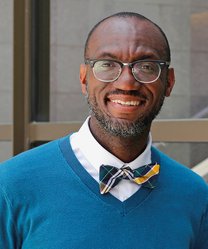
Oral history interview with André K. Isaacs
- 2023-Dec-11
- 2023-Dec-19
- 2023-Dec-21
Oral history interview with André K. Isaacs
- 2023-Dec-11
- 2023-Dec-19
- 2023-Dec-21

André K. Isaacs was born in Kingston, Jamaica in 1981. He grew up in Arnett Gardens, which he describes as being a tough place to live due to the prevalence of crime. However, there was a lot of love and support around him as a child, and he had fun playing games like dandy shandy and cricket. Isaacs enjoyed grade school and thought he would become a mathematician because he excelled at math. After scoring well on the Common Entrance Examination, he was admitted into Saint George’s College for high school. Isaacs moved out of his grandmother’s home and moved with his mother and sister to the Portmore area, resulting in a long commute to high school. Isaacs was very involved in student activities and leadership at his high school, and he even gained teaching experience as a prefect. Isaacs’s choir director had a big influence on him and served as a source of support. Isaacs chose the sciences as his area of specialization in high school. After struggling with chemistry, he started attending his uncle’s evening school, which helped him learn the course content.
Isaacs planned to attend the University of the West Indies, but after his uncle’s death, he decided to apply to universities in the United States. Isaacs accepted an offer to attend College of the Holy Cross on a full scholarship. As he adapted to campus life, Isaacs found that he had to learn about American culture, procure new clothes, and adjust to the weather and food. Soon after beginning school at Holy Cross, the September 11 attacks occurred, leading to stricter regulations for international students. Isaacs got involved in a myriad of campus activities, including participating in singing groups and starting the Caribbean and African Students Assemblage (CASA). He also worked in the cafeteria and as a Resident Assistant (RA). During Isaacs’s second semester in college, he declared chemistry as his major. He played an active part in the chemistry department, taking on leadership roles and organizing events, and was in the chemistry honors program. He also began to do research in Kevin Quinn’s laboratory, working on the synthesis of Muricatacin and researching Rollicosin. Isaacs benefitted from the mentorship of Kevin Quinn as well as the mentorship of Ron Jarret, Isaacs’s organic chemistry professor. As an undergraduate student, Isaacs attended national conferences and received positive feedback about his research when he gave a poster presentation.
Isaacs decided to attend the University of Pennsylvania for graduate studies in chemistry. Over the summer before his program began, he worked in Marisa C. Kozlowski’s (1967-) lab. Then, after his initial graduate coursework, he joined Jeffrey D. Winkler’s laboratory in a collaborative agreement with Bill (William F.) DeGrado’s (1955-) lab. As Isaacs became aware of his identity as a queer person and came out, some of his friends and family responded negatively. This resulted in mental health struggles that took a toll on Isaacs and his graduate studies until he received support. Winkler encouraged Isaacs to go to San Francisco, California to conduct research at Genentech. There, Isaacs worked on novel compounds to inhibit the sonic hedgehog signaling pathway. After a positive experience at Genentech and in San Francisco, Isaacs returned to Penn. In the Winkler and DeGrado labs, Isaacs worked on arylamide foldamers and indole derivatives. Isaacs also worked on steroid-derived inhibitors of the hedgehog signaling pathway, mimicking cyclopamine. Isaacs enjoyed spending time with peers in both the DeGrado and Winkler labs. He worked as a TA during his graduate studies, managing labs and honing his teaching skills. Isaacs was the first member of his family to graduate with a PhD, so his graduation was a noteworthy occasion that family and friends attended, some coming in from Jamaica.
Isaacs accepted a postdoctoral fellowship in Richmond Sarpong’s (1974-) lab at the University of California, Berkeley. At Berkeley, Isaacs worked long hours on his research. Sarpong was a supportive advisor and Isaacs appreciated having the opportunity to work for another Black, immigrant chemist. Isaacs had a variety of projects during his postdoc. One of his projects, in collaboration with John E. Casida (1929-2018), was to work on a synthesis for insecticides. While living in Berkeley, Isaacs met his future husband, and they began dating. When Isaacs heard that College of the Holy Cross was hiring for a chemistry faculty member, he decided to apply. He was offered the position, and he took a road trip with his partner across the country to move to Massachusetts. Soon, he began setting up his lab and reflecting on how to manage the various facets of his position.
Isaacs primarily teaches organic chemistry courses. He strives to build connections between faculty and students, connect course material to students’ lived experiences, and incorporate digital media into his teaching. Isaacs’s research employs click chemistry to make nitrogen heterocycles. His lab is made up of undergraduate students, and Isaacs does regular check-ins with them to learn about their lives and learn how to best support them. He fosters a communal atmosphere in his lab, and the group participates in social events together.
Isaacs has applied computational methods to his chemistry research through his involvement in the Center for Computer-Assisted Synthesis, a National Science Foundation center. He is also part of the center’s Data Chemist Network for faculty of color. Isaacs co-founded Outfront, an LGBTQ+ faculty and staff alliance at Holy Cross. He is also part of the HHMI Inclusive Excellence IE3 team, working on improving the retention of students in STEM who come from historically excluded groups. Isaacs says that Holy Cross’s leadership, faculty, and students have played a role in making Holy Cross a place where diversity and inclusivity are valued. Isaacs is active in professional service, serving on committees at Holy Cross, advising student groups, and serving on the Executive Committee for the American Chemical Society Division of Organic Chemistry. He regularly speaks at conferences, and he organized a conference session about how to interest students from historically excluded groups in STEM. Isaacs also shares his chemistry knowledge with adults and children in his local community.
During the COVID-19 pandemic, Isaacs started creating videos on TikTok. When he created and shared a video of himself in his lab, there was a strong response from people who had never seen a Black, queer scientist. Isaacs realized that he could use his platform to generate interest in science and highlight underrepresented people in science. Soon, Isaacs was dancing in videos with students in a rainbow lab coat, featuring people from historically excluded groups in content, and partnering with other science social media stars. He has garnered a large following, and it has been meaningful for him to hear how his content has inspired students to pursue careers in science. Isaacs’s lab was featured on The Today Show and he has received other press coverage and honors as a result of his social media engagement.
Isaacs reflects on his experiences with international collaborations as a Black, queer person. He talks about the importance of diversity in STEM, becoming a United States citizen, and his goals for future research, teaching, service, and advocacy work. Isaacs shares his hopes for what future generations of scientists will achieve and provides advice for anyone considering a career in science.
This interview was conducted remotely via Zoom.
| Property | Value |
|---|---|
| Interviewee | |
| Interviewer | |
| Format | |
| Genre | |
| Extent |
|
| Language | |
| Subject | |
| Rights | In Copyright |
| Rights holder |
|
| Credit line |
|
About the Interviewers
Sarah Schneider was a Program Associate in the Center for Oral History at the Science History Institute from 2021-2026. She had an interest in preserving and sharing immigration stories in the oral history collection. Schneider holds a BA in American Studies from Brandeis University and an MA in History (Public History track) from the University of Central Florida.
David J. Caruso earned a BA in the history of science, medicine, and technology from Johns Hopkins University in 2001 and a PhD in science and technology studies from Cornell University in 2008. Caruso is the director of the Center for Oral History at the Science History Institute, a former president of Oral History in the Mid-Atlantic Region (2012-2019), and served as co-editor for the Oral History Review from 2018-2023. In addition to overseeing all oral history research at the Science History Institute, he also holds several, in-depth oral history training workshops each year, consults on various oral history projects, and is adjunct faculty at the University of Pennsylvania, teaching courses on the history of military medicine and technology and on oral history.
Institutional location
| Department | |
|---|---|
| Collection | |
| Oral history number | 1151 |
Related Items


Interviewee biographical information
| Born |
|
|---|
Education
| Year | Institution | Degree | Discipline |
|---|---|---|---|
| 2005 | College of the Holy Cross (Worcester, Mass.) | BA | Chemistry |
| 2011 | University of Pennsylvania | PhD | Organic Chemistry |
Professional Experience
University of California, Berkeley
- 2011 to 2012 Postdoctoral Research Associate
College of the Holy Cross (Worcester, Mass.)
- 2012 to 2018 Assistant Professor, Department of Chemistry
- 2018 to present Associate Professor, Department of Chemistry
Honors
| Year(s) | Award |
|---|---|
| 2015 | Research Corporation for Science Advancement (Isaacs, Principal Investigator) Award |
| 2022 | C&EN LGBTQ+ Chemists Trailblazer Award |
| 2023 | TikTok LGBTQ+ Visionary Voices Award |
| 2024 | American Chemical Society Committee on Education – Eminent Scientist Award |
| 2024 | Department of Justice Gerald B. Roemer Community Service Award |
| 2025 | Out to Innovate LGBTQ+ Educator of the Year |
Cite as
See our FAQ page to learn how to cite an oral history.
00:00:05 SCHNEIDER: Okay. So today is Monday, December 11, 2023. My name is Sarah Schneider and I am joined by David J. Caruso. We are conducting the first session of an oral history interview with Dr. André Isaacs online via Zoom. So Dr. Isaacs, thank you very much for joining us today. We’re looking forward to having this conversation. And to start off, I know you were born in Kingston, Jamaica, and I’m curious if you also grew up in Kingston, and what your experience was like as a child there. Maybe some early memories you have or some of your experience from those . . . your childhood growing up there.
00:00:47 ISAACS: Sure. So yeah, I was born and raised in Kingston, Jamaica. I spent the first eighteen and a half years of my life there before I moved to the US. I went to a little, what we call in Jamaica, a basic school, which is preschool, the equivalent of preschool here in the US, in a pretty, pretty tough neighborhood with my grandmother and my mother and her siblings. And spent most of my childhood there until I got into a preparatory school after basic school, where I learned math and science and was, got pretty good at that material. And did fairly well in that school and then went on to high school, in Kingston, Jamaica as well, where I fell in love with the sciences, even deepened my interest in the sciences. And so I—all of that was in Kingston. It was all in Kingston, Jamaica, where I grew up, all those different times or parts of my educational background.
00:02:07 And some really fond memories, I would say, for me was in high school, I was a part of the choir. I was also a part of the student government, I guess, we called it the . . . back then it was the Student Council. Became the president of that, was a part of the choir, and the memories were just being with my friends. Some of the good memories I had were just being with my friends in a choir and the ways in which we were committed to our high school, to help clean up the school, the buildings, different rooms. We were, kind of, the model students. And so we were always on campus until 7:00, 8:00 p.m. at night. Just really making the environment one that was welcoming to not just us, but also to even the younger students. So just . . . really just hanging out with my friends a lot after high school—after classes are over.
00:03:07 SCHNEIDER: And you mentioned the choir. What kinds of things would you sing or what was that experience like?
00:03:14 ISAACS: Yeah. So in choir we sang a range of music. [. . .] My high school is a Jesuit Catholic high school, which actually is why I went to a Jesuit Catholic college after. But I went to a Jesuit Catholic high school, and so much of the music we did were really songs that were sung in church. So a lot of the really staple Catholic songs, with a Caribbean twist, and also some Jamaican folk music, a lot of Jamaican folk music. And . . . yeah. So that was, kind of, the music. Lots of hymns, folk music, Jamaican traditional music is what we sang.
00:03:57 SCHNEIDER: And were you raised Catholic, or . . . ? Was that part of the decision of why you went to that school?
00:04:02 ISAACS: So I was not raised Catholic, but in Jamaica, Catholic high schools are well- recognized for the strength of their, the . . . of their academic work. And so everyone wanted their kid to go to a Catholic high school or grade school. And so I went to Catholic grade school. Was a really good school. My mother [Sonia Lewis] had to work three jobs to send me there. So she was working a lot to afford to send me to that school, but it was known for being one of the best schools. You had to pass a test to get into that school. And I passed the test, and they’re like, yeah, this kid has some promise. You should really do whatever you can to get him to attend. So she’s like, “I’ll just pick up another job.” The Catholic schools were just excellent schools for education in Jamaica.
00:04:54 SCHNEIDER: And I definitely want to hear more about your experience in high school, but to go back a little bit, you were mentioning your mother and her work. What kind of work did she do?
00:05:04 ISAACS: So, yeah, my mother was a bursar at a high—first an accountant, and then she became an assistant bursar and then eventually bursar at a high school in Kingston. So that was her primary job. But she also worked other jobs, doing accounting for other companies on the side in her free time, or evenings after her high school job. So that was her primary job and her way of making a living. My father [Donovan Isaacs] was a high school teacher, and he owned—or started—a private high school, evening school, I should say, it was—actually, no, it was a private daytime school. And he would . . . the government would fund a lot of the students to go to that school as an alternative to a traditional high school. And so that was his job. My parents were never married and so they never lived together. And so I always lived with my mother. And so I never really spent much time with my father, except occasionally when I would see him. So I will probably mention my mother a lot, and that’s because most of my memories and childhood life was really spent with her.
00:06:18 SCHNEIDER: And you also lived with your grandmother, it sounded like.
00:06:23 ISAACS: Yes.
00:06:24 SCHNEIDER: And what was . . . tell us a little bit about her, what she was like, if she worked, or . . . .
00:06:29 ISAACS: So my grandmother [Florence Green], the matriarch of the family, was someone I loved dearly. I would argue that when I was a younger kid, when I was younger, I actually was more fond of my grandmother than my mother because she raised me. My mother was always working as a . . . in order to afford to send me to school and provide for us. So I spent a lot of time with my grandmother, and she was very fond of me. I was her eldest grandchild, and . . . of which there were many. She had eight kids, and so if you think about eight kids and their kids, she had almost twenty grandkids. And so I was the eldest. And so my grandmother was very protective of me.
00:07:14 She would work on the weekends in selling produce in the country area. So she would travel all the way to the other side of the island to sell produce on weekends. And then she would come back, and she’d be home during the week to take care of us. She was really fond of me. She would protect me. She would make sure I had everything I needed. She would give me space in the house to study. And I think she really saw something in me, and she believed that I was going to be the grandkid or the offspring that was maybe going to accomplish something more than she had seen in her own kids. So she was very supportive. Yeah, we spent a lot of time together just chatting, and she was always defending me. So yeah, she was definitely my favorite.
00:08:07 SCHNEIDER: And did you interact a lot with your . . . I think you said your aunts maybe lived there, too?
00:08:13 ISAACS: Yes. Yeah, so I interacted a lot with my aunts and my uncles who were . . . they were also doing their own thing, but, and working. But they were really there to help raise me, in a sense, since my mother was always working. So they were there to support. My aunt [Patricia Lewis] would, one of my aunts, she would pick me up from school, take me to school. She was also really, really fond of me and so she was supportive in that way. So it really was a community that raised me of my grandmother, my mom, and my aunts and uncles. And as I got older, maybe around seven, eight years old, nine years old, many of them had moved out at that point. And so it was really my aunt and my grandmother and one other uncle [Roy Lewis] who remained in the house. And then my mother eventually moved. We all moved when I was twelve years old to a house she bought while I was in—started high school.
00:09:15 SCHNEIDER: And did you have any siblings or cousins that lived with you?
00:09:19 ISAACS: Yeah. So I had . . . it was a big house, of lots of people. So I had a sibling, my sister [Jodiann Isaacs], she lived with my mother, actually. So I guess I should pull it back. So my mother had an apartment once I was five years old, and my sister lived with her, but I still lived with my grandmother. And when I was twelve, she bought a house. And then I was allowed to move in with her, once she had the time. But I had a sister. A little sister. She never lived with us, but my cousin, two cousins, lived [my cousin Shane Johnson lived with us, and my cousin Shantell Lewis often visited] with my grandmother and my aunt and my uncle. And they were . . . yeah, they were . . . yeah, they were there the whole time with me. We had a good time. We always played games in the yard and stuff. I was definitely close to them.
00:10:15 SCHNEIDER: Yeah. And so you said you weren’t raised Catholic. Were you raised with any religion growing up?
00:10:22 ISAACS: Yes. So I was raised a Seventh-day Adventist. My mother converted to Seventh-day Adventism when I was young. I was probably, like, six or seven, and she became a . . . she’s . . . she was very much, she’s very religious. Still is. And I think she pretty much converted half the family into Seventh-day Adventism. And so what I meant is, I couldn’t do anything on Friday nights because we observe the Sabbath because Seventh-day Adventism is a Christian denomination that, kind of, had a lot of the Jewish faith embedded into their beliefs. And so we believed in observing the Sabbath. So Friday evenings couldn’t go to all the school plays or the events. I had to be home from sunset Friday to sunset on Saturday. So yeah, I was raised Seventh-day Adventist, which means I was going to church all day Saturday. Reading the Bible or doing—reading church materials. And I was home.
00:11:27 CARUSO: Prior to converting, was she Anglican? I mean, there’s the, you know, strong British history there. I’m just curious, what tradition was she coming out of that she then converted?
00:11:40 ISAACS: Yeah. So the . . . my grandmother was Anglican. My mother was actually unaffiliated. She wasn’t going to church, really. She was just busy working and I think she got converted to—directly to Seventh-day Adventism. So they—the family was Anglican, actually, but non-practicing, really. Yeah. That’s interesting that you picked up on that because it’s such a—it was such a strong force. It’s . . . I mean, and they’re, kind of, dwindling now in Jamaica. But yeah, the Anglican Church was huge.
00:12:16 CARUSO: Yeah. And, I mean, just thinking about the role that the British Empire played, it was the 1960s, seventies when there was, when Jamaica became independent, but still under the crown, but an independent . . . .
00:12:32 ISAACS: Yes.
00:12:32 CARUSO: Yeah. So I know there were a lot of transitions. And I think politically, there were some transitions going on internally around when you were born as well. And then, like, later in the nineties, right, the National Democratic Movement?
00:12:47 ISAACS: Yes. The NDM, that’s correct. Yeah.
00:12:49 CARUSO: And yeah, I haven’t spoken to anyone who, sort of, transitioned through that, so. Yeah, I’ll stop here because now I’m jumping ahead again.
00:12:56 ISAACS: That’s okay.
00:12:56 CARUSO: [I just wanted to introduce those topics for discussion as we go through your history.]
00:12:56 ISAACS: Yeah.
00:13:01 SCHNEIDER: And growing up, did you speak any other languages at home or was it primarily English?
00:13:07 ISAACS: So growing up, because a lot of my family members were—did not have much more than a high school education, we spoke the dialect there, which is now, many people consider it to be its own language, Patois. And so that was primarily spoken at home. My mother really pushed me and my sister and cousins to learn “proper English” so we could communicate. And so that was something that was really pushed. But at home we spoke [the Jamaican] dialect primarily. Yeah. Now [considered a] language.
00:13:42 SCHNEIDER: And is that something you still speak with family when you’re talking with them, or . . . ?
00:13:46 ISAACS: Oh, yes. So I still speak Patois with my friends from high school, family members. Yeah. Any Jamaican I meet, we will definitely jump into Patois. Yeah.
00:14:00 SCHNEIDER: Yeah. And so you mentioned, I think, playing outside. What were some of those, the things you liked to do when you were a child for fun or with your friends or siblings or cousins?
00:14:11 ISAACS: Yeah. Oh, we loved to play. So some of the games we played were . . . oh my God . . . dandy shandy is a very popular game in Jamaica. And that’s, kind of, like baseball meets cricket, but instead of . . . it’s like throwing a ball at a person, not a bat. And you’d have two people at either ends, and they would be throwing the ball to each other, and you’d be in the middle running back and forth. Meets dodgeball as well. And so you have to avoid getting hit. And so the goal was to get the person out. So, kind of, like cricket, the person in the middle, you’re supposed to hit them with the ball. But every time they make it to the other end, that team gets a point and the other end they get a point. And if they dodge the ball in certain ways, you can get a larger amount of points. And so that was our favorite game. So it’s, kind of, like dodgeball. Yeah. So dandy shandy.
00:15:07 We played a lot of cricket, outdoor cricket on the street. Or a version of cricket with a milk carton that we’d fill with, stuff with paper and round out the edges. That was our ball. And we used to make a lot of box trucks. So we’d take milk cartons and make trucks out of them with . . . the wheels would be the caps of the beer bottles and, you know, we would just pull our trucks all around the neighborhood. We also liked to explore. So we would just go away. We would just leave the house and be like, “Okay, we’re . . . we’ll be back.” And as groups of three or four, we’d walk for miles. And like cats, we would just find our way home eventually in time for lunch or dinner. And so that was most of what we did as kids.
00:16:01 SCHNEIDER: And the area where you lived, can you, kind of, describe maybe what it looked like or what the environment and climate were like? Those sorts of things.
00:16:12 ISAACS: Yeah. So it was, I mean, it’s Kingston, Jamaica, so it’s very warm. I grew up in what we call in Jamaica, a garrison. That was one of the zip codes that were at a higher than average crime rate and poverty. And so I grew up in Kingston 12, Arnett Gardens, which is adjacent to the area that Bob Marley was raised. It was really hard growing up there for the first twelve years of my life, living there with my grandmother, because unfortunately, there was a lot of crime and you would hear gunshots. Occasionally we had to be inside a lot. Parents were not very happy with us exploring the way we did in the daytime. But that’s something we did anyway. In groups. But the weather was beautiful. It was nice. It was warm. It was always hot. It was beautiful.
00:17:12 The houses were in decent shape. Electricity was often stolen by what we call bridging the electric cables with wires to get electricity or internet—or not internet, but more like satellite service—so you could watch TV. We did have running water and so forth, but most of our . . . we used gas stoves. Our floors were polished in the old-school way in Jamaica, where you took a coconut and you cut it in half and use the bristles, the old coconut bristles, with a nice, beautiful red polish. Remember on Sundays where I had to get down on my knees and polish the entire house so it could look beautiful and red for the guests who are going to show up for dinner.
00:18:06 So it was a humble upbringing. But there was a lot of love in that house and that neighborhood. People were still supportive of each other and would look out for people and be like, “Oh, you know, there’s a lot of crime happening in the adjacent streets. We should get all the kids inside.” Yeah. But it was tough. There was crime. We had to be very careful where we walked. And also nighttime was off-limits. We were always inside by sunset. Hopefully that answered some of the questions.
00:18:38 SCHNEIDER: Yes.
00:18:38 ISAACS: There’s a lot more I guess I could say, but, I mean, I’m not even sure where it would go.
00:18:42 SCHNEIDER: Well, if you think of anything, feel free to share more. But that’s very helpful. And so thinking more about your education, you’ve briefly mentioned it, but I’m wondering what your grade school experience was like and if you had any classes or teachers that really made an impact or were formative in some way in those earlier educational years?
00:19:04 ISAACS: Yeah. So grade school [Our Lady of the Angels Preparatory School] was amazing. It was a way to get away from my neighborhood, in a sense. And it was very jarring because I was leaving this really tough neighborhood, which is why my aunt had to walk me to the bus to make sure I got there safely. And she would time when the bus would probably get there after school ends to pick me up and walk me back home. But it was, kind of, jarring to leave such a tough neighborhood and then go to this prep school with all these wealthy kids whose parents were picking them up and dropping them off in cars. You know, none of my family had vehicles or anything to drive me anywhere. And this kind of safe, gated high—grade school, right, with these amazing teachers and support system, great classrooms. And so I looked forward to it. I was excited to go to school. I think that’s one of the reasons why I did so well is because it was a way out of my life in my . . . the neighborhood I grew up in.
00:20:11 I had fond memories of, like, oh, my God . . . [Mrs. Rose-Patricia Boland Welsh] and Miss [Karen] Taylor, those two. And [Ms. Dorett Frankson]. Oh, my God. All three of them. [Ms. Frankson] was really my favorite. She would call my mother and tell my mother how well I was doing. And she’s like, “You really have a gifted child, keep supporting him.” And she was really amazing. [Mrs. Boland Welsh] struck fear in me. We . . . back then, people would still get hit in class. And so we would have . . . our teachers would have wooden rulers that they would . . . she had a triple ruler that they would tape three rulers together. And you’d get smacked with that. So no one wanted to get smacked with the ruler. It was painful. You had to hold your hand out and you’d get really, really smacked for not doing your homework on time or for being loud in class. And so it was . . . they ran a tight ship in class. I remember one of my really close friends who I’m still very close with from grade school, she was always late with her work, and we were all like, “Kimmy, you’re going to get smacked. You didn’t do your homework.” She’d be getting smacked and everybody would be laughing when she got smacked, which is so bad. But that was the culture back then. You get hit with a belt for misbehaving as well.
00:21:39 But we had a really fun time playing games during lunchtime. Singing again. I was also in the choir. [. . .] And the school was run by a nun, Sister Greta [Clarke]. She was tough. And she didn’t play around. You didn’t want to get in, get called up by Sister Greta. And she would be in the yard observing students. I remember being in the yard playing with my friends, and I started drinking some water, and I got the water all over me. And so it was time to go back to class and she’s like, “You, no, you will not go into class. You need to stand in the sun until you dry.” So I had to stand in the sun for an hour. [I had to be fully dry] before I could go back inside of my classroom.
00:22:33 But it was very, very tough. It was very education-focused. You had to do your homework. You had to participate. I remember we had spelling challenges. We had to go home and learn five words a night, and we had to be able to spell them. And I remember one day in the third grade, I was called on to spell the word “chlorophyll.” And I could not spell it. I thought I’d learned it from the night before, but I messed up. And I got beat, like, Miss Taylor beat me for not being able to spell chlorophyll, in front of the whole class. And, of course, all your friends are laughing.
00:23:11 And then I went home with a note to my parents—or my grandmother, actually, that I did not do my homework. My grandmother promptly beat me because she was like, “You were playing all evening yesterday and said you didn’t have any work to do.” And then my mother came home. She usually visits before she goes to her apartment. And then she beat me again because I couldn’t spell chlorophyll. So I got beat three times. So I tell people all the time that chlorophyll is the last word that will leave my memory before I die, because I know I will never forget how to spell that word. [laughter] But those are honestly some of the memories I had from grade school, is a really strict environment where we had to really focus on our academics, on our learning.
00:23:59 SCHNEIDER: And you said you were in choir. Were you doing any other extracurriculars or activities of any kind at that age?
00:24:06 ISAACS: Yeah. So I was doing track, as every kid in Jamaica does. So I had a little bit of running skills. Not good enough to go beyond just high school level, but I did a lot of short distance, 100-meter, 200-meter track events. Yeah, that was it. Track and music were my two main things.
00:24:29 SCHNEIDER: And did you . . . . Well, first of all, I’m curious what classes you took in grade school. So what was the curriculum like at that time?
00:24:38 ISAACS: Ooh, let me try to remember. So, of course, math, English, social studies. Religion is a huge part of Jamaican education at all educational levels. I’m trying to remember. History. Literature. Yeah, those were the main courses we did. And, of course, science you had to do. We had an integrated science course where you were learning all different types of science together. So they weren’t separated yet.
00:25:06 SCHNEIDER: And at that young age, did you have a sense of having favorite subjects, or was it more later that you developed your interest in science?
00:25:13 ISAACS: Yeah. Oh, there was also music. Sorry. At that young age, I . . . math was my favorite subject. I was thriving. I liked science. I liked a little bit of everything, but math, I was thriving. And I really thought I was going to be a mathematician, even all the way through high school, and we can talk about that then, later. But yeah, math was definitely my favorite subject. And also the subject that made my high school—my grade school teacher realize that I needed to correct my . . . my vision needed to be corrected. Because I remember her calling my mom and telling her that, “Hey, he is getting these problems right, but he’s writing the wrong numbers off the board. I think you should go get his vision checked.” So that was something that was, my grade school teacher observed. But yeah, math was my favorite subject. Really loved it. Music I struggled at. We had to learn how to play the recorder, and that was a huge part of our training with music, with instruments.
00:26:15 SCHNEIDER: Okay. And as you moved through the grades . . . now, you said . . . . So what were the schools like in terms of how they separated by grades? And as you moved through, when did you switch to a different school?
00:26:30 ISAACS: Right. So there’s basic school, which I think is equivalent to preschool here in the US. And then there is grade school, is what we would call it. And those are preparatory schools, is what we call them in Jamaica. And those are preparation for high school. And that runs all the way up until the sixth grade. So it’d be from grades one through six of your education. And that would run you till around age eleven, twelve, I think. And then that’s when you would transition into high school. So what happens in the grade school is we would all take—back then—what we’d call the Common Entrance Examination. And the Common Entrance was an exam that everyone in grade school, islandwide, would take. And based on the scores you got, you would get placed into the high schools of your choice.
00:27:31 So you would make a ranking list of high schools you would like to enroll in. And they all had different cutoffs in terms of the expectation for your enrollment. So I really wanted to go to Saint George’s College high school for boys, and I ranked that as my number one school. And Wolmer’s High School [Wolmer’s Boys’ School] was my number two. High school for boys as well. It’s an all-boys school. I was really fond of Saint George’s. My mother was really, really fond of it. It was a well-regarded high school that was also affiliated with the Catholic Church. It’s Jesuit Catholic. And I was also going to a grade school that was a Catholic grade school. And so we were . . . we really wanted to go to Saint George’s.
00:28:17 And so I took the Common Entrance. I did well. There are some high schools that are better than Saint George’s, but I wanted to go to Saint George’s, so it was one of the top ones, but not top top. And so I got into Saint George’s with the scores I received. And so everyone took the exams and you got matched into your high schools. And what’s scary is, they would print it in the newspaper. That’s how you found out. So it would be, you know, like, the day when everybody finds out where they’re going, and everybody wakes up so early. I think that’s the best day of newspaper sales in the country. And everyone would look for the newspaper, and you’d look for the high school, and you’d look for your name. And it was . . . you saw your name and that was it. The whole island knew where you were going for high school.
00:29:10 SCHNEIDER: And do you remember that day of seeing it and your reaction?
00:29:14 ISAACS: I do. I do remember that day. And I remember we were all . . . my . . . I remember that day. We were at school, we saw it before we went to school, but we were at school and it was just celebratory. I think most of my classmates had gotten into the schools they wanted and everyone was just so happy. And so people were crying. A few people didn’t get into schools they wanted, so they were really sad. But most of us were just really happy. There was not a whole lot of learning that was happening that day, and the teachers understood that. And so we all left early.
00:29:48 One of my friend’s parents drove us all home, drove us to buy us lunch. We were all singing. I remember we were singing this song “Free at Last.” I don’t know why. We were all singing that song, and it’s a church song. I don’t even know why we were singing that song. We were singing that song in the car. We’re like, “Yeah, we’re free at last, like, from grade school. We’re going to go to high school and become adults.” At twelve. I don’t know why we thought we were going to become adults. And it was just fun. And then I got home early, and it was . . . my parents were excited for me. My grandmother cooked me a really nice dinner, and I was just really excited to transition into high school and see what that was like.
00:30:32 CARUSO: Just to back up a little bit, in, I think, I would assume it would be your elementary school, grade school, 1988 is when Hurricane Gilbert—
00:30:42 ISAACS: Oh, yes. We can talk about that.
00:30:45 CARUSO: And so I was just wondering to hear a bit about your experiences. I think—I know, or from what I understand, there was a fair amount of damage in Kingston itself.
00:30:55 ISAACS: Yes.
00:30:56 CARUSO: Thirty or more people died during the hurricane. And then, like, there were— political parties afterwards, were, I guess, vying for votes by trying to, you know, provide relief. I know it was . . . you were young, but I was wondering if you had any memories of that.
00:31:12 ISAACS: Yeah, that’s great. I actually just love the fact that you know all of this. It’s amazing. Yeah. So I was a little kid. I was about six or seven—seven years old, 1988, I remember. And in my neighborhood, we were hit very hard in, it’s Jones Town/Arnett Gardens. And so I remember as a kid, we’re like, “Okay, the hurricane’s gonna come. Everyone needs to stay inside.” I had an eye infection. What I really wanted to see was my first hurricane. I was a little kid. And so putting the drops in my eyes, and I’m, like, trying to look through the window. And then it started. I was like, “Wow, this is intense.”
00:31:57 And then all of a sudden, you see fences. In Jamaica, it was very common to have zinc fences as the fences that bordered your yard. It was cheap to get a zinc fence. And so there were the zinc fences just taken up in this really heavy hurricane, these really heavy hurricane winds flying all over the place. And we started getting scared. Everyone in the house was very scared. The roof, everything was rattling, and all of a sudden, the roof in the back bedroom took off and went and we were scrambling. Everyone was crying. My grandmother was crying, was like, “Oh my God, I need to fix this.” My uncles ran. They moved everything out of the bedroom. They closed the door so that the . . . and they were like making a path to sweep the water out through the back door into the yard so that the rest of the house wouldn’t get flooded.
00:32:55 And then the rain stopped. And I guess the eye of Hurricane Gilbert was also passing through Kingston, and it was just the most beautiful thing I’ve ever experienced. It just went from this tumultuous, heavy hurricane to this beautiful blue sky in the eye of the storm. And my uncles went searching for the roof. They found it, the piece that blew off. They got it back in time. They nailed it in. They were adding huge cement blocks. Reinforced cement blocks. It started raining again right as the rest of the storm passed through, and they were still working, but somehow managed to secure it.
00:33:36 And that was my memory of Gilbert during the storm. It was . . . we survived the rest of it. It was terrible afterwards, the whole neighborhood was destroyed. It was years before things went back. There were a lot of politicians who were trying to buy votes by giving people free things, food and water. And so as a young kid, I wasn’t very much aware of the political . . . and what that all meant. But definitely the people took advantage of the time to get votes, especially in those areas.
00:34:10 CARUSO: And you mentioned that it was a relatively unsafe neighborhood that you were in. I’m wondering if, in response to the hurricane, was there an increase in crime—
00:34:20 ISAACS: Yes.
00:34:20 CARUSO: —or was there a decrease because I could also see people just being like, this is horrible for everyone. Crime is going to go down. We’re going to support each other. But you said that crime increased?
00:34:29 ISAACS: Crime, there was an increase in crime where people were stealing, looting. I mean, the looting during the hurricane was huge. I had a friend whose parents lost their store because people just looted it for food and for other things. The government . . . I was . . . my neighborhood is . . . was pretty much a stronghold for the PNP, the People’s National Party. And they, kind of, like, went around and gave people things to keep them supporting the PNP. And that just happened in all the neighborhoods that got affected. JLP [Jamaica Labour Party] went to their neighborhoods and they found means to keep them, to give people things to keep them, like, supporting the parties during that time. And, of course, the people, the parties that were in power, the party that was—I think it was the JLP that was in power—their neighborhoods got more stuff than ours. So it was very obvious that politics are at play.
00:35:32 CARUSO: That’s all I have, Sarah.
00:35:35 SCHNEIDER: Thanks. So you were talking about this transition from grade school to high school. And physically, the building where you were going for high school, was that a different commute to get to school? And how did you feel as you started, you know, you said you were excited. But once you actually started at that school, what was it like and how did that transition go?
00:36:01 ISAACS: Yeah. So Saint George’s was actually closer to where my grandmother lived than where I went to prep school/elementary/grade school. And so it was part of the reason why I wanted to go there. So it was an easier commute. I would just take one bus and I was there pretty quickly. I actually could even walk. It would be probably a thirty-minute walk, but it was close enough that I could get there. I could walk in thirty minutes. So, it was . . . I was really excited to go. And unfortunately, that’s when I moved, at twelve, my mother bought a house, and that was really far.
00:36:43 So it happened that I got into this school because I live with my grandmother and now my mother moved into this new development across the bridge, the Causeway Bridge, in another parish. This was in Saint Catherine. So we lived in Kingston, a neighboring parish to Kingston and Saint Andrew was Saint Catherine. And there was a significant area that was being developed called Portmore. And there were a lot of houses that were being built for cheap by, I think it was [Gordon Arthur] “Butch” Stewart who initiated that development. And so people were able to own houses that . . . people who weren’t . . . . And they were cheap enough that people who, you know, middle-class people and lower-income people could afford a house. And the whole model was that it was a basic house with just literally slabs and that you could expand on it. So it was literally a one-bedroom or a two-bedroom, and some neighborhoods had a three- bedroom house, and all of them had enough yard, land space, that you could build or expand it. So the whole idea was, we’re selling you this really basic slab of a house and you could build on it.
00:37:54 So my mother bought a one-bedroom, and she took my sister and I, and we all moved into this one-bedroom house while she expanded on it, slowly, because she was working by herself. And so we spent, like, literally all of my high school, we lived in a one-bedroom house. It wasn’t completed, of course, until after I left. And so we would commute a longer commute, much longer commute now, so I would get up at 4:30 a.m. And we would be out of the house by 5:15, because if you didn’t catch the bus by 5:15 into 6:00—between 5:15 and 6:00—you’d never make it to school in time for 8:00 a.m. That’s how bad the commute was. A lot of traffic, it became . . . the traffic increased as more people moved into these neighborhoods. And then the buses were crowded. And so not only were you not able to get there on time if you left late, but part of the calculation was, would you be able to get into a bus? Because the buses were so crowded and people would be walking to the terminus to catch the bus when it’s empty. Because by the time the bus gets to where you are, it might be full and you have to wait for another bus and you keep waiting for more buses and then they’re all full. You just never get into a bus. So the idea was you just go on the early end when the buses are emptier, and then you would make it to school.
00:39:27 SO WE WOULD LEAVE AT 5: 15, 5:30 a.m. every morning and get to school by a little bit before 7:00 a.m. And that was, kind of, awesome for us because a lot of my friends actually lived in the same neighborhood as I did, and their parents also bought small houses and built on them. And we’d get to school at 7:00 and school actually started at 7:30. So it was perfect. So I would get to school 6:45, 7:00. And we’d spend much of our mornings just hanging out with each other or maybe finishing some homework really quickly that we’re like, “Did you get this? I was working on this last night and I couldn’t figure it out.” Spend the morning trying to finish up our homework and actually build some friendships and get to know some people. It was a really long commute. That made it very hard because as a young kid, you didn’t want to go to bed at 10:00 p.m. or at 9:00 p.m.
00:40:14 So it was . . . we were always tired because we just had to get up so early, but we never wanted to go to bed early. It was tough living in a one-bedroom apartment with my mother, because we had . . . we partitioned it in a way that I had my own space as the boy and my mom and my sister had their own space. And we made it work, it was fine. But we partitioned it in a nice way. It was . . . living there was pretty much similar to living with my grandmother. Like Sundays, I had to do all this, these chores, dust all the furniture. That was my job, was to dust everything and to clean every—cut the grass in the yard and all those types of Sunday chores. And Saturday, of course, we were—just had to be inside reading our Bibles or going to church. And that was my weekend. Was like literally the same thing every weekend. Friday evening into Saturday was all church related. Sunday was all work. And maybe Sunday evening I’d get to hang out with my friends and do homework.
00:41:21 SCHNEIDER: And did you still . . . . How was it being separated from your grandmother at that point? Did you still visit her a lot?
00:41:29 ISAACS: Yeah. So I would visit my grandmother a lot. I had an aunt [Sharon Isaacs] who bought a house in the same neighborhood. So oftentimes I would go to my grandmother’s house after school and hang out with her. And then my aunt would drive me home late nights because she had—my aunt was my father’s sister. So this was an aunt on the other side of my family. That was my father’s sister. And she had a printery. So my father went into education and she had a printery. So she would print, like, flyers and stuff for companies and whatever—events, and so she had this printery. And so she worked really late until probably, like, ten o’clock at night sometimes. So I would take that opportunity. And her . . . my grandparents on my father’s side also lived in that same neighborhood. That’s how my parents met. In . . . so they both lived . . . . So my aunt would visit her mother and her relatives, and then she just picked me up because it’s, like, a few blocks away. So she would grab me and drive me home. So I would use that opportunity. I’m like, “Okay, today I’m going to go hang out with my grandmother” and I got a ride home and my mother is like, “Yeah, who cares?” But I also just spent a lot of time with my friends after high school. We would just be on campus doing music, our music ministry, which is our school choir. We’d do that kind of stuff or different . . . or different clubs. We are part of the debating club [and] the Schools’ Challenge Quiz Club, which was a quiz competition across the country where you, kind of, like jeopardy for high schools, but it’s a buzzer type thing. You have to . . . whoever answers first. So we were part of the student council. We created, like, every club that existed at that school. We were just very much involved. And we’re some of the smartest kids and most responsible. We were prefects. We stood in for teachers. When once we were in later years of high school, we were like the model students. We represented the school at events. We helped run functions.
00:43:43 There’s a big thing that we had at our high school called Jeans Day, because in Jamaica you wear uniforms. All throughout grade school and, of course, in many developing countries, it’s a cheaper way, right, to send kids to school is if everybody just wears the same uniform every day, and then you don’t have to buy regular clothes. And all these schools had these beautiful designs that made them unique. So my school, we wore khaki shirts and pants. Most schools did that. And then your crest was what . . . the crest on the pocket was what made it clear what high school you went to. So people could always tell I went to Saint George’s because I had the blue and white crest with the dragon and Saint George slaying the dragon. And some school had epaulets, ours didn’t. But yeah.
00:44:31 So we would, on Jeans Day, we would get a chance to dress up in jeans. And everyone was wearing their, like, cool Levi’s or whatever. And there’d be sporting activities and competitions. We’d all be placed in a house. Once you started high school, we were placed in a house. I was in Loyola. Of course, these names are related to different aspects of the Jesuit tradition. So there’s Loyola, Campion, Bellarmine, Saint Francis. So you’re just placed in a house and you get buttons. Loyola was white. And so on Jeans Day, they would have these high school-wide competitions against the houses. So they would do track and field, cricket, all kinds of events. And then whichever house won, you know, that’s, kind of, the exciting thing to celebrate.
00:45:23 So Jeans Day, me and my friends, we would be the ones organizing, like helping to organize the food, helping to organize students moving through. So we’re model students and we were very much integrated in the life of the school. So, yeah, those are some of my memories of high school. And spent a lot of time working with teachers, working with the president, advocating for our peers. We’d be getting together and be like, “As kids, we don’t . . . we need this. We need a new school bus. The one that we have right now isn’t working. We need to hire someone else.” And we were very vocal. We got a lot of stuff done. Actually, as a matter of fact, teachers would come to us and ask us to, kind of, lobby the president of our high school and the principal for things they wanted. We were a powerful voice.
00:46:18 SCHNEIDER: So I have a couple of questions to follow up on some of the things you mentioned. The being placed into different houses, I’m just, sort of, as a reference point, thinking of Harry Potter.
00:46:30 ISAACS: Yes.
00:46:30 SCHNEIDER: How does, how did it work at your school? Was there . . . did the houses . . . like how were the placements made, and why?
00:46:39 ISAACS: Good question. The placements were made randomly. So you would just come into school and you’d—the grade school—and you’d start off in seventh grade. And in our system, it’s first form. Seventh grade is the equivalent of first form. So it’s first through sixth form, but it’s seventh, seventh through thirteenth grade, actually, would be the equivalent. We had a thirteenth grade because it was five years and another—potentially, another two. So seventh grade or first form, you just were randomly placed into a house and one of the teachers would be . . . and other administrators, they’d have a few people who would be like the house leaders. And so they would find representatives to participate in the different events. And some were better than others at finding the best runners, and so, like, Bellarmine house, they were just always really good because I think one of their advisors was the PE [physical education] teacher. So he already knew all the students who could—were very good at track and stuff. They were always hard to beat. But our house never really did very well, but we were still, yeah, part of it.
00:48:03 SCHNEIDER: And would you still socialize with people across houses, or did you spend a lot of time with your house, fellow housemates? How did that work?
00:48:11 ISAACS: Yeah. If I remember, we didn’t really spend a lot of time with our houses outside of just that day when you’d all gather together and celebrate as a house. I think I realized a friend of mine, we were in the same house on that day, so it really wasn’t something. Occasionally, it would come up in conversation, you know, random, like, “Oh, what house are you? Okay, no, we don’t want you here.” But it wasn’t an integral part of—unfortunately, I think it would have been really cool if it was more integrated in, like, a regular time in high school, but it really didn’t . . . . And maybe before my time, it was more of a way to form connections and build communities within the community. But during my time, it really was only around the sporting events that it became something that was significant. Yeah.
00:49:00 SCHNEIDER: And you mentioned being a prefect. And so would you actually be . . . what would you be doing when you were stepping in, were you actually teaching? Were you just, sort of, helping manage the classroom. What was that like?
00:49:13 ISAACS: Yeah. So we call those a beadle. It’s the same thing as a prefect, beadle. I don’t know where that word came from. But that was the equivalent of a prefect, and one was selected for each class. So everyone—one person in your class was the beadle, and you’re supposed to be the model student, and you were selected because you were the model student. And everyone was told, like, “This student”—what a lot of pressure—“This is the student that . . . . ” And you’re responsible for helping to take attendance. You know, helping teachers with whatever they want for . . . you’re like a teacher’s pet in a sense. And so that was pretty much what you did. And then you’d have prefects who were then . . . when you got a little bit older, you had prefects who then were older students who were responsible for that class.
00:50:02 And so I would go to that class, a class, a lower . . . a lower-level class like ninth grade and below. And I would help to take attendance with the beadle to make sure that the attendance— everyone’s there. If the teacher needed something, I would help. So you had the beadle, who was a model student, but then you actually had a prefect who was helping to take attendance as well. So we became . . . I was a prefect early on and we just took a lot of responsibilities on and sometimes the teachers would be like, “Okay, a teacher is sick.” They’re like, “You’ve taken this class before. Go and literally teach the class.” Which is, kind of, weird, kind of, cool, but we were such—we were so mature. Like, we would go in and we’d start teaching a whole lecture. When a teacher wasn’t around. It was really crazy to think back on how, like, you know, my friends—so just a cohort of us. And many of us were in the choir. We were just those students who were just very much committed to the institution. And we would like, get notes and teach the kids in the class when the teacher wasn’t there.
00:51:08 SCHNEIDER: Wow. So maybe your first teaching experience, then, in high school.
00:51:12 ISAACS: No, it seriously was. I think I was literally forced to be a teacher because my mother worked at a high school. And I was . . . when I visited, I was always in a classroom. My father had his own private daytime high school. And then my uncle [Aaron Isaacs], which is my father’s brother, started an evening high—an evening continuing education school for adults. I belong . . . it was a, you know, I was going to be in a classroom someday, someway or another because of just my past. Yeah.
00:51:41 SCHNEIDER: And you mentioned your uncle, and I think in some article I was reading, you had mentioned that he tutored you a bit after school or worked with you after school. So could you tell us more about that and what kinds of subjects he was working with you on and how those sessions went?
00:52:00 ISAACS: Sure. So I’ll give you a little bit of backstory about how our school system works, which was very similar to the British education system, which is you take a range, eight, nine— nine courses, I believe, if I remember correctly, in seventh, eighth, and ninth grade. And everyone takes all the same nine courses. The other thing is you were placed in . . . we had six classes. So 1A through F, 2A through F, 3A through F, and you stayed with that class all the way up. So it was the same class. If you’re in 1A you’re going to be in 2A. And actually, I think in the ninth grade they shifted around a bit. And then you could be in any class and get new classmates.
00:52:39 And so we took nine courses. We had different teachers. It was very much like college, where different teachers taught different subjects. And we had a schedule from 7:30 or 8:10 a.m. I think it started at 7:30 a.m. for the younger kids who are in seventh and eighth grade. And then it started at 8:10 for the ninth-grade kids onwards. That’s my memory. And so you would have forty-minute course classes, and from 8:10 all the way until 2:50. And every forty minutes was a different class. Math, chemistry, physics. And a different teacher would just show up for their forty-minute section, and then a forty-minute period in there would be lunch. And they would stagger the forty-minute lunch periods based on the grade. So first form would eat at 10:10. Their lunch was at 10:10 a.m. We had lunch at 10:10. And then at 10:50 was second form. And then they added second and third and then fourth and fifth were 11:30, and so that’s when you would eat.
00:53:47 [. . .] After third [form]—ninth grade, you choose what subjects you want to focus on, or what area. So in tenth grade or fourth form, that’s when you decide whether you want to pursue the sciences or you want to pursue the arts, business. And [students in] every class 4-1 through 4-6 took the same courses. And they were different. So 4-1 and 4-2 were the science courses. I was in 4-1. So I took biology, chemistry, physics, math, Spanish, in addition to what everyone else across fourth form took, English, English literature, religion. I think, yeah, those were the four. And then the others were—everyone in my class took those. And then, of course, by the time you got to 4-6, they were taking economics and history, or those types of courses. So you had to decide in the ninth grade what your future was going to look like, which is a very hard decision for a fourteen-year-old to make. And so I decided I was going to be, go into the sciences. And so I ended up doing that. And so for me, in tenth grade or fourth form, I was doing chemistry and learning to balance equations, and struggled actually. And so I had a hard time in my chemistry courses initially, and I just . . . it just wasn’t clicking. Chemistry and math, actually. It just didn’t make sense to me. Both of those, I had trouble with both. I loved math so much.
00:55:36 And so I . . . my mother said, “Why don’t you go to your uncle’s evening school?” Because my uncle . . . I wasn’t very close with my father, and my mother and him had, like, tumultuous relationship. They . . . he wasn’t supporting financially the way she wanted him to, and so they had their back and forth. So I, kind of, avoided it. I had a close relationship with my uncle, who took . . . who was very fond of me and thought I was going to do very, very well. So he . . . my mother said, “Talk to him.” And I talked to him. He’s like, “Why don’t you come to my school, evening school, and I’ll help you?” And so I went and he helped me with the chemistry.
00:56:19 My other uncle helped me with math and immediately, that clicked. It was just something that he . . . I don’t know what it was. It was just something . . . I remember him telling me, “You got to really keep track of the x’s.” He’s like, “Just put one over here and then one over. If it’s plus on this side, minus on that side.” And that was it. That literally was what was . . . I was struggling with. And once he did that I was like, “Oh that’s it.” And I figured it out. And that was it. Then my math took off, but the chemistry was a little bit more challenging.
00:56:48 And so my uncle was very good. The problem is, I think a lot of people, students in my class, they also were struggling with chemistry. And I’m not going to blame this on my chemistry teacher. But it just wasn’t clicking for many of us. And so once I went to my uncle’s after school with all these adults, and I want to say that these continuing education schools in Jamaica were very popular, and the reason why they were popular was a function of the way your high school education system is set up, right. So if you have to decide that you want to do sciences in ninth grade, and then you’re forced along this path, and then once you finish high school, you’re like, “I don’t want to do that.” Then you have to go back to a continuing education school to relearn the history or the economics that you didn’t learn in order to get the high school equivalent of that degree so you can move on to college.
00:57:41 So there were a lot of people who were just going back to school after high school so they could get the courses they now wanted to take. So that was a population my uncle’s evening school was catering to, lots of people who were trying to switch jobs or get degrees in different areas. And so I was going there to learn chemistry with all these adults. And he just had an amazing way of explaining chemistry that just made it connect, like the analogies he made, like connecting it to religion, connecting it to relationships. Lots of humor. It just made sense. And so it clicked for me. And then pretty soon, like, half of my class was showing up to my uncle’s evening school with me after school. We flooded his evening school. He got a lot of business from my class.
00:58:31 SCHNEIDER: Very interesting. And were you aware at that time of, I know that there was a Jamaican chemist, Bertram Fraser-Reid, who was an organic chemist. Were you aware of chemistry as a field or what people did in that field for work?
00:58:53 ISAACS: I was not aware. I didn’t even know there were Jamaican chemists until I started my college degree at [College of the] Holy Cross here. It was not something that a lot of people did. Chemistry, biology at the higher levels was, kind of . . . I don’t know . . . elusive for the average . . . . I mean, it was just . . . people couldn’t do it. It wasn’t something you were expected to become. That was something that was done by wealthy people who went to the best high schools, who were usually American-educated, who had education in America—or England. Usually, if you want to become a real scientist in Jamaica, you went to England. That was it. You went to England to get a degree, and that just wasn’t something that was accessible, I would say, for many people or even people thought about that. So, yeah, no. Our culture, scientists weren’t talked about as much. It wasn’t an area that was celebrated, I would say, in Jamaican culture. We weren’t celebrating our scientists.
01:00:12 When we think of science and science advancements, we were looking towards the US or England. So we really weren’t looking towards people in our own country as people who were making significant scientific contributions. As a young kid, you weren’t . . . we didn’t really talk about Jamaican chemists. We weren’t talking about Jamaican biologists or Jamaican doctors, necessarily. Maybe some doctors who were doing really good work. And, of course, culturally, that made sense because people were like, “Oh yes, this doctor cured this for me.” But as [far as our awareness of] scientists, we were not focused on fundamental discoveries. That we were so much more concerned with just getting by that we weren’t really excited about that. So, yeah, I did not know of scientists—Jamaican scientists—until I was in college and was more entrenched in chemistry, which is unfortunate, but that was the reality. We all thought when we, if we got a degree in chemistry, were just going to make cement. That was, kind of, the thing, you’re like, who wants to do that? So that was as far as we thought our degree in chemistry could take us.
01:01:15 SCHNEIDER: Dave, did you have a question, or should I keep going?
01:01:18 CARUSO: I mean, I have some questions. I don’t want to push us in different directions, but—
01:01:24 ISAACS: No, that’s fine.
01:01:26 CARUSO: So I went to a Jesuit high school. And so when you were talking about some of your periods, like, I had the forty-minute blocks and similar, sort of, style. One—and you did mention having religion classes.
01:01:41 ISAACS: Yes.
01:01:41 CARUSO: With my high school, some of the teachers were Jesuits, some were Catholic priests, also a fair number of laymen and laywomen providing the education. In terms of religion, we weren’t . . . religion classes were not about teaching us to be better Catholics. They were teaching us the history of religion. They were teaching us about reading the Bible and doing an exegesis of it to understand its origins and things like that. Since you had mentioned that you were a Seventh-day Adventist, I’m curious to know whether or not the religion classes that you were being taught were, sort of, history of religion, or was it about Catholicism? And if it was about Catholicism, how did you manage needing to talk about that faith when that wasn’t actually something that you subscribe to, yourself?
01:02:42 ISAACS: Yeah. I think we had exactly the same experience. It was about the history of religion. So there were a lot of different denominations of Christianity. People were from different denominations that went to my high school and so no one felt alienated, I think, much like . . . I think the Jesuits are very good at this. Everyone felt welcome, and I was supported in being a Seventh-day Adventist. I wasn’t expected to show up to the Saturday events. But, yeah, we learned the history. So we talked about all different religions. So throughout, you’re learning about the history of religion. We studied what different religions—their faith and the tenets of their religion, et cetera. So, yeah, it wasn’t, we weren’t indoctrinated, for lack of a better word. We were really just learning about religion. And so that was it. We did have a lot of priests and laymen who taught us. As a matter of fact, at Saint George’s College—and I’m glad you brought this up so I can talk about it—at Saint George’s College, we had a Jesuit house on campus. And so whenever Jesuits visited Kingston, many of them, even if they were doing work elsewhere, lived on our campus. So there was this beautiful house right in the middle of campus that the Jesuits would stay in. And we all wanted to have lunch over there. It was exciting when you got to go over into the Jesuit house and hang out with the Jesuits. The president of our high school was always a Jesuit. I think that’s changed, of course, as, you know, institutions of higher ed in the US have [. . .] less Jesuits around now. So the president of our high school was a Jesuit and was one when I was there. And the principal was . . . then became a lay person after a while, they were just teachers who rose to that rank, eventually.
01:04:30 But we . . . I had . . . I was taught by laymen. Our people were in training to become Jesuits, a lot of those as educators. I remember one was my English language teacher in third form [Mr. Mallone]. Oh my God, I forgot his name, but excellent teacher. And I think a lot of that—and was from the US. So we got a lot of the American education system within our high school in Jamaica because of our strong connection with the Jesuits. And many of them were doing service work in Jamaica or part, you know, they were sent there to, part of their training is to live with the people in these different countries and do work in different areas. And teaching was definitely one of the ways many of them spent their—was their vocation. So, yeah, lots of connections with Jesuits, which made it so much easier for me to consider a Jesuit college for my undergraduate education.
01:05:22 CARUSO: And then I’ll just ask one other question. I think indirectly, we’ve heard that, you know, education was important to your family, right? So your father, your uncle, your mom wanted you to go to a good school. She worked in a bursar’s office in a high school. But I don’t know if we’ve spoken specifically about . . . were there . . . we know that you were punished when you didn’t know an answer, but when you were growing up around the dinner table at family gatherings, were there discussions of, “You are going to be going to college. You’re going to be getting an advanced degree. You—we want you to become a doctor. We want you to become a lawyer.” Was there more discussion about what your family wanted your future to be and why they were so invested in you getting a good education?
01:06:18 ISAACS: Yeah. It was, kind of, half and half. Some members of my family wanted me to become a doctor. That was the, kind of, the goal that you should become a doctor. But I must say, there was never any pressure, unlike many households from developing countries where you had to become a doctor, right. In my family, they were just grateful that someone wanted an education or someone was good enough. I think in my family, many of them had, they, kind of, resigned themselves to failure in a sense, and they’re like, “We are poor. We are not smart. Just getting any job is good enough for any member of our family. And just making a living is good enough. And wow, we have this kid in our family who actually could do more than that. Wow. Let’s just support him in whatever way we can and let’s see what happens. You know, he’s going to do something big. We don’t know what it is, but let’s make it easy for him to accomplish that.”
01:07:25 They had . . . most of the decisions I made in my education in my, in my academic career were mine. Because they’re like, “Oh, so you want to do that thing? Okay, that sounds good. You’re going to be in more school.” So they just supported me. Of course, other people in my education were like, “Oh, you should do this. You should do that.” They probably, my teachers and instructors, had more of a say in what I chose to do than my family.
01:07:51 But yeah, they were . . . they were supportive in my, at home. I definitely was treated better than a lot of my cousins and siblings. And there was favoritism, of course. And everyone, some of my cousins didn’t like me, or, not didn’t like me, but like, “Yeah, they love you because you’re smart.” I’m like, you know, there was some favoritism and that pushed me, that propelled me to keep working as well. Around the dinner table, people were always praising me. They’re like, “Oh, yes, André got a 95 [percent] on this test this week. He’s just doing so well.” And then they would, like, shame my sister at the same moment, “Be more like him.” So it was . . . that was pretty much what the dinner table was like.
01:08:37 CARUSO: And I’m sorry to . . . I know we’re going to wrap up very soon. You mentioned an awareness, right, so, like, the wealthy families, you know, people are getting educations in the United States. There’s this history of British colonialism. I’m curious to know, also while growing up, were you exposed to or did you have an awareness of different cultures? Like, what—were you watching American television or British television? What were you listening [to on] the radio? How much awareness of things outside of Jamaica did you have at that period of time?
01:09:16 ISAACS: Great question. Very aware of all things America. I’ll put it simply that way. I think when I was a kid, we had a lot of Jamaican pride, but I think during the eighties and nineties was when I think Jamaica increasingly, with technology, became more attuned to American culture. So I saw a lot of that happening in high school. Everyone wanted a JanSport bag from the US. Everybody wanted . . . if you didn’t have a JanSport bag, you weren’t . . . . And then the funny thing is, a lot of the things we wanted weren’t even things that people in the US were wearing, but it just . . . .
01:09:50 CARUSO: No, I do remember JanSport.
01:09:52 ISAACS: Yeah, but that was—but I think by the time we got into it it was probably outdated. But we all had to have a JanSport bag. You had to have Levi’s jeans. And a lot of that was influenced by our access then in the early nineties to, like, cable, right. So that’s when cable television became accessible for a lot of people. And so we were watching a lot of TV shows. I mean, my parents were all about Golden Girls and soap operas. I watched so much Golden Girls growing up. But then later, Friends, and, you name it, all the TV shows. So that really influenced Jamaican culture and how we dressed in high school, the things we wanted our parents to have. We all need Discmans and Walkmans [portable audio players] and the latest ones. And so Jamaican culture, as I got older, became more and more Americanized.
01:10:42 So the music we were listening to was Mariah Carey, Whitney Houston, Celine Dion, you name it. All the pop divas. Jamaica really loves a big ballad. Jamaicans like people who sing really well. I mean, I grew up listening to Mariah Carey, Anita Baker, Whitney Houston, those were the voices. And the Jamaicans would just remix their songs with—take the songs and put them on a Jamaican beat. So we always had a version of those songs growing up. So a lot of pop culture, American pop culture, not even that much British culture, actually, I would say. We did not have much British influence in terms of my growing up. It was all American culture.
01:11:22 But growing up as a Jamaican, though, within Jamaica, we had a lot of influence from Chinese culture, Indian culture. And that was for the people on the ground, right. So people who lived in Jamaica because of, you know, we had a lot of indentured workers came over as Indians, a lot of Chinese workers. We had Indian food, Chinese food, we had Chinese students and Indian students and a few white students as well. They unfortunately didn’t influence the culture, but they participated in it. So I had a few white friends in my high school, which was pretty cool. So we had a more diverse high school than the average. And we shared our experiences and people would ask the Chinese students to tell them about their life and what they do, and the white students would share. So it was, kind of, cool to be in a cultural, kind of, kind of, a melting pot. It was mostly Black, of course. That was the dominant culture.
01:12:28 SCHNEIDER: Okay. So I think that might be a good place to stop for today. And I’ll—let me stop the recording here.
[END OF AUDIO, FILE 1.1] [END OF INTERVIEW]
01:12:39 SCHNEIDER: So today is Tuesday, December 19, 2023. My name is Sarah Schneider and I am joined by David J. Caruso. We are conducting the second session of an oral history interview with Dr. André Isaacs online via Zoom. So thank you again for joining us today. And we wanted to pick back up on some of your experiences growing up in Jamaica. And one question I had was, you were talking about your experience growing up for a period as a Seventh-day Adventist. And I was wondering if both in your experience as a Seventh-day Adventist and also growing up, just generally growing up in Jamaica, what kind of food you had growing up? Because I know . . . it looked like some Seventh-day Adventists are either vegetarian or follow laws of Kashrut, keeping Kosher. And also, I’m curious what kinds of Jamaican foods were around. So if you could talk a little bit about that, that would be great.
01:13:34 ISAACS: Yeah. So growing up in Jamaica, we . . . I would say all of the island, pretty much, eats the same food. There are certain meals we all cook consistently. That’s, like, rice and beans, we call them peas, but they’re actually beans and some kind of a meat, usually chicken or beef on a Sunday. And everyone in the whole island eats that same meal on Sundays. Outside of that meal, we have foods that I enjoyed, like ackee and saltfish. Ackee is kind of a fruit, very tofu, kind of, like texture that takes on the flavor of whatever you cook with it. So ackee and saltfish. Curried goat. Also lots of soups. So soups with a lot of ground produce and pea soups. We in Jamaica use all of the animal, all of the parts of the animal. So lots of goat head soup. Soups from the cow testicles is a very popular one. Then fish soup. So those were, kind of, the main things we ate, as, I would say, as an island.
01:14:40 As far as my religious upbringing was concerned, I was not allowed to eat any kind of pork. So pork was off-limits. Nothing from the pig. And, you know, a lot of the Seventh-day Adventist teachings came from the Old Testament in terms of the diet. From Leviticus. We weren’t supposed to eat certain animals. So no shrimp, no lobster, no shellfish. So I could only eat standard Jamaican fish. Snapper was my favorite. And the meats I was allowed to eat were chicken and beef. And so those, that was pretty much my . . . the foods that I had growing up.
01:15:20 SCHNEIDER: And was there any . . . when you think about foods growing up, was there any special food that, say, maybe for your birthday or a special occasion that you particularly liked?
01:15:30 ISAACS: Oh, yeah. I used to love Jamaican patties. They’re, kind of, like empanadas. But those were my favorite. I always wanted that for any special event. So Jamaican beef patties were my favorite. They’ve now since put chicken in them and all that type of stuff. But the original Jamaican beef patties were my thing.
01:15:51 SCHNEIDER: Okay. And also growing up, did you celebrate any holidays? Again, both, either as a Seventh-day Adventist, or were there Jamaican celebrations that you grew up with?
01:16:04 ISAACS: Yeah. In Jamaica growing up, I didn’t really . . . we didn’t celebrate Christmas as a Seventh-day Adventist. It wasn’t a day we really celebrated. So Christmas was a little bit muted for me, from my personal upbringing. But extended family members did celebrate Christmas, and if I spent time with them, I would have a more traditional experience. But in terms of holidays in Jamaica for me growing up, it was really just, like, Labor Day was one of my favorites.
01:16:34 Independence Day was great. It was a nice day to celebrate Jamaicans—Jamaica’s young history. So Jamaica gained independence in 1962. And for many, it was always exciting to look back on the decades of independence. Some people lamented becoming independent, others celebrated it. And so it was always a good time to be . . . to experience the love people had for the island, and to celebrate what we’ve accomplished as a very small country. So I really loved Independence Day. Mostly, those holidays we just spent, you know, we dressed up and we were allowed to just roam around and do whatever we please, go to concerts when they had them, went downtown Kingston where they would probably have some larger celebrations with fireworks.
01:17:32 And that’s, kind of, what we did, right. It wasn’t really . . . it was very simple, in retrospect, looking at how we spent our time and what a holiday looks like for us was very simple. It really was just being in community and spending time with your friends and with each other in large groups in the downtown areas or going to the beach. Beach day was another . . . going to the beach was another way we really celebrated, had fun on holidays. So on holidays, most people are like, “We’re going to the beach today.” So that was another thing we did. Mind you, most of the island can’t really swim, so we all just hung out on the beach, on the sand, had food. You could buy food from the local vendors who were . . . caught the fish fresh. You could pick the one you want. They would cook it for . . . right in front of you. And, of course, you’d have some Jamaican flour and oatmeal festivals to accompany that. And so that was how we did it. We really just celebrated our own food, spending time together, and just exploring.
01:18:38 SCHNEIDER: And I’m curious, did you—were you able to swim? Is that something you did at all?
01:18:43 ISAACS: I’m still a terrible swimmer. I can manage, but I would not call on myself to save anyone.
01:18:52 SCHNEIDER: Okay. So also, you had mentioned in the last session, you were talking about quiz club in high school, and so I was wondering if you could share a bit more about that and what some of the content was in that club. What—if you had an area that you were really strong in or that you most liked in quiz club.
01:19:14 ISAACS: Yeah. So in the quiz club, we would compete as high schools against other high schools and you’d have to know history, science, all the categories of high school education or different subject matter. And also current events, that was my favorite thing to know. So like, who [are] the United Nations representatives? Who heads the UN, who is the ambassador to the US? What singer amassed this number of Grammys in record time? So I was always really excited about the current events and the pop culture aspect of it.
01:20:01 Of course I did well with the science and stuff, but really, I was more excited about the current events and thinking broadly about what else was happening in the world because it can feel a bit isolating to live in a small island like Jamaica. And so for us, the BBC [British Broadcasting Corporation] and CNN [Cable News Network] were our windows into the world. And so I used to like watching those channels and news to learn about what’s happening in the world. And, of course, as a young kid, I always wanted to flex my knowledge of what I learned, and current events was one way for me to do that.
01:20:37 SCHNEIDER: And did you ever travel outside of Jamaica when you were growing up?
01:20:40 ISAACS: I did not travel outside of Jamaica until I was fifteen years old. Yeah, so it really was much later in my teens that I started traveling. I always wanted to. And my fascination with planes as a young child started around age ten, eleven, twelve, where I’ve always dreamed of traveling. And so I would always watch the planes as they come in. And I think that was, kind of, the beginning of my fascination with planes. Yeah.
01:21:11 SCHNEIDER: Yeah. And you had talked about your interest in math early on. And that ultimately you chose the sciences pathway. So I’m wondering if you could explain a bit more about when maybe the shift from math to science happened, if that’s how you’d describe it. And what led you to choose that science pathway?
01:21:36 ISAACS: Yeah. So the shift from math to science happened for me in college. I was still stronger in math in high school, going into college. Although my uncle had helped me and I started doing really well in chemistry and enjoyed physics, I was still excelling in math. And the shift happened in college. In college, I was doing way better in chemistry than math. That really was what decided it for me. I remember in my first year of college I was taking Calc II. That’s how I started my college career, with Calculus II, and I started out with General Chemistry I. And I had a much easier time in General Chemistry I than I did with Calc II. I still did pretty well in Calc II. I got an A−. And in General Chemistry I, I got an A.
01:22:16 The next semester, I took Organic Chemistry I and Multivariable Calculus. And the same result. I got an A in Organic Chemistry I and an A− in Multivariable [Calculus] with a lot of effort put into it. And so for me, I think the tide turned. I just recognized I was really excellent at college- level chemistry. And I maybe had plateaued in math by that point. And I was—had to work a lot harder to maintain the same grades in math that I was getting in chemistry. And so for me, I pivoted to chemistry since I was really enjoying it, didn’t need to spend as much time learning it and understanding it as I did at the upper-level math courses. And so I, kind of, just stopped taking math after that.
01:23:02 SCHNEIDER: Okay. And so going back then to choosing that pathway for high school, what led you to choose the sciences? And if you could maybe talk . . . . Well, yeah, let’s just start there. What—could you talk a little bit about making that decision to go to the science pathway?
01:23:23 ISAACS: Yeah. So going into the sciences I think was part, like, encouragement from relatives. As I said, my grandfather [Roland Isaacs] always wanted a doctor in the family. My uncle [Aaron Isaacs] went to medical school and decided not to continue. I think, you know, we were always told, “You should go into the sciences.” And so I think it was part encouragement from family members. But I also just enjoyed it, once I started taking it. Up until the tenth grade, up through ninth grade, we were all taking general courses, right. So I took history and I saw some of that. I didn’t really enjoy those courses as much, either. And so I think the sciences definitely . . . I was drawn towards that content a little bit more. So both encouragement from family members and also my own experience in those courses. I did really well in them once I started taking them. So yeah, I didn’t think of pursuing anything else. But who knows, maybe I could have been an econ major.
01:24:23 SCHNEIDER: Okay. So I think we talked a little bit last time about some of your educational experiences in high school. Were there any other notable moments from your education, whether that’s a teacher or class or things like that that we haven’t touched on yet?
01:24:43 ISAACS: Good question. High school, I would say my choir director, who is now—who became a priest later, Father Michael Davidson, was probably the most important person, I would say, in my high school career. And he taught me one course throughout high school, which was my religious education course in ninth grade. But he was a choir director. And I remember as a young kid starting off seventh grade or first form, I was very nervous to go to this all-boys high school. And I was coming—I was very nervous about being around kids who were a lot older and how it would go. And I auditioned for the choir, and immediately he was just like, “You are in. We love your voice. You’re fantastic.”
01:25:33 And what he did was he built this community, for all of us in the choir, of support. And he was always looking out for us, like he was talking to our teachers, inquiring about how we were doing in classes—how I was doing in classes—I’ll speak for myself. And he was checking in with family members to see if we were okay. He wanted to make sure we were doing well, and really cared about every aspect of my life. And so his support really was important in surviving high school. And so Father Michael Davidson, I would say, was definitely the biggest, the most inspirational and also a mentor in a way that I think was superior to anybody else.
01:26:26 SCHNEIDER: Yeah. And you certainly . . . it sounded like you were, you know, you were involved in the student council or government. You were involved in a lot of activities. So you were very engaged. So did you feel . . . it sounds like over time in your high school experience you became more acclimated to the school, and, sort of, became a leader. What were your thoughts about your decision making around what you wanted to do next, what you saw as your interests and your future beyond high school?
01:27:07 ISAACS: Yeah. So I think for me, the big, the thing that made—the moment or the life experience, or circumstance, that really impacted my decision was the death of my uncle [Aaron]. I think I was very happy and excited to continue on my education in the traditional sense. You know, everyone in Jamaica, you finish high school in Jamaica, and then if you are going to go on to college, you go to the University of the West Indies on the Mona campus in Kingston. And that’s what you were going to do. And I was very content with going into the Pure and Applied Sciences Department at the University of the West Indies. I got in and that was my path. And I think once my uncle died, that really forced me to really sit down and think about what I wanted outside of my family’s interest in what I did and the encouragement I was getting from varying sources.
01:28:09 My . . . coupled with my anger at the Jamaican legal system for failing my uncle. As I might have mentioned, we . . . it was common knowledge who actually committed the crime and there was no justice. And so I was jaded with the Jamaica legal system, and I just wanted to leave. I think I just, with all of that, made me decide I wanted to leave. Jamaica is . . . the law force is fairly corrupt. You can buy your way out of things in Jamaica. I mean, it’s common knowledge that if you get pulled over by an officer, they have a phrase some of them will use, “left or right.” And that’s understood that “left” means you leave them some cash. “Right” means they write you a ticket. So that was, kind of, you know, the ways in which people could navigate themselves through criminal behavior, and there was really not necessarily a standard that was upheld. The law wasn’t upheld evenly across the board.
01:29:20 And criminals had friends in certain places and certain crimes weren’t followed through— followed up. And you could . . . depending on the circumstances, things can go in any direction. And so in the case of my uncle, no one wanted to testify because the person who committed the crime was well connected in that neighborhood and threats to those people and their relatives, and so no one wanted to testify. They decided they didn’t want to pursue it further as a result. And so being jaded by that, I decided I wanted to leave to get away from it all. That was probably the biggest impact on—a hard decision, part of why I made that decision. And so, yeah, I decided I was going to leave the country and study abroad and follow up with my interest in the sciences elsewhere.
01:30:11 CARUSO: Sorry, just a quick question. I’m sorry if I missed this. Was your family politically active or affiliated when you were growing up? Were they—
01:30:22 ISAACS: They were not. They were not politically active or affiliated. My father later decided to become . . . when I was in graduate school, my father ran for office. He lost, but he decided to run for office. But, yeah, my family wasn’t politically affiliated. I mean, every Jamaican family is politically affiliated based on where you live. So it’s just, if you live in a certain neighborhood, you’re just assumed to be either a member of the People’s National Party or a member of the Jamaica Labour Party. Typically. But we weren’t politically active in any way.
01:31:00 CARUSO: I also, if I remember history correctly, violence around elections actually started to decrease over time. And I didn’t know if that was an indication that parties were . . . I don’t know, getting along better. Or if it was just people got tired of, you know, like, killing people during elections.
01:31:22 ISAACS: Yeah, that’s . . . I think it was probably more related to economic changes. [. . .] I think the eighties were just a really bad time. But yeah, I think it was more economic. Yeah. I think it was—that was probably the reason why there was just less crime around that time. Yeah. I think the less reliance on the parties to provide for people.
01:31:50 SCHNEIDER: So as you were thinking about and deciding to go study abroad for your undergraduate education, were you considering schools in different countries, how did you decide where to apply? And what were you thinking about?
01:32:04 ISAACS: Yeah, I—so I went to this evening program. Dr. [Dennis A.] Minott. He ran this really well-known program. It’s very popular in Jamaica, and lots have popped up since he started the first one. And that was an SAT prep course. And he . . . it would be attended by—it was attended, I would say, by students who were from more prominent high schools and wealthier backgrounds who wanted their kids to study abroad. And so I took that SAT prep course and we . . . it was . . . we were helped with, like, how to prepare for the SATs, which was a very different format than how we take exams in Jamaica. So I took that prep course and applied abroad, to schools abroad. And I applied broadly. Huh?
01:32:55 SCHNEIDER: Sorry to interrupt, but just to . . . you noted that difference in the exams. Could you say a little bit more about why the SAT was different from exams in Jamaica?
01:33:04 ISAACS: So, number one, the SATs are all multiple choice exams, for the most part. And in Jamaica, we were just accustomed to writing our answers and showing all of our work. So reading a short paragraph and clicking a bubble was not how we were taught to do English or to analyze. We have to write essays and short answers. And so for us . . . . And the time crunch, right. So it’s all about timing. It’s like, can you read between the lines in five minutes and answer these questions really quickly. And so for us that wasn’t a skill we had, recognizing patterns versus actually, for us, what we consider doing the work. So we had to be taught how to do these things quickly. And how to eliminate answers. And so that was a course prep for us in a sense. So that was the main difference. It was a time management thing. Yeah. And so learning, we got a list of, like, the 5,000 most commonly used words on the SATs. And we needed to learn those and be familiar with them.
01:34:11 And it was an interesting experience. I took that prep course and I applied to a number of colleges across the US. All, exclusively, United States. Because that was the prep. The prep was an—it was an SAT prep course. It was geared towards college in the US. And, of course, for me, I applied to a number of Jesuit colleges as well because I was from Saint George’s. And so I was interested in going to an institution that I had more familiarity with their teaching philosophy or their pedagogy and background. Since the country itself was going to be so unfamiliar, I wanted to be familiar with the institution. And I had met so many of the priests at my high school who were also working at many of the universities and colleges in the US. So I knew that if I got into one of those schools, I could potentially run into one or a few of them. And I would have, kind of, a family, I would say, or someone to look out for me.
01:35:19 SCHNEIDER: Yeah. And I think you were about fifteen, you said, when you first traveled abroad. And so I’m wondering, where did you go at that time? And had you been—had you traveled at all to the US prior to going there for school?
01:35:33 ISAACS: Yeah. So that was my first time to the US. I went to New York. My uncle [Eli Lewis] at the time lived in Queens, New York, as every Jamaican does. And so we would fly to JFK [John F. Kennedy International Airport] and I was, we’d go at Christmas—I went at Christmastime. Didn’t get a full experience with snow. Got some flurries the day before I left. It was pretty exciting. But yeah, it was really cool to be in the US. It was so different. It was a very different experience, but immediately I knew I wanted to come back. I think although I had plans of going to high school in Jamaica, I just really loved the freedom that I felt in New York. There’s this freedom that I felt that I wanted to explore more. But yeah, that was my first year.
01:36:17 And then I went to visit the US maybe twice more? Or once more before I came to college, once more before I came to college I visited the US. And every time it was New York. It was always New York City. Stayed with my uncle. So those were the times. Before that, I went to Colombia when I was in grade school, so I was, like, ten years old, and we went to Colombia for a soccer tournament, which is weird because I was on the choir and they needed one more boy to make the team, so they invited me. I was terrible. We lost every single match we played to the Colombians, of course, because the Colombians are amazing. But it was really cool to go visit another country. So as a ten-year-old, I was in Colombia. That was cool.
01:37:02 SCHNEIDER: And you spoke a little bit about snow in the . . . or seeing a few flurries and there being a different atmosphere in New York. Do you remember anything about, like, the first time you took the plane ride or, you know, arrived there? And, I mean, New York City is a massive city. Do you remember anything about those, sort of, initial moments being in that new place?
01:37:24 ISAACS: Well, the first thing I noticed, I was like, “Oh my God, there’s so many white people here.” That was the first thing. I was, like, a fifteen-year-old and I was like, “Everyone looks so wealthy. They’re dressed so nice.” It was . . . it was . . . I think . . . . Everything was just . . . for me, the thing I noticed most was everything was just bigger and faster. Everyone was, everything was just a much faster pace. Everything was just bigger. People just seemed like everyone is just doing their own thing. It was . . . it was . . . . That’s what I noticed as a . . . the first day.
01:37:57 Jamaica was such a homogenous country culturally. In every way, for the most part, I would say. So to . . . so for me, when I visited the US for the first time, I was really just surprised at how different everyone was. And the way people express themselves was unique to them. There wasn’t really much of a—in my mind—a unifying culture in the way that I was—I experienced culture back in Jamaica. And I, kind of, liked that because I always felt like I was a little bit different, like, “Oh, you know, I want to try something new or something different.” But people were like, “That’s weird.” So I, kind of, felt like I was given permission to just explore.
01:38:48 SCHNEIDER: Okay. So you . . . so is there anything else about that application process you want to share, and how did you decide that going to College of the Holy Cross was the place for you?
01:39:03 ISAACS: Yeah. So the application process to colleges, you mean?
01:39:07 SCHNEIDER: [nods affirmatively].
01:39:07 ISAACS: Yeah. So yeah. So application process was pretty straightforward. We knew what we needed to do. Dr. Minott kept us on our toes. Many of us filled out the Common App [Common Application], and we had to . . . the financial statements and all of that. Ship those off, waited for responses. So the application process was pretty straightforward. Expensive. And just waited. I really went to Holy Cross because I got the best package. So it was really a good aid. And my high school, the president of my high school at the time, had advocated for a relationship between Holy Cross and my high school. And so they are like, “If we do accept a student” from my high school, they were like, “We will cover the tuition for that student.” And so that was why my package at Holy Cross was really amazing.
01:40:03 In addition to that, what my high school president did was he found funds in Jamaica from Holy Cross alumni who lived in Jamaica. So we found out that there actually is a decent community of Holy Cross [alumni], of Jamaicans who went to Holy Cross in the 1900s. And a number of them went back to Jamaica and are fairly successful, one of which is the Issa family. And they own hotels in the North Coast. And my . . . the president of my high school in Jamaica was able to garner some funds from them, that family and others, to, kind of, support this scholarship that was awarded through Holy Cross.
01:40:58 So I was fortunate enough then to have not just my tuition covered, but also my room and board through this added—these added funds. And so Holy Cross was a no-brainer for me. So it was really just the scholarship that I got that made it the easiest choice, but also an easy choice in the sense that I really was already so well connected with the Jesuit Catholic tradition and members of the faith and the priests. And so it was a very easy and comfortable decision for me to move to Worcester, Massachusetts, which I’d never heard of. Pronounced it wrong the first few times. And yeah, it was off. So yeah, it was really the scholarship.
01:41:44 SCHNEIDER: And were any of the Holy Cross faculty or priests or leadership, were any of them part of that connection? Had you actually met people from Holy Cross before, or was it more other people?
01:41:57 ISAACS: I had not met the administration from Holy Cross. I did meet the Issa family. And then I also . . . . I did eventually meet the president and stuff, but that was after I was enrolled at Holy Cross. But yeah, I met the Issa family that were supporting my room and board.
01:42:18 SCHNEIDER: Okay. And so you mentioned Worcester, Massachusetts, and learning to pronounce the name, which I know I might not be—
01:42:27 ISAACS: [Purposefully mispronounces Worcester].
01:42:28 SCHNEIDER: [laughter] Yep. So when you arrived, what were some of your initial impressions of the school and of the area? Well, first, actually, I should ask, did you go and visit Holy Cross, specifically?
01:42:43 ISAACS: So I did not visit Holy Cross. It was too expensive. They had a gateways program, which was a summer program for students to visit and see the campus. For admitted students, or students who are enrolled, yeah, to visit. And I . . . we couldn’t afford to send me off, right, or someone to go with me. So I didn’t go. Instead, I watched them build a new building [on a link on the website]. They had a live feed of this new building they were building. And you could just see people walk by. So that was my window into Holy Cross. So I would watch it, you know, see students walk by. And that was, kind of, how I got a sense of the campus. But then I visited . . . I just literally hopped on a plane to New York City. My uncle picked me up at the airport, and the next day he drove me to Worcester, Massachusetts, and dropped me off and told me “Bye,” and that was it. I was there alone, an eighteen-year-old in this place I’ve never been, never visited. I knew no one. And that was my welcome to Worcester, Massachusetts.
01:44:02 SCHNEIDER: And what was it like in those early days of acclimating to the campus environment, acclimating to being in the US? And then also, maybe, what were some of those first classes you were taking at school?
01:44:16 ISAACS: It was hard. I think the first few days . . . . So when I got to Holy Cross, I got there earlier than regular students because they had a program back then called Passport. And this program was geared specifically towards students of color, international students, and first- generation students. And so I was invited to attend this program. And so I attended. So this was two weeks before school started. And so there are about forty of us total who are all students of color and international students. And it was really awesome because the smaller number of students to get to know, and as similar as students to me would be. Students of color who . . . some had relatives from the Caribbean. So they knew about Jamaica and the Jamaican culture and so, kind of, bonded with these people.
01:45:16 Got to meet the deans, got to meet the president [of Holy Cross, Father Michael McFarland], and a lot of the stakeholders at the institution, people who I could reach out to, if I felt isolated or alone. And also start to build a community. And then, once that ended, everyone else came and literally, it was like all the white students just showed up for orientation. And then it hit me, I was like, “Oh, my God.” This is really a majority-white institution. And back then it was 93 percent white or 91, 92 percent white. So it was very clear that you were in the minority. I think I was one of less than ten male—black males in my class here.
01:46:06 And so I stuck out like a sore thumb. I . . . interestingly, I had met an Asian woman [Elizabeth Roesser] during Passport. We became very close, and we started dating at the end of the Passport program. So we spent a lot of time together navigating the first few weeks. We had friends that we spent a lot of time with. It was very hard because I didn’t know anyone. And culturally, I was so different. They had to help me with, like, the cultural aspects of American culture. I thought I knew enough American culture from watching TV. I knew nothing. The culture I knew was, like, fifteen years outdated. The reruns were not what was in.
01:46:54 So my fashion was hard. I didn’t know what I was wearing. I also didn’t wear a uniform. I wore uniforms in high school, so I had no casual clothes. That was the first time I wore casual clothes to class outside of special days, Jeans Day and whatever. So I had to amass a whole wardrobe of clothes to wear to classes. Some of them my friends gave me. One of the priests actually took myself and two other Jamaicans to some friend’s house and they were like, “Let’s give you all some clothes. Get you all some regular clothes.” So I had—I didn’t—I never . . . I had maybe, like, three pairs of jeans growing up in Jamaica. We had no reason to wear them. We were in uniforms all the time, so I had no clothes.
01:47:44 And then, they’re like, “You’re going to need a good winter jacket.” So that was also the next . . . that was the next hurdle. Had to start shopping for winter clothes because by week three of September, I was freezing, and everyone was laughing at me. They’re like, “What are you talking about? This is amazing weather. Wait until November.” I’m like, “If it gets any colder than this, I’m going to lose my mind.” Although I had spent two weeks in New York, it was just . . . I’m like, “It happens in September?” So it was really, really tough adjusting to the weather that was changing rapidly.
01:48:22 And the food was another thing. Where was my Sunday dinner? There was no rice and peas on Sundays. It was just pasta. I’m like, “This is not Sunday food.” So the food wasn’t seasoned the way I was accustomed to. My friends and I would joke, “It’s time to go to the unseasoned cafeteria” for dinner or lunch or what have you. So the food was different. I wasn’t accustomed to eating so much pasta. We never made pasta. And, you know, chicken parm and all. It was just different food than what I was accustomed to eating. I was also away from home, and so I could start eating pork and bacon, which I ate a lot of because my mother wasn’t there to watch me and make sure I wasn’t eating the pork. So I, kind of, found joy in some aspects of the food.
01:49:18 And so the weather was really tough. That was another part. So food, weather, culture were all challenging. I did start learning some of the culture. I was made fun of for a few things here and there, like using the word “rubber” for eraser. People were like, “No, it’s . . . and you don’t say that.” Or in Jamaica, colloquially, we’d just call an entire salad “tomato” because they, kind of, sound the same. It’s weird. And [I’d be] like, “Can I have salad on my . . . . ” They’re like, “You want the whole salad?” I’m like, “No, I mean tomato.” So we would use “salad” for the word tomato. We all understood that because no one actually had a whole salad. Typically, it’s weird to have a whole salad. So when you just say, “Yeah, can you put some salad on that?” That was, kind of, our thing. Tomato salad was, kind of, the salad for us.
01:50:14 So a few funny, you know, weird, quirky things that I was made fun of. Had to adjust to college life. I could go on. I’m trying to think. Yeah. But those were the initial things I had to adjust to. Casual clothes was a huge thing. So I had to change my fashion because I was not . . . it was not working. I was probably the least fashionable person in my class.
01:50:39 SCHNEIDER: And when you started taking classes, how did you decide what courses to take? And were you thinking about a major right away or how did you start off with selecting your coursework?
01:50:52 ISAACS: Yeah. So I was undeclared in college. I started out undeclared. And I knew I was . . . I did well in math in high school. I really liked it. So I was like, “Well, you’re going to take math.” And I was really still passionate about doing some chemistry. So I was like, “You’re going to also take chemistry.” And then they had a first-year program where they invited students to participate in this program where you’d all live in the same dorm together. And I thought I would do that program because I would get to meet with—build community with the other first-year students, the freshmen.
01:51:24 So I did that program, and in that program was, kind of . . . you took courses as a building. So you lived in the same dorm with the people who were in your classes. And it was, kind of, this idea that it was a cluster. You had clusters within the community. And I took the music one because I wanted, I was interested in learning some music, classical music, et cetera. And then my fourth course was English literature. So it was a poetry course. And so I also wanted to make sure I was doing American English the way I was . . . I needed to adjust accordingly. My spelling was very different. I spelled center “-tre,” they spelled it “-ter.” My chemistry professor corrected my spelling of sulfur. I wrote “-phur,” he wrote “-fur.” So I was like, “Yeah, I’ll take an English course to see what I need to adjust to.”
01:52:16 So those are the courses I started off with in college. And they all went pretty well. My lowest grade was my English class, and it was my lowest grade in college. I got a B minus in that course, which turned out to be the lowest grade I had for the rest of my college career. And funny enough, my colleague who gave me that lowest grade and I carpool sometimes, and she reminds me that she gave me the lowest grade when I was a student. So it’s, kind of, a funny joke now. She’s like, “I had to keep you on your toes. Make you a better writer.” But, yeah, those are the courses I took, and they really just came out of just what I knew I was good at in high school or my interests were. And also, some things I was familiar with. The English. Yeah. So.
01:53:02 SCHNEIDER: And going back to arriving at Worcester and starting college, you probably began school pretty soon after the 9/11 [September 11, 2001] attacks, I would imagine.
01:53:14 ISAACS: Oh, yes.
01:53:14 SCHNEIDER: So what was that like? What was your experience of that event and your perception of it, you know, having just arrived?
01:53:23 ISAACS: That’s a great memory. Yeah. So that really colored my, the rest of my college experience, at least for my—as a class, and something that really drew us together. So this was the second week of college for me. I was in my Critical Reading and Writing: Poetry English class, and our professor just said, “Everyone, we have to cancel.” Actually, no, I was about to go to my class when it happened and class got canceled, our professor canceled. We . . . it was really scary. We all ran back to our dorms, and we were just watching what happened. And we all saw when the second plane hit the tower. That’s when it became clear, I think, to everyone. I was watching that this was a terrorist attack.
01:54:17 And the mood on campus was very tense. A bunch of parents came and got their kids, their children. The rest of us just hunkered down and we were—people were on the phone with their family members, checking in with their relatives in New York City. The buses, even in Worcester, Mass, were shut—public transportation was all shut down. So we were all stuck on campus. A few of us went for a walk off-campus just to see what it was like, and everyone was just tense. It was probably the most—not probably—it was, I would say, the most . . . the scariest experience I’ve had living in America. It was a crazy welcome to America.
01:54:57 And you also saw how the mood changed. I mean, I can talk about this later, but I think it really impacted how people, students who were immigrants or you see how Muslim students felt alienated. And I saw friends of mine who felt . . . had challenges being on campus and things— comments were hurled at them. You know, the whole view of immigrants. And I think things started, kind of, going down. And that, for me, was when I recognized the divisions, I would say, were starting to become apparent politically in this country. Were becoming apparent to me as an immigrant, someone who is living in a country for the first few weeks. That was my . . . kind of, when the conversations were happening in the dorms and people were talking about, like, people are revealing their political stances. And it was an interesting way to start learning about the American political system and the division, I would say, in the country around certain topics. But it was very scary and really colored how the rest of that semester went for me.
01:56:18 SCHNEIDER: Thanks for sharing that. And you mentioned being an immigrant on campus. And I believe Worcester has a decent-sized immigrant population as a city. So I’m wondering if that was the case then and if you had any contact with the immigrant community in Worcester or had a sense of how the broader community was affected by 9/11.
01:56:43 ISAACS: So I wasn’t, at that point, participating much in the greater Worcester community. So I couldn’t comment on what it was like for them. I do know that, and remember now, that the requirements for students who are immigrants became stricter. So the government implemented tougher forms, and you had to get someone on campus to sign off before we leave and to sign in when we come back. I think it was a SEVIS [Student and Exchange Visitor Information System] system that was implemented. It became a lot harder to travel as a student and an immigrant. And that was a direct result of the 9/11 attacks. And so that’s, kind of, the—how it impacted me in terms of my travel. Yeah. And that was clear.
01:57:38 SCHNEIDER: Okay. So getting back into your coursework and schoolwork at Holy Cross. At what point . . . you talked a little bit about making that switch and deciding that you did a little bit better in your science coursework and wanting to pursue that. So if you could talk a little bit about . . . when did that happen? And then how did . . . you know, did you start taking a lot more chemistry and science classes after that point?
01:58:06 ISAACS: Yeah. So as I said, my first two semesters, I was taking pretty much the same courses. I continued on with the math, continued on with chemistry, was still in my first-year program course. I don’t remember what the fourth course I took in the spring semester was. Anyway. But yeah, I . . . at the end of my second semester is when I declared chemistry, or during that semester, I declared chemistry as a major. In my sophomore year, I took Organic Chemistry II and then I dropped the math. I didn’t take any more math courses after that. And just focused on the chemistry, started taking common area requirements and really just leaned into the chemistry major. At that point, I was very confident that I was going to take—become a chemistry major.
01:58:58 And I really started interacting more with the faculty and started talking about research experiences, or opportunities. I applied to be a Peer Assisted Leader, which was someone who would help out with, run an evening session for students who are taking Intro Organic Chemistry. And so I was one of those leaders who would run this session for students to help them with chemistry. And so I was really leaning into the department, organizing, helping to organize events as a part of a student advisory committee. And then join a research lab. Professor Kevin Quinn, who’s an organic chemist and does total synthesis research. I joined his research group and started getting experience doing research. Started working on helping evaluate faculty members who were going up for tenure by reviewing their evaluation forms. And so really just dug into the department. I really was excelling in chemistry and really loving it.
02:00:08 But not only the department. I really started also finding my voice on campus and things that I enjoyed. I joined the college choir, kept my singing going. I joined another choir, which was called the Chamber Singers. They were a subset of the college choir. And they did focus on chamber music, specifically. And then I also joined an a cappella group called Fools on the Hill. So I was in three different singing groups. So I went from one choir in high school to three singing groups in college. And then, of course, the opportunity to work for more money, right. As a poor kid from Jamaica where, although my room and board and my tuition was covered, I still needed to buy winter clothes. So I started working—I think, my second semester of college—I started working in the cafeteria. I worked in the cafeteria, you know, we had all kinds of odd end things we’d do as students in the cafeteria. And then was promoted because of my work ethic in my sophomore year to become a Kimball Captain. So the person who oversees all the other students on that shift. So I oversaw all the other students on that shift.
02:01:26 In my second year, I also decided to start an organization, a student organization called Caribbean and African Students Assemblage [CASA], because there were a number of us that I met in our cohort of students who were invited to do this Passport Program who were from the Caribbean or had Caribbean roots and/or who were from Africa or with African roots, some of whom are living in Worcester and their parents are African. So we started this organization called the Caribbean African Students Assemblage, where we wanted to showcase African and Caribbean culture. And so I was the first president of that organization. And yeah. So those were, like, some of my many . . . . And then in my junior year, I became an RA [Resident Assistant] as well, on top of all of that. So I was an RA for the last two years of college. So living in the dorm, which was nice and get paid as well to do that. Things I was interested in, but also opportunities for making additional money.
02:02:25 CARUSO: Can I just ask about the name for the organization you started? Was it purposeful? [. . .] You know, CASA. Is casa a word for home in African languages, or was it just because you knew it from Spanish? I was just curious about . . . .
02:02:46 ISAACS: So that’s a good question. We’ve all talked about that. And we think because it’s Caribbean and African Students Assemblage, people thought that that was a way it could bring the Latin aspect of the Caribbean into it. But it was only, like, a way to say, “My casa is your casa.” We’re inviting people in. But we weren’t creative in the name. There was another Caribbean organization at Clark University that had that name. And so we, kind of, adopted that name as well. But we talked to them and they seemed to think that was how their CASA came about. Can’t say for sure, but that’s, kind of, our . . . and “Mi casa es su casa” is like, “My house is your house.” You know, a way to, like, say, “You can be from the Caribbean, too.” And there’s a Spanish component to the Caribbean that might not be evident, although it’s . . . because it can be heavily on the Jamaicans and Nigerians, typically, in these organizations. But yeah, it wasn’t something we thought about ourselves.
02:03:48 SCHNEIDER: And while we’re talking about that, what were some of the, you know, things that you would do as a group? Were you planning events? Were you getting together with other people? What was it like?
02:04:00 ISAACS: Yeah. So one thing we did, we would have a yearly event called Culture Night. And that event, we would showcase Caribbean and African culture through dance, through music. The history of a particular island or African country. So it was really educational for the campus community and also for us to stay in touch with our own roots and some of the things we did culturally back home, we would bring to campus and showcase. Also, we would invite speakers, Caribbean speakers from off campus to come and talk. Or African speakers. We’d watch films. One of the films we watched was Life and Debt, that film about the debt that Jamaica amassed through what some would say are predatory policies by the World Bank and things pushed by the US and other First World countries for their own gain.
02:04:57 We also had night things for—events just to sustain us. So one thing is, one thing we did was we reserved the basement of our main building, our student center, on Saturday nights. And we were able to get a Caribbean DJ [disc jockey], and then we’d . . . it would be our little Caribbean club, and then everyone was invited and, you know, to play all the Caribbean music and African music, and we’d all just dance. So that was our club. We didn’t need to leave campus. We had like an on-campus little Caribbean African thing in the basement. And, of course, in those cultures, dancing was a huge part of it. And you had to know how to do certain moves. And we’d teach everybody the dance moves and so on and so forth. Yeah.
02:05:44 So it’s also one of the reasons why I am currently very much drawn to Gen Z [Generation Z] culture and their use of social media and the dancing that is so rampant in their culture now, more so than it is in previous American cultures, because it really reminds me so much of growing up in Jamaica. There was always a new dance that was created that the whole island did. There was one every month. And so building culture around a dance move was something that was part of my culture. So, kind of, now as a faculty member, to see that happening again, where students all know the same dances because they see it on TikTok, it’s, kind of, cool.
02:06:24 SCHNEIDER: All right. And so going back to you mentioned your research experience with Kevin Quinn. Could you talk a little bit about what topic you were focused on? And I believe you had two publications that came out of that research. So if you could talk a little bit about your research and how that led to those publications.
02:06:48 ISAACS: Yeah. So Kevin had just started Holy Cross as a faculty member in 2002. Or 2001. I don’t remember what year he started, but sometime around 2001, 2002. 2002 actually was when he started. And I joined his research group in 2003. And so he’s a total synthesis guy. So he makes natural products. So basically, molecules isolated from nature. And you . . . the goal for most total synthesis researchers is to come up with the first or the best total synthesis of a molecule. And so he was really drawn to these Annonaceous acetogenins, which are really these highly oxygenated molecules. And he wanted to come up with the first total synthesis of these molecules.
02:07:31 I joined his group when he was working on those. And I was the primary person on the synthesis of Muricatacin, which is the first of those two molecules [we synthesized]. And so he trained me on all the techniques to do the chemistry. And we, you know, really just . . . I worked a lot. Learned all the techniques to do that and synthesized the molecule entirely on my own, with his guidance. I’m sure he did some of the work behind the scenes to re-check my work. Yeah, I synthesized a whole molecule that was never synthesized before, and that was really, really cool to be able to say as an undergraduate. And really made me confident in my abilities to go on to graduate school. So that was the research I did in his lab. We also worked on another molecule, Rollicosin, that I also contributed a significant amount of work to. So that was . . . were my two main projects in his lab. And that spanned the two years of my undergraduate time. I learned a lot.
02:08:31 SCHNEIDER: And I realized, I’m not sure if we talked about, in your high school education, did you have any kind of lab experience or hands-on research experience at that time?
02:08:40 ISAACS: No, we didn’t have lab experiences. High school was fairly standard. You just conducted the labs we did. We mouth pipetted. That was the scary thing. I definitely sucked up some sodium hydroxide a few times and we’d all laugh at each other, but we mouth pipetted. But yeah, we just did regular labs, titrations and the standard high school labs. No research, no.
02:09:06 SCHNEIDER: So was Kevin Quinn pretty hands-on in terms of teaching you skills, or were there other people in the lab? How did you learn some of those research skills?
02:09:16 ISAACS: Yeah, so he was hands-on. There were a number of us in the lab that were all undergrads. Holy Cross is an exclusively undergraduate institution. And he was the one that just, in the summers was the training time. He would be there every day, showed us how to do the chemistry, how to set up the reaction, explain to us the mechanism of how it’s happening. And watched us do it and then, kind of, made sure we were comfortable doing it on our own. And then we would go, we would go off from there. So yeah, he was very hands-on, which is needed at the undergraduate level.
02:09:50 SCHNEIDER: And what was it like working with him in general? Was he . . . I guess first I should ask, did you take any courses with him, or was it just for research that you were connected with him?
02:10:03 ISAACS: Yeah. So I ended up taking one course with him in my senior year, a synthesis class, which is focused on teaching you how to do, to think about synthesis, right. So that class was just geared specifically to synthetic techniques and strategies. And so I took that course with him, but I took that course with him after I already, you know, I was already in his research lab and I got to know him pretty well. He was a fantastic mentor, one that was really, really . . . he’s really committed to undergraduate education and to making sure students learn the material. And he’s always available. So he’s always in his office, always helping. Wanted you to come see him. Was always showing you what you needed to learn.
02:10:50 But beyond what you needed to learn as well. So he was like, “Oh, when you go to grad school, you’ll learn about this. Let me explain to you how this works. Let me show you some of the chemistry this person does.” And so he was very excited and enthusiastic about chemistry, and it was, kind of, infectious as an undergraduate to have someone who was so passionate about it. And you could see that not just from the way he mentored, but also just the way he carried himself with science. He was always . . . he’s, kind of, a science nerd, a little bit. So it was very clear. So, yeah.
02:11:24 But he was a great mentor and was really thinking about students. I felt like he thought about me as an individual, not just as me as someone who was conducting his research. And was always checking in to see what I wanted to do with my life. If I wanted to go to graduate school versus medical school and how he could support me. So that was very important, because I think I’ve taken on a lot of that in the ways in which I mentor.
02:11:52 CARUSO: [starts to speak] Sorry, go ahead, Sarah.
02:11:54 SCHNEIDER: Oh, no, actually, Dave, go ahead.
02:11:56 CARUSO: I just had a couple more questions about the lab and the work happening there. Were you working in there voluntarily? Was it for pay? Was it credit?
02:12:08 ISAACS: Yeah. Good question. So it was for credit. So it wasn’t for pay. The summers you could work, you would work for pay. So in the summers, it was a summer research program that you would get paid to work in the summer. But during the school year, it was for academic credit. So I was working as a . . . I was taking research as a course. It’s one of my four courses.
02:12:29 CARUSO: And you mentioned that there were several students in the lab. I’m assuming they were from different grade levels, or was it just . . . ?
02:12:36 ISAACS: Yes. So we were all different grade levels. And as seniors graduate, they get replenished by new juniors. And our lab was never more . . . around four of us at any given time we had in our lab. So there were four of us who were in the lab at any given point, a max of four. I think one year there were maybe five of us.
02:12:54 CARUSO: And what about the gender makeup of the students there?
02:12:56 ISAACS: Yeah. So we were pretty fifty-fifty, surprisingly, at that time, back in 2003 to 2005. Yeah, there were . . . we were fifty-fifty in the lab. It was a pretty good balance.
02:13:09 CARUSO: When . . . so you did have two publications coming out. Were you involved in the writing of those publications?
02:13:16 ISAACS: I was not. Yeah. And typically, we don’t at undergraduate levels, I would say, professors don’t involve students. Most professors don’t involve students in the writing process. I was a part of, like, getting the data really clean and analyzing the data. But in terms of the writing or the idea behind the paper, or articulating that, I wasn’t a part of that. I did read the paper for errors and things. Yeah, I wasn’t part of the intellectual . . . putting together the intellectual argument for why this was valid.
02:13:58 CARUSO: And what were the expectations in terms of time commitment? Did you have to be in there from, like, five to nine every night? Was it more flexible? And when you were in there, were those other, three other researchers, there as well, or were you sometimes just, like, completely on your own in a lab late at night?
02:14:17 ISAACS: Yeah. So the time was flexible. We were expected to work twenty hours a week. It was professor dependent. So some professors would say, “This . . . you need to accomplish this goal, and however long it takes you, that’s how long it takes you.” And some would say, “I think you should work in fifteen to twenty hours a week.” And so for me, it was really goal- oriented, like, “Oh, let’s try to get this reaction done, these two reactions done this week.”
02:14:48 I was typically . . . you worked on your own schedule. It was always nice to have someone else there. But there were times when I was like, “You know what? I’m going into lab tonight.” So I’d go in by myself. There were safety measures in place, that were to make sure you weren’t totally alone in the building and someone had to know you were there. But, yeah, it was definitely—there were safety measures in place, but you could work on your own schedule. You didn’t have to be there with others. But oftentimes we were.
02:15:14 CARUSO: And my last question is, how did you find balancing all the things that you were doing, right. You were . . . I don’t know if you were still in three choirs at this time, if you were still—
02:15:28 ISAACS: All throughout.
02:15:30 CARUSO: So you have those three. You have CASA, you have your job in the cafeteria, you have the research. How was it balancing all of these demands on your time?
02:15:43 ISAACS: Oh, wow. You’re having me, like, reflect right now on the fact that I have not changed much since college, I guess. I think for me, it was . . . I was away from home and doing all these things was a way to cope and to just, like, keep busy and to become a part of the culture. I enjoyed it all. I’m not sure how I did it, but I did it, and it was all fun. You know, I was always participating in something. I found time somehow. Yeah. [. . .]
02:16:19 I didn’t lounge around very much. Let’s just say that. I wasn’t hanging out in my dorm, just kicking it with friends, watching TV. I was always doing something. Yeah. Either in the lab or at an organizational meeting or studying or . . . . Yeah. So I was always keeping myself busy and this stuff kept me busy. And also connected. I think a lot of this was, these commitments were ways that I built community with the people on campus that maybe I wouldn’t have had access to otherwise. So yeah. And those things that I loved. I loved to sing. I liked to dance. I like to do all of that. So it was a way to experience those things.
02:17:03 SCHNEIDER: And when you were doing your research and working on, you know, eventually the publications came out of it. Did you . . . were you also attending conferences as an undergraduate?
02:17:14 ISAACS: So I went to one conference as an undergraduate—or one national conference. I went to two conferences. I went to the National Organization for Black Chemists and Chemical Engineers [NOBCChE]. And surprisingly, that conference was suggested to me by my department, which was really amazing of them, and supported financially by the Department for Academic Services and Learning. And one thing I really loved about Holy Cross was they were just very supportive of their students who were minorities in any category. So any student from a historically excluded group, they really wanted us to survive. I think one of the goals of the institution was to increase the retention or improve the retention of students of color. And so they were committed to making sure that we . . . they could support us in whatever we needed.
02:18:16 One of the more random things they did was when I started college, they found a church, a Seventh-day Adventist church, for me because of my background. I went a few times and then I stopped. But, yeah, they found a church for me, which is really nice. And so when, once I was invited to participate, or it was suggested that I participate in this conference, they actually funded the trip. Got us, got me a rental car and another student I had to drive. MIT was holding it in Boston. So it was really nice. So the support was there. So I did go to that conference. That was my first one, and my second one was in San Diego, [California] at the national conference, the American Chemical Society conference. I went with a bunch of other professors and a bunch of our students who did research. So one of the things they have at Holy Cross is they had funding for any student who does research in the summer to go and present their findings at a conference. And so after my first summer here, I was able to go to San Diego to present at that conference, which was really awesome. As an undergrad. Yeah.
02:19:22 SCHNEIDER: Yeah. And how did it feel presenting at that conference? Yeah, yeah, I’ll just leave it at that. How did it feel to present?
02:19:31 ISAACS: It was scary, of course, as an undergrad standing in, standing with—I mean, we did posters, but just standing in front of your poster and like these other scientists, you’re meeting other scientists for the first time. It’s . . . the only scientists I really knew who were doing research were the ones at my college. And here you were . . . professors. And get to see famous people you hear about as an undergrad give talks. And so it was, kind of, exciting, but at the same time scary when you had to present or talk about your work. But also rewarding because people are like, “This is fantastic work and the support that you got.” And they’re like, “Oh my God, you already have a publication as an undergraduate?” It felt really good. And my confidence grew even more that I could go to graduate school and be successful. Even one professor was like, “Oh, you could totally come to my graduate program. We would accept you right now.” So hearing those words was encouraging.
02:20:29 SCHNEIDER: Yeah, I can imagine. And did you have . . . beyond Kevin Quinn, were there any other faculty members or others who were particular mentors for you in your undergraduate education?
02:20:42 ISAACS: Yeah. So I mentioned Kevin Quinn a lot, but it started off with Ron Jarret. He was my organic chemistry professor. And he is the one who really got me excited about organic chemistry. And I knew I did well in chemistry, in general chemistry, but I didn’t fall in love with chemistry until spring semester of my freshman year when I had Ron Jarret’s organic chemistry course. He is such a spectacular teacher and such an amazing mentor. The way he encouraged me and supported me and hyped me up made me fall in love with chemistry and really think strongly about declaring chemistry. I thoroughly enjoyed his course. I liked his teaching style and the comments he wrote on my exams. And so he was one of my biggest supporters. The one who actually told me I should go to graduate school, and suggested I did research. He had not had a research program. He had shut down his research program by that point and suggested I contact Kevin Quinn to do research as an organic chemist. And so he’s another name, another person who really supported me.
02:22:03 SCHNEIDER: And I believe you were also in the chemistry honors program in undergrad?
02:22:09 ISAACS: Yes.
02:22:09 SCHNEIDER: And were there, like, activities or events affiliated with that, or was it more so just something you were given as an honor?
02:22:17 ISAACS: Yeah. So the chemistry honors program was just a list of courses you had to . . . or requirements you had to meet, and then you would get the honors program. So writing a thesis, taking a certain number of classes, meeting a certain GPA. So that was really what the requirements were. But in terms of the department, I was definitely one of the social chairs of the department. I would organize social events for students and faculty together. So we had Dance Dance Revolution era. We had one of those on a Friday evening. We would have everyone do that. We had a karaoke night. And then we also had, the older students had organized and kept organizing a yearly dinner with the faculty and juniors and seniors. So that was really nice. I was very much a part of the planning process for a lot of those more social events that brought students and faculty together.
02:23:16 SCHNEIDER: Did you feel like you knew a lot of people in your grade and maybe beyond your grade, a lot of people on campus? I’m not sure exactly how big the university is, but it sounds like you were involved in a lot of different things. So I’m curious if you had a sense of knowing a lot of different people, or you were more so in the chemistry world, or what your sense was of the community.
02:23:36 ISAACS: Yeah. So by the time I got to my junior year, everyone knew me. I’ll just say that. Because I was so involved in so many things and because I like to sing, I often was asked to sing the national anthem at games. I was well . . . I was known for being a really good chemistry student. And being a Black student who was doing academically well was something that was talked about on campus by faculty, not just in my department, but across departments. Being a student that was very successful at Holy Cross academically was something people were like, “Wow, here’s our model student.”
02:24:18 So I was asked . . . I was interviewed for lots of magazines. So yeah, I was very much visible on campus. Everybody knew who I was, and I knew a lot of people as a result of all the different organizations and things that I participated in. So yeah, I felt very comfortable at Holy Cross by my junior year. I really felt like I was a part of the campus community. I knew so many people and was really enjoying being there. Yeah.
02:24:48 SCHNEIDER: And it was around this time that social media was beginning, that Facebook was founded around this time, I believe. So were you . . . did you have any interest in that or awareness of that at that time?
02:25:02 ISAACS: Yes. So Facebook started, I believe, 2004. And being in Massachusetts, we were one of the very first colleges to get Facebook, right, because I believe they just expanded out. I think for the Ivies, maybe first. And then I think being in Massachusetts and closer to Harvard, we were one of the first schools. And so I jumped on it, everyone jumped on it. And Facebook was awesome. I had a MySpace before that. And, you know, looking back, now that I think about my social media use, I’ve always liked social media. I had a Yahoo! Pages page, I had a MySpace. I had . . . I always had whatever social media platform was there, I had. I had one.
02:25:44 And so Facebook was really awesome. I was always a social person. So I had a bunch of people I was following that were following me, and I really liked Facebook because you could see who was in your classes, the original Facebook. You could see . . . you click on your class and you see the whole class roster. So it was really cool. It was a nice way to show yourself. And then I posted pictures and curated your page in the way you wanted it. I think that was my first intro to using social media. And I enjoyed it. iTunes was another thing I really liked because you could share your music library with everybody else. If you’re on the same network, you could curate libraries for people to use, and people would always want to use my libraries because I always curated these amazing playlists. So yeah, I’ve, kind of, been a social media person since the beginning, I guess.
02:26:37 SCHNEIDER: And did you . . . you were really well-known, you say, in the campus community. Did you have contact with other universities? Like you had mentioned at one point, Clark University. So either in Worcester or even beyond that, did you have clubs that got together with . . . did your a cappella group get together with another a cappella group or anything like that?
02:27:01 ISAACS: Yeah. So there were a few things like that. Not through me, but through those channels. So we’d get invited as organizations, like Clark’s CASA and our CASA would have joint events. As an a cappella, being an a cappella group, we would also sing at a bunch of other colleges across New England. Those things. Performed with my Balinese dance instructor. Balinese dance was actually a course that I loved. This is a side note, but during my college time, I really fell in love with Balinese dance. And I considered getting a . . . doing a concentration in Asian studies, partly because my girlfriend was Korean. And also, I really liked some of the courses. So I took a few courses. Didn’t really finish the concentration.
02:27:53 Fell in love with Balinese dance. My professor [Desak Made Suarti Laksmi], who was from Bali, invited me and a few other students to perform in Rhode Island, a Balinese dance performance. So I was pretty good at that. I really enjoyed doing it. So yeah, we did a bunch of performances. So yeah, those were, kind of, I would say, the performances at other institutions. Really mostly around coursework or clubs. But I didn’t personally have any connections with other schools. Yeah.
02:28:26 SCHNEIDER: And while you were at school, how did you keep in contact, did you keep in contact with your family back in Jamaica? Or even other family in the US? Did you visit your . . . I think it was your uncle in New York? Or other relatives?
02:28:42 ISAACS: Yeah. So usually in the breaks, I would visit my uncle in New York City. And while I was in college, I went to Jamaica twice. A total of two times. Actually, no, three times. So I went home the first Christmas, the next summer. Then I went home maybe two Christmases later. But then all the other holidays I spent in the US. And then, like, I was going home with my girlfriend at the time. I visited her family for Christmases then, or for Thanksgiving, or friends. And so yeah, I only went home, like, three times, and that was it. So not much during my college time. Spent most of my other time with either my uncle in New York or with friends and their families.
02:29:29 SCHNEIDER: And would you call your family or write letters or email or that kind of thing?
02:29:36 ISAACS: Yeah. So my family would call. So we’d do a lot of phone calls. Never wrote letters, but lots of phone calls. We’d call a lot. They didn’t really email either, but yeah. My mom would call me. My relatives, of course, in the US would call me a lot more because it was easier. So I was . . . . Yeah. We called, we talked on the phone. That’s primarily how we communicated. Maybe, like, once a week.
02:30:02 SCHNEIDER: And so aside from your uncle, did any of your family come to you—when you were at school, come to visit campus, or visit you there at all?
02:30:10 ISAACS: No, it was a very lonely experience being on campus. Not lonely. I wasn’t lonely after a year. But in terms of family support, I didn’t have any family representation on campus at all. I think the next—after being dropped off for college, the next time anyone—family member—came to campus was graduation. And the only people that came to my graduation were my mother and my uncle. So I did not have any . . . much representation, much family presence on campus. No one really visited. I was primarily supported by my friends and their families. Yeah.
02:30:54 SCHNEIDER: Okay. I’m wondering, Dave, if you have any other questions about college before we transition, sort of, into your thoughts about your career and next steps.
02:31:08 CARUSO: I don’t have anything.
02:31:10 SCHNEIDER: Okay, thanks. So you got really involved in your chemistry work, and you said that, at least one, maybe multiple professors said . . . encouraged you to pursue PhD or graduate studies. So how did you decide that that was something you wanted to continue on and do? And if you could talk a little bit about that process of determining your next steps at the end of college.
02:31:37 ISAACS: Yeah. So, you know, it was because we were in this environment where we’re all doing well, myself and my other peers, and we’re all encouraged to consider graduate school. I didn’t know what I wanted to do after college when I started. And I knew I loved chemistry and I knew I didn’t want to be a doctor. I knew I didn’t want to be a doctor, and I just couldn’t think of what I would do with my life outside of just keep doing chemistry.
02:32:04 So for me, the idea of going to graduate school was very attractive because it allowed me to keep doing chemistry and then I could figure out what I wanted to do later. So I decided to apply to graduate school, like a bunch of my peers did during my senior year. And it was a cohort—I was with a cohort of people who were very much graduate school-minded. So it was easy to just . . . we’re all doing the same thing. So I applied to graduate schools. And that was my plan, was to go to graduate school and just see what it was like.
02:32:34 So I applied to graduate school. I applied to a number of graduate schools, probably seven or eight. And I got into four or five, I don’t remember exactly. And some really great schools. I got into Yale [University], I got into Penn [University of Pennsylvania], I got into Cornell [University], got into University of Pittsburgh. I remember those four. And ultimately decided to go to University of Pennsylvania. Visited all of—I visited Yale and Penn, that were my top two. Cornell didn’t have the type of research really that I loved, and so I didn’t go there. Pittsburgh was pretty good, too, but I knew I was going to go to Yale or Penn.
02:33:17 And so chose Penn because they had more organic faculty that I could see myself working with. And that was some good advice that I was given by my, by Kevin Quinn, who was like, “You know, you want to choose a school that you’re not trying to work for just one person. There are a number of people you could see yourself working for in case one of them ends up leaving or doesn’t take you.” And it was a good choice because the two people I could see myself working for at Yale both left Yale within the next two years. So it was a good decision. So yeah, that’s what made me decide to go to Penn. And so I applied, got in, and visited Penn, visited Yale. And really liked Penn a lot and decided to go there.
02:33:53 SCHNEIDER: And it sounds like you were just focused on universities in the United States. Is that the case?
02:33:58 ISAACS: That’s correct. So I applied exclusively to universities in the United States. Yeah.
02:34:03 SCHNEIDER: Okay. And so you decided to go to Penn. So what was it like making that transition from Holy Cross to Philadelphia, to the University of Pennsylvania? Did you feel like . . . I’m just curious how you felt they compared, if they felt like similar environments or different environments?
02:34:31 ISAACS: They were so different. And I think . . . I loved Holy Cross, but I think for me, Holy Cross was—it was a very religious institution. It was in the middle of central Massachusetts, which Worcester is the second largest city in New England. But, you know, it’s still not . . . doesn’t feel like a major city. It’s still fairly small. And so I was really excited to try something new, to be in a larger city, to be at a secular institution. I think I was recognizing, or had recognized, or learned about myself, a few things about myself during college. One of the things I recognized was I wasn’t as religious as I was raised. And so I stopped going to church in my freshman year of college. I wasn’t interested in attending religious events or church or anything like that. I wanted to go to a—to be at a secular institution.
02:35:36 Philadelphia sounded appealing. I had two friends who lived there from high school that I knew. And so I wanted to be in a large city. So that was really the draw. But I was—it was bittersweet. It was, like, I had spent the past four years at this amazing institution and I grew to love and got to know a lot of people and now I was leaving it. But I was very, very excited for the next step in my career. I welcomed the transition as well.
02:36:11 And so I drove down. Graduation happened. My mom and my uncle went back to New York. I had rented a car, a van, packed up all my stuff, drove it to Philadelphia. Crashed with my friend for a few weeks. He had an apartment, stayed with him while I found one. I was working at the University of Pennsylvania with a professor over the summer who had offered me a position. Professor Marisa [C.] Kozlowski, who had offered me a position to work with her for the summer.
02:36:42 And so I worked with her, found an apartment, and started classes later on at the end of August. So it was a beautiful transition. I was thoroughly excited, probably the most exciting transition in my life, I would say I had. Just becoming—feeling like an adult, living on my own, getting my first ever apartment, being in graduate school in a large city, making new friends, being more comfortable and confident living in the US and away from any of the religious pressures that I felt.
02:37:22 SCHNEIDER: And so what was that summer research that you were doing?
02:37:26 ISAACS: Yeah. So I was working on making some intermediates for a synthesis that a graduate student was working on. So she was making, working on a total synthesis. And I was working on making, scaling up some of her intermediates. So instead of her going all the way back to the beginning, I would be the one on the front end of the synthesis to build up materials for her that she could then take on to the next stage. And so I learned a lot, how to do things in graduate school. But surprisingly enough, my undergraduate training had prepared me so well. They were . . . students were surprised at how much I knew coming in. And I felt very confident because what they were doing and the research I was conducting, I was extremely comfortable with the techniques, with the setups, because I had been doing similar stuff for the past two years.
02:38:24 SCHNEIDER: And so when you began your coursework, what was that like? And when, you know, you said you worked doing some, this research over the summer. At what point did you then start doing research in your graduate program beyond that summer experience?
02:38:46 ISAACS: Yeah. So that summer experience ended in August and then classes started. So I took classes for an entire year. And that was the program, the way it worked. So I took classes for an entire year. And then during the end of that, close to the end of that year, we chose groups. And we were placed in different groups based on our preference and the professor’s ability to accept us. So I was . . . ended up in Jeff [Jeffrey D.] Winkler’s group, which was who I wanted to work for.
02:39:16 He didn’t have any funding at the time, so it was a little bit tricky to get into his research group, but I figured it out. And so I got into his group. The expectation was that I did a collaboration with this other professor who could fund some of my work, some of the work. And so I worked with him [Winkler] and DeGrado, Bill [William F.] DeGrado, for a few years. And then I worked exclusively for him [Winkler] the last three years of my PhD.
02:39:42 And so what I did, was I . . . you know, I took all these classes. We also had to be studying for cumulative exams. That was another part of it. We had to pass six cumulative exams by the end of our third year. And these exams were topics. We were just given a topic. And the topic could be broad. Could be ruthenium catalysis. I remember that one destroyed me. We were just given that topic. And as a first-year student, I’m like, “I don’t know anything about ruthenium catalysis. I have three weeks to prepare for this.” Did not go very well.
02:40:21 And other topics were, like, Organic Letters 2004. Like, “I was in college last year. I did not read every single article in this entire journal. I don’t know what you’re going to ask.” Of course, I think it was really for students who are further along. And so the first year you weren’t expected to really pass many cumulative exams. Luckily for me, I passed two, which was pretty good. So I was well on my way to have completed the six before the end of my third year. So that was a challenge.
02:40:56 It was really different from college for me because it was—everything was tougher. Grades were lower. You were just thrown in and expected to figure things out, and you had to really lean on your learning skills, how to learn on your own. So that was . . . that made grad school a bit different. I did do really well in my first year of courses. Did well in a bunch of classes, all my classes. And so it wasn’t bad.
02:41:26 Made a bunch of great friends. We were very close. Way closer than I was with my friends in college, of course, because we’re taking the same courses. Many of us were living in the same buildings. And together—we partied together. We were studying together. So it was constantly . . . we were all constantly together. And it was a really foundational time of my life. I learned a lot about myself, I would say, in those first few years.
02:41:57 SCHNEIDER: Were you able to get involved in extracurriculars like you had been in previously, or did you feel like you had to, sort of, scale back because of the demands of your coursework?
02:42:11 ISAACS: I always find a way. So two things I did in graduate school was I started playing a lot of tennis. I joined this tennis league that was affiliated with the university. And so I was doing that. And then I joined an a cappella group, which was a primarily undergraduate a cappella group, and I was the very first graduate student to ever join that group in the history of the organization. There I was, a grad student with the undergrads, singing. And we . . . it was really awesome. A bunch of them are still really good friends of mine. And so we perform all over campus and with other colleges, too. We travel and perform. So I was still singing. So those were the two main things I did.
02:42:58 The other thing I did was I really loved karaoke a lot, so I’d always go to karaoke. And then on Saturday, some Saturday nights, I would work as a karaoke DJ. And so one of the karaoke DJs—I was going to karaoke and the karaoke DJ was like, “Hey, you come here all the time.” He’s like, “Would you mind sitting in for me for one of these Saturdays because I can’t?” He’s like, “In two Saturdays from now.” He’s like, “But next Saturday, what I will do is I will show you how to do everything. And then the following Saturday, you’ll do it. You can call me if you have any issues.”
02:43:38 So the following Saturday, I showed up and he was like, “Can you show up an hour before?” So I show up and he showed me how to set up the things, and he had me set it up and then everything was great. I was making notes and then I, kind of, ran it for him for a little bit while he was there. And then the following week, it was my gig. So I was a karaoke DJ for maybe a year. I was hosting my own DJ events on many Saturday nights at this hotel bar. My friends would come and we’d have a good time. Of course, they could sing whatever they wanted. And so we . . . that was one of my other things I did for fun. Yeah. So music was a feature in my life. High school, college, grad school. I found a way.
02:44:24 SCHNEIDER: So I have to ask, do you have a go-to karaoke song or a song from your experience DJing that you recommend other people choose?
02:44:33 ISAACS: Yeah. Oh my God, it has evolved. I do have a go-to karaoke song. If I were to pick a karaoke song that’s been with me all these years, it would be “Collide” by Howie Day. Yeah. That’s my song. I would say that song’s stood the test of time for me. But definitely go-to karaoke song for, I would say, that’s just always a winner, is “Don’t Stop Believin’.” You sing that song, you’ll bring the house down even if you can’t sing. Yeah.
02:45:05 CARUSO: When you were talking about your transitioning to graduate school, you said something along the lines of, “I learned a lot about myself.”
02:45:14 ISAACS: Yes.
02:45:15 CARUSO: And what I was curious was, was that a comment on what you’ve already said to us, or are there other things that you haven’t said yet about what you learned about yourself in those first years?
02:45:30 ISAACS: There are other things. David, I love your questions. You always . . . I feel like you just know how to . . . you’re reading into me. It’s for things to come. I guess we could transition into that if you want.
02:45:43 CARUSO: No, I mean, if it’s things to come, then I’m happy to wait here. I also had another question, since you mentioned having a girlfriend in college, was that long-distance relationship or was transition to graduate school both of you were moving on?
02:45:58 ISAACS: Great question. It became a long-distance relationship once I transitioned to graduate school. She moved to New York City. She got a job. And she’s an economics major. So she got a job in New York City working in finance. [. . .] So we would commute to see each other on some weekends a month. Either she’d come down to Philly or I’d go up to New York City. So it became a long-distance relationship once I started graduate school. But I also became independent, of course, as a result. And started just enjoying not being in the relationship or not seeing her all the time because, you know, I was with my friends, I was enjoying life. I was, kind of, a pseudo—not bachelor—but I had my freedom. I could go out whenever I wanted and didn’t have to report to anyone, and I was really liking that.
02:46:48 But she actually moved to Philadelphia to move in with me in my third year of graduate school. And so we decided the distance was not working for us. We were having some trouble, and so she moved. Like, “Well, I can’t quit grad school.” And so she’s like, “I’ll just move.” She was . . . didn’t love her job. And so she decided this was an opportunity to move. So she moved to Philadelphia in her third year, in my third year of graduate school. We lived together for a year, and then I broke up with her. Living together is a great way for you to realize whether a relationship is going to work or not. And during that year, I realized it wasn’t going to work for me. And for her, I think we had some differences that didn’t translate into living together.
02:47:38 But also, I think I recognized during my third year, while I was living with her, that I really enjoyed my freedom, that I felt was missing now that I had to report to someone else or consider someone else more often. Like what we’re going to eat for dinner, where we’re going to go this weekend. And I think that weighed on me as a graduate student. I was just accustomed to working in the lab until I felt like going home. And now, I was like, “Okay, I have to leave lab at seven because we’re going to have dinner at seven-thirty. I’m like, ah, I could just run one more reaction.” And so it was a strain on my program, or the way I went about doing my work.
02:48:21 It was also at a time when I . . . I think I started recognizing in myself that maybe I wasn’t straight or I was queer, whatever that meant. And so I . . . during that year felt as if I wanted to end that relationship as well, so I could figure myself out and what I wanted. And so I ended that relationship. And so that was another tough transition in my life, I would say. I would say the first tough transition was after my uncle died and thinking about what I wanted to do after that. I think I told you all that I delayed, right? I deferred my acceptance from high school. And I was working. Yeah, I think I mentioned that the first meeting. Yeah, that I—yes. That I deferred my acceptance after high school and worked for a little bit. [I worked with my Uncle Aaron at his school as a Teaching Assistant for his classes.] Because I wasn’t sure what I wanted to do, and also took the SAT courses so I could study to come to the US.
02:49:29 But this was another tough time in my life. My work really suffered in graduate school after I broke up with her and started to think about my sexual orientation and how to navigate exploring that, being someone who was from a country that was fairly homophobic. How would I tell my mother this? How would I tell any of my relatives, my uncle, who was a very macho, macho man and often said very hateful things against queer people. And so it was really hard. My work suffered, in my research, and my PhD advisor noticed. I really thought I was probably going to end up being forced out of my PhD program with a Master’s because I was not performing the way I was, which was tragic because I did so well in my first few years of graduate school.
02:50:25 I think he recognized this, that it was just a personal issue. He called me in his office. I told him, I was like, “This is what’s happening.” And he was very wonderful. I’ve been very fortunate to have, at every stage of my life, really good mentors. And he said, “You know, candidly, I don’t have any gay friends or queer friends. I have no idea how to support you or what advice to give you to navigate this. But we just hired a new professor who is queer, so maybe you should go and talk to him.”
02:51:00 So I went and speak with him. Eric [J.] Schelter. He was an inorganic professor. And I was like, “Hey, this is what I’m struggling with and it’s really impacting me. Can’t seem to be able to do my work. I’m just paralyzed.” And he’s like, “You know, when I was your age is when I came out, too.” And he’s like, “The thing that worked for me was therapy.” And so he’s like, “I think you need to talk to a psychiatrist or a therapist.”
02:51:26 And so I looked into therapy at Penn through my health insurance. And they referred me to the psychologist at Penn. I believe his name was Dr. Goodman. I don’t remember exactly. [His name was Dr. David Glassman.] And he had invited me to a group session for Penn undergrads and graduate students who were coming out. And it was a group therapy session on Monday nights, I remember that. And so I went and there were probably eight of us and, you know, we talked. We had therapy together. And then we had individual meetings with him during the week, one on one. And then we had the group session. He decided that I was not functioning at a level that would allow me to do my work. And so I needed to talk to a psychiatrist to get on medication. So he referred me to a psychiatrist at Penn who then put me on medication. And that worked. Within a few weeks, I was doing better.
02:52:30 My PhD advisor sent me to San Francisco, [California] to do a collaboration with a former graduate student [Kurt Deshayes] of his at Genentech [though I ended up working for a different person at Genentech]. He’s like, “You should just go somewhere else, learn some stuff about this research we’re doing.” We were then working on a hedgehog signaling pathway where we were developing novel therapies, or novel compounds, that inhibited the hedgehog signaling, the sonic hedgehog signaling pathway, to be specific. And we . . . there was a company called Genentech in San Francisco that were also working on developing novel inhibitors. And so he said, “Go there and learn and contribute to what they’re doing and learn as much as you can and come back.”
02:53:16 And so I went there for a month. Lived there for a month, and worked. Also experienced San Francisco, probably the most, the queerest city in America at the time. I’m not sure which one is right now. It was great. It was really wonderful. I was on my meds and I was in a queer city. And I was able to be with, meet people and spend time in a supportive academic environment to realize that being a queer person in STEM was not a nail in the coffin, and that I would be able to be successful and still . . . and be my full, true, authentic self. And so it was really great being there.
02:53:55 Came back and really blossomed. Started to work on the relationship with my family. My . . . when I came out, one of the things that led to my depression was my mother and I had a falling out. We didn’t speak. She would send me Bible verses through email. I had relatives that didn’t talk to me. I had friends back home that I lost, didn’t talk to me anymore. And so all of that was really hard. Just watching my Facebook count of friends decrease, all of whom were Jamaican relatives or friends, high school friends. And so it was a very tough period. I was grateful to my PhD advisor for the support he gave me. He could have easily just let me leave, “Master out.” But I think he recognized that I had lots of potential and found a way to support me, even though he himself couldn’t—didn’t know how to directly do that.
02:55:04 CARUSO: So just two things. I don’t know if you saw me smiling a little bit while you were telling the story. Sonic hedgehog. I remember talking to biomedical scientists, and they’re like, “Oh, yeah, they let us name things anything.”
02:55:17 ISAACS: Oh, yeah.
02:55:18 CARUSO: Came up with sonic, Sonic the Hedgehog, as—or a hedgehog—as a naming thing. But what I also wanted to get your thoughts on, in 2023, people now are reflecting on some of the popular culture from the early 2000s, right. Like, and criticizing some of the programming back then, like Friends was popular, and I forget what other shows. And I just . . . since today things are different, I was just wondering if you could give an impression of what it meant also just being in American culture at that time in terms of levels of acceptance, or . . . I don’t remember when some of the hate crimes from my youth happened. And I can’t believe I’ve forgotten names. But, like, someone [Matthew Shepard] who was a [university] student who was beaten to death because he was gay. I don’t remember if that was around this period of time, if that was earlier. So I’m just wondering what things were like more generally in American culture at that period of time.
02:56:26 ISAACS: Yeah. I would say, compared to now, right, it was definitely more hostile. I felt . . . people would yell slurs at me on the street. I remember one of my friends did an experiment. We were walking, we were walking down Chestnut Street and he said—I had just come out. I was telling him. I actually met him through some other queer friends, and he is a really nice guy. And we were just walking on Chestnut Street and he said, “Have you gotten any hate? Has anyone yelled any slurs at you yet? How are you? What’s your experience like now that you’ve come out?”
02:57:07 And I was like, “Well, I wouldn’t say I’m fully out yet. See, I’ve only told a few people. So I think . . . I haven’t really experienced that.” And he’s like, “Let’s do an experiment. I think it’s time because it’s going to happen to you and you should just let it happen now.” I’m like, “Well, how are we going to . . . how am I going to just let someone yell a slur at me?” He’s like, “Hold my hand.” So we were walking on Chestnut, I’m like, this is awkward. Of course I’m just coming out, so I’m so awkward and nervous about holding the other guy’s hand. I’m like, “Oh my God, I can’t do this.”
02:57:38 So there I am, held his hand, and within, like, the space of three blocks on Chestnut Street, yep, someone yelled the “f” slur out their car door. And I remember in that moment, I froze. It was the first time and it was really tough. In that moment, I was now a part of that community. And I’ve heard that term before used against other people, not me. And so those slurs were thrown around a lot. And that was what was happening back then. People could get beat up.
02:58:11 Of course that’s happening to us significantly less, lesser extent right now. I don’t see that. Living in Boston, Massachusetts has also been a way to shelter myself from some of the realities that other people might be experiencing in other towns, smaller towns, or whatever. But it’s my impression that things in the US have generally gotten better and I think people are a lot more accepting. Now I feel no . . . I feel comfortable holding my partner’s hand or any of my male friends’ hands, if I want to hold their hands for whatever reason, without worrying that someone’s going to yell a slur at me. So we’ve definitely come a long way, and I feel it, I feel more comfortable.
02:58:49 I think the way I express myself now reflects how comfortable I am or how much I feel the times have changed. Back when I was in graduate school, I would never wear a woman’s top or a coat or a skirt or . . . I would never do that. That was certainly, I would say, back in 2009, 2010 to get insults hurled at you. Now you get compliments. Now I get compliments if I do something like that. So it’s definitely changed in those ways from my experience.
02:59:24 Also, the representation in my . . . in classes back then, I was the only person—one of two people—who came out who were out in my grade in graduate school. And now, when I travel across the country and meet graduate school programs, they have queer alliances in graduate school of tons of people. So I think so many more people are out, and there are definitely more support systems in place at my institution that I work at, at other graduate programs now to support people who are queer that never existed. And pedagogy around how to support queer students, which is really cool.
03:00:08 SCHNEIDER: Yeah. And that’s something I was going to ask about was you mentioned, like, alliances and organizations. Since you had been such a, you know, you started an organization, CASA, at Holy Cross. Did you start or get involved in any kind of LGBTQ community organization?
03:00:28 ISAACS: Yeah. So I joined the gay graduate students alliance at Penn [Lambda Grads]. I forgot the exact acronym they use. I know there’s BGAPSA [Black Graduate and Professional Student Assembly], which is the Black graduate students. I was a part of that, but I was more involved in the queer graduate student organization. I remember meeting David Soo, who was the president at the time. And he was amazing and introduced me to a bunch of other queer graduate students. And they had the programming at Penn to support students.
03:01:00 I got to know a bunch of queer grad students and became friends with them. As a matter of fact, the people that I’m closest to or became close to the most were people I met in my therapy session. One of whom is now my best friend, one of my best friends, I should say. And so it was . . . that organization was really instrumental in making a new group of friends who were queer in graduate school that I could talk to about how they navigated being . . . navigated their departments and maybe faculty who might not be supportive, or things they anticipate you might face as a queer student once you get to defending [your dissertation], et cetera. So yeah, it was . . . I participated in that.
03:01:51 And I also met a bunch of queer people in the city. Started going to queer bars and the Gayborhood and meeting, making friends. And the queer community became something I really—a community I really leaned heavily on. I think I found myself more—start to express myself more—once I met people in the city who were parts of queer organizations. People who were activists advocating for policies around HIV treatment and prevention. And so became friends with a lot of activists who are queer.
03:02:30 SCHNEIDER: And at this time, were you . . . and I can’t remember, I don’t think you’ve mentioned this yet. Were you part of any kind of Jamaican or immigrant-related organizations or Black student organizations or any—were any other facets of your identity something you, you know, did you seek out community at Penn through those things? And maybe what was the atmosphere at Penn like?
03:02:52 ISAACS: Yeah. So at Penn, I was a member of the Black Graduate Students Association, and I went to a few of the events, but I was not as active in that organization as I was when I was in college. I would say my activism transitioned into queer-related organizations. That’s where I spent most of my time. It was discovering a new part of myself, and I think I was just immersing myself more into the queer community and learning more about that community.
03:03:24 I think I also felt alienated by the Black community, mainly through family and friends and also friends of friends. I was very nervous and reluctant to be queer in the Black community, which is a reality of a lot of, I would say, people who are Black and queer. And I think that probably was part of the reason why I didn’t seek meaningful . . . a meaningful role or place in the—or consequential, I should say—role in these organizations, in the Black Graduate Students Association.
03:04:18 SCHNEIDER: And thinking about your work in the lab during this period of time, I think there were a number of publications that came out of your research and your work, especially with Dr. Winkler. So if you could talk a little bit about the . . . maybe the progression of your research from starting off in his lab and also working with DeGrado and then how your research evolved.
03:04:46 ISAACS: Yeah. So in graduate school, I started work with both Jeff Winkler and Bill DeGrado. So it was a co-op appointment with both of them. And so with Jeff, I was working on these arylamide—well, with DeGrado, I was working on these arylamide foldamers and then we transitioned into making some other indole derivatives. But yeah, we worked on, I worked on that in Bill DeGrado’s lab, and I learned a lot of chemistry. I would synthesize the molecules in Jeff’s lab, and then I would finish the chemistry in Bill’s lab. Bill’s lab was actually, kind of, cool. It was a well-funded lab. Some really amazing people on the biology side. And so I got to learn some techniques that I wouldn’t have learned in a purely synthetic lab. But I also got to work with some really smart people. So I really enjoyed going over to his lab, walking over and using the MALDI [Matrix-Assisted Laser Desorption/Ionization] and the lyophilizer and instruments like that that were important in purifying these compounds.
03:05:52 And then the other half of my time I was working, in my second year of graduate school, doing some photochemistry work with Jeff Winkler and getting my hands wet in the lab and figuring out how to navigate that lab space as well. Unfortunately, that project that I worked on in my first year in lab, in Jeff’s lab, didn’t pan out to a paper. We had to, kind of, tank that project. It didn’t lead to anything.
03:06:19 But then I started working on the hedgehog stuff. So we started working on making these steroid-derived inhibitors of this hedgehog signaling pathway. This one protein called Smoothened. And so we were taking steroids and manipulating the steroids into an inhibitor. And that was inspired by a known inhibitor called cyclopamine. And cyclopamine is a compound that occurs naturally in these leaves of these different plants that was serendipitously discovered because the lambs were grazing on plants and in dry weather, they would graze a little bit higher in Idaho. And they noticed that when they grazed higher, the offspring had these defects, these birth defects. And one of the defects was cyclopia.
03:07:17 And so they recognized that the plant they were chewing on must have been, at those higher elevations, was responsible for it. And isolated the compound that caused that, and it was called cyclopamine. And then this compound was attributed to these birth defects and important at the embryonic stage of development and linked to the sonic hedgehog signaling pathway. But it wasn’t until the late 1990s that people recognized that this was the same pathway that a lot of cancers use to proliferate. And so if this actual drug that inhibits early stage development could also be used in adults to inhibit cancer proliferation. And so everyone got interested in this compound.
03:08:00 Unfortunately, it’s not stable. So we were like, “Well, how can we give it stability?” And to do that, we recognized structurally that the molecule was, kind of, similar to steroids, one half of the molecule. And so if we start with a steroid, we could append the other half of the molecule onto the steroid and mimic the cyclopamine molecule and giving it some properties of stability and solubility in the body. And so my entire PhD was taking a range of steroids, building the other ring systems onto it to make it mimic the structure of cyclopamine.
03:08:38 And then we had a collaborator in the Wistar Institute who would do all of the testing to see if it had—those particular derivatives—had any inhibitory effect. And so I made a lot of compounds in my PhD, and we were constantly in communication and studying the effects. So it was, kind of, a structure-activity relationship [SAR] study. Once we made a structure and deleted certain parts of the steroid, we could see what parts were important for binding. And so it’s been a number of years making derivatives of that. It was really fun working with steroids. That was my thing.
03:09:15 CARUSO: Sorry, just a quick question. In telling that story about your work, there was this move between using “I” and “we.”
03:09:23 ISAACS: Oh, yes.
03:09:24 CARUSO: Can you . . . I mean, I know people in laboratories, they work together.
03:09:28 ISAACS: Yes.
03:09:28 CARUSO: You look at publications, right. You’re talking to people. I’m just wondering, in the work that you were doing, were you doing direct collaborations with other graduate students? Did you have . . . were there postdocs in the lab, technicians, undergraduates? So who is your “we” in that sense?
03:09:46 ISAACS: Great question. So the . . . I was the primary person on all of these projects. So I did, I handled, all the synthesis of all these molecules. And our collaborator had a postdoc that did the testing. Did the assays. So I had no, I didn’t do any of that work. And that was . . . I directly took those molecules and, “Here they are. Test them. Tell me the results.” But I made all the molecules in the lab. I had, at various points during my PhD, students who I trained in the lab who were incoming students through my chemistry.
03:10:20 So there’s a student [Jisun Lee] who worked with us during the summer who ended up working in another lab. I trained her, using my chemistry, on how to do research. And then there’s a high school student who was a family friend of my PhD advisor who worked directly with me, Jenna Paul-Schultz. And she worked with me, and I taught her everything. At seventeen years old, she was conducting research. She was able to do her own chemistry. She was doing hydrogenation. She was manipulating steroids. And she really, really enjoyed it. She’s now a doctor. And so that was, kind of, one of my exciting teaching moments.
03:11:00 But yeah, I worked with . . . and, of course, all the other students who were new to the group, I would train them. But in terms of this specific project, I was the primary person who was doing any of the research. I didn’t have a postdoc or anyone who was working with me. Great question. Yeah, but you are right. The “I” and the “we” it’s . . . you know, you don’t want to say you did all the work because it’s a collaborative. But then we’re talking about what you actually did.
03:11:28 SCHNEIDER: And you mentioned this a little bit in thinking about the person you were dating at one point, but what were your hours like in the lab and what was, sort of, just the general atmosphere? And also, was it different in . . . you mentioned going over to DeGrado’s lab, was that lab, like, across the hall, where did you have to go? And what was the atmosphere like in the two different labs?
03:11:51 ISAACS: Yeah. So the DeGrado lab was in the medical school, so it was probably, like, a ten- minute walk. So it wasn’t terribly far, but I had to go outside and bring my stuff with me, and time to go outside and go over to the other building. And the atmosphere in that lab was actually pretty fun. I liked the people. They worked pretty hard. I became good friends with one of the students over there, graduate students, Meredith [Miller]. She ended up marrying one of my labmates. I’m going to take credit for that. In the Winkler group. So there was this bond, this relationship that built because—between the two labs a little bit—through me. And so it was really, really neat.
03:12:31 My lab was very fun as well. We went to the gym together, a few of us as guys. Myself, Pete [Mikochik], and Mark [Fitzgerald], we’d go to the gym. They made me buy all this gym gear, gloves and everything. They’re like, “If you’re going to lift these weights, you need gloves.” So we had a really good time. We’d go to and have, to the bar some evenings, have dinners together. And it was a fun, collaborative atmosphere. We supported each other, helped each other out with our . . . read each other’s thesis papers. And so it was an environment I really enjoyed being in. Both labs were fun environments to participate and do research.
03:13:10 SCHNEIDER: And were you often staying late or were you more so . . . ?
03:13:14 ISAACS: Oh, right, timing. So our PhD advisor was, I would say, hands-off. So, you know, there are a number of different approaches to being an advisor and some are very much like, come in in the morning, check your notebooks, see what you’re doing, check your notebook before they leave in the evenings. My PhD advisor was fairly hands-off. So he allowed us to do our research on our time, but expected us to do what was agreed upon.
03:13:37 And so for me, I would get in eight-thirty, nine, around then. Sometime between eight and nine and work anywhere from seven to midnight, depending on the day. Sometimes we’d go to dinner, then come back and work till ten, eleven. If we had a concert or something I’d leave at six, seven, go out. So it varied. But we worked on our own schedule. But for the most part, I would say on average, it would be, like, eight-thirty to seven-thirty. Work eleven hours a day, on average. And included in that was lunch and maybe go to the gym or play tennis for an hour.
03:14:17 SCHNEIDER: And did you then get involved in professional societies related to chemistry? And what was your involvement like in conferences and the scholarship more broadly?
03:14:31 ISAACS: As a graduate student, I was only, I was just a member of the American Chemical Society [ACS]. I wasn’t involved in any organizations at a committee level. So I was just a member. So I went to a few ACS conferences. I would say actually three ACS conferences total. And that was the extent of my engagement with the broader scientific community was just my attendance at these events.
03:15:02 SCHNEIDER: Okay. And so as your research eventually moved into the phase of being published. Were you more involved then, at this stage, of writing the papers? And did you present on your research?
03:15:22 ISAACS: So I helped write one paper. My PhD advisor still wrote, like my undergraduate advisor, wrote most of the papers. I wrote all of the supplemental information. So that was just me. I had to write up all the data, and that was . . . I did all of that. But in terms of the actual paper, he wrote most of them. There was one that I helped, co-wrote. But he wrote almost all of the papers. I presented the work at a few conferences, yes, which is typical for attendance to the ACS, is that you presented a poster. So yeah, I presented a poster once.
03:16:01 SCHNEIDER: Okay. And I’m curious about your experience doing research at Genentech. You mentioned it a little bit. Was working at that institution, did it feel different in any way than at a university setting, or what was your experience like of that atmosphere at Genentech?
03:16:25 ISAACS: So I think working at Genentech served the purpose of helping me figure out what I wanted to do with my career. I was still wavering on whether I should go into academia or industry. And I think Genentech helped me to discern that academia was the better option for me. I liked working there a lot. I learned how to do some really fancy techniques. You know, how they do protein synthesis, solid phase protein synthesis. That was really nice to learn. They had really fancy equipment and tools that they employed for their chemistry. And instruments. And they had . . . everyone had all they needed, more than they needed, to conduct their research. Meetings were great. They had large meetings where everyone listened in on a speaker talking about their work accomplishments.
03:17:34 But I realized that I didn’t see myself doing that for, as a career. I couldn’t imagine just going into the lab nine to five every day, just doing research with a radio next to me that I could listen to and all these meetings. I felt like I would have been a caged tiger. I needed another outlet. And so for me, I really enjoyed working there. The people were wonderful, they were great, and I learned a lot. But I also learned that industry was not the career for me.
03:18:06 So when I went back, I immediately decided I was going to do a postdoc to build up my credentials so I could apply for an academic position at some point. So that was what it did for me. But it was a great environment. Wonderful. It was crazy. They had a bus that I got picked up in in San Francisco. Drove me down to Genentech. And they had this amazing cafeteria. It was like being on a Google or Apple campus. It was a whole campus. It was beautiful. And the bus was fancy. So the experience was wonderful, but the day-to-day life was definitely not something that I dreamed of doing for the rest of my career.
03:18:50 CARUSO: So I just have one follow-up question about writing articles. You mentioned that you and your friends were sharing your theses and sharing your writing. Science, I find, is a very stylized form. And I was wondering how you learned how to write scientifically.
03:19:12 ISAACS: I would say I learned how to write scientifically by reading papers. A lot of papers. You’re absolutely right. No one really taught me how to write scientifically. And that’s one thing I think we need to be better at. And some universities are addressing that by making students write more. Really just reading. You read a scientific paper and just the way we frame things, phrase things. It’s the style you pick up after reading a lot. So for me, it really came through reading. Not just publications, but also what my peers, how my peers wrote their theses and also my PhD advisor’s comments on or suggestions on how to rephrase a particular section of my thesis or my review, my committee review presentations. Or in—when we give talks and [. . .] the suggestions that are made for structuring our research talk and how to say something and how to frame it. All of that. The presentation skills as well, I would say, are something I learned along the way in graduate school through giving presentations. But not formally. And that’s something I think we could benefit from.
03:20:26 SCHNEIDER: Okay. So I think we’ve covered a lot with your graduate work, and I think—I want to hear about your postdoctoral research. And I was thinking maybe we should take a quick break if that sounds good. Let me pause the recording. Okay. So we’re back on after a short break. And so you had mentioned your interest in continuing into academia and interest in postdoctoral work. And so I’m wondering if you could talk about how you ended up at UC Berkeley [University of California, Berkeley] for your postdoc. And then how you got involved in your research there.
03:21:05 ISAACS: So after coming back from Genentech in San Francisco, I started talking to my PhD advisor about how to get a, land a good postdoc. And so he suggested I reach out to people I’m interested in. And I came up with a list of people I could reach out to. Tried to work for Erik [J.] Sorensen at Princeton. He wasn’t able to accommodate me at the time, and I really wanted to go back to California, from my experience there. And so I had my PhD advisor reach out to Richmond Sarpong. And he accepted me in the group to join. So that was a very exciting time for me to get to go back to San Francisco. And so I went back there in the spring of 2011.
03:22:09 And so to back up, I started working on my thesis around fall of 2010 and with a planned submittal, or defen[se]—a date of defense—in January of 2011, which would amount to be five and a half years after starting my PhD. At the time, I was one of very few people in my research group, and so I was working on a number of projects concurrently. And because of that, my PhD advisor suggested I . . . he needed me there. And so I, we agreed I would stay around and finish up this, some projects and defend in January of 2011. So I defended then. Wrote my thesis throughout the fall of 2010, defended. And it was an amazing, amazing day.
03:23:08 My father, for the very first time, came to a graduation of mine. It was the first graduation he’s ever attended. My mother was there, all my aunts and uncles, some flew in from Jamaica. And at this point in my life, I think a lot of my family members became more supportive of me. And the accomplishment was very significant to be the first member of my family to have earned a PhD. And so a lot of family members came up to support and, of course, cook a lot of Jamaican food.
03:23:43 My two best friends at the time, I have to talk about them, Damian and Hugh. Damian went to— Damian Oldfield and Hugh Nugent. Damian went to high school with me in Jamaica, and he had moved before we finished high school to New Jersey, Maryland area. Lived in Maryland first and then New Jersey. And so we reconnected when I started my PhD. And he was a source of strength and support throughout my entire PhD. My other friend, Hugh, went to a neighboring high school in Jamaica, and we also connected in, when I was doing my PhD in Philly. So the two of them were also a source of strength and support for me throughout the entire PhD. And I would say I leaned on them heavily, of non-chemists, to navigate my PhD years. And I think without them it would have been an entirely different experience. And so they were there and they supported me as well.
03:24:41 So I defended my PhD. It was great to see my family there. We had some great food. And then, once again, another transition, of course, was ahead of me and one that I was excited and probably a little bit more nervous about. Only because, well, I was moving to California, but I was also leaving everything I knew behind. All my family and relatives that lived in America were on the East Coast. So I was going into new territory.
03:25:08 I never lived in California, and I didn’t know what to expect. The postdoc meant that I was going to be there for probably a short amount of time, and I really had to start figuring out what I was going to do with my life afterwards. So it was—I was a little bit more nervous with this transition. But getting into . . . . I drove across country. Hopped in my car. Drove all the way across country by myself. I refused to have anyone with me. And I drove by myself to San Francisco from Philadelphia. And once I got there, I secured an apartment that I was renting and started working a few days later in my postdoc.
03:25:48 It was a different environment than my PhD. My postdoc advisor was a lot more hands-on. And, you know, he was extremely supportive and attuned to your needs, but he definitely had high expectations for your work. And so I was working definitely longer hours than I did as a PhD student. I would say I worked maybe closer to twelve hours a day and on Saturdays as well. So I was working eleven, twelve hours a day routinely. And we had group meetings on Mondays, often two to three hours long. And I was learning a lot. Berkeley is a really great school for a reason. The professors there hold their students to very high standards.
03:26:38 My advisor was very supportive. It was the first time I was working for a Black chemist. He’s an African American—he’s an African chemist who grew up in Ghana, and moved just like me. A lot of similarities, which was what drew me to him, a lot of similarities to me. He moved to the US to do his undergraduate education at Macalester College, so same thing. And landed at Princeton for his PhD and then Caltech for his postdoc and started at Berkeley, his independent career at Berkeley. So I saw a lot of myself in him.
03:27:11 And he was an inspiration for me to think about how to navigate the scientific community as a Black person in STEM. And he had a lot of success. Published in, like, every top journal you can imagine and continues to do so. And so working for him was both an honor for the scientific work he does, but also a privilege to learn from someone who has navigated some of these challenges as an immigrant and as a Black person in STEM. So that was, kind of, my starting point in my postdoc. I’ll stop there and see if you have any questions before I continue.
03:27:53 SCHNEIDER: Very interesting. I guess, what . . . as you got settled in Berkeley on the East Coast, or, sorry, on the West Coast, leaving the East Coast. What . . . I don’t know . . . what was that beginning of the transition like to that community and then to the lab?
03:28:18 ISAACS: So it was exciting when I got back there because I had lived there for a month, like, a year and a half prior. So I was just excited initially to reconnect with the few people I made friends with and actually be back in the space. So I was . . . it was pretty exciting. A few college friends I knew had moved there, and so I got to hang out with them and see them. So the transition was okay. The transition wasn’t difficult. I would say the hard part was it was culturally a little bit different than the East Coast.
03:28:58 But mostly, I just didn’t know anyone, and it felt . . . I felt like I was moving again from Jamaica to the US, where I was moving into a place where I didn’t know anyone, and it felt new. Really new. And so while I had the—while I was familiar with aspects of West Coast culture, I was not really familiar with West Coast culture. So it was the first time living there in earnest. It was interesting navigating public transportation and how to find housing. It was so expensive. And also where to live as a postdoc is a little bit different than at graduate school, because you don’t have that graduate community of an incoming cohort of people. You’re just . . . so it’s mostly like a job. So it took a while, I would say, to feel a part of the community.
03:29:51 But once I did, it was great. I found an amazing apartment. I was living in a temporary place when I moved there, and my plan was to find a long-term apartment. I found a beautiful space near campus in Berkeley that overlooked the Bay Bridge and the Golden Gate Bridge. I could see it from my bedroom window. I’ll never live in another space that nice. Yeah, it was like a fifteen-minute walk to campus, to my building.
03:30:25 In my lab, everyone worked really hard. It was a fairly large group, the largest group I’ve worked in. We had over twenty students, maybe two-thirds graduate students, one-third postdocs, and a few undergraduates who were working with grad students and postdocs. And these undergraduates were very ambitious and were very strong. And so I felt as if I was in a really, really . . . we’re working with a really smart group of students, like an academic powerhouse. It was really wonderful to be [working with them]. And so we worked very hard and I started to build connections with a number of people or made friends with a number of people in the group. And then once again was part of a community that I felt supported in.
03:31:15 SCHNEIDER: And as you started to do the work in the lab, did you, were you bringing research techniques or use of certain equipment that you had used before, or was this a new area for you?
03:31:27 ISAACS: It was a similar area. But it was focused on total synthesis. So instead of doing, kind of, these, making a bunch of derivatives that we tested, I was instead focused on synthesizing a natural product. And so I was working on a total synthesis project initially. We worked on that for a while. It didn’t pan out. So we then pivoted to working on a methodology project. And I also collaborated with John [E.] Casida, where I came up with a synthesis for these insecticides that he was interested in. Studying the mechanism of them.
03:32:08 And so I was working with him on . . . I synthesized them and came up with a protocol that some folks at a company would radiolabel with tritium. So they would label these compounds with tritium, which is what they use to study the mechanism. And so I synthesized that. And then he would work on the mechanism from their results. And so that was one project. So it was another collaborative endeavor. But then I also had an in-house synthesis project that I worked on and later a methodology project that I worked on as well. So I had a few projects I worked on in my [postdoc]. The techniques were all the same, and so I didn’t learn any new techniques or brought any new techniques. Because they’re identical in a synthesis lab. So I went from a synthesis lab to another synthesis lab.
03:32:57 SCHNEIDER: And this might be more relevant in thinking about your later work. But when you’re thinking about your research, are you interested in . . . like, thinking about insecticides, that’s a pretty clear application of your work. Are you . . . do you think about that or like to see the applications of your work? Or are you more focused just on the chemistry and the, you know . . . ? Or how do you think about that kind of thing?
03:33:25 ISAACS: For me, I like to think of myself as a pure chemist. And while I think it’s important to connect to your work, to its application in the real world, I think I . . . I’m excited more about the foundational science. So for me, I’m fairly excited about developing the strategies for making carbon-carbon and carbon-nitrogen bonds and how we can build molecular systems. And less so about the later applications of these systems. The application’s exciting. And I think that’s something that I hope that the work will lead to. But I am in no means confident that the work that I do will necessarily come to make a . . . like . . . I don’t think the work that I’m doing will necessarily transform the way we approach human health. But I am excited to make a contribution in the ways that I do. Yeah. If that makes sense.
03:34:41 SCHNEIDER: Yeah. And so did you find a way again at this stage to find a community outside of the lab, whether through singing or cultural organizations or anything else?
03:34:58 ISAACS: So during my postdoc years, it was a lot harder to, I would say, find those communities. I think because I was working so much more. I was not involved in the institution in any other way. So I wasn’t in any . . . no more a cappella groups for me or any other positions of leadership. So I was primarily just an employee, I would say, when I was at Berkeley. I did find karaoke bars that I attended regularly. But that was the extent of my interaction with the Berkeley community and the San Francisco community at large was really just through my work at Berkeley. I did have a fairly short postdoc compared to the average person. I was only there for a year and a half, approximately. So that was fairly short.
03:35:52 SCHNEIDER: And . . . I’m just making a note here. I forgot to ask, when you were doing your PhD work, did you have any teaching experience at that point in time?
03:36:05 ISAACS: Oh, right. Yeah. So during my PhD work—that’s an important part of it. So I did my PhD work. I had to TA in my first year and subsequent years due to funding. If a professor doesn’t have a significant amount of funding, one way to make it up is for a student to TA. So I TAed for quite a bit. And that meant—and I TAed the lab. So that meant I was manning the labs, overseeing the students, conducting the labs, grading lab reports, turning those lab grades into the lab supervisor.
03:36:42 And I think that’s where I, kind of, honed my teaching skills, some of my teaching skills, working with undergraduates in that setting. And that was a primary way I taught during my five and a half years there. I didn’t do any teaching during my postdoctoral work. But I did sit in on classes of my postdoc advisor. I did sit in on his classes to, kind of, soak up how he taught his classes to get some ideas of how to navigate that.
03:37:12 SCHNEIDER: And then again, what were the demographics of that lab like [during your postdoc]? You mentioned the makeup of different levels of students. But I’m wondering in terms of gender, in terms of racial background and different things like that, was there diversity in the lab?
03:37:29 ISAACS: The lab was actually quite diverse. I would say it was once again fifty-fifty in a gender balance. There were four African-American students in that lab, that one lab. And I suspect many of us were drawn to Richmond’s lab because we saw him as a role model. And there were quite a few queer students. A few of us. Not a lot, but there were a few queer students in the lab. So it was actually quite diverse as far as sexual orientation, gender, and racial makeup was concerned. I felt very comfortable in that space working with a fairly diverse group of people. Yeah. And also a number of international students as well. People from Canada, people from Europe were members of the lab.
03:38:18 SCHNEIDER: Okay. I think those are most of the questions that I have about your postdoc. Is there anything else you feel like we haven’t talked about with your postdoc that you’d like to mention?
03:38:27 ISAACS: Yeah, I would say my postdoc advisor was . . . had a really unique way of mentoring students. I appreciated his mentoring style. I think he was able to look at each individual, or he looked at me, and he was able to tell that to excite me, you know, he . . . it was important to lean into the things that I was interested in. I know one day he invited me to play tennis with him and we went to play tennis. We did karaoke at his house. And so he was a very good mentor.
03:39:05 And at the same time, he encouraged me to really work on the things that . . . any weaknesses I had. So he would always help me to do a presentation and work with me on how to write up my application. He was helping me navigate that. So he was very supportive. So he . . . and he knew what each student needed. And he knew how to encourage you and support you along the way without being, like, making it feel as if you’re being . . . you’re under fire. He was very supportive. And so he was preparing you for the future. He knew what you needed to know in this community and how you would survive. And he wanted to make sure you had the right tools. And he was very excited about doing that kind of work. So yeah, that’s what I would say about him. I really want to point that out.
03:40:10 SCHNEIDER: Okay. And so then, you know, you said you knew that this period of time, you had to, sort of, think about what was next and thinking about jobs. So it sounds like you probably were still considering academia, academic positions. Is that the case?
03:40:28 ISAACS: Yes. I had made a decision at that point, once I started my postdoc, that I wanted to go into academia. And what happened was I noticed that my alma mater, Holy Cross, was hiring. In conversation with a former professor, we were just chatting, and he’s like, “Oh, we’re hiring this year.” I was like, “Oh my God, okay, then I have to apply.” And in my case, it was very rare to apply so early in my postdoc. I started my postdoc in April, and the job was being advertised in August. So only a few months later, I had to approach my postdoc advisor and be like, “Hi, I know I just got here, but this job looks amazing. Can I apply? Would you support me?” And he supported me. He said, “If this is what you want to do with your career, if you want to go back to a liberal arts college, then you should apply.”
03:41:16 So I applied. And I was, while I was working on my total synthesis, I was writing my documents for this job and submitted it. And so I applied, you know, six months within my postdoc, was applying for a job. I got that job in December of that year. So eight months into my postdoc, I already had a job. So it was a quick turnover and I worked for another, I don’t know, another eight months or nine months—nine months—before I left. So it was a very short postdoc. And I already knew I was leaving within eight months of being there. So it was . . . yeah, it definitely eased some of the stress I had going in. Yeah. So I knew I wanted [it] and I applied. Yeah. And Holy Cross was definitely where I wanted to be. I saw it as an opportunity to go back to my alma mater. I had fond memories of being there. I also saw it as an opportunity to make some change. I saw there were some changes that could happen there in terms of how students are mentored, I think. I could bring a unique perspective. I also just thought it would be a good . . . I had a good shot at getting the job because I was familiar with the institution. So I was like, “Hey, if I’m going to get a job, this might be it.” So I’d better jump on the application process. I could sell myself pretty well to this institution. So those are the reasons.
03:42:46 I thought, looking back at Holy Cross, what it was when I was a student, when I was not queer. I’m like, I think queer students could benefit from having a queer faculty member. I think Black students could benefit from having a Black professor. There were none in the department at the time. And if you look across the country at the time, there was no representation in—I would say very small numbers of Black professors at colleges.
03:43:08 And so I was like, this is an opportunity for me to really mold undergraduates. And I wanted to be more of a mentor and less so of a researcher because I thought as a mentor, that would allow me to help these students navigate some of the challenges I thought I faced and would benefit from having a mentor. And I was less so interested in working at an R1 institution like Berkeley or Harvard, where the research, I think, is the critical piece of—or part of your job.
03:43:40 SCHNEIDER: Did you have any concerns about going back to the institution where you had your . . . your alma mater, going back there? Or did . . . you know, I could see where certainly the institution might be very excited to hire you and have somebody who knows the campus and knows the community, knows the department. But do you think there was any . . . I could see where also sometimes maybe departments prefer not to hire somebody that they already have that kind of connection with. So I’m just wondering if that was ever part of the conversation or decision-making process.
03:44:18 ISAACS: No, it was a net positive for me going back to Holy Cross. I wanted to be in a place that I was familiar with. And I was a little bit nervous going back to work for people who taught me. But I also was very comfortable. And I think it says a lot about the relationship I had with them as an undergraduate, or that we built. I thought those relationships were so positive and so powerful that I was excited to be in the same space with those people. To work collaboratively with them to really think about our curriculum and how we can excite students learning chemistry. So it was overall, for me, a net positive going back. And I felt that way when I came back. When I came back, they were very excited to have me here. I think for them it was also a positive thing that they had someone who was familiar with the institution. And I’m actually the second faculty member in our department who is an alum. So they already had experience hiring one of their own before. So it wasn’t new. In fact, we have three alums in our department. One’s a faculty advisor—I mean a lab supervisor, sorry. So there are three of us.
03:45:30 SCHNEIDER: Oh, wow. So to get back to the East Coast, did you do another road trip back the other direction?
03:45:37 ISAACS: I did. I did, of course I did. And I brought my current husband [Samuel “Sam” Sheffield] with me.
03:45:44 SCHNEIDER: And how had you met him?
03:45:47 ISAACS: So we met, like all other queer couples meet, or most other queer couples meet, online, which was the beginning, I would say, of the dawn of online dating. And we met in Berkeley while I was doing my postdoc. Actually a few months into my postdoc. I started in April, and I met him in June, and he had graduated from Berkeley and was just working. And we met and we started dating. And when I got the job, I was like, “So I’m moving to the East Coast, do you want to come?” And he was like, “I’ll think about it.” And then a few months later, he’s like, “When are we leaving?” I’m like, “Yes, great.” So we met there and we moved to Massachusetts.
03:46:30 First moved to Framingham, which is in between Boston and Worcester. Lived there for my first year of my job at Holy Cross. And then my second year we moved to Boston because he had gotten into Boston University for medical school. And so we figured we’d move to Boston. He decided it was time for him to stop working and just go back to medical school—to go to medical school, which was his long-term goal anyway. We moved to Framingham. So I could go halfway. Maybe he gets a job in Boston, maybe he’ll get a job in Worcester, but at least it’ll be halfway in either direction. And so that’s why we chose Framingham.
03:47:08 And so we drove back across country. And on my first day, I stopped in on our way back to—on our way to Worcester area. The first stop was Holy Cross. Pulled up with all of our stuff in the car. Shipped most of the rest. And pulled up to campus, convinced the campus police to let me into my soon-to-be office. And took it in. It was a very powerful moment to walk through this current door [gestures at office door] and to see my future empty office for the first time. Started thinking about how I was going to make a contribution to the scientific community.
03:47:55 Yeah. Moved, saw my lab, and then the rest is history. I started ordering stuff for the lab. I moved in August, August 1, so that I could have the month of August to get my lectures together and also to get my lab set up so I could start conducting research and start to see if my research ideas made any sense before the students came on campus. So that’s how I spent that first month.
03:48:25 SCHNEIDER: Was the lab space . . . I don’t know how much the buildings had changed over time. Was it a space you had been in before or taken classes or labs in before?
03:48:34 ISAACS: Ah, so one nice thing about coming back here was I came back to a brand-new building. So it wasn’t all the same. Many of the faculty were still the same, but the building was new. So the building had been renovated and a new space had been added on, too. My lab is currently in the brand-new space, so that is new to me. Yeah, so it was, it was different. And that made it feel, while I was coming back to the same campus, gave it this new element. This new feel, as well. None of the space that I worked in as a student exists anymore. It was fully renovated.
03:49:12 SCHNEIDER: And were you mostly on your own in making those decisions about ordering equipment and setting up the lab? You didn’t have an assistant or anything?
03:49:22 ISAACS: Yeah. No. [. . .] We have a . . . what’s the position? An administrative position. And we have an administrator who works for the department in an administrative support role to help us with any orders and things like that. But, yeah, I’m the—I was the one who was like, they’re like, “Here’s your startup. Good luck.” So it’s, kind of, how it works. They’re like, “We’ve agreed on this startup for you, and you agreed on that. So here it is. You have three years to handle these lines [of funding].” So from that I look back at my—while I was making my list in my postdoc, I’m like, “Okay, I’m going to need this. I’m going to need that.” So you’re making the list as you go and then you . . . . Ordered some when I was in my postdoc and the rest ordered while I was here. Made sure I had everything I needed to get my lab up and running. And the funny thing about running a lab is no one tells you how to run a lab. No one tells you what you need to buy, what you need to do. There’s no . . . there’s not, like, a template. And so much of the work we do setting up our labs, much of the work we do mentoring, much of the work we do teaching. That’s all left to you. You’re left to your own devices. You, kind of, have to figure it out on your own. So it was really exciting, but, kind of, nervous.
03:50:43 I’m like, I am now the CEO of my own research production. I have to figure out my own style of teaching. And also my style of mentoring. And also the service opportunities on campus that I’m interested in. How do I want to spend my time on this campus? What service opportunities will I—will I be interested in? And so it was a unique time. It was an exciting time, but still a little nervous about how am I going to make my mark on not just this campus, but the greater scientific community? And I was ready to see what I could do. Primarily in the lab.
03:51:29 SCHNEIDER: Okay. And back to . . . you were talking about at first you lived in Framingham, and then you moved to Boston. What was the commute like? Because I’d imagine Boston, I believe it’s, like, an hour or so drive. So yeah. What is your commute like?
03:51:48 ISAACS: So I think you can see a theme here that I like to drive. My commute is an hour from Boston. And it’s . . . I love it. It’s my time for introspection. And I think about . . . I write exams in my head while I’m driving. I call my mother or my friends. I reflect on the day. Plan lessons. Yeah. I do it all in the car and it’s a nice time. My personality is, I am always running around, talking to someone, interacting with someone, and it’s, kind of, like my forced time to be by myself. Yeah. My commutes. [. . .] I look forward to my commute and I still do. I’ve since started carpooling with a physics professor, Professor [Janine] Shertzer, who has been at the college for almost forty years. She never taught me as a student, but she was aware of who I was. We carpool four days a week. So I either pick her up or drop my car off at her house, and we drive together. So that’s been a fun way of spending the commute.
03:52:58 SCHNEIDER: Okay. And so how much of your position is focused on teaching? How much is focused on research? And how . . . so how would you describe how much time you’re spending on different tasks?
03:53:11 ISAACS: So it’s been—it’s changed over the years. I would say when I started my job, I was heavily focused on my teaching. I needed to get my lecture plans—my lesson plans and my lectures figured out and also my research. So I would say, my first few years, it was probably sixty-forty teaching research. And then I would say by the time I got closer to tenure, I was spending, like, 40 percent teaching, 50 percent research, and 10 percent on service. So it definitely swung heavily from teaching towards research closer to tenure.
03:53:57 And since tenure, I would say, it swung heavily in the area of service. So I spend a lot of my time doing service work on committees, giving lectures [. . .] but also research. So my teaching, I’ve taught these courses a lot. So I do spend a lot of time on the teaching. But in terms of time spent developing modules and stuff like that, it’s definitely less than I did when I started. So I’m probably spending 30 percent on teaching now. 50 percent research, another 20 percent on service—or probably more on the service. But it swung heavily in the service area. So it’s fluctuated. It’s changed over time. Heavy on the teaching then heavy on the research. And I would say now it’s heavy on the service.
03:54:47 SCHNEIDER: And is your focus mainly organic chemistry courses? I believe that’s what your website mentioned. And how . . . like, what are some of the courses you’ve taught? Yeah, let’s start there.
03:55:02 ISAACS: So I teach primarily organic chemistry courses. And at my institution, when I started, I taught Organic Chemistry I and Organic Chemistry II for a number of years. And then I added Advanced Organic Chemistry, which is a course that comes after Organic Chemistry II. And then I also taught a few times our synthetic chemistry course, which is the one that I took as an undergraduate with Kevin Quinn. I teach that course, synthesis, which is, kind of, a first-year graduate school course. So that’s something students have seen first year of graduate school and it’s an elective for our majors. And so those are the four courses I teach in rotation.
03:55:38 And recently, last fall, I taught General Chemistry I for the first time. That’s our intro gen chem [general chemistry] course. And then in the spring semester, I will also be teaching a brand-new course called The Chemistry of Wine in a few weeks. So that’s a new course that I’m currently still developing. That will be a course that’s for the greater population of the institution. So this will be the first course I’ll teach that will be for students outside of the department. And that’s been my goal all along, is to really teach the foundational organic chemistry courses. The upper- level ones. Venture out into some other general courses that we teach in our department, and then eventually out into the greater community.
03:56:22 It’s tough because our department has such high needs for . . . chemistry is a course that is taught that so many pre-meds need and other students in the health professions in general. And so many of us are, we have to spend so much of our teaching in the department in those intro courses. We have to staff those. And so there are not a lot of opportunities for us to teach outside of the department or to teach elective courses to upper-level students because of the need in the intro courses. Luckily, our department has grown since I’ve started here. And we now have the ability, or the flexibility, to teach more new courses and courses outside of our department. And I’m taking advantage of that.
03:57:04 SCHNEIDER: Okay. And I have a lot . . . I have many more questions about teaching and how you approach it. I know we’re coming up on four o’clock, so I think now might be a good spot to pause. So I’m going to stop the recording.
[END OF AUDIO, FILE 2.1] [END OF INTERVIEW]
03:57:22 SCHNEIDER: Today is Thursday, December 21, 2023. My name is Sarah Schneider and I am joined by David J. Caruso. We are conducting the third session of an oral history interview with Dr. André Isaacs online via Zoom. So we’re glad to pick up the conversation again today. And last time we were talking, you were discussing your—starting to talk about your teaching. And so I was wondering if you could share a little bit about your teaching philosophy or what your goals are, you know, in the classroom and in working with students.
03:57:57 ISAACS: Yeah. So I would say my teaching philosophy really is built on communities. I really value students and faculty working together. I like to tell my students that they should view the course as them and I against the material and not them against the material and I. I think it’s important to let students know that they are collaborators in the learning process. And so I really try to make that clear in the way I teach, how I interact with students, how I also try to connect the material that I’m teaching them to their lived experiences so it makes sense. And so I’m very much aware of the difference, the generational differences in learning styles. And so I’ve been really working very hard to understand how students today learn, what excites them, and try to fuse that with my teaching.
03:59:00 SCHNEIDER: And what are some of the things that you’ve found help either connect students—help students connect with the material, and you said connect the material to their lived experiences? Or, you know, make it relevant to how students are learning today or how they . . . what they’re thinking about in their lives today?
03:59:20 ISAACS: So one thing I’ve found is students are very much drawn towards digital media. They are digital natives. They grew up using technology. And so I think to be an effective educator, we have to recognize that for them, technology is not a tool but is a part of life. And we should leverage that in their learning. And so for me, I’ve been trying to find video content that will explain the material in a different way than the traditional classroom setting. Also other sources of media and web pages, phone apps that help students to learn chemistry on their phone on the go. And social media platforms that they are constantly utilizing for entertainment and other purposes. So basically, trying to find ways to bring science to where students are existing currently. Instead of asking them to change how they live in order to learn, bring in the science to their natural environment.
04:00:33 The other thing I’ve been very much passionate about is—in my teaching—is recognizing that, for the most part, we have, kind of, separated culture from scientific learning. And we often view that there is no place for having conversations about culture and the challenges students face in the world and identity in our classroom curriculum. And so for me, I’ve been really trying to create a space where all students feel comfortable, where they can see themselves in the material, they can find connections between their lived experiences. An example of that is I try to incorporate diverse scientists, or chemists specifically, in my lectures. So I talk about African-American scientists who have made contributions to chemistry that you might not find in your traditional textbook. And so that students who have these identities can see themselves in a scientist. They’re learning through people who look like them and people they would like to emulate in their careers.
04:01:48 Other things is thinking about someone like myself who has a queer—who is a queer person. How do you bring queer identity into the classroom? I try to find ways to do that. When I talk about cis and trans alkenes, that’s my opportunity to talk about cis and trans gender identities. When I teach about the wave-particle duality of light, I’ve adopted work from other physicists who’ve talked about that. Queer physicists who’ve talked about that in the context of their non- binary identities. And so finding ways to make science relevant and also to connect it to students’ lives is something that I’ve become very passionate about in my teaching.
04:02:33 SCHNEIDER: Very interesting. And do you feel like . . . you know, I’m thinking back to when you were talking about your experience with your uncle in his night school. Do you think that either the way that he taught or any of your mentors or teachers over the years have taught has influenced your teaching? Or . . . and/or are there things that you felt like you wish you had had in your education that you try to . . . that you’re trying to incorporate with your students?
04:03:05 ISAACS: Yes. I would say, I’m heavily influenced by how my uncle taught. I think I look back at all the analogies he made and how those analogies were instrumental in my love for chemistry and what helped me to navigate what was a challenging time, learning chemistry. And so I really . . . that’s weighed heavily on me. And I’ve really been thinking about how can I reach every student in the class who might not feel a part of the dominant culture? And if it’s even one lecture that I can use to make them feel a connection to the material, then I think I would, I feel like I would have done my job if I could make them feel a connection, even in one lecture. And so I’m always searching for ways to make every student feel as if the science . . . they’re connected with the science.
04:04:04 SCHNEIDER: And do your—have your students ever commented on how that impacts them [. . .]? Or have you seen students relate particularly strongly to certain approaches or certain things you’ve talked about?
04:04:21 ISAACS: Yes. I have seen students—I have heard from students. One of the things I do is I often have them watch a video on this African-American chemist called Alice [A.] Ball, from the early 1900s, who came up with a partial cure for leprosy. As an African-American woman back in the early 1900s, that was pretty historic and quite an impressive feat. And so I have them watch a short, ten-minute video on her life, and I have them do a reflection. And it’s very powerful, the comments students make, particularly students of color and women who, in their reflections, talk about how connected they feel to the science because of the success of this woman that they’ve learned about and how that is inspiring them to continue on. I’ve also had queer students reach out to me and tell me that they were really appreciative of the conversations around gender in class because they felt seen. And, for them, it was a lot easier to understand the concept because they were already familiar with the idea of cis and trans.
04:05:31 SCHNEIDER: And I saw that you have been . . . had a couple of articles about introducing STEM concepts in neuroscience courses and work around a curriculum for neuroscience. And so I’m wondering if you could talk a little bit about how you got involved in that and what that work entailed.
04:05:53 ISAACS: So a colleague of mine, a professor in the psychology department, and a neuroscientist, Professor Alo [C.] Basu, undertook a project in her sabbatical where she took intro courses in chemistry, physics, and mathematics as a way to learn about the courses that would form the foundation of a neuroscience major. And during that project, she really learned a lot about some of the holes in our curriculum and how overlaps could be made between courses that would benefit student learning. And we started working together since she sat in on one of my classes for a few weeks, and some other colleagues, and together, she pulled us all in together to design a course, an intro to neuroscience course, that drew from all of those foundational science courses. And together we worked on developing modules where neuroscience could be a course that would introduce students to foundational scientific concepts in the different disciplines. And so as a team, we worked together to develop modules and to help with that course as a different entry point for students who are interested in science, but want to see the big picture of how science comes together. The different science disciplines come together, and then from there on, could either continue on in neuroscience or use that as a springboard to pursue a career in one of the other STEM disciplines. And so we worked on that for a while. And then we published another paper again together where we’re looking at the outcomes.
04:07:48 SCHNEIDER: And could you say a little bit about some of those outcomes that you saw?
04:07:51 ISAACS: Yeah. So we’ve seen an increase in particularly students of color who’ve gravitated towards this approach to teaching. And also their understanding of these scientific concepts from the neuroscience perspective really helped them to understand these foundational concepts a lot better.
04:08:17 SCHNEIDER: Okay. And you were talking about, earlier, that you had . . . you do a lot of teaching of organic chemistry and that’s, I think, notoriously a challenging class for a lot of people. So I’m wondering what . . . maybe what some of your approaches are in organic chemistry, specifically, to make it approachable and relevant for students. And if you have, you know, if you have any thoughts about just organic chemistry as that course that some people maybe dread, but maybe also there are new ways to approach it.
04:08:54 ISAACS: So, you know, I tell my students that organic chemistry is a language, and because it’s a scientific language with a lot of vocabulary and jargon, that it will require them to immerse themselves into it and to really practice organic chemistry daily. You need to be speaking the language of organic chemistry. But I also have to facilitate that process for them. And so one of the things that I do is I make myself abundantly available for students. So I have a lot of office hours during the week, six to eight hours on average during the week. And I also make myself available by email and also by Zoom on certain weekends when we have an exam coming up. So availability and constantly working with students, I think, is one of the ways that I’ve really gotten students to learn organic chemistry.
04:09:45 But outside of the availability and work with them one-on-one, I think really doing things like weekly assignments where every weekend I have them do a problem, low-stakes problems over the weekend so they can work on the problems without thinking about the consequences of getting it wrong. And for me, that’s been very helpful because what I have them do the whole class, they do the problems over the weekend. And then by Sunday night I can see some of the challenges students are having. And that informs how I start off the week with students. Are there particular things I need to revisit with the entire class or emphasize that students need to work on. But also it gives me an opportunity to invite students into my office to work with me so I can help them on anything I think that they’re struggling with. So I do these low-stakes weekly assignments.
04:10:35 I also do a lot of—a few—quizzes where I put—have students work together because I like to tell them, “No man is an island and no man stands alone,” and they have to work together as a team. And so I oftentimes will make groups for students. I will—I make the groups, I choose the groups and I choose the group strategically. I put students who are strong, students who might be a little bit weaker. I try to make the group as diverse as possible, balance of gender, racial identities. And I try to put students together in those groups. They work together, and they turn in a common answer to the problem, to the quiz. And so that’s another thing.
04:11:12 And then I change it up, and later in the semester, I make a brand-new group so they can get to meet other people and interact with each other. That’s one of the things I also do. I try to spread out my exams. I don’t do the, you know, the midterm and final, I try to give four or five exams a semester so students can have more opportunities to demonstrate their learning on a particular concept or set of, part of the course that they feel stronger in and that no one exam has a significant impact on their grade.
04:11:45 And so laboratory environment is another place where I really get to know students. I think it’s very important to get to know the students individually. At a liberal arts college it’s a lot easier to do that because I’m teaching no more than thirty, maybe sixty students. And so I get to know them really well. I find out what their interests are and try to find—help them find ways to connect that to science. But I think the most important thing that students need from us as educators is to know that we believe in them.
04:12:16 And so, for me, I try to encourage them to have a growth mindset. And I also like to approach things authentically and reveal much of myself, because I think a lot of the time students think there’s a wall between them and the professor, and oftentimes they’re vulnerable to us. We’re not vulnerable to them. And I think by being a little bit vulnerable to students and being more of our authentic selves, we can break down those barriers that often prevent students from coming in and seeking the help they need from us.
04:12:47 SCHNEIDER: And you mentioned, you know, thirty to sixty students. Are you typically teaching a class a semester, multiple classes a semester? How many students are you usually working with in teaching?
04:12:58 ISAACS: So at my institution we have a three-two load, which means three courses in one semester, two courses the other, or two and a half, two and a half depending on how it pans out. You just have to teach five courses in a year. And so typically I’m doing a three-two load or two and a half, two and a half. And so I teach, on average, three classes one semester, two the other. So for example, the last semester I taught, I taught a lab and two different lectures, and that was, would have been a three load for me.
04:13:32 SCHNEIDER: Okay. So I think I’d like to move on now to your . . . thinking about your research. So if you could describe the focus of your research in your lab, that would be great.
04:13:47 ISAACS: Yeah, fantastic. I’ll try to do it for lay people, if that makes sense.
04:13:53 SCHNEIDER: That would be great.
04:13:55 ISAACS: Thanks. So my research really focuses on making what we call nitrogen heterocycles. And heterocycles are really just ring systems that have more than two different elements as members of that ring. And so for our ring systems we’re very interested in making, they’re primarily carbon atoms and one or two nitrogen atoms that are present in these ring systems. And so these are, therefore, nitrogen heterocycles. Primarily nitrogen and carbon atoms.
04:14:25 And the reason why I’m really drawn to those ring systems is because nitrogen heterocycles or heterocycles, I should say, in general, heterocycles in general, represent over fifty percent of all known organic compounds. And they are also overrepresented in pharmaceutical drugs. Over eighty, ninety percent of compounds that have been approved by the FDA have nitrogen heterocycles embedded in their structure. And so for me, it’s an interesting area of research to develop syntheses off these ring systems to improve the efficiency of these . . . of the syntheses and hopefully to lower costs at the pharmaceutical stage. And the way we make nitrogen heterocycles is by employing a reaction called a copper alkyne, a copper . . . I’m sorry, I’m going to sneeze. [sneezes] Pardon me.
04:15:24 SCHNEIDER: Bless you.
04:15:24 ISAACS: Yeah. Thank you. The way we approach synthesizing nitrogen heterocycles is to employ the copper-catalyzed azide-alkyne cycloaddition reaction, or copper AAC [CuAAC], colloquially known as “click chemistry.” You might have heard of click chemistry. And click chemistry won the Nobel Prize last year [2022]. Awarded to [Morten P.] Meldal, [K. Barry] Sharpless, and Carolyn [R.] Bertozzi for the development of click chemistry and also for its application by Carolyn Bertozzi in bioorthogonal chemistry. And this chemistry is really beautiful. It was developed in 2001 and has taken off, in chemistry and beyond, for its application in different subfields, but also for how efficient this reaction is.
04:16:09 And so for our research, what we imagine doing is to, kind of, hijack the click chemistry reaction, which forms a particular heterocycle called a 1,2,3-triazole. And what we do is we can manipulate the formation of the 1,2,3-triazole and push it into a different direction, where it breaks down into another intermediate called a ketenimine. Now, breaking it down into a different intermediate allows us to build it back up into different types of heterocycles that we want to make based on how we manipulate the structure and how we . . . what groups we have attached that will react with that intermediate that we now have generated.
04:16:56 And so using that chemistry, basically click chemistry, fragmented to these reactive intermediates and then trapping those reactive intermediates in an intramolecular fashion to make new nitrogen heterocycles, we’re able to contribute methods that might be . . . that are efficient to the known methods for making a wide range of different nitrogen heterocycles. And so we spent a lot of time in the lab optimizing these new approaches. And one of the things my . . . a standard project would include me coming up with an idea where I’m like, “Okay, if we fragment this triazole into the ketenimine and we have this group attached to it, then that group should fold around, react with it, we should make this particular ring system. Let’s go in the lab, build the substrate, expose it to the conditions, and see what we get.”
04:17:53 Typically, we get the desired outcome. And then we spend a year or two optimizing this process because, of course, what we would like to have is the most—the highest yielding outcome. And so my students and I work together, we will spend, you know, a year to two years varying the conditions, trying different copper catalysts, trying different bases and solvents to get the highest yield. And once we get the highest yield, then now we can showcase this method onto a larger number of substrates to show that it will work on a range of substrates, and you can modify the groups that are attached to it and still get the same outcome. So you can have diverse heterocycles with that system embedded. And so that’s the chemistry we do. Hopefully that makes sense.
04:18:45 SCHNEIDER: Yeah, thank you. And what kinds of equipment are you using in the process of doing that research?
04:18:51 ISAACS: So we use standard equipment. [. . .] We use standard equipment for organic chemistry labs. So we run all of our reactions in a hood. Our chemistry we run in round-bottom flasks. We use hot plates, heating plates. We have nitrogen lines to do our reactions under inert conditions, free from water and air. Other types of equipment we have include rotovaps [rotary evaporators], which is how we remove solvents. We typically purify our compounds using flash column chromatography. And then we analyze our compounds using nuclear magnetic resonance spectroscopy, and also infrared spectroscopy and mass spectrometry. And those are some of the primary techniques we use in instrumentation.
04:19:45 SCHNEIDER: And have you . . . since you started at Holy Cross, has this been consistently your focus and have you . . . has anything evolved or changed in the process of doing this research?
04:19:57 ISAACS: So this has been my research project since I started Holy Cross and it continues to be. And I anticipate it will be for a number of years. We’ve been lucky to find some really good projects utilizing these intermediates, and we have quite a few more ideas that we want to explore to make different nitrogen heterocycles. And so I anticipate this project will be going on for this research goal—our program, I should say, this research program—has quite a few legs that we can be working on for a number of years to come.
04:20:32 SCHNEIDER: And I can’t remember if it was in your current work or in previous work you’ve done, but I think I saw some mentions of some kind of animal specimens used in your research or something similar. And so I’m wondering if that’s something you use currently or if that was past research.
04:20:48 ISAACS: So in my PhD work I worked a lot on the hedgehog signaling pathway. And in that research, we did test a number of our compounds in mice with our collaborators. So I haven’t done any research in animals since then. Yeah. So that was during my PhD work.
04:21:09 SCHNEIDER: Okay. And you talked about trying to lower costs and make things more efficient. Could you say a little bit more about maybe how that works with the pharmaceutical industry or the creation of drugs so we can understand that a little bit better?
04:21:30 ISAACS: Sure. So oftentimes when people think about the cost of drugs, what you have to imagine is the production cost. And so if you have a synthesis that requires six transformations, where you start with a starting material, and then you have to manipulate that into compound number two, then you take compound number two, manipulate that into compound three until you get to compound six. Each manipulation along the way costs a lot of money. You will need solvents. You’ll need reagents. Purification techniques. And if you’re making this on a kilogram scale, in order to get to our tonnes sometime to get to the drug, then you’re going to require money for each transformation.
04:22:19 So if you can shorten the number of steps in your synthesis, then you can—say if you go from six transformations down to three—you can say on average that should cut the cost of production in half. And so the goal is always to find the chemistry that you can rapidly build up the systems you’re interested in in very short order. And so chemists are always looking for reactions that accomplish a lot more in one pot versus multiple pots. And so the chemistry we’re developing typically requires two, maybe three steps to get to these heterocycles. And so we’re hoping that these . . . this chemistry might find use to pharmaceutical companies who might be interested in those specific heterocycles for a potential drug target.
04:23:19 SCHNEIDER: And is it through . . . do you publish and present your research and then . . . or, you know, it becomes . . . it’s out there, or is it more through . . . do you actually talk to, say, pharmaceutical companies or representatives to share what you’ve learned?
04:23:35 ISAACS: So typically, we present this work at conferences. But the primary way people will be aware of our work is through publications. And so we’ll publish the work. And oftentimes when anyone wants to build a system, myself included, you typically, we have these online platforms, for example, our databases, for example, SciFinder is a popular one that you can just draw the system you’d like to build, and it pulls from all the publications it can find that has the system in them. And so you get to see all the approaches known in the scientific community for building these systems. And then you can judge for yourself which one’s appropriate for building the particular system you want with the substituents on it. And then you can employ the shortest method that would work for you. Or test all of them out and see how they work for you. So we publish our work. It’s out there, other people see it and they’ll utilize it. If it’s some—if it’s a structure they’re interested in.
04:24:41 SCHNEIDER: Very interesting. So I guess I’m curious now about, when you’re doing this research in the lab, how many people do you typically have working on it at one time? And also, do you—is it—I know you’re primarily working with undergraduate students. Do you have any other levels of students or others working with you in your lab?
04:25:12 ISAACS: So my research program is focused primarily on undergraduate education and training. And so I use my research program as a platform for training undergraduates. And that’s really what drew me to a college like Holy Cross, which is a primarily undergraduate institution. At Holy Cross we’re an exclusively undergraduate institution, which means I have—I do not have graduate students or postdocs working in my lab. So all the work, research, I’ve done in the past twelve years of my independent research career has been with undergraduate collaborators.
04:25:44 And so at any given time, I have from four to eight undergraduates that are working in my lab. And because we have multiple projects that are undergo—that we’re working on at the same time—I’ll have anywhere from two to three students working on one particular project at a time. And so they’ll work together as a group on different aspects of the project, and try to advance the work in collaboration with me. And so that’s, kind of, how we work on our research program.
04:26:15 Going forward, I recently joined a National Science Foundation center called the Center for Computer-Assisted Synthesis. And in that center, the goal of that center is really to employ computational tools and data science tools to inform how chemists approach synthesis and optimization. And so we are fortunate enough now to be able to start having collaborations with computer scientists that will help us speed up how we optimize our reactions and also help us learn more about how our intermediates are interacting and how we can improve the efficiency of the reactions by studying the transition states of the reaction and learning about how the energy of the intermediates—learn about the energy of the intermediates and what potential pathways could be happening during the reactions to improve them.
04:27:22 SCHNEIDER: And with that work, I know it involves, sometimes, AI [artificial intelligence] and machine learning. And so I’m wondering if you could talk about how that plays a role in either your research or these collaborations where people are talking about . . . I mean, I know there’s a lot of talk about AI right now in . . . whether it’s ChatGPT or other things, but in terms of your science, how does that . . . how could that inform what you do?
04:27:49 ISAACS: So we’re currently using, in our center, machine learning is a huge part of what we do. And so I’ll speak particularly about my—I’ll speak specifically about my research, and how I’ve been drawn into collaborating using machine learning. So there’s this—we do optimizations, right, where we try to improve the outcome of our reaction. And out of the Doyle group at UCLA [University of California, Los Angeles], there’s this program that was developed called EDBO+. And what this program really is, it’s this machine learning algorithm that is able to pull apart your results and suggest what it thinks are the better, the best combinations of the different reagents to get the best yield.
04:28:39 And so what we do is we input our results. We input the parameters. And it, kind of, is able to use, the algorithm is able to pull out what it thinks is the best combination and suggests combinations for you to try. You do that. It learns again, and then it improves and it makes a few more suggestions until you eventually land on the best conditions. And that’s really awesome because typically how we do optimization is we optimize one variable at a time, and then we take that one variable and we move on and optimize the other variables. But what that does is that it neglects any synergistic effects between two variables you didn’t try. And so by using computational methods, you can get a mathematical approach to the process of putting variables together, one that, kind of, removes the human element from it.
04:29:40 SCHNEIDER: And I’m wondering . . . this might, kind of, seem like a silly question, but how do you feel like it is, how much it is right or really useful? And are there times when it makes errors or you think, “Oh, you know, human judgment maybe could have done this better”?
04:30:01 ISAACS: It’s been extremely useful and it’s been demonstrated to be quite powerful. We’ve already found in our current project we’re working on that our optimization efforts were inferior to this tool. And that’s because after employing this tool, we were able to find better conditions. The suggestions made from this program resulted in higher outcomes in the current chemistry we’re working on. And other research groups and pharmaceutical companies, including Pfizer, have also been using these tools that are developed out of the center. And they found them to be really, really, really helpful. They sped up the time we’ve taken, that time we take to optimize our reactions. And so, yes, it’s been very successful. And all the outcomes, our results have shown that it works much better than just us eyeballing it and figuring it out on our own. So I plan on using this program for all my optimizations going forward.
04:31:15 SCHNEIDER: Dave, did you have a question?
04:31:17 CARUSO: I mean, I have some general questions, but I don’t want to interrupt your line if you have a few more.
04:31:22 SCHNEIDER: You feel free to go ahead, and then I might have a couple more.
04:31:26 CARUSO: Sure. So I asked you this question before. It’s going to . . . . I’m going to ask it again, but it’s going to be slightly different, and I’ll explain what I’m thinking. When you were talking about your research, again, using a lot of “we,” right, I know you have undergraduate students in your lab. And you spoke a little bit about focusing on teaching them, training them. What I’m curious to know is when it comes to—you’re part of a department, you have your own specific research agenda. I’m wondering if the department as a whole is trying to achieve something with the individuals who it hires and brings into the department. Also, since you’re not at an institution that trains graduate students, you know, PhD students, I’m wondering what, at a departmental level, your institution is trying to achieve with the education that it is offering undergraduate students. And how your research, if in any way relates to research that other professors in your department are also doing.
04:32:42 ISAACS: No, that’s a great question. So I think it’s been the philosophy of my department to hire excellent educators. We are very much committed to educating undergraduates and helping them realize, [. . .] to help them to realize their full potential in either chemistry or in the health professions. Many of our students go into medical school or dental school or other . . . or directly into industry. And so for us, really our passion as a department is the education of undergraduates.
04:33:24 We’ve also, in the past ten to fifteen years, have been really focused on diversity, equity, and inclusion. And our department has been very much committed to hiring a diverse department. I think we want our faculty to look like the population. And so we currently have parity, gender parity, in our department. We have a few racial minorities in our department. We have queer representation in our department. And some of that has been influenced by our students who ask—who make it clear that they would love to see more diversity in our STEM disciplines, and other . . . and some of it’s also just been the leadership in our department. And so we’re very much committed to that. And we want our faculty to be people who are also committed to this work.
04:34:29 And so as a department, we meet regularly, and we talk about how we can improve our pedagogy to make the students do better. We do reading groups as a department. We’re reading papers to see what best practices are out there that we could employ in our courses. We’re learning from the literature about changing our content or reducing some of our content so that students can actually learn better instead of inundating them with material that they might not need to move on to medical school or to upper-level courses.
04:35:05 As far as my research is concerned, I do very specific research, different research from everyone else, and we all have our own areas of research that we’re interested in. That’s really informed by our own training from our PhD or postdoctoral work and types of science, and stuff that we’re interested in. As an organic chemist, I’m one of five organic chemists in our department, which is a quite large number for a department of a size of thirteen—twelve, thirteen. And my research is quite different from the others.
04:35:38 We have in our department a synthetic person who, Kevin Quinn, his interest is, lies, really, in making molecules that already exist in nature. We have another chemist, Professor [Brian R.] Linton, who likes to study the kinetics of reactions and learn about how they transform. And then you have myself. I am a reaction, a methods development type of chemist, where I try to develop a new method for making a particular system that is of interest to the synthetic community. And that came out of my training and my research that I did in my postdoctoral work, that I was really drawn to this chemistry and wanted to study that further. It’s definitely . . . fit perfectly into the department because it’s nice to have faculty who do different types of chemistry that students can have a broad range of options to choose from.
04:36:38 Now, I know I use the word “we” a lot, and that’s, kind of, our traditional way of talking about our chemistry. You try to recognize that while the intellectual work is yours—all the ideas really come from me, I’m the one who is coming up with the ideas—that by using “we,” I’m really crediting my students’ time and their commitment and their results that have led to many of the papers we’ve published. But yes, the intellectual . . . and all the ideas are mine.
04:37:16 CARUSO: Okay. And I’m also curious to know if, within the department and in terms of teaching students, you mentioned that students could be going into different areas. Maybe they’re going into industry because they want to be a chemist, or they’re going into health or something like that. Are there certain core principles that you’re trying to get students to understand and using—by doing science, right. Like, are you trying to get them to understand the scientific method? Are you trying to get them to understand what it means to do research and analysis, to understand data?
04:37:55 And part of the reason, just to give you some background, part of the reason why I’m asking this question is, at least within contemporary society, the past several years, previous presidencies, science itself has come into question as something that can be questioned. And so I’m wondering—you know, people who are dismissive of scientific data more easily. So I was wondering whether or not . . . or what it is you’re trying to teach students to take with them into whatever career paths they are choosing to pursue.
04:38:32 ISAACS: That’s a great question. I think that probably the most important thing we want students to get out of taking science courses is critical thinking skills. So how can you be faced with a problem and come up with a way to approach the problem? What types of tools you’d need to analyze the data you’re provided with. What types of instrumentation you would utilize to get the data you need.
04:39:02 But also really a passion about the role of science in the world. So we are trying to make students see that science is everywhere around them, and they can use it in their daily lives. And they can also—if they don’t become chemists—they can share what they’ve learned with others in their capacity, in their roles in business or whatever fields they go into. Yeah, we are just very much committed to getting students excited about science.
04:39:35 And also the ethical side to science. There is a, there are lots of scientists who, you know, scientists are . . . scientists make mistakes. And so we are really trying to teach our students to be steadfast about doing science properly. Learning how to check their work and how to accurately represent our . . . to provide accurate data when they do their work. But also realize that they have a role in advancing science beyond their learning. And that their scientific learning can impact how the public views science going forward. So for us, those are, kind of, our primary goals, I would say, in what we do with students.
04:40:28 SCHNEIDER: All right. And going back to, you mentioned the Center for Computer-Assisted Synthesis, the NSF center. Through that, there’s also the Data Chemist Network. And so I’m wondering if you can talk about what that network is and then I’ll have some more questions about that.
04:40:46 ISAACS: So the Data Chemist Network is, kind of, a subset of the Center for Computer- Assisted Synthesis. And we are faculty from primarily undergraduate institutions who are faculty of color. And so the whole idea is that as a network of faculty of color from liberal arts colleges, we can serve as a resource to each other. And we can do collaborations to advance the output of scientists of color and highlight their work to the broader scientific community.
04:41:26 SCHNEIDER: And so to collaborate with these other scientists, do you . . . how does that collaboration happen? Do you meet in person sometimes? Do you typically, you know, do Zoom calls or how do you communicate and collaborate with those people?
04:41:41 ISAACS: So we do Zoom calls and we meet in person. I was a part of the center. We have a yearly center retreat, if you call it that, or meeting. And so we all get together as an entire center. And then the people from the Data Chemist Network, we also get together. But we meet on Zoom and we . . . currently, myself and another member are working, are about to draft a proposal for funds to work on a project together. And so it’s been a really nice opportunity to meet other chemists and to collaborate with them, potentially.
04:42:18 SCHNEIDER: And does that ever lead to your students interacting with other faculty or chemists or having a faculty member from another university speak at your university? Or is the focus more, like, research and resources that you’re sharing?
04:42:36 ISAACS: The focus has been primarily on research and resources. However, next summer we have a center-wide conference where our students will attend and they’ll get to meet other students. We also have a summer research program through the center that our students are— have been able to talk to other faculty and present their work and get ideas from the other faculty in the center on how to improve the results or suggestions on the research. So it’s been rewarding for both myself and also for my students to be able to have access to these really successful scientists and people who are really changing the field of science.
04:43:23 SCHNEIDER: I noticed that you had a patent from 2014, “Compounds and Methods for the Prevention and Treatment of Cancer.” And so I was wondering if you could talk a little bit about that and what element of your research that relates to.
04:43:39 ISAACS: So that patent also came out of my PhD work on the hedgehog signaling pathway and also with the studies in mice. When we recognized that a few of these compounds are actually quite powerful in inhibiting the hedgehog signaling pathway. And so we patented those compounds as treatments for certain cancers. Unfortunately the drugs, the compounds, never made it beyond initial studies or results. And so they didn’t lead to actual treatments that were viable in humans. But we patented it in the hopes that they would potentially lead to that, but they didn’t.
04:44:33 SCHNEIDER: And does any of your current research, do you think it would have implications for patents? Do you use that in your work, or is that not so much in your current area of research?
04:44:44 ISAACS: So in my current area of research, I do not have any patents. However, I have a project that we’re currently working on, and the goal is to test these compounds that we’re making. We’re working on a subclass of compounds that we hope to use to treat, to address antibiotic resistance. And so we are going to collaborate with a chemist, or a scientist, I should say, broadly, who will be testing these compounds once we make them. And, of course, patenting it. Patenting these compounds will depend on their activity against different bacteria. So that’s to be seen. If they work well and they have really good activity, then we’d probably want to patent that as soon as possible.
04:45:40 SCHNEIDER: And as you’re working with undergraduates in your lab, do you find . . . how many of them would you say, typically, are going on to those careers in science, or you mentioned in medicine and the health sciences? And how many of them, you know, how much are you working with students who maybe chemistry isn’t their major or isn’t their area of focus? So I guess maybe two different places, both in the lab, what kinds of . . . what are your students going on to do? But then also maybe in some of your coursework, maybe it’s a little bit different as to who you’re teaching.
04:46:20 ISAACS: So I’ve had about forty-one students come through my research group that have worked in my research lab and about a quarter of them have gone on to do PhDs in chemistry. About half have gone on to careers in the health professions, either medical school, dental school, PA [physician assistant] school. And then another quarter have gone on to work directly in pharmaceutical industries or other unrelated jobs. Like, I have one student who’s gone on to, got an education degree to become a high school teacher. I have one who was actually gone into business. And so primarily, they’re going into graduate school. The majority go into medical school or health professions related, and then others directly into pharmaceutical industries. So that’s been what my research students have gone on to.
04:47:23 As far as the students I teach in my classes, I would say it’s pretty similar. Many have gone on to the health professions. Holy Cross definitely attracts students who are interested in the health professions. And so the majority of the students I teach in my introductory courses are interested in that. So that’s where they’ve gone on.
04:47:47 SCHNEIDER: And how would you describe your style of managing your lab, of working with students? Are there any things that you’ve learned from your mentors that you’ve, you know, tried to emulate, or new ideas and innovations that you’ve liked to implement in how you run things?
04:48:05 ISAACS: So I would say, like many other scientists, much of what we do is informed by what we’ve seen in our own experiences as graduate students, undergraduates, and postdocs. And I am no different. I would say I’ve definitely drawn from my postdoc advisor or my PhD advisor in how I run my group. But, of course, as well I have my own personal spin and way in which I do things. As far as managing my group, we do the standard group meetings once a week on average, where students present their accomplishments that week, updates on their research progress. We also do reaction mechanisms to keep their chemistry fresh.
04:48:49 And also one thing I would say I do a lot of that might be a little bit different than other people is I do check-ins on my students. I like to find out how they’re doing individually. What’s new in their lives? Whatever level they’d like to share. And oftentimes, as a result, provide ways in which I can support them in their academic work or outside that as well. We also have a very commun—we have a strong community in my research group where we have our group chat where we send memes and we text and we have just a good time cheering each other up or just spreading joy throughout the research group. We spend a lot of time together in the lab. We play music, we dance, as you might see in some of my videos. And I think the whole point is I try to meet students where they’re at and try to participate in their lives in however it is that they go about—however they go about their lives in terms of the things they enjoy. We try to fuse that with their learning and also with how they exist in the space.
04:50:10 SCHNEIDER: And we’ll want to delve into social media more in a bit. But I’m wondering, before we talk about that, if you have any other things that you do socially as a lab? Like an annual—any annual celebrations or activities you like to do together?
04:50:25 ISAACS: Yeah. So every semester we have a meal together. In the fall semester, they always come over to my apartment, and my partner and I cook for them. I don’t cook, my partner cooks. I just do the hosting. And we always have the lab. The thing we have every time students come over is this cream cheese and goat cheese dip that the whole lab is very much obsessed with. And when they leave, we give them the recipe so it becomes a lab thing, where everyone gets the recipe for this goat cheese and cream cheese dip. And that’s, kind of, a—and then they all make it afterwards. And we text, they text pictures of it. It’s really cute. So that’s the one thing we do every fall, we have a group dinner. In the spring, we go out to dinner in Worcester as a group to a nice restaurant. I take them all out to dinner at a nice restaurant. So those are two things around food that we do.
04:51:26 The other thing we do is every year we make a lab video where we all dress up. They pick the theme. Last year we did—or this year, I should say—we did The Wizard of Oz. Last year we did Bridgerton. And the debate, the debates, we’re having debates now about what next year’s theme will be. And so we’ll meet in the spring together, and I’ll fund their outfits and we’ll dress up as whatever theme they decide. We’ll take pictures and make videos to, kind of, just celebrate our time together and that cohort. And that’s, kind of, another thing we do.
04:52:07 We celebrate birthdays, so we have a little birthday list. And whenever it’s someone’s birthday every month, whoever’s birthday it is that month, we buy whatever they’d like. Some people like cakes, some people like . . . whatever they want. So I will normally buy that. And we’ll have a little celebration of each person as well. We also try to support each other, like if someone’s having a game or a concert or performance then we make sure to encourage everyone in the group to attend and support.
04:52:42 SCHNEIDER: Great. I think I’m curious now about COVID-19 and how that played a role in—how that affected you, whether it affected your research or your teaching or anything else in your work. So yeah, if you could share a little bit about that, that [would be great].
04:53:01 ISAACS: Yeah. So COVID was very disruptive. And I think—but at the same time, it really pushed me and I think pushed other educators as well to really rethink how we go about educating. I think we’ve been reluctant—many of us have been, were reluctant to incorporate new techniques in our teaching. And for me, COVID really pushed me to try some new things. What I learned from COVID was we really had to start incorporating more technology in our teaching. Students, kind of, started demanding that. Particular students who were coming in now, who were learning a lot on Zoom and online and some of whom, some who liked that format. So for me, I’ve been doing a lot more videos trying to bring video content into the classroom. To, like, upload lectures. And as I said, provide other resources for students to learn using online programs and so forth.
04:54:04 So COVID was disruptive, but it forced me to think about how students learn and inquire from them what would make their learning better and use that in my teaching. My course looks very different now than it did pre-COVID. Pre-COVID, it was all lecture style in a classroom, on a chalkboard. Everything was done in that space. And now much of my course has been moved online, where some lectures are provided in video format. A lot of assignments are done online. Students are watching videos online and then answering questions. I have students do . . . record their own videos as a part of the courses and so forth.
04:54:56 SCHNEIDER: And I know you’re . . . you talk about supporting students and their lives both in and outside of the lab. Did you find that students’ mental health or their ability to focus on their schoolwork or things like that were impacted by the pandemic? And did you . . . were there any ways . . . were there . . . was there anything you did to address that?
04:55:21 ISAACS: Yeah, so, I mean, it’s no surprise to anyone that students’ mental health declined significantly and continues to decline since the pandemic. And I think a lot of the students, I’ve recognized that they, you know, resilience is something they struggle with. And as an educator, it’s very hard for you to teach resilience. But I have been helping students as much as I can who are struggling with their confidence, but also students who are struggling with mental health issues as a result of their situation at home. Whether they have to, like, compromise their time or share their time for studying with doing chores at home or helping to take care of siblings or whatever else is happening in their lives.
04:56:17 And so for me, I’ve been, instead of having firm deadlines for things, I am more flexible with students turning in work later. And really asking students to be honest with me about what their needs are. I . . . a lot of students have extra time for exams. So being aware of that and trying to facilitate that. Yeah. But just generally just trying to meet students where they’re at, where they, in terms of their needs. Mental health needs and just being flexible. Or designing the course to accommodate that as well.
04:56:57 SCHNEIDER: And also thinking about the pandemic, I saw that Anthony [S.] Fauci is a Holy Cross alum. And so I was wondering if you’ve had any contact with him, if he’s spoken on campus or been involved in your department in any way.
04:57:13 ISAACS: So we recently dedicated the entire Integrated Science Complex to Dr. Fauci. So we’ve renamed it. It’s now the [Anthony S.] Fauci Integrated Science Complex, which houses biology, chemistry, physics, mathematics, and computer science. And there was an event to celebrate that and he attended. It was two years, two summers ago. I believe June 2022. And I got to meet him then and chatted with him for a few minutes. And yes, I mean, he’s been, for students, a source of inspiration. And I think during the pandemic and beyond, our students were very excited to learn science at Holy Cross because they saw Fauci as a model, role model for them. Yeah. It was . . . it’s a really cool thing to have him as an alum as well.
04:58:15 SCHNEIDER: All right.
04:58:15 ISAACS: And they have this thing they call Fauci Fridays where they would have their little Fauci celebrations.
04:58:24 SCHNEIDER: Wait, can you say a little bit more about that? What do you mean? There were celebrations on different Fridays? Or were you saying that this specific Friday . . . ?
04:58:30 ISAACS: During the pandemic, they had Fauci Fridays where it was just a day, Fridays were to honor Fauci. And they would do that in—however undergrads would do that. Sure, some of them were drinking to him, honoring him. And they would have his face plastered all over.
04:58:50 SCHNEIDER: That’s funny. And then also, in thinking about your environment at Holy Cross, whether it’s working closely with students or some of the DEI initiatives you mentioned in your department, do you think any of that is impacted by being at a Jesuit school? Or how has that, you know, working in that community impacted your work in any way?
04:59:16 ISAACS: I do think so. I think the Jesuits are known for their commitment to social justice. Cura personalis, the care of the whole person. And so I think our DEI initiatives fit well within the Jesuit mission. Holy Cross has been very much committed to working on inclusive excellence to try to improve retention of students of color, make sure that even queer students are, feel comfortable on this campus. And so I think it’s been very easy to do that work at a college like Holy Cross, particularly because of the Jesuit commitment to social justice. So yeah, it’s been wonderful.
05:00:04 SCHNEIDER: And much like in your other stages of your career, you co-founded Outfront, an LGBTQIA+ faculty and staff alliance, and I believe you’ve also been involved in seminars in DEI. So I was wondering if you could talk about that work, and what it’s been like to be involved in that work on campus as—from the side, specifically, as a professor now?
05:00:29 ISAACS: Yeah. So when I started at Holy Cross, there was a cohort of us that were queer that we didn’t realize, of the eight of us that were hired for work. We were like, “Wow, well this is a large number.” And we had conversations. Julia Paxson was the person who was the key person in starting this. I was actually a founding member, one of the people who had these conversations. Julia formalized it. And we started a faculty and staff alliance called Outfront. And I was one of the later co-chairs of this organization. And the goal of this organization was really to, kind of, just get all queer faculty and staff together to be more visible for students to support them, but also to push the institution to be more . . . to have policies that were more progressive that would support queer faculty and staff.
05:01:20 And so we hosted speakers to educate the campus on queer issues. We started a mentoring, an LGBTQ+ mentoring group or program, I should say, where we mentored undergraduates and paired them up with a queer faculty or staff member so they could find, feel supported on campus and learn about how they could navigate themselves on the campus as queer students. And so those are some of the things we did. We worked closely with the student organization as well to have events as well. So yeah. We . . . it was a wonderful opportunity to, kind of, move the needle on queer issues or to make queer faculty more visible on campus. And hopefully, queer students would feel more comfortable. Other initiatives, of course, on campus, DEI initiatives. Working with Alo Basu, we’ve—and other faculty—we are now part of the HHMI Inclusive Excellence IE3 team, where we were funded by HHMI [Howard Hughes Medical Institute] to really do work around inclusive excellence. How we’re going to improve retention of students from historically excluded groups, particularly Black and Brown students in STEM disciplines, specifically. And so we’re in a cohort of a number of undergraduate and some graduate institutions to really think about ways in which we could do that.
05:02:56 Our group is really, really focused on coming up with ways to move the needle on these deficit approaches that a lot of our institutions use, where we view students as being, you know, like, broken and that we have to fix them and they don’t really know anything, and they need to take remedial courses in order to get up to our courses. And really try to have an achievement mindset where we’re like, “Okay, students already have what they need. We need to work on making the material more accessible for students and in how we talk about the student learning.” And so we are coming up with ideas. How can we improve student outcomes? And part of that is to reduce content and focus more on building community with students in our classroom and other efforts to get students to be successful in our classes.
05:04:02 CARUSO: One question, just out of interest. Do you think some of the push or the moving forward at Holy Cross with thinking differently about LGBTQ+ issues, is any of that related to the positions of the current pope, Francis? Since he has been much more open, I’d say, than previous popes. And I’m . . . I know I’m generalizing here. I also come from a Catholic tradition in terms of religious education and attended a Jesuit high school. I’m just wondering if that level of religious . . . or having someone like Pope Francis also being more of an advocate played any role in some of the changes that could happen.
05:05:01 ISAACS: I think it’s played some role, but I would say the primary driver of the change at Holy Cross has been faculty and students on the ground. I mean, I think if you look at other Jesuit and Catholic institutions, they’re not as progressive as Holy Cross is. I mean, if you look just down the street at Boston College, one would argue that we are, as a smaller institution, a lot more progressive than Boston College. And a lot of that has to do with the leadership. I think our president, former and current, have been openly committed to supporting LGBTQ+ students, unlike other presidents, other institutions who might actually have said the opposite, who have made it very clear that this is not something that they necessarily want to support fully.
05:05:54 We’ve gotten pushback. Just to show you that it’s not just . . . it’s not universal, in the church, we’ve gotten pushback from the Bishop of Worcester, who has made disparaging comments about a former trans faculty member who actually left the institution because of some of these comments. And has made some very strong anti-LGBTQ+ stance—taken some strong anti- LGBTQ stances—that have made a lot of the faculty—have put a lot of faculty at odds with him.
05:06:30 So it’s been a challenging road being, I would say, a Jesuit Catholic institution that is more progressive in our views. But we have done so primarily because the faculty and students have demanded it of the institution. However, it does help to have the pope in your corner. And I think his recent, the recent decision of the church led by the pope to bless queer couples is definitely going to move the needle even further.
05:07:12 SCHNEIDER: And do you think being at different stages of the tenure process has played a role in how much you’ve spoken out or what you’ve been able to do? Because I believe you do now have tenure. Has that impacted you?
05:07:28 ISAACS: That is a great question. And I think you already know the answer to that. The answer is yes. I think, unfortunately, the tenure system does result in pre-tenure faculty being very cautious about how they approach their work. I would say pre-tenure for me, I was a lot more careful and nervous about the things I was involved in and the things I did and was thinking more about, “How do I prove myself and garner—gain the support of my department and institution to get tenure?” And unfortunately, I think that’s the reality for many people. Even if you’re at an institution that’s extremely supportive, that’s always going to be something you think about, and that might limit you in terms of the things that you really want to do. And so for me, I would say post-tenure, I’ve been a lot more comfortable in making myself visible in ways that I wouldn’t have pre-tenure, and also speaking out in ways that I would have been less comfortable doing pre-tenure.
05:08:40 SCHNEIDER: And how did that whole tenure process go? What was your experience like of, you know, moving through that, those stages of applying for and receiving tenure?
05:08:50 ISAACS: Yeah. So it was an interesting process. And I fortunately didn’t feel nervous at any stage of the process. I, you know, during my first research leave in my third year, I got my first publication out. Later got two other publications out. And I think felt that that was a . . . put me in a pretty good place to get tenure. My teaching was very good. I had really positive responses from students across the board in all my classes. I knew I was doing a very good job at my teaching, and I had met the bar as far as research expectations were concerned.
05:09:33 I had a very strong service record. So being an extrovert and being an alum of the institution and also being a very student-centered faculty member, I was always involved in, on different committees. I helped on searches for the Vice President for Student Affairs. I was on other search committees and I served on different committees for the institution. And so my service was pretty broad. And so I was pretty excited and comfortable, I would say, or hopeful that my tenure process would go well. And it did.
05:10:17 Since then, I have been, I’ve continued my research program, continued publishing. I have taught new classes since then, and will teach a new one in the spring. And my service has gone through the roof now. I have taken—my service record has expanded beyond Holy Cross. I currently serve as a member of the Executive Committee for the [American Chemical Society, ACS] Division of Organic Chemistry. And on that committee, I serve as the co-chair for the Membership and Communications Committee on which I have, as co-chair—on my term as co- chair—have seen the first time we’ve gotten an increase, I should say, of membership. Of members. I’ve stopped the hemorrhaging of members, I would say, our committee—I’m not going to take credit. Our committee has seen the first increase in members of the Division of Organic Chemistry in the past ten years. And so it’s been great to do work on that committee. And organize around communicating the Division’s priorities and to get students interested.
05:11:27 I’ve been doing a lot more work in the community. In my neighborhood in Boston, I work with the tennis club. And at the club, they have an after-school program for kids. And I’ve done a few things where I’ve done some science experiments with them in evenings. Made liquid nitrogen ice cream for them. Made pretzels for them and taught them chemistry. Making the pretzels more brown or less brown based on whether I use acid or base in the dough. And then also did some other things like gave lectures to my neighborhood and also to the tennis community about wine, for the adults, the chemistry of wine. Just trying to find ways to give back to the community.
05:12:16 I’ve given a number of talks at high schools. I talked at Brookline High School in Boston as a queer person, talked to their queer organization, high school students. And I’ve also been traveling around the country giving a lot of lectures at different universities and colleges about my thoughts on how we can broaden participation in STEM by employing some of these tools that I talked about, like using videos. How we need to think about exciting queer students and students of color to improve retention. So those . . . my service work has expanded beyond Holy Cross. I still have served on a number of committees at Holy Cross since tenure. Very important ones like faculty affairs committee [Committee on Faculty Affairs]. And probably the most important one, I served a term on the Committee [on] Tenure and Promotion, where I got to be a part of the committee that determined the promotion of pre-tenure faculty. And I’m currently on a search for the new dean of the faculty. I have a meeting after this. So it’s been really neat to make more, I would say, impactful contributions to the institution and beyond in the greater chemistry community.
05:13:34 SCHNEIDER: And you talked about the ACS Division of Organic Chemistry and growing the membership. What do you think, what do you attribute to that increase in membership? And are there other changes that you’re hoping come about in that group?
05:13:48 ISAACS: So I think the increase in membership is due to the visibility of the organization. We’ve been using social media a lot and we’ve been posting. We’ve seen our members increase on social media. So people are following along and like the things that we do. One of the members of the committee organized an ice cream social that I participated with—participated in. And I think just exciting younger people to be a part of the Division. And so one of the things we want to do going forward is to really sell to the public what it is that we offer. So we’re coming up with a nice little pamphlet that we’ll post in a PDF form online. This is what you’ll contribute if you’re contributing. And also for students, this is what you’ll get as a member. So, kind of, letting people know what we do as an organization and how they can benefit from it.
05:14:38 But also to show the organic chemistry community to be one that’s more inclusive and one that’s exciting. Because I think one of the things people often think about chemistry, particularly organic chemistry, is that we’re, kind of, dull and there’s no reason to go into organic chemistry because it’s just going to be really boring and super nerdy. And so, kind of, bringing the fun back into chemistry or into chemistry. I don’t know if it ever was there, but, kind of, making chemistry appear fun, I think is the goal. So those are some of the initiatives we have in mind going forward.
05:15:14 SCHNEIDER: And speaking of the fun in chemistry, you mentioned the chemistry of wine, and I think you had said that that was a class you are going to be teaching.
05:15:21 ISAACS: Yes.
05:15:22 SCHNEIDER: Have you . . . I would imagine it’d be popular. I don’t know if you’ve gotten a sense of students . . . how they’re feeling about it.
05:15:29 ISAACS: It’s overenrolled. Yeah. The class is already overenrolled. I have five more students than capacity already. I think that’s where we’re going to stop. But, yeah, it’s . . . students are very excited about it. I’m very excited about it. I’m really looking forward to it. And, you know, a number of other institutions have this class. It’s not a class that’s been taught broadly in a lot of—most schools that have this course are schools that have, like, viticulture programs or enology programs. And so a lot of California universities and some upstate New York ones, the Finger Lakes or in wine country in upstate New York have courses like these. And so I’m excited to have a course like this at Holy Cross. Yeah. It’s an exciting opportunity to just teach outside of my department. And also for me to even learn more. I love wine, and so I will also be learning as I teach this class, too.
05:16:24 SCHNEIDER: Very good. And in addition to the many things you mentioned, I believe you’ve also done some other service work on campus in terms of working with student groups.
05:16:34 ISAACS: Oh, yes.
05:16:34 SCHNEIDER: I believe with the Caribbean African Students Assemblage, you’ve been an advisor. And also . . . maybe also with the Fools on the Hill a cappella group that you used to be a member of. So what is it like serving as a faculty advisor and working with those students after, you know, you’ve done that when you were at Holy Cross?
05:16:54 ISAACS: It’s been pretty awesome coming back and working with these students to see how different the students are and what their priorities are. But also to give them that institutional knowledge of how the organizations were, like, back ten, twenty years ago. But it’s been really nice. So the Fools on the Hill, I sing with them every year. They have, they always have me sing a song with them. We practice together. I go to their shows and support them. The Caribbean African Students [Assemblage], the same. They just had a fashion show that they asked me to model in, so I—they wanted me to open the show. I had to do a runway walk in one of the outfits for one of the scenes.
05:17:33 So it’s really nice. It’s a really nice opportunity to be in community with students and to support them. And so it’s . . . I’ve really enjoyed it. Yeah. I am also faculty advisor for the tennis club. Club tennis. So I also play tennis with them. So really all the things I’m passionate about, I get to do it with students, and they also get to do it with a faculty member. And I think it’s a nice bonding opportunity.
05:18:02 SCHNEIDER: Oh, have . . . I’m just thinking about this now. Have you ever had your a cappella group, have you featured Fools on the Hill on social media before?
05:18:13 ISAACS: I have not yet. I featured the CASA on social media. Next spring. We have plans in the spring to do a little feature. Yes.
05:18:26 SCHNEIDER: Okay. And just thinking about your time at Holy Cross, in 2013, there was the . . . I’m not sure if that’s . . . oh yeah, that would be the right year. 2013, there was the Boston Marathon bombing. And I’m wondering what your experience was of that and where you were and if it impacted people on campus or you at all.
05:18:53 ISAACS: So it didn’t impact people on campus, but everyone was very much concerned about their relatives and friends. Of course, Worcester is very close to Boston, and a lot of our students are from New England and have family and relatives who probably live in the Boston and surrounding areas who commute into Boston or have relatives in the area. And so there was a lot of conversation on campus when that happened and a lot of nerves. People had to call their family members. We weren’t sure what was happening. My partner worked in Boston at the time, and so I was very much concerned. And [he] was on a train when that happened.
05:19:30 It was a scary time, but also a time, I think, that drew people together. And people were very much trying to support those who had relatives who were impacted directly by it. Not as significant as 9/11, when I was a student, but definitely one of the times on campus when we were, as a community, drawn closer together. The other time that that happened on campus was when there was an accident, and then a student passed away [when traveling to compete] on a [Holy Cross] sports team in Florida. That was another time when students were really drawn together. That was a tragic time [almost four] years ago [in 2020]. Yeah.
05:20:16 SCHNEIDER: And then I was just wondering, you’ve mentioned quite a lot of ways in which you’ve been involved with service. But I’m wondering if you’ve been involved in any journal editing or planning of conferences or anything else you haven’t yet mentioned that, sort of, encompasses your work beyond the lab.
05:20:34 ISAACS: Yeah. So I have done a number of reviews for different journals. I have reviewed quite a few publications—manuscripts, I should say, for different organic chemistry journals. I have organized a session for the New England [Northeast] Regional Meeting, conference, where I organized a whole entire session on communicating effectively using social media, to students, for students. Where I invited a bunch of people to speak. And also a . . . . No, oops. That’s incorrect. I spoke in that session. The one I organized was a DEI session on how to excite students from historically excluded groups in STEM. That’s the one I organized, but I also spoke in one.
05:21:33 So I’ve talked to a number of—I’ve given a lot of lectures, I would say, at conferences. And I’ve organized one session. I haven’t organized a conference as a whole, but just one session I organized. But I’ve talked in a number of sessions at conferences. I also attended the NOBCChE conference and gave two talks there in September, the National Organization for [the Professional Advancement of] Black Chemists and Chemical Engineers. That was also a really wonderful opportunity to speak at a conference and share my ideas to students of color and to excite them to continue on and pursue PhDs and postdocs.
05:22:13 SCHNEIDER: Okay. So unless, Dave, I don’t know if you have any other questions at this point in time before we jump into social media?
05:22:21 CARUSO: I don’t.
05:22:22 SCHNEIDER: Okay. So I’d like to hear more about all of your work with social media. And hear first, how did it all start? I know you mentioned you had gotten on Facebook early on, so you had an interest in this and certainly are interested in engaging students in new ways and in ways that are relevant to them. But if you can talk about just the origins of your social media work.
05:22:48 ISAACS: So yeah, pre-pandemic I had social media, as I said, I had every social media—an account on every social media platform you could imagine just because everybody else had it. And it was a way to connect. But I would say I didn’t start using it intentionally to excite students about science until [. . .] after the pandemic started.
05:23:16 So I downloaded, I would say, TikTok, which was an app that I never had, a social media platform I didn’t have because I thought that was just not one that was accessible to me. All the others felt accessible, but that one was just, seemed very complex. And I was like, “I think my time using social media platforms has passed.” But during the pandemic, we were all sent home and it was very boring as an extrovert for me to just sit around, and I needed something to pass the time. And so I downloaded it and I started teaching myself how to use it and watching YouTube videos. I was like, “Ah. Maybe I could make some videos just casually for fun to keep myself occupied.” And I did.
05:24:01 And it wasn’t until I went back to campus in the fall of 2020 for the first time and made a video in my—showcase in my lab, just being in the lab, that I noticed there—this was an opportunity to use that particular platform to excite students about science. And that came about because of the comments in the videos, on the video that I posted. People had never seen a Black queer scientist before. For many of them, they’re like, “Wow, you exist.” And my rainbow lab coat was unique. So there are a lot of things in that video that I think people identified with, different groups of people identified with and wanted to see more.
05:24:46 And so my students were like, “We should do a dance together. I saw you do this one dance. Let’s do one.” So they taught me dances and we recorded them and posted them. And then it evolved to include people now who were excited to see a mentoring relationship that they don’t have. And they’re like, “Wow, here’s a professor who is having fun with his students while teaching them in the lab. And also one that holds these different identities that I haven’t seen in the scientific community before.” And so that became my platform.
05:25:20 My platform was, is one that showcases people from historically excluded groups. It showcases a different way of existing with students, breaking down that faculty-student barrier. Bringing joy back into science. And one that serves to challenge the normative ways we exist in scientific spaces that hopefully will welcome others who feel excluded from those spaces in.
05:25:51 SCHNEIDER: And your social media handle is @drdre4000.
05:25:56 ISAACS: Yes.
05:25:56 SCHNEIDER: So I’m wondering if you could talk about creating that handle and it’s, sort of, a fun play on your name. And if you could speak about that.
05:26:06 ISAACS: That’s really funny. Because, you know, when I made that, that was a silly, funny play on my name kind of thing. And, of course, I did not think my account was going to be anything more than 200 people saw. Unfortunately, it’s approaching 500,000 on TikTok alone already, and so now I have to explain what was going through my head when I came up with that handle.
05:26:31 So it’s really a combination of two Andrés that are already prominent in the entertainment industry. The first one is Dr. Dre, who is a rapper, a very successful rapper. And having—since I have a PhD, I was like, “Well, I am Dr. Dre. So that makes sense.” The other one is André 4000—André 3000, I’m sorry. André 3000 is half of the group Outkast. And so I decided to combine both those names, Dr. Dre and André 3000. But somehow I felt like I couldn’t steal the 3000 because, you know, that was him. So I added another thousand, and so it became Dr. Dre 4000. I was like, “Let’s take it a thousand more. Let’s add another thousand to that.” So that’s, kind of, where it [came from]. That’s, kind of, how it happened.
05:27:30 SCHNEIDER: And also you mentioned your rainbow lab coat. And I was wondering, when did you first—did you make that lab coat? I’ve seen videos of you tie-dyeing lab coats, so I don’t know if that was one you made or you purchased. But how did that first come about? And do you have a lot of different lab coats, like, what’s the story behind your attire in the lab?
05:27:50 ISAACS: So I’ve always hated white lab coats. I find them to be boring. And when lab coats were designed, the white lab coats made sense for you to see stains so you could see quickly if you’ve spilled—had a spill or something. But I don’t find them exciting. And I think they only serve to tamper one’s individuality. We wear different clothes to work. I think we should be able to wear different color lab coats. I’ve always been a fan of different color lab coats. But the rainbow lab coat, specifically, came about because a colleague [Bobby Kennedy] of mine had one. When I saw his rainbow lab coat, I’m like, “I want this lab coat. Where did you get it?” And it turns out he bought it from a company called Flinn Scientific, [Inc.] in Canada, I believe, is where they’re from. And so I just bought one for myself. It’s fairly expensive, but I bought one, and I’ve been wearing it since. And so that’s why it features in my video heavily, because I’m really fond of that lab coat. But I got it because a colleague of mine discovered it first.
05:28:59 I do have a wide range of other colors. I think we have, like, eight or nine different colors in the lab that we all wear, depending on . . . everybody has their favorites, but we can wear whichever ones we want. Including an all-black lab coat that one of my students decked out with patches and chains to match her style. She’s since graduated. Yeah, so that’s where the lab coats came from. Really just my desire to have some individuality and people to express themselves a little bit more, not just the traditional white lab coats.
05:29:32 As far as the tie-dyeing, I tried to tie-dye lab coats. They just do not look the same. And so I’m actually currently talking to a tie-dye specialist to see if . . . I could probably find a way to tie- dye my own instead of buying this really expensive lab coat. Maybe I’ll open a merch store and make my own tie-dye lab coats for public purchase, consumption. We’ll see.
05:30:04 SCHNEIDER: When we were in high school, the big thing in chemistry was to tie-dye t-shirts at some point in chemistry class. And that was a big thing. Every group of chemistry students [. . .]. And so that, you know, I can see that maybe being something, an activity you could do to incorporate chemistry and also creating these exciting lab coats. So how do you decide what you’re going to create—what videos you’re going to create, what content you’re going to include? How do you plan all that out? And I know you collaborate with students. So how does that process work of making those decisions?
05:30:45 ISAACS: So I think my platform serves to excite and less as an educational resource, first of all. And that’s because there are a wide range of resources online that teach. So students have Khan Academy, they have Chegg, they have so many resources on YouTube and really excellent educators who put out material. And so what I think is needed in addition to those resources is community. And so I use my platform as a way to build community around science.
05:31:28 And so the way I do that is to collaborate with my students to really bring Gen Z culture to science and in scientific spaces. And so we do a lot of dances that Gen Zers are doing right now, or educational content as well. So I will often do, teach about a topic that I think is relevant or exciting. People how to draw chair conformations or explain the difference between two reactions, but try to use humor as a part of it, as a way to get people to see chemistry. I’ll sing a song, you know, they’re all listening to Nicki Minaj’s new album right now. So I recently turned the lyrics of her song into chemistry lyrics and sang some chemistry using her songs. So ways to bring the current culture into the scientific space.
05:32:22 But in terms of the people in the videos, they’re typically my students who are either in my lab or students I have taught in classes, in my chemistry courses. And it’s a collaborative endeavor, meaning they will suggest dances we do or skits we do with a scientific twist to it. And we’ll all make suggestions. And it’s a group vote. So we have a text message group or in person, like, “Oh, we should do this video.” And someone will say, “Ah, I don’t know if I can do that.” Or, “That might be too hard.” Or, “Why don’t we do it this way?” And so we come together and we agree upon what we want to do. And then we execute it.
05:33:08 For dances, we have, usually have a point person who will break down the dances for us and send out the choreography. And then we’ll all learn it on our own, at our own pace and on our own time. And then we’ll schedule a time where we all come together and practice. And then we’ll record it when we’re all ready. And so this is really neat because what it does it, like, it’s another community building kind of experience where we’re all together. We’ll talk a little about our chemistry. Then we’ll do a little dance practice. We’ll check in on each other to see how people are doing, and then we’ll record.
05:33:47 A number of the students have interests in other areas. So some are in, have interest in dance, some have interest in theater. And I think what this allows for these science students to do is to really bring all of their interests together in one space. And to show that scientists can be people who are, who have broad interests and not just be focused on science. And so that’s pretty much how it happens. We collaborate and we record and we . . . . I do all the editing. I’ll do all the recording, or someone will record. It’s all recorded on my phone, my iPhone. And I edit everything on my iPhone. So everything is recorded on my phone, whether through a stand or someone else holding the phone. And then I take the footage and I edit it on my own time.
05:34:43 SCHNEIDER: And I know you’ve done a lot with singing. Had you done any dance prior to, you know, whether more formal training or more informal dance before doing these videos? And if not, what have you learned?
05:34:59 ISAACS: So I did not do any formal dancing, and it’s pretty obvious, maybe not from the videos, but my students will tell you that I am the slowest learner of the group. And it will take me the longest to learn the moves. And so for me, it’s been really fun. I loved, I’ve always loved to dance, but I wasn’t formally trained. And so it’s been exciting to learn dance moves, but dance moves that are unique to this generation. They dance so differently than I did. The moves they do just don’t feel natural to me. And so it’s been pretty exciting to learn how to do their types of, their style of dancing. Yeah. I think that’s, that was the question? Yeah.
05:35:43 SCHNEIDER: Yeah. And have you . . . I believe you’ve collaborated with other professors or included people outside of your lab in videos as well. So how does that come about and why have you chosen to do that?
05:35:56 ISAACS: Yeah, I think it’s . . . there are a group of faculty—or professors, I should say, who use social media to educate or to excite students about learning or to really, kind of, break down the stereotypes of professor-student relationships or to make professors seem more cool and approachable. And a bunch of us have connected because of our social media platforms and have conversations behind the scenes about how we can collaborate. And so a lot of it has come out of just people reaching out. I’ve reached out to a few people. People reached out to me. And we’ve built connections and made friendships and shared our ideas about things we can do in our classrooms to make students more excited about learning. So that’s where those collaborations have come about, really just through seeing other people online and connecting with them and being excited by the things they produce.
05:37:00 SCHNEIDER: And have there ever . . . have you ever collaborated with any of scientific, say, influencers on social media? Or do you think that might happen in the future? Maybe some other TikTok stars or Instagram stars?
05:37:16 ISAACS: So I’ve made a few videos with some big Instagram stars. There’s another scientist named Raúl Peña out of Barcelona, [Spain] who has a lot of followers on Instagram. Him and I collaborated on a fun video. I did one with Hank Green, who was probably the most visible science communicator. Yeah. A lot to come, I would say. I suspect that I will probably make more content with other science communicators in the future. I hope to.
05:37:51 SCHNEIDER: Yes. If you could share a couple of examples of videos you’ve created, maybe a video that was the most popular or a video that made the biggest impact or that you had the most fun making or just, sort of, share a few videos that really stand out to you throughout.
05:38:10 ISAACS: Oh my God. It’s crazy to think that I’ve probably made . . . I don’t even know. Maybe two, three hundred videos by now. That’s crazy. But I would say . . . let’s see. One of my favorite videos ever, I would say, was really my Bridgerton video that I made with my lab students. And I think I really liked that video because it allowed me to, and my students, to show a different side of us as chemists. And the way the video happened with the transition between the lab and all of a sudden we’re promenading in these Victorian outfits. I think those are my favorite videos to make because it, kind of, showcased scientists as being multidimensional people. It was one of the first videos that I made that I think really showed that you could be a scientist by day, but you could have other interests at other times of the day. So that’s one.
05:39:13 Another video that was not even a science video, but this was a really just fun idea that a student and I had was one where I was waving at someone who—the quintessential thing that happens when you think you’re waving to a friend but it’s not the person. And it’s very embarrassing. And it happens on campus all the time. Where I think there’s a student, I’m like, “Oh my God, hi!” And they’re like, “Um, I’m not who you think I am.” And so my students are like, “This is really funny. You should make this video.” And that’s been my most popular video and non- science related, just something a lot of people identify with. And that video just took off. And it’s been three years since I made that video, and people are still reposting it on different social media platforms and getting millions of views from it. So that was an interesting one.
05:40:05 The other video I really loved was a video I made about three, a series of videos I made about, and during Black History Month, to really highlight Black chemists. Those were well received. People really liked learning about chemists they didn’t hear about, like Alice [A.] Ball, Alma Hayden, [Percy Lavon Julian], and those chemists, their contributions. And also Carolyn Bertozzi. I made a video about her work that led up to her click chemistry Nobel Prize. So just videos like those that really serve to educate the public about a scientist that they may have not heard about.
05:40:57 SCHNEIDER: And in addition to featuring Black scientists and I think you highlight and represent—provide representation for the LGBTQ+ community. So I’m wondering also if your identity as an immigrant ever comes up on social media? It’s maybe something a bit less visible about your identity. And I’m just curious if it’s something you ever talk about or that has come up in some way.
05:41:27 ISAACS: I have not found a natural way for me to really talk about my status as an immigrant or to showcase that in a video. It’s something I want to do, and I would like to, but I’m waiting for a moment or some inspiration to make content around my status as an immigrant. Or to excite other scientists who are immigrants. Yeah. So that hasn’t happened yet, but it’s something that I hope I’ll find a way to do.
05:42:11 SCHNEIDER: And what has been the response of other people to your work on social media? I’m thinking about especially people in your department or on campus, but maybe also others in your field beyond your specific department.
05:42:27 ISAACS: The response has been overwhelmingly positive. My department, a number of faculty in my department, have featured in some of my videos. I think I’ve gotten half the department in—at least half the department—in a video so far. Some of the other half might not happen. You know, not everyone wants to be on video and that’s something that we all need to respect. So they’ve viewed it positively. My institution is also very supportive. As a matter of fact, when they give tours, they’ll talk about my work on the tour to students and their— prospective students and their families. Yeah. And I feel very supported by our upper administration as well.
05:43:17 The chemistry community or the scientific community at large has been also very supportive of my work. But, of course, you’re going to have people who think that this is not a good use of time for a scientist, but, of course, I would like to push back at that. But yes, it’s been overwhelmingly positive, and I’m grateful for that. There’s been some hate comments as, you know, online, of course, from people who might be homophobic or have racist opinions who think that a queer Black person is not qualified to be a scientist. And I’ve gotten comments like those before, and I think they serve to help articulate—help me articulate the need for this kind of work.
05:44:09 SCHNEIDER: I’m wondering if you’ve ever had concerns about privacy, whether in terms of your own personal privacy or safety, or even in terms of the privacy of your scientific work. If you’re showing something happening in the lab, are you ever concerned about, you know, what you’re working on getting out and competition in the field?
05:44:30 ISAACS: Yeah, that’s great. I’m not concerned about that. That’s because the videos I make don’t reveal the chemistry we’re actually doing. But I do give talks about my work, and I try to talk about work that’s close to publication so that it’s not something that somebody’s going to steal because they probably won’t have time to catch up. So I’m pretty confident in the security of the work that I do and protecting that. In terms of my own safety, I haven’t yet had a reason to worry about that. I don’t make videos about where I live. People do know where I work though. So the safety at work could be a problem, but I haven’t had reason to worry about my safety.
05:45:22 SCHNEIDER: And what has generally it been like to have some sort of, I’d say, fame or stardom? Like you said, you have, as of recently, you had 486,000 TikTok followers. And then also there’s Instagram and other platforms. How has it felt to have that kind of attention on you? And, you know, do you ever . . . . Yeah. I’ll just say, what has it been like?
05:45:52 ISAACS: Honestly, it’s still surreal to have that because as I said, when I started making videos, it really was just a way to cope with the pandemic. And then I saw that people wanted more of these videos because they identified with me in different ways. And so I kept making those videos. So for me now, it’s still, kind of, surreal and shocking that people still respond favorably to my videos. And so it’s, kind of, weird. But, kind of, cool to be in a position where you can influence young scientists to continue on in science.
05:46:31 So I think one of the amazing things that I’ve gotten out of this experience is that I get a lot of emails from high school kids, college kids, graduate students, postdocs, even other professors really emailing me and asking me questions or just saying thank you for your visibility. It means a lot to me. And I think that’s the thing I get out of it the most. The thing that means the most to me is that if my visibility can encourage someone to stay on in science, then that’s all I can ask for. That’s the ultimate reward for the work that I do. And I feel really lucky to be able to do that. And so every day I get an email from a student is a successful day. And so that’s been the highlight for me.
05:47:20 But yeah, it’s been interesting being recognized on the streets. Like the first time that happened, I was like, “What is going on?” You know, I was in New York last week with a friend of mine, and we were going to watch a movie, and we took the train, and then someone came over and was like, “Oh my God, are you the chemistry professor?” I was like, “Yes.” My friend’s like, “Are you serious? This is happening on a train?” And I’m like, “Yes.” And he’s [the student’s] like, “Can I take a picture with you?” I’m like, “Yeah.” And everyone on the train is like, “What’s going on? Who is this man? Should we know this man?” So it was really interesting.
05:47:51 But this was a young student who was a high school student who was interested in science and was telling me that they were planning on applying to college for chemistry or biology. They hadn’t decided yet. And so it was just a rewarding experience to meet students who are inspired to go on into science because they felt—that student felt as a queer, Black student, which was also more—even as powerful as a queer, Black student who was like, “I am so excited to go on into science because of you.” And so for me, it’s—that’s been a powerful experience and rewarding one.
05:48:36 SCHNEIDER: Do you find that—do you have a similar experience at conferences? Have people started to come up to you and notice you at conferences?
05:48:44 ISAACS: Oh, yes. Conferences is even worse because they’re all scientists and apparently all scientists probably know who I am by now because they just keep sharing these videos. So it’s crazy. Like I go to a conference and everyone knows me. Not everyone, but at least, like, half to three-quarters of the people know who I am. And it’s wild. Usually I go to a conference and I just do whatever and nobody notices me. And now I’m like, “Oh my God, everyone’s gonna know who I am.” And it’s, kind of, crazy. So it’s been cool. And I think it’s given me some opportunities to interact with people that I wouldn’t have before and also start collaborations on my research with people who I wouldn’t have known about. Yeah. It’s been rewarding in that way as well.
05:49:33 SCHNEIDER: And I want to mention that you were featured on The Today Show because of your social media work. You’ve also received a TikTok LGBTQ+ Visionary Voices award. And there is a Nature article called “TikTok’s Dancing Chemist Catalyses Joy in Students.” And also Chemical and Engineering News featured you as a 2022 trailblazer in their issue on LGBTQ+ chemists. So I wanted to mention some of those ways in which you’ve been featured or honored. And I’m wondering if you have any thoughts about receiving those awards or honors or even just talking about The Today Show. If you could talk a little bit about the process of being featured on The Today Show.
05:50:22 ISAACS: No, those honors were just, as I’ve been saying all along, or I’ve been saying that it’s just been honestly surreal. When The Today Show reached out to me, I was like, “Are you serious?” They’re like, “We even want to come to you.” So they brought a whole . . . . [Asks David Caruso] Is that a beaker you’re drinking out of? That’s so cool. I love it. I have my beaker mug somewhere around here. But yeah, when they reached out to me, it was just surreal. And they came up with a whole, like, they had trucks and they had all their equipment and they’re reeling them out into the lab and putting up the lights. And it was just a whole spectacle. It was really cool. And they filmed my students and I, and they interviewed me. And then they had a five-minute part of the program that they compiled all of the footage together into a segment. But it was really amazing to be a part of it and really neat to get that opportunity and to talk to the producers and to be on the show.
05:51:37 So yeah, all of these awards have been humbling for me. I think it’s . . . I don’t feel like I deserve them. I just really think I’ve been revealing just myself to the world as an educator. Not just in my role as an educator, but as a person, and what excites me and the different interests I have, fashion, sports, whatever it is that I’ve been interested in. Just revealing myself as an educator and I think it’s . . . what it’s taught me, I think all of these accolades have taught me, is that it’s so important for us to just be ourselves. And that’s really what matters. But luckily for me, people seem to like the things that I do and how crazy I am and all of my shenanigans. People wanted to—Today Show wanted to feature it, so I was happy to be on. But no, it’s been—it was wonderful. I’m mumbling now, but yeah, it was great.
05:52:37 SCHNEIDER: Okay. Well thank you. Thank you for sharing your thoughts in today’s session. I’m going to pause the recording now.
[END OF AUDIO, FILE 3.1]
05:52:47 SCHNEIDER: Okay. So we are picking up the interview later in the day. It’s still Thursday, December 21, 2023. I am Sarah Schneider and this is an oral history interview with Dr. André Isaacs. It’s being conducted online via Zoom. So I wanted to ask you some questions about international issues in science and connections with scientists in other countries. So I was curious if you’ve ever collaborated with scientists in Jamaica or had any kind of contact with the scientific community there, whether visiting or giving lectures or any other kind of collaboration.
05:53:26 ISAACS: Unfortunately, since leaving Jamaica, I have not kept in touch with the scientific community back in Jamaica. I have become aware, I would say, about Jamaican chemists since I left Jamaica in my work, in my PhD, reading papers from chemists in Jamaica, who actually did some really cool stuff, but I haven’t actually interacted or collaborated with chemists in Jamaica. I did do a panel—I was on a panel once at the University of the West Indies via Zoom to talk about how Jamaican students who are considering studying abroad can pursue PhD programs in the US and postdoctoral programs as well.
05:54:10 SCHNEIDER: Okay. And I’m also curious about just generally your connection to scientists abroad. And there was an article, the Chemical and Engineering News article that you were featured in as an LGBTQ+ chemist. In that article, Dr. Yoon writes about the uneven acceptance of LGBTQ+ people in different countries and how that affects science. And so I was wondering if you do work scientifically internationally and if so, if your identity either as a gay man or any other elements of your identity have affected where you do your work or how you do your work abroad.
05:54:58 ISAACS: Yeah, definitely. Being a queer Black person in science is, means I’m still a part of a group that’s historically excluded and existing at an intersection means you, one can consider themselves oftentimes doubly excluded. And so for me, I am fortunate and very happy that I got educated in the US, which is a fairly accepting country in the scientific community, I would say. And so I have been fortunate enough to have collaborations and to interact and work with, professionally, people across the country without being too terribly concerned about how I would be received.
05:55:41 I am, however, nervous to initiate collaborations and to communicate with folks in other countries, even my home country in Jamaica. I think that’s one of the things that might have held me back from initiating these collaborations or conversations or even attending conferences in my homeland is, kind of, my fear of how I would probably be received in that community, knowing the history of Jamaica as a fairly homophobic country. I have friends and people I work with on different committees and organizations that are from Europe and from South America. And many of those people I have fantastic relationships with.
05:56:30 SCHNEIDER: And has any conference travel or meetings . . . ? Well, I guess, how often do you travel abroad for conferences or other meetings?
05:56:41 ISAACS: Traveling abroad for conferences is actually not as common in chemistry, I would say, as maybe some other disciplines. But I would say being invited to give a lecture or talk abroad is, kind of, a huge accomplishment, I would say, as a local chemist. And so I recently gave a lecture at King’s College in London that was an invited lecture, and it was a fantastic opportunity. And I really enjoyed that. And I’m hoping—this is not official yet—but I got invited to give a lecture in Australia. And so I think that shows that people respect me and the work that I do and are excited by this prospect of having me share my research and also my thoughts on how to excite students in science.
05:57:35 SCHNEIDER: And do you have any thoughts about your, either, like, best practices in how . . . maybe that’s not the right word. Let me start again. Do you have any thoughts about how international collaboration could perhaps enhance scientific work, or is a part of doing the work of science, or any other reflections about, you know, thinking about, sort of, an international community of scientists?
05:58:05 ISAACS: Yeah. I think the COVID-19 pandemic showed us that it was really important for people across the globe to interact and work collaboratively on challenges we face as a human civilization. And that’s because we all approach it from a different angle. And our skills are unique and are influenced by our culture and our experience and how we work and how we see things.
05:58:38 And I think for me, what that speaks to is the broader diversity that I think is integral to the advancement of STEM. Whether it be geographical diversity, cultural diversity in different ways, but also racial diversity, sexual orientation diversity, gender diversity. And there’s a lot of literature that has shown that the best outcomes, as far as lab research and discovery, comes from laboratory groups and collaborators that are more diverse. And so I think whenever you can get together a group of people who are different in any way, you’re more likely guaranteed that you will have an outcome that is more representative of people’s needs on a broader scale.
05:59:33 SCHNEIDER: Okay. And since immigrating to the United States, have you become a citizen? And if so, what led to that decision to become a citizen?
05:59:42 ISAACS: So I, after finishing my college and my PhD, I was still on a visa. And so I secured my position at my college. I was on an H-1B visa, which is typical for a work visa. I was in a long-term relationship with my current husband—or my husband, not current—my husband— and we decided to get married. And I think . . . . Through our marriage, I became a citizen. And I think becoming a citizen has made it a lot easier for me to . . . it made me more comfortable working in this country and not worried about having to leave, or if I lose my employment, then I might have to go back home. And so I think that has given me greater opportunities for funding and so forth. So yeah.
06:00:40 SCHNEIDER: And what was your experience like of becoming a citizen? How did that feel? And do you remember, if you participated in a citizenship ceremony or anything of that nature, what was that like?
06:00:52 ISAACS: Oh, yes. So I do remember. It was summer 2017 when I became a citizen, and it was honestly a very emotional and exciting day. For years I had lived in this country as an undergraduate and as a PhD student and as a postdoc and a few years as a faculty. And I always felt like there was this, I was existing in this limbo. And like at any point I could probably be sent home. The political, the politics of the country were very tricky. And there were lots of laws being passed that were, I would think, regressive and hostile, I should say, towards immigrants. And so for me, the day I became an American citizen was an exciting day. Also, I’ve lived in this country for so long that I became very fond of this country. I really like the United States of America. I like living here. And so it was a very, very cool day.
06:01:53 So it was at the JFK Library [John F. Kennedy Presidential Library and Museum] in Boston, and it was a beautiful ceremony with all the people who were being, were getting their citizenship that day. A number of us, probably, like, a hundred of us. And it was really neat. It was . . . the national anthem was sung by the state troopers. And we all got called up individually and we got flags and recited a few things, including singing the national anthem. It was a wonderful day, an exciting day. And after that day, I really felt a part of this country, a lot more part of this country and committed to the work of educating the young folks in America.
06:02:39 SCHNEIDER: And so thinking about the future of science, I’m wondering in part your own— what your own goals are for the future, for your career, for your science. And then I also have some other questions about, sort of, your future thoughts about science as a field. So yeah, to start off, what are your, some of your own personal goals for the future?
06:03:02 ISAACS: So my personal goals for the future include really getting my research out there. So I have some research ideas that I want to build on. I’m currently working in the lab on a project I want to complete that I’m very excited about. And I have a number of research ideas that I think are pretty cool. So I really want to keep working on my research. I want to initiate some collaborations to, kind of, build my research program in different directions. I’d love to have some international collaborations as well. And I would also like to keep working on committees at the national and international level. Right now I’m on the executive committee of the Division of Organic Chemistry. And I think it’s an exciting opportunity for me to do some good work. And I really want to continue that type of work.
06:04:03 My long-term goal also includes working on my own pedagogy and continuing to find ways to excite students about chemistry and to effectively reach students who often feel excluded from the enterprise of science. And so that includes my own lectures, but also it includes my work that I do on social media to really excite young, marginalized students. I think one of the challenges we have in chemistry and STEM in general right now is that of representation. And we have not done a very good job of educating kids in high school. I think our country has dropped the ball on high school education as it becomes more privatized and less public. We are seeing a drop-off in the quality of education students are receiving.
06:05:02 Our high school teachers are not getting compensated at the rate of our, at the same rate our academic institutions of higher ed are. And so what that means is we’re not really seeing the same level of quality in high school, which means our students are coming into our college courses at a disadvantage. And so I’m going to, I want to keep advocating for that to change. Keep providing support, where I can, for high school teachers. Going into high schools and making content to excite students and maybe do things, demonstrations and other things that’ll keep them grounded in the STEM discipline. Particularly, of course, as I said, for students who are historically excluded from science.
06:05:59 SCHNEIDER: I’m also wondering if you have specific goals for either your social media work, your—you, kind of, touched on that—or your mentorship or other advocacy work that you haven’t yet mentioned.
06:06:16 ISAACS: So I honestly don’t have a particular target for where I want to take my social media. I really just want to continue to be a voice for the people who are marginalized in STEM. I really want to continue to be, potentially, a role model for others and be visible to remind people that this is a space they belong because other people like them exist in it. And so that is my main goal is to continue to be visible and to be a presence in chemistry. As far as advocacy work, I really want to keep pushing efforts around DEI, of course, as I mentioned. I think there’s much for us to do in my work with the HHMI cluster through my institution. I want to keep moving the needle on how we educate and to encourage others to rethink some of the outdated ways in which we approach our pedagogy.
06:07:19 SCHNEIDER: Okay. And what are your thoughts about, you know, you work a lot with encouraging younger generations of people to go into science. What kind of future do you envision that they might contribute to? Or what ideas do you think younger generations might bring? Or what might you hope to see come out of those younger generations or future generations of scientists?
06:07:46 ISAACS: What I hope to see is current and younger generations rebuild a trust, the public trust in scientists. I think currently, the public does not have a lot of trust in scientists. And that’s partially because they learn about science through politicians, who mostly have an agenda, and frame scientists in a way that fits their agenda. And because of that, we do get a bad rep, and unfortunately so, because I do think that scientists play a significant role in our world and our societies.
06:08:28 And so I think what I can see, I hope younger generation, current generations do is to really start effectively communicating science to the broader public. Also really build the trust through making science accessible to a broader group, to a larger group of our population, so people can start understanding the role of science in their daily lives. And so we can then increase scientific literacy, which I think is also lacking. Maybe more of our younger generation will opt to go and become high school teachers in science. And that way we can build science literacy and interest in science further. But also reimagine how we do science ethically from the business models of a lot of our pharmaceutical industries could improve to be less of a profit model and more a “for the people” model. And so those are some of my thoughts in terms of where I could see the younger generation making science better.
06:09:40 SCHNEIDER: And if some younger scientists or future generations of scientists are watching this interview, what kind of advice would you give them about pursuing a career in science, maybe specifically a career in chemistry? Or anything else that you want to, sort of, impart and share your wisdom from what you’ve learned.
06:10:01 ISAACS: Science is hard, but it’s fun. And what I’ve learned over my decades of taking chemistry and conducting chemistry is that it is some of the most rewarding work I’ve ever done. It’s frustrating, but it’s rewarding. And I’ve learned a lot about myself. I’ve built up a lot of—I’ve learned how to be patient. I’ve learned how to develop—or I should say—I’ve developed my skills, my technical skills in the lab. I have also learned how to work with people who are very different from me and constantly learn how to do that. I think my social skills have been developed as a result of being in a lab and working with such different people from different countries and different parts of the, of this country itself over the years. And I think I’ve become a better person because of science.
06:11:09 It’s also helped me to contribute in different ways to humanity. So through my research I’ve developed a number of compounds that have shown to be efficient against certain cancers. They might not have gone and made it all the way to becoming a drug. But it has taught the scientific community lessons about how to inhibit some of these pathways that are important to cancer development. But also, I have learned from my students, I’ve learned from peers, and I think I’ve become a better person as a scientist overall because of all these interactions I’ve had. And so yeah, my advice to them with that is to really see science as not just being in a lab where you’re just conducting research, but it’s a way for you to become a better person and to make an impact on the world through the work that you do.
06:12:09 SCHNEIDER: Okay. So we’ve covered the questions that I had. So I was wondering if there’s anything else that we haven’t talked about that you’d like to say or bring up. So if there’s anything else you’d like to talk about, this is the time.
06:12:23 ISAACS: Woo. Great question. I’m like, what do I . . . I feel like I’ve talked about everything. I’m trying to think, what have I not talked about that I’ve done in my career? Yeah. I feel like you covered it all. I feel like you know everything about me. Everything that I’ve done. Yeah. I can’t think of anything.
06:12:49 SCHNEIDER: Okay. Well if anything comes up, we could always do an additional session. But this was, it was really wonderful to have the opportunity to conduct the interview with you. Thank you very much for taking the time and sharing so many of your reflections with us. And I know that a lot of people will benefit from this interview in the future.
06:13:08 ISAACS: Thank you so much.
06:13:09 SCHNEIDER: All right. Thank you very much.
[END OF AUDIO, FILE 3.2] [END OF INTERVIEW]
Complete transcript of interview

The published version of the transcript may diverge from the interview audio due to edits to the transcript made by staff of the Center for Oral History, often at the request of the interviewee, during the transcript review process.