-
Emblema XL. Ex duabus aquis, fac unam, & erit aqua sanctitatis.
- Emblem 40. From two waters make one, and it will be the water of holiness.
- Part of Atalanta Fugiens
- 1618
- Author Maier, Michael, 1568?-1622
- Engraver Merian, Matthaeus, 1593-1650
- Printer Galler, Hieronymus
- Publisher Bry, Johann-Theodor de, 1561-1623
- Subject Alchemy, Alchemy--Early works to 1800
-
Emblema XXXVIII. Rebis, ut Hermaphroditus, nascitur ex duobus montibus, Mercurii & Veneris.
- Emblem 38. The Rebis, like a Hermaphrodite, is born from two mountains, of Mercury and of Venus.
- Part of Atalanta Fugiens
- 1618
- Author Maier, Michael, 1568?-1622
- Engraver Merian, Matthaeus, 1593-1650
- Printer Galler, Hieronymus
- Publisher Bry, Johann-Theodor de, 1561-1623
- Subject Alchemy, Alchemy--Early works to 1800
-
Emblema XXXVII. Tria sufficiunt ad magisterium, fumus albus, hoc est, aqua, leo viridis, id est, æs Hermetis, & aqua fœtida.
- Emblem 37. Three things are sufficient for the magistery, white smoke, that is, water, the green lion, that is, the ore of Hermes, and foetid water.
- Part of Atalanta Fugiens
- 1618
- Author Maier, Michael, 1568?-1622
- Engraver Merian, Matthaeus, 1593-1650
- Printer Galler, Hieronymus
- Publisher Bry, Johann-Theodor de, 1561-1623
- Subject Alchemy, Alchemy--Early works to 1800
-
Emblema XXXVI. Lapis projectus est in terras, & in montibus exaltatus, & in aëre habitat, & in flumine pascitur, id est, Mercurius.
- Emblem 36. The stone that is Mercury, is cast upon the land, lifted into the mountains, resides in the air, and nourished in the waters.
- Part of Atalanta Fugiens
- 1618
- Author Maier, Michael, 1568?-1622
- Engraver Merian, Matthaeus, 1593-1650
- Printer Galler, Hieronymus
- Publisher Bry, Johann-Theodor de, 1561-1623
- Subject Alchemy, Alchemy--Early works to 1800
-
136 items
L'Arte Vetraria distinta in Libri Sette
- The Art of Glass
- 1612
This early treatise on the chemistry and technology of glassmaking by Antonio Neri revealed the closely guarded secrets of Venetian glassmaking for the first time. The main part of the text deals with the coloring of…
- Author Neri, Antonio, 1576-1614
- Publisher Nella Stamperia de'Giunti
- Subject Precious stones, Artificial, Glass manufacture
-
17 items
Occasional Reflections upon Several Subjects. Whereto is premis'd a Discourse About such kind of Thoughts.
- Occasional Reflexions
- 1665
Dedicated to "Sophronia" (Robert Boyle's "dearest sister," Lady Ranelagh), this is a compendium of moral essays that Boyle had previously written in Stalbridge and Oxford. The work draws parallels between natural…
- Author Boyle, Robert, 1627-1691
- Printer W. Wilson for Henry Herringman
- Subject Boyle, Robert, 1627-1691, Meditations, Philosophy, Physics, Essays
-
An Archimedean Screw
- Part of Vier Bücher der Ritterschafft
- 1529 (M.D.XXIX)
A device for raising water, the Archimedean screw consists of an external cylinder surrounding a screw. The bottom of the cylinder and screw must be immersed in water, which is not correctly depicted here. If the…
-
124 items
Vier Bücher der Ritterschafft
- 1529 (M.D.XXIX)
First edition published by Heinrich Stayner of De re militari, a classic work on the science of making war by Publius Flavius Vegetius Renatus, commonly referred to as Vegetius, a writer from the Later Roman Empire…
- Author Vegetius Renatus, Flavius
- Publisher Stayner, Heinrich, -1548
- Subject Military art and science
-
16 items
Theatrum Chemicum Britannicum
- 1652 (MDCLII)
First published in 1652, this compilation of English alchemical literature was collected and annotated by Elias Ashmole. The book made available many works that had previously existed only in privately held manuscripts,…
- Creator Of Work Ashmole, Elias, 1617-1692
- Printer Grismond, John
- Subject Alchemy, Alchemy--Early works to 1800
-
Touching Sir Edward Kelley, he was borne at Worcester, the scheame of whose Nativity (Graved from the Originall Calculation of Doctor Dee, and under his Hand) I here Exhibite.
- Part of Theatrum Chemicum Britannicum
- 1652 (MDCLII)
- Creator Of Work Ashmole, Elias, 1617-1692
- Printer Grismond, John
- Subject Alchemy
-
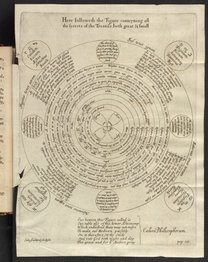
Here followeth the Figure conteyning [containing] all the secrets of the Treatise both great & small
- Part of Theatrum Chemicum Britannicum
- 1652 (MDCLII)
Engraved diagram from George Ripley's The Compound of Alchymie. Known as Ripley's Wheel, the drawing depicts concentric planetary spheres along with his alchemical recipes.
- Author Ripley, George, -1490?
- Creator Of Work Ashmole, Elias, 1617-1692
- Engraver Goddard, John, active 1645-1671
- Printer Grismond, John
- Subject Alchemy
-
Alchemical laboratory
- Part of Theatrum Chemicum Britannicum
- 1652 (MDCLII)
This 17th-century engraving is from Thomas Norton's The Ordinall of Alchimy and was made after a 15th-century illuminated manuscript (now preserved in the British Library). Norton, a practicing alchemist, depicts an…
- Author Norton, Thomas, active 1477
- Creator Of Work Ashmole, Elias, 1617-1692
- Engraver Vaughan, Robert, 1597-1663
- Printer Grismond, John
- Subject Alchemy
-
Title page from Elias Ashmole's Theatrum Chemicum Britannicum
- Part of Theatrum Chemicum Britannicum
- 1652 (MDCLII)
The engraved emblem on the lower half of this title page was made after a 15th-century illuminated manuscript (now preserved in the British Library) and depicts an eagle, snake, and toad against a solar and lunar…
- Creator Of Work Ashmole, Elias, 1617-1692
- Engraver Vaughan, Robert, 1597-1663
- Printer Grismond, John
- Subject Alchemy, Title pages
-
Alchemical master and disciple
- Part of Theatrum Chemicum Britannicum
- 1652 (MDCLII)
This 17th-century engraving is from Thomas Norton's The Ordinall of Alchimy and was made after a 15th-century illuminated manuscript (now preserved in the British Library). Norton, a practicing alchemist, depicts the…
- Author Norton, Thomas, active 1477
- Creator Of Work Ashmole, Elias, 1617-1692
- Engraver Vaughan, Robert, 1597-1663
- Printer Grismond, John
- Subject Alchemy
-
70 items
Palmer's New Catalogue, with Three Hundred Engravings of Apparatus, Illustrative of Chemistry, Pneumatics, Frictional and Voltaic Electricity, Electro Magnetism, Optics, &c.
- 1840
Regarded as the earliest, freely-accessible sales catalog of commercially available chemicals and scientific apparatus, Palmer's New Catalogue by Edward Palmer (1803-1872) provides insight into the costs and…
- Author Palmer, Edward, 1803-1872
- Printer Gilbert, William
- Subject Scientific apparatus and instruments, Barometers, Commercial catalogs, Drawing instruments, Electric machines, Magneto-electric machines, Electric batteries, Microscopes, Telescopes, Eyeglasses, Thermometers, Scientific apparatus and instruments industry
-
Plate 8: Diameters of Elastic Atoms; Ebullition of Volatile Liquids
- 1810
The first 16 figures represent the atoms of different elastic fluids, drawn in squares of different magnitude in proportion to the diameters of the atoms.
Fig. 17 exhibits curve lines by which the boiling point of…
- Author Dalton, John, 1766-1844
- Printer Russell & Allen
- Subject Dalton, John, 1766-1844, Chemistry, Inorganic, Atoms, Atomic theory, Boiling-points
-
Plate 7: Arrangements of elastic fluid particles
- 1810
Figs. 1-3 represent profile views of the disposition and arrangement of hydrogen, nitrous, and carbonic acid gas particles.
Fig. 4 is the representation of four particles of azote with their elastic atmospheres, marked…
- Author Dalton, John, 1766-1844
- Printer Russell & Allen
- Subject Dalton, John, 1766-1844, Chemistry, Inorganic, Atomic theory
-
Plate 6: Symbols of compound elements
- 1810
Continued from plate 5.
- Author Dalton, John, 1766-1844
- Printer Russell & Allen
- Subject Dalton, John, 1766-1844, Chemistry, Inorganic, Chemical elements, Atomic theory
-
Plate 5: Elements
- 1810
This plate exhibits various symbols devised to represent simple and compound elements; they are nearly the same as in plate 4, only extended and corrected.
- Author Dalton, John, 1766-1844
- Printer Russell & Allen
- Subject Dalton, John, 1766-1844, Chemistry, Inorganic, Chemical elements, Atomic theory
-
Plate 4: Elements
- 1808
This plate contains the arbitrary marks or signs chosen to represent several chemical elements, from simple elements such as hydrogen, carbon, and oxygen, to septenary elements such as an atom of sugar.
- Author Dalton, John, 1766-1844
- Engraver Slack
- Printer Russell, S.
- Subject Dalton, John, 1766-1844, Chemistry, Inorganic, Chemical elements, Atomic theory
-
Plate 3: Representations of water particles in water and ice
- 1808
Fig. 1 represents particles (balls) of water, the square form denoting the arrangement in water.
Fig, 2 represents particles (balls) of water, the rhomboidal form denoting the arrangement in ice.
Fig. 3 represents the…
- Author Dalton, John, 1766-1844
- Engraver Slack
- Printer Russell, S.
- Subject Dalton, John, 1766-1844, Chemistry, Inorganic, Atomic theory, Water, Ice, Molecular structure
-
Plate 2: The expansion of air by heat
- 1808
Fig. 1 represents an air thermometer, or the expansion of air by heat.
Fig. 2 is the logarithmic curve.
Fig. 3 is a device suggested by "Mr. Ewart," to illustrate Dalton's idea on the temperature of the atmosphere.
-
Plate 1: Capacities of bodies for heat; views of mercurial and water thermometer divisions
- 1808
Fig. 1 is intended to illustrate Dalton's ideas on the subject of the capacities of bodies for heat.
Fig. 2 is a comparative view of the old and new divisions of the scale of the mercurial thermometer.
FIg. 3 is a…
- Author Dalton, John, 1766-1844
- Engraver Slack
- Printer Russell, S.
- Subject Dalton, John, 1766-1844, Chemistry, Inorganic, Thermometers, Atomic theory, Temperature measurements
-
976 items
A New System of Chemical Philosophy
- 1808 – 1827
First edition of a milestone work in the history of chemistry, in which Dalton announced his revolutionary atomic theory and laws of definite and multiple proportions. As outlined by Dalton, these fundamental laws…
-
Plate II: Various furnaces
- 1777
- Author Macquer, Pierre Joseph, 1718-1784
- Contributor Keir, James, 1735-1820
- Engraver Westwood
- Publisher Elmsley, Peter, 1736-1802, Cadell, T. (Thomas), 1742-1802
- Subject Furnaces, Chemistry--Dictionaries