
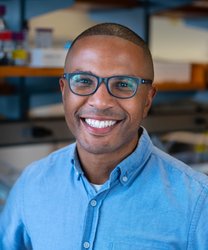
Oral history interview with Bryan Bryson
- 2024-Jan-04
- 2024-Jan-08 – 2024-Jan-09
- 2024-Jan-12
Oral history interview with Bryan Bryson
- 2024-Jan-04
- 2024-Jan-08 – 2024-Jan-09
- 2024-Jan-12

Bryan Bryson was born in Worcester, Massachusetts. When he was three, he moved with his extended family to Miami, Florida. Bryson had a formative experience at the W.J. Bryan Elementary School in North Miami, which he describes as being diverse, having excellent teachers, and prioritizing math and science education. His mom advocated for him to be in the academic excellence class. Bryson was also on the math team and participated in science fairs. In addition to the educational environment at school, he grew up in an educational environment with family; his mother and grandfather had been trained as educators, and his grandmother had a scientific and technical bent. His grandfather often took him to the main branch of the public library after school. Bryson has three younger brothers and says that he was the one with the most intense interest in science.
Bryson’s family eventually moved from Miami to Houston, Texas, where Bryson started the seventh grade. Scoring well on an early SAT helped him get into a sleepaway camp at Skidmore College run by the Center for Talented Youth (CTY). Bryson was intellectually challenged by the courses at the camp, and he had a positive social experience. In middle and high school, Bryson had influential English teachers, and in high school, Bryson enjoyed his computer science coursework. He was on the debate team in middle school and competed on the computer science team in high school, as well as dabbling in soccer and track.
One day when coming home from high school, Bryson experienced racial profiling from the police. The encounter led his mother to move them to a more diverse neighborhood, and Bryson switched schools during his freshman year of high school. The incident led Bryson to consider leaving Texas after high school, and when it came time to apply to college, Bryson’s mother encouraged him to only apply to schools outside of Texas. When Bryson received a phone call about his acceptance to Massachusetts Institute of Technology (MIT), he knew right away that he would attend. He had the “best time” attending MIT’s campus preview weekend.
Bryson describes the transition to MIT as “exciting” and “humbling.” He quickly became friends with his roommates and hallmates in his dorm. He was impressed by the academic caliber of his fellow students, and his classes were challenging. Bryson initially declared a major in aeronautics and astronautics. During a summer internship at Shell Oil Company, he received advice that led him to change his major to a flexible mechanical engineering major with a biomedical engineering minor. Through his coursework, Bryson gradually developed and learned to trust his engineering intuition.
One day, Bryson was reading research posters in a hallway on campus, and a professor, Linda Griffith, asked if he was interested in participating in undergraduate research. Bryson joined Griffith’s lab, working on a variety of projects, including research related to fluidic capacitors and research on the thick-walled cylinder problem. Griffith worked with Bryson to help him develop his ideas so that they were more at the cutting edge. During undergrad, Bryson presented a poster at a pharmaceutical company and on campus and was a coauthor of a paper.
Towards the end of college, Bryson decided that he wanted to go to graduate school and he applied to bioengineering PhD programs. During the application process, he considered a variety of schools but ultimately chose to stay at MIT for his PhD.
In graduate school, Bryson joined Forest White’s lab and conducted research on insulin receptor signaling in adipocytes and lysine acetylation. Though he had useful initial results, when he used a different antibody lot later, experiments stopped working. Bryson asked two postdoc mentors to test the experiment, and their results matched his. Changing his approach, Bryson shifted to learning new techniques in his fourth year, including cloning, making recombinant proteins, and making E. coli. Bryson was surprised and disappointed when a paper came out in a high-profile journal that was similar to his work. Bryson eventually presented at a lysine acetylation conference and at local meetings and had his work accepted and published.
During graduate school, Bryson was involved in activities and service in his department. He served as a TA for a class about transport phenomena, learning to prepare for and give lectures and to set boundaries around work-life balance. Outside of his graduate studies, Bryson enjoyed biking, running marathons, and spending time with friends.
As Bryson’s graduate studies were winding down, he applied to postdoctoral fellowships to do infectious disease research. He chose to work in Sarah Fortune’s lab at Harvard University’s T.H. Chan School of Public Health, where he began research using single-cell technologies to study host-pathogen interactions in the context of tuberculosis (TB). He learned to ask big questions about his research and learned not to make unfounded claims. Bryson’s experimental results surprised him, but he went on to publish his results and present them at the TB research community’s Keystone meetings. During his postdoc, Bryson was in a running club and he ran the Chicago Marathon.
Towards the end of Bryson’s postdoc, he applied to and was offered a position in biological engineering at MIT. He accepted the offer, returning to his alma mater as a faculty member. Bryson began setting up his lab, recruiting lab members, and seeking research funding. Bryson describes teaching practices that he employs to engage students in the classroom and help them develop skills needed as a professional scientist. He describes a TB-related measurement technique that his lab, in collaboration with Forest White, came up with. Bryson mentions his hopes for designing a TB vaccine that takes into account human diversity. He discusses his use of proteomics and other research techniques in projects in his lab.
Bryson reflects on public perceptions of science, managing students’ expectations, and the role of failure in scientific research. He discusses competition and explains how he determines when research is ready to be published. He talks about animal models in research, including the use of non-human primates. Bryson describes his approach to mentoring students, the social atmosphere in his lab, and how he chooses scientific collaborators.
Bryson explains why he chooses to serve on a graduate admissions committee and do admissions blogging. He reflects on the importance of diversity in solving challenging problems in science and explains how he uses metrics to evaluate and improve diversity in science. Bryson has given talks and visited communities in South Africa that are impacted by TB, informing his approach to developing treatments for the disease.
Outside of work, Bryson enjoys visiting libraries, reading, running, and participating in other athletics. Bryson lives on campus in an undergraduate dorm as an associate head of house and has fun making homemade ice cream to share with students in the dorm. Bryson explains how he met his husband and mentions the interests they share as well as their differences. He talks about bringing his whole self to work and the importance of visibility.
Bryson shares his optimism about future innovations in TB vaccine development and his goals for contributing to a vaccine. He also discusses his hopes for training future scientific leaders and shares his teaching goals.
This interview was conducted remotely via Zoom.
| Property | Value |
|---|---|
| Interviewee | |
| Interviewer | |
| Format | |
| Genre | |
| Extent |
|
| Language | |
| Subject | |
| Rights | In Copyright |
| Rights holder |
|
| Credit line |
|
About the Interviewers
Sarah Schneider was a Program Associate in the Center for Oral History at the Science History Institute from 2021-2026. She had an interest in preserving and sharing immigration stories in the oral history collection. Schneider holds a BA in American Studies from Brandeis University and an MA in History (Public History track) from the University of Central Florida.
David J. Caruso earned a BA in the history of science, medicine, and technology from Johns Hopkins University in 2001 and a PhD in science and technology studies from Cornell University in 2008. Caruso is the director of the Center for Oral History at the Science History Institute, a former president of Oral History in the Mid-Atlantic Region (2012-2019), and served as co-editor for the Oral History Review from 2018-2023. In addition to overseeing all oral history research at the Science History Institute, he also holds several, in-depth oral history training workshops each year, consults on various oral history projects, and is adjunct faculty at the University of Pennsylvania, teaching courses on the history of military medicine and technology and on oral history.
Institutional location
| Department | |
|---|---|
| Collection | |
| Oral history number | 1152 |
Related Items


Interviewee biographical information
| Born |
|
|---|
Education
| Year | Institution | Degree | Discipline |
|---|---|---|---|
| 2007 | Massachusetts Institute of Technology | SB | Mechanical Engineering |
| 2013 | Massachusetts Institute of Technology | PhD | Biological Engineering |
Professional Experience
Harvard T.H. Chan School of Public Health
- 2013 to 2018 Postdoctoral Fellow
Massachusetts Institute of Technology
- 2018 to 2022 Assistant Professor, Biological Engineering
- 2022 to present Associate Professor, Biological Engineering
Honors
| Year(s) | Award |
|---|---|
| 2003 to 2007 | National Merit Scholar |
| 2003 to 2007 | Gates Millennium Scholar |
| 2007 | John C. and Elizabeth J. Chato Award for Excellence in Bioengineering |
| 2007 | MIT Presidential Fellow |
| 2011 to 2012 | Krakauer Fellow |
| 2012 to 2013 | Hugh Hampton Young Fellow |
| 2019 to 2022 | Esther and Harold E. Edgerton Career Development Assistant Professor |
| 2022 | Terry and Susan Ragon Associate Professor |
Cite as
See our FAQ page to learn how to cite an oral history.
00:00:03 SCHNEIDER: Today is Thursday, January 4, 2024. My name is Sarah Schneider and I am joined by David J. Caruso. We are conducting the first session of an oral history interview with Dr. Bryan Bryson online via Zoom. So Dr. Bryson, thank you very much for joining us today, and we’re looking forward to learning about your life experiences and your scientific career. And so to start off, I know you were born in Worcester, Massachusetts. And so I was wondering if you could share a little bit about your early childhood and where you were born and where you grew up. And then also maybe a little bit about your family as well.
00:00:43 BRYSON: Great. Thank you. So I was born in Worcester, Massachusetts, and Worcester has experienced many waves of, forms of Worcester, we’ll say. And my grandfather—my family is very, very tight-knit. So we move, it’s, kind of, a cluster. And so my grandfather [Pablo Bryson] was a social worker, then worked on presidential campaigns. And one presidential campaign that he worked on was a Dukakis campaign in the 1980s. And when [Michael S.] Dukakis lost, my grandfather decided that he was going to move climates and become a professor at the University of Miami. And, in fact, our whole family was like, “Okay, we’re moving with you.” Uprooted my uncles, my aunts—I have two uncles [Pablo and Carlos Bryson] and one aunt [Maria Bryson] on my maternal side. And then I was the only grandchild at the time. So we’re like, “Okay, guess we’re moving to Florida.”
00:01:54 And we had this, kind of, like, two-week road trip planned out. I very vividly remember my grandfather’s station wagon. And actually, in that two-week road trip, my grandfather went from, “I’m taking a faculty position” to, “Actually, I think I’m going to retire.” So in his fifties, my grandfather retired and just became a full-time grandfather by the time we got to Florida. So yeah. So we lived in Miami, Florida. In Miami, I went from being an only child to being one of four. And like I said, I’m the oldest grandchild. So that, kind of, comes with a lot of rights, responsibilities, and privileges. Insofar that having a full-time grandfather also means that’s your full-time supplemental childcare. And so I spent a lot of time with my grandfather, who spent a lot of time doing one of two things. My grandfather was very, very religious. So I spent a lot of time doing outreach and ministry in unhoused communities and spent a lot of the rest of his time at the library. So actually, as a child, every day when I got picked up from school, we would go to the main Miami public library, which is a very, very beautiful place. And I think that’s actually where my love of libraries has come from. Actually, every time I go somewhere, to a new city, my—one of the main attractions that I put on my list that I must go to is the main public library of that city.
00:03:44 And also the reality is that actually, I do not come from a family of scientists. Well, I think my grandma [Ana Bryson] is like a secret scientist and we can talk about that later. So I don’t come from a family of scientists. Either designers, architects, social workers, teachers. And so I don’t really know how I caught the science bug. My mom will tell you that it was when I was a kid— well, my grandma will tell you it’s because she played with me with Legos. My mom will tell you it’s because I decided to build robots out of light bulbs and Styrofoam. I don’t know how I would answer that question, honestly. I think it’s just a combination. At this point it’s so—I’m so far away from what my childhood is. Is there one specific formative moment? No. But I think I always preferred science over not-science.
00:04:40 So I spent age three to the end of the sixth grade in Miami, Florida. I went to the same public school. It was amazing. W.J. Bryan Elementary [School]. I will never forget that place. It was so formative. Actually, the only people I keep in touch with from my prior-to-college days, from my educational days, are actually my friends from elementary school. Just because we went through this really amazing number of years together because we all took—it was a cluster of students that all went to the—took the same classes together for five years straight. So that was really amazing.
00:05:27 And then we moved to Houston, when I was in the—for the start of the seventh grade. And that was a different—that was a different experience. I grew up very much a public transportation kid. My family lived very accessible to public transportation. Like we . . . that’s how we got around the city. We had a car, but it was just . . . I think it was partially my grandfather did not like to drive. My grandfather did not like to drive. That was very much part of his culture. He did not like getting in a car. And so as a family, we just took Miami public transportation. But you can’t do that in Texas. So that was one of the biggest transitions, going to Texas and one, not living in a super urban environment, moving to suburbs and being . . . I was like, “What’s a suburb?” You know, that was a big transition for me, being in a suburban place.
00:06:27 Also not seeing . . . . Houston is very diverse, but at the time when I first moved to Houston, it was not very integrated, like, you had different pockets. And my mom really prioritized living in a neighborhood close to where her coworkers live, because she got a lot of feedback on this is where her coworkers live, so that’s where we’re going to live. And that was interesting because I had never been aware of my skin color because I had always been in super integrated spaces. And that was different. And so I went to two different high schools in Houston, one [Kingwood High School] being in one suburb of Houston called Kingwood, and then a different suburb called Jersey Village. And it was from Jersey Village High School, another public high school, from where I graduated. Then I flew the coop. I flew the coop. I got into MIT [Massachusetts Institute of Technology] for undergrad, and I never came back.
00:07:38 SCHNEIDER: I think I might have been on . . . I think I was muted. I was starting to talk. But just . . . I just said thank you for that overview. And so to go back a little bit, you mentioned the, you know, your grandfather and the reason for moving to Florida. I’m not sure if you mentioned what led to the move to Houston.
00:07:59 BRYSON: Oh, yeah. That’s a good question. Actually, it was my mom’s turn to, kind of, dictate the family location. So my mom had taken a job with then Continental Airlines, which is now United [Airlines] in corporate training. And so we moved to Houston because that was where Continental was headquartered.
00:08:20 SCHNEIDER: Okay. And do you have any memories of Worcester and those first few years?
00:08:27 BRYSON: Do I have any memories of Worcester? It’s actually really interesting. I only . . . the only memories I have are those that I’ve seen photographs of. It’s weird, I don’t—I have all these—there are many, many photos, many of them embarrassing, of my childhood in Worcester, like being afraid of Big Bird, being at . . . hanging out with family. But I, my own memory, cannot recollect a single event from that.
00:09:09 SCHNEIDER: Okay. And in . . . once you made that move to Florida . . . . Well, actually, I’m curious, you said you don’t remember Worcester. Do you remember . . . I know you remember, mentioned this—the car, I think, I don’t know if you said station wagon or what kind of car you mentioned. Do you remember actually the physical journey to move and, sort of, that early transition to Miami?
00:09:35 BRYSON: Yeah. You know, there are two places, there are two stops that I remember specifically. One is a stop in front of a K-Mart. And why that stop is very important is because I think it’s associated with what I’ll air quote “early trauma.” So some kids have a pet teddy bear or something. Mine was a towel called Biebersh. And actually, when we moved to Miami, my mom actually forgot it. Forgot to pack it. But it was a pretty generic-looking towel. And so I remember, I now, kind of, remember the events in which my mom found a replacement Biebersh, but tried to make it feel like it wasn’t one. So I remember that K-Mart stop. And then the other stop, I don’t really remember. I remember it being like a campground kind of space that was Yogi Bear themed [Yogi Bear’s Jellystone Park Camp-Resorts]. Those are the two things that I very much remember about this road trip.
00:10:51 SCHNEIDER: Okay. And once you were living then in Miami, you mentioned the impact of that elementary school that you went to. Could you talk a little bit more about what some of your classes were that you took there, and also just generally why you feel like it made an impact on you?
00:11:11 BRYSON: Yeah, I mean, I, you know, it’s so interesting. I remember . . . I remember a few things, actually. So I actually went to two elementary schools in Miami, in part because of Hurricane Andrew. I was there in 1992 where Hurricane Andrew, kind of, terrorized this, the most southern parts of Miami. So we moved to North Miami. And it was really this North Miami elementary school that I remember being just like, “Wow. Wow, wow, wow.”
00:11:45 So my mom has always been a pretty strong advocate of me and my educational attainment. And I remember when you have those meetings where you go check out a school for the first time, you’re like, “Okay, cool.” Like, my mom came with me to the school and they’re like, “Oh, we’re assigning your son to this class.” My mom was like, “No, no, no, no, he’s going in the academic excellence class.” And so the academic excellence was, kind of, like the advanced classes for elementary schoolers. There was one academic excellence class per grade. So my mom was like, “Nope, he is going in that class.” They were like, “But there’s tests.” And I remember her just negotiating her way. She’s like, “Nope, I will not settle.”
00:12:34 And so that was really an amazing experience because I think, one, I just saw my mom negotiating on behalf of my education. And then, two, just this idea that, “Oh, wow, my mom sees something in me,” which, I didn’t know, what does smart mean when you’re, like, five years—five or six or seven? My own self-awareness of intelligence, like, that’s not a real thing in my worldview to be that self-aware at that point. But my mom had that awareness, and so she advocated for me to be in this class. And it was just really interesting because, you know, I don’t . . . . It was just, one, I think it was a really amazing collection of teachers. So it was the same teacher teaching you everything. Same teacher teaching you all of the subjects, but they were just really creative teachers. They were really dedicated to the profession. They were really . . . they had a youthful energy about themselves. They were culturally aware. I went to a super diverse, socioeconomically diverse school. And it just was this place that felt like paradise. It was joy to go to school every day.
00:14:05 And I just remember that they really prioritized math and science education in a meaningful way. I actually was not good at math. I remember one of my academic excellence classes, the school was quite large—the population of the school was quite large, but the building wasn’t at the time, when I first entered. And so we had all these portables in the back. And I remember in the third grade, I could not do multiplication tables. And then they got the fourth graders to come be tutors to us to learn our multiplication tables. I’m, kind of, embarrassed, as an MIT professor, saying that I couldn’t do multiplication tables when I was in the third grade. But it’s true.
00:14:48 And I just remember it just being a place where like, “Wow.” But they had this . . . . But I also think it was just, kind of, an amazing time to be educated. The quality of PBS [Public Broadcasting Service] was amazing, The Magic School Bus, all of those things were just really . . . . It was just an amazing time to be young and science-curious because the combination of having really amazing teachers who really went above and beyond in combination with all the public resources around science education, was just, it was a perfect storm to be elevated.
00:15:27 And I honestly even tell people, my childhood—so some people will call this helicopter parenting, but I say thank you to my mother for doing this, so I grew up in the age of X-Men and Power Rangers and all these things, and I really wanted to watch these TV shows because I was like, “It’s the cool thing.” But I . . . the way that my mom actually negotiated watching it at the time was she’s like, “You can watch these shows as long as you write down ten new vocabulary words every episode.” And so it was, kind of, like an interesting . . . .
00:16:05 So I think I had this perfect trifecta of publicly available education, either through PBS—PBS was amazing back in the day—an amazing school, and highly, highly, highly connected, resourced family members, like my grandparents, my mom, all focused on my education. So the other thing to note is, before my grandpa was a social worker, he was an elementary school teacher. My mom was also an elementary school teacher. So you could not escape it. I think that was—maybe that’s part of it—I had an immersive—my whole science and education early on was super immersive because there was no hour of my day that I wasn’t surrounded by an educator.
00:17:00 SCHNEIDER: And are there any educators, either at that specific school, the W.J. Bryan Elementary School, or even thinking beyond that to other schools you attended when you were growing up, who particularly sticks out to you, or maybe a few people who stick out to you?
00:17:18 BRYSON: Oh my gosh. Yeah. Wow. I actually—okay, so I use Facebook in part just to keep in touch with my elementary school teachers. So the ones I really remember start at second grade. So there was—I can’t make up this name—Miss Trick, Miss Press, Miss [Susie] Morton, Miss [Yvette] Padron, Miss Landon, Miss [Ellen] Cohen. That takes you all the way through all the people who were really formative in my educational experience in elementary school. Like they were just . . . they were amazing.
00:18:01 They’re just like, “Oh my gosh, you’re an MIT professor. I’m so proud.” So it’s nice to have that. Like even my elementary school principal, Miss [Nora] Brandt. I keep in touch with all these people. In part because—I also—many of them are even at this point retired, but it’s valuable to me, in part to just remind them because, like, “Hey, you had an impact.” If you’re still in the profession, I also like to try to make myself available to talk to their classes, and those types of things, because I think it’s important to give back in that way. So yeah.
00:18:42 So elementary school . . . yeah, I just, they . . . [shrugs shoulders] they, you know, we had a math team in elementary school. Science fairs were actually competitive. There were some amazing science fair projects. I have pictures of me and my friends on the math team from elementary school, and I still keep in touch with them and we still reflect on those photos. So yeah. I . . . they all . . . . Yeah, it’s that collection of—I don’t—I’ve never had, I mean, other than college, I’ve never had a similar educational experience. That’s not to say I didn’t have—I had good middle school and high school teachers. Less so in science and math, honestly. I think my humanities instruction was better in elementary—or middle school and high school—than my math and science was.
00:19:46 SCHNEIDER: And could you talk a little bit more about the math team and what that was? And then also, I’m wondering if you ever participated in the science fair.
00:19:56 BRYSON: Yes. Okay. So the math team, I don’t really remember how we competed in math, but I think it was like, you know, there were five or six select students from our class and they got to be on the math team and represent. And it was like, you know, some people have football teams, our math team was representing our elementary school. And we’d go to places field-trip style and compete on behalf of our school. And I don’t remember what the nature of the math problems were, if they were like, we each got sheets of paper and we had to solve it, and it was a question of who did it fastest. I don’t really exactly remember the mechanics, but it was very competitive. But it was like a team sport. Yeah, it was really cool, honestly.
00:20:50 And then science fair. Science fair. I mean, I—once I did one about the—the one I remember the most vividly was one on the science of the Leaning Tower of Pisa. That was probably the one that I remember the most vividly. It was an all-hands-on-deck kind of situation when it was time for science fair. Everybody in my family got involved. Yeah. I think that’s the one I remember the most vividly. I probably had something on plants because my grandma is—I think if my grandma had had the same educational opportunities that I had had, she would have been a botanist of some sort, like a plant biologist. I definitely know that to be true. So I definitely— one year there was definitely a plant-inspired project. I just can’t remember the full detail.
00:21:51 SCHNEIDER: And so is that why you had said that, you know, your grandma’s like a secret scientist? Or were there other things that she was interested in beyond the interest in plants?
00:22:01 BRYSON: Yeah. I mean, so my grandma, it’s a very interesting life my grandma leads. My grandma is ninety years old. And actually, I visited her for the holidays, and my grandma is a master Lego user. She’s got—you know, her eyesight is what it is for a ninety-year-old. And so she’s got this big magnifying glass and she’s got her Lego kits, and she’s assembling, keeps super detailed notes. She keeps super detailed notes. She would build these toys for us as children out of just random pieces of things. Soda cans—instead of recycling them, she would make them into some kind of contraption, like airplanes, you know, you name it. She was very engineering and science heavy. She just liked to have a measurement.
00:23:00 Now she’s older and she’s like, plots her blood pressure as a function of day. She measures the pH very actively. She’s always doing different experiments with her soil pH and how fast her things are growing. And she’s like—it’s like, it’s very much a scientist because people just experiment with things. She takes notes and tries to learn from her experiments and says, “Here is what I advise if you’re growing a lemon. Here is all these experiments that I’ve done over time. Here’s the data to support that.” So she’s very data-driven. So I think those things are probably . . . . And honestly, if I could ever get one of my grandparents to watch Power Rangers with me, it would be my grandma. My grandfather was like, “That’s foolishness.”
00:23:55 SCHNEIDER: And so was she doing any work outside of the home when you were growing up?
00:24:03 BRYSON: Nope. Full-time grandma.
00:24:07 SCHNEIDER: And you also mentioned your siblings. What was your relationship with your siblings like growing up? You were the oldest, it sounds like. So how much did you interact with your siblings and what was that experience like?
00:24:24 BRYSON: Yeah. So my siblings and I, it’s a . . . let’s see, a seven-year age difference from the youngest to the oldest. So yeah, it’s interesting. I mean, when you’re a kid, when you’re that age, it’s hard to be friends—it was hard to be friends with my youngest brother—or my two youngest brothers—because they were so far in age. My brother, the brother immediately younger than me was very much, kind of, like a mirror image. In elementary school, had all the same teachers, just a few years behind because he’s only two years younger than me, basically. So that was . . . that was a lot of fun.
00:25:13 But we were very—we’re very, very different. We’re very, very different people. And I think even then it was very clear that we were very different people. And that’s, kind of, borne out even later as adults. But yeah. I mean, we definitely had very—we had shared interests, I will say, but the intensity that we each play, gave to our shared interests was a little bit different. So I think I was the most intense about my science interests, like my “science interests” and if you . . . my younger brothers were probably a little bit more intense about their humanities interests or something else. I was not—like as a kid, I did not—I read books, but I did not enjoy reading books.
00:26:13 SCHNEIDER: Okay. And so you’ve talked about, a little bit about a number of relatives. Were there any other relatives who played a big role in your childhood or earlier days growing up?
00:26:26 BRYSON: No, it was them. The dream team. Like, you know, I have aunts and uncles and they played a helpful role. But I think in terms of cultivating the person who I am today, that’s my siblings, my mother, and my grandparents.
00:26:48 SCHNEIDER: Okay. And I know you mentioned also your grandfather’s connection to religion. So what was your religious upbringing like as a child?
00:26:58 BRYSON: Yeah. We were like a pray at the dinner table every day, my grandfather as an—I think I actively . . . we . . . . So my grandfather had two jobs. He was, when he was a social worker, he was a social worker Monday to Friday and was actually a radio evangelist on the weekends. And that definitely held true all of my childhood. He, on Wednesdays, would, when—the exception to going to the library after school was on Wednesdays because he’d pick me up and he’d actually take me on his unhoused ministry trips.
00:27:52 But we never really were churchgoing folks. There are parts, there were blips in life where we were churchgoing folks, but why do you need to go to church when your grandfather’s a minister, kind of situation. So it was a really interesting kind of dynamic to under—learn about going to church because it wasn’t a thing that we did very regularly in my elementary school days. You would . . . church was something you did on Christmas and Easter situation, as opposed to we went to church every weekend kind of family.
00:28:36 SCHNEIDER: And it sounds like, though, your mother also, sort of, shared similar beliefs, or is that the case, with your grandparents?
00:28:47 BRYSON: Yeah. So I mean, they all . . . . Yeah. My grandma was born Catholic. My grandfather is Presbyterian. I think I would just categorize my mom as a nondenominational Christian, I think, because that’s probably the best characterization. So yeah. That’s what I would . . . that’s how I’d probably describe them. And so I guess I grew up, kind of, nondenominational, insofar that maybe we went to churches that were of different denominations, but we never affiliated like, “Oh, we’re Baptists. We’re this.” We’re just like, “Christian” was the catch-all term for us.
00:29:31 SCHNEIDER: Okay. And growing up, did you speak any other languages other than English in your home?
00:29:39 BRYSON: Yes. So actually, I was very shy in elementary school, actually. So my grandparents, both of my maternal grandparents, were born in Spanish-speaking communities. So my grandfather was born in Panama. My grandmother was born in Puerto Rico. And so my grandfather speaks very British English because his parents both worked on the canal during its construction. And actually, my grandparents met in New York City at a Christian conference. That’s their love story. But they were very strict about actually learning Spanish. So to this day, if I—my grandmother will talk to me and we’ll—she’ll speak to me in English now because she’s ninety and she’s like, “I do whatever I want.” But I think they had a secret agreement. My grandparents would only talk to us in Spanish.
00:30:42 And so I was a very shy individual when I went to kindergarten. And I remember one day, my mom came to pick me up early. And my mom also speaks to us in Spanish, sometimes, and they were like, “Oh, this explains everything.” Because they were—my mom was talking to me in Spanish, and then my, Miss Trick came up to my mom. She’s like, “Oh my gosh, he needs to be in an ESL [English as a second language] class because he doesn’t speak English. That’s why he’s so shy in class.” Like I wasn’t . . . I was pretty silent.
00:31:16 And so they thought that I actually, she took that moment of me speaking in Spanish to my mother being reflective of I didn’t know how to speak English, but actually I could speak English totally fine. I’d been reading since I was, like, three and a half. But it was just . . . yeah. So yeah. So I was, you know, Spanish was the primary language at home just because my entire childhood, even to my adulthood, both of my grandparents either lived within a five-minute walk or with us. So yeah. So it was Spanish all the time. And English was something we did at school.
00:31:59 SCHNEIDER: And in Miami and in Houston, were there other Spanish-speaking students in your classes, and did you ever speak Spanish with other students, or like you’re saying, was it really just English in school?
00:32:13 BRYSON: Yeah, I mean, I was in . . . so in elementary school, it’s interesting. So everybody had to learn Spanish. But there were two different Spanish classes that we actually separated into. One was Spanish for native speakers and one was Spanish for non-native Spanish speakers. And so we actually had classes where we were like, “Okay, cool.” We . . . so I knew all of the other Spanish speakers. We spoke to each other in Spanish in that class, but it didn’t really . . . it wasn’t something that we did normally—did in other settings, really. The place—yeah. So it was like . . . yeah. That’s how I’d describe it.
00:32:53 SCHNEIDER: Okay. All right. So I think maybe we’ll go back to your educational experiences for a bit. Oh, Dave, did you—
00:33:06 CARUSO: Yeah. Just a quick question. So you’d mentioned, I mean, you’ve mentioned a lot about your family. And you’re surrounded by education. What I’m curious to know is, as you were growing up, were there any discussions around the dinner table with you and your siblings about what your parents—what your family, I guess is a better description—what your family, what they wanted you to do later in life? Was there an expectation to go to college? Did your family members—you mentioned, you know, social work. I’m assuming there might have been a degree in social work, Master’s, maybe?
00:33:42 BRYSON: Yep.
00:33:42 CARUSO: Like was that . . . was there a discussion about, like, you’re going to college?
00:33:47 BRYSON: You know, it’s interesting, I think that it was never a conversation topic because it was just assumed. I think it was like, it’s very interesting. I sometimes identified with this second-generation immigrant experience, but also first-generation because my grandfather had such a strong influence. So my grandmother will say, “Oh, it’s my fifth child.” She had four kids. She’ll be like, “You’re my fifth child.” And so I definitely heard that from them. So my grandfather moved to this country probably in his thirties. Got his degree when he was thirty- two or something. So definitely was delayed in his educational attainment, but nevertheless did.
00:34:40 And so it was just one of these things. They will tell me that as a kid, when we still lived in Massachusetts, my grandfather would just come with me to MIT and just stroll me around, like, “Hey, just take it in.” So I think it was very . . . it was never . . . it was never too heavy-handed, I would say. It wasn’t like . . . it was just, kind of, always like . . . . My grandfather is a very proper kind of guy. He was just like, he always wore French cuff handcuffs with a cuff link. And that was his MO [modus operandi]. So he always gave professor vibes because he always had a stack of books. And it was just, he was our male role model. So we just emulated him. So we’re like, “Ooh, we’re going to read books, too. We’re going to wear dress shirts. We’re going to do all these things.” So yeah. I think that’s how I would describe it. It was never explicit. We didn’t start having explicit conversations about what our educational plans were until I was actually applying to colleges. Because I think they just, kind of, set up this system. Maybe they had their secret council where they made a series of decisions about, “Here’s how we’re going to talk—here’s how we’re going to impress upon our children and grandchildren the importance of education.” And that’s just, “This is how—this is our family plan.” And then they just stuck to it.
00:36:16 So they never really had to talk to us about it because they just, kind of, brain—I don’t want to say brainwashed. Brainwashed is unfair. But they helped us see, without being too explicit about it, the beauty of learning and education and educational attainment. And I think also . . . I think there was, sprinkled in sporadically, tales of my grandfather’s experience pre his getting his degree. So there was a little bit of that, like, “Ooh, look at what, look at the doors that were open for your grandfather at the time by getting his degree. And look at what we have.” And those kind of things. But never so . . . always a light touch. I would say very light touch.
00:37:10 SCHNEIDER: Okay. And I think you said you had this interest in science that was growing. But at . . . did you say you’re not sure at what point you, sort of, decided to be—that that was the path you wanted to pursue as a career? Or do you have a sense of, sort of, how your interests in different subjects came about or evolved throughout your education through high school?
00:37:41 BRYSON: Yeah, I think I always knew what I didn’t enjoy. I was like, there’s the difference between technic—like competent and can do the job versus like, “Oh, I’m having a fun time doing this.” And so I think I quickly learned that for me, personally, that history as taught in high school and middle school was not my favorite thing. I actually, we had to take Texas history when I was in the seventh grade. And I actually remember I actually failed the Texas history test once. And it was the parent-teacher conference. My mom came and she found out that I got a 44 [percent] on my Texas history test. Because I was just like, “I don’t want to read this. I don’t want to do this. I just don’t want to touch it.” And I was, kind of, allergic to history at that moment in time. You know, and I—
00:38:41 SCHNEIDER: Sorry to interrupt, but do you think that was just because it was Texas history, specifically, or do you think it was just broader—was it broadly the subject of history?
00:38:53 BRYSON: You know, I never enj[oyed]—I can’t tell you—other than my world history class, I cannot tell you a history class that I enjoyed in my life. So yeah. So I never really . . . it never really captured my attention the way that other coursework did. And so I always was like—and I just felt like—you know, there’s . . . . I think the other thing is intuition. And maybe this is, maybe I was also, I was a high schooler. I was like, there was a version of my high school laziness. And so, for me, I never really liked memorization. And it felt like, you know, English class and history were all about memorization. What details do you remember from a book? What details do you remember from history? Who was this important person in history?
00:40:02 Versus science and math was like, “Oh, this just comes to me intuitively.” And I just, I think I just felt intuitively comfortable with science and math in a way that I did not feel that comfort with English and history at the time. It just, like, yeah. [. . .] That’s how I would describe it. I definitely had history fair projects that I enjoyed and books that I enjoyed reading. But it wasn’t like, if I was thinking about, “Oh, I have all these classes that I’m taking, six different classes. When I get home, which homework am I going to do first, versus which homework am I potentially going to ignore?” And I would always do my math and science homework first. And then I would maybe read the book that I was assigned in my English class. And then history, I don’t think I . . . I think it was also an immaturity on my part, not realizing the importance of history at the time. But it also just . . . its instruction was, kind of, mediocre at best.
00:41:20 SCHNEIDER: And did you have any engagement with, more specifically, some kind of engineering? It sounds like maybe your grandmother had, sort of, that kind of way of thinking or acting in an engineering way. But I’m wondering if that was either in course instruction or even more informally, you felt like you had some exposure to engineering.
00:41:43 BRYSON: No. No, not—I think the closest it comes to engineering was a computer science class that I took in high school. But that’s it, really. Like I never . . . . And then the spaghetti bridge in physics class. But aside from that, we didn’t really have too much in that department. And so that definitely was something that came from either supplemental opportunities that my family provided me with—and not even really engineering. I went to math camp in the summer, but it was math camp, not engineering camp. It was very much first principles, not anything, nothing really applied. The closest anything came to applied in my education early, until college, honestly, was the computer science team, or at least like—or it’s computer science class, even, where we were like, “Let’s make a program to do this.”
00:42:58 SCHNEIDER: And so could you say a little bit more about that math camp? What was that like? Was it a day camp? Was it a sleepover camp? And yeah.
00:43:09 BRYSON: Yeah. Okay. So this was really interesting. So in the—I think it was in the seventh grade. Yeah. In the seventh grade, again, my mom being the champion of educational opportunities, there was a program where you could take the SAT in the seventh grade. And so I took the SAT in the seventh grade. And I was unaware of this, but there was this book. And depending on how you scored on the seventh grade SAT, there were all these science and math—sleepaway math camps that you could go to. So I went to one called CTY, which is the Center for Talented Youth that I think is either run out of [Johns] Hopkins [University] or Duke [University]. And so I got a good score that made me eligible for a summer applied math program.
00:44:00 So I went for three weeks to Skidmore College in Saratoga Springs, [New York]. I will never forget this. And I lived in a college campus for three weeks that I thought I was the coolest thing ever. I was there. I had a roommate, Max. I still remember him. And it was just very interesting because it’s . . . . High school and middle school back in Texas, for me, was super awkward for just a whole number of reasons. But then I went away to this camp and I was like, “Oh, I found my people” because everybody . . . . You know, I think I . . . I will admit that I was a little bit spoiled in elementary school because—I was spoiled in the sense that I was surrounded all by the same people in this academic excellence class. Mm. Okay. I should be careful about my words. Spoiled. Spoiled—I will use that word because that’s how I felt at the time.
00:45:01 I was also sheltered, in a way, if I look at, look back on this in retrospect. So I’d always been around people who really loved all of the things about school. Like academic excellence class was like, “Cool,” you had to keep a B or better to even stay in these classes. And that’s not something you hear about anywhere these days.
00:45:27 So I was—and then I got to middle school and there were people who were very into other things that I wasn’t into. But I had to, then I was around them and I didn’t really know how to navigate that because I didn’t know how to have those conversations. Like people into fashion and what they were wearing. My mom was still picking out my clothes. And so I just couldn’t engage there. And so it was really awkward for me. I was very socially awkward then. So yeah.
00:46:00 So I think going to this math camp where, look, I could be freely myself and talk about my interest in math and spend a whole day doing math and also feel intellectually challenged. But also I was intellectually challenged, but then we had these curated social experiences. Like every day after math class, we had to pick two activities every day. And I also had never been to summer camp. What is . . . yeah. It was just summer camp wasn’t a thing for us growing up as kids. And so it was my first summer camp experience. I was like, “Oh my gosh, this is amazing.” Yeah. It was just like, it just . . . I was ready to have . . . . It was also amazing to have my first fully independent experience where I got to forget about being a child—like a son or an older brother. I just was like, “Hey!” So yeah, that was . . . yeah, that was really fun. That was really fun, I have to say. I think it was, it was just so . . . . And so yeah.
00:47:04 So I did this and so I think that’s when I started to, like, “Oh, college. College.” At the time, actually, right after summer camp, I was like—I don’t know why—but I was totally convinced that after summer camp, I was moving to New York and I was going to study biomedical engineering at Columbia [University]. That’s actually the only time, I was like, I’ve made a life decision was after summer camp. I was like, “Oh. I got to go to school in New York.” I got it. And I was like, “What’s the best school possible for me in New York? Based off of my interests, it’s Columbia. And if anything, I’m going to study biomedical engineering.”
00:47:42 SCHNEIDER: Wow. And so was that, were you talking to other people who said to you something about Columbia, or were you doing research, or how did you, sort of, come to that idea?
00:47:55 BRYSON: You know, it’s interesting. I think because of this summer program. Because this book was huge. It was, like, this thick [holds fingers up to indicate a thick book]. It was, like, an inch thick of all of these different summer programs. But a lot of these summer programs were at universities. So it was like, finally in seventh grade, imagine that you’re finally being like, “Oh,” you get to pick where you go to college and that whole kind of exposure. Especially because it wasn’t a dinner table conversation, like, “Okay, what are your SAT scores, your grades, blah, blah, blah, blah” because maybe they weren’t worried about it because I was always getting A’s. But it was the first time to be like, “Oh. I’m going to have options. What does it mean?”
00:48:39 [. . .] For some reason, New York was calling to me. New York was calling to me. I think it was just like, “I got to move to the Northeast. I got to go somewhere.” And I was, I think I was thinking like, “New York has this balance of good school and it’s New York City. How cool would it be to be in New York City?” So I think that’s why Columbia was at the top of my list. Yeah. I think that’s how I would think about it.
00:49:14 And so yeah, I just was like, “Oh.” It was like I finally started to think about going to college in the seventh grade, which is, kind of, a weird time to be thinking about it, but that’s the time that it was happening. And I had such an amazing time. I had a college textbook. I needed, like it was . . . I was actually taught out of a college text—applied math textbook. Yeah, it was . . . it was just really nice because it was, it felt very cosmopolitan. I was meeting people from all over the world. I think that was the first time I’d ever met somebody from Connecticut at this camp. So it was like . . . so it was a lot of . . . .
00:50:04 It was, kind of, like a sneak preview of what college could be like. Getting exposed to people from all over. Struggling academically. Having to team up with other people, having people who were smarter, who I felt were smarter than me. And that was like . . . . Humbly, I didn’t really feel like in elementary and in middle school, specifically, I was like, “Oh, I got to do better. I have to do better.” I just felt like I was excelling. Whereas at this summer camp, I was like, “Oh. Hey. There’s room to grow.” So yeah, that’s how I would describe that experience.
00:50:52 And yeah, I don’t know how—I think also, I made a really good friend [Chris]. I made a really good friend who I kept in touch with for, like, six years after summer camp, who I think also wanted to go to Columbia. So even though he was from New Jersey, I was like, “Oh, we’re going to reconnect when we go to Columbia together.” It was just, you know, like that kind of intensity of friendship that you’re like, “We’re going to be best friends” and you’ve only known each other for a week. And we’re like, going to be in each other’s lives for like—six years is actually pretty good when I think about it.
00:51:28 SCHNEIDER: I was actually going to ask you about that, if you kept in touch with anybody from camp—from that camp. Is there anybody else who you—either a student or a, like, instructor or counselor there who you kept in touch with?
00:51:39 BRYSON: I did not. I’m part of our CTY alumni association [CTY Alumni Network] now. Because when I went to college, I actually ended up meeting . . . small world. There were many different classes that were offered. But you really spent a lot of time with the people that were in your class. And so it’s, kind of, interesting. There was actually somebody that I went to college with who was actually at the same Skidmore summer camp. And so we became friends. And so we, kind of . . . and there were a lot of people from college that also had done CTY. So we all had this unique set of weeks that we’d experienced. So we bonded over that.
00:52:29 I still remember many people’s names and periodically I’ll look them up to see what are they doing now. Like my summer camp best friend from that year is now a physician in Washington [State]. So yeah. So I know where some people are and I try to keep in touch or just keep up-to- date is, rather, the way that I’ll say it. But yeah, I haven’t really stayed super like, “Hey, how’s life?” kind of situation.
00:53:02 SCHNEIDER: So I was also wondering about, you mentioned this computer science class and computer science team, I believe, as well. So if you could describe a little bit about, describe what this—you were doing in this class. And then also what the team was like, if it was like the math team or different.
00:53:24 BRYSON: Yeah. Super interesting. It was a C++ class. And so the capstone in this computer science class, which was taught by a very interesting man, Mr. [John] Havens. Mr. Havens had long, kind of, auburn hair, and was the computer science and the calculus teacher. And computer science was an oversubscribed class. So there were only, maybe, two sections of this class. But yeah. So yeah, we just learned all the fundamentals of programming and then every— but also a little bit of theory.
00:54:03 And so there was this supplemental . . . . There were two things. One was this—I don’t remember the name of it, but it was this national computer science exam that was administered periodically that people would take. And if you did well, you got to go into this special computer science thing. But it was more like exam competition versus the computer science team was, you know, different schools—it was, kind of, interesting. So different high schools, their computer science teams would host computer science tournaments and invite people from all over the city to compete. And I had a team of three. [. . .] So it’d be teams of three that would get assigned to something—that would compete together. And so my high school had multiple teams of three, but I remember my team was Chris and Charles Wei. Charles Wei actually went to Columbia. So yeah.
00:55:08 So we would, this is how we would spend our weekends in high school. We’d wake up at, like, 7:00 a.m., we’d go to a different—Chris would pick us up because he was a year older so had a car. And so he would drive us to whatever the school was and we would have these programming things and you’d get a stack of different programming tasks of different difficulties. And then you would pick which ones you were going to do. You’d submit your program and then they’d see how your program performs against some new set of inputs. And if you did it then you got the points.
00:55:46 So yeah, it was like a very . . . yeah. It was a very interesting experience. I guess it’s very similar to the math team in some ways, because it’s like the grown-up version of it because it’s like, what—well, maybe nowadays fifth graders can program, but back then I definitely could not. It was definitely an intellectual extension of that, where it’s like, “Okay, I’ve got a team, we’re going to be super close,” because we were already taking classes together, we were. And then we were doing this team on the weekend. Some people were athletes. I was on the computer science team. That was my competitive outlet in high school.
00:56:41 SCHNEIDER: And I know you use computational methods in your research now, so I’m curious if, looking back at the computer science work you were doing back then, if you could— what your thoughts are about either the computers you were using or the programming you were doing. Or just, sort of, you know, maybe from your perspective today, I’m curious what your thoughts are about that—the programming happening at that point in time.
00:57:10 BRYSON: Yeah, it’s interesting. [. . .] It’s amazing to think about the computer programs that I thought were pushing the boundaries of what I could do then versus what I can do now. What I thought was complicated, like to make this hangman game, it could probably run on my Apple Watch. So it’s interesting. I loved—I love computer games, like when I was in—computer games and video games—and that’s what I actually really thought I was going to do when I went to college.
00:57:48 So it was, kind of, perfectly set up because I’d taken computer science. I was like, “Oh, I, kind of, acknowledge that I’ve learned this, but there are programmers who are making computer games. How do I get to that moment? Or how do I get to that place?” And so that’s one of the things that I think was really interesting for me, that I definitely had these influences in terms of, “Oh, I really like this.” Okay. I guess it was like, in some ways I was—the way that I think about it is—there was this perfect marriage between academic things that I was good at, leisure things that I enjoyed, and a potential career path that merged the two.
00:58:40 And so it’s very interesting to think now that what I thought was leading the cutting edge in terms of programming languages—do people even—people don’t even really program in C++ as much anymore. I’m like, “Oh, there are all these new languages. And blah, blah, blah, blah, blah, blah, blah, blah, blah, blah, blah, blah.” I was like, “Oh gosh.” It’s, kind of, hard to keep up, honestly. There was a certain beauty in the simplicity back in the C++ only days, versus— not only—but that was the only language in my universe, to where I am today, where I’m like, “Wow, I haven’t programmed in R for a year and I just feel like I’m starting all over.”
00:59:33 So there’s this other part, which is like, oh, I felt super elite and fresh and all these things when I was in high school because it was the only—it was the only thing I was doing. I’d go home and I’d write a program. Then I’d play a video game. And then I’d go to class and I’d write a program. And now, it’s definitely not that anymore, in part because I just feel like . . . . Also, with the advent of the internet really creating a broader . . . . I could never . . . also, debugging your code was a stress point. Back in the day of like, hey, I actually can’t just go to a message board and see if somebody’s been struggling with the same thing. I just have to struggle through it. So I also think that the pacing of things was very different than what it is now. If I’m like, “Oh, I’m stuck with this,” I can just type into Google, “I need a code to do this,” and it’ll just pop me onto that website that I need. So yeah. It’s just different.
01:00:47 SCHNEIDER: And I’m wondering if you had a computer at home, or if you remember when you got a computer at home, because I know, like, you know, in my childhood growing up, I remember having that point when we got a computer and what that was, sort of, like to have that. So I’m curious what your experience with that was like.
01:01:08 BRYSON: Yeah, that’s a really good question. So I actually got my first, we actually had a computer maybe since I was five. So we had computers. Yeah. So we had a computer in the house. I think our first computer was a Tandy, then a Hewlett-Packard, actually. And so we’ve had computers in our house since I was five. Yeah, I just remember—I don’t remember what in the world the Tandy did other than the text was green, and the screen was black. And then I remember we got a Hewlett-Packard and that had the—it had a CD-ROM drive. And so my mom would buy educational computer games. And then the rest of history.
01:02:00 SCHNEIDER: Okay. And so it sounds like you were pretty busy with, you know, at one point, the math team and in camp and everything. And then at this point, computer science. Did you have—were you involved in any other extracurriculars throughout your education? Through high school, specifically.
01:02:20 BRYSON: Yeah, that’s a really good question. I did a little bit of . . . like I played soccer periodically. But that was really . . . . In middle school, I was a really good Lincoln-Douglas debater. So I was actually on the debate team. So yeah. I did a lot of debate in middle school. And then I did it for a little while in high school, and then I was on the track team for a little while, and then I didn’t want to do that. And then I just did the computer science team. And then I joined the soccer team halfway, for the last two years of high school. And that was about it.
01:03:17 SCHNEIDER: All right. And then I’m wondering if there’s anything else in terms of either coursework or teachers or anything else from, you know, your educational years through high school that we haven’t talked about that you think played a big impact in your, either career or who you became as a person.
01:03:44 BRYSON: You know, that’s a good question. There are two people who come to mind, both— there are three people who come to mind. They’re all, actually, the English teachers, really interestingly, my English teachers. So in the seventh grade, there was Mr. [Andrew] Robia, who actually lent me his personal copy of Ender’s Game. And it was at the time the longest book that I’d ever read. And it was just so cool to be exposed to science fiction in a more mature way.
01:04:20 And then in high school, I had two really amazing English teachers, Miss [Anne] Nugent and Miss [Marte] Parham. And they were both just, they were both accessible human beings. They, kind of, saw you as emerging adults. They talked to you in interesting ways. They had opinions. They didn’t feel like sterile characters in your life. Like a lot of times your teachers feel like sterile characters. They’re just there to teach. You don’t really see. But I think when you discuss literature, you get to see people’s identities a little bit more shine through. Like when they tell you how they interpreted a scene or a conversation in a book. So it was interesting to see. I think that made them more human to me. So that was super interesting and valuable.
01:05:23 SCHNEIDER: I’m just taking a note here for one second. Okay. And so you’d mentioned a little bit about, sort of, the environment in moving from Miami to Houston. And I’m wondering if either in Miami and/or in Houston you had any interactions with—like outside of your family—with the broader Black community or Latino community or any sort of cultural or other communities in those places. And also, if you want to talk a little bit more about maybe that move to Houston and your experience in that way.
01:06:14 BRYSON: Yeah. So that’s interesting. That’s an interesting question. I tell people I went to the equivalent of finishing school in elementary school. So on the weekends, there was a Black fraternity that ran etiquette classes. And so my mom sent me to these etiquette classes just because she felt like . . . . I think my mom also was very prescient in a way that—or still is very prescient—in a way to just think about, what are the skills that I think my child is going to need later on in life? And so yeah, we learned all of these, about all the forks and everything. And it was very . . . it’s, kind of, very odd to think that that was how my mom wanted me to spend my weekends, and it was very regular. We would learn how to sip cups of hot beverages and we’d have hot cocoa and we’d just be . . . .
01:07:16 At some level I’m like, “Oh, wow, that’s, kind of, weird.” But actually, it was interesting because I think it served two purposes, in retrospect. One, being introduced to the Black community in a different way than others might build their relationships. It wasn’t through just neighborhood connections. It was broader than that. And also, I think that—I don’t remember which Black fraternity, which historically Black fraternity it was—but they were very successful professionals that were teaching seven- and eight-year-olds and nine-year-olds etiquette classes on the weekends. It was just very interesting because you, kind of, got to see them. You saw them in a really interesting light. So yeah, that was very . . . that was very interesting.
01:08:18 I mean, I think, you know, when you live in Miami, Florida, you can’t, it’s all . . . . Also, I go back to the example of riding public transportation. Riding public transportation is one of the most amazing ways to immerse yourself in culture, I have to say. Because it, you just . . . there are all kinds of folks on a bus. They’re just trying to get somewhere and they just similarly either don’t have a car, because we did lose a car in a very hilarious series of events when I was in elementary school, but also, or they just don’t want to drive or it’s more convenient to take public transportation. So yeah. That was my, the bulk—the bulk of, actually, my exposure to the Black or Latinx community actually occurred in elementary school.
01:09:21 And in high school, my first high school that I went to—actually, both of the high schools that I went to—were majority-white schools. So that was very—and it was like . . . . And the city was—in Texas—is so large that it’s not just your school, because the schools are associated with the neighborhoods, your neighborhood is this. So I went from an elementary school just being one of a very diverse population to being the sole Black student in anything. And then it was like my whole life was that, being the sole Black person. And it didn’t change again until college, actually.
01:10:11 SCHNEIDER: And if you want to share, feel comfortable sharing, I’d be curious if you want to share anything about how you navigated that experience. Or if there were ways in which— yeah, if there were things that you did to navigate that experience.
01:10:29 BRYSON: Yeah, it’s really interesting. What will I say? So I would say that it was . . . I think if you ask any, I think if you ask many Black people who grew up in predominantly non-Black communities, they might all have a story like this. And so I’ll keep mine short. But the reason that I went to two different high schools in high school was because I experienced what I will call racial profiling. Others might call it something different. But I just remember my first high school had a ninth grade campus and a tenth to twelfth grade campus. And because I was on the track team, the track team would actually practice on the main campus on certain days. But then on Thursday we had early release. So school ended at 2:30 [p.m.]. And so that was a day where we didn’t have track practice and I would just walk home instead of taking the bus from the main campus. And so I walked home. It was in one of these master-planned communities. And I just remember very vividly—and I didn’t have any friends, so I wasn’t walking with anybody. I was just, kind of, walking around people because we, kind of, all lived in the same neighborhood. But I wasn’t actively talking to anybody. I remember we got to one of these entrances to a neighborhood, and I got pulled aside by the cops. I had no perception for what was happening. It went to eleven very quickly and I’ll spare some of the details, but it was very troubling.
01:12:11 So all these people that I was walking with who could have provided alibis like, “Hey, he’s been walking with me from school” all quickly disappeared. And I lived in one of those kind of neighborhoods where a lot of the . . . one of the parents may not have had to work that day, and so they were picking their kids up. And so here I am, me, all of these parents watching as this whole scene is unfolding [uses hand motions to indicate that parents were standing nearby while this was going on]. And then the cops eventually let me go and I ran home, kind of, terrified.
01:12:43 And I remember my mom was at work and I knew her phone number at work. I call and her assistant answers, and she’s like, “Your mom’s not available right now.” I was like, “No. You need to make her available.” My mom, just, my mom left work and she was like, “Can you identify the police officer?” And I was like, “Yeah, I can. It’s the same one that patrols the neighborhood, blah, blah, blah, blah, blah.” And so my mom actually went and she found the police officer and she was like, “Look, if you ever do something like that to my son again, it will be the end of your career.” And then she just left. And actually, within a week’s time, my mom was like, “We can’t live in this neighborhood anymore.” And she was like, “Okay, we’re going to try to move to a more diverse community.”
01:13:36 And so yeah. So that’s—I moved. I moved high schools in the middle of my freshman year, in part because of difficulties around race. I’d never known the term “racial profiling.” I’d never— I didn’t—I couldn’t put a name to it. I didn’t know what these things meant. So my grandfather is, my maternal grandfather, is half Senegalese, half Scottish, but he’s, you could tell that he’s not purely Scottish. And my grandma is Puerto Rican. And so my family is incredibly diverse in many, many ways. And so this conversation about race never really was something we talked about because in my grandfather’s head, the problem had been solved once his parents were able to get together. Because it’s a Senegalese woman and a Scottish man, like, we are past this. So it was never a life lesson that I was prepared for coming in, and then I got the reality check.
01:14:52 And I don’t think there was anything that they could have done to prepare me for that moment. But it was pretty traumatizing, honestly, if I look back on it. And it was my first—you know, I just, I never was like—I was aware that I was a different color skin than a lot of the people around me, but I never realized that that would result in me being categorized in a way that was not favorable, so to speak. I had a very different worldview. I don’t want to call it naïve. I will call it different because I don’t think it was naïve. It was just informed by the lived experiences that I’d had. And so I was just like, “What is this? What is going on? Look at my geometry book. Why are you in my backpack?”
01:15:44 And so yeah, I quickly . . . . So I think that changed the rest of my whole high school experience because I was just like, “Look, just keep to yourself, stay out of trouble, just do really well.” [. . .] I think that was the moment, “Oh, let me synthesize all of the data I have collected.” And to me, the conclusion was, “I just got to get out of this state.” So for me, I was like, “I got to get out of here.” And so part of it was, I think that was a trigger to say like, “Okay, my ticket out of here is getting into the best school possible and going far, far away.” And that’s what I did.
01:16:34 SCHNEIDER: Thank you for sharing your experiences. And I want to hear more about, you know, that decision to move away in a moment, or apply to schools elsewhere. But I’m also wondering, in thinking about those early years, you talked certainly about some cultural things like PBS, and, you know, X-Men and things like that that you were interested in. I’m also wondering if there was anything else culturally that had a big impact on you growing up, or if there were any big historical events, thinking back on your childhood, that you feel like had a big impact, whether it was something in national news or more local news growing up.
01:17:16 BRYSON: Yeah, it’s interesting. I mean, Hurricane Andrew was very hyperlocal, hyperawareness—where I had a hyperawareness. I think, honestly, the Radio Shack era of just technology becoming—consumer tech. Consumer technology. I feel like that was, kind of, an era of consumer technology that was very—like the introduction of internet at home. All of these things were, like being able to be in the fifth grade and in the library computer lounge and being on the internet. That was, kind of, wild. It was super slow, but I was like, “Wow. Wow.” I think those moments were pretty amazing. I mean, it’s, kind of, weird, and I just remember, in the fifth grade, the O.J. Simpson verdict being actually announced on the morning—on the intercom system. And I was like, “Why is it? This is weird.”
01:18:39 Other moments. I mean, 1999 to 2000 was a moment. Because everybody was like, “Oh, Y2K, the world is going to end.” I was still pretty religious at the time. So I was, there was this tension for me, which is like, “Why am I spending all this time in school if the world’s just going to end tomorrow.” It’s 2024. So yeah. So I think a lot of those, a lot of these, kind of, technological moments. This transition from [no internet to internet]. The fact that we could get information. The fact that you can send messages super rapidly, like instant messaging. All of these things were this introduction . . . . The idea that you had to previously go somewhere to use a computer, and now this idea that actually the computer was connecting you to the rest of the world and you didn’t have to go anywhere. That was, kind of, exponential. Like from where I first—I remember my first experience with the internet in the fifth grade to where I was when I was leaving for college. I was like, “Whoa.” So I think those moments. I mean . . . .
01:20:04 Yeah, I think it was interesting, presidential elections, because I guess I . . . . You know, it was interesting—it’s no longer the case, I don’t think anymore [that Florida is a swing state]—but living in a swing state. Wow, that was, kind of, cool. Florida. I lived in a swing state. That was, kind of, interesting. It was actually very interesting because I just remember when [Bill] Clinton won the first time and I was just, like, remember, it was a big thing. So yeah, a lot of these moments in American history, and then moments in technological history are the ones that I think stick out to me the most.
01:20:52 SCHNEIDER: Yeah. And just one follow-up to that, you mentioned Hurricane Andrew. What was your experience like of that event?
01:21:00 BRYSON: Yeah. I mean, it’s very interesting. I’m a very heavy sleeper, so I actually slept through the roof being torn off part of our house. I woke up the next day without electricity and the hurricane was over, for the most part. The eye had passed. And I was just like, my mom was like, “You slept through the whole thing.” Yeah. I mean, that was, it was very interesting to see. I, kind of, believed in superpowers back then, and so I think I had this idea that Captain Planet was going to come to our rescue. I had this, I think I had this worldview, like something was going to save us after this really catastrophic event. And that didn’t really happen. It was just sheer will of people after a really, kind of, horrible series of weather events.
01:22:12 SCHNEIDER: Okay. All right. You talked about this desire to maybe go to the Northeast, be in a different place. What was the college application process like for you? Did you apply to numerous schools? And what were some of the factors in your decision-making, maybe other then, you know, wanting to get to—go to a different place?
01:22:44 BRYSON: Okay. So we’ve talked about family dinnertime conversations about college. So this is actually the first time I remember being exposed to opinions from my family about college. And there was a strict “no Texas” rule. They were like, “You gotta go. You gotta go.” And I had a lot of friends, or like, “friends,” that were going to either UT Austin [University of Texas at Austin] or Texas A & M [University] College Station, and that was what the pipeline was. And it was like, “Nope. Nope, nope, nope, nope.” My mom was like, “I will not support applications to Texas universities.” It’s, kind of, interesting. It’s, kind of, very interesting. So I really wanted to study biomedical engineering. So I think the top two schools that I applied to—I don’t actually, I can’t actually— so as much as I was in love with Columbia, let me tell you what happened. So I actually, we went on a college visit to Columbia. And I remember talking to some college students and they were like, “Biomedical engineering is the most difficult major at Columbia University.” And I just . . . and I think that just removed it immediately from my list. So I actually didn’t even apply to Columbia for college.
01:24:03 So I applied to Johns Hopkins [University], I applied to MIT. Those were my two reach schools. And then I had a few others scattered around, kind of, the Eastern Seaboard. The list was actually quite short. I know people apply to many more colleges now. I think—I did not exceed . . . I did not exceed ten for sure. I think. And then even some of the schools, I applied to some of them because there was no application fee. So I was like, “Okay, cool.” But I wasn’t necessarily thinking about . . . .
01:24:46 Like I had this. Okay. So I had this—it was very interesting. So I’d taken the PSAT [Preliminary SAT] and the SAT, and I was a National Merit Scholar and there was this, it’s, kind of, wild, I should plant a tree on behalf of my college applications. But back in the day, they would just, you remember they would just send all that mail, that mail. You’d get your— they saw based off your SAT scores and they would spam you, like, “Apply to us. Apply to us.” And it would all come in the mail. And I just remember when I left for college, my mom had this bag because, we’re, kind of, like celebratory hoarders insofar that I was the first grandchild going to college.
01:25:30 I think my—what a difference a few generations makes in terms of really understanding what college applications means. My grandpa went to a community college when he first moved to the US. And then so he didn’t really understand what applying to college was. And so gave my mom okay, but not amazing, advice when she was applying to college. And then by the time it got to me, they were like, “Oh, we know all the rules.” And so there was this moment of joy. My grandpa was like, “Oh, I remember what it meant to be living at the poverty line with a growing family, just having moved to the United States. And look at us now.” So he was like, “Save everything. Save everything.”
01:26:15 And so I remember there was just this huge bag of stuff, of every piece of mail because I was not allowed to recycle it, not allowed to throw it away. It was just this greatest hits. Like we just wanted to celebrate every little piece of Bryan’s applying to college experience. Because it was a source of pride and joy for my family. It was like, “Okay. It was all worth it.” So I was still very much like—at that point I was like, okay, when I was applying to college, when I was submitting my applications, biomedical engineering. Biomedical engineering. That was the thing. But different schools had different processes. At Hopkins, you were actually applying to be accepted into a major. MIT, you were applying to be accepted into the school. I did pretty well. I got into every place that I applied.
01:27:11 But let me tell you two stories that are associated with this. Humility at that stage of my life as a seventeen-year-old did not exist. And so I just knew—I was a know-it-all. So what does that mean? So the first is like, I actually got into Hopkins and I remember two things about the Hopkins application experience. One was they had an amazing college admissions essay. I just wish that these types of college admissions essays still existed. It was the question of like, “If you were given ten dollars and you had to have a day of fun, what would you do?” I just thought that was—I still think of that as an amazing admissions question. And then the second thing about that is they did not accept me into the biomedical engineering major. And they were like, “You can do this other one. Biomaterials.” I was so offended. I was like, “No. No, no, no. No, no, no.” [I was] offended because I was like, I didn’t know how to process the emotions of rejection.
01:28:20 And then, I remember one weekend I was just chilling out at home. And this was in the caller ID era, thinking of consumer electronics, being able to screen who is calling you. And it’s an out- of-town area code, 508 area code. And my mom was like, “Oh my gosh, 508, that’s Massachusetts. Blah, blah, blah, blah. It could be MIT.” This was after the Hopkins situation. So I was like, I was very—I was not in a good mood. I was not in a good place. And I just remember I was like, “No.” Or no, it was actually—okay, I got it wrong. It was a 617 area code, and I thought I knew everything. My godfather lives in Massachusetts and I know his number, and it starts with, it’s a 508 area code. And so I’m like, here my mom’s holding the thing. And we’re having this back-and-forth argument like, “No, no, no, that’s not Massachusetts. What is 617?” I was like, “You don’t know what you’re talking about. Bla la la la la.” So we have this whole back-and-forth argument. None of us answers the phone. And I’m angry, so I go to my room and I’m hanging out in my room.
01:29:31 And then my mom, again, quite prescient. She decides, “I’m just going to call that number back.” And then she comes to my door, she knocks. She’s like, “Oh, I called that number back. It’s MIT, would you like to speak with them?” And I was like, and then my whole life changed. My whole life changed. My whole life changed. I started packing my room that day. I’d never actually visited MIT during my college visits, but I was like, “I’m going. I’m going. We can start packing.” Like, “Okay.” Right. I was just like. And I was the most . . . yeah.
01:30:06 I just remember . . . and then my mom was like, my mom gave me some important advice because a lot of other people from my high school had applied to MIT. And I don’t think they were—I don’t know the last time before that that somebody from my high school had gone to MIT. It wasn’t like, “Oh yeah, let’s talk to so and so. He’s a student at MIT right now.” There was no recent memory of an MIT student. And so I got to school on Monday, and I was supposed to be sworn to secrecy. And I was like, “Nope.” That went out the window. I was telling everybody I knew, I was like, “Oh my gosh. Oh my gosh. Oh my gosh.” And then it actually turned out that somebody else from my high school got into MIT that year. So that was, kind of, cool. But there were a lot of people who didn’t.
01:30:51 So then came the campus preview weekend and I went. And I flew out earlier than my mom did. And I had a cell phone at the time and it was raining and I wasn’t answering my phone because I was having the best time. And my mom found me on campus somewhere, just serendipitously. And she didn’t even bother to interrupt me because she’s like, “Oh. I think he’s found his place.”
01:31:23 So after that weekend, I bought a bumper sticker. I didn’t own a car. I had a t-shirt. And I was like, it was in the messenger bag era—the first phase of the messenger bag era. So I put my bumper sticker on my messenger bag, just to make clear that I was going to MIT because a lot of people at that point had already known they were going to UT or Texas A & M because Texas had this top ten percent rule. So if you were in the top ten percent of your graduating class, you were automatically accepted to Texas A & M or UT. So people were like, “Oh, I know my class rank. I don’t have to worry about college.” And then there was me who’s on this high drama because none of the schools that I was applying to had this kind of automatic admissions, so to speak. So I was like [makes a tense facial expression and holds a tense posture]. And then I got into MIT and there was no stopping me at that point. By the middle of July, my full room was packed up and I think I was just sleeping on a mattress. I was like, “I’m going to college. I’m going. I’m going.”
01:32:33 SCHNEIDER: And you mentioned the stacks of papers and your family’s excitement and pride. How did that feel to you at that age? Did it—because I could see where maybe it would feel like a lot of pressure. Maybe it would also feel very supportive. I don’t know. It could be a lot of things. So I’m wondering how it felt to you.
01:32:53 BRYSON: Yeah, it was only joy. It was only joy. You know, it’s very interesting. I think at that point, the pressure, the person providing the pressure, was me. Yeah. It became very clear that—I think there’s so many, there are so many reasons why I think my life story seen through the lens of my mother, my grandparents, is just like, “Wow. Wow. We did it.” You know, some people live in the same home their entire lives before they go to college. And so there was the concern of like, “Oh, we moved him around too much. We did this. We did this.” I think they were concerned about like, “Oh, did we make all the right choices?” And so I think there was a lot of concern on my family’s part like, “Have we set him up for success?” But I don’t think they ever formally would tell me that. But then when they saw the success start to come in, then they were like, I think they were seeing a sense of relief.
01:34:07 But then they were also seeing like, “Oh, maybe all those decisions or the sacrifices we made are paying off.” Because I think, you know, they definitely—I definitely know my mom . . . . My mom is a single parent. I think that’s obvious. My mom is a single parent of four boys. It’s like, that’s not easy, even in Texas. That’s not easy. And now that I’m an adult, I appreciate the sacrifices that are, that come with making these—three-week summer camp that costs, like, three thousand dollars in 1997. That’s not cheap. I realize all these sacrifices, it’s for the good of the child, regardless of whether it pays off. But, hey, I think they were thrilled when it started to pay off because they’re like, “Okay. Yeah.”
01:35:05 And then also when you’re the first one and you try an experiment and you’re like, okay, cool, there’s now seven other grandchildren. If you have to try to quickly pivot your strategy, you could imagine that that would be difficult. But yeah, it’s interesting. I never felt family pressure, educationally. Again, maybe because they did such a good job early on cultivating this idea. To give you an example of family pressure. Okay. This MIT application story. I was so last minute, and my mom was not pressuring me sufficiently to get my application done on time. And they had strict deadlines and you couldn’t submit it on the internet. So what did I have to do? On December 31, we went to the airport post office to get things postmarked on time. So that’s just an example of—they were not. They should have given me a deadline. They should have pressured me. But they did not.
01:36:22 SCHNEIDER: And was it like that in terms of your homework and things like that as well? Were you more independent in doing your work or were they monitoring, you know, that you were keeping up with your work?
01:36:38 BRYSON: There was no academic monitoring. I think because I also had younger siblings and they needed more attention because I think my mom does ascribe to the early intervention model. You either do this and create this culture early, or it’s all bets are off. It’s hard to change. And so they’re like, “You’re on your own. Get to and from school. If you’re staying after, figure out a way to get home. Blah, blah, blah, blah, blah.” It was very much . . . yeah, it was very much . . . . It was supportive, but on your own. I’m remembering now that there was, depend[ing]—there were two years that you took your PSATs in high school, sophomore year and junior year. And then depending on how—in my high school—depending on how you performed on your PSAT sophomore year would influence whether you could get into a special PSAT prep class. But the PSAT prep class was at zero period, which meant it started at, like, 6:30 [a.m.] as opposed to 7:30 [a.m.].
01:37:50 But there’s no bus picking people up for 6:30. And in Texas, the concept of biking to school when you live—if you live more than a mile away—was not a thing. People would drive. But there was no—there was one car in our household. And I wasn’t driving. My mom was driving to work. So I would, I remember, I would bike to school and that might seem very commonplace for somebody who lives in New England, but biking to school in Texas, where there’s barely even sidewalks, is not a thing. So I remember, but my mom was like, “Well, you want to do this. Well, figure it out.” So yeah, very much became a sense of cultivating—like the independence has been cultivated and you will figure it out because this is something that you want to do, not something we want you to do, necessarily.
01:38:49 SCHNEIDER: That makes sense, thank you. Dave, do you have any questions at this point?
01:38:55 CARUSO: I mean the only thing. So with oral history, we like to see where interviewees go and what they talk about. Sarah did ask you about important events. You didn’t mention September 11. I didn’t know if it was—I mean, it happens. We remember it. I was in New York. I had family in New York, so it stands out to me a bit more. I just wanted to check to see if you had any experiences with, around September 11. And also some of the ethnic, racial backlash that was directed at random individuals. We were just looking for everyone to blame. And so even people who had no affiliation or no backgrounds related to it were sometimes attacked or discriminated against and things like that.
01:39:49 BRYSON: Yeah. You know, now that you raise it, I do. I do. I don’t know why it doesn’t stick in my memory as much as other events. But what’s really interesting is, like I said, my mom was working for the airline industry at the time and she was on a trip. She was on a trip. I remember somebody—I remember it was actually in Precalc. Somebody came in and we had the—remember when the TVs on carts that would get rolled into the classroom? Yeah. So we had the TV on the cart. And somebody, who I guess had a cell phone—because they weren’t really allowed in school at that point, but people were starting to carry their own cell phones— she had gotten a phone call. And I remember Miss [Debbie] Fitzgerald put the whole thing on TV. And then it was just, it felt like a real scramble the rest of the day.
01:40:42 And I was like, “I can’t reach my mother. I can’t reach my mother. I can’t reach my mother.” Until sometime in the middle of the day, I got a principal—I got a “Come to the office” note that my mom was there to pick me up. And I was like, “Phew.” Because I was like, it sound—it was like, really . . . yeah. So it was, kind of, terrifying. But I think may—yeah, I think I just zoned it out. Because I feel like we, kind of, in my case, we came out unimpacted directly by the events. So yeah. But it definitely, it definitely, now that you mention it, I do, kind of—I very much remember the tension of like, “Oh my gosh, my mom could be on a plane right now. My mom could be on a plane right now.”
01:41:39 SCHNEIDER: Okay. So next, I’ll be wanting to hear about your transition into your studies at MIT. I’m wondering if it makes sense, maybe, to stop here for the day, since we were planning to stop at five and start on that next time. What do you think?
01:41:58 BRYSON: Sure. That sounds great.
01:41:59 SCHNEIDER: Okay. Let me pause the recording.
[END OF AUDIO, FILE 1.1]
[END OF INTERVIEW]
01:42:06 SCHNEIDER: Today is Monday, January 8, 2024. My name is Sarah Schneider and I am joined by David J. Caruso. We are conducting the second session of an oral history interview with Dr. Bryan Bryson online via Zoom. So thank you again for joining us today.
01:42:23 And we’re going to pick up where we left off in the last session. You were describing your decision to attend MIT, or the Massachusetts Institute of Technology, for your undergraduate studies. And so I’m curious to hear about that transition from living in Houston and your high school education to college. What was it like physically making that move? What was it like returning to Massachusetts, a state where you were born but only spent, you know, a few years before you moved elsewhere? And then what was it like making that transition to life on campus at MIT?
01:43:02 BRYSON: Yeah. So the transition was a bit . . . like, I think I wasn’t really thinking about it as a transition when I came because I was very excited to get out. And so getting to MIT was like, “Oh, I’ve made it.” And I had a level of self-confidence. It was like, “I did it.” This is one of the most difficult schools to get into. And I wasn’t really, like, I wasn’t very . . . I don’t think I was very thoughtful about the transition, honestly.
01:43:40 I think I had a little bit of over-the-summer panic because I was like, “Oh, maybe I should try to get ahead.” And I downloaded some homework from calculus, from MIT. And I was like, “Oh gosh, I made a terrible mistake” because I was like, “I don’t know how to do this homework. This is calculus. I’m supposed to have done calculus already. Why is this so hard?” But I think I just was like, “It’s summer, so that’s why my brain’s not on,” so I just, kind of, let that go.
01:44:10 And then I just said, “Okay. I’m going to campus.” And so it was really interesting. I chose— MIT’s really unique insofar that you have a lot of agency in terms of the communities you select in which you live. So I really prioritized one particular dorm called Baker House because one of the things that they advertised was like, “We have this open door policy. It’s a very social dorm.” I was coming . . . there was somebody else from my high school who was coming to MIT, but we weren’t best friends and we weren’t planning on being roommates.
01:44:45 And so I really wanted to make sure that I was getting to know people in this whole open door policy, especially because at that time I think I was exuding strong introvert energy still, nonetheless. So forcing me to have the door open was a way to encourage social interaction. And then on top of that, I really—well both for financial reasons and for practical reasons, I actually prioritized living in a quad. So I had three roommates.
01:45:19 So I arrived at MIT, we had freshman orientation, which was like, you know, just meet a bunch of people. It was incredibly humbling because we did one of those icebreakers where you say something about yourself, and then people raise their hand and say, “Oh, yeah, me too.” And I remember being so proud of being a National Merit Scholar. And then everybody else was like, “Oh yeah, I’m—same, same, same, same.” I was like, “Oh gosh, we’re not in Kansas anymore.” So it was really humbling in that way. The transition was like, “Okay. Yeah. Yeah, yeah, yeah. You’re no longer big fish in a small pond. You are just a fish. You are just a fish and you are finding what the limits of this pond are.”
01:46:00 So I think that was, kind of, the first realization. I was like, “Okay. This is not the same place.” And then realizing how impressed I was. I’m not going to say that I felt threatened, but I’m going to just say I felt very impressed by the people that I was going to college with. That was, kind of, cool, right, to be like, “Wow. I admire you and we’ve just met.” And I’m just like, “You’ve done interesting things. You’re a nice person. How cool is this?” So that transition was great. I feel as though I quickly found a community that I resonated with. The people that I met my first week that I lived on my hall with, I still text them to this day as if they live down the hall. I was like, “Oh, I made a cake.” And instead of bringing them cake, I send them the recipe.
01:47:01 So yeah, I think it was really amazing. And, you know, the other thing that’s interesting about MIT is they, kind of, give you this ease-in process, academically, where the first two semesters are really designed to get all the first-year students through the same curriculum. So you’re all, kind of, taking these larger classes than what would be normal at MIT. So you have these large classes, you got a lot of folks, you meet a lot of folks, you see a lot of faces. And then the first semester is pass/no record. So you don’t have that grade anxiety. But you still get graded on things.
01:47:45 I remember the first exam usually that students have at MIT, undergrads, is a physics exam. And I remember it was mechanics. And I was like, you know, I’m not going to say that I had the best mechanics education growing up in high school, but it did the job. I got to MIT. And so I remember taking this test and getting the score back. And I was devastated because it was the first B I’d ever gotten in my life.
01:48:11 And I called home and I was crying. I was crying, I was like, “Mom, this is not working. This is not working.” And I remember very vividly she said, “Hmm. Is this my son on the phone?” And she just said, and I was like, “Yes.” I was like, “Where is . . . ?” I was crying, but also, kind of, yelling through my voice and being like, “Where is the empathy?” And I remember her saying, “Umm, you just got a B at MIT.” And that was, kind of, her gut check moment, like, “Are you sure you want to be complaining about what you’re complaining about right now?”
01:48:55 And it was just a moment of perspective that I had quickly lost coming to MIT. So I feel like I got so caught up in this wave of, like, “Must be excellent. Must be pristine. Must be perfect,” that I wasn’t offering myself this grace. And I just remember it was a really poignant comment from my mom to just, kind of, remind me like, “Hey, a B at MIT, how bad is that really? You know, there’s a lot of people who would, who are tripping over themselves trying to get into MIT, and you’re here calling home and saying you’re upset that you got a B.” And she was just like, “You know, maybe you might want to reevaluate how you think about your performance.”
01:49:38 So yeah. So I went through that whole experience and then I just started to figure out how to do classes. I figured out like, “Okay, what is—how much . . . ?” Because when I was in high school, I did not—I didn’t have to study. I didn’t have to study. I never read the textbook. I didn’t do home—I did homework, but I didn’t, like, do homework, right? Homework wasn’t like I was like, “Oh my gosh, I really have to start on this homework because it’s going to be hard and it’s going to take me a long time.” No, it was like, “I’m going to do the homework.” And I was just like, “Cool.” Guaranteed that I would do it, and most of the time, get most of the answers correct.
01:50:22 That definitely was not the case at MIT. So I think the first semester was a trial and error in terms of learning when it was difficult. And I think that was—that wasn’t, you know, like I talked about learning the multiplication tables in the third grade and having to get remedial help. That was the last time I had to actually seek academic support. Otherwise I’d been operating, kind of, like, “Okay, got this. Got this.” And then I got to freshman year and I was like, “No way.” I would see a homework problem and be like, “I promise I went to every class and I took notes and I still have no idea how to start this problem.”
01:51:05 So that whole experience was, kind of—was fun. And it was just like, I was around people who were also very honest and open about the limitations that they were struggling through. So it was like—it wasn’t—it didn’t feel—it also didn’t feel really isolating. It felt human because we were all going through something together. So I think that was probably the unifying thing is that we were all going through really difficult intellectual times together. And we shared in that and we bonded over that. So that first semester was kind of, you know, it came out okay. I did okay. I made a lot of friends. I learned a lot about myself.
01:51:52 Yeah, and I think, you know, I didn’t think of it as a homecoming per se. Because in Massachusetts—I didn’t have memories of being in Massachusetts. I wasn’t prepared for the cold. Like, I just remember, you know, the first—I remember actually, we actually, when I was in college, the first snow was actually on Halloween. I remember I had a roommate, he was from Miami, and we were both—we had windows that faced the river. And he woke me up. He’s like, “Bryan. Bryan. It’s snowing!” And it was just a few flurries. And I was like, “Okay, we need to calm down.” But you couldn’t tell us anything. So yeah, it was a good transition.
01:52:38 I think there was a lot that I was really looking forward to about being in Massachusetts and being at MIT, like that I could walk places, that I felt like I was in a city, and all those things. And all those things bore out. We didn’t really go to the city very often, but when we did, we rode public transportation. And, you know, it was a whole thing for us. So yeah, it was like . . . . The transition was . . . the transition I think, overall, I’d say it was both exciting but also humbling at the same time.
01:53:16 SCHNEIDER: Okay. And what . . . . Were your friends—you mentioned somebody from Miami. Were your friends that you were meeting and building community with in those early days coming from all over the place? Were there are a lot of people from the northeast? Because I’m also wondering how that felt to be immersed in that community.
01:53:43 BRYSON: Yeah, it was really interesting. So I had my freshman year roommates. Okay. Let me tell you. So the three—there were three others, obviously: Eitan [Reich], who was from Miami, my roommate Matt [Williams], who was from Michigan, and Chris [Cabral], who was from Virginia. And so we all had differing experiences with the cold, just MIT. Eitan was really into coding, was really into computer science. And then the rest of us were like, “We don’t really exactly know what we’re doing. We’re going to do some form of engineering.” But that was about it.
01:54:24 So it was very much this little—like that’s what I think about of the beauty of college. We just, kind of, stumbled into each other in the dining hall and we’re like, “Should we all live together? Sounds great!” And you just don’t know that much about somebody. Like, come to learn that Chris’s mom was, at that time, Treasurer of the United States. So signed the dollar bills. All these, kind of, random things that you just learn about people in that period of time. So it was really . . . it was really . . . . It was really nice, I have to say. It was just cool.
01:55:04 And then my neighbors, I still, like, literally, one of my neighbors was—it was a triple to our— that was right next to us. And one of them, Yonas [Tesfaye], is still a—still I see Yonas, like, twice plus a year. And then there was Martin [Segado]. Martin, you just have to understand, Martin was our resident Canadian. And Martin just was always up for a trick. He always wanted to—he never wanted to do his homework. He always wanted to do a different side project.
01:55:41 So one year—and this just shows how much technology has changed—we were really into the song “Stacy’s Mom” by Fountains of Wayne. But at the time, we didn’t have really good speakers. So Martin coded a program so that we could all start playing “Stacy’s Mom” on our computers, but to synchronize the timing of playing the song. So it was all synchronized. So there’s, could be like surround sound, so to speak, without having surround sound.
01:56:10 So yeah. So Martin was, kind of, like this character, and he always would just pop up out of nowhere. He still, to this day, in my life, pops up out of nowhere. I’ll be walking down the street and I’ll just, out of the blue, be like, “Martin! Where’d you come from?” He’s just that person. But yeah. So it was really . . . it was really . . . . Yeah, it was just, kind of, like a motley crew. It was, kind of, like what you dream of when you’re thinking of—or at least what I would dream of when I’m thinking of like, “Okay, I’m going to go to college. I’m going to get exposed to a bunch of different folks. Different perspectives, people from all over the world.” And that also all bore out very quickly. [. . .] Yeah. It was, kind of, amazing, honestly.
01:57:06 CARUSO: So just to ask a question, it sounds like pretty early on you developed a “friend family,” right? So people who you became close to, hung out with. When we spoke previously, you had talked—you know, you lived with your family. Not just your mom, not just your siblings, but, like, your family, your aunts, uncles, cousins, grandparents. How was that transition for you being so far away from people who you’d been quite close to for the first eighteen years?
01:57:38 BRYSON: Yeah. I don’t—you know, it’s very interesting. Okay. So I don’t know what this says about me, but many people—like, I definitely have older sibling vibes, but I think I was really trying to undo those older sibling vibes. I was really trying to just be. I called home with regularity, but I was just like, “Look, this is what you all wanted for me. This is what I wanted for myself. I’m out.” I was like, “I bequeath the role of oldest sibling to my younger brother. I’m no longer oldest sibling. I’m college sibling.” I was just like, “Look, I’ve done my work right here. My work here is done. Family, I’ll see you when I see you. I love you very much. But I gotta go do this MIT thing now.” So I was very—it was very easy. I didn’t—I never felt a sense of homesickness, family sickness.
01:58:35 Also, I could see them whenever I needed to. They weren’t that far away. It was a three-and-a- half-hour plane ride. So I saw them at the holidays, and that was enough. And I spent a summer at home. And I think we just had this agreement, like, “Look, we know what you need to do. You know what you need to do. And part of that means growing up and stepping out on your own.” But yeah. I always, you know, my mom’s voice, my grandma’s voice, my grandfather’s voice, those voices are always in the back of my head. So I carry them all the time. And so I think they’d ingrained themselves into me. So I was like, “I can be far away from you and still feel like I am experiencing your influence.”
01:59:34 SCHNEIDER: Okay. And so as you’re starting college and then as you move through, what kinds of courses are you taking? And did you—at what point, also, did you decide on a major?
01:59:48 BRYSON: Yeah. Oh, okay. So I took a standard issue first-year curriculum at MIT. So I took . . . . My first year fall, I took an accelerated calculus class. So Calc I and Calc II. I took a chemistry class offered by the material science department, which was taught by this very gregarious and entertaining faculty member [Donald Sadoway]. I took intro physics, like mechanics. So 801. And then I took a humanities class called Understanding Culture. So it was like an intro anthropology class. And yeah, they were all fairly large classes, save for the intro anthropology class, which was, like, ten people.
02:00:39 And yeah, I just, kind of, I didn’t have AP credit that got me out of anything. So I was just like, “Look, I’m starting from scratch here.” But that was good because most people were starting from scratch at the time. So you had lots of people in your classes. You could like—you had lots of—there was lecture and then there was recitation. So because these classes were quite large, you could, kind of, shop around for a recitation instructor to find one who met your style. So that was all really good. And then in the spring, I took differential equations, I took another physics class, I took biology, and I took an environmental politics and policy humanities class. I kept it low for those two semesters, just in terms of like, “I don’t want to go too crazy. I just want to do this at my own pace.” Yeah.
02:01:37 And then, you know, it’s really interesting. I think about my exploration of major. So I always had this interest in—I always had an interest in doing something with biology. That was something that I experienced early on. But then when I came to MIT, I was like, “Well, I’m really good at coding, so maybe I should be electrical engineering, computer science.” But then I realized, like, 25 percent of the undergrads were doing that, and I was like, “No way.” I was just like, “Nope, doesn’t fit. That doesn’t fit who I am.” And then I was, kind of, like, I was all over the place. I wanted to do something combined with biology. That was what I wanted. That was my defined criteria.
02:02:27 So, believe it or not, actually, my first year of college, the major I declared was aeronautics and astronautics because what I thought I was going to do at the time was make next-generation spacesuits. And that was how I was thinking about my future. So I was going to like—so that was what I was doing. I was really interested—I had had a professor [Dava Newman] who had worked on—whose research area was human space flight. And I was like, “That sounds super cool. I want to do that.” Well, obviously, that’s not how life ended up. So how did the tables turn?
02:03:05 So I actually did a summer internship at an oil company. I’m from Houston. Oil companies are abundant there, easy to get a summer internship there. So I ended up doing a summer internship at Shell Oil [Company], but it was a really interesting time because a lot of the people who were at Shell, who were at retirement age, were talking about, “Oh, don’t get too tied up in what you’re going to major in. Don’t focus too much.” Because it seems as though, that the engineering generalists had more flexibility when there was turnover or pivot in terms of intellectual direction and companies more so than the people who had a very, very narrow skill set. So I was terrified. I can only go to MIT once. I must pivot.
02:03:57 So I decided to switch to mechanical engineering. And even there I did a flexible mechanical engineering track because there I could actually do a mechanical engineering track and incorporate a bunch of biology and biomedical engineering classes that were available. So I was like, “Oh, this sounds great.” And so I actually first—one of the first things I did when I stepped on campus as a sophomore was actually changed my major to mechanical engineering, and that’s how I ended up a mechanical engineering [major]. On paper, at least.
02:04:38 SCHNEIDER: Okay. And I’m curious also about that Shell Oil experience. Could you talk a little bit more about—so was that the summer after your freshman year of college?
02:04:52 BRYSON: Yeah.
02:04:55 SCHNEIDER: So I’d love to hear more about what you did in that internship. I’m guessing you lived at home, but you can share whether or not that’s the case. And yeah. Describe what kind of work you were doing there.
02:05:07 BRYSON: Yeah. So I was living at home, which was convenient. Yeah, it was interesting. I will tell you, the first week I wanted to quit because I just felt like it wasn’t going to—I felt like, you know, there are the internships that challenge you. And then there’s the internships that pay you. This was one of those internships that was going to be a pretty penny because it was at an oil company. But I was like, “I don’t know if I’m going to get much out of it.”
02:05:41 I don’t know that they really knew what to do with me as an intern. So I was making some very small computer programs for them to help process some data. But it wasn’t like. [. . .] It was definitely not as hard as any problem set that I was doing. It felt like, kind of, an intellectual vacation, so to speak. I was like, “Okay. I am in theory doing engineering, but not at the intensity that I was a few weeks ago when I was on campus.” So I think maybe that was nice, in retrospect, to not be at full intensity the whole time. So yeah. I worked on a small—I had two supervisors. They were quite nice. I don’t know what they’re up to these days. I didn’t really keep in touch with them because I, kind of, knew at the end of the summer that oil wasn’t going to be for me. Yeah. So I hopped out. But I had a good experience overall.
02:06:48 It was also at a different time in Houston’s history. So it was, kind of, like downtown only functioned as a place where people did a nine-to-five job. So even though I was “working downtown,” right, that sounds fun and exciting. It definitely was not. I remember leaving work one day at like 5:30 p.m. and Subway was already closed. So I was hungry and I couldn’t find anything to eat. So yeah. It was a good experience. I’m glad to have experienced big industry at some point in my life. But I, kind of—it also was useful insofar that it told me something that I—where I didn’t want to be.
02:07:31 SCHNEIDER: And beyond, you know, it sounds like maybe the position, the internship wasn’t as challenging as you would—as it could have been. But beyond that, what were the things that made you feel like that this wasn’t the path for you or that oil wasn’t the career path for you?
02:07:52 BRYSON: Yeah. I think part of it is, I was actually really—I don’t even know that people really talk about this anymore, but Shell had a hydrogen business or—they were really interested in hydrogen. And so I was like, “Oh, that sounds cool.” I really wanted to be on what I thought was the cutting edge and oil was not. I think that was the real issue is the way that oil and gas was being presented to me during that internship, it did not feel as though it was going to be cutting edge and really—I went to MIT to invent the future. And I definitely was not feeling like, “Ooh, this is going to be the opportunity to invent the future.” But I was, by exception, was like, “Hydrogen.” I was like, “Oh, that sounds cool. That sounds cool.” So I was open to the energy industry, but not energy in the oil and gas lens because it definitely didn’t . . . .
02:08:53 You know, I had just come off of a full year at MIT being doused in what people call the fire hose, which is just this intensity of MIT, intensity of MIT, really pushing the limits of what’s possible. And then I just was like—I got to this experience and I was like, “Oh, no. Oh, no.” I think I was just really nervous that I was like, “This is not—I don’t feel inspired. I don’t feel inspired by the problems that they’re working on. I don’t feel inspired by the . . . . ”
02:09:31 Yeah, definitely—also, I’d never owned a car. So this—that piece of it to me—I know it’s really important. I know it keeps the world running. But at the same time, I’m not like a—I don’t come from a car culture family where it’s like, “Get under the hood. See what’s going on.” So it was, kind of, lost on me, actually. So yeah, it just definitely didn’t—it didn’t fit who I was intellectually.
02:10:12 SCHNEIDER: Okay. And I have one more question about that internship experience. How did it feel going back to Houston and being—working in industry in Houston after having been in Massachusetts for a little bit? Did you feel some kind of difference, or . . . culturally or socially?
02:10:29 BRYSON: I mean, it was definitely a lifestyle difference. If you ever—you can tell who’s from New England when you put them on a sidewalk. They are very intentional. They’re going to zip, zip, zip, zip, zip. They’re going to get to where they want to be. And so you could just feel a little bit of a—even . . . I took—well, I took partial public transportation to work. I took the park and ride. Because there’s no such thing as going from my neighborhood in Houston to downtown purely by public transportation. One has to go to the parking lot and then get on a bus to go.
02:11:19 And it was actually more expensive to ride the bus in Houston than it was in Massachusetts. It was just very interesting. It just definitely was not something that people . . . yeah. It was just very interesting. I just remember I was like, “Look, it cost me ninety cents to ride the subway.” I was like, “What do you mean you want to charge me three dollars each way to ride the bus?” Yeah, I was upset about that one. Especially because it was my first time earning real money and then to be like, “Oh, I have to pay six dollars a day just to get to and from work? This is a scam.”
02:12:04 SCHNEIDER: Okay. So going back to being at MIT, taking courses throughout your education. What kinds of courses, once you declared that major in mechanical engineering, but you said it was flexible, what kinds of courses were you taking at that point? And were there any courses that particularly made an impact on you or were formative in your education?
02:12:32 BRYSON: Yeah. I really—okay, so the first mechanical engineering class I took was called 2.001. It was Mechanics and Materials [I]. And I found it super intellectually interesting, the idea of stress and strain and how you model, how weights are distributed across materials and how materials break. That sounded fun. You always think about things breaking, but you never think about actually the physics that underlies it. So that was really great.
02:13:05 And the professor was really great, Mary [C.] Boyce. She just knew her stuff up, left, right, and center. She was a very effective educator. And so that was just—it really sat well with me. And so I ended up taking—and then I decided, based off of my experience in that class, that I would then take an additional mechanics and materials class because I liked it so much. So that was really fun.
02:13:39 One of the classes that I think really, you know, everybody talks about this class being hard, is thermodynamics. So I took both Thermodynamics I and II, and, yes, they were hard. But I will say, one of the things that that class taught me is to not second—it taught me to develop engineering intuition, which I hadn’t been really . . . I was really good at knowing how to set up a problem, but less good at developing an intellectual intuition around things. But it was finally that class that I started to feel my engineering intuition, like, “Ooh, this is what I think should be happening.”
02:14:21 And I remember—and these classes are notorious for being really difficult for folks. And so I just remember one time we had an evening exam and I showed up to it and I was just marching right through it. I was like, [makes writing motions] buh, buh, buh, buh, buh, buh, duh, duh, duh, duh, duh. And I was like, I think I know everything on this test, which is just—engineering classes, especially at MIT, very rare. The exams are not designed for people to get everything right. And I was just like, hah, hah. It was like, “This is what’s happening at the beginning of the pipe, the end of the pipe, what do you think is happening?” And I was like [makes fast writing motions indicating ease of engagement with the material]. But then I think what actually got me was that I didn’t have—I wasn’t fully at the level of self- confidence [to fully trust my abilities so I] just was like, “Huh. This made too much—” then I started second-guessing myself and I was like, “This made too much sense.” So I was at my last question and I scratched it out and then I wrote something else because I was like, “This has to be the right answer instead.” Because it was like, “Why did that just come so naturally?”
02:15:33 And then I remember turning in the exam and then getting the exam back and being like, the last question was marked incorrect, but they said, “Your first intuition was correct” because they could see what I’d written. And I think that was both—it was useful. Like sometimes trust your gut. Also that people—that it wasn’t just this transactional education like, “Here’s the answer that you wrote. We’re not going to pay attention to anything else. We’re not going to give you feedback.” It was really useful to receive that feedback in that way.
02:16:11 Yeah. And then another just fun class for a mechanical engineer was design and manufacturing. So learning how things get made and how you make things. And so one of the capstones in this class was that we actually had to design and manufacture yo-yos. And if you think about it, actually, there’s a lot of physics that goes into building a yo-yo. And we wanted to—it was a team project, and we wanted to make something very, very clever.
02:16:44 So we made—who in the world would ever use these? We made what were called yo-yo phones. So you could actually detach them and then they became headphones. Obviously, nobody uses headphones of that size anymore. Yeah. So they were functioning headphones. They were, like, dual-purpose—who needs a dual-purpose yo-yo and headphone? But that’s what we thought we were going to do. Also because it was, kind of, a fun engineering problem to figure out how do you get—the speaker is in, blah, blah, blah, blah and still get it to do the yo-yo function. So that was, that was really cool.
02:17:29 I think those are my—the classes that I remember the most. I mean, I took a lot of really great classes. I think, in retrospect, almost all the classes I took were like, I was like, “I’m glad that I took them” because they each taught me something, I think, new and distinct. And it also taught me a lot about myself. Like, I think if I think about it, the student I was at the end of college was very different than the student I came in.
02:18:05 SCHNEIDER: Okay. And were you taking any computer science courses at this point in time?
02:18:10 BRYSON: I took one computer science class in college, even though that was what I was so . . . I felt like, “Oh my gosh, this is my future.” I actually only ended up taking one programming class at MIT. As [an undergrad student at least]. Yeah.
02:18:31 SCHNEIDER: And also going back to the yo-yo phone, I think it’s a great idea that maybe if you tried marketing again, there might be more of an audience for it than you’d expect. But anyway, it’s really interesting to hear how you worked on that project. So were there any biology classes that you were able to take that, you know, played a big role in your later career?
02:19:01 BRYSON: Yeah. So I took organic chemistry, I took biochemistry, and I took cell biology. I mean, I think these are—they were really great, formative classes. I wish in retrospect that I would have paid even more attention in biochemistry because I just feel like biochemistry is life. And being able to understand though—being able to like—okay. If I think about having engineering intuition, having biochemical intuition is so powerful to be like, “Ooh, what’s the pH? Did you think about the enzyme kinetics here?” You know, whenever I think about having to debug something scientifically in lab today—these days—I’m like, “We need to use a biochemical lens.” I just look at everything almost through that lens. So that’s really—that’s really nice. I wish I would have known how important it was going to be for me because I would have just, like, even . . . .
02:20:02 I wish I would have known that I was going to become a professor because you know how even those small things that you do—and I don’t even know if people buy textbooks anymore or just get them as an e-book—but you could go to the campus bookstore and resell your books. And I resold my books at the end of every semester because I was like, “I’m done with this class.” And now I’m like, “Oh. I wish I would have kept, held on to many of these books,” which I’ve now subsequently gone and repurchased. One of my hobbies whenever I go to used bookstores is to go buy used textbooks because they’re expensive, one, and two, they’re actually really good resources.
02:20:43 So yeah. I feel a little bit like . . . . Yeah, those classes were really—those classes were really useful. But I think the most—I mean, I think the most useful biology experience for me was just the hands-on research experience that I had as an undergrad. I think that, you know, homeworks—the thing that I say that distinguishes research and coursework is coursework— every problem set that they gave us there was, they had an expectation, like everybody is going to get to this answer. There was an answer that they expected us to get to. Versus research was, for the first time, kind of, this open-ended exercise that you never knew when it was going to end and you had to just like—and that the idea was that the answer was potentially not in the textbook. Textbooks are these incredibly well-curated behemoths that summarize everything that people think is, kind of, canonical information. But then the idea of like, “Okay, how do I actually navigate being at an intellectual frontier? How do I adeptly navigate being at an intellectual frontier and doing something that is going to be rigorous, thoughtful, and aware of the underlying scientific principles?” So that was, kind of—that was a wild ride, honestly.
02:22:19 SCHNEIDER: So what kind of research—hands-on research experience—did you have? And were you—what kind of research methods were you learning as part of it?
02:22:29 BRYSON: Yeah, that’s really interesting. So I literally stumbled into my undergrad research experience. Also I didn’t know the idea of a scientific poster when I came to college. So much of research is you either publish a journal article or you go to a conference and you have your poster, and it’s summarizing your research project. And I didn’t know about that.
02:22:55 But at MIT, the posters are everywhere. Every hallway is plastered with research posters. So I just remember, kind of, being lost in a hallway somewhere and just stumbling across this series of posters and I was just reading them. And then somebody came out of an office and starts talking to me like, “Hey, are you looking for somebody?” I was like, “No, I’m just reading this poster.”
02:23:22 Low and behold, it actually turned out to be the professor that ran the lab. And then I was like, “Oh, I’m just an undergrad, reading.” And they’re like, “Oh, great.” MIT puts a lot of resources into undergrads getting research experience. And she was like, “Oh, do you want a UROP [Undergraduate Research Opportunities Program]? Blah, blah, blah, blah,” which is this undergraduate research opportunity. And I was like, “Oh. That sounds cool.” So yeah, that’s, kind of, how I stumbled into research.
02:23:47 Not like—I didn’t systematically survey every lab and what they were doing. I just, kind of, ran into this person [Linda G. Griffith] who seemed like they were really invested in undergraduate education and training and providing opportunities. I was like, “Okay, cool. Can you tell me exactly what you do?” I, kind of, signed up because I was an undergrad, and I was like, “Oh, yay, opportunity.” You know, you, kind of, don’t—at that time, I wasn’t filtering the world through a really critical lens about opportunity. It was like, “Ooh, opportunity arises.” And I was like, “This sounds fun.” I just thought it was going to be cool to be like, “I do research.” This hidden, mysterious thing and just being able to share that with people. And so I was so excited.
02:24:37 And then, yeah, so I joined this lab [run by Linda Griffith]. It was really—it was a really interesting lab because it was run by somebody who is formally trained as a chemical engineer, but was in the mechanical engineering department and did a lot of microfluidic devices, specifically for cell culture. So the idea is that some cells are highly metabolically demanding. So if you culture them in 2D, they—the way that they access oxygen and other nutrients is a little bit limited. So they can’t really metabolically perform the way that you’d like them to. So the idea of culturing them in 3D with fluid flow means that you can recirculate the air, you get more convection, you get the nutrients flowing a bit more. And so I was like, “This sounds really cool.”
02:25:25 So yeah, I worked on—I worked on so many different projects in that lab. Early on, it was very mechanical engineering. So measuring fluid flow rates and thinking about capacitors to dampen out pulsatility of valves opening and closing because you don’t want your cells just getting like oont, oont, oont, oont. You want to actually dampen out that flow. So actually adding in fluidic capacitors is useful.
02:25:52 I worked on understanding the—what in mechanical engineering people call the thick-walled cylinder problem, which is how you model the stress and strain in a—not something that looks like a paper towel roll, but something with a much thicker wall. And actually, the math around modeling those stresses and strains is a little bit different than a thin-walled cylinder. So thinking through that and what it means to compress something into a smaller ring. I worked on some very cellular experiments thinking about, “Okay, cool. How do you get cells to attach to a non—or, kind of, a modified substrate?” So not something that’s entirely biologic, but something, maybe, like a silica wafer coated with collagen, for example.
02:26:49 And then my thesis in that lab was focused on this kind of balance. If you’re taking cells that are in monodisperse and you’re trying to make a tissue, but you’re also applying fluid flow, there’s this balance between the cell trying to attach to the collagen matrix versus this fluid flow rate. Because if you ratchet up the fluid flow rate, you’re going to start having this shear stress. And so that shear stress you could potentially yank the cells and detach them from the collagen substrate.
02:27:23 It’s, kind of, the way to think about this is it’s like modeling the tug-of-war between a natural biological adhesion and the shear stress of fluid flow pulling on something. So if you’ve ever thought about power washing, it’s shear stress that’s pushing off whatever grit and grime is on your side of your house. The same idea is like, the shear stress—you want it to be—you want the flow rates to be good enough so that you can support nutrient circulation. But not too much of a—not generating too much of a shear stress such that you rip the cells away from forming, being able to form a tissue.
02:28:15 SCHNEIDER: Okay. And so how did you come to that as your thesis topic? And what kinds of, you know, what was, sort of, a day like in the lab in terms of what—how were you making experiments and carrying them out? What kinds of things were you doing?
02:28:33 BRYSON: Yeah, so it was really interesting. So we worked in this lab that used primary cell culture, primary rat culture, actually. So there was a vet tech who would actually harvest cells from the liver, from rat liver. So there was the day that there was a cell harvest. And so you would write, “Okay, I want twenty million cells, blah, blah, blah.” And so everybody was writing. And then as soon as the cells were ready, everybody distributed and started their experiments. And so everybody had slightly different experiments.
02:29:08 And so actually if we were using the bioreactor, this microfluidic device, we would actually have our fluid flows already going and the system already operating. So it was primed before we would just drop cells in there because you also just don’t want air bubbles in these kind of things. So there was a lot of planning that went into it.
02:29:31 And there was—it was, kind of, interesting because there was the planning that you did that was like the, kind of, engineering planning. Do we have the microfluidic devices? Do we have the programmable chips ready to program the flow rates? Do we have all those things? Do we have those consumables ready? Do we have our cell culture media? Do we have our scaffolds coated? Do we have our cells? So it was this, kind of—you had to simultaneously be ready in two different ways, which was a form of intellectual multitasking that I learned there.
02:30:10 And then just thinking about, “Okay cool. How do you assess, what do you want to assess when you’re thinking about taking liver cells and making them into a tissue?” You want to look at functions associated with liver cells. So looking at metabolic conversions. You want to make sure that the cells are still alive. So a lot of the experiments that I did was just using dyes that get into dead cells and then quantify, “Okay, do I see a lot of live cells or do I see a lot of dead cells?”
02:30:40 So no two days were ever the same. I think part of it, when you’re doing this kind of methods and tech development, you’re not necessarily—sometimes you have a hypothesis, sometimes you’re just trying to get something to work. So you’re, kind of, throwing spaghetti at the wall, doing these parameter sweeps where you try a bunch of different options and just see which works. And then you try to explain after you figure out which one works. And come up with an intelligent way to explain your result as opposed to being like, “I hypothesize that a flow rate of 2.5 microliters per second is going to be the one that supports the tissue.” [puts arms up in a shrugging motion]
02:31:19 I think one of the things that I really learned there is you just have to start somewhere. Just to get—you just have to get a point—you got to get a point on the board. You have to be able to try something and say, “Look, that didn’t work at all.” So at least it gives you some—it helps you create a parameter landscape in terms of what may or may not work.
02:31:46 And that was, kind of, different, because I think one of the things we learned oftentimes in our biology classes is classical, kind of, “This is the model. This is the hypothesis I’m testing. I’m going to mutate this and look for this outcome.” And it was very much less so that in the lab because we just didn’t know enough to really be able to clearly articulate an intellectual direction of how we wanted to approach the experiments.
02:32:20 SCHNEIDER: And so who were you working with? And who were the components—who was in the lab? Who were you working with? And to what extent were you independently working on this project? Did you have others working with you in any capacity, including somebody mentoring you, or . . . ? Yeah. So I’m wondering about, sort of, your independence and role in the lab.
02:32:47 BRYSON: Yeah. So I had two, kind of, direct grad student mentors at different times. One was Nate [Tedford] and one was Walker [Inman]. Walker was, kind of, the more engineering mentor, and Nate was a lot of the biology mentor. So they definitely were there all the time. I made 3D models of what I was doing and I would send them to Walker for feedback, blah, blah, blah, blah. And eventually, I worked very, very closely with Walker when I first came in, it was like training wheels. It’s like, “We’re going to work very closely. You’re going to learn how to keep a lab notebook, how to really rigorously test your hypothesis, blah, blah, blah, blah, blah.” And a staff scientist, Karel [Domansky]. So those are the people that I worked with super closely when I first started.
02:33:32 But then I—you know, I joined the lab as a sophomore. So as time went on, I started to be able to have a lot more, let’s say, independence in what I was doing. And to the point that at some point, I was just—I just had my own project. And I was just, kind of, taking the lead on that and really saying, “This is the direction I want to go in. Here are the papers that I’ve read that inform the hypotheses that I want to test for the parameters I want to modify.” So yeah. But it definitely—it took some time to get there. But yeah. And it was really nice to work with them. They were both—they were pretty young and accessible. So it was. Yeah. It was pretty easy to . . . yeah. They were really easy to work with.
02:34:29 SCHNEIDER: And to what extent, if any, did you have interactions with the professor whose lab it was?
02:34:34 BRYSON: Yeah, all the time. She [Linda Griffith], kind of, just had open office hours. She’s actually somebody who still to this day was very hands-on, wants to see the data. “I don’t just want you to describe it. I want to see the experiment.” So she would come in. She would image. She was very thoughtful. Gave real experimental suggestions. Yeah. She was willing to get into the weeds. You know, there are some people who, some scientists who operate at a super, super high level. But she was not one of them. She would—she was willing to get in the weeds with folks. So yeah.
02:35:15 And then I would just come to her with ideas, sometimes. I’d come with my lab notebook and be so proud of what I’d read and, you know. And then she helped me take some of these ideas and mature them into something that was a little bit more innovative and cutting edge, because I think that’s one of the things I didn’t know how to do. I didn’t know how to really propose—I knew how to propose ideas, but I didn’t know how to propose ideas that were at the cutting edge, or at the leading edge.
02:35:49 And so that was something that she really helped with, is learning how to, “You have to understand the field, like what do you think the field’s not doing? You don’t want to be derivative. You want to be a leader.” And so I think from that experience, one of the things I really got from the PI of the lab was thinking like, “What does it mean to pursue scientific leadership?” And not just like, you know . . . . Scientific thought leadership, moreover, like how do you push ideas? How do you make people think about a problem differently? So yeah. So that’s really one of the big things that I got out of that experience.
02:36:35 SCHNEIDER: And how much time did you find yourself spending in the lab? I’m also curious as well about, you know, if you did any other internships, had any other research experience, and also, if you were busy with extracurriculars or anything outside of your coursework. So I’m wondering how your research work fit into your broader schedule and then also what kinds of other things you were up to at MIT.
02:37:03 BRYSON: Yeah, I mean, I just felt like . . . . Being in lab was really awesome. It was just a different lens of the MIT experience. So I spent as much time as I could, at least ten hours a week. By the time I was a senior, I was in there for, like, twenty hours a week because I didn’t have other things that I needed to be doing. So yeah, I was there all the time. I mean, I still did lots of other extracurriculars. I still spent time with friends.
02:37:38 But yeah, I prioritized being in lab because I felt like—also it really gave me a practical outlet for the curriculum I was learning. So it was, kind of, like, imagine—because a lot of the classes that we took as undergrads didn’t have the lab class associated with it. And so here I was learning things in a class and then some of those concepts, I got to go and directly apply them in my research. So that kind of pairing was really, really nice.
02:38:13 Because I had to—I had this, microfluidics devices, and here I am taking a fluid mechanics class. Thinking about the thick-walled cylinder problem, and here I’d just taken mechanics and materials and I could actually do the derivation. I did the—I wrote out the whole derivation. I typed it out pretty in LaTeX and I wrote out all the equations and I sent it to my grad student. I was like, “I’m deriving this for you.” And I was just so proud of myself. So yeah. I definitely jumped in whenever I could and it was my sole research experience that I had when I was in college. That was the one for me.
02:39:01 SCHNEIDER: And thinking about connections with friends or peers. What was the lab atmosphere like in that regard, and did you make any friends through that experience?
02:39:10 BRYSON: Yeah, I mean, I still—some of the—actually, the three people that I had the closest—well—maybe the four or five, four or five of them, I still see almost all of the four—of the people that I was closest to in that experience—I see them at least once a year to this day. They helped me revise my grad school essays. They helped calm me down when I was having panic attacks about getting into graduate school. So they were—they know me at a different— they knew me at a very, very unique point in my life.
02:39:48 And they helped, they really helped dramatically with a, kind of, intellectual transition that I was making, undergrad to grad school, undergraduate researcher to independent researcher. They were really formative in terms of helping me know what I needed to know and also being hype people. They were very—they were good and helpful at really being encouraging and being like, “Oh, that’s cool. Let’s try this. Let’s try this.” So yeah. Yeah, they were really amazing. And now they’re all doing super amazing things, actually. I was like, “I knew that person!”
02:40:32 SCHNEIDER: That must be neat to see. Do you . . . were there any—was there anybody else, whether a professor or somebody on campus or, you know, other people you took classes with—was there anybody else who, during your MIT undergraduate experience who you felt like really helped mentor you or inspire you to pursue a particular direction or, you know, you felt like supported you during your undergraduate studies?
02:41:02 BRYSON: I mean, my—the professor who ran the research group that I was in, Linda Griffith, she was probably the most—she’s probably one of the biggest influences there. And I think everybody else was, kind of, like, they were fine. They were good and they knew me in classes, but it wasn’t the same level of connection, so to speak. I think that everybody—everybody that I—every professor I had that I actually bothered to actually spend [. . .] time with outside of class actually, in some ways, helped the journey. Yeah, that’s what I’ll say. But nobody—but everybody—there’s nobody else who was the other person who had this really—maybe there’s one.
02:42:04 Actually, there was, my freshman year, my freshman year advisor, Sydney Yip. He played the role of “bad cop,” let’s just say. I think that his form of encouragement was just—let’s just call it different. And so he saw my hidden grades because we were on pass/no record. And I’m, you know, I also optimize to pass my classes. If nobody is ever going to see what the grade was, do I really need to get an A? But this guy saw what the grades were and he was like, “You know, you might want to consider . . . . ” In retrospect, I don’t know if he was telling me to go somewhere else or telling me to, like, “straighten up and fly right.” But let’s just imagine that he was saying “straighten up and fly right.” And do that.
02:43:03 But yeah. It was an interesting—like I still remember that conversation to this day because [. . .] also I was at that age where I was like, “I don’t need a parent telling me what—about my grades. I’m at MIT. Let that be it.” Like, “Even if I get a C at MIT, who cares?” was my worldview. But I was just definitely not—I definitely was not ready for the advice that he was trying to give me, and it definitely wasn’t delivered in a way that I was like, “Oh. You want to see me succeed. You’re just . . . . ” Yeah. I don’t know. He might have been, kind of, a jerk.
02:43:51 SCHNEIDER: Okay. So you were . . . . I wanted to ask if you had any other internships, or it sounds like this was your only research experience, but very in-depth. Did you have any other internships or other kinds of hands-on experiences during your studies?
02:44:12 BRYSON: No, those were the biggest ones. You know, there were classes. One class we had to make this robot car situation, but I didn’t really love that. Yeah. All the hands-on kind of experiences came from that research experience.
02:44:29 SCHNEIDER: And you wrote a thesis. Did you attend conferences or do any kind of presentations? Did you create a poster from your research at this stage of your studies?
02:44:41 BRYSON: Yeah, I was a coauthor on a paper. I presented at a different—I presented at a little, not like a, you know, get on an airplane and fly away conference. But I presented at a pharma company at a poster session. And then I presented at some other campus-wide poster session. So, yeah, that was a good experience.
02:45:08 SCHNEIDER: And were you talking about science with, you know, did you have speakers come to campus through your department? Were you talking with your friends or peers about scientific things outside of the lab, or was it mostly through that lab experience that you were engaging with those thoughts and ideas?
02:45:32 BRYSON: Yeah. I mean, it was really interesting. So there was a bunch of us who were clustered in this flexible mechanical engineering degree with a biomedical engineering minor. So we had our little friend group, me, Christa [Margossian], Steph [Reed], blah, blah, blah, blah. We just had our little friend group. And so we were always talking because we were—we had a very similar course schedule. We were all in slightly different labs but talking about the experiments that we were doing. We all studied in the same spot on campus.
02:46:08 So yeah, I spent a lot of time outside of the lab because sometimes you run into a puzzle and you’re like, or you had an amazing thing happen in lab and you share those things with your friends. And so yeah, there was no, there was no like, “Ooh. This is work conversation. This is friend conversation.” Also MIT is, kind of, an interesting place insofar that a lot of your social life surrounds your—is built around your academic experience. It’s like, “Oh, we’re in this lounge. I guess we’re friends now.” All of those things, I feel like the MIT experience is—the MIT social experience—is built around the academic experience.
02:46:53 SCHNEIDER: And was that the case also for your extracurricular activities? Were you involved in any teams or clubs or groups, student organizations?
02:47:03 BRYSON: So I was on the fencing team for a hot second, in part because I learned that the fencing team, you had to practice two hours a day from five to seven, five days a week. And I was just like, “I don’t know that I have bandwidth for that.” So I joined really quickly, and then I jumped out really quickly. But I was involved in my dorm. I was involved in student government. All those things. And yeah, I stayed active in all those things all four years. Yeah.
02:47:43 It was a really—it was really useful. A lot of the people that I’d met were involved, so if I think about, if I think about my friend groups and it was like, “Oh,” and I narrate different friend groups, it was like, “Ooh, these are my student government friends. These are my Course Two [mechanical engineering major] mechanical engineering friends. These are my dorm friends.” And some of—it’s not totally exclusive groups, but they were definitely—they were definitely the groups.
02:48:16 SCHNEIDER: Okay. So at this period, it sounds like you probably did not. But did you study abroad at all in your undergraduate studies?
02:48:27 BRYSON: I did not.
02:48:29 SCHNEIDER: Okay. Because I noticed, you know, you end up staying in Massachusetts throughout really your whole education after high school. So I was just wondering if you ever . . . I don’t know if you traveled at all, either for fun or, you know, through—maybe this will come up later in later phases of your career, but did you go other places and explore other parts of the country at all?
02:49:02 BRYSON: Oh, yeah. So my mom worked in the airline industry, so airplanes were, like, my jam. And actually, my—I think it was—it was my sophomore year—oh, wow, yeah. Sophomore year, my first solo international trip, was poorly planned and poorly organized, but I convinced me and three other friends to go to Tokyo, [Japan] for spring break. So we went to Tokyo for spring break, but we were broke college students and, you know, so [shakes head]. But it sounded fun and we got a good deal.
02:49:45 And so we went to Tokyo. We had a very hard time because none of us knew how to speak Japanese and very few of the signs were translated, but you just have to realize that you missed your last train once, and you realize you never want to do that again. And then you realize there’s no other trains. Yeah. At one point we were trying to go from Tokyo to Kyoto, and we thought we had everything mapped out, and we actually missed the last train.
02:50:20 And we’re like, “We don’t even know where we are. So should we just sleep in the train station?” So we just, kind of, all huddled together on a bench. But in Japan they shut down the train station so they can clean them every night. So the police had to come and wake us up and usher us out of the station. And I remember, like, three days after this happened, I sent my mom an email about what had happened, but I didn’t want to freak her out at that moment because it was my first time traveling internationally without a family member and I didn’t want to lose that privilege.
02:50:57 SCHNEIDER: Had you done a lot of international traveling with your family before?
02:51:01 BRYSON: Yeah, quite a bit. It was just like every summer vacation, whenever my mom had a business trip, she would just take us with her. So it sounds super pretentious until you understand that my mom worked in the airline industry and just had this negotiation that she was like, “I’m a single parent. I have four boys. So when you send me on a business trip, I’m taking my family.”
02:51:33 SCHNEIDER: Okay. Dave, I’m wondering if at this point, if there’s anything you wanted to ask about undergrad before we talk more about, sort of, your career interests and that sort of thing.
02:51:45 CARUSO: I mean, not specifically. You know, I may have missed it, but when you were working in lab, were you exposed to what it was like to be a principal investigator in terms of the responsibilities for overseeing the lab, looking for funding support? Were you exposed to the journal article writing process, like was that part of the undergraduate laboratory experience, or not?
02:52:23 BRYSON: That’s a good question. I would say that the only component of being a principal investigator that I was exposed to was one, being busy, being busy, being infinitely busy because I was just always like, “My PI is—she’s always busy. She’s always busy.” And then journal article writing. Everything else, I was like, “Don’t know how this works. Don’t know how this works. There’s just resources. There’s equipment here. Don’t know who pays for it. Don’t know.” I totally had no clue.
02:52:58 SCHNEIDER: And that reminded me, when you did your first presentation of some kind, if it was—I don’t know if it was a poster presentation or something else—what was that experience like? How did you feel going into it?
02:53:11 BRYSON: Yeah, it was, kind of, nerve-wracking because when you give a PowerPoint, it’s one thing, but when you give an actual research presentation, you don’t know what people are going to ask you. You don’t know what people are going to ask you. You don’t know if somebody’s going to come to your poster. It’s, kind of, like—it’s very—yeah, it’s weird. It’s weird insofar that I have no—it’s unlike anything that I’d ever experienced at that point because it’s, kind of, like an oral examination. And you don’t even know who your examiners are going to be. Because it’s just a bunch of people at a meeting, and you hope that somebody comes and you hope that you have an intelligent answer for what they’re about to ask you, but there’s no guarantee that that’s going to be the case.
02:54:04 So yeah. I would say that it was a really good experience overall, but it was definitely an experience that I wasn’t necessarily 100 percent sure where or how it was going to go. In part because I just had never done it before. Like a lot of the things that I imagine that I have done before in life, like I have the experience to draw from and I know exactly what I’m getting into. This was one of those where I was like, “Mmm. [shrugs shoulders] Who knows?”
02:54:42 So yeah, it was definitely fun. I just remember it all being okay. Also because I think they can tell when you’re an undergrad and they want to be—most people, most scientists operate with the mentality of like, “Look, we should be encouraging the youth. Encouraging the youth.” So I think everybody, you know, even if they wanted to ask me a difficult question, they were, kind of, leading me along to getting to the answer that I—that they wanted me to get to. So even there, it was like, really . . . yeah. It was a really healthy interaction scientifically.
02:55:23 SCHNEIDER: All right. And so I’m curious at what point you decided that you wanted to continue on and pursue a PhD. And as you were making that decision, what kinds of—how many programs did you apply to? What was your process like to approach your next steps?
02:55:47 BRYSON: Yeah, I mean, I—you know, it’s really interesting. I quickly realized that at the end of college, end of junior year, I was like, “I want to go into research.” It definitely wasn’t something that I’d come to MIT with the mission of doing. I didn’t think, like, “I’m going to grow up and be a researcher.” I was like, “I’m going to go be an engineer and make some money.” That was my mentality. I was like, “I’m going to go have a four-year education and then go into the workforce.”
02:56:23 But then I remember it was actually senior year, my friend Elyse [Engel] and I, it was the MIT Career Fair, and the MIT Career Fair is an event. There’s all these companies, there’s all this swag. And we just made this pact to ourselves that we were going to wear our pajamas to school that day. So we would intentionally not go to the career fair because that was our form of protest. And forcing ourselves to not actually because we were like, “We’re going to grad school. We’re going to grad school. That’s what we’re doing.” And so yeah. So I was—my head was set. I, kind of, knew that that’s what I was going to do.
02:57:04 And at that point I realized like, “Mechanical engineering was great for learning the engineering discipline and how to think like an engineer. But I want to get a little bit closer to bioengineering.” So I was like, “Let’s get on a bioengineering track.” And so that was the—that was what I decided to do. I was like, “I’m applying to bioengineering PhD programs and hopefully one accepts me and then we’re off to the races.” So that was what I did. I was very set on—very set on it.
02:57:37 I had to have an interesting series of conversations with my family members where I was like, “I think I’ll do five more years of school. See ya.” And I think it’s different when you’re saying, “Oh, I’m going to go to medical school,” because everybody, kind of, understands what the product is at the end of medical school. I don’t know what my family would have said if I said, “Actually, I’m going to go”—because I didn’t—I don’t think you can just say—maybe some people can, but I definitely didn’t feel empowered to say, at this point, “I’m going to go become a professor.” When I was in my senior year of college, it wasn’t that I was saying, “I’m going to graduate school and that my career trajectory means that I’m going to be a professor.” Being a professor still seemed like this esoteric, decided-at-the-back-of-a-smoky-room kind of situation. I still don’t understand how people got—became professors as a job. I didn’t understand. I didn’t have that. But I knew that I enjoyed research.
02:58:41 So I think that was this—it was, kind of, this interesting moment intellectually, where it was like—where I guess for one of the first times, not—no, that’s not true. But it was a major decision. Going to college was a decision that you don’t—in my family, you’re going to college. There wasn’t a debate about it. There wasn’t a conversation. It was just, kind of, accepted. This was the first time a major life decision. My family was not mincing like, “Oh, you should take that version of chemistry instead of that form of chemistry.”
02:59:20 But it was like—choosing to go to graduate school is the first, kind of, major life decision that I got to make because of what I wanted. In a different way than going to college was. Like, I got to go to MIT—I got to choose MIT because it was of the colleges that I knew I was going to college—like I got to pick of those. But that’s just like, that’s like going to the ice cream store and your mom being like, “We’re getting ice cream and you get to pick your favorite flavor.” That’s not a real choice. As opposed to making an actual life choice of like, “I’m going to go in this direction with my life, and I don’t even know what that means I’m going to be able to do at the end of it. But I’m making this big life decision and this is the direction I’m taking.”
03:00:12 I guess it was, in theory, the first time I got to do that. And to be able to do it and not even really know what was going to happen at the end. I had a lot of friends going to medical school. I was like, “They’re going to be a doctor. I’m going to be a student.” And so yeah, that . . . . But I knew that’s what I wanted to do. I felt—I derived a lot of joy out of being a researcher. And so I was like, “I think I can safely say I’m going to be a researcher.” That was probably what I said I was going to do. But the idea of like, “Well, I’m going to become a professor.” Was that even what I wanted to be at that time?
03:01:06 SCHNEIDER: So as you’re thinking about that decision to apply for PhD programs, what led you to—well, I guess I’ll ask, what . . . . Did you apply to a lot of schools or not so many? So what was that like? And then what led you to decide to stay at MIT for your PhD?
03:01:34 BRYSON: Yeah, it’s interesting. I think I actually ended up applying to more PhD programs than I did undergrad. Because I think that one of the things that you do in high school is you, kind of, know where you are. There’s a class rank and all these things that you have access to. So you, kind of, know how you stand. And even if that’s one university, you know—or one institution—you know where you stand at that institution.
03:02:03 But at MIT, there’s no such thing as class rank. You don’t even know where you stand. Nobody’s talking about their grades. They’re not posted publicly. So I didn’t really know where I ranked. I was like, “I’m doing pretty okay in my classes. I’m getting A’s.” But I didn’t know—how many other people are doing this? How many—what did my competition look like?
03:02:24 I actually would have panic attacks about applying to graduate school. I would actually have to leave and go for walks to calm myself down because I was like, “I just made this big life decision that I’m not going to go to the career fair. I’m not going to . . . . ” So I was like, “I’m betting on getting into graduate school. That’s my ticket to the next step.” And I was like, “Okay.” Then there are people who painted these horror stories, like, “Oh, I applied and then I didn’t get in. Blah, blah, blah, blah, blah, blah.” [makes a hyperventilating-like noise] You could just see the hope and optimism just slowly, slowly, slowly, slowly shrink. And I was like, “Oh, no. Oh, no. Oh, no.”
03:03:09 And then it worked out okay. It worked out okay. I think of all of the places that I applied to, one rejected me. And it’s funny to think about which one that was. But yeah. And then this big wind of like, “Ooh, I’m going to do it. I’m going to do it.” And I actually really wanted to not stay at MIT because that was the—that was, kind of, the party line at the time, don’t stay where you did your undergrad.
03:03:41 So I actually really wanted to go to UC Berkeley. They had a really good bioengineering program. But I think what scared me off there was I was meeting graduate students who are in their seventh year. And I was like, “I just had a series of difficult conversations with my family about going to graduate school and being timely about it. And I don’t know what they would say if they knew that at this school, there were seventh-year PhD students. So who can help?”
03:04:16 And then I actually was like, “Ooh,” UPenn had a really amazing program, and I was like, “Pennsylvania. Philly. Cool.” But the issue that I ran into there was you had the interview weekend and you had a list of people that you wanted to meet with. And then there was a list of people who wanted to meet with you, and then you met with these people over the weekend. And then if you decided that you had a mutual interest, you wrote it down. And then that was how you got funding for your PhD, if there was mutual interest. And I was like, “Uh. You mean to tell me, after a thirty-minute to sixty-minute interaction, I’m going to be making a five-year decision?” And that just—that threw me for a loop. And I was like, “That does not work with my personality.” And so that’s why I disqualified that one. And then, “Well, Harvard rejected me. And so, well, guess I’m going to MIT.” So it was, kind of, process of elimination.
03:05:20 SCHNEIDER: And thinking about your experience at MIT, whether it be in undergrad or then your PhD, or even your experience as a professor, so far, it sounded like you’ve generally had a—been in an environment where, you know, your peers supported one another. That’s the sense I’m getting from what you’re saying. But I’m wondering if you ever felt like it was a competitive atmosphere or what you felt like the MIT atmosphere was maybe especially thinking about being there in undergrad and then deciding to go back or continue on for PhD. Was, sort of, that—the academic or campus atmosphere part of your consideration?
03:06:05 BRYSON: Yeah. You know, I never felt a competition. It’s, kind of, amazing to think about it. I think the competition was us versus them, like us students versus MIT’s curriculum and rigor and everything was like, “We got to make it through, y’all.” So there was this sense that we just had to make it through. And I never really—you know, sometimes there was envy. I was like, “Oh, no, they did better than me on this test.” But then sometimes I was the one doing better on the test. But this is somebody who, like, am I really going to begrudge them? They did better on a test. What does their success take away from mine? And so I never really felt this “competition,” so to speak. It was always like, “We gotta get through this, y’all. And we have to really support each other.”
03:07:15 I never felt—I actually never felt a sense of competition. I mean, I think nowadays I’m competitive. I’m very competitive these days. But when I was in college, I was like, “No.” And maybe that’s—maybe also as I think about why I think I’m maybe more competitive these days than I was when I was in college, I think it’s also a question of self-confidence. I didn’t think, maybe, in college I felt confident enough to feel like, “Why would you ever try to compete if you’re not going to win? Or if you don’t think you have a chance of winning.” And so I think my self-confidence was not at the most ideal place in college. I think I was always a little bit anxious about my capabilities. And so I was like, “What? Why am I going to try to show up to the race and I can barely walk a mile—and I’m trying to show up to a marathon—and try to be competitive.”
03:08:24 But I think the difference twenty years makes, as I think about it now, is like, “Okay, yeah.” People will tell me, “Oh, Bryan, you are so competitive. Did you play competitive sports when you were a youth?” I was like, “Nope. Nope.” I was on a fun little neighborhood basketball league, but not anything super serious. And people were like, “Oh. You are so competitive.” I was like, “Well, I think I’m competitive now because I feel like there are things that we can ‘win’ at doing.” And so I was like, “Well, you obviously decide to compete when you feel like you are competitive.” And now I feel actually competitive.
03:09:08 SCHNEIDER: Very interesting. Okay. So how did it feel staying at MIT for your PhD? And I’m wondering if any of your peers from undergrad also continued on at MIT. And I have more questions about that transition, but I think let’s start off with just what did it feel like to continue on there? And was there anybody else on a similar path as you?
03:09:40 BRYSON: Yeah, it’s really interesting. So most of everybody left. My friends were like, “Okay, San Francisco, here we come.” So yeah, everybody, kind of, split ways. There were a few people who stuck around for a fifth-year master’s in electrical engineering. So I got to see them periodically. But it was really, it was like a reset. The only thing that I knew is I knew where the buildings were, but I didn’t know my classmates. It was starting all over again. I knew problem sets. I knew the MIT style of teaching. I knew those pieces, but it was—socially, it was a reset.
03:10:28 Because also being a graduate student is different. It’s like, “Ooh, get an apartment. Get this, get that. Buy a couch. Buy furniture.” Never had to do that before. It was like adulthood. A student adulthood that was different than the student adulthood of undergrad.
03:10:50 SCHNEIDER: And did you have a sense of the faculty members in the department? I mean, I guess you had been in mechanical engineering with that special focus. So maybe you did, maybe you didn’t know the faculty members. But I’m wondering if you had a sense of who you wanted to work with going in, or if that was more, came about after either rotating in labs or trying out different things?
03:11:16 BRYSON: Yeah, I definitely had a sense of what I wanted to do. I really wanted to understand how cells process information. That was what I wanted to do. And I will say that that’s partially what I did in graduate school. And so I, kind of, had a list of people who were doing that. And I just turned through them. You have all these informational conversations. You talk about, “What are possibilities?” All these things. And you work through it, and then you finally figure out, “Okay, cool.”
03:11:51 And then you’re also talking to your classmates and you’re trying to optimize. So you’re trying to be like, “Okay, y’all are going this way, we’re going this way, we’re going this way. We want to have this optimum that works out for us collectively as a class.” Because we were a small class; there were thirteen of us. So, you know, you got to be friends with everybody. It’s not a huge program; everybody knows each other. So yeah, that was definitely a part of it.
03:12:20 But yeah. I quickly figured out that the lab that I thought was at the top of my list stayed at the top of my list, and then we just went with it. And I joined that lab and it was like, “Yeah.” It was, kind of, it was very . . . . You know, I think a lot of people struggle a lot through their PhD lab selection. For me, it was like, “All right. We’re doing it. Cool.” There’s a spot where I want a spot to be, and I think that I get along with this person and they’re going to be good for me.
03:12:58 SCHNEIDER: And did you know that person in undergrad at all?
03:13:01 BRYSON: Not really. Yeah, I’d never taken a class with them. I’d heard of them, but never had really extended interactions at all.
03:13:14 SCHNEIDER: Okay. So before we get to your lab work and research, did you do coursework at the beginning of your PhD? And if so, what were the kinds of things you were taking? And how did that experience go for you?
03:13:29 BRYSON: Yeah. It was so interesting. Yeah. So we had to take, I think, maybe seven or eight classes in total for the PhD, which is very different than undergrad. But it was also they didn’t want you taking too many classes at once. So it was just two classes a semester sometimes. And that’s just, kind of, wild because when you have two classes you get to—you actually read everything. You read everything, you take time to understand in a way that’s durable. Because I feel as though, in undergrad, it was like, “I got to learn this and then I can pass the final at the end of the semester.” And then, whereas, grad school was like, “I have to learn this and know this for the rest of my life.” So it was just a—I definitely—I just felt like I had more time on my hands to actually read and get into things and have a level of curiosity that I didn’t have before because I just felt like fire hose, fire hose, fire hose, must do everything, complete everything. I didn’t have extracurriculars in grad school. I was just like, “Okay. I just get to—it’s like I’m now a professional student and that is my job.” And I think I made that transition quite quickly. So that was really helpful.
03:14:53 And a lot of the classes—I had actually taken—one of the classes that was required for graduate school, I had actually did this, kind of, like “try before you buy.” So I actually took it as a senior in college just to see if I was going to like the material. Yeah. So there was maybe one or two classes that were like—no, probably closer to three or four classes—that were totally new material for me.
03:15:20 And then the other classes were, kind of, like, “I’ve seen this, kind of, ish, before.” I took a machine learning class that was totally new to me. I took a true computational biology class. That was new material. I took a biological dynamics class, and that was all new for me. And what was . . . . And then I took a methods class and that was very new material for me. So I was like, “Oh, I’m learning something.” The other classes, I was like, “Okay. I know—I can do this. I can do this.”
03:15:55 SCHNEIDER: And for the new material, how were you reacting to it? Were you—how did you, like, feel about it? Like did you feel like you were pursuing an area of interest? Was it confirming your interest in this general subject? And also, how did you feel about your competency with the rigors of graduate school life?
03:16:16 BRYSON: Yeah. I think I was probably annoying in graduate school because it definitely did not feel as difficult. I had already made the MIT transition. So what I described with like, “Oh gosh, I can’t even do MIT calculus. I don’t belong here.” I’d already gone through that, kind of, intellectual, questioning oneself. So I was like, “I can do MIT. I can do MIT.”
03:16:42 And so I think where I still had room for growth was like, “Okay. How do I pose an interesting biological question? How do I pose an interesting biological question? What is the simple way to test the hypothesis I’d like to test? What is the difficult way?” Oftentimes I was designing these very, very, very complicated experiments. So I think that was where I had to learn. I had some classmates who had actually worked in industry, so had a lot more independence than I did. My undergraduate research experience was still a little bit curated. You know, it was a project. It didn’t—there was nothing make or break about it. It went at whatever pace that it did, et cetera. And then I was like, “Oh gosh, now I’m responsible for reading the literature, coming up with a series of hypotheses I want to test.” That was new to me. That I struggled with. Not in a bad way, but just I was like, “This is new to me. How do I develop the language?”
03:17:51 And sometimes I’d be like—and then sometimes you could start to see the cracks in where I didn’t have enough biology wet lab experience. So I was designing really complicated experiments and then somebody would be like, “But you could just do this experiment.” And I just didn’t know that that biological assay was available. So that was where—that was the tension, so to speak. But it was a fun—it was a fine tension.
03:18:19 SCHNEIDER: And did you have any teaching experience in your graduate program? Did you do any teaching?
03:18:25 BRYSON: I did. I had to TA in my second year of graduate school. And I TA’d this class called Fields, Forces, and Flows in Biological Systems. So it was a transport phenomena class for graduate students. So that was interesting, in part because I’d just taken the class the year before. I definitely was not an expert, and the lab that I had joined for my PhD research was not a lab that was doing research in that area.
03:18:57 So it was definitely like, “Okay, I have to put on my TA hat, and I have to think about problems in a different way than when I think about my research problems.” And also I wanted to be the TA that everybody loved. And I think that that challenged what I—my perception of work-life balance and boundaries. But it was, on the whole, a pretty good experience. And it was my first, let’s say, foray into learning what my potential teacher voice was like. How to stand with authority, how to know everything.
03:19:35 And also just—in that class, I actually volunteered to teach a lecture. And the idea—you never—preparing for a lecture, what does that actually mean? And I just remember I just, like, five textbooks spread out on the ground. I was scrawling, scrawling, scrawling, scrawling. And I was like, “Oh my gosh, I just spent five days preparing for a ninety-minute lecture. Is this what professors do?” So yeah. So that was—there was that element to it. So yeah, there was a lot of new for me in graduate school. But a lot of, like, healthy new.
03:20:21 SCHNEIDER: I’m wondering about that work-life balance piece you mentioned, and if you could explain more about what you mean by that and what—how that played a role in your teaching experience at that time.
03:20:32 BRYSON: Yeah. So there’s this dichotomy between what it looks like to be a professional and have other things going on and what it means to be a student. When you’re wearing your student identity, especially the homework type of student, the day doesn’t—there’s no distinguishing, like, “I’m going home to do something else.” A lot of people, students, don’t have families yet. And so they’re doing their homework all the time. So if they have a question at 10:00 p.m. when they’re doing their homework and they email the professor, they’re just sending the email. And I was like, “Oh, let me just respond right back.” But then you get into this almost real life back- and-forth, back-and-forth, back-and-forth.
03:21:19 And I was just like, “I, kind of, want to go to sleep.” So just learning to say like, “How about we set up a meeting for you to come and ask me these questions tomorrow during working hours?” As opposed to me trying to watch—at that time, I was watching—it was in the era of 24 on Fox. And I just remember being like, “Oh, I’m trying to watch TV and you’re emailing me with questions and is it my job to be responding to your email at 10:00 p.m.?” I don’t know. When is it okay to not be on call? And that’s been, kind of, a big life lesson to have learned. But yeah, learning this idea like, “Oh, actually, it’s safe to have work-life balance boundaries.”
03:22:16 And this is something that I think my PhD advisor helped me learn because I was stressed out. And I was telling him about everything. He’s like, “Do you realize that if you were to email me on the weekend, I would not respond?” And it didn’t click that that was just how he operated, “I’m not—I don’t respond to emails on the weekends. I have a family.” And you’re just like, “Okay.” And I was like, “I don’t feel like this is something that, one, I need to give you feedback on. That sounds great.” All these things. And it was just the first time that somebody had clearly articulated their work-life balance boundaries. And I was like, “Oh, I get to do that, too.”
03:23:02 I realized there, you don’t always just have to be the “yes” person. Part of teaching is not giving everybody all the answers. And I remember, actually, in this class, this Fields, Forces, and Flows class, we were reviewing for the final and a question came up about integrating a delta function. And the class has prereqs. And I just remember very vividly somebody saying like, “Oh, can you teach us this?” And I said, “No, that’s part of the prereqs.” And the version of me that would have started at the semester would be like, “Okay, cool, give me five minutes. Let me run back to my office and get my textbook, and then I’ll walk you through the derivation.” But I was actually like . . . . It’s not my job entirely to be responsible. You have to challenge people a little bit to participate in, develop their own agency on certain things.
03:24:07 SCHNEIDER: Okay. So thinking about your own work-life balance, you had said something about that you weren’t involved in extracurriculars. So I just wanted to check back in on that and see, was there anything—I mean, I’m sure you were doing things outside of your work, but were there any specifically student activities that you were involved in during your PhD? And then I’m also wondering what you were doing outside of all of your schoolwork, you know, socially or otherwise.
03:24:41 BRYSON: Yeah. So extracurriculars, I mean, we had an intramural sports team in our department—a lot of the extracurriculars I did were department-related. So we had our intramural sports team, we had our biological engineering graduate student board, and then somebody had to be our representative to the overall graduate student council. But it was very much insular focus, not institutional level. I mean, I did do, I think, when MIT had to pick a new president, I did serve on that search committee. But that was, kind of, like, here’s an opportunity that appears not so frequently. So I wasn’t on the hook for a lot of things all the time.
03:25:33 But yeah. My greatest involvements were departmental involvements just because my department was small. I really liked the people. They formed a lot of my social network already, so it was very easy. And they were very easy to work with. And yeah, I feel like—whereas as an MIT undergraduate, “I’m an MIT student,” like, “MIT!” versus when I was a graduate student, my affiliation became more narrow to biological engineering.
03:26:09 And I think that’s what it feels like for a lot of graduate students is like, you know, we talk about the Sloanies at MIT, the business school folks. Everybody has their affiliations. And those affiliations are more connected to your academics than it was in undergrad. I would be like, yeah, I was Course Two, but that didn’t really define what my experience was, in terms of my social experience. But I feel like actually as a graduate student, my department really was the anchor in my whole social life.
03:26:51 SCHNEIDER: Okay. I’m thinking it might make sense to delve into your research experience and lab experience next time. Dave, is there anything else you wanted to ask about things we’ve discussed so far?
03:27:07 CARUSO: No, no, there’s nothing that comes to my mind specifically. One thing—so usually at the end of all the interviews that we do, we ask the question, you know, “Is there anything that we didn’t ask about that you want to talk about?” But it might also make sense to, kind of, break that question up into different segments. And so is there anything in the—that we covered about your early life and also up to this point in time that we haven’t asked about that you think would be important for us to know about in terms of your personal life, in terms of your work life, what you started to see as your career?
03:27:49 BRYSON: I think a lot of that is going to come in the grad school era, grad school section. Yeah.
03:27:57 CARUSO: Okay. So yeah. I just wanted to check to see if there was anything that you—any direction you wanted us to go.
03:28:03 BRYSON: No. We’re doing great.
03:28:05 CARUSO: Okay.
03:28:05 SCHNEIDER: Okay, great. I’m going to stop the recording.
[END OF AUDIO, FILE 2.1]
[END OF INTERVIEW]
03:28:13 SCHNEIDER: Today is Tuesday, January 9, 2024. My name is Sarah Schneider and I am joined by David J. Caruso. We are conducting the third session of an oral history interview with Dr. Bryan Bryson online via Zoom. So we’re excited to get back into hearing about your PhD studies at MIT. And so I’m wondering, to start off, if you could share a bit about the research that you were doing in your PhD studies. What area were you focused on? What kinds of experiments were you doing? And if you could just talk to us about that lab work that you were conducting.
03:28:50 BRYSON: Yeah. So my PhD was, kind of, a blast from the past in a really interesting way because I decided—actually, what I realized, not that I decided—I realized that for the types of questions that I really wanted to answer, which is like, “How do cells interpret really complex signals and decide what to do?” That’s like the essence of biology. These complex information source of breathing air, being in an environment. And a cell has to decide, “Am I going to live? Am I going to die? Am I going to move? Am I going to stay put?” And so that was, kind of, the mission of my PhD education was like, that’s really something that I wanted to do as a graduate student.
03:29:34 But then I quickly realized that in order to really answer those questions well, I needed to do some biochemistry. So I joined a mass spectrometry lab that was really good at cellular signaling. So the idea of understanding how cells take in these complex signals and decide to do something.
03:29:54 And the product that I started off on was really focused on studying insulin receptor signaling. So insulin receptor activity is super important in diabetes and overall health. So we really wanted to understand how, when cells are stimulated with insulin, how they communicate that receptor binding event, so insulin binding to its cognate receptor on the surface of cells, and then transmit that to cells. And what’s really, kind of, cool about the insulin receptor is that the insulin receptor is actually expressed by a bunch of different cells that also do very different metabolic things. So I was studying the insulin receptor on adipocytes. So fat cells. But people often study insulin receptor on muscle cells or liver cells.
03:30:50 The basic experiment that you can imagine is that a lot of historical—a lot of really, kind of, fundamental biochemical or cell biology knowledge about how cells bind—cells bind to a particular ligand via a receptor and then transmit a downstream signaling—was done with very meticulous, very hyper-focused biochemical analysis of one individual protein. And you figure out how that protein gets modified and how that protein moves in the cell. How much of that protein is expressed?
03:31:27 Now, what was really cool about the lab that I joined for my PhD, was that they developed these really high-throughput methods instead of looking at one protein at a time to look at a bunch of proteins at once using proteomics. And the specific kind of innovation that they introduced is we oftentimes think about proteins, kind of, modulating their activity by the way that they get modified. So people talk about post-translational modifications, of which there are many. The way that we narrowed this search space is that we are focused on a particular modification called tyrosine phosphorylation. And this is one of the least abundant modifications in the cell, but it has a huge—it has this huge impact in regulation of biological activity.
03:32:21 So that was really what my goal was, was to study insulin receptor signaling in adipocytes, and understand how different proteins contribute to different things adipocytes might do. One of the things adipocytes do is they either secrete lipids or they store lipids. The way that my PhD evolved is how almost everybody’s PhD evolves. One is you, kind of, get an interesting signal or you find an interesting paper that inspires you to think about something.
03:32:58 And so for me, what I stumbled across was this paper that I still remember it to this day. It was a paper about a protein that binds directly to the insulin receptor called insulin receptor substrate 2 [IRS2]. And in this paper, what they were studying was actually the competing activity of two different types of post-translational modifications. So lysine acetylation and tyrosine phosphorylation. So two different modifications on two different amino acids. But it was, kind of, this lock and key system. So if one lysine was modified and then the tyrosine could not be modified and reciprocally. And so that was, kind of, cool.
03:33:41 And I was like, “Oh.” I was like, “What I really want to do in my PhD is systematically map all of these combinatorial switches.” So understanding how different post-translational modifications on the same protein modify each other. Because the other thing to think about is when proteins get modified via post-translational modifications, sometimes that even changes how they fold. And so that’s how we think about its regulation of activity. So I really wanted to do this.
03:34:14 So I actually told my PhD advisor, who was really an expert in mass spectrometry, but really the lab focused on tyrosine phosphorylation, that I wanted to expand the capabilities of the lab to really study lysine acetylation as well. So I, kind of, took my PhD in a new direction. And I think I learned a lot. I learned a lot. I got this really amazing—when I started, I think one of the things that I realize now as a PI [Principal Investigator] is sometimes your advisors have really good ideas and one might want to capitalize on that advice. You have to filter, sometimes you want to just filter it through your own practical reality of like, “How doable is this experiment?”
03:35:05 But my advisor had made this really cool suggestion, and I went and tried the experiment, and I was like, I wasn’t saying that I didn’t want to do the experiment. What I was saying is I didn’t want to do it yet because I felt like I needed a more complex system in order to learn something interesting. Turns out that I didn’t. So I had this really amazing result going into my thesis proposal.
03:35:26 But this is where I think that I had some gaps in my own understanding of how to set up really robust long-term experiments. So in order to really look at lysine acetylation, one of the things that you have to do is you have to use an antibody that recognizes a set of related lysines. And so as opposed to an antibody recognizing a viral protein, this was an antibody that recognizes a particular post-translational modification.
03:36:00 What I learned the hard way is that there’s this thing that we talk about when we talk about antibodies, monoclonal antibodies versus polyclonal antibodies. Polyclonal antibodies are— traditionally, what you do is you immunize an animal, mouse or rabbit, usually. You pull out the antibodies and then you find antibodies that bind to your target of interest. But then you don’t pull out one specific antibody, you pull out all possible antibodies. And that’s polyclonal. And then monoclonal is when you really get down to, “I just want one—I want this one antibody and this antibody alone to be generated.”
03:36:40 Turns out that I was doing my PhD studies with a polyclonal antibody. And you can imagine that animals have limited volume. So that means you’re getting a limited volume of antibody. And so this means that every time they do another immunization, there’s what’s called a lot. And so no two lots are the same. And you can see where this story is going, potentially. Because actually, I generated my early data with one lot of antibody. And then I was like, “Now I really want to go do the rest of my PhD.” And then it all—everything stopped working for, like, two years. And what was really—and I was like, “Okay. It’s the next experiment. The next experiment is going to work.” And I was always the—the interesting or difficult thing about doing a project in a new area where there’s nobody else working is I was doing these projects—or doing these experiments—and there were multiple variables. One was the scientists doing the experiments. Two was the fact that I was using a different antibody than everybody else was in the lab for their projects.
03:37:54 And so I think, again, to this idea of, where was my self-confidence at the time? I always blamed myself. So for two years I was like, “I did something wrong. I messed up the pH. I messed up this. I messed up this. I messed this up.” And then I was like, “Oh my gosh, I’m four years into my PhD.” I used to have these amazing results and I don’t—now I don’t get them anymore and I don’t understand. And it was really . . . . I bounce back pretty easily, but I was waiting for my bounce back. I was like, “Where is it? Where is the comeback story? Where is the comeback story?”
03:38:41 And the comeback story came two ways, actually. The comeback story came from an intervention provided by two postdocs, Hannah [Reeves] and Amanda [Del Rosario], where I really admired both Hannah and Amanda for—I was like, “Oh, my gosh, all their experiments always work.” And so I was like, “Can I ask you to do my experiment for me?” Because then I started to think, “Maybe I’m doing everything right. I’m taking all these copious notes about everything that I’m doing. I’m now tracking the lot of my antibody.” And I actually—it took me two years to think to do this. I was like, “Hannah, could you just try my experiment for me?”
03:39:26 And then I had this one particular failure mode by which my experiments would fail. And would fail like, you know, I’d start my experiments in, let’s say, 8:00 a.m. and then I’d know it had failed by 11:00 a.m. and I just wouldn’t proceed with the rest of it. And then I remember the day because I was like, “Hannah, I’m just going to give everything to you. If I’m bad luck, I’m going to step away from the experiment. I’m not even going to be in the room while you’re doing it. I’m just going to give you what I use as my protocol and leave.”
03:39:50 AND THEN THE DOOR OPENS AT 11: 00 a.m. and she announces that she got the same failure mode that I had. And I was like, “Aha.” It was redeeming because I was really, really blaming myself. And I was like, “Oh, well, if Hannah—who can do no wrong in my worldview—it didn’t work for her, then I feel like maybe there’s some other interpretation of why my experiments haven’t been working for two years.” And so that was really—and I was like, “Now, Amanda, you try.” And then I was becoming very entrepreneurial about getting other people to try my experiments. And then it became clear that actually what had happened is that the antibody lot had changed, and something about everything had changed how the experiments were going to proceed. And that was something that was out of my control. And so what I then—was like, “Antibodies. Maybe they . . . this antibody that I have maybe is not going to cut it for what I—or this lot at least.”
03:41:02 So what was actually, kind of, cool is, you know, when you think about post-translational modifications of proteins, in order for it to be, kind of, a relevant system, you want to think about two things. There’s the enzyme that puts the post-translational modification on. There’s the enzyme that takes it off. In order for that post-translational modification to actually change how biological networks are organized, you would hope that that post-translational modification changes an interaction that can occur in a cell. And so actually, that’s what we observed—or people had actually observed this, we were just benefiting from the previous knowledge—is that there are actually natural protein domains that bind to lysine acetylated residues.
03:41:53 That was really cool because I was like, “Forget about antibodies. There’s a natural protein that does what I need it to do, which is to bind this post-translational modification. So what if I just make those?” So then what we did is we actually—so in yeast, there’s actually fourteen of what are called bromodomains. Bromodomains are protein domains that bind acetylated lysines. And I was like, “Okay, cool.”
03:42:24 Then I actually became—my whole life transformed. I learned how to clone. I learned all these new techniques in year four and a half that I’d never really developed myself. I learned how to clone. I learned how to make recombinant proteins. I learned how to make E. coli, make proteins. I would tell people it was super arduous, I would—not super arduous. I would have to grow liters of E. coli, like, two liters of E. coli, then grow that overnight, then pellet out the bacteria, so centrifuge the bacteria to separate it from the media.
03:43:02 Then I would have, like, twenty milliliters of bacterial pellet—but the protein was inside the bacteria. So then I’d have to disrupt the bacteria. But you want to do this so it’s cold because you don’t want to heat up your protein. So I would do this in a four-degree cold room. In the summers I’d bring a jacket because I’d be standing in the cold room for, like, an hour, using this thing called a sonicator, which is like, it has this little probe and it’s oscillating very, very rapidly to provide these sonic waves to disrupt the membrane of different bacteria.
03:43:38 And also, my lab was not a lab that was where people were doing recombinant protein production all the time. So we didn’t have a huge setup for it. And I had to make fourteen different proteins. You can imagine, “Oh, make them all at once. Parallelize your whole system.” But we didn’t have that many large, two-liter flasks. So we had three, maybe, at the time. Because they also take up a lot of space.
03:44:06 So I would start my day. I would come in super early. I would inoculate my cultures. I would have my two liters. Make my recombinant protein. And then I would pellet the bacteria. And then I still needed those two flasks that I’d used for the next two batches of proteins that I wanted to make. But you have to sterilize the whole thing. So I’d have to wash it, sterilize it, autoclave it once to sterilize it. Then I would autoclave my media in there, which would take another two hours. I had this whole factory.
03:44:41 Then I finally became—that project made me scientifically efficient. I think—like I was not as efficient as a graduate student. I didn’t realize—I just got to get this done. I realized in graduate school, there’s multiple different types of experiments: the experiments that just require—that require thought, the experiments that just require energy, and then there’s the experiments that require both. And the ones that require both are the ones that are the most complicated because you’re like, “I don’t even know how to do this. And it might take me a lot of time to actually do it when I pull it off.”
03:45:15 There are other experiments where somebody has already written out exactly how you do this. And so the time, the amount of time required to do it, all these things, you just got to do it. And so those are the experiments that I love, where I was like, “I know how much this is going to take and I just have to show up and do it.” And this is what this protein production project was like. And so what was cool at the outcome was that I’d actually identified a bromodomain that had similar functional properties to an antibody, and that was cool and nobody had actually described that before. So that was really cool.
03:45:54 So then we tried to engineer it to be better. That was, kind of, a toss-up in terms of how well it worked out, but it was okay. Yeah. And then I guess—and then the antibody that I was using never got to be back, never got back to being as good of an antibody as the early days of my experiments. But it was enough to publish my papers and finish my PhD, which was like, at the end of the day, what I wanted to be able to do.
03:46:26 I think I learned—I’m very grateful for that experience at that time in my life. In part because if you really think about what a PhD is for, it’s training to become a rigorous scientist and think about how you would approach things like learning how to ninja yourself out of a corner, like learning that there’s nothing . . . . Actually, in my PhD experience, one of the things that was really a big demotivator is I had this vision for what my PhD should look like or what one of my PhD papers would look like. And I was really working with that template. And I was very stuck on it. And I was like, “This is the only way that I want to do this project.” And I remember, I had this method working and I was like, “I need more. I need more. I need more.” And I actually remember in this super high-profile journal, this paper came out that was very similar to what I was doing, and I was just like [makes a surprised facial expression]. I was just, kind of . . . I was surprised because I would have thought that in order to publish in that journal with the method that I was developing, that I was going to need a lot more. It turned out that I didn’t need a lot more.
03:47:47 And so that was, kind of, demotivating because it’s like, “Wow. I can do exactly what they did. And they got a super high-impact paper in one of these shiny prestige journals. And I’m still humming along over here.” And it happened on my birthday, which was like, never . . . . It was like, yeah. It was not ideal. As a policy, actually, I decided after that, all birthdays I don’t work, in part because I didn’t want to—my birthday to be spoiled by an experiment.
03:48:26 CARUSO: So I do have a few questions. And I’m going to try to break things up into, like, a pre-realization period, so that first couple of years where things weren’t going well. And then once you, you know, you had the postdocs do the experiments, you realized it wasn’t something that you were doing wrong. There’s the period where you start having a lot of success and things start working again. What I’m—so in that early period—at a basic level, how many students—graduate students, postdocs—were in your advisor’s lab? Roughly.
03:49:05 BRYSON: Yeah. I would say, like, ten, like, ten plus.
03:49:09 CARUSO: Okay. And when you started talking about the work that you were doing, you—I got the sense that you were the—I think you phrased like you were working on this with this one system, everyone else was working with this other system. Was there anyone else in the lab that was doing something different at the same time that you were doing something different?
03:49:33 BRYSON: Yeah. There was like, you know, everybody was doing something different, but they might be working in a different tissue or a different ligand, blah, blah, blah. But in terms of the core bread and butter, that’s something that everybody shared. So everybody was, kind of, using the same bread and butter methods. There was one other graduate student who was trying to develop a new kind of—unlock a new biochemistry. And I think that was the hard part. So there were two of us that were trying to unlock a new biochemical way to do the mass spectrometry. Yeah. But I think a lot of other people were leveraging the existing techniques that were available in the lab, maybe trying to tweak on the margins a bit, but they were all utilizing one of the lab’s bread and butter, biochemical strength.
03:50:25 CARUSO: Okay. And I asked that question in part because there were a few times where you did say “we” as in, like, the lab or perspectives on the lab. And I didn’t know if that was just a royal plural that you were using while you were speaking, or if you were describing some sort of broader cohesion within the lab in terms of the work that was going on. That’s where that question was coming from. You also mentioned that in those first couple of years, by 11:00 a.m., you knew if your experiment had failed. Did you then at 11:00 start again, or what was your day like when you were going through this regular feeling of like, “Well, this is just not working”—or it wasn’t working?
03:51:09 BRYSON: Yeah. There was like the stages of grief, let’s just say. Like I would, you know, “Oh gosh, it didn’t work again.” And then I’d walk away, walk away from the situation. Then I would try to go back and try to salvage it in some way to be like, “Oh, what if I try this? What if I try this? What if I try this?” None of it ever really—none of it ever really worked the way that I wanted the salvaging to. So yeah.
03:51:38 Yeah, I mean, it was hard to set up another experiment in series because we were using a mass spectrometer and we would, the week before, we would sign up for time on the instrument. So it wasn’t like, “I’ll just do it again tomorrow,” because oftentimes that wasn’t available or I didn’t even have sample to run. So yeah. So it was interesting insofar that maybe I got lucky and maybe, you know, this is when I learned how to bet hedge a little bit. If I had a day booked on the instrument, I was going to set up a day’s worth of experiments.
03:52:16 And not necessarily—one of the things that I think that experience taught me is not to bank on your first experiment working. Actually, expect it to fail. So that—and then in case that it succeeds, then I could just—that other sample is, kind of, a sunk cost, but this idea maybe set up a few things so you can have at least a few wins. Setting up one thing and then expecting that one thing to work and then it not working, actually, for my personality type, does not work. I’m very achievement driven.
03:52:54 So being able to be like, “Oh, I spent twelve hours at work and I have nothing to show.” When I was a graduate student, some days I would get on the first subway. I would get on the first subway to get to work. I’d wake up at four in the morning so I could have a full day on the instrument. I was like, “If I get one day a week, I’m taking the full day.” Yeah. I realized quickly that if I only set up one thing and if I bet on that one thing and then the one thing fails, then what you going to do?
03:53:31 CARUSO: Were there other students running into problems as well, such that there was a way to, sort of, commiserate?
03:53:38 BRYSON: I mean. Yeah. I think there was, you know, my PhD cohort, we were all, kind of, going through the third-year slump at the same time. So that—so there was, so there definitely was a community. And I mean people definitely had experiments not work out the way that they wanted them to, always, in the lab. But theirs would be like—you could imagine, “My experiment worked 100 percent of my dreams.” And maybe some people will be like, “Ooh, 50 percent.” I was closer to 10 percent. If it looked like it was working, maybe I got 10 percent of what I thought the experiment could look like, versus other folks would be like, “Oh, yeah. It didn’t go as well, but I still got 50 percent of what I would have hoped.” And 50 percent you can make a story with. Where I was, I was like, “This story is no.”
03:54:36 CARUSO: So at any point in that first couple of years, were you thinking of either—switching project? Was your advisor saying like, “Hey, look, you’ve given this a good shot, but you got to move on to something else.” Was there any sort of moment or intervention where there was this, you know, like, “Okay, I want my degree. This isn’t working. I need to figure something else out. I can’t just keep plugging away and not having success.”
03:55:03 BRYSON: You know, I think that came eventually. But my advisor is the eternal optimist. And so he was like, “Oh, it’s going to work. It’s going to work. It’s going to work.” So we never had that moment where I was like, “We should pivot to another project.” I think it was like, “We should maybe pivot strategy.” And so that’s how this, kind of, alternative bromodomain project came about. Also I was—I really wanted to get it to work. So I think my advisor could also read that in me, like, “You don’t really want another project.” I wasn’t—I never came in and was like, “This isn’t”—like, “This project will not work.” I never—I don’t think I got that far. I was always like, “It didn’t work this time. Hmm. Hmm. Roll with it.” So yeah.
03:56:06 So I guess what I’ll say there is yeah, I never really thought—I never really wanted a totally new project. I also felt like, “I’ve gotten”—you give somebody one taste of like, “This is an amazing result.” And I was always like, “Man, if I could just get back to where my experiments were in year two of my PhD, if I could just get a few more replicates and get it to be reproducible and get somebody else to do my exact same experiment and get the same result in the lab, I’m good.” I was like, “I just need to get there.” And I just—yeah, I wasn’t willing to let that go.
03:56:44 CARUSO: And the last question I have about this period of time, and then Sarah, I’ll turn things back over to you, is when you weren’t in the lab, what were you doing?
03:56:59 BRYSON: Yeah. That’s a really good question. So when I started graduate school, I became very athletic. I decided to—I would do a lot of biking. Every Thursday morning, I actually would “play hooky.” I would show up to lab at 10:00 a.m., and I would go on a forty-mile bike ride in the morning. I also became a marathon runner. I actually ran my first full marathon in my first year of graduate school. And then running a marathon is like having a job. Training for a marathon is like, each day it’s like, “Seven miles, five miles, twelve miles.” And so that was my next—that was my other—that was like . . . yeah. So there was that. It was running marathons, cycling.
03:57:57 I really enjoyed my lab mates. So I would socialize with them quite a bit, like we would have group dinners, blah, blah, blah, blah. I really enjoyed my grad school roommates. So we would always have this Sunday dinner tradition where we would like—all my roommates were really into food. So we would be like, “The theme of this week’s Sunday dinner is this.” And then we would invite just a handful of guests to come join us for dinner. So yeah.
03:58:30 I mean, also—I became a little bit of a social animal. I, you know, “Back in those days,” I tell my grad students now, “I used to go out dancing until two in the morning on Thursday nights.” I would—yeah, I would go out dancing until, like, yeah, two in the morning and then I’d show up to lab at, like, nine in the morning the next day. So yeah, that was, kind of, like what life was. It was pretty . . . it was, like, routine, but fun. I had a really great social community.
03:59:08 Exercising for me is still, to this day, the place where ideation happens. My PhD advisor sometimes would be at the gym at the same time as me, and he would actually make fun of me because I would take my phone with me. And he’s like, “Who in the world are you emailing from the treadmill?” I was like, “I’m emailing myself. Leave me alone.” Because I would be like—actually, that’s where I felt like I had the most clarity, scientifically, is when I’m exercising. So still to this day, exercise for me provides a level of clarity in my thought. And so I oftentimes have these email threads with myself where I’m like, “Oh, I got that really good idea while I was running,” and I have to send it in real time because short-term memory.
04:00:06 SCHNEIDER: So you mentioned this interest in running and running marathons. I’m wondering what your experience was when the Boston Marathon bombing happened, which was on April 15 of 2013.
04:00:18 BRYSON: Oh my gosh, that was actually terrifying. That was terrifying. That was—it was just, kind of, surreal, for a few reasons. So one is that the brothers [Tamerlan and Dzhokhar Tsarnaev] lived literally around the corner from me. So my neighborhood was in complete lockdown. The police officer who was killed was killed right outside my lab space. That was, kind of, terrifying. I was like, “I don’t know what’s happening.”
04:00:58 I remember I was actually having dinner with friends, and this was when there was still the manhunt going on, and I was like, “You cannot walk home. You have to call a taxi. You have to call a taxi.” And I’d be like, “You have to text me when you get home.” I just felt like I’ve never been at the epicenter of something like that.
04:01:19 And then I felt—and I was actually using a piece of equipment that I was running overnight. But one of the things that when I was using that piece, getting trained on that piece of equipment, I—they were like, “You cannot let the instrument run dry. You cannot let the instrument run dry.” So that meant that the next morning I should get into lab and turn the instrument off so it doesn’t dry out. But that was the day that they were like, “Everybody go into lockdown.” You actually can’t go back. And so here I am terrified because I’m using a quarter of a million dollar piece of equipment and I’m literally breaking the rules. But I can’t not break the rules because I’m not supposed to leave the house.
04:02:01 And then I’m in this panic of like, “Are they . . . ?” Because they were evacuating people from their homes. I was texting a friend. I was like, “I might have to get evacuated.” I actually had already a friend who didn’t feel comfortable going home so was staying in my dining room. And then I remember the one day when they finally were like, “Okay, you can go back on the sidewalk and go places.” I just remember, like, “This is terrifying” because I’m the only one person on the sidewalk in a neighborhood that is at the center of this whole conflict. I was just afraid of everything.
04:02:36 I took a pair of scissors with me when I walked to work because I was just terrified. That was my protection. I was like, “I don’t have mace. I don’t have anything.” It was just weird. I’ve never been—I’ve never walked—like even a snowstorm. Even in a snowstorm. I always see somebody else on the sidewalk during a snowstorm. This was uncanny because it was a situation in which I have no idea what’s happening in my neighborhood. It was, you know, I will say—huh. You know, I don’t—I rarely feel unsafe. Maybe that day I felt unsafe. I was very, very anxious when I was walking to lab. I never feel that way. But that day I was like, “This is very weird. This is very weird. Thank goodness for cell phones.”
04:03:34 SCHNEIDER: And so it sounds like you weren’t running the marathon that day. Is that the case?
04:03:38 BRYSON: Correct.
04:03:38 SCHNEIDER: Had you been interested in running at that point? Were you—did you—or did you have friends who were running it or anything like that?
04:03:44 BRYSON: Yeah, I don’t think I had friends running it that year. I had—so there used to be this, kind of, accepted thing for the Boston Marathon that you didn’t actually have to have a bib in order to run it. They just had the—the “bandit runners” is what they were called—and they would just let you run it. You’d be at the back of the corral and then you could just run. That’s how most of my friends in graduate school ran the Boston Marathon because it wasn’t like you—it wasn’t like they’d run a previous marathon, qualified, because they were still students.
04:04:18 And so that’s how I had actually run it the two times that I had run it, is I ran it as a bandit. And I don’t know why that year I didn’t run it. It was also—hmm—well, it was, kind of, in crunch time of graduate school. So that’s probably why I didn’t try to bandit it. And then, yeah, it was, kind of . . . . Yeah, it was a year in which it was a good thing I didn’t run it because that was just terrifying. That was mortifying.
04:04:52 SCHNEIDER: Okay. Thank you for sharing that. So going back to your research and time in the lab, what was it like working with Forest White? So I’m curious what Forest White was like as a mentor. You’ve alluded to this a little bit, but if there’s anything else you wanted to add. And then also, were there others beyond people you’ve mentioned, like those postdocs, were there others who served as mentors during this period for you?
04:05:22 BRYSON: Yeah. I mean, the postdocs, Hannah and Amanda, they were very central. And also my PhD advisor. And then there were my other close friends in the lab who weren’t helping me scientifically because they were also just graduate students and we were all, kind of, struggling through, like Emily [Miraldi] and Scott [Carlson]. So they were there as well. Yeah. [. . .] Scientific advice by and large came from Hannah and Amanda.
04:05:52 And then, actually, one of my thesis committee members, when I was struggling, actually became very hands-on, Mike [Michael B.] Yaffe. He actually was like, “Oh, what if we tried the experiment this way?” And he’s a surgeon. So he’s very precise about his experiments and takes copious notes. And so he came in to help with trying to figure out what was going wrong, because he was like, “This was going so awesome, what happened?” And I was like, “I can’t explain it.” So yeah. So I think that that was probably the—that was the really—that was the community that surrounded me at that time.
04:06:28 SCHNEIDER: And were you doing anything—some of those techniques that you described, would you describe any of those as being computational in nature or connected with later computational work, or not?
04:06:42 BRYSON: Yeah. The big—if I think about what my thesis proposal I wrote, is I was going to generate all these high-throughput data. So I was going to have these really large matrices of biological data, a bunch of different time points, perturbations, blah, blah, blah, blah with all these different post-translational modified proteins quantified. And then I was going to build this computational model that explained everything. So yeah.
04:07:11 So at the time, I was building out these methods, thinking like, “Okay, one day I’m going to have my own data to plug into these methods.” So yeah. So I definitely had a good bit of computation on the side. I think that was useful because it provided some respite. And you need respite intellectually when other things weren’t working. Code can be debugged in a way that sometimes biology cannot. So that was really—that was really valuable to have that also as an intellectual outlet.
04:07:49 SCHNEIDER: Okay, interesting. And then . . . . I’m wondering about how your work then translated to publications and to conference presentations. What was your involvement like in attending conferences, presenting, and sharing your research in other ways?
04:08:13 BRYSON: Yeah. So I actually remember the first—so there was, I discovered that there was this lysine acetylation conference. So in my—maybe my third or fourth year, I went to this meeting. It was my first fly away somewhere to a conference. That was, kind of, cool. And yeah, it was also I remember I got it—actually for that conference, I actually got invited to give—like I submitted my abstract and I got selected for a short talk.
04:08:45 And it was, kind of, nerve-wracking because I was the talk right before lunch. Everybody jokes nobody has an attention span right before lunch. I was like, “I thought I gave a good talk,” and nobody has a question. And then the floodgates open. Then I was like, “Everybody just wants to get to lunch.” But then, people were lined up at the microphone. So that was, kind of, cool.
04:09:07 And it was nice because people actually wanted to collaborate with us—with my lab—after that. So that was a really cool experience to have your science be recognized in that way because here I am. I’m not germane to this field. My lab is not a lab that oftentimes participates in this specific scientific community. So I’m, kind of, an outsider just being like, “Hello, I made this, could this be useful?” So that was really—it was really nice to have that experience.
04:09:42 And yeah. Then I presented at a few, kind of, local meetings. Yeah. And then when it came to public—like I always had this dream about “What could my publication look like?” And so actually, towards the end of graduate school, I finally had enough data to pull together at least one manuscript. And I submitted it and then we submitted it, and then I got the reviews back, and I thought I did all the reviewer experiments and then they still rejected it. And then we did that song and dance where you’re like, “Okay, try another journal, try another journal, try another journal.” And then it eventually got accepted.
04:10:16 Then I had my other story from my PhD, which was about these protein domains that we were engineering. And that got accepted actually a lot easier. We submitted it to a journal. The journal accepted it. And then they wrote a little “news and views” coverage on it. So that was, kind of, cool. I remember that—it was such a—the review of our paper was like, “These protein domains break the hegemony of this.” And I was like, “Ooh. I love that.” I would never say that, but I’m okay if somebody else says that about my work. So that was cool.
04:11:00 That was useful just in terms—it was useful for a few reasons. I got my work published. And then the other thing is just learning how to—there’s so many experiments, you, kind of, think about it, you’re like, “Wow, I spent five and a half years and I wrote forty pages.” It’s, kind of, this weird dichotomy, like, “Where did everything else go?” But you realize that so many of the experiments you do in your PhD, or just at all, kind of, live in your head and in your lab notebook and they never make it out there. Because you want to tell a concise narrative that’s clear, compelling, is hypothesis-driven. And so I was like, “Wow, there are all these things that I did that I . . . I know that I did them, but they’re not in a publication.” I guess they’re, in theory, in my thesis, but nobody . . . yeah. So that was, kind of—that was a good experience. It was great when it all finally was accepted.
04:12:11 SCHNEIDER: And were you involved in any professional organizations at this time?
04:12:17 BRYSON: No. I never really . . . like I didn’t realize the existence of these professional societies. So my professional society was really just being around my lab mates.
04:12:31 SCHNEIDER: Okay. So as you’re towards the end of your PhD and you’re finishing up your research, and writing it up, I’m wondering what you were thinking about at this stage in terms of your career goals and interests? I know you had said going into your PhD, you were, kind of, thinking, “Well, I might be a professor,” but you maybe weren’t ready to articulate that quite yet. So by the end of your PhD, did you feel like, “Yes, I’m going into the academy, into—am I going to become a professor?” Or were you considering industry or anything else at this point?
04:13:14 CARUSO: Actually, can I just jump in quickly?
04:13:17 SCHNEIDER: Yeah.
04:13:17 CARUSO: How did you know you were coming to the end of your PhD?
04:13:21 BRYSON: Yeah, I think I, kind of, knew when I was like, “I got it working enough. I got it working enough.” It may not be perfect, but it’s a system that does the job. And I think we’ll be able to say something intelligent. So yeah. That’s, I guess, where I—like, maybe, end of 2012, I knew that it was like, “The end is nigh.”
04:13:52 CARUSO: So there wasn’t a specific requirement in the department that you had to have five papers published or presented at a certain number of conferences plus have certain papers published? It was just something that was clear between you and your thesis advisor that you’d done enough work and that . . . .
04:14:15 BRYSON: Yep. Yeah. So there was no explicit requirement. I think I, for myself, had a requirement, like, you know, I want to be able to publish. I want to be able to say, “Here’s my scholarship.” So that was, kind of, a self-imposed, like our department doesn’t—didn’t have an explicit requirement.
04:14:36 SCHNEIDER: Okay. So as you reached that point, what were your career goals and what . . . . Did you know if you wanted to become a professor, or were you considering industry or anything else?
04:14:51 BRYSON: So that’s a good question. So I definitely wanted to become a professor at that point. I was like, “Cool,” being able to run my own research program and do that was—sounded very compelling. But I realized that I definitely needed to do a postdoc and do all those things. So I was like, “I’m at least going to commit my next five years to this.”
04:15:23 I knew I wasn’t—I felt like I also had a little bit of a score to settle, like I wanted to . . . . I was like, “Wow, I learned so much in my PhD. What would happen if I took all these life’s lessons that I’ve learned about being a scientist and knew them at the beginning?” So yeah. So I definitely was like, “Okay, becoming a professor sounds really cool. It sounds very aligned with who I think I am as a person right now. So let’s go for it.” Yeah.
04:15:57 SCHNEIDER: Okay. And so did you . . . . It sounds like you were thinking about postdocs specifically. Did you apply to just postdocs at this point in time, or were you applying to other positions as well?
04:16:08 BRYSON: No. At that point, I was just applying to postdocs. I had, kind of, three people . . . . Okay. So the backstory of like, “How did I pick my postdoc?” So, you know, I really wanted to work on infectious disease, potentially infectious disease signaling, because I thought it was interesting to think about. I’d been thinking about these biological problems where a protein ligand gets exposed to a cell and then the cell responds. But it’s a more complicated system to think about a pathogen seeing a cell. And then there’s actually two things that can respond: the pathogen or the cell that just got infected. So that sounded like a conceptual extension of what I’d been doing. So that sounded interesting.
04:16:55 And personally, my maternal grandfather had both yellow fever and malaria as a kid. And he was very much like, “Infectious diseases aren’t solved. You should think about working on infectious disease.” So that was, kind of, my search parameters. But the reality also was that I still to this day have never taken an immunology or a microbiology class. So to be like, “Oh yeah, I’m going to go work on infectious diseases now.” Like, come on. I don’t necessarily have the prereqs, so to speak, if prereqs were to exist. The prereqs that I would say in my head, I certainly don’t have them. So yeah.
04:17:38 But nevertheless, I was like, “Here are some names that I’m interested in.” I went and I had some conversations. At that point, I really, again, wanted to move to the West Coast just to have a different experience. But that didn’t pan out just because one of the people who I thought about wanting to work with turned out to not be a personality match on the West Coast. So it was like, “Oops. Guess we’re staying here.”
04:18:03 And then I just had a really, super invigorating conversation with the person who’d ultimately become my postdoc advisor. I knew nothing about TB [tuberculosis]. But she was really good at convincing me that TB was a really important problem. And so yeah. So I was like, “I don’t really know that much about TB, but sounds fun. I’m in.”
04:18:46 That’s, kind of, how that was . . . . I wish I had a more mature framework for making major life choices, but I didn’t. I was just like, “This sounds fun.” And I think that’s, kind of . . . and maybe that’s my just scientific mentality, “This sounds fun. Let’s just jump in.” But that was definitely how I, you know, I was like, “I think that we have a personality match in terms of research, and you’re willing to hire somebody with my skill set. So you value my skill set.” And the lab seemed like a really cool environment. So, I was like, “Okay, checks all the boxes for Bryan’s decision-making framework.”
04:19:29 SCHNEIDER: And so you ended up at the Harvard T.H. Chan School of Public Health. So you were staying in the Cambridge, Boston area. So how did that go moving from MIT to Harvard? And just in thinking about maybe the lab environment, thinking about being in a similar place geographically but at a different university, how did that feel?
04:19:59 BRYSON: Yeah, I mean, it definitely felt like a whole—it actually felt really different because it was, for the first time in almost ten years, that I was at a different institution. So yeah, it was really—it was actually very different. Being at a school of public health, the way that people formulate problems—just hearing how people formulate problems is a little bit different, like, the mindset and the approach. Yeah. So it was actually very, very different. So that was, kind of, cool.
04:20:28 And also I was just in a different part of the city that I hadn’t really experienced very much. So yeah, it definitely felt—like even though I was technically in the same metropolitan area, it definitely felt like, “I have a totally different set of experiences to embark on.” Because also the people I was working with, their training was very different than mine. And so that was also really, that was really fun. Yeah.
04:21:00 But it was also, kind of, different because you—at the end of your PhD, you know everything. You’re supposed to know everything in and out about your project. And then you get dropped off in this new location and you’re like, “Where is the water?” You don’t know where anything is anymore. And so it’s like, “Wow, I went from being super efficient and knowing everything. And then I went to ab initio again.”
04:21:30 SCHNEIDER: Okay, so I’m curious how you, sort of, became integrated in that new environment and learned new things. But first, going back to finishing your PhD, did you attend graduation and what was that experience like?
04:21:44 BRYSON: I did attend graduation because the hooding sounded cool. But then it turned out that the next—the day of the big graduation, it was raining. And so the hoods that they’d given us, the MIT hoods, were actually a poor quality. So they started bleeding on people’s robes. And the MIT robes are not black. They’re gray. So you could definitely see this running [red] dye going down. In some cases, people had rented these robes. And I was like, “Yikes.” So yeah. So that was entertaining.
04:22:22 But also, I don’t know the last time a family member of mine got a PhD, so it was a huge family affair, which I guess I’m thankful for. I don’t really love fanfare very much anymore, but, I mean, my—I don’t know, how old would my grandfather have been at that point? My grandfather would have been eighty-two years old. So my eighty-two-year-old grandfather got to see me get my PhD hood. That’s, kind of, cool.
04:22:55 SCHNEIDER: Was your grandmother there as well?
04:22:58 BRYSON: Yep.
04:23:02 SCHNEIDER: And how, at this point in your career, were they responding to what you were doing? And, you know, you had said many years of school and then now you’re doing this postdoc. Do you think over time they came to understand what you were doing more or just, sort of, what was their reaction to this stage of your career?
04:23:25 BRYSON: Yeah. I mean, at that point they were like, “Wow, this is all working out for you.” I think there was a sense of uncertainty at the beginning, like, “What is this that you’re doing?” Because, you know, it was a path that nobody in my family had taken before. So I think it was just unfamiliar. But then when they—when it became familiar, they were 100 percent in. So yeah. So I think in the grand scheme of things, it worked out incredibly well. They were super excited. They were very jazzed about everything that I was doing.
04:24:07 I think I practiced trying to become a good scientific communicator. And so even my grandma could understand, even though she’s not a trained scientist, she could tell people, with a rough approximation, what I did and how I did it. So that was, kind of, cool. So yeah. So it was very— it was a really good . . . . Yeah, I would say it turned out to be, have a super amazing happy ending. Despite there might have been questions about like, “Why are you doing this? Do you have to do this right now? Could you go get a real job?” It all turned out to be—it all turned out really well at the end of the day.
04:24:55 SCHNEIDER: Okay. So now that we’re back at your transition to Harvard, in those early days when you’re saying, you know, you didn’t even know where the water was, how did you make that transition? Were there people in the lab who helped you? And how did you—were you starting to learn some of more of the infectious disease-related subject matter?
04:25:23 BRYSON: Yeah, definitely. I mean, you know, what was really amazing about the lab that I was in is there was definitely a strong culture of—there was a strong culture of everybody—it was, kind of, an amazing environment because people would have this scientific curiosity and they’d go write on the whiteboard. So there was a really immersive learning environment. And then there were always—every week there were multiple seminars, lab meetings that you just, kind of—you had no choice but to learn all the new material that was available to learn.
04:26:06 Now that I’d gone through graduate school and I was like, “Huh. What did I do in graduate school that I don’t necessarily want to repeat in terms of managing my scientific education?” So I had a really nice—I organized my thinking and learning more intentionally. I would outline, like, “Okay, this is the paper that I’m reading today and this is what I want to get out of—these are the questions that I have.” Reading a paper and then highlighting the references that I want to go and read those references. So there was a lot of that.
04:26:45 So to me, that was one of the things that was really, really powerful and useful about starting in the lab is it was a lab where—even more than maybe my PhD lab—a lab where we were always talking about hypotheses, questions, unknowns in a different way because, yeah, just was the culture of that environment was a different—their, the way that they approached the science was a bit different. So yeah, I was like, “I have no choice but to learn.” So I would always have these, I would be making these diagrams that explain how I—like, what is it that I learn. Understanding what are the gaps, what are opportunities. So having that entire framework available was really useful. So that’s how I organized my thinking.
04:27:36 And then I had a very clear directive as part of my postdoc training was to bring this kind of single-cell technologies to studying host-pathogen interactions in the context of TB. So I was always trying to think like, “Okay, how do I make sensitive readouts? What do I want to read out? What do I want to measure?” So there was a lot of tinkering, tinkering. And trying to optimize. And now I felt a little bit more empowered and technically competent in this optimization of these new methods. So yeah, I felt a little bit—I felt a lot better.
04:28:17 But it also was this, kind of, amorphous space to be working in because it was like, “Do—study heterogeneity.” Like, “Heterogeneity in what, please?” Like, “Can we be a little bit more specific?” So I think that was the hardest part of the postdoc is defining what I wanted to specifically measure. But I also think that whole exploration was really useful because then I became—then I got exposed to this question of like, “How do I really, really prove something? How do I really prove something?” What is—so my—one of the observations is that we had this reporter that told you whether the bacterium retained transcriptional activity. And so one could argue that if you’re transcriptionally and translationally inactive, maybe you’re dead. But why? What is death? What is death? So thinking about, “How do you really prove that a bacterium is dead? And my grandma would always—still, to this day, she’s like, “You know, that’s a little morbid. Why are you so obsessed with death?” But I was like, “Grandma, if you were infected with TB, I think you’d want it to be dead, too.”
04:29:34 But thinking about, like, “How do I actually measure bacterial death and measure every individual bacterium dying? Wouldn’t that be great if I could do that?” Because honestly, that’s one of the things you really hope you care about with treatment or anything is you don’t just want to kill 10 percent, you want to kill almost all of them. So yeah. So that was, kind of, a—but it became this intellectual question, like, “What does it mean to be dead? And has anybody ever . . . . What does it mean to prove that a bacterium is dead inside of an immune cell?”
04:30:11 That’s actually—what was nice about—one of the things that I value about that postdoc experience is it exposed me to . . . it created a bigger skeptic in me in some ways, insofar as thinking like, “Is this proven? What is the most parsimonious conclusion that you can make from this data?” I became very cautious about overclaiming. You know, people making this claim and being like, “Do you have the data to support that conclusion?”
04:30:50 And so I think that my postdoc gave, imbued me with a lot of that, like, “What do we know for sure that we really believe? And what do we think we need more experiments to really be able to address? And what are the things that are totally unaddressed and that we should think about addressing?” I hadn’t been framing scientific opportunities in that way. And that was another big thing that I got out of my postdoc.
04:31:22 As a graduate student, I was like, I’m just trying to get something to work. I’m trying to get something to work. And I wasn’t being like, “Ooh, what’s the big question that I should think about from these data?” Now, in the postdoc, I was very much challenged to really think hard about, “What is the big question here? What is the big question that I’m trying to answer?”
04:31:53 SCHNEIDER: Okay. And so how did you ultimately define what it was you were wanting to study, what questions you were most interested in answering, and then what techniques and equipment and processes were you using to address those questions?
04:32:12 BRYSON: Yeah. So it was, kind of, a change of gear. So whereas my postdoc, a lot of the techniques were protein-based techniques, here I was dealing a lot more with sequencing and RNA expression and a little bit of fluorescent protein. I learned a lot about fluorescent proteins, actually. Because that’s one of the common ways that people look at gene expression at the single-cell level in bacteria is to use transcriptional reporters that report in fluorescence intensity. So yeah.
04:32:46 That was, kind of, the major—a lot of microbiology, so standard molecular biology. Clone something, try to figure out like, “Where is the promoter for this gene?” A lot of that. A lot of sequencing. As single-cell technologies became more and more prevalent, a lot of single-cell both experiment but also analysis. Like, “What are the computational pipelines that are required?”
04:33:13 We had this reporter where the bacteria all were—expressed a red fluorescent protein. And then they had a tetracycline-inducible GFP. And so you can infect a population of immune cells, so macrophages in this case, and then you could mark all the bacteria. And then after five days you could add tetracycline and see how many of the bacteria can turn green. And that was, kind of, a proxy of they have transcriptional and translational activity. And what you would see is like, “Wow, not all the bacteria turned green. So what does that mean to not turn green?” So yeah.
04:33:57 So that was very interesting to say, “Hey, we’ve got this system wherein we can, kind of, probe this with single-cell resolution.” And then you can imagine, “How do I want to mature this approach? How do I want to understand what are the determinants of—” back to this idea of you’ve got this two-body problem where the bacterium can be doing its own thing, the immune cell can be doing its own thing. And then you see this outcome that is some product of the bacterium and the immune cell interacting. Now you have to back that out. Like, “How did I get here? Do I want to take a microbiology lens to this question? Do I want to take an immunological lens?” So there’s all those—there are all those pieces.
04:34:52 SCHNEIDER: Okay. And how many of these techniques and things that you were learning—it sounds like a lot of it was pretty new because of—the subject area was different. How much of it was new versus skills and techniques that you were taking from your previous research experience?
04:35:08 BRYSON: So I want to say, like, 85 percent new. Like at that point I knew how to clone. So I was like, “Okay, cool. Some of this molecular biology.” But all the other microbiological techniques, a lot of these RNA-based techniques, they were all new for me. So yeah, people often say, “Sometimes a postdoc is like a second PhD.” And for me, it definitely was a second PhD.
04:35:37 SCHNEIDER: And what was that lab environment like, and how many hours were you spending in the lab, or what was your schedule like in the lab at that point in time?
04:35:48 BRYSON: Yeah, I, kind of, kept the same hours that I did as a graduate student. So I would try to get there early. I would bike over to lab and I’d probably leave between five and six. So arrive eight, leave between five and six. So yeah. I definitely—I really enjoyed it all. And yeah, I felt like I—maybe this is when I’m, kind of, making my transition into being like, “Oh, wow. I really would just like to be a professional learner here. Cool. Any more of this, the more of this I can do, the better.” So yeah, that’s how I would, kind of, frame that part of my life is that I was like, “Wow, I really enjoy it. It’s a really great scientific environment. I feel valued, I feel like there’s scientific contributions that I can make and that I’m making. What else do I need in life?”
04:36:54 SCHNEIDER: And how would you describe the results of your experiments or discoveries that you were making at this time? And did you see them as—how did you see them as fitting into your broader goals or the goal of addressing TB?
04:37:11 BRYSON: Yeah. I think that at the time, I didn’t appreciate the importance of the findings that I had made. If I’m being really honest. I, kind of, again thought that I’d done the experiment the wrong way because I had this hypothesis about what I thought was going to happen, and it tested incorrect. But this was a time when I was using some methodology that wasn’t as well, kind of, pressure tested. It was a new method and a new question. So that’s a not ideal situation because you’re like, “I have no way to benchmark whether or not—is it my method that’s telling me something different? Is the result a consequence of being in a scientific unknown, or is it the result of a method that hasn’t been fully vetted?”
04:38:07 And so when I got these results, I was like, “Huh, this is definitely not what I would have expected. This method stinks.” And I, kind of, thought that the paper wasn’t going to get accepted. And then the paper was accepted. I was like, “Huh, weird.” And there were all these other alternative hypotheses that I think should have been tested, which we’ve since tested. But the papers that came out of my postdoc definitely laid a new foundation for like, “Is it true? What does it mean to sense . . . . ”
04:38:42 So here’s an interesting puzzle that I always think about. So somebody infected with TB, the measurements argue that these people are not coughing out millions of bacteria. They’re coughing out, maybe, tens of bacteria in an hour. So this tens of bacteria. So when somebody gets exposed to TB infection, exposed to TB, how many bacteria are they actually inhaling? And is a single bacterium enough to—what is it enough to do? Because think about, we’re always breathing in air. Some of the air has particulate matter. And so why are our lungs not always inflamed? We’re breathing in foreign things all the time.
04:39:32 And you could imagine that actually, in an effort to preserve lung health, you would have these barriers to being, having an overly ebullient immune response. Because if you do that, maybe— like, every time you see something, you don’t want to cry wolf, cry wolf, cry wolf. But maybe pathogens benefit from that in some way, that if there’s some barrier to really being like, “Ooh, something is wrong here.” And so that’s one of the things that came out of my postdoc, is I was like, “Huh. I would have expected more to be happening here, but there really isn’t. So maybe that tells me something. It makes me challenge an assumption.”
04:40:17 And oftentimes, we often think about bacterial pathogens, kind of, coming in and mucking everything up. If you get a salmonella infection, you know the next day. Most people know the next day that they have food poisoning and it’s a salmonella infection and something is awry. People who get infected with TB definitely rarely, not to my knowledge, know the next day that they’re infected. It takes time for the TB to actually manifest in something that people can detect, even.
04:40:54 And so it raised this big idea. Have we been—it certainly is a pathogen, but maybe we need to evaluate its pathogenic properties in a different way than we traditionally do. So that’s—yeah, I think that was the big culmination out of all of the experiments and papers that I published, is like, “Should I—how—what assumptions are fair to make about TB and which ones are not? And where instead do I want to start from scratch and have really rigorous methods and not take assumptions for granted?”
04:41:40 SCHNEIDER: And it sounds like you—it seems like you maybe were satisfied with your work and felt like it was important. Were you thinking that you might want to continue on looking at TB specifically and these types of considerations, thinking about, you know, you’d come from, initially, mechanical engineering through to this. Were you thinking of continuing in the same vein in the future?
04:42:11 BRYSON: Yeah. Yeah. I—it’s, kind of, interesting to think, “Whoa, mechanical engineer turned TB immunologist.” But yeah, I was really into that identity. I was like, “Wow. I actually think that even though I don’t have formal training here, I can feel like—I palpably feel that I can make a contribution here.”
04:42:35 And I think that was the wind in the sail that I needed is like, “Oh, wow, I can do something here. I can really do something here. And it can be really interesting. And it’s also the way that I’m framing the problem as somebody who’s trained as an engineer, like, I can think about the problem a different way than somebody else might.” And that creates both opportunities but also can create conflict. But mostly just opportunities. And so I was like, “All right, I’m just going for it. There’s nothing—there’s nobody telling me that I can’t, so . . . and I’m having a good time. So let’s just keep going for it.”
04:43:18 SCHNEIDER: And during your postdoc, were there any notable conference presentations that you made, other kinds of lectures or presentations or—during that time?
04:43:28 BRYSON: Yeah, I went to a lot of the big—so the TB community is pretty large. So there’s an annual Keystone meeting [part of the Keystone Symposia on Molecular and Cellular Biology], a big conference. Yeah, I went a few times. One time I presented a poster. Once I gave a short talk. Yeah. So I’ve always, so that’s always been a meeting that I continue to go to these days, are these Keystone meetings, and they’ve been really great.
04:44:03 SCHNEIDER: And by the end of your postdoc, did you feel like you were part of that community of TB researchers? Did you feel like you knew people in that area?
04:44:12 BRYSON: Oh yeah, 100 percent. I definitely felt like a card-carrying member of the TB community.
04:44:23 SCHNEIDER: And what—during your postdoc, were you still running? Were you doing other things outside of the lab?
04:44:30 BRYSON: Oh, yeah, I definitely was still running. I turned thirty when I was a postdoc, and I ran the Chicago Marathon, actually, officially, like, I paid money and I ran it. And that was, actually, I tell people, when I was thirty, I was in the best shape ever. I just became—I joined a running club, and I had a—there was this guy who ran a, who owned a shoe store who also did free track workouts. And so I was super into it.
04:45:04 I, to give you a reference point, had it not been for a mid-Chicago Marathon injury, at the halfway, I was at a 01:25:00. So I used to, I tell people I was like, “I used to be super fast.” And then I ended up having a little injury midway, but I still did it. I ran the Chicago Marathon in like a 03:05:08, which was eight seconds shy of qualifying for Boston. So yeah.
04:45:31 So I definitely . . . yeah. Running was definitely a big thing in my life. It was actually, it was my running club, we ran on Tuesdays, but then we had our social on Fridays and then just other people—like we had our running club social on Fridays and then we would just have other things, and then . . . yeah. So that running club was an anchor part, like socially, as a postdoc, my running club was the center of my social universe.
04:46:03 SCHNEIDER: And during the period of your postdoc, you worked with Sarah Fortune. Were you—how closely were you working with her? And who served as mentors for you during this period?
04:46:20 BRYSON: Yeah. So Sarah was an incredible mentor. She was mentor number one. She just had this, she has a boundless energy and just a creativity that she tried to inspire in all of us to think about things that people couldn’t do before, like, “Okay, what if we modify this?”
04:46:41 And then the other mentors available that were there who played a really pivotal role were Eric [J.] Rubin and Barry [R.] Bloom. They were just really, they were very senior people in the TB community who just were very prescient and thoughtful and could always suggest a control or a paper to read like, “So and so published this paper that has something that you may want to know about.”
04:47:10 And so they always had this very—they were always—it was really something that I benefited from my entire scientific career are really thoughtful advisors who know the literature, who know people and you never feel like there’s a limit to what your possibilities are with these folks because they’re like, “Oh, I know somebody who can help. I know this paper. Here’s—” you know, they were always very, kind of, solutions-oriented, in terms of connecting. So yeah, they were all really—they’re great.
04:47:45 SCHNEIDER: And then I’m also wondering about your experience at Harvard, how you would compare the atmosphere at Harvard to MIT, and if you were doing anything with the campus or the university at that time, and if that—maybe how that environment at Harvard affected your postdoc.
04:48:10 BRYSON: Yeah. I mean, it’s really interesting. It was just a very different environment. Because MIT has STEM, STEM, STEM, STEM, STEM most of the time, in a very particular type of STEM. The STEM at the [Harvard T.H. Chan] School of Public Health ranges from behavioral economics to intervention medicine, like clinical trials, RCTs [randomized controlled trials], field-based science and lab-based science all under the same umbrella. So it’s just very different where here, people at the School of Public Health were actually collecting samples from humans and analyzing human disease really directly. And that was something that I didn’t really get as much exposure to. So yeah.
04:49:04 So I think that that was maybe one of the big differences is a problem framing, just the types of people in the room to ask questions. Like you always, I think, had to, kind of, broaden your perception of who you think your audience is. Thinking about like, “Who is in the room? How do I need to communicate this? Who do I want to be able to walk away having learned something from what I’m talking about?”
04:49:31 I also think—one of the—the biggest thing that I think that I learned in that environment is, you know, coming out of MIT, it was always really about the technical solution that you were achieving. It was strictly—almost strictly. There was never a consideration of like, “How much of what I’m developing—how much is it going to cost? How is it going to be deployed?” Never really cared about those things.
04:49:57 But being in a school of public health, you really had to start centering what would be considered implementation. Like TB has a four-antibiotic regimen. Is it transformative to introduce antibiotic number five that they have to take if it’s not going to reduce the treatment length for—to a week? And so I’d never heard my scientific problems framed with this additional consideration. And I think that was maybe the biggest thing that distinguished my experience at MIT versus my experience at Harvard, especially at the School of Public Health, is this idea that I actually have to understand the broader context in which this is working.
04:50:51 SCHNEIDER: And so do you have an example of a time when, say, thinking about that changed an experiment, or how you were approaching [it], or what technique you were using?
04:51:04 BRYSON: You know, that’s interesting. I don’t think that it ever really changed—it heightened my awareness. But I always go back with this tension, like, “Is it my job to simultaneously think about one of human history’s most pressing global health problems, like leading causes—it’s one of human history’s all top ten causes of mortality—do I also have to come up with a solution that costs a dime?” And so I always have this tension.
04:51:41 I don’t want to create an overly complicated solution, like you need to pursue Occam’s razor.1 But to what extent am I going to let that be the hurdle that I have to clear first? Is it okay to make a vaccine that’s maybe a little costly, but where it has really good protective efficacy and then figure out how to make it more inexpensive, as opposed to being like, “The only vaccine we’ll accept is the one that costs ten cents to manufacture. Thank you so much.” I think that’s . . . but it’s definitely something that I think about it in my head.
04:52:19 And that’s why I think we pursue in our lab now, thinking about like, “How are we going to make a TB vaccine that’s effective, maybe two doses and that’s good, that’s it?” Because that would be transformative. Antibiotics for six to nine months, yikes. Deploying that is hard. Deploying two shots of a vaccine would be amazing if we could make it work.
04:52:49 SCHNEIDER: Okay. So unless Dave has any other questions, I think that is a really helpful overview of your postdoc experience. And I’m wondering now if—at what stage, like Dave was asking for your PhD studies, at what stage of your postdoc did you decide that it was time to move on to something new, or did a position come up that interested you? What led you to apply to positions and take that next step?
04:53:25 BRYSON: Yeah. So, I mean, I think everybody, kind of, imagines a world where you do a four to five-year postdoc. So in year four of my postdoc, I actually started to apply for what are called transition awards. They’re awards that you get as a postdoc and then, if awarded, then if you get a faculty position, the money becomes available and it’s money to help start your lab at that time. So I was applying for these transition awards.
04:53:52 But it also just turned out that this job posting in biological engineering at MIT, with, kind of, a focus in infectious disease spaces had become available, or was posted. So I, after some encouragement, was like, “Maybe just modify your application that you’re using for your transition award and think about how to make that into a faculty application and throw your name in the hat.” These faculty job opportunities don’t appear that often. So you can’t just be like, “Oh yeah, there’ll be another—hiring next year.” Not guaranteed. So I just threw my name in the hat.
04:54:39 And then it happened that I got the job, but I didn’t get the transition award. I wasn’t—I had up to another year of my postdoc funding left. So I was like, “I don’t have to find a job this year, but hey, throw your name in the hat, see what happens.” Nothing ventured, nothing gained, I guess. Yeah. And so then I got hired. But I actually got hired in 2017, but I actually didn’t start until 2018. So yeah. So I still took the full five years of my postdoc, but I had my faculty job lined up by the end of my fourth year of my postdoc.
04:55:26 SCHNEIDER: And what was it like interviewing at MIT and making that decision to return to MIT after all the years you had already spent there?
04:55:37 BRYSON: Yeah. I mean . . . . Okay. So it actually became a very narrow job search, believe it or not, because if you study tuberculosis, like lab tuberculosis, you need a biosafety level three environment. And I really enjoy an engineering mindset. So I wanted to be somewhere where they had biological engineering graduate students. So after you actually filter the world on that filter, top-tier biosafety level three and top-tier biological engineering programs, that actually becomes a very narrow glimpse of the world.
04:56:14 And I wasn’t, again—I’m really bad at life transitions. One might have argued, “Oh, well, if you’re going to apply to MIT, apply to a few other places.” But I was like, “I’m just, kind of, applying to MIT on a whim. If I get the job, cool. If I don’t, then I’ll do a proper job search next year when I’m fully qualified, with all my qualifications.” So yeah. So it was still weird, though. It was still weird, because having your advisor sitting in the room when you’re giving a seminar is different when you’re not their PhD student and now they’re like, “Okay, how much has this person grown up or matured?” You know, those types of questions, “How well . . . . ” So yeah. It was, kind of, an uncanny experience because these are people that I was like, “You taught me. Now I’m here to teach you about TB?”
04:57:14 So that was, kind of, a—it was something that I definitely feel like I’ve become better with over time. But there is definitely a sense of, like, “Am I doing this right?” A sense of hesitation that I went into the experience with. And then I just had to, over time, stop seeing myself as a graduate student among them and say like, “I’m a potential colleague. Now I’m actually your colleague.” Yeah. So that transition was—I didn’t know what to expect or predict. It just was a transition that I had to deal with.
04:58:06 SCHNEIDER: And what was the process of setting up your lab at MIT like? How did you determine, you know, whatever considerations you were making about, whether it was equipment, or who to hire, or things like that? How did you set up your lab?
04:58:24 BRYSON: Yeah. I, kind of . . . okay. I, kind of, run my lab a little bit like my mother ran my childhood, which is like, you never really know how much money is available, but there’s always enough. And so I operate a very—we do cutting-edge science, but we are not spendthrifts.
04:58:51 And so I always went with this model of like, every place where I ordered something, I was like, “What kind of discounts do you offer new faculty?” I was always like, “What’s the discount? Can I buy this on auction somewhere?” I was always trying to find a deal. I was trying to find a deal. Because that’s how I operate in my life. I’m always like, “Can I get a discount?” Like, “What are the coupons?” And so I definitely operated that way, especially when picking out pieces of equipment.
04:59:23 Also, I was advised not to really make big equipment purchases early on until I really knew that that piece of equipment was going to be central to my research program. Because big pieces of equipment can cost, like, four hundred thousand dollars. And then you’re like, “Oh, well, actually, that hypothesis that we had that required this piece of equipment tested incorrect. So now we’re stuck with this four hundred thousand dollar piece of equipment that’s not going to help us go anywhere.” So yeah. So I tended to be very conservative about spending and equipment purchases. I was like, “I just want the equipment that I know that I need.” And then what’s amazing about being at a place like MIT is there are all these core facilities that service their own equipment, and you pay a fee for utilizing it, but it’s better than, like, “Hey, I’m going to spend four hundred thousand dollars on something I’m not sure I really need.” So I tended to operate with that mindset, like, “Let’s go have the equipment that we know that we need for certain and then use core facilities,” even though there’s a little bit of a price markup, until we really know that we need our own piece of equipment. And that was actually very prescient because honestly, I’m now almost six years into this job and I’m like, “I’m so glad I didn’t buy those pieces of equipment” because there was actually no piece of equipment that I’m like, “I use this every day and can justify spending a hundred thousand dollars.”
05:00:58 And then, you know, recruiting people was, kind of, interesting. So I had one researcher who actually came along with me—he was doing—he joined my postdoc lab, and he was a medical student doing a research fellowship. And then he got an extension of a year of funding to do another year. And so he came with me to set up the lab. So it was really the two of us early on. And then I recruited three graduate students in my first year, so two biological engineering and one computer science graduate student.
05:01:37 And that was, kind of, daunting because it was like, graduate students, you know, that’s like three new mouths to feed, in the proverbial sense. Like, “I’ve got to find research dollars to support their training.” And so that was a little anxiety driving, because I was like, “Ooh, it’s hard to get grants these days, blah, blah, blah, blah, blah.” Like, “Am I going to do this? Am I going to do this?” But then one of my students got a fellowship. Another student got a partial fellowship. Then I started getting some grants. So I was like, “Oh wow. This might actually work out.”
05:02:09 But it was definitely some—it’s an internal panic. I never really shared the panic with my graduate students, but it was definitely something that I was—had a lot of concern about. Like, “I got this job. It’s so cool. I’m an MIT professor.” But then, when you think about actually keeping the research enterprise alive, that costs a lot of money. That costs a lot of money. And I was like, “Where is this money going to come from?” Because this startup package that you get when MIT hires you, they give you a bunch of research dollars. But I was like, “If I plot how much I spend each month, we’re going to run out at some point.”
05:02:47 SCHNEIDER: And so where did some of that come from? What kinds of funding have you received in your lab?
05:02:52 BRYSON: Yeah. So I have, at this point, I’ve gotten foundation money, I’ve gotten NIH money, I’ve gotten money from the Army. I have the money that I got as part of my startup package. Those are the primary sources of money that I have. Oh, I’ve had some industry funding. So yeah. People always say, “You should have a diversified portfolio.” And I feel like—it’s never equivalent, equal parts industry, this, this, this. But I always have a little bit of everything. So that’s been good.
05:03:35 Yeah. I’ve had really good collaborators and mentors who’ve supported me on the journey to help me figure out how to write grants. Write grants that are competitive. Learn how to really articulate the vision of the science that I was doing. And yeah. So I’ve had considerable luck, I’ll call it, still. I still think getting grants is luck in this system.
05:04:06 So I’ve been lucky enough to have enough grants awarded that I can keep this, now—what? I think I have twelve—twelve people in my lab, plus about six undergrads. So yeah. I was thinking about the evolution of my lab from, like, three to here today I’m like, “Cool. I think we might need to book a different conference room because we’re getting too big.”
05:04:37 SCHNEIDER: And I’m wondering about that, specifically, the funding from the Army. Could you—and I don’t know if it makes sense for you to answer this now or if you want to talk about this later when we’re talking more about your research, but what was the Army’s interest in this research?
05:04:53 BRYSON: Yeah. So, I mean, the Army’s, kind of, interesting, and my perception is they really like to do things that have real immediate translational application to soldiers in the field, but also foundational knowledge-building exercises. And they have a different risk tolerance than people reviewing NIH grants do. So they were like, “Give us—” and they also have a different process. It’s like, “Give us a concept sheet. If we like the concept sheet, then we’ll invite you to write a full application.” So that’s, kind of—it’s just different, a different process, a different framework for evaluating what the scientific contributions of that proposal could be. So yeah. So that was all, that was a really . . . yeah. It was this, kind of, different opportunity. I was like, “Let’s put our hat in the ring and see what happens.” Yeah.
05:05:54 SCHNEIDER: Okay. And how much of your position going in—and I don’t know if it’s changed since you started or if it’s stayed similar over time—how much of it is research versus teaching and other components of what you do?
05:06:12 BRYSON: Yeah. So I guess there’s three pillars of a faculty job at MIT. So it’s teaching, research, and service. In my time at MIT in the fall, I’ve taught two different courses, one, a first-year graduate course on transport phenomena in biological systems. So it was called Fields, Forces, and Flows. Actually, the same class that I TA’d when I was a graduate student. So I co- taught that class with two others for, I guess, three years. Yeah. No—two years. Three years. I don’t remember. Yeah. And so I co-taught that class. Oh, yeah. Three years. Three years.
05:07:02 And now I teach an upper-level undergraduate course in what I call computational bioengineering. So how to test biological hypotheses with computation as opposed to wet lab experiments. And in the spring, I’ve taught the same class the entire time I’ve been at MIT, which is this class called Biological Networks, which is a class on omics and modeling. So very germane to my own research interests. And that’s a class that I co-teach with one other person. So yeah. So that’s, kind of, the traditional teaching load of an MIT professor.
05:07:46 And then they expect you to serve on committees as needed. So I co-chair our admissions committee [in biological engineering]. I co-chair our community committee [in biological engineering], which I call it, I call myself “Chief of Party,” which is how I interpret the job to be, like, help build community and get people interacting. And then I’ve dabbled in a variety of other committees as needed. So yeah. So that’s, kind of, been . . . .
05:08:23 And then research. Research all the time, 24/7, is how I feel, like, keep your research enterprise alive and thriving. Which has—it’s wild to think like, “Oh, wow, it has almost been six years.” I started 2018 before this pandemic, in a place where there was representation of infectious disease, but not as much representation of infectious disease on the MIT faculty. So that was an interesting experience. So yeah. So I think . . . yeah. So that’s, kind of, the job description.
05:09:07 My job is a little bit more expanded in terms of the service category because I actually—by choice—live in an undergraduate dorm. So I actually live in an undergraduate dorm as an associate head of house, which also, in a lot of ways is an extension of the Chief of Party role. I tell people it’s like being a mayor of a small town. So I live with 370 undergraduates. So yeah. So that’s my faculty life. I actually, I tell people, “I live on campus. I literally live on this campus.” I love it. I really do love it. There’s some days where the job is really hard and arduous, but, you know.
05:09:52 I actually—you know, I think one of the special sauces of MIT is the teaching requirement of faculty. Where teaching can be really difficult because you’re—it’s like every—imagine twice a week you have to do scientific improv, which is the equivalent of teaching. You never know what somebody is going to ask you. What is going to be happening in the world? You’re just like—you just have to show up and you have to know your stuff left, right, and center.
05:10:22 Last semester, I actually was so proud of myself because I was writing my notes in Notability on my iPad so I could archive them and have them really nice and pretty. And then, but I would print them out so I don’t have to carry my iPad in class. And then I would annotate after class, like, “Oh, how did everything go?”
05:10:38 And there was one day—but my office is very far from my classroom. So I print out the notes, but guess what? Guess what I did? I left the notes. I left the notes in my office, and then I get to class and I was like, “Oh gosh.” I was like, I can’t hike back to Timbuktu because it’s another ten minutes. It’s going to be fifteen minutes, at least, round trip for me to get back here. So I was like, “Guess what? I think it’s in my head. I’m just going to roll with it.” So I gave an entire ninety-minute lecture from my brain. And I was like, “I’ve made it. I’ve made it.”
05:11:10 But the classroom, to me, is really a very unique environment because it’s hyperacute eye contact with between five and fifty people for ninety minutes. And you can like, you know, in my smaller classes, I can tell exactly when somebody has a question because I can make eye contact with everybody. And I was like, “You have a question.” And when you’re teaching a small class, you can be like, “Cool. Let’s just pause. What is the question? And let’s make sure we resolve the confusion in real time,” as opposed to big classes where you’re like—you would be afraid to ask a question. So yeah, I, kind of, teach across the gamut. So yeah. It’s never—no two days are ever the same. No two days are ever the same. But I’m very, you know, now that I’ve been in this role for six years, I think I’m more optimistic about everything than I’ve ever been.
05:12:16 SCHNEIDER: Wow. And can you say more about why you feel that way?
05:12:20 BRYSON: Yeah. So part of it was . . . okay. So I think everybody who works on TB is like, “I’m gonna, I’m gonna, I’m gonna do it. I’m gonna do it. I’m gonna do it.” Like, “I’m gonna unlock the thing that needs to be unlocked intellectually to move us forward for a new vaccine or new therapies.” And, you know, I started my lab with, like, three people. Again, never taken an immunology or a microbiology class. And last fall we tested our first mRNA vaccines. I was like, “That’s, kind of, cool.” And you can be like, “Well, anybody can make an mRNA vaccine. Are you sure that it’s going to do the right thing that you need it to do?” But actually, that was, kind of, our special sauce is, as an engineer, oftentimes many of the questions I have—the field has—is like, “Is this a—what kind of problem is this?” And so a lot of the problems that I think we’ve tried to tackle are measurement problems. How do we measure this? If we could measure this we could unlock something. So in collaboration, actually, with Forest White, we came up with this new way to actually measure what might be relevant for a TB vaccine.
05:13:40 You can think about it like—for SARS-CoV-2, it’s pretty easy to get to the spike protein as being the antigen to include in a vaccine. Because people knew about coronaviruses. They knew that spike proteins were on the surface. And if you think about it, an antibody recognizing the spike, that’s the molecular handshake that you’re trying to do. Viral genomes, especially SARS- CoV-2, is, kind of, small, you know, tens of proteins. TB, 4,000 proteins. So how do you pick, of those 4,000 proteins, which ones?
05:14:16 And even though we’ve been calling it TB for over a hundred years, there’s so much that we don’t know. We don’t know where half of these proteins go in the bacterium. So there’s all these unanswered questions, but we decided, like, “Let’s try to—we hypothesize that the interaction between T cells and infected macrophages is what we need to optimize for in vaccination.”
05:14:42 So in order for a T cell to engage with a TB-infected macrophage, T cells use a T-cell receptor that recognizes this particular protein complex called the peptide-MHC complex. And so these peptides can either come from self-proteins or they come from things that the immune cell has engulfed, in this case, TB. So what we tried to identify are what are the peptides from TB proteins that make its way all the way out? Because that’s the way that you’re going to be able to detect a TB-infected cell.
05:15:12 So we actually came up with a measurement technique that works in primary human cells at low input, is compatible with human diversity. And then not only that, we were like, “Guess what?” A lot of the proteins that we were seeing from TB that were actually getting to the surface of immune cells are actually proteins people haven’t been putting into vaccines. So I was like, “Okay, well, this is, kind of, cool.” And you could say, “Oh, well, here are all these issues. You’re doing these experiments just in an incubator. Is this happening in real people?” And actually, we can say—we can now show that these things that we see in our very simplified experiments happen in people. And I was like, “Okay, that’s cool.”
05:16:00 Yeah. I just feel like actually I have an engineer’s roadmap at this point to designing a next- generation TB vaccine. In fact, undergrads who joined my lab have joined not knowing how to do any cloning or anything. I had an undergrad join January of 2023 never having cloned ever in their lives. And now they have made, I don’t know, maybe twenty-five different TB mRNA vaccines, many of which we can now test using our new approaches. So that’s, kind of, like—to me, I’m like, “That’s bonkers.” I was like, “Wow, in five years, the combination of just a few really talented people really opened up this whole new . . . . ”
05:16:46 I was like—and now I’m like, “Okay, cool. What is this—what is this . . . ?” I think it’s provided a next-generation set of intellectual questions. Like, “We use mice very often, but are mice the right model to learn what we need to know for humans?” I’ve become super intellectually inspired by this idea of, “Where do we have gaps when we try to do mouse immunology?” And use that to inform human immunology.
05:17:18 So yeah, I just . . . I’m very bullish. I’m very bullish. I turn—oh gosh—I turn forty next year. I turn forty next year. And I was like, “Look,” I was like, “Actually by the time I’m forty, we will have actually designed—we’re now on the second-generation TB vaccines.” And I can actually . . . . And we have—I have knowledge in my head that only the other people in my lab have. And that’s, kind of, the weird thing about being a scientist is like, we know something—or we think we know something—and we don’t think anybody else in the world knows this yet, but we think it’s really important. And so that’s where we are with some of this vaccine stuff.
05:18:08 We know proteins that, independent of human diversity, seem to get presented by infected immune cells. And that’s, kind of, the ticket. If we could find out what those proteins are. Because if you tell me, like, “Oh wow. Now different people are going to require different types of vaccines because their genetic backgrounds are different.” That becomes a difficult—like implementation science—that becomes hard.
05:18:33 You want to manufacture one vaccine and have it work for the entire population. I think it’s going to be hard, but I know how we’re going to solve that problem. Or if we can’t solve it, I want to be able to do the experiments that say, “Look, human diversity is a challenge. It is not something that we can control. So here’s how we design a vaccine accommodating the complexity of human diversity.”
05:19:04 SCHNEIDER: Okay. So I have many more questions, you know, thinking about some of the things you just said, and I think that would be good for next time. So I’m going to go ahead and stop the recording now.
05:19:16 BRYSON: Okay.
[END OF AUDIO, FILE 3.1]
[END OF INTERVIEW]
05:19:20 SCHNEIDER: Today is Friday, January 12, 2024. My name is Sarah Schneider and I am joined by David J. Caruso. We are conducting the fourth interview session with Dr. Bryan Bryson online via Zoom. Okay, so last time we talked about your transition to your work as a professor at MIT. And there were a couple of things that you started to talk about that I wanted to go back to and ask you more about, and one of them was your teaching. And so I was wondering if you have any sort of teaching philosophy or goal when teaching or, sort of, strategies that you use to try and convey scientific information in the classroom.
05:20:05 BRYSON: Yeah. I mean, okay, so I think it’s really important. I actually—teaching is the most nerve-wracking practice of my professional practice. Because I tell people it’s—you are, in my case, I’m twice a week doing science improv because you actually have no clue what somebody’s going to ask you. But you want them to ask you something. So you have to thread this fine needle where you have to deliver your material in a way that inspires curiosity, as opposed to when you are delivering a scientific seminar to a bunch of other PhD, other professors. You want to be like, “I rigorously thought this through and my conclusions are sound.” Versus teaching is similar but different. You want to teach people how to be rigorous, how to be thoughtful, but you also want them to imagine possibilities and imagine themselves in those possibilities.
05:21:13 So I have a few teaching practices that I always—people are going to say—some people might think that this is over-the-top, but this is what I do. So all of my lectures are “scripted” insofar that I actually try to map out what is eighty minutes of material. And if it’s an eighty-minute lecture, I actually only prepare what I think is maybe seventy minutes of material, and then there, you know, I’m even—I trained with this professor [Alan J. “Al” Grodzinsky] who was legendary. And he would actually map out his chalkboards before class. So he knew what he was going to write on chalkboard A, then B, then C. It was totally choreographed.
05:22:00 And I have managed to find my own form of that choreography, so to speak. Like pause here, ask for questions, make a joke. Like I kid you not. I have those, kind of, laugh breaks. And so the philosophy is really like, okay, how do I pull people in? And I also like to, as much as possible, make eye contact. Eye contact is really, as a scientist, I think, super important when doing any form of presentation because eye contact is a signal, like I’m on board, I’m confused, you’ve totally lost me. So I use that a lot as calibration.
05:22:44 And then one of the things that I’m piloting right now—or I piloted last semester—was this idea that as a professional scientist, oftentimes I’m rarely in make-or-break situations where I have to have the right answer right at that moment. What I need to have is the right intuition about the problem.
05:23:10 And even in the documents that I turn in, for example, like if I’m submitting a journal article, I’m submitting a good job. I want to submit the best first submission possible, but there’s always going to be some place where a reviewer thinks that I could do better. Or this wasn’t super clear, or you didn’t appropriately cite the vast body of literature in this space. And then so you submit a journal article, you get feedback, you revise. So I’ve actually adopted part of that. I’ve adopted both philosophies in my classroom.
05:23:45 One is I do give quizzes that are really intuition quizzes. Are you developing the appropriate intuition to think about this problem critically? As opposed to, like, here, do a bunch of math and get bogged down in decimal points, blah, blah, blah, blah, blah. That’s just not necessary. I personally feel like I’m—there are few professions where you really need to get it absolutely 100 percent right the first time. We don’t happen to be in one of those because it is subject to a lot of scrutiny. A surgeon, on the other hand, has to get it right the first time. So my worldview is like, look, I want to make sure that people are developing the intuition. And that’s why I give these quizzes that are designed to be like, “Tell me what your intuition about this problem is.”
05:24:36 The second thing is that whenever I have longer-form assignments is I’m like, “Did you do a good job, acceptable job, or unacceptable job?” as the first pass, and then you give feedback and then you actually formally grade it. And so that gives people both a signal like, “Good means I could go into a great and excellent.” Or pass—acceptable means that’s all it is. It’s acceptable. And then unacceptable means you didn’t do enough. And so that gives people a way to calibrate and also respond to criticism.
05:25:18 I could be very cavalier when I submit a journal article and get all this reviewer feedback, then submit something back that, kind of, ignores everything that the reviewers told me. And the likely outcome is a reject. And so students have the option to decide, “Am I going to work on this and resubmit it, or am I going to take the grade that was offered, on the table?”
05:25:44 SCHNEIDER: And in teaching, you’re talking about intuition and the importance of intuition. Are there ways that you feel like you can teach that skill or guide your students to learn that, or . . . ? I know you’re doing that through the way you evaluate their work, but it seems like it might—it’s less tangible, maybe. So I’m wondering how you try to instill that in students.
05:26:11 BRYSON: Yeah. So part of it, initially, is like—I think in order to be, to have an intuition around things, you also need to be really very solid in your fundamentals. So you need to be solid in—for your biochemistry. You need to understand a little bit of math. You don’t need to know all of the math in the world, but you should have a little bit of math and mathematical intuition. And then it’s like, “Here’s a question. Let’s talk it out. What are the things that you want to consider? What are the important variables?” Intuition, for me, to practice intuition, is a practice in articulating my thought process, and helping people see, like, “Okay, how did this person . . . ?”
05:27:01 We do a lot of—one of the things that I do in the class is I actually cite a lot of science history. So, like, “How was this done thirty years ago? Let’s go back to them. So what were the things that they had access to?” Because so much of what we do now, there’s just a kit. There’s a kit. There’s a kit. There’s a kit. And you don’t have to think about what’s in the kit. You just follow the steps. But I try to go back to the first principles back in the day where we didn’t have seventy gajillion kits and you had to do it from first principles. Like, “What were the hypotheses that were embedded in those activities?”
05:27:38 So if this were to happen and you did this at low pH, what would you expect to see from an experiment like this? So trying to do the best job of narrating thought process and narrating the trade-offs, the considerations that you need to make. Because it doesn’t come overnight, but you really have to think like, “How do I think about the problem as a whole?” Because sometimes we’re so bogged down in the answer and so much of it is actually—you can’t get a good answer if your process is bad.
05:28:17 SCHNEIDER: Okay. So moving forward, you were talking a little bit about your passion for your scientific research and its importance last time we were talking, and I’m wondering if you could go back to talking about what—who’s involved in your lab work? I know that there’s—I want to hear about who’s in the lab at the MIT side. And then I also know that you partner— you’re involved with [the] Ragon [Institute of MGH, MIT and Harvard]. And so I’m wondering, sort of, about the people in the lab, people you partner with, and collaborations that make your work possible.
05:29:06 BRYSON: Yeah, that’s a really good question. So I have, my lab directly, I think I have—I don’t remember the exact number. I think I have nine graduate students, two postdocs, a research assistant, and depending on the day, between five and seven undergrads in the lab. So it’s pretty large at this point.
05:29:27 And so, you know, I think at this point, I, kind of, have three motivating questions in the lab, that I think are, kind of, like—I do this practice where I try to take a step back and I’m like, “What’s the problem I’m trying to solve? I’m trying to solve TB. I’m trying to solve TB. The science of TB, particularly the immunologic science, like, make a vaccine.” So then I take this step back and I’m like, “What are the things that I think I need to be doing in order to tackle that problem?”
05:30:02 And for that, we’ve identified three key areas. One is understanding the cell—so TB is a bacterium. Immune cells eat up bacteria. And then I always tell people, “Imagine every time you took a bite of food you made a new stomach. That’s what the cell is doing.” And this creates this really complex organelle called the phagosome. And that is where the bacterium goes to live or die. And so, to me, if we’re going to figure out how the immune system controls this infection, we need to understand how this organelle behaves. So it’s very—kind of, a fundamental cell biology and biochemistry question.
05:30:41 In some cases, that immune cell by itself can’t do the job by itself. And so what is necessary is that immune cell needs to communicate to other immune cells that it needs help and that it’s infected. And that’s actually really important for vaccine development, because when you design vaccines, what you’re really trying to do is design vaccines that can present TB proteins to the immune system such that the next time the immune system sees it in the context of infection, it knows to target the cells that are infected. And so for that, we’ve developed a suite of questions around, like, “What does an infected immune cell, TB-infected immune cell, present to the rest of the immune system to alert the immune system that it’s infected?” And then—I guess maybe there’s four areas.
05:31:41 The one—the new—another area is the simple concept, it’s a bacterium that—we all need food to survive. And you could imagine, wouldn’t it be great if we could understand how the bacterium accesses nutrients and how the immune cell might be able to starve the bacterium— just starve it to death?
05:32:07 And then the last thing is, “How do we understand complexity?” Oftentimes, we do experiments in these very, very reductionist systems, which is really powerful. But when we think about disease, disease is a mess. Disease is a mess. Diseases—you’ve got, like, seven different cells doing twelve different things. You have bacteria. You’ve got immune cells. You have dying cells. You have all these things happening. But we don’t ever try to design experiments to embrace said chaos. But biology, to me, is—has a small dash of chaos, especially when you deviate from homeostasis and disease. And so we’ve been trying to come up with frameworks to really handle higher-order complexity that might be closer to what happens during any disease or pathophysiological event.
05:33:12 SCHNEIDER: And so could you talk a little bit about how you get at those questions, what techniques and equipment and research methods you’re using?
05:33:21 BRYSON: Yeah. So a whole bunch of different techniques. One of the prevailing techniques that we’re using at present is proteomics, so measuring protein expression with high-throughput. Traditionally using mass spectrometry because that allows us to—it allows us to come in in an unbiased manner and try to catalog and identify all the relevant proteins as opposed to having an a priori hypothesis. And this is—you know, as a scientist, there’s a lot of power in having a hypothesis. Sometimes it’s really hard to have a hypothesis. So what you instead try to do is you try to design a rigorous experiment that can be hypothesis generating.
05:34:15 So a lot of what we’ve been doing over the last few years has been these large-scale, hypothesis- generating exercises to identify what’s there. And so what becomes really important is developing cool measurement techniques for hypothesis generation. So to give you an example, this organelle, the phagosome, the phagosome is a dynamically-generated organelle, unlike other organelles that are always there, like the nucleus—well, in most cells, you’ve always got a nucleus. You always have a plasma membrane. But the process of phagocytosis means you have to have some foreign external cargo, and the cell has to wrap around it, the immune cell.
05:34:59 And so how do you study that? It’s, kind of, like—it’s a transient organelle. So you can’t just, like, you know, people classically in cell biology will have some genetic way to tag a particular thing to a particular organelle, but here we don’t. So we, kind of, thought about like, “What is always in the phagosome?” Well, guess what? What’s always in the phagosome is the cargo it engulfed. So what if instead of trying to tag the cellular compartment by engineering the cell of interest, what if we just engineered the cargo such that the cargo could do something that would allow us to deliver a protein or other cargo to this phagosome? And that’s, in fact, what we did.
05:35:49 So we, actually, one of my graduate students developed this really nice approach where we can, on different phagocytic cargo, put on an enzyme onto those phagocytic cargos. What’s really cool is imagine that this enzyme—imagine you’re in a dark room and you don’t know where you are. But everything that you touch, you could put a post-it on and then you could turn the lights on, and then you see everything that you or came in proximity with because you put a tag on it. That’s, in fact, what this enzyme can do. It’s called a promiscuous biotin ligase.
05:36:27 And so basically, this ligase is anywhere it comes in contact within a twenty-nanometer radius, it just puts a biochemical tag on it. And what’s really nice is this biochemical tag is something that we can pull and pull on and find in complex lysates. And then we can actually identify, “Oh, here is what I was in contact with.” And that’s really cool because now it takes this compartment that otherwise could not be tagged and makes it taggable in a way that—and we don’t know what we expect to be there. But because this tag is pretty, just, generic, anything nearby gets tagged and then we can figure out what was it that we tagged using proteomics. So that’s really cool.
05:37:10 Using, kind of—drawing similar inspiration there, one of the things that we don’t have the answer for is, you know, we think a lot about, what will I say—we think a lot about how bacteria interact with immune cells. Now, imagine this is, kind of, like a David and Goliath problem, like, the bacterium is this small little, it’s very small relative to an immune cell, but it manages to wreak havoc on lots of different folks. And one of the big questions there is like, how in the world does it do this? And so the, kind of, paradigm in the field is that bacteria secrete things into immune cells to disrupt their activity.
05:38:06 Now, all right, TB has 4,000 proteins. What proteins actually are getting secreted out of the bacterium into an immune cell to disrupt or perturb the immune cell’s function? Well, we have some ideas, but we don’t know everything. And so how do you do that when you, one, don’t know what the bacterium can secrete inside of an immune cell, two, if you said, “Oh, well, just take the cytoplasm of the immune cell and find a bacterial protein.” Keep in mind that the protein biomass of an immune cell relative to the bacterium is at least a hundred to one. So you have a hundred-fold more host material than you have bacterial material. And it’s really hard. Then it’s like a needle-in-a-haystack problem.
05:39:02 If you’re just trying to compare protein to protein, inherently, bacteria use the same amino acids then that humans do. So there’s no way to be like, “Ooh, pull out exclusively the bacterial proteins,” until we actually said, “Oh, actually, these promiscuous biotin ligases, what’s cool about them is that they are, one, promiscuous. And what they do is when they, when this ligase is active, what it does is it biotinylates proteins. So we hypothesize that we could actually express this biotin ligase in the bacterium.” What’s valuable about that is that now we have actually a way to biochemically barcode all of the proteins in the bacterium with a unique chemical handle. So now we can provide orthogonality to distinguishing the bacterial proteome from the host proteome.
05:40:01 So even if there’s a hundred-fold to one, the bacterial proteome has, kind of, a unique biochemical handle that we can again pull on. And what’s cool about that is now you have this, now you don’t have to know which protein it is that’s being secreted initially because all of the proteins are going to get this label. And now, or really, technically, 97 percent of the proteins can get this label. And then you can just track that label. And then after the fact, try to identify what proteins the bacterium actually secreted.
05:40:36 So I’m super excited about that, again, because, you know, sometimes I tell people as a systems biologist, my favorite thing is not having a hypothesis. All I need to do is I need to have a really clever technique that allows me to generate new hypotheses in a rigorous way. So if these tools were crummy tools, it would help me generate not the world’s best hypotheses. So we spent a lot of time thinking like, “How do we develop these technologies and approaches so that we are really confident in the hypotheses that these experiments will ultimately generate?”
05:41:13 I guess since staying with this philosophy of—or the utilization of proteomics—one of the things that I tell people that we really need to be able to understand if we wanted to build a vaccine for TB, is that we need to understand, of those proteins that might be getting into the cytoplasm, which ones actually make it all the way out to the surface of an infected cell to communicate, like, “I need help.” So the way that you think about it is like, “I’m waving a flag. I need help.” And the way that the cell does this is by delivering either peptides from a protein or the whole protein onto the cell surface, and that’s a way to detect infection or alert that there’s infection.
05:42:05 And so this is actually a really, again, a needle-in-a-haystack problem. I guess I have a—I guess I love these problems. There what we needed to do is—so there are these classes of proteins called major histocompatibility complex [MHC] proteins—and what’s important to know about them is they shepherd bits of proteins to the cell surface. In some cases, it will carry self- proteins. In some cases it will carry pathogen-derived proteins. And again, this is one of these problems where we can’t distinguish an MHC protein that has a pathogen-derived protein versus a self-derived protein. So we just have to look at them all.
05:42:53 And in doing that, we basically, one, we identified a series of TB proteins that actually get to the cell surface. And then, two, what we also identified is that this is a highly genetically diverse process because we all express slightly different MHC proteins. And this means that the peptides that they can carry to the cell surface are slightly different. And so when we think about designing vaccines, one of the things that I’ll say that this, that these experiments have really illustrated to me, is that we actually have to design vaccines with human diversity in mind because if we don’t, we end up designing around this particular human genotype. And this vaccine might potentially work in this genotype, but this—it won’t work in another one.
05:43:47 And so that has actually been transformative for our work because it’s really laid this really amazing, I’ll say, groundwork for, “How do I systematically think about designing a vaccine that’s going to work for human populations?” We’ve had too many—we’ve had a lot of failures in TB vaccine trials recently. We’ve had some successes. But there was, just two weeks ago, they discontinued another TB vaccine trial early because it didn’t have any signal. And I just think that it’s important to recognize that we really need to think critically about how all these pieces, both in human diversity and these fundamental biological processes come together.
05:44:34 So yeah, that’s just, kind of, a smattering. I mean, we do—I tell people I’m not the kind of scientist that likes to restrict possibilities in terms of what techniques that we use or don’t use in the lab. I tell people that my philosophy is that we’re a lab that’s really focused on infectious disease, especially tuberculosis, and as a consequence, that’s where I get my focus from. Like a problem-centered focus as opposed to a technology-centered focus. And then I’m just like, “Look, whatever it takes, whatever the . . . if we have to build something new, we’ll build it. If we just have to repurpose something, we’ll do that.” And so that’s been my philosophy, as opposed to being like, “Oh, we’re a this type of technology lab.”
05:45:27 SCHNEIDER: That makes sense. And you’ve had some papers related to machine learning, learning algorithms, uncertainty, prediction, topics like that. And in looking at some of those papers, I thought it was really interesting that there was a paper where you were using machine learning for natural language processing or natural language methods, and applying it to your biology research. And my brother does computational linguistics research. So when I saw this article, I thought this was really fascinating. And I’m wondering how you, sort of, came across the natural language research or decided that that might be something that would have relevance for your work.
05:46:20 BRYSON: Yeah. So there’s a really funny story and it’s, kind of, a funny story of serendipity. So my colleague at MIT, Bonnie [Anne] Berger, originally had this conceptual idea that she really pioneered with lots of different, early algorithmic approaches to think about amino acid codes as a protein language. And so Bonnie really broke open the field with this big idea.
05:46:54 And when I started my lab, we actually had a student together, Brian Hie. And so he, what you need to know about Brian Hie—and this really pulls the story all together. So Brian Hie is a computer scientist by training, formally, both of his degrees are in computer science. But he has a real fascination with English language. So, actually, when he was applying to graduate school, he applied to computer science PhD programs. But he also got into, like, the Harvard literature program.
05:47:27 And he just so happened to decide that he was going to focus on getting a PhD in computer science. But actually, every semester that he was a graduate student, he was reading tons of, you know, just, like, tons of books. And then also taking Harvard literature courses at the same time, just for his own leisure and curiosity. And so this really sets up this idea that this was a person who really wanted to work in computational biology, was an exceptional computer scientist with a fascination with language. And so it was, kind of, a perfect storm for this individual to really say like, “Oh . . . . ”
05:48:11 I remember, actually, we were actually supposed to be working on a totally different project when this all happened. And what had happened is we had this really big project plan about combinatorics and complexity in biological systems. And we had it all laid out. But that just happened to be the week that MIT shut down because of COVID. And so everybody got sent home. So I had this big dream for this huge experiment. Everybody in my lab was going to have to participate. We were going to have to use liquid handling robots. And then we couldn’t do it.
05:48:48 And then eventually, MIT was like, “We’re not reopening anytime soon.” So Brian was from California. He went back home to California. And I remember getting a Slack message one day where he said, “I’m watching a lot of Netflix these days. I need to do something else.” And he’s like, “Can you help me? Can you explain to me how viruses mutate?” Because he hadn’t gotten to that part in the immunology class that he was taking at that point. I was like, “Okay, here are some papers, blah, blah, blah.” He’s like, “Oh, I have an idea.”
05:49:19 And so a week later, he actually sent me another Slack message where he said, “Oh, I had this idea about modeling viral mutation as, kind of, a Mad Libs problem.” When you think about playing Mad Libs, you’re trying to find—you have a sentence context, and you’ve got a blank. And that blank is, you know, if you’re playing Mad Libs to “win” in Mad Libs, you’re trying to find something that’s grammatical but super funny, that potentially changes the overall meaning of the original sentence.
05:49:56 And the conceptual analog here is that if you think about viruses mutating, the viruses want to mutate in a way that preserves structural integrity of that viral protein. So if you mutate a viral protein such that it no longer folds, it’s no longer infectious. But, if you also want to change the meaning, potentially, you could imagine that, okay, prioritizing semantic change, as you might think about it in playing Mad Libs, might be a favorable activity. Because if we think about the immune system, the immune system has previously generated antibodies against this particular structural epitope. So if you can find mutations that allow— that preserve the structural grammar of a protein folding while also managing to mutate in a way that prioritizes “high semantic change” as a language model might quantify it, the hypothesis was, is that high grammaticality and high semantic change would be mutations that were enriched for mutations that allowed one to escape antibody neutralization.
05:51:13 And, obviously, we could not do any experiments ourselves because we were all at home. But it actually turned out that there were people at the Fred Hutch [Fred Hutchinson Cancer Center] who’d done a series of experiments prior where they were actually mutating influenza, making every single individual amino acid point mutation, mutating to every other amino acid, and then identifying whether antibodies could still neutralize those viruses or not. And so we used that as a validation of this hypothesis where we said high grammaticality, high semantic change we hypothesized would be enriched for viral escape mutations.
05:51:55 And actually using our language model, plus this, kind of, publicly available data, we were actually able to show that actually, “Hey, yes, in fact, that hypothesis does test correct,” because the experimentally validated escape mutations were enriched for high grammaticality, high semantic change. So that’s, kind of, super . . . I think what was the conceptual leap in language modeling in biology at that point was the idea of introducing semantic change as an additional parameter to quantify mutation.
05:52:38 And then yeah, it’s been really—and now, you can imagine, everybody has a large language model for proteins these days. Facebook has one. Salesforce.com I think has one. Everybody’s making these big, large language models because people have seen, like, “Oh . . . . ” They can be really, really powerful in terms of learning this distributional hypothesis about how particular biological molecules covary with one another in a context. Yeah, that was an incredibly fun project.
05:53:21 And so we’ve continued to use these large language models for a variety of different applications in immunology and microbiology. So trying to use large language models to predict antibiotic resistance. Using large language models to predict antigen presentation, to understanding antibody evolution. So yeah, these tools have been really fun, I would say. There are the moments in, like when I started my lab, I had absolutely no intention going in like, “Ooh yeah, we’re going to be using large language models as part of our research enterprise.” But I think part of—especially early on in a lab, so much of where your lab goes is dependent on the people who come in. And this was just a serendipitous moment in my academic career where the student came in with this ability and curiosity and a willingness. And so they just, kind of, like, did it.
05:54:29 SCHNEIDER: And you were talking about the impact of COVID-19 on your research in this moment. How else did it affect your teaching or your research or your service or anything else at that point in time?
05:54:44 BRYSON: Yeah. It was wild. It was wild. I have to say. I just remember they gave us a week. MIT gave us a week of no class, and then they’re like, “You have to boot up remote teaching.” My dining room at home became my classroom, office, everything. I barely like being on the phone. So the concept of everything that I had to do was now on Zoom, that was weird. And I’m very much a—I’m going to just walk to the office and chat with you kind of mentor. So having to be scheduling time and all of that. That’s just not how I operate, per se. Like it wasn’t aligned with my personal ethos, but nevertheless, that’s what life became.
05:55:38 So yeah, it was super disruptive because we’re not as much of a—like we certainly integrate computational elements into all of the things that we do research-wise, but we oftentimes want to be modeling our own data that we collected ourselves, because then we know all the caveats about the experiments. Yes, there are data in the public domain, but were they generated in the same conditions in which we were generating our data? All these things. And I was just like, “I just, I just want to go to lab.”
05:56:11 SCHNEIDER: [Schneider and Caruso start to talk at the same time] Go ahead.
05:56:13 CARUSO: No, I was just going to say along similar lines, but a little prior to COVID, so about three years earlier . . . . So one of the difficult things in oral history is we don’t like asking questions that assume things to be true. But I’m not sure how to ask this question in any way that doesn’t have that assumption built into it. So forgive me if you don’t agree with it, and if you don’t agree with it, please argue against it.
05:56:41 But in 2016, 2017, I think a decent number of individuals in the scientific community felt that there was a rise against science, rise against scientific thought. And individuals around the country and around the world in 2017 participated in what’s often referred to as the Scientists’ March [on Washington, also known as the March for Science]. I think people partly treated this as, you know, a response to the election of [Donald] Trump and his—what he said about science and scientific knowledge and things like that.
05:57:25 I’m wondering if you had any engagement with—from 2017, earlier, later, any engagement with these ideas about pushing against science, against scientific knowledge, against scientific work by the public or others? Did you participate in the Scientists’ March? I’m just curious to know if any of those, sort of, more political, broader cultural, social phenomena that were happening in that period of time, if you responded to it, to that in some way, if you experienced that in your own work, in your own teaching. So it’s a very broad-based question. But yeah.
05:58:08 BRYSON: Yeah. I mean, you know, I think science has been maligned in a way that I think is just unfair. I think one of the things that as a—one of the things that I now appreciate deep, deep in my soul is that science is a continual, iterative process to get closer and closer to what may be truth under the experimental conditions utilized. I think oftentimes, science gets maligned in this way that “it didn’t work.” It didn’t work. The drug didn’t work because this person still died at the end. Or the vaccine did not protect.
05:59:04 And I think that that is true, like, that the vaccines don’t necessarily—they protect against really severe disease, but do they always protect against infection is a different question. But also, I have an explanation for that. I can explain biologically why I think that those things happen. And I think that some, you know, sometimes we don’t have . . . . It’s very easy to point to a scientific failure and say that science—that science does not work. Science fails us. But I’m not sure that—I don’t think that that’s a fair characterization. It’s that we didn’t have all the information we do now, as we did then, to inform all the decisions that we’re making.
05:59:56 I think about, as a kid, my mom used to tell me, like when we were doing art activities, “We don’t make”—and I would get really upset when I would, like, use the wrong color paint. And then I’d be like, “My art is ruined!” And she always had this response like, “We don’t make mistakes; we create new ideas.” And I think that’s very true for science. But people don’t give science that grace. You either failed or you didn’t.
06:00:28 And I’m not sure if that’s the appropriate framework, but people have exploited that framework to be like, “Science failed us. Science failed us. Science failed us.” But honestly, science is a story of failure with a periodic demonstration of success in the way that people would, you know, go on the news, like the president’s going to do a press conference to celebrate the fact that we got to the moon. But look at it. Look at how many attempts were required to do that. People don’t learn two—there’s two things that I wish people would understand. That science history—anything that we celebrate—has a storied history of failure before it got to work. And you have to understand that context. And the second thing is, look, we’re doing our absolute best with the information that we can gather, but we cannot measure everything. We cannot measure everything. It’s very hard to predict how things are going to happen, work in people until they’re tested in people. We’re always working without all the information that we potentially need or could have.
06:01:49 Like I always tell people, I love to do experiments—technology changes. And I tell people that, oh my goodness, sometimes I will just repeat an experiment that I did fifteen years ago with just the new pieces of equipment that are available. Because it’s like, wow, the measurement sensitivity, all these things might give you slightly new insights.
06:02:11 And so I think that people have exploited this—what I think is just reality about the scientific enterprise—and turned it into something. And they’re, kind of, rewriting history insofar as they’re like, “Science failed us. Science failed us.” But yeah, everything that we take advantage of that is a product of science has a history of failure before it got to work. But that’s the part that we omit. We just point to like, “The vaccines don’t work. These things don’t work. These things don’t work.” But I was like, “Look. How many things worked on the first try?” Oh my gosh, do you know what my life would be like if everything I did as a scientist worked on the first try? I would have a TB vaccine by now.
06:03:11 CARUSO: As an educator, and being at an institution that is very much focused on science and technology, what are your impressions of the perspectives that students are coming on with in terms of their vision of what science is? Do they have this belief that science is about you do an experiment and, like, truth is revealed? Or do they have a sense that truth is something that winds up being built over time with multiple experimentations—multiple experiments—and multiple people doing different experiments and correlating data? Do you have a sense of what they’re coming in with, their perceptions of science?
06:03:57 BRYSON: So that’s a really good question. And I think one of the things that my perception is, is you have to do expectations management. And this is something that maybe scientists just need to be better at doing. I have new undergrads joining my lab all the time, and I’m like, “Look, you’re going to feel bored. You’re going to feel frustrated. You’re going to feel all these things in the first three weeks. But part of it is you got to stay in the race because this is the price of admission to starting in a new area. Don’t expect all the experiments to work the right way. This is part of exercising those muscles.” So I think part of it is expectations management. Look, I tell people, when I started in the lab, I was like, I don’t know what to do, where to find things, all these questions. But now, look at me, I’m an MIT professor. That’s like, in some people’s world, a capstone achievement as a scientist. But I was like, look, we all had to start somewhere with both an incomplete understanding of what I was working on. Being bored because, you know, when you’re—especially when you’re starting and you’re, like, doing all the trainings, you’re like, “Where’s the science? Where’s the science?”
06:05:18 Expecting that the first experiment is going to work on the first try. I, now, having worked in a lab for, what, twenty-plus years of my life, I always tell people, look, I operate—my scientific practice assumes, makes a few assumptions. It’s unlikely to work on the first try, so always have a backup plan. Maybe have three or four backup plans if you can devise them. Understand that the early parts are going to feel slow, but then at some point when you get things working, there will be more data and information than you can handle. So yeah.
06:06:06 So I tell people, you just have to—you have to know that early on—and there’s going to be . . . . And also be prepared to be proven wrong. It’s okay if your hypothesis tests correct or if it tests incorrect. As long as you do the controls. Like I think a lot of times we get so beholden to a hypothesis. And I think that’s actually really dangerous. You have to look at the data holistically and say like, “Okay, what . . . ?” And I was like, look, it doesn’t matter. It really doesn’t matter.
06:06:40 And I also tell people that science is this, kind of, nice thing that if you do an experiment one way with the hypothesis and then it tests incorrect and it goes the total opposite way, but then over time you actually realize, actually, maybe that—maybe this new result makes sense. When you’re telling the story, if now, the things have changed, you can tell the story like, “I initially went in with this hypothesis. It tested incorrect. But actually when I went back and I reread the literature and I thought about it a different way, this result also makes sense.”
06:07:13 So I think it’s allowing yourself flexibility to be incorrect about your—allowing your intuition to be incorrect about an experiment. And I just try to model that. I tell people all the time. Two weeks ago—or no, right before the holidays, I was like, “Oh.” One of my postdocs came to me and he was showing me this data where it’s like human cells did one thing and mouse cells did another thing. And I was like, “That’s really interesting. I’m so excited. And I know how it works.” I was just like, “I just know. Here’s the experiment you’re going to do. And when you do it, you’re just going to prove this point. And I’m so excited.”
06:07:50 And then he did the experiment. Then he showed me the data, and I couldn’t have been more wrong. And I was like, “Oh.” But then I’m like, “Ooh, cool. Now we’re going to use that as a dramatic element when we tell the story.” That, you can, you know, my postdoc advisor always said you can set up the straw person and take it down. Set up the straw person and take it down. And that’s a fun part of science, creating a little bit of drama. It’s science, like, you can’t have that much drama, but when you can, go ahead.
06:08:25 CARUSO: Thanks. Sarah, that’s all I had.
06:08:30 SCHNEIDER: All right. So another, sort of, specific thing that you worked on that I wanted to ask you about was Scanorama. And if you could talk about creation of that approach, that technology, and how you use it, and then also, why did you decide to make it publicly available?
06:08:53 BRYSON: Yeah. So this was something that I—one of my faculty colleagues talked about this Wayne Gretzky quote, like, you don’t want to skate to where the puck is, you want to skate to where the puck is going to be. And I try to adopt that framework as much as possible. I would call myself a strategic scientist in some ways. And so one of the things that I was realizing, you know, when I was finishing my postdoc, it was like the single-cell genomics era. Everybody was like, “Ooh, we can measure gene expression in individual cells. And now doing it in simplified systems and then in tissues.” And then I was like, “Cool, lots of different tissues.”
06:09:39 And then it was, like, “hot data summer” where everybody was doing a different tissue and all these data sets were becoming available. And then I was actually getting a little frustrated because people, I think, were, kind of, cavalier in their language about, “We found a new cell type or a subset and blah, blah, blah, blah, blah” using these single-cell approaches. But then you’d look at their data and I was like, “Wait, these gene markers that you say mark this population are very similar to this set of gene markers over here in this other study. Are you sure that they’re really distinct and novel?” And so I wanted a framework to deal with that. And so that was, kind of, how Scanorama came to be.
06:10:19 Actually, Brian Hie did this work. And I was telling him—this was actually the project that I pitched to him when I was trying to recruit him to join my lab. And I was like, “I feel like we need a framework to integrate these data sets.” Because I think that’s where the real knowledge is. To me—you know, there’s multiple types of scientists that exist on the spectrum of the covert scientist who works in their lab. Their lab is doing stuff. And then they just, kind of, appear with this high-profile manuscript, and they just don’t want to get scooped. They don’t want anybody to know until they’re ready to publish. And then there’s folks on the other end of the spectrum, me, who is like, “I will talk to anybody who will listen to me about my experiments.” And I want to learn and share with other people because I actually think that nobody has a monopoly on good ideas. And so being able to share insights across diseases, disciplines is actually really powerful. And so this was a computational approach to draw that out in the scientific community. It’s like, “Cool. Here is now a tool by which we can now compare across data sets, see commonalities, see differences, see disease- specific responses. See things that are just general things associated with homeostasis.” And so yeah.
06:11:53 So that was really the inspiration behind that work was like, “I think that there’s something to be learned if we can actually put all of our”—you know, think about it, whenever we’re collaborating, it’s like, cool, multiple heads are better than one. And this is like, multiple data sets are better than one because of the insight, the potential insight. Because you can always have this critique, “Well, I just found this.” And then somebody is like, “Well, how do you know that this is relevant for anything beyond the disease you study?” And so what’s somebody’s response to that?
06:12:28 With this tool, now you can say, “Actually, I know that you think”—and maybe this is also, kind of, self-serving. Like I study tuberculosis, which isn’t necessarily the most heavily studied disease in America or even the world. And so oftentimes, I’m trying to be like, “Hey friends. Hey friends.” And they’re like, “Oh, here comes the TB guy.” And I found that actually by having this tool, I could say, “Hey, I found this same population in my data set as you have in your data set in cancer. So now we can be friends and talk about it.” Because maybe there’s experiments that we could do that would be helpful to them. So it’s a really—I think about it as also a tool for scientific networking because now you can actually share with other people and say like, “Oh, look at something that we have in common.”
06:13:23 SCHNEIDER: And have you ever—so you mentioned competition and getting scooped. Have you ever experienced that and what has been your response to it?
06:13:39 BRYSON: Yeah. Ha. Ha ha ha ha. Okay. So at multiple stages in my career, I have been scooped. I think I handled it poorly as a graduate student because I got scooped on my birthday once, and that was really . . . that was—I didn’t have the emotional framework to realize that there’s actually no such thing as . . . . Now, my worldview is there’s no such thing as being scooped. It’s something—a paper is something that—anybody else’s publication that’s aligned with your observations is leverage. Leverage. But also there is—I didn’t realize I had a competitive bone, but I do have multiple competitive bones—so there is, but there is something a little joyous about, like, splashing and just being the first to, kind of, show something. Like there is—to me, there’s a lot of joy in that. So getting scooped is not fun. Don’t recommend. But it’s not the end of the world. There’s always a different way to tell your story. Or I really value the journals who actually don’t think of it as scooping, where you have to be the first to show everything. Like actually, confirmation is really important and valuable. Honestly, we spend so much in the scientific enterprise, so many things go not—don’t get reproduced.
06:15:17 So that to me is actually really valuable to have somebody else get something similar to you because then you’re not like, “I’m the only person in the world. It happened because I have these weird incubators or because the floor vibrates in a weird way.” All those things can happen and you don’t want to get in that trap. So yeah. So I guess what I’ll say is in my worldview, there’s no such thing as being scooped now, but there is a value still in, kind of, being the first to show something really cool. There’s always, like, the “gee whiz.” And so the gee-whiz factor is nice.
06:16:17 And so I’m always a little bit strategic about our publications. I’m always like, what I call the MPU, the minimal publishable unit. Because oftentimes as scientists we have this, we set up this dream that like, the paper I want to write has, is going to show this and this and this. I’m going to have these cell lines and these mouse models or these animal models and have all these pieces. Sometimes it works out that way. Sometimes it does not. But there’s still a piece—some really valuable nuggets in there.
06:16:56 And so I always tell people, actually, we should think about what I call the MPU, which is a minimal publishable unit that really carries the core, core, core observations that are needed to make a conclusion, to support it rigorously. And then there’s the stretch goal. The stretch goal. So I always encourage people, “Let’s get to the MPU as swiftly as possible.” Because what does that do? One, it guarantees you that you’re going to have something and you don’t leave all these dangling threads that you don’t go and resolve.
06:17:32 And you get to the MPU and then you can just say, “How much time am I willing to dedicate to these, kind of, stretch goals that I’m trying to do scientifically?” It could be two weeks. It could be three months. It could be six months. I put a cap on how long that is because you don’t want to wait too late, because—and we also don’t know, outside of our own lab, we have no clue what everybody else is doing. So you, kind of, have to think like, we do not have a monopoly on good ideas. So other people could have gotten to the same idea as us. And so I always think about it in that framework. Let’s get to the minimal publishable unit. Let’s set our stretch goals, but let’s set a deadline. Because at the end of the day, all science is incremental. My former department head used to say this thing in a way, he’s like, “Look, science is built brick by brick as opposed to somebody just landing the castle on the ground.” So thinking about, “Okay, how do I do this brick by brick to show the progress to something?”
06:18:37 All these things that are part of our common scientific vernacular, like CRISPR Cas9, people talk about this like, “It’s in everybody’s labs.” You can do CRISPR in the weirdest organisms these days. But CRISPR represents multiple decades of advances. In the early stuff, who knows if they thought that CRISPR is going to become this huge, kind of, generic biotechnology that’s used in everybody’s lab the same way that we do a western blot. Nobody would have predicted that. So you also have to realize that it’s incremental. And if you give a good increment, you can be really helpful.
06:19:27 SCHNEIDER: So in looking at some of your research, I noticed that you use, you know, mice as a—in thinking about animal methods or animal use in research. And also [macaques], which I think is very interesting. So I was wondering if you could share a little bit about how you used animal models in your research and particularly the [macaques], if you could talk a little bit about that, because I’m not sure how prevalent that is in your area of study, but it was something that seemed unique to me, reading about it. So I was wondering if you could share more about that.
06:20:05 BRYSON: Yeah. So one of the challenges in TB research is the—you know, TB in humans has a particular disease manifestation. One is you have these, this spectrum of clinical symptom severity. So you have latent disease to active disease and everything in between. Also TB is a highly focal disease. So people talk about what’s called a granuloma, which is this multicellular aggregate of multiple different cell types with bacteria, cell death, all these types of things. And one observation is that traditional mouse models of infection, they don’t give you this spectrum of disease that you see in people traditionally. And so there’s always been this question of, “Okay, are there better animal models?”
06:20:59 So JoAnne Flynn at the University of Pittsburgh was one of the early people to propose, like, maybe we should be thinking about alternative animal models for TB research that might give you a little bit more of a spectrum of disease. And so we’ve collaborated with her for, now, almost a decade to think about how can we leverage these animal models with all of the modern systems immunology techniques that are available. And that’s been a really powerful collaboration for a number of reasons. One, because these non-human primates do give you a little bit more, give you these organized granulomas, they give you this spectrum of immune responses that you would see in people, disease severities. They reflect a little bit more diversity than what you would have in genetically inbred mice.
06:22:04 The drawback is that, you know, one of the things that’s really powerful about mice is that you can do all these genetics. There’s all these really clever things that you can do in mouse models that are just still out of reach for some of the other animal models, the non-human primates included. So that would be what I say the trade-off is. So yeah. It’s both a—it’s a real amazing opportunity, just immunologically, but also in terms of the study of this complexity, so to speak. But it does come with these limitations that you cannot—the sum of the experiments that we get so excited about doing in mice just are not accessible in the larger animal models. So that’s the trade-off. But it’s a workable trade-off.
06:23:08 And I think we’ve become, molecular biology and molecular immunology has actually become so advanced that I think that we’ve become—we’ve come a long way in terms of what we can do in a non-human primate that I don’t say eliminates the need for mice—I would never say that—but I would say that allows us that we don’t feel the envy that one might have felt years ago, and be like, “Oh, I wish I could do an experiment like that. I wish I could do an experiment like that.” People have become really clever and ingenious in their problem solving for being able to answer these questions.
06:23:54 SCHNEIDER: All right. So you have shared quite a bit, I think, in some of your other discussions about—some of your other responses—about how you’ve mentored students, like you mentioned that your style is you like to, sort of, stop by somebody’s office and chat with them. You talked about setting expectations for doing research and, sort of, the approach to research you like to model. But I’m wondering if you have any other reflections about how you approach mentoring students, particularly in terms of their research or how you—if you’ve taken things from what you’ve learned from other mentors in your career, in life. How you’ve decided to approach mentoring your students.
06:24:50 BRYSON: Yeah, there’s a few things. I think one thing is that recognizing that your students are not you. That is a really timeless tale. They’re not you. There are personality traits that you may share, but there are personality traits that you may not share even as an individual and as a scientist, and that has to be respected.
06:25:16 The other thing that I’ve realized is that feedback is a form of respect. I think oftentimes, sometimes, we can fear giving feedback, especially for people with whom we work closely because we’re afraid of how that might impact our relationship. But I tend to be of the belief that it’s really important to provide feedback. That’s part of what the trainees are here for. They’re here to get better. And you can’t get better if all you ever hear is, “That’s good, that’s great, that’s great, that’s great.” Without helping people identify room for improvement, how do we expect people to get better?
06:26:03 I think, you know, one of the things that I’ve learned, perhaps the hard way, but I’ve learned it nonetheless, is that some people like to be pushed in different ways. So how you—the words you use for encouragement, the strategies you use to challenge somebody to reach a little bit further is definitely a lot of work. Helping people—also, I’ve had my PhD for now, a decade and my trainees, they’re just starting, some of them are undergrads. So they haven’t even gotten into grad school yet. So understanding, one, how to still give them an experience where they still like science at the end. I think some people talk about PhDs not being the most uplifting experience.
06:27:10 And so trying to thread a needle with all of those considerations. You want people to stay in the race, stay in line. But you also want them to get better. And also, I often think about my postdoc advisor, the people who supported me in my journey. Part of it is—you also—the scientific community is both amazing, but can—it has its critiques, some of them deserved, about collegiality and how people are quick to jump to judgment about your science and they’re— because sometimes we allow our hypothesis or intuition about the world to play out in reality, very visibly in front of people like, “Ah, that’s got to be wrong. That’s got to be wrong.”
06:28:12 So part of what I also do is I talk about what I call the sword and shield. My postdoc advisor used to talk about the concept of the power pose. The power pose is when you go and give a talk you—doesn’t matter if there’s a Nobel Prize winner in the audience, you should be able to go toe-to-toe. And so what does that mean? That actually means a lot. That means you really need to know your experiment up, down, left, right, and center. You need to know your—you need to be your own biggest critic about your approach, and then try to deal with all the possible critiques before you go and share your data publicly. So that you’re like . . . .
06:28:59 I recently had to give a talk in front of a bunch of people who I think if I were twenty-three, I would have lost my mind because I was like, “Wow, there are people on the Zoom call who won Nobel Prizes.” And I was just like, I was freaking out. I tell people, kind of, jokingly, but seriously, when I am nervous about a talk, I wear a dark-colored shirt so nobody can see how much I perspire.
06:29:24 And I was telling people, I was telling one of my students, I was like, “Look, here I am on this Zoom call with people who won Nobel Prizes, people who started premier immunology companies, like, [Anthony S.] Tony Fauci.” I’m in a Zoom call and I’m like, “Ah.” And I just remember, I was like, “Look, I have been working on this particular project for four years. We have done many controls. We have been very rigorous about this.” And I went and I gave that talk and I just walked out and I was like, “Ha.” And they were like, they just at the end, they were like, “There was not a question for which you did not have an experiment for to support your conclusions.” And I was like, “That’s where I love to live.” That is where I like to be.
06:30:12 And I try to tell my students, even though it might be more work, I’m always—when I’m asking them to be more rigorous, like find alternative ways to show what they’re doing, I’m also asking them to do more work. And I know that. Graduate school is hard. And here I am being like, “Ugh. No, you can’t submit your paper yet until you do this next experiment.”
06:30:35 But when somebody says, “Hey, I don’t believe that.” And you’re like, “What about it don’t you believe? Would you like to see the alternative ways that I demonstrated this hypothesis?” And you can show them this, this, this, this. And then they’re like, “Okay.” And then they just go back to their seat. That’s a cool feeling, to just have that sword and shield and say—because there are some people who are just going to be at the microphone and just be there ready to tell you every way you did that experiment wrong.
06:31:09 And, you know, I want my students to say, be able to stand up there confidently and say, “Thank you for that feedback. Is there an experiment here that I’ve shown you that you would disagree with the interpretation? Would you like to see the replicates? Would you like to see the alternative ways by which I sought to do these experiments?” I welcome that.
06:31:36 But I don’t—what I don’t welcome—and I don’t want them to explicitly say this—but I will tell the person who asked them the question afterwards. I was like, “What I won’t have is somebody coming up to my students or my trainees and just being like, ‘I don’t believe what you found’ even though they had all the experiments.” I was like, “I’m sorry that your feelings are hurt because your worldview and hypothesis has changed. That’s not a me problem. The science is the science. If you have a problem with how the science is done, let that be known. But if you have a problem just because you just want to make somebody feel small, not here.”
06:32:17 SCHNEIDER: Okay. And then thinking about students in there—and your lab as a whole— what kind of environment is it like in your lab? How would you describe that? And are there social things that you do as a group?
06:32:30 BRYSON: Yeah. We—my lab is very social. I think part of my recruitment strategy is to find people who I think will work well together. And I think that’s very true. They’re always socializing, like they like to get coffee together. We’ll have a lab lunch every month. We try to do different lab activities. We took a lab summer trip to the beach and did a whole beach—we did everything, actually, that day. We went to the beach, we went on a bike ride, we went dancing. All in the span of eight hours. So yeah. I would say that it’s a really great, amazing group of people.
06:33:18 I would also say that I try to make sure that people feel empowered in this community. I think one of the things that I think about a lot is, it’s all about empowerment, empowering students to feel part of the community. Empowering them to take ownership over their projects. I would say that the lab environment is awesome, actually. I think that they all get along together really well. I’ve been trying to do more of—trying to find places for people to collaborate on projects. I think when I started my lab, I needed everybody to have their own project by themselves. But now it’s in a different place where I was like, “Ooh, all of y’all can work together on this so it doesn’t feel as large or daunting.” So yeah. It’s been a very fruitful enterprise.
06:34:27 SCHNEIDER: And on that note of collaboration, you’re a core member of the Ragon Institute of MGH, MIT, and Harvard, which brings together scientists and engineers “to better understand the immune system and support human health,” is what they say on their website.2 So I’m wondering if you could talk a little bit about your involvement with Ragon, and how you collaborate with scientists at these other institutions. And also as somebody who, you know, you did—you spent some time at Harvard. Does—are you collaborating with maybe some people that you worked with during your postdoc there? So, yeah, if you could just share a little bit about how you collaborate and who you collaborate with through the Ragon Institute or through any other collaborations of note.
06:35:17 BRYSON: Yeah, I mean, I collaborate with tons of folks. At the Ragon, at MIT, at Harvard, like, everywhere. You know, I think part of—I think—I don’t know that I would call myself an extrovert, but I’m definitely a scientific extrovert. Like, I’m always happy to talk to anybody about an experiment, brainstorm, share reagents, share students in some cases. I have co-advised graduate students with some of my colleagues. So yeah. I think about it as, “Cool. I want the collaboration to be mutually beneficial.” So there’s got to be something in it for the both of us. Intellectually, like, “Ooh, I want to work on infectious disease. TB is a cool infectious disease.” Or like, “Hey, I have this method.” So it’s a lot of—it’s quite a bit of that. It’s quite a bit of—I tell people it’s, kind of, like dating. There are certainly people that I’m more excited about collaborating with than people who I’m not excited about collab[orating] . . . . And that’s also—you know, a collaborator in my world as a scientist is—eventually, I would like them to be a friend. And so I do, kind of, filter my collaborations in that way. Like, “Is this somebody who I think can be a friend?” Because a friend is somebody who I really, really trust. So yeah.
06:36:50 So it’s about, there’s an element of trust-building. But fortunately, I think one of the things that I value from my colleagues is that when they hire at their various institutions, they do a really good job of hiring. So they bring in people that I actually really enjoy. So I have a collaborator here, Alison [Ringel], we talk about—whenever we meet to talk science, we have twenty minutes of like, “Oh, let’s just talk about our lives.” And then we talk about science.
06:37:18 I really value that I have—that my science coworkers have become my science friends. So I will—we can be in the middle of a text conversation, and I can text them a piece of data and then go back to talking about pop music. That, kind of, versatility. But that’s—those are the people that I’m looking for in my life. Also because when I have a bad hypothesis, I want somebody to be able to tell me. And so again, it’s about this trust. It’s about the candor. And I think that that is really important to have scientifically. So I . . . yeah. So I really want that as part of my ecosystem.
06:38:06 SCHNEIDER: And the Ragon Institute noted that they had COVID-19 as an emergency priority area. So I was just wondering if you were involved in anything related to COVID-19 research through your work.
06:38:21 BRYSON: Yes and no. I had this anxiety about jumping into COVID as a bacteriologist. I’m like, “Ah, yikes.” There are people who spent a whole lot of time studying coronaviruses. So, over time, I think I started to get into it in a way that felt comfortable for me, insofar as our language modeling stuff we could apply to SARS-CoV-2 sequences. Our study of immune cells in the lung, in TB, that framework could be applied to thinking about immune cells in the lung during COVID. So I did it in that way so that I could center—not throw myself into the deep end in a space where I didn’t know anything about.
06:39:13 I was like, “Let me do this, kind of, like baby steps.” Let me work in this space in a way that still—doesn’t take me totally away from the things that I already love to do. And I’ve spent a lot of time in scholarship on. And let me do it in a way that I can—that, kind of, matches my willingness to start something totally, totally new because I think it’s different at different career stages. I’m pre-tenure, right? I’m pre-tenure. I don’t want to be totally spreading myself too thinly. And so I really wanted to operate in a way that I wasn’t going to be like, “Oh yeah, now we’re a COVID research lab.”
06:40:01 SCHNEIDER: And I’m wondering, especially in your background as an engineer, do patents come into play at all in your research? Have you had patents on—for—from—coming out of your work, or is that not something you’re involved in?
06:40:16 BRYSON: Yeah. It definitely is. We definitely try to patent where we think things—it’s appropriate to try to file a patent. So all of our vaccine design work, we pursue patents. There I think that’s been one of the major areas just because that’s one of the biggest pieces of intellectual property coming out of the lab. So yeah, patents are—it’s not the first thing I think about.
06:40:48 I think I had a learning curve in terms of, “What does it mean to file a patent?” All the different things like compositions versus inventions, what is an invention disclosure, so to speak? So I, over the last five years, have learned that lingo to understand like, “Oh, what are—what can I patent even?” I think that was one of the things that I had to learn because I’d never done it before. But now I have a better understanding, and when . . . yeah. I have a better understanding of that whole process and ecosystem such that, yeah, we definitely make use of it as a tool.
06:41:28 SCHNEIDER: All right. So I think the next big area I’d like to talk about is your professional service and the things that you do in addition to your research and teaching. I know one of the things you’ve been involved with is the graduate admissions committee. And so I’m wondering if you could talk a little bit about your work on that committee. And also, you had mentioned to me at one point admissions blogging, so I thought that sounded interesting. And if you could share a little bit about the blogging you do and why you choose to be involved in that.
06:42:11 BRYSON: Yeah. I mean, I think that our trainees are the lifeblood of our research enterprise. And I think that one of the biggest ways to be involved in the future of your science and the future of your department and the future of just our scientific community as a whole, is to make sure that people who are deserving, and show initiative, and show the makings of a great scientist, have the opportunity to continue. And so part of that is making sure that you have an admissions process and you’re looking at all the applications and seeing who wants to be there and also making sure that the place—and so that’s why I’m involved in the admissions committee is really just like, “Hey, I want first dibs.” If I see somebody amazing, I don’t want to find this out. You get early access and early visibility to everybody who wants to be part of your research community so you can be like, “Oh, great.” It’s an early recruitment tool for your lab. It’s also just a real good service to our scientific community, so the biological engineering community.
06:43:33 And then admissions blogging is something I started when I was like, oh my gosh, nineteen years old. And, you know, part of when I came to MIT the first time, I had a lot of high school teachers that were like, “Why in the world are you doing that to yourself? MIT is an awful place.” And MIT is a unique place, however, but at the same time, I think it’s a good place for certain types of folks. So I think it’s important to also break down the fallacy that if you’re an MIT student, you can’t have fun, that you don’t have a social life. These were the, kind of, these tropes that existed. And I just didn’t feel like they were healthy. Especially now being here for a very long time, I realize that actually MIT is a really great place.
06:44:30 So yeah. So the participation in admissions and visibility is like, “Look, you can . . . you . . . . ” The admissions committee is a pipeline to bringing people to MIT, and the admissions blogging is a pipeline to get people to think about MIT and see themselves in experiences that people share in these admissions blogs, et cetera, et cetera. So yeah, that’s how I think about it. It’s like, let’s break—it’s about breaking down barriers. The barriers that people put up in their own heads about MIT being for them. And then the people trying to gain acceptance is about breaking down the barrier of acceptance, so to speak.
06:45:15 SCHNEIDER: And then speaking about breaking down barriers as well, I know you’re involved, have been involved, in the Ragon Institute Diversity Taskforce Metrics Committee. And you were on an organizing committee for the AfroBiotech Conference. So I’m wondering if you could share a little bit about your involvement in efforts to encourage minorities in science. And how involvement in those two specific—the taskforce, the conference, or any other initiatives you’re involved in, how that helps further that work.
06:45:51 BRYSON: Yeah. So that’s a really good question. I think about this a lot. I think that, look, science works best when lots of different folks with different perspectives are looking at a really complex problem. And, look, I think all the easy problems have been solved. We’ve only got hard ones left. And look, you don’t want—you don’t want to miss out on an opportunity. You don’t want to miss out on an opportunity for somebody who can be brilliant and can make amazing contributions to really difficult problems. That’s what it boils down to for me, is that, look, we’ve got really hard work in front of us and we need everybody engaged.
06:46:45 So for me—but I think another thing that I struggle with a lot is, I think we talk about problems, but I’m a scientist, so I like to quantify things. I like to actually understand, “What is the problem? What’s the size of the problem? What are we trying to do? Where are the problems existing?”
06:47:10 People often talk about graduate school, for example, the diversity of graduate schools. And one of the things that I’m sensitive to is that there are—how do we evaluate that? So there’s different frames with which you can evaluate it. You can look at a department and look at what the diversity of their graduate students are. You can, alternatively, evaluate a department through looking at their undergraduates, and how does the distribution of different demographic groups go on to graduate school?
06:47:41 And I think these are all different metrics that are really important to be considering because people are not . . . how do I want to say this? Part of what we need to discuss is how we encourage people to stay in science if they like it and they want to continue in it. And part of what I struggle with sometimes in the conversation is like, “Who’s accountable for this?” Is it the responsibility of the PhD program, or is it the responsibility of undergraduate programs that are, maybe have some not-so-ideal professors giving advice to students like, “Oh, you’re not a fit for this.” People have heard that before. I’ve heard it myself.
06:48:34 And you also have to think about, “Who are the people who are going to be your supporters in your trajectory?” And so I think about, you know, it’s easy to point to a number and talk about the number as a problem. But if we don’t think about things holistically in terms of, “What are the environmental conditions that actually bring us to the problem that we find ourselves in today?” then we haven’t really solved the problem because we haven’t—it’s about problem definition. We need to be able to define the problem in order to be able to solve it.
06:49:13 And so all things taken together, my involvement has been, one, the metrics. I like to see the numbers. I want to see where are things operating with a ratio that you think, “Ahhh.” [indicating confusion] One way to think about it is, if I have a class, a graduating class, that is 50 percent underrepresented minority and 50 percent not, and then I look at the number of people graduating from our department going on to graduate school, and it’s not fifty-fifty, then I think we should have a conversation about that. Because I think that’s really important to do.
06:50:09 So that’s why I think about metrics, because I really want to understand—people talk about a leaky pipeline, but where is the pipeline leaky, and what can we do as an intervention? That’s how we think about problems as a scientist. We’re like, “What is the molecule that is dysregulated? How do we fix this molecule, or fix this pathway?” And so I think that’s the way that I think about this problem.
06:50:34 And then I think it’s also just about building community. I—it’s not lost on me the number of Black faculty that exist at MIT. And I think sometimes—it helps. It helps to see people like you who’ve had similar experiences who are thriving where you would like to be. That is a wind in a sail. And so being able to create those opportunities, create that visibility.
06:51:09 I also think that sometimes, it’s easier to do that than other times. For example, it’s easy to see me as a Black man. I think about other identities, like immigrant identities, first-generation identities. Those aren’t something that you can see in another person, but it’s something that is a shared experience that might be something that people want to talk about or understand and think about. So I think it’s about—I think it’s really all about building communities that are supportive. And that’s not exclusively limited to people with whom you share demographic information, but about creating lots of different communities for people to feel supported in so that they stay in the game.
06:52:05 SCHNEIDER: And I wanted to mention that one of the groups you’re involved in is Black in Immuno. And my sense from what you just said is that maybe that’s one of those ways of building community. Would you say that that’s the case or what do you think Black in Immuno offers?
06:52:26 BRYSON: Yeah, I think it’s about community. Yeah. I think it’s really about . . . yeah. I think it’s very much about building community. Meeting folks. Like I said, I’m a scientific extrovert, so meeting other scientists, building those communities are really valuable and important to me. And just meeting other folks.
06:52:59 I also think about the disease that I study is endemic to communities where there’s lots of Black people. And so understanding—I think this comes back to a point about how you deploy your scientific solutions is you have to have an awareness of community. It’s not just about the most optimal technical solution. It’s also about finding solutions that are culturally aware and culturally competent. So yeah, I think that for me, I have to think about—you know, whenever I’m thinking about the problems that I’m trying to solve scientifically, they occur in a broader cultural context that cannot be ignored.
06:53:55 SCHNEIDER: Okay. And also in a similar vein, thinking about cultural context, do you have connections to scientists internationally, in other countries? And do you travel to . . . I know that you travel to places internationally for your work. I’ve seen that you’ve given at least a couple of talks in Cape Town, South Africa. So I’m wondering how any connections you have to science happening internationally, or traveling to different countries plays a role in your thinking about science and in your work.
06:54:35 BRYSON: Yeah. I mean, I think that—I think it’s very easy to study TB without ever seeing it and seeing it in people and seeing it in communities. So yeah. So I really, truly believe that it’s very important to see firsthand the context in which people are being impacted by the disease you’re trying to study. So South Africa is a place where there’s a lot of TB burden. And so that’s just been a really amazing set of collaborations and relationships.
06:55:18 Also, seeing how you study a disease when it’s very prevalent in the population, like how you do clinical studies, how you talk to people about TB. I think that that is really powerful. And seeing TB in different types of communities in South Africa. South Africa is very culturally and socioeconomically diverse. So seeing that—it’s a really great, to me, has been really powerful just to understand TB disease and understand how people talk about it. How people talk about it at, kind of, dinner table conversations as opposed to how we talk about it as, kind of, like, New England scientists.
06:56:17 So yeah. I try as much as possible to keep strong collaborations with folks there in a way that’s mutually uplifting. I think I’m always a little cautious about science that can be seen as exploitative. So I’m always trying to think about, “Who can I write grants with in South Africa? Who can I collaborate with?” They send students here. We send students there. I just wrote two grants like that.
06:56:50 So I’m oftentimes thinking about, there’s something unique about the tools that I have available that I’ve developed, but they’re not the only tools that are needed to solve this problem. So it has to be like, “This is what I can bring to the party and I can offer, but y’all—other folks are going to have to bring in other things where I have a deficiency.” And I don’t believe that I alone or my lab alone can solve this problem. We need to be working together here.
06:57:27 And we also . . . people talk about things being tone-deaf. I think there’s a way to be scientifically tone-deaf is coming in with this and trying to deploy it in a community that you have no context for. And that is something that I’m immensely aware of. Like even where I think about what’s happening in—where TB is endemic in the US versus where TB is in other countries, the deployment strategies would be very different. And I think you have to—in order to do this well, you have to understand the context.
06:58:11 SCHNEIDER: And hearing you talk about this, it’s reminding me a little bit of your childhood when you’d go around with your grandfather and visit people. I’m not sure if you would use the term street outreach or what term you’d use to describe that, but going around and talking to people in the community. And so I’m wondering if you think any of your family background or things you learned growing up have informed that, kind of, thought process about your research or if you think it’s more other things, like maybe seeing how other scientists conduct their work. But that experience as a child just, sort of, came to mind when you were describing seeing what’s happening on the ground in the community today. So I’m wondering what your thoughts are about that.
06:58:58 BRYSON: Yeah, that’s a really good question. I think that one of the things that I really got out of that, can say that I think those experiences have shaped in me, was one, this trying to approach everybody as an individual. I think that’s one really big part of it is. Disease does not discriminate. I think that’s something that I learned very clearly, disease does not discriminate. We saw this with COVID. We saw this, we see this, with other diseases.
06:59:42 I think being able to meet people where they are was something that I definitely got out of that experience with my grandfather because it takes a lot of, I think . . . . It took a lot, honestly, to think about like, “Oh, yes. I’m just going to go talk to a random person on the street and hope that they engage with me in a meaningful way.” And figure out ways to make sure they would engage with me. So yeah, I think that those experiences were really formative.
07:00:22 Also just understanding culture in a way that was—that reminded me that my worldview is not the exclusive worldview that exists. I think that many times, repeatedly, I have had to have my own worldview challenged. And I think that because that happened a lot as a child, I was much better prepared as an adult to have my worldview about things challenged continually. So yeah. I would definitely say that those experiences were really helpful.
07:01:09 And also just being able to communicate in a way that—communicating across audiences. I can talk to another scientist. But I also—I just came from getting a passport photo taken and somebody was like, “Oh, where are you going?” And I was like, “Oh, I’m going to this.” And then we started talking about disease biology and pharmaceuticals. And I could sense a little bit of scientific skepticism in them. And learning how to have a conversation that didn’t judge their skepticism, but met them where they were and tried to have a conversation about, “What is it that you have concerns about? What is it—what do you have curiosity about? What are things that you feel like the scientific community is not effectively communicating to you that you feel is important and necessary information for you to build trust?” It’s about trust building, actually, I think.
07:02:19 SCHNEIDER: And also in communicating about science, you talked about speaking to students in schools like, including, you know, talking with your former teachers and saying, “Oh, I’m available to speak in schools if you’d like.” What do you try to communicate to students at earlier stages, young children in their educational—that stage of their educational journey? What kinds of lessons or information are you trying to get across to them?
07:02:52 BRYSON: “You can do anything.” I know that sounds very pithy, but I just remember . . . I remember two things. One is like, “Look. Lots of people in life are going to have opinions about what you can or cannot do. The opinion that matters is yours.” If I listened every time that somebody said I couldn’t do anything, I don’t know what I’d be doing, but I wouldn’t be doing this. And so I try to remind people that, “Look, if you have the determination and the desire, that’s what matters. What other people want to say about your capacity or your capability to do so, everybody is entitled to an opinion, but that doesn’t mean you have to listen to it.” That is something that I think is really important.
07:03:38 And that happens so early. People were being like, “Oh, you can do this. You can’t do this. You can’t do this. Blah, blah, blah, blah.” Says who? I also tell people, if—especially as a scientist, you just have to be committed to learning, unlearning, and always relearning things. If I—and you have to say, “What is the requirement to enter these doors, and how do I obtain those requirements? How do I obtain those credentials?” If I said, “Look, I can’t study TB because I’ve never taken an immunology class.” Well, yikes, I would be doing something different.
07:04:18 So I think it’s about telling students that, “Look, it is a—the journey is long. The journey is very, very long. But you have to be okay with the journey being part of the whole experience. If you’re in a rush to get an answer and get an answer quick, this is not the job for you.” I hope by the time I retire, that hopefully a few things that I’ve done turn into something that end up in people. But I have to be okay with—I have to be realistic that that might not happen till I’m seventy. And so yeah. I tell people like—I think it’s about belief in yourself. The journey being a little bit windy. Like if I think about this whole conversation, I’m just like, “Wow, what a hot mess.” I could imagine, like, “Wow, you thought you were going to build spacesuits and now you’re making a TB vaccine? That demonstrates lack of focus.” There’s all these ways to narrate an unfocused, disorganized narrative, but there’s also a way that just says like, “You just, at every stage, made decisions that met your needs as an intellectual and your curiosity, and you let that drive you.”
07:05:51 And so I think that’s my message to students is like, “Look, you don’t have to be committed to the same thing forever. You just have to be committed to being willing to jump in, being willing to have to do some learning before you can really make active contributions in a space. But you’re not restricted to doing one thing forever and ever.”
07:06:22 SCHNEIDER: Okay. I think I’m going to stop the recording for a moment just to touch base about timing. So let me pause the recording here. [recording paused and then resumes] Okay, so I was also wondering about your life outside of the lab now, [in] the present moment. What kinds of interests and hobbies and things do you like to do these days? Are you still interested in the athletics or are there other things you like to do when you’re not busy wearing the multiple hats that you wear in your career?
07:06:56 BRYSON: Yeah. I’m returning to my roots of library obsessions. So I go to the library, like, every Sunday. I walk to the library and I get a new book or books. I’ve recently mastered the art of getting cookbooks from libraries, because sometimes—I feel like buying a cookbook is like, nobody has enough shelf space for all the cookbooks that you might want to imagine wanting to cook from. So I just now let the library play my cookbook bookshelf. So yeah. So that’s a tradition for me.
07:07:38 So I read maybe between one to two books a week. And people say, “How in the world is that possible?” So I have mastered the art of reading on the elliptical, so I actually will read while I’m doing my elliptical workout. I know that looks crazy to some people, but I’m one of those. So yeah. So I read for an hour plus a day, every day. So that’s, kind of, big in my life. For a while, I wasn’t, early as a faculty member, I was definitely not reading books as frequently. And now I’m just—now my New Year’s resolution is to break fifty-two books in a year. So that’s a big part of my life.
07:08:33 I exercise regularly. I just have to. I’m just not the same person if I haven’t exercised. I watch, probably . . . I don’t watch as much TV as I used to, but I watch an hour of good TV a day because I’m oftentimes late to a show. And then I binge it. So I do a lot of that. I cook with regularity, but I also live in a dorm, so during the semester I’m oftentimes eating with students, so in the dining hall. But in the summers, in January, I definitely do a lot of cooking.
07:09:20 I make a lot of ice cream, actually. That’s, kind of, a hobby of mine. Ever since I was—when I was a kid, my grandfather was a—in addition to all of his quirks, he was really interested in, he was very much a health nut and he was like, “No added sugar. No added sugar.” And the only way we could have ice cream as kids is if we—he had one of those turn crank ice cream machines and he would be like, “Oh, you want ice cream? You’re gonna have to work for it.” And he would line up all the grandchildren and we’d turn the crank to make ice cream.
07:09:53 And so when I graduated from college, I bought myself an ice cream maker. And then when I was in grad school, I bought another ice cream maker. So yeah. So oftentimes, at many points of the year, I live with 370 students, so I will literally make 370 servings of ice cream on my home ice cream maker.
07:10:15 So that’s a lot of . . . . I’m trying to learn new sports. So my husband and I started doing cross- country skiing. But there hasn’t really been enough snow for that. There’s not a lot of time in the day after you have a job, I feel, anymore. And I really prioritize sleep. I’m not one of these, “Oh, four hours is enough.” Eight hours. Eight hours at least. So yeah. So I spend a lot of time sleeping, let’s just say. And then I travel quite a bit, also for leisure, if I can, just to try something new, be somewhere new. So I think that’s probably how most of my time outside of “professional life” is spent.
07:11:15 SCHNEIDER: So just for fun, do you have a favorite ice cream flavor that you’ve made and/or that other people really like?
07:11:22 BRYSON: Okay. So it depends on if I’m expecting adventurous company or not adventurous company. So if I’m expecting not adventurous company, I will do a vanilla ice cream with black peppercorn. So I will crush a bunch of black peppercorn and I’ll make a black pepper milk tea and then I’ll take out the peppercorns. And so it’s like—and then I’ll add the vanilla bean, blah, blah, blah. So it’s a very subtle ice cream flavor. If I’m like, these people, these friends are not going outside of the box. But the students I live with are very, very adventurous. So last semester, I made them pandan ice cream. I made them ube ice cream. We’re going through this tropical flavor situation. So I made a passion fruit ice cream as well. One time I actually had a pop-up ice cream shop for a day. And so there I did, we did ice cream four different ways. So we did an ice cream sandwich that was a brown butter sandwich with— oh, what was in that one? We did like a—I think the flavor that I—okay, so I did a grapefruit champagne sorbet. I did this—oh, a dark chocolate ice cream with a cherry . . . it was a float, so it was a dark chocolate ice cream with a cherry vanilla soda. I can’t remember—oh, it was a pistachio ice—no, it was a pistachio cookie. I can’t remember what was in the ice cream. And then I did a root vegetable-inspired ice cream, so it was a spiced ice cream with candied parsnips and a beetroot syrup.
07:13:20 SCHNEIDER: Wow. I can picture the students really enjoying the ice cream creations. So you haven’t mentioned your husband much, so I was wondering if there was anything about him you wanted to share, like how you met? Or share a little bit about what he—what his life is like, what he does.
07:13:40 BRYSON: Yeah. So it’s funny, I know that, if this lives in perpetuity, I don’t know how long [the dating app] Tinder will last, but we actually met on Tinder just super randomly. And I was like, “Oh,” we both had pictures of animals in our—us with animals—in our, one of our profile photos. So I had a camel and then he had a giraffe. And yeah. We went on a few dates and I was like, as anybody in their early years of dating, you’re like, “This is a nice person. I don’t know what’s going to happen.” And here we find ourselves married.
07:14:23 But we are not—we’re very different. We are very different. You know, he works in agriculture consulting. He reinvigorated my book-reading habits. So I feel like we are always competing, like, “Who read more books this week?” I’m probably a little bit more athletic than he is. He’s a middle child. I’m an oldest child. That’s—I definitely feel like that’s a big part of our relationship. I was like, “You’re giving middle child vibes right now.” But yeah. No, he’s really delightful. Yeah. We’ve been together, oh, wow, seven years. So yeah. We’re very similar, but also very different, which is fun.
07:15:22 SCHNEIDER: And have you had any involvement in LGBTQ+ communities, either in terms of thinking about encouraging minorities in science or in any other way has that played a—is there anything in your intersection of your identity with your scientific work that’s—that you’d like to share?
07:15:46 BRYSON: Yeah. It’s interesting. It’s interesting. I would say that one of the things that I tell people about me is it’s hard to separate—it’s hard to—I bring the totality of me to work every day. So you’re going to see a picture of my husband in my office. You’re going to see—you’re going to see my pictures of my family. You’re going to see all of this. And I think that’s—I’m entitled to that just like everybody else is. And so that’s one of the things that I oftentimes tell people is that you are entitled to bring the totality of you or whatever pieces of you you want to bring to work. So that’s one part.
07:16:35 The second part is, look, I’m trying to encourage literally everybody to do this. And I think that there are nuances for different communities about how empowered they are. And I think those are important conversations to have. You know, I don’t hide my—for me, I don’t hide my identity. So it’s very—I share that with everybody.
07:17:05 And I think that that’s the first step for me in the advocacy work is to just be present and be visible. And to throw it into conversations. And sometimes, I don’t know who these folks are, but I’m just going to throw it in there just to, you know, some . . . . We talk about safe spaces, but sometimes people don’t know if it’s okay to talk about something. And so sometimes I’ll just take the first step in breaking the ice in terms of new conversation topics or letting certain conversation topics be welcome. So yeah.
07:17:46 So I’ve been involved with—I’ve been involved with everybody just because, one, it’s not something that I hide. Two, it’s something that, if it helps somebody see themselves as a scientist and see themselves in this job, it’s doing its job. It’s good work to be doing. So yeah. That’s how, I guess, I think about it.
07:18:18 SCHNEIDER: All right. And then I’m curious what your goals are for the future. You’re still fairly early in your career and hopefully have many years left to go. And so I’m wondering, what are some of the things you’re looking towards as far as—whether it’s your research or your teaching or mentorship or service or anything else—what are some of the things you’re hoping to accomplish?
07:18:43 BRYSON: Yeah, that’s a really good question. What do I want to do? I’m very optimistic about a TB vaccine. Or at least designing a TB vaccine that incorporates scientific principles that I think are really essential to the success of a TB vaccine in humans. So that’s the first thing I’ll say. I think that that’s what I—I think that’s one of the things I want to do. And I’m not going to do this alone. I’m going to need a lot of help with lots of collaborators, but I have a vision for that.
07:19:20 And it really involves really designing vaccines that incorporate human diversity up front. Being as rigorous about the conclusions we make as possible and trying to show things multiple ways. So if we do an experiment just with cells in a dish in the lab, let’s try to find evidence of that happening in people. So that’s one thing that I would like to achieve. And I think that together my lab is going to do that. Like, literally, they’re doing experiments right now, an undergrad, a postdoc, a research technician are all together making a TB vaccine right now. So that’s amazing. So I’d like to continue that.
07:20:04 I think I’ve learned a lot in terms of advising and encouraging people on their journeys. And so I think I want to take all the lessons that I have learned and almost, kind of, have a reboot situation. Now, with all the lessons I’ve learned about being an advisor, how do I want to frame people’s PhD trainings in my lab, in terms of the expectations that I invite them to have of me and the ones that I want to have with them. And really have a curated experience towards becoming scientific leaders. I think it took me a long time to really fully articulate what it was that the goal of training in my lab looks like. And I really want to help support the training of scientific leaders.
07:21:04 I think teaching, I’m actually looking forward to developing this class that I’ve been teaching in the fall, as a small class into a lab course. So I’ve been teaching this computational bioengineering class, which is how to test biological hypotheses without going to the wet lab, but instead going to the dry lab. And now I’m looking forward to making that as—offering that as an alternative lab course for undergrads in our department. So that’s something that I’m really looking forward to. Yeah.
07:21:40 I think those are the major, major, major things that I’m looking forward to. I think, at some point, maybe there will be a leadership role that I have to fill. I don’t know how I’m going to feel about it when I get asked, but we’ll just let that—we’ll let the cards fall when they do. I’m also looking forward to, we’ve figured out some cool ways to do experiments that as a postdoc, I didn’t think we were going to be able to do. So I have to—I’m also just looking forward to having a three-month sabbatical where I can just digest and vision board my scientific future.
07:22:26 And I’m looking forward to . . . yeah. I mean, I am always, I’m always blown away by what a few determined scientists can do and build. So I’m also looking forward to just being—going to those seminars in life that you’re just like, “[gasps]” where all you want to do is gasp. I do that often. I get really excited. Even about science—one of the things that I enjoy is I really get—I enjoy getting excited about science that has no direct impact on the science that I do. I love beautiful science. I love beautiful science.
07:23:09 SCHNEIDER: Okay. So I think we’ve covered a lot, and I’m wondering if there’s anything that we haven’t talked about that you would like to mention or discuss. If there’s anything else that comes to mind, this would be the right time to do that.
07:23:27 BRYSON: Not that I can think of. I feel like this has been very comprehensive. Yeah. I feel it’s been very comprehensive in terms of the journey. It’s been a good exercise for me to just reflect, like, how in the world did I get to this place?
07:23:49 SCHNEIDER: Yeah. Thank you for sharing your insights and lessons and things you’ve taken from your journey. So if there isn’t anything else, I just wanted to say thank you so much for taking the time to spend with us and discuss your experiences. We really appreciate it.
07:24:08 BRYSON: Yeah. Thank you for having me.
07:24:11 SCHNEIDER: Okay.
[END OF AUDIO, FILE 4.1]
[END OF INTERVIEW]
Complete transcript of interview

The published version of the transcript may diverge from the interview audio due to edits to the transcript made by staff of the Center for Oral History, often at the request of the interviewee, during the transcript review process.