
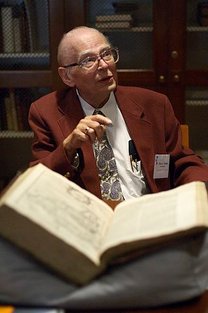
Oral history interview with Allen G. Debus
- 2007-Mar-29
Oral history interview with Allen G. Debus
- 2007-Mar-29

Allen G. Debus grew up in Evanston, a suburb to the north of Chicago, where he attended public schools. He earned a BS in chemistry, with almost enough credits for a second major in history. After working at Abbott Laboratories for about five years, Debus decided to seek a Ph.D. in the history of science, at Harvard University under I. Bernard Cohen. He accepted an assistant professorship at University of Chicago and became the first director of the Morris Fishbein Center for the Study of the History of Science and Medicine. Debus wanted to study the place of chemistry in the scientific revolution with materials available to all; to that end he has a large collection of rare books from this time period, a collection he began in the early 1940's. He says that he has about 650 such books, the earliest from 1501.
| Property | Value |
|---|---|
| Interviewee | |
| Interviewer | |
| Place of interview | |
| Format | |
| Genre | |
| Extent |
|
| Language | |
| Subject | |
| Rights | In Copyright |
| Rights holder |
|
| Credit line |
|
About the Interviewer
James J. Bohning was professor emeritus of chemistry at Wilkes University, where he had been a faculty member from 1959 to 1990. He served there as chemistry department chair from 1970 to 1986 and environmental science department chair from 1987 to 1990. Bohning was chair of the American Chemical Society’s Division of the History of Chemistry in 1986; he received the division’s Outstanding Paper Award in 1989 and presented more than forty papers at national meetings of the society. Bohning was on the advisory committee of the society’s National Historic Chemical Landmarks Program from its inception in 1992 through 2001 and is currently a consultant to the committee. He developed the oral history program of the Chemical Heritage Foundation, and he was CHF’s director of oral history from 1990 to 1995. From 1995 to 1998, Bohning was a science writer for the News Service group of the American Chemical Society. In May 2005, he received the Joseph Priestley Service Award from the Susquehanna Valley Section of the American Chemical Society. Bohning passed away in September 2011.
Institutional location
| Department | |
|---|---|
| Collection | |
| Oral history number | 0365 |
Related Items


Interviewee biographical information
| Born |
|
|---|---|
| Died |
|
Education
| Year | Institution | Degree | Discipline |
|---|---|---|---|
| 1947 | Northwestern University (Evanston, Ill.) | BS | Chemistry |
| 1949 | Indiana University, Bloomington | AM | History (assistant to John J. Murray) |
| 1961 | Harvard University | PhD | History of Science (under I. B. Cohen) |
Professional Experience
Abbott Laboratories
- 1951 to 1956 Research and Development Chemist
Harvard University
- 1957 to 1959 Teaching Fellowship
University of Chicago
- 1961 to 1965 Assistant Professor of the History of Science
- 1965 to 1968 Associate Professor of the History of Science
- 1968 to 1978 Professor of the History of Science
- 1971 to 1977 Director, Morris Fishbein Center for the study of the History of Science and Medicine
- 1978 to 1996 Morris Fishbein Professor of the History of Science and Medicine
- 1996 to 2008 Morris Fishbein Professor Emeritus of the History of Science and Medicine
Honors
| Year(s) | Award |
|---|---|
| 1957 to 1958 | Bowdoin Award in the Natural Sciences |
| 1959 to 1960 | Fulbright and Social Science Research Council Fellowship |
| 1960 to 1961 | Fels Foundation Fellowship |
| 1961 to 1962 | American Philosophical Society Research Grant |
| 1961 to 1963 | National Science Foundation Research Grant |
| 1962 to 1970 | National Institutes of Health Research Grant |
| 1966 to 1967 | Overseas Fellow, Churchill College, Cambridge |
| 1966 to 1967 | Guggenheim Fellowship |
| 1969 | Overseas Fellow, Churchill College, Cambridge |
| 1971 to 1974 | National Science Foundation Research Grant |
| 1972 to 1973 | Member, Institute for Advanced Study, Princeton |
| 1974 to 1975 | National Institutes of Health Research Grant |
| 1975 to 1976 | National Endowment for the Humanities Fellow, The Newberry Library, Chicago |
| 1977 to 1978 | National Science Foundation Research Grant |
| 1977 to 1978 | National Institutes of Health Research Grant |
| 1978 | Edward Kremers Award of the American Institute of the History of Pharmacy |
| 1978 | Member, Phi Beta Kappa Science Book Award Committee |
| 1978 | Pfizer Book Award, History of Science Society |
| 1980 to 1981 | National Science Foundation Research Grant |
| 1980 | Member, Phi Beta Kappa Science Book Award Committee |
| 1981 to 1982 | Fellow, Institute for Research in the Humanities, University of Wisconsin |
| 1981 to 1983 | National Science Foundation Research Grant |
| 1982 | Appointed to the International Advisory Committee, the Cohn Institute for the History of Science and Ideas of Tel-Aviv University and the Sidney M. Edelstein Center for the History of Philosophy of Science of the Hebrew University in Jerusalem |
| 1983 | Invited Lecturer, University of Coimbra |
| 1984 to 1985 | Visiting Distinguished Professor, Arizona Center for Medieval and Renaissance Studies, Arizona State University |
| 1985 | DSc, Honorary, Catholic University of Louvain |
| 1985 to 1986 | Consultant, Literature and Science Curriculum, Georgia Institute of Technology |
| 1987 | NEH Fellow, The Folger Shakespeare Library (Washington, D. C. ) |
| 1987 | Elected Foreign Associate Member, Académico Correspondente Estrangeiro (Classe de Ciências) Académia das Ciências de Lisboa |
| 1987 | Dexter Award, American Chemical Society |
| 1988 | Member, International Program Committee, Portuguese meeting of the International Union of the History and Philosophy of Science |
| 1990 | Visiting Lecturer, Insituto Italiano per gli Studi Filosofici |
| 1990 | Visiting Professor, Instituto de Química, Universidade de Sãn Paulo, Brazil |
| 1992 to 1993 | Consultant to the History of Medicine Library of the National Library of Medicine for the 500th Anniversary of the birth of Paracelsus |
| 1992 to 1997 | National Institutes of Health Research Grant |
| 1993 to 1996 | Appointed to the International Advisory Committee, the Cohn Institute for the History of Science and Ideas of Tel Aviv University |
| 1994 | Sarton Medal, History of Science Society |
| 1996 | Distinguished Lecturer, History of Science Society |
Cite as
See our FAQ page to learn how to cite an oral history.
BOHNING: This is Jim Bohning talking to Dr. Allen Debus at his home in Deerfield, Illinois. I know you were born on 16 August 1926 here in Chicago. Could you tell me a little bit about your parents?
DEBUS: I was born in Chicago and brought up in the northern suburbs. My father was in the set-up paper box business. He had a factory on the north side of Chicago, Modern Boxes, and my grandfather had also been in the set-up paper box business. We lived in Evanston where I was brought up. We moved to Glenview and then my parents moved to Northfield, which is just a little bit south of here.
BOHNING: Do you have any siblings?
DEBUS: No.
BOHNING: You were an only child. Where did you get your early schooling?
DEBUS: In Evanston, at the Orrington School for grammar school, [Haven School for 7th and 8th grades], and then Evanston High School. I graduated from high school in 1944 and I had a scholarship to go to an engineering school in southern Indiana. I thought, “Well, I’ll be in the Army in a matter of weeks, so I’d rather stay at home.” I made a last-minute application to engineering at Northwestern and was accepted right away and went right into college.
BOHNING: Was that school Rose-Hulman in Terre Haute?
DEBUS: I think that was it. That sounds right. I really don’t remember exactly. I had something like Rensselaer in my mind, but that’s in New York. Yes, that sounds like it.
BOHNING: When you were in high school, did you have any teachers who had an influence on you, or anyone else who had an influence on you?
DEBUS: Yes, I had two teachers. One of them was Emma Rodgers. I think I took two courses from her, American history and world history. There was also Mr. Anderson, who taught chemistry. Both of them were excellent teachers. And really I should add a third one, too. Oh heavens, what was his name? [Mr Ulrey. He] was an older gentleman who taught modern European history which I took my senior year. The name will probably come to me later, but, I don’t remember right now.
BOHNING: What attracted you to engineering?
DEBUS: It was chemical engineering that attracted me. Also, this was war time and this was a practical area, and something where I could do some good. I really didn’t want to go into business, because I never felt that I was a businessman in the sense that my father and grandfather were. For this reason, I thought that combining engineering with chemistry made a great deal of sense, especially at that time. Now, in time, I moved out of that. I don’t know if you want me to go on with this?
BOHNING: Oh yes.
DEBUS: The one thing I really disliked about engineering at Northwestern was the fact that it was a condensed program, not necessarily because of the war, although that might have been part of it, but because somehow I felt that engineering was sort of like medical school—you had an awful lot to take and just a limited amount of time. I think it was into the end of my sophomore, or even the beginning of my junior year, that I had an elective. [laughter] And I took a course in history from someone who was very influential on me also, [Professor] John [J.] Murray, who taught Renaissance and Reformation history. He was really a great teacher. John really got me interested in what he was teaching. I wish I could say that about every teacher I’ve had, but he did.
BOHNING: Was there any reason why you selected that particular course?
DEBUS: It was about the only one that was available in history. [laughter]
BOHNING: Because for an engineer to take a Renaissance history course as an elective seems unusual.
DEBUS: Although I had an interest in early history anyway. I remember once in high school, we had an English teacher who wanted all the students to talk on something as part of an assignment. I decided to talk on the history of ancient Egypt. I took up the whole hour, and I think I bored everyone to death. [laughter]
BOHNING: You were not drafted.
DEBUS: I was not drafted, no. That was another strange thing. I was continually being reclassified. At one time I was 4F—I think at the end I was 4F. It’s because of my eyesight. But another time I was 1A-L. Another time I was 4A-L. I don’t know what 4A-L is. I never knew another person who had that. But, yes, I escaped it. I got through Northwestern. I went every quarter and was out in three years. At the end of that time John Murray took a position at Indiana University and he offered me an assistantship. So, I went down there.
BOHNING: At this point you were moving out of engineering?
DEBUS: As a matter of fact, I had moved from chemical engineering to a chemistry major. So my Northwestern degree is in chemistry. It’s a B.S. in chemistry, and I had almost a second major in history by the time I graduated. I was really moving towards the history of chemistry although I didn’t know it.
BOHNING: That’s what I would like to get into, how you made that move from a chemistry major. I think you worked [at] Abbott Laboratories as a chemist, is that correct?
DEBUS: Yes. Well, that’s quite a bit later.
BOHNING: Okay. I’m intrigued about how all this fits together. Why don’t you just take us through it?
DEBUS: All right. I was John Murray’s assistant at Indiana in the fall of 1947. He was a very good teacher, especially in seminars. He would try to choose topics that made sense. He gave a seminar in Tudor history one year and in Stuart history another year. Oh, there’s a deer out there. Oh no, it’s a little girl. We see deer out there. Sorry, every time I see something move, I think it’s a deer.
B. DEBUS: We get deer in the back all the time and they eat my flowers.
DEBUS: Anyway, when I was getting ready to prepare my master’s thesis, he said, “Now don’t be foolish. Don’t write another thesis on Tudor political history or something like that. You’re a chemist, so do something on chemistry in the period that we’re dealing with. Here’s a journal, Isis. Take a look at that.” So, I started looking at Isis. And in the end I wrote a thesis on Robert Boyle.1 And by that time I was really into the history of science.
BOHNING: Did Indiana have a history of science program?
DEBUS: No. It was really no field whatsoever at that time. Indiana did get into the history of science. First I think by inviting George Sarton to give a series of lectures there on Renaissance history, but that was after my time. It was one of the last things he did. A little after that Marie Boas and Rupert Hall went there. Again, I didn’t know them, as it was after my time. Anyway, I graduated. I was out of money. I don’t think my parents wanted to support me anymore. I went to work for my father for a year selling boxes and then I went back to get a master’s degree in chemistry. And that’s where I met my wife [Brunilda Lopez-Rodriguez].
BOHNING: Oh, are you a chemist?
B. DEBUS: Yes.
BOHNING: Okay. And you went back to Northwestern?
DEBUS: No, Indiana.
BOHNING: Oh, you were still at Indiana.
DEBUS: Yes. I went back to Indiana. While [there I began my research with Professor Frank T. Gucker’s group in physical chemistry]. We were both towards the end of getting our master’s degrees in chemistry, I had one more course to take, I think, to finish the coursework, and we decided to get married. We got married on August 25, 1951 in Miami. Her parents came from San Juan, and mine came from Chicago. For our honeymoon we drove back to Chicago. I had $200. Money went a lot further then. We didn’t have a job or any prospects of a job.
BOHNING: Neither of you got a degree then? Or did you get your degree?
B. DEBUS: No, I didn’t finish it.
BOHNING: So, neither of you finished your degrees?
DEBUS: I had my master’s degree in history.
BOHNING: But you didn’t finish the degree in chemistry?
DEBUS: No, no. After we got back to Chicago we started looking for jobs in the newspaper. We checked out several places and finally one of them was Abbott Laboratories in North Chicago, and there was a job for a woman. That’s how we did it, wasn’t it? Or did I go in?
B. DEBUS: Oh, you went to interview.
DEBUS: I went first or you went first?
B. DEBUS: You went first.
DEBUS: I went first. They said they wanted a woman, so she went and she got the job. [laughter] She told them that I needed a job too, and there was a job available over in development, so I took that. So we both got jobs there. I worked in research and development for five years.
BOHNING: Where was your job?
B. DEBUS: Microanalytical chemist. Our division was in charge of making sure that the new products that the other chemists brought were at such carbon, oxygen, nitrogen [percentages], using a nice microanalytical balance, little platinum dishes and tools, to make sure that the new drugs were where they [were] supposed to be. From there then it went to Allen’s part so they were approved for him to get new methods of making them.
BOHNING: You were there for five years. Was history still in the back of your mind all of this time?
DEBUS: No, not at first, although I always had an interest in it. They had a history club at Abbott Laboratories that I belonged to. I went to that and I spoke there. We started in 1951, and by 1953 I was getting a bit tired. It seemed as though unless you had a Ph.D. in chemistry, you would always just be handed down somebody else’s project to work on. And that was all right. I got a couple of patents out of my work,2 but still, you didn’t initiate anything, really.
B. DEBUS: You worked on the new production of Novocaine for Abbott.
DEBUS: Yes, I know. That was a good one. Then again, you do that and you only get a dollar.
BOHNING: That’s true.
DEBUS: Anyway, in 1953, we thought maybe we should go back and get a Ph.D. I was interested in the history of science and had been all along more or less. I went up to Madison and spoke to Marshall Clagett and I was introduced to all of the members of the department there. It looked interesting, but the living conditions for graduate students in Madison at that time were really not very good. You had to go out in the town and have oil heating stoves, and we thought this was just a bit too hard to deal with. So we went back and bought a new Buick instead. [laughter]
BOHNING: That was in 1953?
DEBUS: Yes.
B. DEBUS: We had our baby by then too [Allen Anthony George Debus]..
DEBUS: No. That was afterwards. We got a Buick and [then] a baby. We continued at Abbott Laboratories. Bruni stopped working after the baby was born [1954]. And it just seemed as though it was pretty difficult to get anywhere. I had a good friend, [Walter Southern], who was head of the library at Abbott Laboratories. He offered to take me in the library, but even that wasn’t really what I wanted.
So we finally started looking at history of science programs. There were only three to speak of at the time. [I.] Bernard Cohen was at Harvard, and Marshall Clagett was at Wisconsin, and Henry Guerlac was at Cornell. None of them were really interested in exactly what I wanted to do, which is certainly not too surprising. I was admitted to all of the programs. We finally decided on Harvard. And so we just sort of packed up and left.
B. DEBUS: You were working as a [teaching assistant with Professor Leonard K. Nash in Natural Sciences 4].
DEBUS: You mean at Harvard?
B. DEBUS: Yes.
DEBUS: I got an assistantship after I got there, but that was the year after I started.
BOHNING: What did you do for financial support?
DEBUS: My grandfather had died and he left some money, and we were able to get started there. Later on my parents helped […]. Of course, the money in fellowships in those days, very, very little. I don’t remember how much it was at Harvard, but I do remember that when I was John Murray’s assistant at Indiana it was $600 for the year. So, it really wasn’t enough to take you anywhere. Of course, tuition and the cost of living was much, much less than it is today.
BOHNING: That was 1956 that you went to Harvard?
DEBUS: Yes.
BOHNING: Who did you work for then? Did you find someone to mentor what you wanted to do?
DEBUS: No. Only in a roundabout way, but not at Harvard. Technically my dissertation advisor, chief, whatever, was [Professor I.] Bernard Cohen. There were hardly any people there, and you more or less had to choose your own topic and do it largely on your own. I had three fields when I had my oral examination. That was history of science, and Tudor/Stuart history, and medieval history. That was interesting. The orals were held at the house of Wilbur K. Jordan, who was the president of Radcliffe University. He was in the Harvard history department program. But, there really was no one who was doing history of chemistry. Leonard K. Nash of the chemistry department had an interest in the field, but his interests were really more in the philosophy of science rather than the history of chemistry. He was an awfully nice fellow. He’s still alive, I believe.
BOHNING: Is he really?
DEBUS: I think so.
BOHNING: What about [James Bryant] Conant? Did you interact with him?
DEBUS: Conant was no longer involved in the program. In fact, I don’t remember seeing him once on the Harvard campus.
BOHNING: So, this was all done within the history department?
DEBUS: Well, no. The history of science was sort of a semi-autonomous unit. Cohen was in charge of me, although I didn’t see him very often. I always like Cohen, but he was kind of aloof, and I don’t think he really wanted to be bothered an awful lot by the students, especially students who weren’t working in an area close to his own interests. I hope I’m not doing him an injustice.
B. DEBUS: I liked him and his wife.
DEBUS: I like[d] him too.
B. DEBUS: When they had seminars, they would invite the wives. I thought his wife was very nice because they had a baby, and she told me where to take him to the doctors. She was very helpful, a very nice person.
DEBUS: When Cohen was working in his office, in Wagner 189, he really didn’t want to be bothered, so you didn’t bother him. [laughter] Or if you did, you could get in trouble.
BOHNING: I was going to ask you what kind of a person he was, but I think you’ve just told me. What about coursework? Was there any coursework, and were there courses in the history of science?
DEBUS: Oh, yes. Cohen gave a one-year survey of the history of science, which I think, was very useful and very influential, probably. He wrote a short history of physics and scientific revolution or something.3 It’s a nice little paperback that I think was the basis of his lectures. In addition to that, each year he gave a two-semester seminar in the history of physics, primarily. He was very interested in motion, Galileo, and, of course, Isaac Newton.
BOHNING: Your oral, though, sounds like a tour-de-force if you had those three areas in which you were going to be quizzed. Was your panel mostly historians?
DEBUS: Two historians and, of course, Cohen was there. That’s three. I think that Leonard Nash was there also. Taylor was the medievalist. I had taken his course in medieval intellectual history.
BOHNING: What was your thesis on?
DEBUS: The thesis was on The English Paracelsians.
BOHNING: Which was your first book.4
DEBUS: Yes.
BOHNING: Had you pretty well thought out by this time what your career was going to be and what you were going to pursue?
DEBUS: I was very much interested in the Paracelsians, and when I was doing the preliminary research on the dissertation, I ran into a 1935 multipart article by Walter Pagel.5 I don’t remember the exact title. But it dealt with the background to biology in the seventeenth century. He took up all of these people that I had not seen much of before and were never mentioned in other courses or books, mostly the more mystical figures of the period. I was very interested in Robert Fludd, for instance. I had been interested in Paracelsus earlier, but Pagel’s work was especially interesting to me.
And there was opportunity to apply for [a] Social Science Research Council grant, Fulbright, various things. I applied for a number of scholarships, and I don’t think you were too happy about it at the beginning [speaking to Brunilda]. But in the 1950s, students weren’t commonly going off to Europe to study. Of course, we were married and had a baby. In fact, by the time we went, we had two, [Richard William, born 1957]. and that wasn’t very usual either. I applied and I got the Fulbright and then I got a supplementary one from the Social Science Research Council, and we went to England. Before leaving I wrote Walter Pagel and expressed my interest in his work. And he said, “By all means, come and see me.”
[END OF TAPE 1, SIDE 1]
DEBUS: I don’t know. You could probably talk more about the problems of moving to England in 1959 [speaking to Brunilda]. But, anyway, Walter Pagel was just a delightful gentleman.
BOHNING: And you were at University College?
DEBUS: Yes. And that’s something also. I think nearly everyone who was applying for a Fulbright wanted to go Oxford or Cambridge. I applied to University College because Douglas McKie was there. He really was one of very few people who was working on anything related to the history of chemistry. And I’m glad we went there also, because it was nice to have lived in London. I think I always liked London better than Cambridge. I never got to know Oxford very well, although I was there several times. London is just a wonderful place. Great place to look for books too; at least it was then.
BOHNING: We’ll have to talk about that then when we get to the books part.
DEBUS: Walter Pagel invited me to see him. I found out how to get way out to Mill Hill by the tube and by bus and walking. We had a car, by the way. I felt that this would probably be the only time we’d ever get to Europe, and I should see something. Those times have changed too, but at that time I didn’t expect to see much. Back at Indiana one of my professors, a Professor [Prescott W.] Townsend of ancient history, had actually been to Greece, and no one else had.
Pagel was, as I said, was just such a friendly person, and his wife was as well. In the end, every time I went to England, I would see him once a week. I’d spend an afternoon at his place once a week. He had a study just filled with books. Books you couldn’t possibly find anymore. Most of them were auctioned at Sotheby’s after his death. It was a remarkable collection. I learned an awful lot from that man. He was very generous, and it was a wonderful experience knowing him. I would say that there’s the person who really was the director of my dissertation, at a distance.
BOHNING: You didn’t really get your degree, if I look at these dates correctly, until you came back from England. Is that correct?
DEBUS: That’s right. We spent a year, 1959 and 1960, in London and I completed my research on the dissertation and wrote most of it. We were back in Cambridge, Massachusetts, the following year, and I finished writing it and got the degree in June of 1961. in the meantime, I had the job at Chicago. That’s a case where Cohen was a great help to me. At the time there were very few positions in the history of science. In fact, the profession was a pretty small one.
The History of Science Society met in New York in December of [1960], and I gave a paper. [Graduate Students] were allowed to give longer papers then. I gave a forty-five minute paper based on my dissertation. Cohen knew about the job at Chicago. [Professor] Cyril Stanley Smith was at Chicago, and he was at that meeting. Smith was a great historian of science as well as being a great scientist. I can still remember when I went in to give my paper, there was Cohen, and he took Cyril Stanley Smith by the arm, walked him down to the front of the hall, so he would be sure to hear it. [laughter] Smith was a great fellow too. I liked him. He was leaving Chicago just as I arrived. Years later, he gave me some of his books, including a very rare one that I have here.6 I will always be indebted to that man too. I only wish I had seen him more often. He went to MIT.
BOHNING: At the time that you were still a graduate student, how many other students could you identify in the history of chemistry? Or were you it?
DEBUS: I was the only one. Another one became very prominent in the history of chemistry, but years later, and that’s Larry Holmes. He did a great deal of work on Lavoisier, for instance, among other things. And he came after me. Actually, there was a Japanese graduate student, [Shigeru] Nakayama. I don’t know where he is now. I think he came to the United States eventually. He gave a talk at Chicago once, and I ran into him on the street. He was very interested in pointing out that he was, I think, the seventh Ph.D. out of Harvard in the history of science, and I was the eighth, or something like that. There were very few of us.
BOHNING: And the others would be in physics or biology or something besides chemistry?
DEBUS: Yes. In fact, when we entered in 1956, I was one of three new graduate students for Cohen. The other two were Bill Coleman, who’s now dead about twenty years. He died at about fifty or fifty-three. He worked in nineteenth century biology. And the third one was George Basalla, who taught at the University of Delaware. We’re still in close contact.
BOHNING: When did that all change? That is, when did the history of chemistry start to attract more people? I may be jumping ahead.
DEBUS: Yes, I think you are. [laughter] There was this long interest in Lavoisier. The French were interested in Lavoisier, and McKie taught it at University College. [James Riddick] Partington, of course, wrote his great books and he had that interest. There’s a great man. That’s another person who was impressive. I had a friend at University College who was teaching for the first year. That was Bill Smeaton. He was just my age. He had taught at a technical college and McKie hired him to do the history of chemistry at University College. He started the same year that I got there as a student working on my dissertation. Smeaton was working in the McKie tradition really, on eighteenth century, early nineteenth century— especially very late eighteenth century—French chemistry. So, there was that. We got along well together with Smeaton. We went to see shows together.
B. DEBUS: Nice person. I met him.
DEBUS: Yes, an awfully nice guy. A couple of times he took me to visit Partington at his home in Cambridge. He was a very interesting man. He was pretty old at the time. I don’t know how old. He was straight as a ramrod. He had been in the Army and in ordnance, I think it was. I don’t remember. He was, I guess, close to as far as he could go with his four-volume magnum opus.7
At the time he was working on volume one, which was the last, and which he never finished. We just sat in this little room on the second floor, with his books around him on shelves, and there next to the window, a stack of papers so high, just with notes for volume one. I was told once that the book he published in the mid-1930s, something on technical chemistry (I don’t have that), had something like twenty-five thousand references. I don’t know. I never tried to check it out, but someone told me this.
BOHNING: He did write a multi-volume series on physical chemistry.8
DEBUS: Oh, physical chemistry. Not the history of it.
BOHNING: No. Just physical chemistry. It was three volumes or something like that.
DEBUS: I think it was [Indiana] when I took a course in advanced inorganic chemistry, I used a one-volume work that I still have upstairs.9 That was the best book I had on inorganic chemistry.
BOHNING: Somewhere, I recall, that he said that whatever reference he put in the book, he had read.
DEBUS: I don’t doubt it.
BOHNING: When you look at some of those references, it’s really very impressive if he read them, because they were not always in English. They were [in] other languages.
DEBUS: He was interested in the smallest things. He knew that I had been interested in Robert Fludd. He hadn’t spent much time on Robert Fludd, he wasn’t interested in that kind of a more mystical chemist, really. But I have a little note from him that he sent me after I saw him at his place, and he’s talking about the correct spelling of Fludd’s name. In his book he has F-L-U-D, and most of the references I know of have a double-D. He wanted to bring this up.
BOHNING: You arrived in Chicago in 1961?
DEBUS: Yes.
BOHNING: Did you have any other possibilities, or was Chicago it?
DEBUS: There was one other one and that was Ohio State. I had that offer. I remember I went down to interview with the University of Delaware, but I don’t think anything came of that. I had the Ohio offer, which I held off a while because I knew that they were thinking about it at Chicago. It so happened that my father had to go to the hospital, and I went home to see him. And my father said, “Well, if you’re interested in a job, go down and talk to them. Tell them that you’re here.” Which I did. They didn’t bother to have me give a paper or anything for them. I had lunch with a bunch of people and then, in what seemed like far too much time, they made me an offer.
BOHNING: And this is in the history department?
DEBUS: Yes.
BOHNING: What was the history of science like in the history department? Was it a sub- discipline within the department?
DEBUS: There wasn’t any. I was the first one. There were two other people who were interested in it. Well, there was someone else, yes, Ilsa Veith. She’s a historian of medicine from Austria. She really didn’t have much interest in the history department, so they didn’t have much interest in her as a result. That, I think, was her fault. It’s not that she was a bad scholar or anything, but she was interested in medicine. She managed to get an office in the medical school, and she had luncheons with the medical students. They loved her over there. But the history department didn’t do much, and they just didn’t want to do anything. She got an offer in a medical school in San Francisco, I believe, and she went there. So I was there in history. Bob Palter, who must be retired now, went someplace in Connecticut, but at that time he was in the philosophy department at Chicago, and he was giving an undergraduate course in the history and philosophy of science. So there was that course, and there was an undergraduate course. My appointment was two-thirds in the undergraduate teaching in the college, and one-third in the history department.
Now, in those days, if you said you were in the history department, it was largely graduate teaching. In the undergraduate program there weren’t enough students for me to be in Bob Palter’s course, really. As a result, two-thirds of my time was teaching physics. Not chemistry, physics. [laughter] Which I am not—however, we do things like this. So when I taught the history of science, it was largely to graduate students in the history department. More like one course a year or something.
After a year or two I—how did I do that? Bill [William H.] McNeill liked my work. He was the chairman of the history department at the time and he increased my participation in history. I think he made me first either half or two-thirds history, the rest in the undergraduate college program. And then I became full-time history. The program at Chicago, at least when I was starting, was largely a graduate program for history students.
BOHNING: Were you able to attract students to the history of chemistry?
DEBUS: Over the years I have had several excellent students, some of them in the history of science. Not at the beginning, necessarily, although I had some who wrote some interesting papers early. One of the books by someone who started in my seminar is […] by Nicholas Clulee on John Dee that is now considered the standard work on [this figure].10 Michael Walton was another one of my students, and he keeps writing papers all the time on Paracelsian-related topics. Who else should I name?
I have some I’m very close to who didn’t even end up in the history of chemistry. One of them is Karen Parshall at the University of Virginia, and Karen has just written a terrific book, really a superb book, on James Joseph Sylvester, a nineteenth-century mathematician.11
You mean we’re ready for another one already?
And who else, Bruni?
B. DEBUS: The Chinese student you had.
DEBUS: Oh, yes. Kevin Chang, who was my last student to get a degree. He’s a member of the Academia Sinica in Taiwan, and he’s constantly traveling the world. He wasn’t really admitted to the graduate program at first, I think because we’re always a little bit wary about people coming from other countries with different basic languages, but he picked up English rapidly. He became interested in seventeenth- and eighteenth-century chemistry.
And this current year four months at the Institute at Princeton, and now he’s at Yale University. He’s published some wonderful papers and is well along with a book dealing with the educational system in eighteenth-century Germany. He just amazes me. He’s picked up German, he’s picked up French, he’s picked up Latin. He didn’t have any of these. It’s just remarkable.
B. DEBUS: Not [much] English when he came.
DEBUS: He’s a remarkable person, and again, a very nice one.
BOHNING: During your tenure at Chicago, how did the department change? Were there more people added in the history of science?
DEBUS: Yes. Sometimes not exactly the way that you would want. If you’re building a program, it would be nice to say, “Well, we need somebody here, we need somebody there, and let’s push for these fields and these people.” I think it’s important to have the fields covered that you wanted, above all, and then find someone in the field. Sometimes I think they go about it the wrong way and say, “We’ll take anybody doing anything, provided it’s a very prominent person.” I don’t think that’s the way to build a program, but that’s a just personal feeling.
Anyway, back in the 1960s the Oriental Institute at the University had some people. One of them was David [Edwin] Pingree, who eventually went to Brown University and became the successor to Otto Neugebauer. Pingree died a year ago. He was another one of these remarkable people who have just an amazing talent for languages, from Sanskrit to heaven knows what. David knew of a brilliant young man at Yale University, and that was Noel Swerdlow. He wanted Noel Swerdlow, and I believe the money came from the Oriental Institute or something like that.
So if someone says, “Look, you can have another person, here’s the salary,” that’s one way to go, but, again, you’re not really doing it necessarily the way you want to build it. Noel is still teaching at Chicago. He is very technically-minded and he has had, I believe, a number of fine students. I’ve been on some of the oral examinations that he has chaired, but he hasn’t had many students that you would call history of science as a whole. They’ve been history of some ancient mathematics or astronomy. He’s done some important work— he translated one of the works of Copernicus, The Commentariolus.12 So, we had that.
Occasionally we get people from other departments who have an interest in the history of science as well. But we never, at any time, had a large number of people teaching it. Now, I’m retired for ten years, mind you, but I’m talking about when I was doing it. We tried to use help throughout the university. One of our first Ph.D. students was Will [William B.] Provine, who went to Cornell University. Will was interested in twentieth-century molecular biology, which is not my field. I had to represent him in the history department because he was getting a history degree.
[END OF TAPE 1, SIDE 2]
DEBUS: We had to have one of the biologists to work with him. That means, of course, in a case like that, you have to have the biologist satisfy[ied] that the historian knows enough science to deal with the topic he wants to work on. So Will ended up doing almost a master’s degree in molecular biology with Richard Lewontin, who went to Harvard.
We had cases like that, always utilizing scientists when we could, for one of the students, or sometimes working within the history department. Of course, if a person was working on some aspect of the seventeenth century you’d get someone who’s doing seventeenth-century intellectual history, if you can. But you have to, somehow, spread it rather than holding it just within the one or two people who call themselves historians of science or chemistry or whatever.
BOHNING: You never had a separate department?
DEBUS: No, I didn’t want a separate department.
BOHNING: Like Penn had a separate department.
DEBUS: Yes. Yes. The reason I didn’t want it is because I really wasn’t interested in being an administrator. I felt that I had to be, to a certain extent, but I really wasn’t very interested in getting involved in financial matters and determining people’s salaries and things like that. Now, we did have a change in the 1970s when the friends of Morris Fishbein decided to honor him on his eightieth birthday by setting up a center in his name. I think he would have been happy just with a professorship in the history of medicine.
BOHNING: Could you tell me something about Morris Fishbein?
DEBUS: Fishbein was a person who got his medical degree at Rush Medical College in Chicago and became famous primarily as a medical journalist.
B. DEBUS: JAMA [Journal of the American Medical Association].
DEBUS: He was the editor of JAMA for many years, twenty-five years at least. He wrote columns constantly. He was very much interested in attacking medical quacks. He wrote books on it. He wrote an awful lot of books, and he said that [he] read a book every night. I don’t know how he did it. He was a remarkable man. Now, there was an administrator.
I was on a board once at the Chicago History of Surgery Museum. He was the head of the committee who was going to determine who the lecturer was going to be for the year. I got there and a number of the people were there, and just started talking about this and that and the other thing. Finally Morris Fishbein came in and sat down and said, “Okay, this is what we’re going to do.” [laughter]
B. DEBUS: He and his wife were very nice. When Allen became the director we had parties here. He would come with his chauffer and park right in front and bring the liquor. They had a great time. He was a very nice person, both of them. We had a great time with them.
DEBUS: We established this Morris Fishbein Center for the History of Science and Medicine. It’s a center, not a department. We set up a lecture series, and we always had the Fishbeins come, or invited, anyway. Mrs. Fishbein would always look at the audience. She’d count them, and then she’d let us know later how it compared with the audiences her husband had. [laughter]
BOHNING: Did the endowed chair that you held start at the same time? Or was that earlier?
DEBUS: It’s not an endowed chair. It’s a named chair. Yes, it started at that time. Our first plan was to look for someone who was strictly history of medicine, because that’s what the Fishbeins had in mind. We invited one person to come and give a course for a quarter, I guess it was. He was from Germany and his name was [Fridolf] Kudlein. That really didn’t work out as his wife didn’t like it and I don’t think anyone particularly cared for him. He didn’t set off any wildfires or anything. They then named me the Fishbein Professor. So, that’s how that happened.
BOHNING: Does the institute still exist?
DEBUS: Yes. The present director is Bob [Robert J.] Richards, who was one of my students, actually.
BOHNING: As I look over your Chicago career, the output of your work is really quite impressive. It’s astounding to me.
DEBUS: I don’t think it’s enough, to be honest with you.
BOHNING: I think I understand that, but for me to look at just the books that you’ve published, alone, it’s quite a remarkable record. And your last one was just last year.13
DEBUS: Well, that’s mainly a collection of papers.
BOHNING: From what I can tell, and I’m not a historian of science, you sort of never left the seventeenth century. Am I correct, or am I misreading it?
DEBUS: No, that’s right—sixteenth, seventeenth, and into the eighteenth.
BOHNING: What was the fascination of that period that kept you there for your career?
DEBUS: I think it’s because at first I was interested in alchemy. I remember I picked up a book on Broadway in Chicago—there was a little bookstore there—and it was a reprint of a translation from the fifteenth century. At the end of it, it had a short description of how to make gold. It made sense about halfway through, and then it became ridiculous. It was just an interesting—what does this mean? I think that there are several ways that you can look at this. I think that today there’s a great deal of interest in going through manuscripts that can be interpreted chemically, and that’s fine. I became interested in something else though, and that is that when you’re dealing with the sixteenth century, and if you’ve been trained in the history of science, and if you were trained at the time that I was trained, the emphasis was on the great change that occurs with Copernicus and with Vesalius, and the people who followed them, in one case leading to Galileo and Kepler and Newton, the other case leading to Harvey. In other words, it is a scientific revolution that occurs, and chemistry plays no real part in it. But, it seemed to me, and I remain convinced it’s true, that just as important, at the time, was Paracelsus, who said that, “If you’re going to look at the world, you’ve got to do it differently.” To be sure, he has a lot of Hermeticism and other mystical aspects, but he also brings in chemistry. He says, “You have to go out into nature, you have to study nature, and after you go and collect examples of nature you take it back into your laboratory and, in effect, you analyze it with the fire.”
This is something that was very attractive to many people who were sometimes not so much interested in trying to just deal with changing base metals into gold, they were interested in something more than that, trying to understand nature, and understanding nature through chemistry or examining nature in that fashion. That’s what has always interested me more than going through chemical attempts to make gold.
BOHNING: Is alchemy making a comeback? There was a time when that was one of the major topics, then it seemed to disappear for a while, or at least decline.
DEBUS: You mean in the history of science?
BOHNING: Yes.
DEBUS: Oh, yes. Absolutely. Bill [William R.] Newman and Larry [Lawrence M.] Principe won the Pfizer Award last year for their book, Alchemy Tried in the Fire14 and that’s very gratifying to me. You do know of the meeting they [Chemical Heritage Foundation] held last July?
BOHNING: Yes
DEBUS: There were lots and lots of people from all over Europe and United States. I was surprised. That was very nice for us to be invited to attend.
BOHNING: Are there still manuscript resources from that period that haven’t been looked at?
DEBUS: Oh, I think so, yes.
BOHNING: And are they becoming more available?
DEBUS: It’s going to take a lot of people to do this, but there’s something else. It’s not only the manuscript sources that are important. You have to keep in mind that the printed books of the period haven’t really been studied. And those are the documents that people could get at. I think there’s more and more of an attempt to get to manuscript sources, and that’s great if you’re trying to understand Isaac Newton. You’ve got a lot of Newton manuscripts all over.
I was at King’s College when my friend Piyo Rattansi, who was another good friend of Walter Pagel, had a year at King’s College to look through the Newton manuscripts there. He invited me up there once to look at them. There was a big stack of Newton manuscripts. They’re going to publish and translate all of these, just as they have the works he wrote on physics of motion and everything else. But it’s going to take a long time before people read all of this material.
Perhaps it’s because of my connection with Walter Pagel, who was really mostly interested in books, that I can see the importance of looking at the books that could be read, rather than the manuscript notes of the individual, which might be kept in his own laboratory. I don’t think, for instance, that much of Newton’s work on alchemy was available. This was something only on paper that he kept to himself. I’d have to talk to Bill Newman, I guess. He might argue with me, but I don’t think so. It’s a way to understand Newton, and that’s important.
But I’d rather see what the place of chemistry is in the scientific revolution as a whole, with the material that was available to all people. For instance, there was a great debate in Europe in the late sixteenth and throughout the seventeenth century over chemistry. This is something that affected the physicians, to be sure, because the chemists were saying, “It’s the only way you can understand the human body, or anything else. Everything is chemical. The human body separates the pure from the impure, discards the impure, and builds the pure material of food into body parts.” They tried to use chemistry to explain everything that they saw in the world. This is something that was of no interest to people who were rolling balls down inclined planes. They were just different approaches, and chemistry deserves to be considered a major factor. I have a group of books on the shelf there by Joseph Du Chesne.15 I managed to find them. They’re all from the period from 1575 to about 1610. He was involved in a big debate with people in France over the chemical interpretation of nature.
BOHNING: What about this country? In the seventeenth century in this country, was there anything going on?
DEBUS: There was this one person that Bill Newman had dealt with—George Starkey at Harvard, 1646. But, other than that, there’s not much other than Governor [John] Winthrop, [Jr.]. He wrote to the Royal Society. He was interested in it. And I read that a few years ago they were excavating Jamestown, I think, and they found some distilling flasks.
BOHNING: That’s actually going to be an ACS [American Chemical Society] National Historic Chemical Landmark at Jamestown.
DEBUS: Oh, great.
BOHNING: Next year, whatever the anniversary is. It was a little complicated because they had to get the National Park Service approval, and they can only use their signage and not the American Chemical Society plaque. But anyway, it is going to happen.
DEBUS: That’s good. I’m glad to hear that. But you can’t really say that there was any teaching of chemistry, and Starkey’s work seems to have been done in London rather than in Cambridge.
BOHNING: Priestley’s move to the United States almost seems, in many respects, to be the beginning.
DEBUS: Yes, you have to get down to that period really. I imagine there are some others. I remembered at one book sale I saw one American imprint from the 1790s on chemistry. But, I can’t think of anything offhand.
BOHNING: Well, maybe we should start talking about books. You’ve alluded to some at this point. Have you always been a book collector, even when you were young?
DEBUS: I was a collector. I’ve been a collector of many things, actually.
BOHNING: I heard you have quite a record collection.
DEBUS: Yes, I’ve got at least fifteen thousand records and cylinders and disks.
BOHNING: That’s amazing.
DEBUS: When I was a kid I collected stamps and coins. Now I even have a 1932 Pierce- Arrow.
BOHNING: Really?
DEBUS: Yes.
BOHNING: Oh my. Is that why there’s a picture up there? I don’t know if that’s a Pierce- Arrow or not.
DEBUS: Yes, that’s a Pierce-Arrow. Both of them.
BOHNING: How long have you had it?
DEBUS: For ten years. I’ll show you a picture. I know that won’t show up on the tape, but I’ll show you the picture anyway. It’s a nice car.
BOHNING: Oh my. Oh yes, that is wonderful. Was there any particular reason for this car?
DEBUS: Well, no, there aren’t too many Pierce-Arrows that turn up for sale. There was a retired United Airlines pilot in Marengo, which is about forty miles west of here. His uncle had willed him the car. He really wasn’t very interested in it, and he put an ad in the Chicago Sun- Times, which I happened to see. I went to look at it, and we decided to get it.
BOHNING: Was it restored, or did you have to do work to it?
DEBUS: I didn’t do anything to it. It had been partially restored, but it was in very good shape. I’ve been a record collector since the late 1930s. Now one of the things I do is prepare the program and write notes for CDs of historical recordings.
BOHNING: Any particular type of music?
DEBUS: Yes, American popular music. I like vaudeville, and I think, furthermore, it’s important. I’ve given several talks on topics like this and I’ve been interested in the fact that so much ethnic comedy material was popular at the time. To be sure, there was an African- American dialect, but a lot of other dialects from people coming into the country at the time. It seemed to be part of our culture and certainly acceptable then.
BOHNING: I can remember when I was a kid my grandfather had a Victrola similar to what’s over in the corner there.
DEBUS: That’s my great-aunt’s. That’s the one I first listened to old records on.
BOHNING: I found my grandfather’s in his attic, and I think I got him to at least show me how it worked. My uncle had a big collection of Big Band music on 78s, but I used to sit and listen to them for hours, and I was just fascinated by that. I tell my children about the Big Band Era, they have no idea what I’m talking about for the most part.
DEBUS: Most of my records are before 1930, and a lot of them going back even to the 1890s. And nobody can understand that anymore. Only I can. [laughter]
BOHNING: Have you written about this?
DEBUS: Yes.16
BOHNING: So, that developed very early in your life.
DEBUS: Yes, very early.
BOHNING: It’s fascinating. So you collected records, you collected stamps, you collected coins. When did you think that you wanted to collect books?
DEBUS: I suppose in the early 1940s. Occasionally I would look in at a bookstore when I was downtown. There were a fair number of used bookstores in Chicago then. Not today. I remember picking up some early nineteenth-century books, part of a series of history books of different countries. And that interested me. But it wasn’t until later that I became interested in the history of science and history of chemistry. When I was a graduate student at Indiana, I ran into a book catalog from somebody in Cincinnati, and they listed the works of [Jean Baptiste] van Helmont, and it was the 1682 edition for $10. So I sent for it. I have it there on my shelf.17
[END OF TAPE 2, SIDE 1]
BOHNING: Sidney Edelstein tells a story of his visiting Eva Armstrong in the Smith Collection, somewhere in the 1940s, and telling her that he had a chance to buy a Robert Boyle for $25, and she said, “Well, Dr. Smith never paid more than $5 for a Boyle. It’s way overpriced.”
DEBUS: Now everything’s overpriced. [laughter] But I got that book for $10. It turned out to be missing [the frontispiece], but I have the text. I picked this book up just at a time when I was becoming really interested in the field, and it seemed to me that what I needed, I needed the texts. Above all, I needed the texts. I think this would be different from a lot of collectors who wanted beautiful bindings and large paper copies and all of this. I wanted the texts.
Now, I continue to see an occasional catalog. We were living in Waukegan when I was working at Abbott, and I remember getting some catalogs from a London dealer, G.W. Walford. He had his store on 186 Upper Street. I still remember that. And he had a 1664 edition of Francis Bacon’s Sylva Sylvarum that I sent for.18 I think it was only about four pounds. And I became convinced, about that time, that it would be possible to get an occasional book. Now, we weren’t making very much money in those days. I think when I went to Abbott my [annual] salary was $3,900. Bruni was getting $3,700 because she was a woman. She had exactly the same credentials. We just didn’t have enough money to spend on other things, really. And things weren’t any better when we went back to graduate school.
Of course, I bought books when I was at Harvard, but I didn’t really think of antiquarian books. I like getting books. I bought new books in my field. I guess it really wasn’t until I went to England in 1959. Pagel was a real book collector. He used to have new catalogs on his desk all the time. He told me, “Look at every catalog that comes your way. Makes no difference what it’s on. A dealer might have something that doesn’t fit into the category just to see if someone will take it.” So I’ve always looked at all of the catalogs that I see.
I don’t get as many today. I don’t buy as much. He also used to bid on Sotheby auctions pretty regularly. I used to work at the British Museum, and the British Library was in the center there at the museum in those days. At lunchtime I would go out and walk down Charing Cross Road. It wasn’t all that far away. There were bookstores all around there and I used to find things there. I started getting catalogs, and I started buying when I thought something would give me another text that I wanted.
BOHNING: So, you were still thinking in terms of material you were going to use rather than buying for just having it as a collector’s item.
DEBUS: That’s right. I would pick up some things that I thought I might possibly use in the future. And if there was something that particularly caught my fancy, I might get it. If I point out books to you I’ll show you what I mean. I went after collections if I could, in order to get collected texts, because it’s so much cheaper to get one book rather than ten individual maybe earlier editions of single texts.
BOHNING: Were there any unexpected treasures that you found by accident?
DEBUS: Yes, I guess some. One of them comes to mind particularly. Of all places it turned up in Chicago. In my first couple of years of teaching at Chicago, I used to read the university newspaper, The Maroon. There was a book dealer who advertised. He was west of the loop in an Italian neighborhood. I went out there to see what he had. And here was this bookstore filled with old books in the middle of the Italian neighborhood of Chicago. In time, I found out that it was an Italian who had come to Chicago because his wife was American, and before he left Italy he had bought out a noble’s library in Bari. Again, it wasn’t a time when I could buy a great deal, but I did buy some things, and he did have some early chemistry material. I got are two interesting [Antoine] Lavoisier items. They were unknown to [Denis] Duveen.
BOHNING: Wow.
DEBUS: Can I show them to you?
BOHNING: Please do.
DEBUS: Since then somebody has found a second copy. I don’t know, maybe it’s Neville. But this was a translation of Lavoisier’s Treatise on Chemistry made for the Artillery School in Naples.
BOHNING: Oh, my.
DEBUS: In two volumes. I wrote to Duveen about it. I wrote a paper on it for Ambix.19
BOHNING: “Forgotten chapter in the introduction of the new chemistry in Italy.”
DEBUS: This was just a time when Duveen was putting out the second volume of his Lavoisier [bibliography].20 He didn’t spell my name right.
BOHNING: How well did you know Duveen?
DEBUS: I didn’t know him well. I corresponded with him in regard to this book and to another one. And then, when I was lecturing in Sao Paolo, he was living in Brazil at the time, and I called him on the phone and spoke to him.
BOHNING: I have tried to track down his lineage to the Duveen family, only out of personal curiosity when I discovered that he ended up dying in Brazil. There were many orchids named after him, and that’s what he was doing down there, was orchids.
DEBUS: Yes, he was interested in perfumes too.
BOHNING: He had the soap company in New York, at one time.
DEBUS: Yes.
BOHNING: “First recorded in Ambix.” This is from his supplement to the bibliography.
DEBUS: Yes. I was very pleased that I had found that. And there was a second one that I found too at the time I found this, which is complete. I found Volume Four only of another Italian translation, also in the same shop.21 I think the first three volumes are somewhere in Chicago, because for years after that when we were looking at houses, I found in these model homes they would have books on shelves, and they had his little mark at the bottom. Sisto.
BOHNING: I have a friend who said at one time he found some great books in furniture stores because they just put on anything on the shelf to make it look like books on a shelf.
DEBUS: That’s right.
BOHNING: What is the library here?
DEBUS: Does it say Sisto? I don’t remember.
BOHNING: I don’t have my reading glasses.
DEBUS: Let me see. This is the little thing that you find. Yes, Sisto’s Antique Library.
BOHNING: Okay. Well, that’s a marvelous find.
DEBUS: This was unknown to Duveen too. This is the other volume, part of a four-volume set of another Italian translation of the same thing. This shop had a number of books that I picked up.
BOHNING: Did you feel pleased that you found things that were unknown to Duveen, given his collection?
DEBUS: Yes! [laughter]
BOHNING: That’s a great answer. I like that. Were these unknown to Neville too?
DEBUS: I don’t know about that. I never really knew Neville.
BOHNING: Can I assume that the “thirty-five” in pencil mark on the title page is the price?
DEBUS: No, it probably cost me more than that. But it wouldn’t have cost more than a couple of dollars. You meant thirty-five cents?
BOHNING: No, $35.
DEBUS: No, I never would have paid $35 at that time.
BOHNING: Okay. Neville was a chemist who collected on the side too.
DEBUS: Yes.
BOHNING: He spent his whole career as a chemist.
DEBUS: Of course, that’s late for me, to deal with the late eighteenth century. I had another thing that was kind of interesting that I got out of the same library. I don’t know if I can find it. It was an eighteenth-century manuscript, but it was just a textbook for probably a monastic school. I don’t want to waste too much time looking for it.
BOHNING: That’s all right. I’ve got lots of time and I’ve got lots of tape, so.
DEBUS: Well, I don’t know. Maybe I’ll see it on the shelves. Trouble is, this is arranged largely alphabetically according to author and the book does not have an author. Oh, there it is. This is it. I don’t know why I put it here.
BOHNING: Because this will be transcribed, if you could read the title and whatever else that we can then put into the transcript about the book, that would be helpful.
DEBUS: This is an eighteenth century Italian manuscript.22 It’s sort of a beginning to philosophy. That’s probably the price. Probably $4. It’s rather nice, because it has diagrams, including diagrams of the systems of the world. There’s Tycho Brahe’s system, and Copernicus and Ptolemy. This dates from the 1730s, so it’s really not very early. But it’s rather a nice manuscript. I’ve never really thought very much about that one, but maybe I should have.
This is a nice seventeenth century English alchemical text, a philosophical epitaph.23 I would assume that this is in the Neville collection. What do you want me to show you?
BOHNING: Well, what you want to show? What do you want to brag about? I’ll leave that up to you.
DEBUS: I have a couple of fairly important early works. This is a 1501 edition of Ficino on the books of three lives.24 This has a good deal of astrology and medicine in it, and was influential on Paracelsus.
BOHNING: When you bought these, were these bound like this?
DEBUS: This one was, yes.
BOHNING: I wondered whether you ever had anything restored.
DEBUS: Oh, yes, I have. I’ll show you a nice example of that. I had this binding done in England. I bought it in Chicago. I was looking through Isis once, and there was a devastating review by George Sarton, of a translation of Ptolemy’s Tetrabiblos.25 It was done, evidently, or at least published, by an astrologer. And I thought, “Well, I should be in touch with these occult stores.” It was in Chicago. So I went there, and here this little old man had a bookcase full of old books, and included was the works of Glauber.26 It was in a horrendous bright orange library binding. [laughter] So I had it rebound. All of his books were cheap. Very cheap. I was very lucky.
BOHNING: Was there any particular person that you used to do this?
DEBUS: I don’t remember. Most of the books I had rebound in England were rebound in Cambridge. If I remember correctly, it was Gray.
BOHNING: That’s beautiful.
DEBUS: Yes, they did a nice job.
BOHNING: Let me get a picture. If you hold that, I’ll get a picture.
DEBUS: What I was talking about before, though, was that my interest in getting collected editions and in alchemy, what I went after and was able to get eventually, were the key collected editions of alchemical works. Manget, for instance, a two-volume Manget of 1702.27
BOHNING: May I open it or?
DEBUS: Yes. I’m afraid it’s not going to hold much longer anyway.
BOHNING: I won’t do it then. Now, when you say collected works, that’s a collection of manuscripts that are put together?
DEBUS: In here, they’re printed, of course. But some of them go back to an early period and go up to the seventeenth century. Another major collected edition is the Musaeum Hermeticum.28 I had these boxes made for me. This is 1678. Here’s one plate. There are better ones than that, anyway. Here’s one of the universe.
Now this is something that I’m sure is in the Neville collection. It’s a famous work.
B. DEBUS: When we bought this house, he came, brought all his books, all of his records, then he came and told me, “I’m already moved.” [laughter]
BOHNING: Were the bookshelves here or did you build those?
B. DEBUS: We had to build them. This was a model house, so when we bought it we had them built. They built the bookcases for him. But his books and his records, that’s what his house was all about.
BOHNING: How do you store all those records?
DEBUS: They’re on the shelves. We bought something called jar shelves, and they’re just right for ten-inch records […]
[END OF TAPE 2, SIDE 2]
BOHNING: Have you cataloged your collection?
DEBUS: Yes. They’re on three-by-five cards.
BOHNING: How many do you have, approximately?
DEBUS: I really have no idea. They’re all around the house. [laughter]
BOHNING: I don’t have a collection like this, but my books are all over the house too.
DEBUS: The records are, for the most part, in the basement, which is not the best place in the world for them.
What else could I show you. Oh, I had a special interest in Robert Boyle, and this is a case where I finally got a [copy of the 1772] edition.29 But you can see, again, I take it in a bad binding to get the text.
BOHNING: Robert Schofield, who is a Priestley scholar.
DEBUS: Right. I know him well.
BOHNING: He told us in Philadelphia after he had finished the last Priestley volume30 he wasn’t going to touch Priestley ever again, and he sold all his Priestley books.
DEBUS: Oh, I had no idea.
BOHNING: He said he collected those books simply to use for his work. He did not collect them for any other reason. And when he was finished with Priestley, he didn’t want the books anymore. He wasn’t worried about condition, he wasn’t worried about anything else. They were simply a resource for him.
DEBUS: Well, these are a resource for me, but I like having them too. [laughter]
BOHNING: I’m pretty sure that he sold most of the Priestley books after he finished that second volume recently.
What was the most you’ve spent on a book? If I may ask.
DEBUS: I’m not even certain. The most expensive one I can think of at the moment is a Libavius, his Alchemia,31 which I paid $350 for.
BOHNING: Is this another one you had rebound?
DEBUS: No. That’s the way I bought it.
BOHNING: I’ve noticed that you have also signed your name in these books.
DEBUS: Sometimes.
BOHNING: Okay. I wanted to ask if that was a standard practice?
DEBUS: No, not always.
BOHNING: My great-grandfather bought a three-volume Bible in Philadelphia and signed his name in the front like this, and many years later it was discovered the Bible belonged to Bach.32
DEBUS: My goodness.
BOHNING: Bach’s notes are in the margins and his name is on the title—the J, and the S, and the B are intertwined on the title page. And there have been two Ph.D. theses done on this Bible. But he didn’t know it, and it was discovered by accident by somebody else. They gave the Bible to the Lutheran Seminary in St. Louis, which is where it is now.
DEBUS: Interesting. That’s really interesting.
This is another famous work. The Theatrum Chemicum Brittanicum.33
BOHNING: That’s a nice binding too.
DEBUS: That’s from Walter Pagel. He didn’t like things that—
BOHNING: Oh, his name’s in it. I’m sorry, I interrupted you.
DEBUS: He didn’t like books that weren’t perfect. I know something is replaced in it. Anyway, anything that he thought I might like that he wasn’t satisfied with, he’d let me have for ten pounds.
BOHNING: I learned that Edgar Fahs Smith, when he’d bring things to the American Chemical Society meetings and they would show each other parts of their collection, he would give people things to get them started in collecting.
DEBUS: I know somebody else who did that too. Aurele La Rocque, a historian of geology, would give books away to people who would work on them.
I don’t want to bother you with too much, but some things are quite rare. One of them, if I can find it.. I had this rebound. This is the first book by an Englishman, in Latin, on the Paracelsian system.34 It’s a very rare book.
BOHNING: Moffet.
DEBUS: He was a member of the Royal College of Physicians.
BOHNING: Did you get this in England, or here?
DEBUS: To be honest with you, I don’t remember.
BOHNING: What kind of information do you have on your three-by-five cards?
DEBUS: I don’t have the price and I probably don’t have where I got it—the dealer. And I bought from dealers anywhere. I never bid in auctions like Pagel did. I didn’t think I’d have a chance. [laughter] But I have just the normal thing that you would find on a library card, like author, title.
B. DEBUS: When he graduated, Life Magazine came and took pictures of us.
BOHNING: Really?
B. DEBUS: Because we had two kids and the family were there, and so they took picture of him with myself and the two little children, and I said, “And there’s a baby in the house we left behind,” so they published it.
BOHNING: What year?
B. DEBUS: Yes, what year. 1961.
DEBUS: Well, it wasn’t published in Life though.
B. DEBUS: Yes. We have the picture.
DEBUS: Yes, we have the picture. They took the pictures but they didn’t publish the pictures. We sent the pictures to Harvard and they published it in their graduate magazine.
B. DEBUS: I think we have the picture somewhere around, don’t we?
DEBUS: Yes. We’ve got the picture somewhere.
B. DEBUS: We have the picture. If you want it, we can send you a copy.
BOHNING: Definitely. That would be nice.
B. DEBUS: In fact, Larry Holmes’ wife had a baby at the same time and he was not graduating, so she came to baby-sit with the baby so we could all go to the graduation.
BOHNING: This is the Fludd you were mentioning early?
DEBUS: This is the Robert Fludd I was mentioning. I didn’t know that this book was available. It’s the second edition of the first publication by Robert Fludd.35 Sidney Edelstein told me about it. So, I sent for it.
BOHNING: Did you have much interaction with Edelstein?
DEBUS: Not a great deal, but I knew him. I met him at meetings, but also in Israel. We saw him there. He took us to his apartment, or his daughter’s apartment or something, right on the beach, on the Mediterranean. It was very nice.
BOHNING: Did you go to any ACS meetings?
DEBUS: I’ve been to some, yes. The last one I was at was an ACS meeting was in Chicago, about four or five years ago, something like that. I gave a paper there.36 It’s when Bill Smeaton was given the Dexter Award and I spoke at that time.
BOHNING: I didn’t go to that meeting. At one time the history of chemistry division of the ACS had people who were really professional historians who were active in the division, and I’m including in that Aaron Ihde, who was really a chemist but by that time had really become a historian of chemistry and published his book.37
When the division started it was mainly chemists. Edgar Fahs Smith started the division for chemists to get together and show things from their collection. Charles A. Browne, at one of the meetings had the most unusual artifact of anybody, and that was a lock of John Dalton’s hair.
DEBUS: My goodness.
BOHNING: Supposedly, it’s in the Smith collection in Philadelphia. It shows up in a catalog as being there, but nobody can find it. And I don’t know how you prove that it’s a lock of John Dalton’s hair either, but that’s what Browne claimed.
DEBUS: Well, he must have had some reason for it.
BOHNING: This is with the two Ds, and not the one [Here showing the Fludd volume].38
DEBUS: It’s always with the two Ds. Except for Volume One of the History of the Macrocosm, which has it with one D. And that’s what he was working from primarily.
Some of the early chemical text books are interesting. Again, they must be in the Neville collection. This is one of the first books I got. Bruni and I were down on Wabash Avenue in Chicago and went into Kroch and Brentano’s bookstore. On the second floor they had a whole bunch of old books, mainly in the history of chemistry. This one, I think, was $17.39 I think you bought it for me [speaking to Bruni]. I have the works of Paracelsus in German and Latin. The Latin is from the library of the Prince of Lichtenstein.40
BOHNING: How multilingual are you?
DEBUS: Not an awful lot, by many people. I read English. I’ve written a book on the French Paracelsians.41 Their works are mainly in French. I use German. I use Latin. I use Spanish. I find Italian a maddening language.
BOHNING: Any reason?
DEBUS: All those little words that they have. [laughter]
BOHNING: Did you develop this ability to read in all these languages on your own?
DEBUS: In high school I had Latin and one year of Spanish. In college I had I think I only had Spanish. When I decided to go back to graduate school, I used to go in every week with Bruni and we would study Latin and German and French with a retired professor of classical Greek. That was kind of difficult, as I look back, after working a full day at Abbott Laboratories and driving into Evanston from Waukegan. I couldn’t do it anymore.
BOHNING: And with roads that aren’t like the roads today either.
DEBUS: I guess it’s thirty-five miles or so each way. Sometime we would stop in Glenview on the way down to leave the kids with my parents. Oh well. I’m older now. I’ve got more sense. I’d never go back to school again. Really, I just jotted down some of the names when I was thinking you wanted to see some books.
In addition to Paracelsus, I’ve got the English van Helmont, which is a very desirable book.42 Again, I suppose that it’s in the Neville collection, but I was very glad to get it. I don’t know if I’ve ever seen it on sale. I got it from Lester King, who taught the history of medicine in our group. He was a senior editor of JAMA. He published widely in the history of medicine. He was through working on van Helmont and I had a beautiful copy of some other work that he wanted, so we just traded. It’s all the work of van Helmont, and very nice. This is an original binding. Moffet and [Petrus] Severinus. Severinus is another major figure. I’ve got a couple of his works.43 Angelus Sala.44 No one has really done any work on Angelo Sala, who’s another very important iatrochemist. Oswald Croll—he’s important. I’ve got him in French and English45. [Jean] Beguin. I’ve got his textbook.46 [John Baptist] Porta’s work on distillation.47 [Nicase] Le Fevre.48 [Christophe] Glaser’s important text of chemistry.49
[N. Gaintherius von] Andernach. I’ve never seen that work on sale. I’ve got his work on the old and the new medicine from Walter Pagel for $10.50 It’s this thick. It’s down on the shelf there. He was a teacher of Vesalius, and late in his life, when he must have been about seventy, he started reading the work of Paracelsus and wrote this book, which included traditional medicine and then a discussion of all the new medicines that were coming in. Now, that’s important, because it made a real difference in pharmacy with the addition of all these chemically prepared medicines. Not that they were doing anyone any good. They were killing people. [laughter] I shouldn’t be so harsh on the poor people.
[Daniel] Sennert is another major name. I’ve got Sennert.51 And [Sir Kenelm] Digby,52
[Johann] Becher,53 [Georg Ernst] Stahl.54 I have Thomas Willis, whose early work is very much in the chemical tradition.55 And [Franciscus] Sylvius,56 another iatrochemist. [Herman] Boerhaave. I’ve got Boerhaave,57 Stahl, and Lavoisier.58 What I wanted was a collection that would be sort of a base collection. I like working at home, and that’s really what I worked up. It isn’t enough to write a book from these, but it’s enough to get the basis for a book, in many cases. Did I mention [George] Starkey? Starkey is one that seems to be of a lot of interest today, because he was of great interest to Isaac Newton. This is another one of the works I picked up in that little astrology bookstore in Chicago.59
BOHNING: “Secrets revealed.” I notice you that in each of these books that you’ve shown me, you have information about that book from various sources.
DEBUS: When I see it.
BOHNING: Are they from catalogs or?
DEBUS: Yes, from catalogs. It’s useful because it shows what people think in general about someone at the time. At first I thought I would be helpful in regard to prices, but prices change so quickly that the prices really don’t count for much.
BOHNING: I guess in recent years prices have really gone through the roof too, haven’t they?
DEBUS: Yes. It’s too bad. Really, it’s too bad, because I think it’s fun to collect. I never, never thought that the books would be worth a great deal. I’m not sorry that they’ve appreciated. I mean, that Libavius that I paid $350 for I think it’s worth something like $15,000 today. Now, that’s ridiculous, at least from my point of view. And that’s a beautiful copy. I have other copies that will be worth less because they have a page in facsimile or something.
BOHNING: Roy Neville told me that at one point he thought about selling his collection, and decided not to. But the price of the collection at the time he thought about it (and of course, he added after that) but it wasn’t anywhere near what it brought later on. He even admitted he never thought it would ever accrue to the value it did.
DEBUS: I wouldn’t even know how to sell the books. I have so little interest in selling. I’m sure that dealers only give a fraction.
BOHNING: Are your children interested in them?
DEBUS: No.
BOHNING: Did any of them follow in your footsteps or become academics?
DEBUS: No, although the oldest boy is a chemist with the EPA in Chicago, with a great interest in prehistoric life. He’s written three or four books already.60 He should have gone to graduate school, because writing books and articles, that’s what people in the academic world do. That’s how they get credit for what they’ve done. But in the EPA it doesn’t make much difference, except for himself. And that’s important too.
BOHNING: Well, I think many academics do it for that reason too. There’s a certain amount of satisfaction you derive from the writing that you do, the research that you do. Regardless of what anybody else thinks.
DEBUS: Oh yes, that’s true. You don’t go into the academic world for the money. At least I didn’t. And I think it’s true in most cases.
BOHNING: I have some other questions, sort of general questions about your collection, but it may be time to turn this tape over first.
[END OF TAPE 3, SIDE 1]
BOHNING: Or, as you said earlier, you didn’t have the money. Neville went through that period too. He said in the early days he knew he wanted to collect, but his funds were so limited when he was working in the aerospace industry as a practicing chemist. We’ve already talked about the range of the subject matter, which is primarily material that was supporting the work you were doing. Is that a correct statement?
DEBUS: Yes.
BOHNING: Was there anything you might have come across that didn’t support your work but caught your eye anyway?
DEBUS: Let me show you one.
BOHNING: Okay.
DEBUS: In fact, I can show you several, but let me show you one that’s probably worth as much as anything I have. This is the first English translation of Euclid with the introduction by John Dee.61 I’m interested in Dee, but this is not one of the topics of Dee that interests me especially, although I had it reprinted.62 I picked it up by mail from a catalog in Philadelphia, William Allen. I don’t know if he’s still in business or not, but he had it for $200, if I remember correctly, missing twelve leaves.
And I went to London and at Dawson’s (I don’t think Dawson’s is in business anymore) they had a nice fellow there by the name of Osborne. They had an imperfect copy of this work, and he sold me the missing twelve leaves for twelve pounds.
BOHNING: I’ve never heard of that. That’s interesting that they would essentially cannibalize the book.
DEBUS: It was a poor copy. The pages were in fine condition, but it was missing a lot.
BOHNING: Okay. There’s a letter in here from William Allen, at 20th and Walnut Street.
DEBUS: Does that have the price on it?
BOHNING: No.
DEBUS: Well, I think it was $200, but I’m not positive.
BOHNING: Neville mentioned this too. He said dealers would say, “If you would care to see the book on approval I would be glad to send it on.” Was that common practice, that they’d send you a book to look at before you might buy it?
DEBUS: It was done on occasion with customers they knew. I don’t think I asked anyone to do that. I think that I just said, “Send it, I’ll buy it.”
BOHNING: I confess that I was ignorant of John Dee until recently, and became quite fascinated with him.
DEBUS: Yes. He was a very interesting individual.
BOHNING: There is some group I found on the Web, who is trying to reproduce Dee’s library electronically.
DEBUS: There are a bunch of English people interested in Dee, and they’re always inviting my former student to speak to them. This is out of my area too, but I call it part of my collection. It’s my great-grandfather’s diary of his trip to the Klondike in 1898.
BOHNING: St. Michaels, August 1898, Alaska. Norton Sound. Why was he in Alaska? Was he part of the gold rush?
DEBUS: Yes. He left his wife and his lumber business in Chicago.
BOHNING: Did he strike anything?
DEBUS: No, he just came back with one nugget. I have some books on extinct animals that I like.63
BOHNING: My grandfather kept a daily diary from about 1880 to 1940. About sixty years worth.
DEBUS: Yes, that’s wonderful to have it for that a long a period.
BOHNING: There’s hardly a day that he didn’t write. What intrigues me is that the handwriting never varies. It’s always the same. All that period of time you can’t spot any difference in the handwriting. I guess it’s because he was a clerk in a county court and he had to do it all by hand, so he took great pride in his handwriting.
I asked you earlier about the number of volumes. Would you care to hazard a guess?
DEBUS: Well, it all depends what we’re talking about.
BOHNING: All together.
DEBUS: Pre-1900 imprints? I have lots of books that are current or recent, and they’re scattered all over the house.
BOHNING: Let’s say pre-1900.
DEBUS: I think that there are about eight hundred in this bookcase, roughly. And these are relatively recent, most of them. So, we slice out, how many? A sixth. Let’s say six hundred and fifty minus some post-1900 books, but not many. Call it six hundred fifty. There are some older books upstairs too.
BOHNING: What’s the oldest?
DEBUS: The Ficino I showed you from 1501.64
BOHNING: We’ve talked about the cataloging. We’ve talked about you having mostly working copies in the sense that most of it was for your own work.
DEBUS: Yes.
BOHNING: Is there anything that’s inscribed or autographed?
DEBUS: You mean from the seventeenth century on?
BOHNING: Yes.
DEBUS: No.
BOHNING: This was a question somebody else came up with on this general list of things, and that is, if you have a book with uncut pages, do you cut them?
DEBUS: Generally no, unless I need to use the book. As I told you, I’ll buy books that I think I might use sometime, and if I need to use the book I’ll try to limit myself to the pages I need. And that’s really a question for a different kind of collector.
BOHNING: I actually bought a book one time that was almost all uncut pages. I bought it for another reason, but the price was pretty low because the pages weren’t cut. I cut a few of them, but not many.
What is the most prized books in your collection?
DEBUS: That’s a hard one.
BOHNING: It’s like picking between your children.
DEBUS: Well, prized for different reasons, in a way. I’m very pleased with the books I have by Robert Fludd. They are getting very difficult to find these days. I think it’s because of all of the plates in them. The book by Arnald de Villanova is a nice thing.65 I haven’t shown that to you because it’s on a top shelf. The Dee is very nice.66 I have a beautiful copy of Kircher’s Mundus Subterraneus.67 In fact, Ron Brashear was showing me the one in the Neville collection, and mine is a nicer one. I won’t say that for much of anything else, but my copy of Kircher is better. I don’t know. It’s as a whole rather than the individual items. I like the books by Joseph Duchesne that I managed to find, a nice group of them, but not necessarily one or the other. I don’t know. You can’t compare it to someone like Neville, who had a great deal of money to do this. But, considering the fact that I was a student much of the time that I bought this, and an assistant professor, I’m really very pleased with what I managed to get.
BOHNING: It’s a marvelous collection.
DEBUS: I don’t know if it’s a marvelous collection, but it’s suited my purpose and it has been very useful to me. It’s not just something that has been something to look at the bindings on the shelf.
BOHNING: Are you still buying?
DEBUS: I’m not buying books anymore, because I really don’t get very many catalogs, and when I do get catalogs, the prices are more than I really want to pay. Quite a bit more. A lot more than I want to pay. I am buying records still, and there it’s a different order, even though records are getting to be quite expensive. For example, George M. Cohan made six records that were released in 1910. They’re all rare, but one of them is especially rare. It’s a song he wrote in 1897 and was classed as a coon song at the time. It’s called, “P.S. Mr. Johnson Sends Regards.” I picked up three copies of it over the years, in beautiful shape, and it was listed in an auction catalog with a minimum bid of $250 last month. So, even that sort of thing is getting to be quite expensive. It’s more than I would have paid for books years ago.
BOHNING: Where do you find these records from that time period? Are they mainly at auction, or are there dealers like there are book dealers?
DEBUS: There are dealers. But most of them are going to auction these days, mail auctions. I have a “want list,” that runs about six or seven pages. I haven’t received it in the mail yet, but I just won at auction a record I’ve been looking for, for about thirty years. It’s a campaign song from 1904. Billy Murray, who was the most popular tenor of the period, made two records for Columbia at the time. One of them was, “We Want Teddy Four More Years,” which I’ve had for years. And the other one is what was for the Democrats called, “Good-Bye. Teddy, You Must March, March, March.” [laughter] That is the one I just won at auction.
BOHNING: Do you play these? Do you listen to them?
DEBUS: Sure. Sure I do.
BOHNING: What do you play them on?
DEBUS: Of course, I’ve got the equipment. I’ve got another forty machines downstairs.
BOHNING: How many?
DEBUS: About forty. They are scattered around the house. But I play them often on electric equipment.
BOHNING: Have any of these been digitized?
DEBUS: Yes. They’re doing that out at Santa Barbara now, and they’re making them available on the Internet.
BOHNING: What does that do to a collection?
DEBUS: I really don’t know. I think prices continue to go up, frankly, judging from this last auction catalog. [laughter] The fellow who runs this auction is Kurt Nauck, and he lives in Texas. He seems to know what people want, and one of the things that some people want are Vogue records. I don’t know if you’ve seen them when you were young. It was a 78 record that came out at the end of the war, or right after the war, and the record was a regular ten-inch record. But an artist had painted some picture relative to the song, and then they put plastic on top and the bottom. I would guess they released about one hundred different records.
Kurt told me that in the auction he had a complete set that sold to someone for $88,000. Some people have an awful lot of money. And furthermore, there was nothing of any importance. It’s just that someone starts—
BOHNING: Was it getting the complete set that was important? I heard someone say at the meeting this week that Google is at the University of Michigan digitizing every book in the library.
DEBUS: I’ve heard of that.
BOHNING: He showed us an example— Edgar Fahs Smith’s book Chemistry in America.68
You can read the whole book online, or print it out, which I found fascinating. I guess what I’m getting at is that will books disappear from libraries as everything becomes digitized? For example, at Lehigh, Science Magazine, which was bound back to issue number one, had been used so often that it was in terrible shape. Now it’s all digitized. You don’t need to use the hard-cover binding anymore, because you can get it off the computer. The university actually took the hard-cover off the shelf and put a note on the shelf giving the electronic location.
DEBUS: Do they put it in storage then?
BOHNING: Yes, they put it in storage.
DEBUS: I think that a lot of libraries are putting less-used books into storage. I know Chicago has done that for a long time, although normally anything I wanted has been on the shelf.
BOHNING: I guess I still like to hold a book in my hands.
DEBUS: Oh, I do too. [laughter] I really don’t like computers. Someone got into my last computer and I have not been able to use my e-mail since then. I bought a new computer, and it makes no difference. I’ve got a problem with the university system, and I’m going to have to actually go down there and talk to the people. I’ve been trying to handle it now for a month by phone. They’ve given me a new password and it seemed to be up and running and then suddenly I’m locked out again. That’s just a terrible nuisance. If you’ve got a book, it’ll be there all the time.
BOHNING: I told someone recently that when I travel my portable means of entertainment doesn’t require a battery.
DEBUS: Right.
BOHNING: Is there anything you’d like to add that I haven’t asked you? Anything you wanted to comment about?
DEBUS: I don’t know. I suppose there are lots of books I could point to. That top shelf there, that’s another case. That’s the Histoire et memoires de l'academie des sciences from volume one, 1699 to 1747. I wasn’t sure that I was going to be working on French science, and Bob Rosenthal, who was in charge of special collections at Chicago, used to tell me when he saw things that might be of interest. And he told me about this, and I thought, “Oh well, it’s $200. But I don’t know whether I want it.” So, I sent him an order by surface mail, and I got it.
This is the [1809 abstracted collection] of the Transactions of the Royal Society.69 All of the articles are listed. Most of them are printed completely, but not all of them.
B. DEBUS: I have some coffee and things too. You like some coffee?
BOHNING: Actually I’ve never had a cup of coffee in my life.
DEBUS: Better not.
B. DEBUS: Well, I can make some tea.
BOHNING: Actually the water would be fine.
B. DEBUS: I have some things to eat. You want to come to the kitchen?
BOHNING: Well, we’re just about finished, I think.
DEBUS: Do you have anything else?
BOHNING: No, I don’t have anything else.
DEBUS: I can go book by book on the shelves. [laughter]
BOHNING: If you want to. Let me stop this.
[END OF TAPE 3, SIDE 2]
DEBUS: [I entered the graduate program in the history of science at Harvard only a few months after the death of George Sarton and evidently he had left many of his books to the Harvard libraries. Some of the duplicates turned up in a library sale and I picked up some of them at that time. In addition to his bookplate, the volume has his initials, “G.S.,” intertwined on the binding.]
BOHNING: That looks very good. That’s excellent. [Referring to photocopy of George Sarton bookplate]
DEBUS: You want to jot down the book it’s from?70 Wait a minute, wait a minute. Let’s do it this way. Might as well do this too [photocopying title page]. I wish I had the first volume though. Well, that’s not quite as good as the bookplate.
BOHNING: Well, that’s all right.
DEBUS: Now, what I wanted to show you, this is a two-volume set on radioactivity.71 This was a discard from the University of Chicago library. I thought there was a signature in here too. I don’t see it. Anyway, that’s getting into the twentieth century for me. Where’s the other one? There it is. Franz Devereaux Kurie. I’d have to know more about the family. It looks as though it was someone in the family had this copy. Anyway, that’s my twentieth century.
BOHNING: Fascinating.
DEBUS: One other thing that I didn’t mention. These things keep coming to mind. This would happen to anyone. It would be more things. Where is it? Hitchcock. Ethan Allen Hitchcock on alchemy.72 Hitchcock was a civil war general, and he was an alchemist, the kind that was frowned upon.
BOHNING: 1857.
DEBUS: Then he wrote another book.73 It’s bound to be in here somewhere.
BOHNING: There it is. It’s just a little further back, I think.
DEBUS: An interesting thing.
BOHNING: Published at Carlisle [Pennsylvania]. Was he at the War College?
DEBUS: I don’t know. I don’t know. I checked with the University of Chicago Special Collections. I think this is what I’m looking for. I got a sample of his writing, which is, I think, the same handwriting here. There are notes, but very few.
BOHNING: Oh yes.
DEBUS: It certainly is similar.
BOHNING: It’s very similar. So, this was his copy?
DEBUS: I think so.
BOHNING: There’s a plate in the front of some kind.
DEBUS: Meroni. C.F. Meroni. I don’t know who that is. A book dealer in Highland Park called me and offered it to me.
BOHNING: I guess that’s part of collecting, isn’t it? Once you get known for an interest, dealers will contact you if they think you’re likely to buy it, rather than you contacting them.
DEBUS: Well, it’s happened to me occasionally, though not very often.
B. DEBUS: Did you take his picture?
BOHNING: I want to get a picture of the two of you, and then one of you holding a book in front of the bookcases.
B. DEBUS: Get your picture first, holding the book. [See beginning of transcript]
[RECORDER OFF]
B. DEBUS: While he’s on the telephone, I want to show you our grandchildren. Kristen is at Northwestern doing microbiology but she is going into cancer research and they pay all of the expenses. She graduated summa cum laude. Of the three boys we only have one grandson.
BOHNING: What is his name?
B. DEBUS: John, and this is Katy. She’s fourteen. And this is Allison. She’s nine. And there is my son Richard. This is the oldest one, [Sara]. She graduat[ed] summa cum laude from Tulane University before the hurricane. It was such a beautiful thing, and then to see all that mess afterwards. She’s doing graduate work in clinical psychology at University of Alabama. She knows Spanish. She has clients with little children who are the only one who can speak English in the family, so she’s able to use the Spanish language to speak to them.
BOHNING: It’s a beautiful family.
B. DEBUS: The future generations.
BOHNING: That’s intriguing, because I’ve interviewed mostly scientists, and very few of them have children who became scientists.
B. DEBUS: The only one who is not interested in science is Lisa. She is very creative. She is very good in Japanese.
DEBUS: Are we showing pictures of grandchildren again?
B. DEBUS: Our children. Yes.
BOHNING: It’s a beautiful family.
B. DEBUS: This one lives in San Antonio. I don’t know what he’s going to be. After three boys we have five girls and one boy. It was nice to have the girls. It’s nice. It’s nice. They are very attached to him. “Grampy, where is Grampy?” Okay. And he wants to take a picture of the two of us?
Okay. Put your hands around me.
DEBUS: No books this time?
BOHNING: No books this time. I’ve got books in the background.
B. DEBUS: And smile.
DEBUS: I did.
Here’s another book to look at. This is one of the Fludd works.74 This is the same [printer’s device that appears on the title page of] Harvey’s de Motu Cordis.75 Harvey was using Fludd’s publisher. And this is Fludd with two Ds again. And this is good paper for the [title]. But it’s also Germany in the Thirty Years War period. And so one of the worst cases of [browning for the remaining pages that] I’ve ever seen. I was working at the Newberry Library at the time, and the thing was really falling apart. I had bought it from Ernst Weil, the Einstein specialist dealer. They rebound it at the Newberry for me. But they did every page in this plastic. It’s very difficult to read. The book cost me ten pounds from Weill, and it cost $200 to rebind it, and then it’s practically unreadable, I’m afraid.
BOHNING: But it probably wouldn’t exist if you hadn’t had that done, if it was falling apart as badly as it looks.
DEBUS: I’ve never seen it offered for sale other than this copy. I’m sure there are copies that are offered for sale, but I’ve never seen it. Anyway, such is life.
BOHNING: I also have one small matter of business. And that is a release form.
DEBUS: Okay.
B. DEBUS: By the way, our oldest son is a writer too.
DEBUS: I told him that.
B. DEBUS: He publishes on dinosaurs. He makes models too. They are anatomically perfect and he has some in museums. He’s a chemist with the Environmental Protection Agency.
BOHNING: It’s nice that you have some of them nearby at least.
B. DEBUS: Yes. I know. It’s sad when they move out and they have to go where there interests are. We’re having a wedding in August. One of our granddaughters is getting married, and she’s getting married on our wedding anniversary too.
BOHNING: That’s wonderful.
B. DEBUS: Two generations. Allen has to learn to dance again.
DEBUS: Oh boy. I hope this didn’t take too much of your time.
BOHNING: Oh, not at all. That’s what I’m here for. I purposely didn’t book a flight back until tomorrow morning anyways [sic]. I’m too old to rush off to the airport anyways [sic] anymore [sic]. I like to take my time. Before I turn the tape recorder off, let me just end by saying thank you very much for spending the afternoon with me.
B. DEBUS: Well, thank you for coming.
DEBUS: I enjoyed meeting you, and I rarely get a chance to talk about the books.
BOHNING: I’m glad you did, and I’m glad you took the time to talk to me about them.
[END OF TAPE 4, SIDE 1]
[END OF INTERVIEW]
Complete transcript of interview

The published version of the transcript may diverge from the interview audio due to edits to the transcript made by staff of the Center for Oral History, often at the request of the interviewee, during the transcript review process.